
Search History
Popular Searches
Dealer Login / Sign Up


"The company is willing to compare technical capabilities with FSD 'face-to-face'."
WeRide Founder, Chairman and CEO Han Xu, stated this during the Q2 2026 earnings conference call.
In his view, the ultimate competition in autonomous driving is not about marketing, but the ability to consistently deliver in real roads and real environments.
From the first half of 2026 performance, WeRide is entering an accelerated commercialization stage. In the second quarter, company revenue was approximately 232 million yuan, up 82% year-on-year, up 103% quarter-on-quarter, with a gross margin of 37.5%. Overseas revenue increased by 164% year-on-year, approximately 170% quarter-on-quarter, accounting for nearly 40% of total revenue.

However, the company still had a net loss of 790 million yuan in the first half, with R&D investment of 798 million yuan. Revenue growth coexisting with losses indicates WeRide is still in the stage of scale expansion and technology investment, with some distance to true profitability.
Regarding profit expectations, WeRide executives stated that they will maintain R&D investment discipline in the future, continuously invest in foundation model R&D. With the scaling of L2++/L3, operating leverage will accelerate further. The company is expected to achieve comprehensive break-even before 2029.
During the conference call, company executives divided the business into three major segments: L4, L2++/L3, and AI infrastructure, and clarified the company's Physical AI strategic positioning.
Specifically, in the first half, L4 business revenue was 179 million yuan, up 44.8% year-on-year; other business revenue was 166 million yuan, up 119.8% year-on-year. Among them, product revenue increased by 62.8% year-on-year, service revenue increased by 78.8% year-on-year.
Compared to L4 business which is still in a large-scale investment phase, L2++/L3 is becoming the fastest-growing business segment. In the second quarter, company L2++/L3 business revenue grew approximately 26 times year-on-year, with WRD 3.0 shipments of approximately 30,000 units. As of the end of June, the company has secured L2++ mass production design points for over 30 vehicle models, expected to reach cumulative installed capacity of over 100,000 units by the end of 2026, reaching 500,000 units in 2027.
The characteristic of L2++/L3 business is that it can bring scale growth to the company. The characteristic of this business is that once vehicle adaptation is completed, the software can go into mass production with the OEM, and revenue growth from new vehicles does not require a proportional increase in R&D investment. WeRide hopes to establish scale effects through this and gradually form a second growth curve.
By region, the overseas market is one of WeRide's fastest-growing businesses currently.
As of the end of July 2026, the company's global L4 fleet was approximately 3,400 vehicles, of which Robotaxis were over 1,800; business covers 13 countries and over 60 cities. Overseas revenue in the first half was 119 million yuan, up 154.4% year-on-year, accounting for approximately 34.5% of total revenue; Overseas revenue in the second quarter grew 164% year-on-year.

WeRide mainly adopts a light-asset model to expand overseas Robotaxi business: Vehicles and daily operations are managed by local partners, while the company provides autonomous driving systems, vehicle modification, technology deployment and continuous operation support, and earns revenue through technical service fees and mileage fees.
The company expects that under steady-state operations, each Robotaxi in the overseas market can generate over $40,000 - $50,000 in technical service revenue annually. Compared to purchasing vehicles independently and bearing operating costs, this model helps reduce capital expenditure and improve business expansion efficiency.
Currently, WeRide has advanced Robotaxi projects in markets such as Madrid, Spain; Zurich, Switzerland; Denmark; Singapore; and Abu Dhabi, Dubai. Among them, Abu Dhabi and Dubai have achieved full unmanned Robotaxi operations, with approved service areas covering over 70% of urban core areas.
It should be known that overseas operating licenses must be obtained through technology localization, ecosystem integration, and strict safety verification. Relying on this alone, WeRide is already 2-3 years ahead of competitors. Subsequently, as regulatory frameworks in different markets become increasingly similar and compliance marginal costs continue to decrease, expansion speed will continue to accelerate.
However, whether overseas business can continue to grow depends on whether partners can continuously expand fleet size, and whether "demonstration projects" can be expanded to more cities. In any case, licenses, regulatory experience, local partnership networks, and safe operation records have become important barriers for its overseas expansion.
In terms of the domestic market, WeRide emphasizes autonomous operations and real order growth more.
In Q2 2026, the company's Robotaxi average daily orders per vehicle exceeded 21, up 24% quarter-on-quarter, with a peak of 28 orders per vehicle per day; domestic ride-hailing revenue grew approximately 140% quarter-on-quarter, registered users grew 35% quarter-on-quarter.
In Guangzhou, the company's Robotaxi service coverage has extended to areas such as Huangpu, Tianhe, Haizhu, etc., nearly expanding 3 times compared to the end of 2025, and achieving 7x24 hour commercial operation. Service areas have also extended to complex urban road environments such as Zhujiang New Town, Tianhe, and Canton Fair Complex, Haizhu District.
For Robotaxi companies, fleet size is not the only indicator; order volume, vehicle utilization rate, and revenue per vehicle better reflect commercial quality. WeRide's current order level still cannot compare with mature ride-hailing platforms, but the continuous growth in orders indicates that its service areas, user perception, and operational efficiency are improving.
In the future, the company needs to further increase vehicle density, reduce empty driving time, and expand Robotaxi coverage in urban core areas to convert technical capabilities into more stable revenue.
During the conference call, an analyst asked WeRide about its view on the trend of OEM self-research. Han Xu stated that he welcomes competition. However, Han Xu also stated that Physical AI cannot generate hallucinations; safety is the top priority. In Han Xu's view, there is a clear threshold in the Robotaxi industry: it requires operating for more than half a year, a fully unmanned fleet of 100 units, and no major accidents to qualify, otherwise propaganda without meeting standards has no practical significance.
Compared to L4 Robotaxi, the commercialization path of L2++/L3 is closer to the traditional automotive supply chain.
WeRide WRD 3.0 adopts a one-piece end-to-end architecture, having secured mass production design points for over 30 vehicle models, and is conducting testing and adaptation in markets such as France, Germany, and Japan. In April 2026, GAC Aion N60 was officially launched, becoming the first mass-produced passenger vehicle from the cooperation between WeRide and an OEM.

In addition, the company cooperates with mainstream global automakers, which helps improve market recognition of its technology and engineering capabilities.
During the conference call, an analyst asked questions about WeRide's L2++/L3 competitive advantages. WeRide stated that the Genesis and WITT two major models are its core technology barriers. Relying on these two technologies, the company can build a globally leading ADAS solution with a team of only two to three hundred people, supporting rapid business growth.
Simply put, WITT extracts and verifies "physical facts" from massive real road test videos, while Genesis reconstructs long-tail scenarios and extreme conditions based on these facts through simulation, forming a complete closed loop from data understanding, generation to algorithm iteration.
The direct effect brought by this technical architecture is an exponential improvement in efficiency. According to financial report disclosures, the WITT model can save up to 98% of token costs in similar tasks, with a single GPU processing up to 10,000 minutes of vehicle operation videos per day, achieving up to 200 times data processing efficiency improvement.
Han Xu said: "With the support of this model, WeRide only needs 200 TOPS computing power to surpass competitors requiring 2000 TOPS computing power, and has won the China City Intelligent Driving Challenge championship for six consecutive years, which fully demonstrates the technical advantage of our customized foundation models."
The core problem WeRide currently faces is whether business growth can ultimately translate into cash flow improvement.
In the first half, company R&D investment was 798 million yuan, net loss was 790 million yuan. As of the end of the period, the company has approximately 5.4 billion yuan in cash, cash equivalents, time deposits, and restricted cash. Capital reserves are relatively sufficient, but continuous R&D, overseas expansion, and domestic operations will still bring significant cash consumption.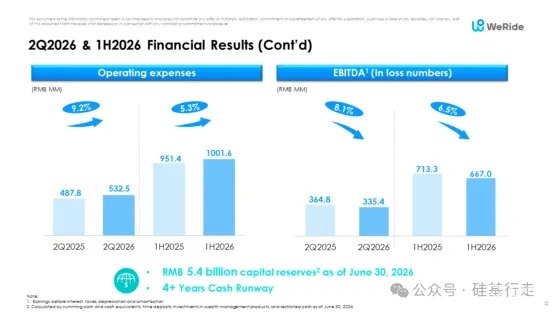
The company expects to achieve comprehensive break-even before 2029. To achieve this goal, the overseas Robotaxi fleet needs continuous expansion, L2++/L3 needs mass production installation, while R&D and operating costs cannot grow in sync with revenue.
WeRide has already formed a relatively clear business portfolio: Overseas L4 provides high gross margin and light asset growth space, Domestic Robotaxi provides real operational data, L2++/L3 undertakes mass production tasks, and AI infrastructure such as WITT and GENESIS attempts to reduce data processing and model training costs.
It can be seen that in the first half of 2026, WeRide has sailed into the deep waters of commercialization. Next, the market will focus not just on new licenses, new models, or new partners, but on when fleet utilization, revenue, and profit inflection points will truly appear.
To conclude the article, we end with a quote from Han Xu on the conference call -
"For our business, what ultimately matters is not what we claimed. But what we have consistently delivered in the real world, in real environments? Narratives may change, technology may iterate, market cycles may rise and fall, but facts endure, and excellent performance in the real world endures. And a proven track record is always the most powerful language."
---END---
© 2024 Bitauto.com. All Rights Reserved.
Bitauto (www.yiche.com and www.bitauto.com) is one of the most visited automotive websites in China. We provide detailed info on Chinese car brands available in your area. Please note that the information provided on this website is based on publicly available data and is for reference only. It may not be fully updated or accurate at all times.

Help us improve our website


