

HomeAutomaker

Search History
Popular Searches
Dealer Login / Sign Up


Author | Klein
Produced by | Roadside Coffee
Abstract: A globally leading new energy vehicle industry should not just earn a "pittance".
On October 12, 2026, there were two news items worth looking at together.
Morning: The 91st Paris Motor Show opened. Among approximately 60 vehicle exhibitors, 20 were Chinese brands, a full third, double the previous edition. AITO, Avatr, Li Auto, AION, 212, all visiting for the first time, the exhibition hall was lively.
At 5:09 PM, the Ministry of Finance and the State Taxation Administration announced that starting April 1, 2027, the VAT export refund rate for new energy vehicles will be reduced from 13% to 9%.
One set up a stage in Paris, one withdrew support in Beijing. These two events coinciding on the same day may not be anyone's arrangement, but putting them together reflects the most accurate situation of Chinese automakers going global right now: the stage is getting bigger, the way out is getting fewer.
Hidden Messages in the Announcement
The policy itself is not long, can be clarified in a few sentences.
Refund rate drops 4 percentage points, from 13% to 9%; only new energy is affected, the 13% for fuel passenger cars, commercial vehicles, and engineering machinery remains unchanged; a buffer of nearly six months is given, to be implemented only on April 1, 2027; based on the export date on the customs declaration form.

The last point means that there is likely to be a wave of export rush in the first quarter of next year. Automakers and dealers will concentrate customs declaration before the end of March, pushing the data very high, then it will drop back in the second quarter.
By then, if you see news of record exports in the first quarter, you must squeeze out this part of the "water".

What is truly worth pondering are these five words "only new energy". According to the consistent terminology of domestic financial and tax policies, new energy vehicles include pure electric, plug-in hybrid (including extended range) and fuel cell vehicles, meaning DM-i which BYD is currently promoting in Europe, and extended range of Li Auto and AITO, are all within the range of these 4 percentage points.
And fuel vehicles sent to Russia and the Middle East by automakers such as Chery, Great Wall, and Geely, continue to enjoy full tax refunds.
In fact, this story has been told for a while, and the capital market even began selling off automotive stocks early for this expectation. At the end of September, a Citi meeting minutes already revealed the script, stating that tax refund adjustments "will be led by new energy vehicles", and "it is expected that it is unlikely to apply to fuel passenger cars, commercial vehicles, or engineering machinery".
The announcement today almost follows this script, only the implementation time is three months earlier than rumors (rumors say the policy starts implementing from July 1, 2027).
Script Played Twice
Looking at this announcement alone makes it easy to underestimate it. Looking at it over a long time line, one will discover the consistent deep meaning of the policy.
In December 2024, the export refund rate for photovoltaics and lithium batteries dropped from 13% to 9%. This April, 249 photovoltaic products were directly zeroed out, batteries first dropped to 6%, and will be completely cancelled starting January 1, 2027.
Now, it's the turn of complete vehicles. From now on, the export tax refunds for photovoltaics, batteries, and complete vehicles, the "New Three", have all entered the decline channel.

The export side is retreating, and the domestic side is too. Starting this year, new energy vehicle purchase tax changed from exemption to half reduction, with a maximum reduction of 15,000 yuan per vehicle. In 2027, purchase tax is likely to be fully collected. This year's policy also cut into lithium battery consumption tax. Starting September 1, lithium primary batteries, lithium-ion batteries, and all-vanadium flow batteries were re-added to the consumption tax items, collected at 2% first, and will restore the 4% statutory tax rate starting September 1, 2027.
Domestically and internationally, financial and tax support are coming to an end.
The official explanation for the previous two adjustments is against "involution-style" competition, and this is indeed a common pain point of the "New Three" industry. Under involution, automotive industry profits continue to drop, many automakers treated exports as a "lifeline", but automakers spread "involution" to overseas markets in a very short time.
The "price war" of Chinese automakers in overseas markets has already started. Automakers use taxes refunded by the state to negotiate prices against each other overseas. The finance ministry is essentially paying for foreign consumers, and in the end, it only brings a letter of anti-subsidy investigation.

This accounting, no one is willing to calculate it again. So why is new energy targeted first? Because it is the main cause of trouble.
Shortly after Chinese pure electric vehicles were levied with anti-subsidy duties by the EU, plug-in hybrid cars and hybrid electric cars were also put on the negotiation table by the EU. On October 9, the EU just reached an agreement with the Chinese government that Chinese car exports to Europe over the next four years should be cut by more than half compared to the original forecast.
As for fuel vehicles, going overseas is to fight head-on with Japanese and South Korean traditional automakers in their own territory, it didn't invite encirclement, and there is no reason to add another blow, moreover fuel vehicles are experiencing a cliff-like shrinkage in the domestic market, at this time it is also necessary to protect them.
There is another reason that sounds not very nice but is very realistic. New energy has already accounted for more than 40% of car exports, the financial bulk of tax refund expenditures is pressed on it.
In a sense, this announcement is an official certification, the wings of new energy vehicles are deemed hard enough to "wean off".
How painful is 4 percentage points?
Simply do the math, the refund rate drops 4 points, equal to 40,000 less refunded per vehicle exported with an FOB price of 1 million yuan. Roughly calculated at an average export price of 150,000 yuan, one vehicle will refund about 6,000 yuan less.
What does 6,000 yuan mean? Just look at the financial reports of BYD and Chery, the two major exporters. BYD's net profit attributable to parent company for the first half year was 12.325 billion yuan, selling 1.8085 million vehicles, with a net profit per vehicle of about 6,800 yuan. Chery's first half year net profit attributable to parent company per vehicle was 6,719 yuan.

In other words, if this cut is swallowed entirely by the automakers, the export profit per vehicle for top enterprises will basically be zero.
Of course, not all will be swallowed. Automakers with brand and channel bargaining power will raise prices, especially on the European side where the anti-subsidy case follows the "price commitment for tariffs" route, which already requires Chinese cars to be sold at "higher prices". The reduction in tax refunds equals handing over a ready-made reason for price increase.
The ones who really feel the pain are two groups of people, small and medium players relying on low prices to grab market share, and parallel exports and zero-mile used car chains eating the tax refund price difference.
One cut down, the tail is cleared out, what is squeezed out is gray business. This might just be the effect the policy wants.
Localization Acceleration Again
In 2026, China's automotive export volume is expected to break through the 10 million unit mark, and besides the milestone of scale, this year will also be a key year for Chinese automakers' overseas localization layout.
Looking back at this year, multiple forces are pushing Chinese automakers to accelerate overseas market localization layout.
The EU just put a "four-year halving" framework on hybrid exports; Thailand tightly binds imported cars with local production obligations; the RMB appreciated against the US dollar by more than 4 percent in the first half of the year. Just BYD, Chery, SAIC, and Geely, the four companies' exchange loss total was over 9.4 billion yuan, BYD alone 4.7 billion; after domestic purchase tax was halved, the price war continues to overflow overseas; now, tax refunds take away another 4 points.

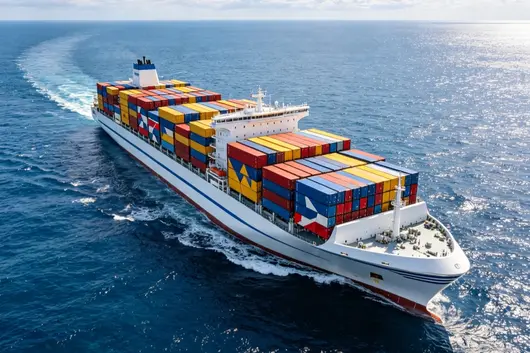
Let's not count the capacity bottlenecks of Ro-Ro ships, that's the story for another article.
The next phase of this business of complete vehicle exports almost only has one clear direction left — building factories overseas.
Local car production, there are no issues with export tax refunds, no exchange exposure, no touching import tariffs, and can bring jobs and tax revenue to the host country, transforming from "blockaded exporters" to "welcome investors".
The EU forces you to localize with walls, Thailand forces you to localize with ratios, the RMB forces you to localize with exchange losses, now the Ministry of Finance pushes you with tax refunds again.
Inside and outside the walls, the direction happens to be consistent.
Final Words
New energy vehicle export tax refunds of course will not stop at this point. Photovoltaics took less than a year and a half from 13% to 9% to 0. Batteries took one year from 9% to 6% to 0. Cars might take a bit longer, but never too long.
According to the prediction of CPCA Secretary-General Cui Dongshu, the reduction of complete vehicle export tax refunds will take two steps, from 13% to 9% to 5%, finally down to 0, the second step may land around mid-2029.
For automakers, a steady posture is to treat 9% as a transition, doing long-term overseas financial models based on "zero tax refund". As for the 13% for fuel vehicles, it is probation, not exemption.
Only after the tax refund safety net ends will the globalization of Chinese automakers truly begin. There is only one question left, which overseas factory will be able to complete proper layout before that day?


When the growth dividend of the industry fades, the 2026 semi-annual reports reveal the underlying colors of automakers, with differentiation further intensifying.
Author | Zhang Heng
The semi-annual reports of listed automakers for 2026 have all been released.
Among the 23 A-share and H-share listed complete vehicle companies, 14 realized profits, accounting for just over 60%; however, only 6 saw year-on-year positive growth in net profit, less than 30%. Revenue increasing but profit not increasing has become the most common industry characteristic.
In the intense competition cycle of the industry, automakers with different backgrounds have walked completely different development paths.
State-owned Automakers: Independence Has Not Yet Achieved Self-Sustaining
Changan, SAIC, and GAC's revenue size firmly ranks in the first tier of the industry, but the model of relying on joint venture business for profits and feeding back to the independent brand sector has exposed obvious shortcomings in this semi-annual report.

Changan's first-half revenue was 65.63 billion yuan, down 9.71% year-on-year; net profit attributable to the parent was 817 million yuan, down significantly by 64.32% year-on-year. The reduction in exchange gains dragged down profits significantly. After deducting exchange influences, net profit attributable to the parent grew by about 12% year-on-year. The product structure continued to optimize in the first half, but the industry's common problems still existed: the market share of the joint venture sector continued to shrink, and profit contribution declined year by year; independent brand sales increased, but single-vehicle profitability was weak, unable to fill the profit gap left by joint venture business. Independent brand sales accounted for more than 80% of the group's total sales, but profit contribution was far from reaching the same proportion, and the problem of increasing volume but not profit was prominent.
SAIC and GAC transformation contradictions are also prominent.

SAIC Group's first-half revenue was 298.65 billion yuan, down slightly by 0.31% year-on-year; net profit attributable to the parent was 5.15 billion yuan, down 14.38% year-on-year. The decline in profit was mainly dragged by the joint venture sector. Joint venture enterprise revenue and profit contracted double. The traditional fuel car base shrank, new energy products lacked competitiveness, terminals kept lowering prices, continuously squeezing joint venture business profit space. The independent sector sales rose steadily, new energy sales increased year-on-year, but it was in a high investment cycle of platform iteration, channel expansion, and smart driving R&D. The profit created currently was not enough to cover the huge gap brought by the contraction of joint venture business.

GAC Group's first-half revenue was 46.12 billion yuan, up 9.38% year-on-year; net loss attributable to the parent was 4.47 billion yuan, turning from profit to loss compared to the same period last year. Independent sector sales and new energy penetration rate rose synchronously, but profitability was weak. GAC AION sales continued to surge, but to cope with the price war, terminal concessions were increased continuously, and the sector still failed to achieve obvious scale profitability. The joint venture sector encountered the problem of fuel car shrinkage and insufficient competitiveness of new energy products. Joint venture enterprise profits retreated significantly, causing overall profit to continue to be under pressure.
It can be seen from the semi-annual reports of state-owned automakers that getting rid of the profit dependence on joint venture business and promoting independent brands to truly self-sustain, the transformation task is urgent.
Private Automakers: Going Global Becomes the Watershed
BYD, Geely, Great Wall, Chery, and Seres are representative samples among private automakers. Enterprise revenue and profit sizes still show differentiation, and the core variable that widens the gap between them comes from overseas business.
Geely, Chery, and Great Wall relied on overseas market volume to offset profit compression caused by domestic price wars.

Geely's first-half revenue was 173.6 billion yuan, up 15% year-on-year; net profit attributable to the parent was 9.09 billion yuan, down slightly by 1.8% year-on-year, with profitability basically stable. Exports were the biggest highlight — first-half overseas sales were 474,000 vehicles, up 158% year-on-year. In Southeast Asia, Middle East, and European markets, the proportion of high-margin models continued to rise. The revenue earned from overseas business basically compensated for the single-vehicle profit ceded from domestic price cuts. Geely's multi-brand matrix has taken effect after two years of structural adjustments. The proportion of high-end model sales increased, solidifying the overall profit base.

Chery's first-half revenue was 143.28 billion yuan, up 1.2% year-on-year; net profit attributable to the parent was 8.57 billion yuan, down 11.7% year-on-year. Although revenue growth was flat, the overall gross margin increased from 13% to 16.1%, and the profit quality was outstanding. Overseas markets were the core growth engine, reaching revenue of 98.97 billion yuan, up 51% year-on-year, accounting for nearly 70% of total revenue. Domestic market was squeezed by price wars, single-vehicle profit was under pressure. Chery relied on high-margin overseas business to hedge the profit pressure of the local market.

Great Wall's first-half revenue was 102.1 billion yuan, up 10.6% year-on-year; net profit attributable to the parent was 2.47 billion yuan, down 61.1% year-on-year. Profit fell significantly, mainly due to the impact of large one-time gains last year pulling up the base. Overseas, Thailand, Brazil, and Russia three major production bases' capacity continued to climb, exports rose 45% year-on-year, and overseas revenue ratio further increased. Domestically, relying on Haval, Tank, Oric, and Weimo multi-category layout to disperse operating risks brought by single-model sales fluctuations.
These three automakers did not cut R&D investment. The profit buffer provided by overseas business made their anti-cycle ability significantly better than peers.
BYD and Seres, however, faced greater profit pressure.

BYD's first-half revenue was 344.82 billion yuan, down 7.13% year-on-year; net profit attributable to the parent was 12.33 billion yuan, down 20.54% year-on-year. Although BYD is still the only automaker in the entire industry with net profit breaking 10 billion yuan, the decline in profit cannot be overlooked. Domestic hybrid and pure electric terminal discounts continued to be released, single-vehicle profit space was continuously compressed.

Seres's first-half revenue was 57.49 billion yuan, down 7.87% year-on-year; net loss was 1.72 billion yuan, turning from profit to loss compared to the same period last year (profit was 2.94 billion yuan last year), operating pressure further amplified. AITO's main models were at the new-old iteration node, old model concessions cleared inventory lowering overall gross margin, new model capacity and delivery were still climbing. Added to inventory impairment provisions and various expenses from channel optimization, multiple pressures were concentrated in this financial report.
By comparing several financial reports of the private camp, it can be seen that the dividend period of the domestic new energy industry has ended. Overseas revenue ratio, high-end model penetration rate, product iteration rhythm, these three indicators determine enterprise profit performance.
New EV Players: Profitability Remains a Difficulty
Li Auto, XPeng, NIO, and Leapmotor all had to bear three rigid expenditures in the first half: product replacement, smart driving R&D, and channel operation and maintenance. There was already obvious differentiation within the camp.

Leapmotor's first-half revenue was 38.11 billion yuan, up 57.14% year-on-year; net profit attributable to the parent was 210 million yuan, up 531% year-on-year, achieving profitability for three consecutive semi-annual periods, operating relatively stably among new forces. Relying on supply chain vertical integration, focusing on mainstream home market, in the general environment of price cuts in the whole industry, Leapmotor's vehicle gross margin was maintained in a healthy range (first-half gross margin 11.7%, second quarter rose to 12.6%). Sales growth smoothly converted into operational resilience. New forces that can maintain the profit window belong to the minority.
Li Auto, XPeng, and NIO, on the other hand, are bearing operational pressure brought by the industry cycle.

Li Auto's first-half revenue was 48.65 billion yuan, down 13.4% year-on-year; net loss attributable to the parent was 3.99 billion yuan, turning from profit to loss (profit was 1.74 billion yuan last year). Existing main range-extended models entered the end of the product life cycle, terminals lowered prices significantly for promotion, all-new product series had not yet formed enough sales contribution, product gaps directly lowered vehicle gross margin. Smart driving business continued to invest money, profit end was squeezed from both sides.

XPeng's first-half revenue was 32.78 billion yuan, down 3.8% year-on-year; net loss attributable to the parent was 3.12 billion yuan, loss expanded significantly year-on-year. Vehicle platform iteration, all-domain smart driving large-scale upgrade, channel system adjustment synchronously, R&D expenditure remained high. Technical investment has not yet fully converted to sales. Product terminal prices adjusted frequently, continuously impacting profit levels.

NIO's first-half revenue was 57.67 billion yuan, up 85.8% year-on-year; net loss attributable to the parent was 1.22 billion yuan, loss significantly narrowed year-on-year. First-half cumulative delivery was 191,100 vehicles, up 67.4% year-on-year. Three product matrices brought significant sales increase, scale effects were gradually released. But high-end market growth slowed, charging swap station construction and operation, high-end service system brought continuous fixed cost expenditure, book balance overall has not yet achieved net profit attributable to parent turn positive, operating pressure hard to resolve in short term.
Looking back at the new forces sector, the past logic that "scale could exchange for development space" has become invalid. Vehicle gross margin, cost control ability, cash reserves, became the core elements for enterprise survival.
2026 first-half automaker financial reports reflect the difficult industry situation, but not the entire industry collective decline.
State-owned automakers test transformation landing effectiveness; private large factories compete on overseas expansion speed and product iteration rhythm; new forces need to guard gross margin, control costs, and ensure cash safety. With the centralization of a large number of all-new products in the second half, the gap inside major camps will further widen. [Copyright Notice] This article is original to "AutoMan", all rights reserved by the publisher. No reprint or partial copying without authorization, violators will be investigated.

Chilly July, when industry negative growth, especially Chinese passenger cars domestic wholesale retail July and January-July both plummeted by over 20%, its independent passenger car sales still rose against the trend for seven consecutive months, and accounted for over 70%;
In May, it was the industry's first Chinese automaker with historical sales exceeding 100 million vehicles;
In July, it was the only automaker in China's automotive industry with over 2 million vehicles in half a year.
Some say it is the all-subject champion of the Chinese auto market!
It, who is it?
It, how was it forged?

July 2026, the Chinese auto market encountered a rare "Summer Cold Snap".
Data from the China Passenger Car Association shows that retail sales of passenger cars nationwide in July reached 1.461 million vehicles, down 20.9% year-on-year, down 8.8% month-on-month; retail sales cumulative to date were 10.173 million vehicles, down 20.3% year-on-year;
July fuel vehicle retail sales down 41% year-on-year, among which pure fuel vehicles down 44%, regular hybrid down 4%. Among fuel vehicles, independent down 46%, mainstream joint venture down 40%, luxury down 28%, all undifferentiatedly hit hard by high oil prices.
July new energy vehicle retail sales down 3.9% year-on-year, among which independent down 4%, mainstream joint venture up 36%, luxury down 23%, independent economy EV domestic retail was significantly affected by subsidy plummet.
July independent brand retail 1.04 million vehicles, down 14% year-on-year, down 6% month-on-month. The month's independent brand domestic retail share was 71%, up 5.4 percentage points year-on-year.

Data released by the China Association of Automobile Manufacturers seems like Typhoon White Dolphin No. 13 in 2026, making people feel chilling:
July domestic passenger car sales 1.345 million vehicles, down 10.1% month-on-month, down 24.7% year-on-year, while fuel vehicle sales 429,000 vehicles, down 383,000 year-on-year, down 12.5% month-on-month, down 47.2% year-on-year.
January-July, domestic passenger car sales 9.633 million vehicles, down 24.4% year-on-year, among which fuel vehicles 4.123 million vehicles, down 2.116 million year-on-year, down 33.9% year-on-year.
January-July, domestic sales 11.462 million vehicles, down 21.4% year-on-year. Among them, traditional fuel car domestic sales were 5.364 million vehicles, down 30.1% year-on-year.
January-July new energy vehicle exports 2.909 million vehicles, up 1.2 times year-on-year. Traditional fuel car exports 3.231 million vehicles, up 36.2% year-on-year.
Off-season plus structural adjustment, the whole industry is permeated with a breath of contraction and survival.
Most brand target completion rates are less than 40%, inventory is high, price war intensifies.

Just in the cold of Black July, SAIC Motor Group handed in a rising scorecard!
July total vehicle sales 339,000 vehicles, January-July cumulative sales 2.384 million vehicles, continuing to rank first among Chinese automotive enterprises.
More interesting is the change of structure.
Independent brand July sales 257,000 vehicles, up 19.9% year-on-year, achieving seven consecutive months of year-on-year growth this year, more importantly, July independent brand share was as high as 75.8%, and January-July independent cumulative sales 1.725 million vehicles, up 13.6% year-on-year, independent sales share reached 72.4%, up 0.7 percentage points month-on-month compared to the first half of the year.
Looking at its new energy vehicles, July sales 177,000 vehicles, up 50.7% year-on-year, month's penetration rate 52.2%, reaching the high level of Chinese new energy vehicle July sales penetration rate breaking 50% for the first time.
Finally look at overseas markets, July sales 142,000 vehicles, up 72.5% year-on-year, overseas share as high as 42.9%, and January-July overseas exports 876,000 vehicles, up 52.1% year-on-year, overseas share 36.7%.

When the whole industry declined, especially passenger car retail wholesale declined by 20%, SAIC's three major growth engines, all ran double-digit or even doubled growth rates, this is not simply a quantity progress, but a breakthrough in quality.
Looking at January-July, SAIC cumulative sales 2.384 million vehicles, with an advantage of about 156,000 vehicles to crush the runner-up, firmly holding the top spot.
In the context of top automakers especially automotive central SOEs generally negative growth, SAIC held the position with year-on-year basically flat performance, and its independent, new energy, overseas three core sectors growth far exceeded the industry average.

This means, SAIC's basic position is undergoing profound structural replacement, especially its independent and joint venture balance has undergone fundamental reversal.
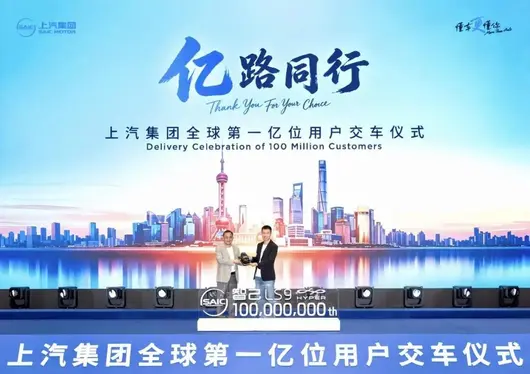
(II) Despite Wind and Rain, the King ReturnsMay 28, 2026, Shanghai North Bund World Living Room, in the applause of industry amazement and user pride, SAIC Motor Group held the global 100 millionth user delivery ceremony, its 15 brands, 19 models with global relay delivery method across Asia-Europe, linked globally, officially became the first automobile group in Chinese automotive industry history with cumulative production and sales exceeding 100 million vehicles.
Dare to be first for China.
From 1955 alley workshop start, to 1958 workers used hammer to knock out Phoenix car to achieve zero breakthrough, SAIC, long ago like FAW and Hongqi, became the label and symbol of Chinese automobiles.

Dare to be first for sedans.
From 1983 Santana offline to open Chinese sedan joint venture era, to 2006 independent brand Roewe birth.
Dare to be first for era.
From 2016 global first Internet car Roewe RX5 exploding Internet of Vehicles, to 2020IM Motorsestablished anchor high-end intelligent electric, SAIC over 70 years of development history, itself is a Chinese auto industry from nothing to something, from weak to strong evolution history.
Since this century, SAIC once continuously 18 years蝉联Chinese auto sales champion, is the industry leader without doubt.

In the new energy wave intense shock, SAIC also once briefly slipped to runner-up position, also exists doubt:
Relying on joint venture era ended?
Elephant turning too slow?
Time is the best referee!

First half of 2026, SAIC with 2.045 million vehicles became domestic only breakthrough 2 million vehicles threshold automaker, strongly grabbed half-way champion;
January-July continued leading, King returns.
From 100 million vehicles historical height to King leading reality speed, SAIC used market performance prove:
Scale leading is not the end, quality leading is the direction.
This is not accidental bottom rebound, but a long-term brewing systematic reform concentrated cash out.
Early 2025, SAIC started large passenger car, large commercial vehicle sector reform integration,打通 product definition, R&D, production, marketing full link, compress management level and decision chain;
Joint venture sector, SAIC-GM renewed to 20 years to 2047 start Zhijing model, SAIC Volkswagen renewed to 2040 to enter technical co-creation, SAIC Audi start ADP Platform new strategic cooperation.
As Chinese auto joint venture pioneer and vanguard, this time, SAIC's three major joint venture brands all completed from technology introduction to co-creation and joint research paradigm upgrade.
Thus far, SAIC in joint venture, passenger car, commercial vehicle, overseas market layout all completed, overall from planning layout "entered full sprint phase.
(III) All-Rounder, Real SkillsIf use one word summarize SAIC current competitive state, that is:
All-Rounder!
No obvious weakness, every subject is improving, and several core subjects are sprinting for good, excellent, impact full score.
Passenger and Commercial Vehicles Together, is chassis stability.
Passenger car sector, SAIC Passenger Car July sales 107,000 vehicles, up 78.2% year-on-year, January-July cumulative 656,000 vehicles, up 53.4% year-on-year;
IM Motors January-July cumulative sales 46,000 vehicles, up 82.4% year-on-year, high-end process continuous acceleration;
SAIC-GM-Wuling monthly sales maintain 100,000 vehicles level scale,Huajing SJuly delivery breakthrough 7,200 vehicles, cumulative delivery breakthrough 20,000 vehicles, joined flagship large six-seater new energy SUV first echelon.

Commercial vehicle sector, SAIC Maxus July sales 23,000 vehicles, up 29.8% year-on-year, January-July cumulative 161,000 vehicles, up 29.2% year-on-year;
SAIC Hongyanand Thailand top port large customer reached 1,000 vehicles new energy heavy truck strategic cooperation, break foreign brand in Thailand heavy truck market monopoly pattern.
Large commercial vehicle strategy anchor Chinese light van first, new energy light commercial first, overseas light commercial export first three support, passenger commercial together, dual-wheel drive pattern has formed.
Oil and Electric Intelligence, is technology equity.
SAIC did not bet on single technology route, but with full scenario, full technology route, full price band product portfolio cover market.

Pure electric, extended range, plug-in hybrid, fuel four lines advance, and every line all put out hard technology:
DMH hybrid thermal efficiency 46.3%, Star Super Extended Range pure electric range 450 km, semi-solid state battery global first batch mass production on board, wire-controlled steering technology first mass production landing.
More importantly technology equity, 60,000 yuan level Roewe i6 standard 8155 chip, Doubao Large Model, 90,000 yuan levelMG4Xfull series semi-solid state battery, rear drive five-link, 150,000 yuan level Clever Zhijing E7 first launch Doubao Large Model, Qualcomm 8775 chip, 200,000 yuan level Shangjie full series Huawei ADS 4.1+896-line LiDAR.
July,IM LS9 Hyperfirst standard full line wire-controlled four-wheel steering, bring million-level luxury technology into 300,000 yuan level interval;
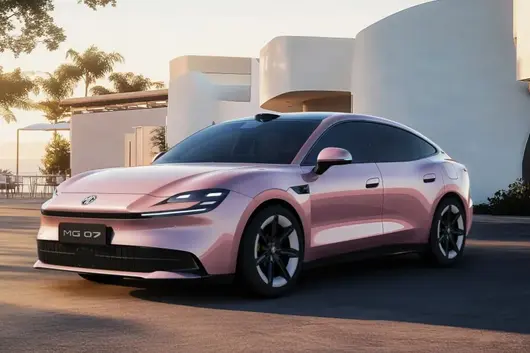
MG07 will 800V+5C fast charging and 845 km range into 150,000 yuan pure electric coupe market, pre-sale 20 hours orders breakthrough 21,000, listing less than two minutes large order break 10,000.
SAIC Roewe and ByteDance Volcano Engine deep co-creation global first AI native car—Jia Yue 07 open blind order, put far beyond 250,000 yuan level full family configuration down into 150,000 yuan mainstream price interval,凭借 spacious space, long range capability, fully equipped cabin and Momenta R7 world model, bring more Chinese families high-quality travel experience. Currently, Jia Yue 07 blind order orders have exceeded 11,000.
Technology is no longer cold numbers on parameter sheet, but user-perceived value experience.
This is exactly knowing cars better knowing you better implementation.
Domestic and Overseas Both Thriving, is space breakthrough.
Domestic market steady leading at the same time, overseas market is becoming SAIC growth second curve.
January-July overseas cumulative sales 876,000 vehicles, up 52.1% year-on-year; July single month 142,000 vehicles, up 72.5% year-on-year.
Europe as largest overseas market, MG brand January-July cumulative sales 218,000 vehicles, up 22.8% year-on-year,蝉联Chinese brand Europe sales champion, and became first in Europe cumulative sales breakthrough 1 million vehicles Chinese auto brand.
SAIC in shareholders meeting explicitly propose "No Overseas, No Survival", this year Europe target 400,000 vehicles, Spain factory steadily promote.
More symbolic significance is, July 8, MG in UK London held technology conference, bring frontier smart electric technology back to brand birthplace;
July 9, MG appeared Goodwood Festival of Speed, global launch MG Go! and Cyber Concept two concept cars.

From Frankfurt to London, from product export to technology output, SAIC's Glocal 3.0 strategy is realizing from going out to going up leap:
Scale expansion to value creation, product output to standard output.
Dual Excellence in Culture and Tech, is ecosystem depth.
Culture is brand and culture, Tech is technology and manufacturing.
SAIC nearly 10 years in electrification, intelligentization field cumulative investment nearly 190 billion yuan, own over 24,000 valid patents, build autonomous controllable technology base.
But SAIC's ambition not limited to making cars:
Through strategic direct investment, SAIC has cumulative investment over 18 billion yuan, harvest 85 listed companies, build AI, humanoid robot, chip, intelligent chassis industry ecosystem network.

Momenta HKEX IPO, SAIC is largest external shareholder;
CXMT STAR Market listing, fundraising 57.9 billion yuan create STAR Market record, SAIC Financial Holdings is early investor;
2026 World Artificial Intelligence Conference, SAIC 34 invested companies centralized appearance, from underlying computing chip to large model, from embodied intelligence to brain-computer interface, cover AI full industry chain.
Invest its use, use so investment production investment integration model, let SAIC from manufacturer to eco-tech enterprise transformation, ecosystem is becoming its widest moat.
(IV) Through Cycles, SAIC DNALook back SAIC over 70 years history, it through joint venture opening cycle, independent brand rise cycle, new energy disruption cycle, and current intelligence and globalization superposition new cycle.
Every time industry upheaval, once had voice pessimistic:
SAIC can't do it?
But every time, SAIC used performance respond to doubt.
Behind logic is breakthrough, cooperation, quality three cultural genes throughout.
Breakthrough, is from alley workshop to 100 million vehicle level automaker dare to be first;
Cooperation, is from Santana joint venture to Huawei, Momenta, Audi co-creation and joint research open mindset;
Quality, is from Santana localization establish world-class quality system to Magic Cube Battery zero spontaneous combustion record ultimate pursuit.
Three in one, landing on:
Knows Cars Better, Knows You Better!
Know Cars is to core technology ultimate pursuit, Know You is to frontier technology landing to user-perceived beautiful travel experience.

2026 Fortune Global 500 Ranking, SAIC ranked 125th, up 13 positions from last year.
In 15th Five-Year Plan intelligent connected new energy vehicle clearly new quality productive forces core track opening year, SAIC with mid-season leading momentum, with 100 million vehicle milestone posture, with four major coordinated efforts state, for Chinese auto industry high-quality development write SAIC footnote.
Black July will pass, but through cycles ability will not fade.
When industry expect galloping horses new pattern, one horse leading SAIC, one special All-Rounder already prove:
True Kings are not those who never fall, but those who always get up!
And, each time getting up again, can:
Grab some mud, seize opportunities;
With reflection, with exploration;
Climb faster, run faster;
Stand higher, live longer!


From its birth in 1955 to 2026, Shanghai's automotive industry has evolved from nothing to something, from weak to strong. Guided by the "Understanding Cars, Understanding You Better" philosophy, it has formed a flourishing scenario with independent and joint ventures, passenger and commercial vehicles, and domestic and overseas markets.
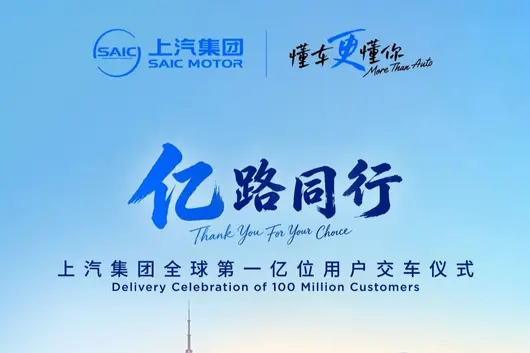
On May 28, 2026, the "Global 100 Millionth User Delivery Ceremony" of SAIC Group was held at the Shanghai North Bund World Living Room. Over ten vehicle brands and nineteen models under SAIC coordinated globally through "Global Relay Delivery." SAIC Group thereby became the first Chinese automotive enterprise to accumulate production and sales exceeding 100 million vehicles, creating a new milestone.

In 1955, the Shanghai Internal Combustion Engine Parts Manufacturing Company was established, marking the start of Shanghai's automotive industry. In 1958, workers hammered out the first "Phoenix" sedan, achieving a "zero breakthrough" in Shanghai sedan manufacturing. For over seventy years, SAIC has witnessed and promoted the entire process of China's automotive industry evolving from nothing to something, from weak to strong: In 1983, the Santana rolled off the line, opening joint venture cooperation; In 1997, Shanghai GM was established, creating the "Shanghai Speed" of building a factory and producing cars in 23 months; In 2006, the independent brand Roewe was born, and in 2016, the world's first internet car, Roewe RX5, was launched; In 2020, the intelligent electric brand IM Motors was established.

Running through this journey is the "Understanding Cars, Understanding You Better" user philosophy that SAIC has always upheld. From the Santana localization community to Joint Venture 2.0 technology co-creation, from internet cars to full wire-controlled chassis, solid/semi-solid batteries, and AI large models in cars—every leap forward is an upgrade in "Understanding Cars" capabilities and an inheritance of the original intention of "Understanding You".

SAIC Group Global 100,000,000th User Delivery, IM LS9 Hyper
The 100 millionth vehicle delivered by SAIC Group is the IM LS9 Hyper, a masterpiece consolidating over 70 years of SAIC's technical accumulation: It is equipped with next-generation chassis technology, featuring the first-in-class full wire-controlled four-wheel steering system; next-generation intelligent driving hardware, including 520-line ultra-view LiDAR and NVIDIA Thor chips; next-generation powertrain system—global 800V high-voltage platform and Star Super Range Extender. This car also fully reserves the capability for continuous evolution towards L3 and above advanced intelligent driving. At the same time, the IM LS9 Hyper adopts the SAIC Gold Label Hurricane Three-Motor for the first time, joining the 3-second 0-100km/h club; it also jointly launched the "Intrinsic Security" technology with Purple Mountain Laboratory globally for the first time, expanding automotive safety boundaries from "Physical Security" to "Information and System Security," serving as an essential safety cornerstone for the AI era.

Behind the 100 million vehicles is SAIC's full value-chain closed loop covering six major sectors: complete vehicles, parts, mobility and services, finance, international operations, and innovative technology. From January to April 2026, SAIC accumulated sales of 1.302 million vehicles, ranking first in sales among Chinese automakers for four consecutive months. Among them, independent brand sales were 910,000, accounting for nearly 70%; new energy vehicles sold 412,000; overseas market sales were 459,000, a year-on-year surge of 50.2%.

At the delivery ceremony site, SAIC's full brand and product matrix collaborated. Independent brands went all out, covering multiple scenarios such as personal mobility, family life, commercial operations, and logistics transportation. Joint venture brands showcased "Joint Venture 2.0" results: Volkswagen ID. ERA 9X will globally debut with the Momenta R7 Reinforcement Learning World Model; AUDI E7X plans to become Audi's first global model to achieve L3 autonomous driving landing; Buick Zhijing E7 is built based on the "Xiaoyao" Super Fusion Architecture, achieving over 10,000 deliveries one month after launch.

Starting from the main venue in Shanghai, the delivery scene lit up successively in multiple domestic cities such as Nanjing, Liuzhou, Taiyuan, and countries including the UK, Indonesia, and Singapore. Behind this lies SAIC's deep foundation for global layout. SAIC is a pioneer in Chinese automotive enterprises "Going Global": It owns over 100 parts production bases and over 3,000 dealer networks overseas, has built 3 major R&D innovation centers including London, and 4 manufacturing centers in Thailand, Indonesia, India, and Pakistan; Anji Logistics owns 42 Ro-Ro ships of various types, with 8 international routes covering Southeast Asia, Europe, and the Americas. Today, SAIC's products and services are distributed in over 170 countries and regions, with cumulative overseas sales exceeding 7 million vehicles. SAIC MG has retained the title of the European sales champion among Chinese brands for 11 consecutive years; in 2025, European annual sales surpassed 300,000 units, becoming the first Chinese automotive brand to break one million in cumulative sales in Europe and the UK. In March this year, MG held a Tech Day in Frankfurt, Germany, globally debuting semi-solid state batteries and Hybrid+ hybrid technology, with the Hybrid+ family's overseas monthly sales already exceeding 20,000 units. In 2025, SAIC released the overseas "Glocal Strategy" (Global + Local), accelerating from "Product Going Global" to "Value Chain Going Global," allowing "Chinese Smart Manufacturing" to go further into the world.

100 million vehicles is a phased answer sheet for SAIC's over 70 years of development, and even more so, a new starting line for SAIC's "second entrepreneurial journey" towards the future of intelligent electric vehicles. In 2014, SAIC actively implemented the important instruction that "developing new energy vehicles is the only path for China to move from a car major power to a car strong power," leading the way in comprehensive transformation. Twelve years later, from the "leading the way" of intelligent electric transformation to a "flourishing boom" in independent/joint ventures, passenger/commercial, and domestic/overseas, SAIC will continuously take "Understanding Cars, Understanding You Better" as the user philosophy, letting technological innovation truly benefit every user.
The author of this article is A Lai from TiCheBang

Seen plenty of car delivery ceremonies? But what about the 100-millionth user?
On May 28, 2026, SAIC Group held a "Global First 100-Millionth User Delivery Ceremony", becoming the first Chinese automotive group to exceed 100 million cumulative production and sales!
The first 100-millionth delivery vehicle is the IM LS9 Hyper, the culmination of SAIC's over 70 years of technical accumulation.

Full steer-by-wire four-wheel steering, 520-line ultra-line-of-sight LiDAR, NVIDIA Thor chip, global 800V high-voltage platform, Stellar Super Range Extender, SAIC Gold Badge Hurricane three-motor, as well as pre-embedded redundant capabilities for continuous evolution of L3 and higher-level intelligent driving, etc., are all highlights of the IM LS9 Hyper.
So are you curious who the 100-millionth user is? Momenta CEO Cao Xudong!
It is indeed SAIC's core strategic partner in the intelligent driving sector, and the results and vehicle deployments of Momenta in the intelligent driving field are undoubtedly familiar to everyone.

At the delivery site, besides the 100-millionth user, there were the 100,000,001st, 100,000,002nd...
Dominestic brands went all out: Shangjie Z7, Huajing S, Roewe M7, MG4 Semi-Solid State Battery Version, Wuling Starlight 560, Maxus eDeliver 5, Hongyan Heavy Truck, Yuejin Danaka T1, Sunwin Pure Electric Bus, Iveco Juxing EV, etc., were delivered successively, covering diverse scenarios such as personal mobility, family life, commercial operations, and logistics transport.
Joint Venture Brands centrally displayed "Joint Venture 2.0" achievements: Volkswagen ID. ERA 9X will be the global debut with Momenta R7 Reinforcement Learning World Model, achieving over 7,000 units deliveries in one month after listing; AUDI E7X plans to become Audi's first global vehicle to achieve L3-level autonomous driving landing; Buick Zhijing E7 is built on the "Xiaoyao" Super Fusion Architecture, achieving over 10,000 units deliveries in one month after listing.

100 million vehicles is a significant number, reflecting SAIC's systemic strength.
From complete vehicles, parts, mobility and services, finance, international operations to innovation technology, six major sectors, achieving a closed loop of the entire value chain.
From January to April 2026, SAIC's cumulative sales reached 1.302 million vehicles, ranking first among Chinese automakers for four consecutive months. Among them, domestic brand sales were 910,000 vehicles, accounting for nearly 70%; New energy vehicle sales were 412,000 vehicles; Overseas market sales were 459,000 vehicles, year-on-year growth of 50.2%.

Gaining the trust of 100 million users, this owes to the power of globalization. SAIC's global layout has deep foundations, owning over 100 parts production bases, over 3,000 dealer networks abroad, and having built London and other 3 major R&D innovation centers, as well as 4 manufacturing centers in Thailand, Indonesia, India, Pakistan; Anji Logistics owns 42 Ro-Ro ships of various types, 8 international routes covering Southeast Asia, Europe, Americas. Now, SAIC's products and services cover over 170 countries and regions, overseas cumulative sales exceeded 7 million vehicles.
Among them, SAIC MG has ranked first in China brand European sales for 11 consecutive years, 2025 European annual sales exceeded 300,000 vehicles, becoming the first Chinese automotive brand to exceed one million cumulative sales in Europe and the UK.

From 1955 to 2026, 100 million users, is a phased answer sheet for SAIC's over 70 years of development, and at the same time its new starting line towards the intelligent electric future "second start-up". Continuing to travel the billion-mile journey together with global users and global partners, creating a new future of beautiful mobility, this is what SAIC needs to do next!

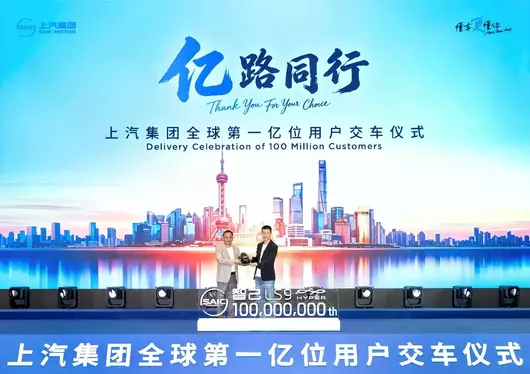
On May 28, 2026, SAIC held a "Global 100 Millionth User Vehicle Handover Ceremony" at the North Bund in Shanghai. Over a dozen brands under its umbrella and 19 car models handed over vehicles in relay from domestic to overseas markets. SAIC has become the first automotive group in China to exceed 100 million cumulative production and sales, making history in China's automotive industry.

From "Phoenix" to "IM", the history of Chinese automotive struggle behind 100 million vehicles
The story of SAIC begins in 1955, when it was called Shanghai Internal Combustion Engine Parts Manufacturing Company. In 1958, workers hammered out the first "Phoenix" sedan, and Shanghai finally could make sedans on its own. For more than 70 years, SAIC has witnessed China's automotive industry starting from zero and becoming increasingly strong: The Santana rolled off the assembly line in 1983, opening the joint venture era; Shanghai GM was established in 1997 and completed construction and production in just 23 months, known as the "Shanghai Speed"; The independent brand Roewe was launched in 2006; In 2016, the world's first Internet car Roewe RX5 was made; In 2020, the high-end smart electric brand IM was established.
Throughout this journey, SAIC has always adhered to a concept: "Knows cars better, understands you even better". Simply put, technology must be solid, but more importantly, users must enjoy driving and using it comfortably. From Santana localization to Joint Venture 2.0 technology cooperation, from Internet cars to full-by-wire chassis, solid-state batteries, and AI large models on board, every progress is to turn high technology into tangible driving experiences. 100 million vehicles are also 100 million units of user trust.
The 100 Millionth Vehicle is IM LS9 Hyper, combining over 70 years of SAIC technology
This IM LS9 Hyper is considered the culmination of SAIC technology, representing the arrival of the "New Three Major Components" era for new energy vehicles. It is equipped with next-generation chassis technology; full-by-wire four-wheel steering is the first in its class; in terms of intelligent driving, it features a 520-line LiDAR + NVIDIA Thor chip; the three-electric system uses a full-domain 800V high-voltage platform and Stellar Super Range Extender. It also reserves upgrade capability for L3+ advanced intelligent driving in advance. In addition, it debuts the "SAIC Gold Label Hurricane Three-Motor", easily entering the 3-second club for 0-100 km/h acceleration. Even better, in cooperation with Purple Mountain Laboratories, it globally debuted "Intrinsic Security" technology, extending safety from the physical level to information and system security, which is an essential guarantee for driving in the AI era.
The 100 Millionth user is Cao Xudong, CEO of Momenta, and Momenta happens to be SAIC's core partner in the intelligent driving field. The intelligent driving technology developed by both sides has been used in multiple brands of both independent and joint ventures. "Partners become car owners", this is not just about selling cars, but also deep resonance in the intelligent automotive ecosystem.

Behind 100 million vehicles is SAIC's full-brand, global hard power
SAIC has six major sectors: whole vehicles, parts, mobility services, finance, international operations, and innovation technology, forming a complete industrial chain. In the first four months of 2026, SAIC sold a cumulative 1.302 million units, ranking first among Chinese automakers for four consecutive months. Among them, independent brands sold 910,000 units, accounting for nearly 70%; new energy vehicles sold 412,000 units; overseas sales reached 459,000 units, a year-on-year surge of 50.2%.
At the vehicle handover ceremony, SAIC's independent and joint venture brands all participated. On the independent brand side: Shangjie Z7, Huajing S, Roewe M7, MG4 Semi-Solid State Battery Edition, Wuling Xingguang 560, Maxus eDeliver5, Hongyan Heavy Truck, Yuejin Dan T1, Sunwin Pure Electric Bus, Iveco Juxing EV, etc., covering scenarios such as personal mobility, home use, commercial use, logistics, etc. Joint venture brands also showcased the achievements of "Joint Venture 2.0": Volkswagen ID. ERA 9X globally debuted the Momenta R7 Reinforced Learning World Model, delivering over 7,000 units one month after launch; AUDI E7X plans to become the first model for L3-level autonomous driving landing globally for Audi; Buick Zhijing E7 is based on the "Xiao Yao" Super Fusion Architecture, delivering over 10,000 units one month after launch.
The ceremony held Shanghai as the main venue, with the relay extending to Nanjing, Liuzhou, Taiyuan, and places like the UK, Indonesia, Singapore, etc., creating a new way for Chinese automotive brands. Behind this is SAIC's foundation of multi-year global layout: Overseas have more than 100 parts production bases, more than 3,000 dealer networks, built 3 major R&D centers such as London, and 4 manufacturing bases in Thailand, Indonesia, India, and Pakistan; Anji Logistics has 42 Ro-Ro ships, 8 international routes covering Southeast Asia, Europe, and the Americas. Currently, SAIC's products and services are distributed in over 170 countries and regions, and cumulative overseas sales have exceeded 7 million units. MG has been the European sales champion of Chinese brands for 11 consecutive years; in 2025, it sold more than 300,000 units in Europe, becoming the first Chinese brand to exceed 1 million cumulative sales in Europe and the UK. In March this year, MG held a technology day in Frankfurt, Germany, globally debuting semi-solid-state batteries and Hybrid+ hybrid technology, and the Hybrid+ family's overseas monthly sales have exceeded 20,000. In 2025, SAIC released the overseas "Glocal Strategy" (Global + Local), shifting from "Product Going Overseas" to "Value Chain Going Overseas", letting "Made in China Intelligence" go further.

100 million vehicles is the answer sheet of the past, and even more so a new starting line
100 million vehicles is a stage achievement of SAIC's 70+ years of development, and also a new starting point for the "second entrepreneurship" towards the future of intelligent electrification. In 2014, SAIC actively responded to "Developing new energy vehicles is the only way for car countries to move towards powerful countries", taking the lead in comprehensive transformation. 12 years later today, from the "leading in the pack" in intelligent electric transformation, to "ten thousand horses galloping" in independent vs joint venture, passenger vs commercial, domestic vs overseas, SAIC will continue to adhere to the concept of "Knows cars better, understands you even better", letting technological innovation truly benefit every user.
From 1955 to 2026, from the first user to the 100 millionth user, from grope start to industry leadership — SAIC will continue to accompany global users and partners on this "billion-mile journey", creating a better future for mobility together.

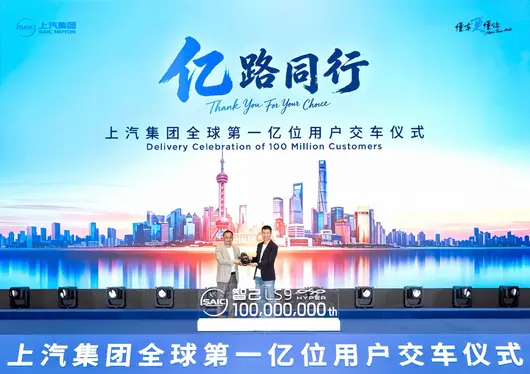
May 28, 2026, SAIC Motor Milestone Celebration grandly opened at the Shanghai North Bund World Living Room, with the world's 100 millionth user officially completing delivery. With over 70 years of dedicated effort, SAIC Motor successfully became the first automotive manufacturer in China to achieve cumulative production and sales exceeding 100 million units, setting a new height for the development of China's automotive industry. This delivery event involved over ten full-vehicle brands and nineteen main models under SAIC Motor, marking a new milestone in the development of China's automotive industry through a global relay delivery format linking domestic and international regions and continents.

Seventy Years of Legacy Continuation: From Domestic Market Breakthrough to Leading the Era of Intelligent Electrification
SAIC Motor's development trajectory is a condensed history of China's automotive industry rising. The company traces its origins to the Shanghai Internal Combustion Engine Parts Manufacturing Company in 1955, with the first "Phoenix" sedan handcrafted in 1958, achieving a breakthrough in Shanghai's independent car manufacturing and starting the curtain on domestic car production. For over 70 years of hard work, SAIC Motor has always resonated with China's automotive industry, witnessing and promoting the industry's leap-and-bound transformation from nothing to something, from weak to strong, from following joint ventures to independent leadership.

Looking back on the development journey, every iteration of SAIC Motor has anchored industrial opportunities and closely tied to the pulse of the times: In 1983, the Santana went off the assembly line officially, opening a new era of domestic automotive joint ventures; In 1997, SAIC-GM went into production, creating a 23-month industry miracle of factory construction to vehicle output, casting the nationally renowned "Shanghai Speed"; In 2006, the independent high-end brand Roewe was heavily launched, blowing the horn for independent brands to break through upward; In 2016, the world's first mass-produced internet car Roewe RX5 was launched, leading the way for intelligent automotive transformation; In 2020, the high-end intelligent electric brand IM Motors was established, fully developing the new intelligent electric track, completing a strategic transformation to New Quality Productive Forces.

Cultivating the industry for decades, SAIC Motor has always adhered to the core brand concept of "Understands Cars, Knows You Better", insisting on dual empowerment through technical deep-dive and user-first. From joint efforts in Santanna localization to technology co-creation and win-win in the joint venture 2.0 era; from pioneering new internet car forms to the implementation and application of cutting-edge technologies such as full wire-control chassis, solid-state/semi-solid-state batteries, and in-car AI large models, SAIC Motor continues to convert hardcore technology into perceivable, implementable, and inclusive mobility experiences. The eye-catching performance of 100 million units of production and sales is the highest recognition of billions of users for SAIC Motor's quality and service, and the best witness of the brand's original intention and strength.

Million-Level Benchmark Heavy Delivery: IM LS9 Hyper Carries the Accumulation of Seventy Years of Technology
The 100 millionth vehicle delivered at this celebration is SAIC Motor's high-end flagship model, IM LS9 Hyper. This vehicle concentrates SAIC Motor's 70 years of car manufacturing technology accumulation, reconstructs the core configuration system for new energy vehicles, and opens a new era of the industry's "New Three Major Components", representing the culmination of SAIC Motor's technological iteration and quality upgrade.
In terms of core hardware and intelligent configuration, the IM LS9 Hyper is equipped with multiple first-in-class technologies: The full lineup comes standard with a full wire-control four-wheel steering system, paired with a 520-line Super-View LiDAR and NVIDIA Thor top-tier intelligent driving chip. It also carries a global 800V high-voltage platform and the Stellar Super Range-Extending System, with hardware pre-embedded for L3 and higher-level intelligent driving upgrade redundancy capabilities, bringing users a full-scenario, high-safety, and evolutive intelligent mobility experience. In terms of performance, the model is the first to be equipped with SAIC Gold Badge Hurricane Three-Motor, successfully entering the 3-second supercar performance tier. In the safety field, SAIC Motor partnered with Purple Mountain Laboratory to globally launch "Endogenous Security" technology for the first time, breaking traditional automotive safety boundaries and building a dual security system of physical protection + information protection, consolidating the security foundation of the AI intelligent mobility era.

It is worth noting that SAIC Motor's global 100 millionth owner is Momenta CEO Cao Xudong. As a core strategic partner in SAIC Motor's intelligent driving field, the two parties have long collaborated deeply and co-created technology, with jointly developed intelligent driving technology widely empowering the implementation of multiple brand models for SAIC Motor. This time, an industry partner changing into a brand user is not only a vivid demonstration of the results of their ecological co-building, but also interprets SAIC Motor's brand core of being technology-based and value symbiosis.
Full-Chain Synergy Global Layout: Hardcore Strength Fortifies Industry Leading Position
Behind the 100 million units production and sales milestone is SAIC Motor's hardcore strength of synergy across six business sectors and full value chain closed-loop operations. Relying on the linkage empowerment of six core sectors: complete vehicle manufacturing, core parts, mobility, automotive finance, global operations, and technological innovation, SAIC Motor has built a stable, complete, and sustainable industrial ecosystem system, providing solid support for continuously leading the industry.

Market data validates strong development momentum: In January to April 2026, SAIC Motor's cumulative sales reached 1.302 million units, ranking first in Chinese automaker sales for four consecutive months. Among them, domestic brand sales reached 910,000 units, accounting for nearly 70%, with a significant trend of domestic rise; New energy vehicle sales reached 412,000 units, highlighting the results of electrification transformation; Overseas market performance was particularly impressive, with cumulative sales of 459,000 units, a year-on-year significant growth of 50.2%, with rapid momentum of global development.

This delivery celebration had a complete lineup and numerous highlights, with SAIC Motor's domestic and joint venture brands fully launching and appearing together. Domestic brands Shangjie Z7, Huajing S, Roewe M7, MG4 Semi-Solid State Battery Version, Wuling Starlight 560, and other models comprehensively cover diverse mobility scenarios such as family, commuting, performance, and business; Joint venture brands Volkswagen ID. ERA 9X, AUDI E7X, Buick Zhijing E7, and other new models made a collective appearance, fully showcasing the new results of SAIC Motor joint venture 2.0 era technology co-creation and value upgrade. This delivery took Shanghai as the main venue, coordinating with domestic core production bases such as Nanjing and Liuzhou, synchronously linking key overseas markets such as the UK, Indonesia, and Singapore, launching global synchronous relay delivery, comprehensively highlighting SAIC Motor's deep foundation and systemic strength in global layout.

As a pioneer and leader in China's automotive going global, SAIC Motor has long established a perfect global industry system. Currently, it has laid out over 100 parts production bases, 3,000 terminal distribution outlets, built 3 overseas R&D centers, 4 overseas complete vehicle manufacturing centers, achieving full-chain localization operations of R&D, production, sales, and service. Relying on Anjie Logistics' 42 ro-ro ships and 8 international routes global logistics network, products and services cover over 170 countries and regions worldwide, with overseas cumulative sales breaking 7 million units. Among them, the MG brand has consecutively won the China Brand Europe sales champion for 11 years; In 2025, annual European sales broke 300,000 units, becoming the first Chinese automotive brand with cumulative sales exceeding one million in the UK and Europe markets, promoting China's automotive industry from single product export to technology export, brand export, and value chain export comprehensive upgrade.


Starting with a Billion for Second Entrepreneurship: Original Intention Reaches Far, Building a New Mobility Future Together
This delivery celebration always centered on users, with diverse guests including tech bloggers, industry experts, public welfare representatives, and domestic and overseas veteran car owners gathering on site; Every user's trust and choice is a vivid interpretation of SAIC Motor's original intention "Understands Cars, Knows You Better". For many years, SAIC Motor has always taken user demand as the core orientation, deep diving into technological innovation, refining product quality, and optimizing mobility services, allowing cutting-edge technology to walk out of the laboratory and truly benefit the public's mobility life.

The 100 million units production and sales achievement is SAIC Motor's glorious answer sheet of over 70 years of continuous cultivation, and more importantly, a brand new starting point for the brand moving towards a new journey. Standing at a new trend in industry development, SAIC Motor will take this milestone as an opportunity, launching a new journey of second entrepreneurship in the intelligent electrification era, and continuing to deep dive into the core tracks of automotive intelligence and electrification. In the future, SAIC Motor will rely on full value chain core strength, partner with global users and billion-strong partners to move forward together, continue to lead the transformation and upgrading of China's automotive industry, go global, and write a brand new chapter for the high-quality development of China's automotive industry.

May 28, 2026, on this day, SAIC Group officially became the first enterprise in the history of China's automobile industry to exceed 100 million cumulative production and sales. No speeches from leaders, no product presentations, and no data bombardment on slides. In their place was a "Global Relay Delivery" spanning the Eurasian continent, connecting more than ten brands and nineteen car models. Every delivery moment opened a chapter of someone's life. 100 million vehicles are a number, but more importantly, a mirror. It reflects the ups and downs of an enterprise's seventy-plus years and the microcosm of China's automobile industry knocking out the first "Phoenix" brand from alleyways to standing on the global stage in the Smart Electric Era.

A "Delivery Ceremony" Only SAIC Could Pull Off
If one word were used to define this delivery ceremony, it would be "unreproducible".
It did not take place in a closed convention center but unfolded synchronously in multiple cities worldwide. Beyond the main venue in Shanghai, Nanjing, Liuzhou, Taiyuan, London, Jakarta, Singapore... delivery scenes continued to light up. The countdown went from the 99,999,996th unit to the 100,000,013th unit. Every vehicle delivery opened a real user story.

This "decentralized" ceremony design is not a brand show but an open presentation of system capabilities. Mobilizing a full matrix of 15 brands, from commercial to passenger vehicles, from the 60,000 range to the 500,000 range, from independent to joint venture, from domestic to overseas, and completing delivery under the same time and theme, requires behind-the-scenes whole industry chain collaborative capability.
More critically, it transformed the cold industrial number "100 million vehicles" into personal memories with warmth. For example, a couple returning to their homeland brought MG memories from their stay in the UK back home; a post-85s village party secretary used a Wuling Rongguang Pure Electric to deliver meals to left-behind elderly people; philanthropist blogger Liu Jia cut hair for left-behind children in Guangxi mountains for five consecutive years, and Buick provided immediate aid; he was moved by the "Full-score cabin" of Zhijing E7.
This shift in narrative style is essentially a public test of a "user-centric enterprise". In the past, automotive industry milestone releases were often enterprise-centric—leader speeches, technology presentations, sales data. This time, SAIC handed the stage completely to users, even the 100 millionth user, who was Cao Xudong, CEO of Momenta, a core partner in its smart driving strategy. "Partner becomes owner" is both a coincidence and a metaphor: in the intelligent electric vehicle era, the boundaries between users and enterprises are blurring, and the depth of ecosystem relationships is becoming a new competitive barrier.
The Hidden Card Behind 100 Million Vehicles: System, Globalization, and "Joint Venture 2.0"
If the delivery ceremony is the "face", the "backbone" behind the 100 million vehicles is the whole value chain system built by SAIC over seventy-plus years.

Many people see the data of SAIC ranking first in Chinese automaker sales for the first four months of 2026: cumulative sales of 1.302 million vehicles, independent brands accounting for nearly 70%, new energy vehicle sales of 412,000, and overseas markets surging by 50.2% year-on-year. But more worthy of attention are the structural changes behind these numbers.

Independent brands are no longer the "runner-up" role but the absolute main force. Roewe, MG, IM, Shangjie, Wuling, Maxus... Passenger and commercial lines advance together, covering almost all imaginable scenarios from personal travel to logistics. Joint venture brands have not stayed in the old script of "trading market for technology". Buick Zhijing E7 is based on the "Xiaoyao" Super Fusion Architecture, delivering over 10,000 units within a month of launch; Audi E7X plans to become Audi's first L3 level landing vehicle globally.

As the 99,999,999th delivery vehicle model of SAIC Group, ID. ERA 9X is a sample worthy of separate analysis. This car is not only the flagship for SAIC Volkswagen to counterattack in new energy but also a highly persuasive footnote of the Joint Venture 2.0 era. 11,079 orders locked within 1 hour of launch, 2,326 retail units delivered in 5 days, directly entering the top three of 300,000+ RMB extended-range large high-end SUVs. One month after launch, cumulative deliveries broke 7,000 units. In the high-end extended-range market where joint venture brands have long been suppressed by new forces, this speed breaks the stereotype that "joint ventures can't do new energy well".

Among the first batch of ID. ERA 9X owners, 60% live in first and second-tier cities, over 80% are management elites, over 40% are bosses and company partners, 58% hold a bachelor's degree or above, and average annual family income is 430,000 RMB. Female percentage exceeds 20%, over 85% are married with children, and those aged 25-39 account for more than half. About 40% come from old Volkswagen owners, 20% from traditional luxury brand replacement users. More than half directly chose the high-spec Ultra version. The 6,999th owner is Yang Chen, the first Chinese player in the German Bundesliga. These data point to a clear conclusion: ID. ERA 9X did not trade the market with low prices but truly entered a user group with high education, high income, and complete judgment on products.
From extended-range systems to smart driving algorithms, from chassis tuning to cabin interaction, a large amount of core capabilities come from SAIC and its ecosystem partners' local innovation. This is the most essential change of "Joint Venture 2.0": it is no longer foreign parties giving technology and Chinese parties doing the market, but both sides jointly defining products on the same platform, or even led by Chinese teams on technology routes. Behind these products is SAIC's role transition from "local adaptation" to "technology definition". In the past, joint venture R&D centers were more about executing global headquarters' technology localization, whereas now, SAIC's technical capabilities have started to be output in reverse, participating in the definition of global products. This is what is truly worth paying attention to in "Joint Venture 2.0"—it is not a slogan, but a capability.

Globalization is another hidden card. SAIC is currently the representative with the earliest and largest scale of "going out" among Chinese automobile enterprises. Overseas cumulative sales have exceeded 7 million vehicles. MG has consecutively ranked first in Chinese brand sales in Europe for 11 years, European annual sales in 2025 exceeded 300,000 vehicles, becoming the first Chinese automobile brand to break one million cumulative sales in Europe and the UK. More importantly, SAIC is shifting from "product going overseas" to "value chain going overseas". It possesses over 100 parts production bases, over 3,000 dealer networks overseas, has built three R&D innovation centers including London, and four production manufacturing centers in Thailand, Indonesia, India, and Pakistan. Anji Logistics owns 42 roll-on/roll-off ships, with 8 international routes covering Southeast Asia, Europe, and the Americas.
The depth of this global layout means SAIC is no longer a purely Chinese local automobile enterprise but a true industrial player with global operation capabilities. When many Chinese brands are still discussing how to "go out", SAIC is already thinking about how to "go up".
Technology is Not Just an "Exhibit"
Another key support for 100 million vehicles is the technology landing capability.

SAIC's 100 millionth delivery model—IM LS9 Hyper, is a good observation sample. It is equipped with full steer-by-wire four-wheel steering, 520-line ultra-vision LiDAR, NVIDIA Thor chip, whole domain 800V high-voltage platform, Stellar Super Extended Range, and even jointly premiered the "Endogenous Security" technology with Purple Mountain Laboratories globally, expanding automotive security from the physical level to information and system security. These technical indicators would not be inferior on any international brand's high-end models.

But more worthy of attention is that these technologies do not only exist on IM's flagship models. The Roewe i6 in the 60,000 range comes standard with 8155 chip and Doubao Large Model; the Buick Zhijing E7 in the 150,000 range is the first to equip Doubao Deep Thinking Large Model; the Shangjie Z7 in the 200,000 range carries Huawei ADS 4.1+896-line LiDAR, with 12,000 large orders in 27 minutes of launch. This landing capability of "technological democratization" is the real gold content of SAIC technology breakthrough. It shows that SAIC's technology logic is not "stacking specs" but precise matching around user real scenarios. Whether it is the "Smart Brain" end-to-end smart driving large model, or the "Robust Body" Digital Chassis 2.0, or the "Powerful Heart" thermal efficiency 46.3% DMH hybrid system, they all have to answer the same question: What can users perceive?

SAIC's answer is: From understanding cars to understanding you. Understanding cars is the extreme pursuit of core technology, and understanding you is precisely landing every cutting-edge technology into user-perceivable and enjoyable travel experiences. This sentence sounds like a concept, but from the delivery list of 100 million vehicles, it has been broken down into countless specific product decisions.
From "Leading the Horse Pack" to "Thousands of Galloping Horses"
In 2014, SAIC pioneered a comprehensive transition to new energy. At that time, many in the industry were still watching and waiting. Twelve years later, SAIC gave its own answer with 100 million vehicles. These twelve years happen to be a complete zodiac cycle. From the then "Leading the Horse Pack"—pioneering transformation, pioneering investment, pioneering going overseas, to the current situation of independent, joint venture, commercial, passenger, domestic, overseas "Thousands of Galloping Horses", the road SAIC has walked is almost a microcosm of China's new energy vehicle industry.

Behind 100 million vehicles is nearly 150 billion RMB in R&D investment over the past decade, nearly 26,000 effective patents, and two National Science and Technology Progress Awards. But its more important value lies in answering an industry-level question: When scale expansion meets a ceiling, how should Chinese automobile brands proceed next? SAIC's answer is "Second Entrepreneurship". This word sounds a bit old-fashioned, but placed in today's context, it points to the transition from scale leadership to quality leadership. 100 million vehicles is not the end but a new starting line. Next, what needs to be competed for is not who sells more, but who can define standards in the global market, establish irreplaceable brand assets in users' hearts, and continue to invest in technology no-man's land and achieve a commercialization loop.

From workers using hammers to knock out the first Phoenix brand sedan in 1958 to the IM LS9 Hyper with endogenous security technology driving off the production line in 2026, SAIC completed the leap from zero to 100 million in nearly seventy years. And the true revelation of this leap may not lie in the number itself, but in the fact that it proves one thing: China's automobile industry has the ability to walk a road from following to parallel running, and then to leading in local areas.
The Next 100 Million Vehicles, SAIC's Journey Has Just Begun.

May 28, SAIC Motor completed delivery of its 100 millionth new vehicle, becoming the first domestic automotive group to exceed 100 million in cumulative production and sales, resetting the production and sales record of Chinese automakers.

The vehicle model delivered this time is the IM LS9 Hyper, the top-spec version of the IM LS9. It features a full wire-controlled four-wheel steering system, equipped with a 520-line ultra-vision LiDAR, Nvidia Thor chip, and the Momenta intelligent driving large model.
Regarding power, the vehicle is built on an all-domain 800V high-voltage platform, equipped with the Star Super Range Extender System, and features the Gold Badge Hurricane Three-Motor System. The peak power of the motors reaches 160kW (Front), 195kW (Rear Left), and 195kW (Rear Right) respectively. The comprehensive range exceeds 1400 kilometers.

In 1955, the Shanghai Internal Combustion Engine Parts Manufacturing Company was established, marking the formal start of the Shanghai automotive industry; in 1958, the first "Phoenix" sedan went off the line, achieving a zero breakthrough in Shanghai sedan manufacturing. In the 1980s, SAIC introduced the Santana model through joint ventures and cooperation, promoting the scaled development of China's sedan industry. In 1997, Shanghai GM was established, setting a record of 23 months from factory construction to vehicle delivery. The Roewe brand was born in 2006, and the first Internet car, Roewe RX5, was launched in 2016. In 2020, IM Motors was established, positioning itself in the high-end intelligent electric vehicle track.
In terms of overseas markets, SAIC Motor has already established over 100 parts production bases and a dealer network of more than 3000, with products and services covering more than 170 countries and regions globally. Additionally, 3 major R&D and innovation centers, including London, have been built, along with 4 production and manufacturing centers in Thailand, Indonesia, India, and Pakistan. The owned Anji Logistics operates 42 various Ro-ro ships, with 8 international routes covering Southeast Asia, Europe, and the Americas.
© 2024 Bitauto.com. All Rights Reserved.
Bitauto (www.yiche.com and www.bitauto.com) is one of the most visited automotive websites in China. We provide detailed info on Chinese car brands available in your area. Please note that the information provided on this website is based on publicly available data and is for reference only. It may not be fully updated or accurate at all times.

Help us improve our website


