

HomeCar Dealership

Search History
Popular Searches
Dealer Login / Sign Up

The domestic new energy vehicle market saw concentrated price increases in May
Over 15 automakers adjusted prices or reduced benefits, Tesla Model Y Long Range version increased by 18,000 yuan, Performance version by 20,000 yuan, Xiaomi SU7 entire lineup adjusted up by 4,000 yuan, BYD increased the price of the LiDAR option package, NIO adjusted prices for some models and cancelled free battery swapping. The core reason is that battery raw materials such as Lithium Carbonate prices rose significantly, battery cost per vehicle increased by 3,000-6,000 yuan, plus automotive-grade chip price hikes, intelligent driving model costs increased an additional 3,000-7,000 yuan. The price hike wave indicates the industry is shifting from price wars to cost pass-through. Top-tier enterprises can still absorb some pressure thanks to scale, but mid-tier and new forces face tighter constraints. Consumers will likely wait and see in the short term. Long term, new energy penetration rate continues to steadily rise. May new energy retail penetration rate is expected to reach around 62.5%.
Dense launch of new cars after Beijing Auto Show
In May, multiple new cars were released. WEY V9X launched, 349,800-389,800 yuan, large luxury plug-in hybrid SUV, first on the Guiyuan S platform, pure electric range up to 470km, combined range 1700km. XPeng GX launched as a full-size flagship SUV, filling the brand's high-end gap. Voyah Taishan X8, Geely Galaxy Star 7, etc., also launched subsequently, focusing on mid-to-high-end plug-in hybrids and intelligent configurations. These cars concentrate in the interval above 300,000 yuan, indicating automakers are working harder in the high-end market with larger profit margins. Configurations generally strengthen 800V platforms, LiDAR, and hybrid systems. In actual usage scenarios, long range and recharging convenience are the main selling points.
Sales and Market Performance
January to May passenger car retail sales declined overall year-on-year, new energy retail also declined year-on-year but penetration rate continued to set new highs. BYD's domestic sales in April exceeded 320,000 units, continuing to lead. Exports remained strong, Chinese brands in Europe electric vehicle market share broke through 15% for the first time. Domestic demand was weak, exports became an important support. Independent brand retail share approached 70%, Geely and Changan stood out in traditional automaker transformation. Fuel vehicles exchanged price for volume but sales declined, inventory was high, indicating the trend of consumers shifting to new energy hasn't changed, just the rhythm affected by cost and economic environment.
Xiaomi Pure Electric SUV Delivery and Intelligent Hardware Cost Reduction
Xiaomi Auto delivered Xiaomi YU7 pure electric mid-to-large SUV in May. The vehicle uses an 800V high-voltage platform, equipped with 101 kWh battery, CLTC range 810 km. Intelligent driving system selected pure vision solution with dual Orin-X chips, computing power 508 TOPS. First month delivery quantity 12,000 units. Xiaomi reduced hardware costs through supply chain restructuring, bringing the price of intelligent SUVs at the same level down to 220,000 yuan. Pure vision intelligent driving solution has entered the scaled implementation stage in the mid-to-high-end market.
BYD Fifth Generation DM Model Sales and Market Share Changes
May statistical data, Qin L and Seal 06 equipped with Fifth Generation DM hybrid technology single month sales combined 60,000 units. The system engine thermal efficiency 46.06%, fuel consumption with depleted battery 2.9 liters per 100km, combined range 2000 km. Due to core components full industry chain self-production, automakers set starting price within 100,000 yuan. This pricing strategy led to market share decline of joint venture brand fuel vehicles at the same price level. May joint venture Class A fuel vehicle market share declined 12% year-on-year, speed of fuel to hybrid transformation accelerated.

Tesla FSD China Data Center Operations and Localized Testing
Mid-May, Tesla completed Shanghai data center expansion, autonomous driving system FSD obtained partial city map audit and data compliance access. End of May, Tesla pushed V12.5 version internal test to users in Shanghai, Shenzhen. The system adopts end-to-end large model technology, cancelled rule-based code. Test data shows, when the system deals with non-motor vehicles and complex intersections, intervention rate is 1.2 times per 100 km. Data compliance landing accelerated domestic automaker end-to-end intelligent driving model iteration speed, industry competition shifted to model training efficiency.

Chinese Automakers Building Overseas Factories and Supply Chain Localization Transformation
Late May, BYD Thailand factory and Geely Southeast Asia manufacturing base completed Phase II expansion, two factories annual capacity both reached 150,000 units. Chery Spain factory started assembly. Facing tariff policy changes, Chinese automakers May adjusted going global strategy, shifted from complete vehicle exports to full industry chain localization. Data shows, May Chinese car overseas factory local parts procurement rate increased 15 percentage points. Through capital and technology output to respond to trade barriers, reshaped global automotive supply chain, overseas factory profit ratio became indicator to measure automaker operation status.

Traditional 4S Dealership Channel Transformation and New Energy Outlet Expansion
May passenger car market data shows, new energy vehicle penetration rate stable above 53% for three months. Affected by this, traditional fuel vehicle 4S dealerships appeared store closure phenomenon, May nationwide closed fuel vehicle stores quantity 180 stores. Meanwhile, automakers converted shopping mall direct stores to comprehensive delivery centers. Among newly added new energy vehicle service outlets this month, comprehensive centers integrating sales, delivery, after-sales accounted for 70%. Channel structure changes indicate, new energy vehicles completed market education, sales network layout entered service efficiency competition stage from traffic acquisition stage.

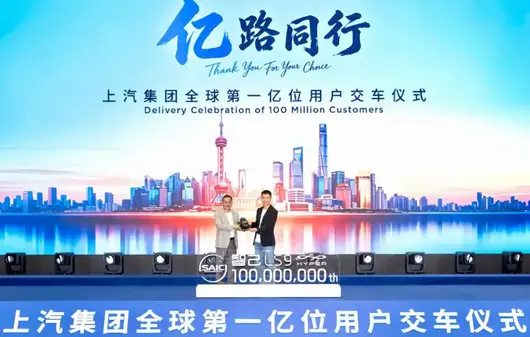
On May 28, 2026, SAIC Motor's "Global 100 Millionth User Vehicle Delivery Ceremony" was held at the World Living Room of the North Bund in Shanghai. Over ten passenger car brands and nineteen models under SAIC, through the method of "Global Relay Delivery", traversed mountains and seas, crossed continents, and connected globally, making SAIC Motor the first Chinese automotive group to accumulate production and sales exceeding 100 million vehicles, casting a new milestone for the Chinese automotive industry.

In 1955, Shanghai Internal Combustion Engine Parts Manufacturing Company was established, marking the start of Shanghai's automotive industry. In 1958, workers hammered out the first "Phoenix" sedan, achieving a "zero breakthrough" in Shanghai's sedan manufacturing. For over 70 years, SAIC has witnessed and driven the entire process of China's automotive industry from nothing to something, from weak to strong: Santana rolled off the line in 1983, opening joint venture cooperation; Shanghai GM was established in 1997, creating the "Shanghai Speed" of 23 months from factory construction to vehicle launch; the independent brand Roewe was born in 2006, and the world's first internet car Roewe RX5 was launched in 2016; the high-end intelligent electric brand IM Motors was established in 2020.
Running through this journey is SAIC's user philosophy of "Understanding Cars, Understanding You Better". From the Santana localization community to Joint Venture 2.0 technology co-creation, from internet cars to full-by-wire chassis, solid-state/semi-solid-state batteries, and AI large models on vehicles — every leap is an upgrade of the "Understanding Cars" capability, and a continuity of the original intention of "Understanding You". 100 million vehicles, but also the concentrated fulfillment of 100 million users' trust.
The first 100 millionth vehicle delivery model, IM LS9 Hyper, is a masterpiece of SAIC's over 70 years of technical accumulation, ushering in a new era of the "New Three Major Components" for new energy vehicles. It is equipped with next-generation chassis technology, the industry-first full-by-wire four-wheel steering; next-generation intelligent driving hardware, 520-line ultra-view LiDAR + NVIDIA Thor chip, next-generation three-electric systems — whole-domain 800V high-voltage platform and Star Super Range Extender. Fully pre-embedded redundant capabilities for continuous evolution towards L3 and above high-level intelligent driving.
At the same time, IM LS9 Hyper is the first to equip SAIC's Gold Label Hurricane three-motor, calmly joining the Performance 3-Second Club; furthermore, collaborating with Purple Mountain Laboratories, globally launching "Intrinsic Security" technology, expanding the automotive safety boundary from "Physical Safety" to "Information and System Security", which is an essential security cornerstone of the AI era.
Behind the 100 million vehicles is SAIC's full-value chain closed loop covering six major sectors: passenger vehicles, components, mobility, services, finance, international operations, and innovative technology. From January to April 2026, SAIC's cumulative sales reached 1.302 million units, ranking as the China automotive sales champion for four consecutive months. Among them, independent brand sales reached 910,000 units, accounting for nearly 70%; new energy vehicle sales 412,000 units; overseas market sales 459,000 units, a surge of 50.2% year-on-year.
At the delivery ceremony scene, SAIC's full brands and full product matrix collaborated and exerted strength. Independent brands went all out: Shangjie Z7, Huajing S, Roewe M7, MG4 Semi-Solid State Battery Version, Wuling Starlight 560, Maxus eDeliver5, Hongyan Heavy Truck, Yuejin Dana T1, Sunwin Pure Electric Bus, IVECO Juxing EV, etc. were successively delivered, covering multiple scenarios such as personal travel, family life, commercial operations, and logistics transport.
Joint venture brands concentratedly displayed "Joint Venture 2.0" results: Volkswagen ID. ERA 9X will globally launch equipped with the Momenta R7 Reinforcement Learning World Model, delivering over 7,000 units within one month of launch; Audi E7X plans to become Audi's first global model to implement L3-level autonomous driving landing; Buick Zhijing E7 is built based on the "Xiaoyao" Super Fusion Architecture, delivering over 10,000 units within one month of launch.

Starting from the main venue in Shanghai, the delivery scenes were continuously lit up in multiple domestic cities such as Nanjing, Liuzhou, Taiyuan, as well as in countries such as the UK, Indonesia, and Singapore, pioneering a new narrative method for Chinese automotive brands.
Behind this is the deep foundation of SAIC's global layout. SAIC is a pioneer of Chinese automotive enterprises "Going Global": owning over 100 parts production bases overseas, over 3,000 dealership networks, built 3 major R&D innovation centers including London, and 4 production and manufacturing centers in Thailand, Indonesia, India, and Pakistan; Anji Logistics owns 42 Ro-Ro ships of various types, 8 international routes covering Southeast Asia, Europe, and the Americas.
NOWadays, SAIC's products and services are distributed in over 170 countries and regions, with cumulative overseas sales breaking 7 million units. In 2025, SAIC launched the overseas "Glocal Strategy" (Global + Local), accelerating the shift from "Product Going Overseas" to "Value Chain Going Overseas", letting "China Smart Manufacturing" further go global.
The final focus of "Understanding Cars, Understanding You Better" is the travel life of every real user. "GetApp" founder Luo Zhenyu, as Huajing S No. 001 Experience Officer, from New Year's Eve speech praising Huawei Qiankun Intelligent Driving to entering the factory to witness the roll-off; Former German national football team member Yang Chen chose ID.ERA 9X, because its Golden Range Extender and Long-termism coincide; Cao Kailiang ordered a car for the whole family, then idol Jay Chou happened to become the Buick MPV Family Spokesperson; Charity blogger Liu Jia cut hair and gave company for left-behind children in Guangxi mountains for five consecutive years, Buick assisted immediately, he was moved by the Zhijing E7 "Perfect Cockpit". From self-media bloggers to village secretaries, from charity guardians to logistics enterprises — every user is a microcosm of real life, this is the most vivid interpretation of "Understanding Cars, Understanding You Better".
100 million vehicles is the phased answer sheet of SAIC's over 70 years of development, and is more of a new starting line for SAIC facing the intelligent electricity future "Second Entrepreneurship". In 2014, SAIC actively implemented the important instruction of "Developing new energy vehicles is the inevitable path for China to move from a car big power to a car strong power", taking the lead in comprehensive transformation. Twelve years later, from the "Leading the Charge" in intelligent electricity transformation to the "Ten Thousand Horses Galloping" in independent joint ventures, passenger/commercial use, domestic/overseas, SAIC will continuously use "Understanding Cars, Understanding You Better" as the user philosophy, letting technology innovation truly benefit every user.
From 1955 to 2026, from the first user to the 100 millionth user, from startup exploration to industry leadership — SAIC will continue to walk the 100 Million Mile Path together with global users and global partners, co-creating a new future for beautiful mobility.
© 2024 Bitauto.com. All Rights Reserved.
Bitauto (www.yiche.com and www.bitauto.com) is one of the most visited automotive websites in China. We provide detailed info on Chinese car brands available in your area. Please note that the information provided on this website is based on publicly available data and is for reference only. It may not be fully updated or accurate at all times.

Help us improve our website


