

HomeCar Exports

Search History
Popular Searches
Dealer Login / Sign Up

Domestic car market competition intensifies, automaker profit margins remain under pressure, expanding into overseas markets has shifted from an optional layout to the only path for survival and development. Latest industry data shows, in the first half of 2026, China's car exports saw explosive growth, both export volume and total export value hit new highs, but overseas trade barriers continue to increase, localized production has become the core solution for automakers to break through.
According to relevant statistics from the China Association of Automobile Manufacturers, in June 2026, domestic car exports reached 1.04 million units, up 75% year-on-year, achieving single-month exports exceeding 1 million for the first time. Car cumulative exports for the first half reached 5.1 million units, up 65% year-on-year, half-year export volume broke through 5 million units for the first time; total value of vehicle exports exceeded 600 billion yuan. Now car exports account for 35% of total domestic sales. Compared to the thin domestic profits, overseas markets offer higher gross profit margins, many automakers rely on overseas profits to support domestic business to counteract profit pressures caused by intense domestic price competition.
In the first half of the year, the overseas sales tiers of major automakers were clear. Chery led with exports of 939,000 units, overseas sales accounted for 74% of total sales; BYD followed with 792,000 units, localized production in overseas factories can effectively increase profit per vehicle; SAIC and Geely ranked third and fourth respectively. Among them, Geely's new energy vehicle exports grew rapidly, new energy vehicles accounted for 60% of its total exports. Changan and Great Wall also maintained stable overseas output. Major automakers continue to ramp up overseas capacity construction, consolidating market share by building factories overseas to cope with the continuously changing overseas policy environment.
Behind the outstanding export performance, external challenges follow in succession. The EU imposes anti-subsidy duties on Chinese electric vehicles, and plans to extend restrictions to plug-in hybrid models, while introducing relevant bills to raise investment thresholds for foreign capital. Brazil raised tariffs on imported electric vehicles, Thailand implements production capacity commitment policies, multiple rules significantly increase the cost of direct vehicle exports. The model relying solely on vehicle exports carries increasingly high risks.
Accelerating local factory construction, automakers seek paths to break throughFacing trade barriers, domestic automakers chose to accelerate overseas localized production, forming two development paths. Chery adopts a reverse joint venture model, leveraging local brands to obtain production qualifications and reduce market resistance; BYD chose to fully self-construct factories, fully controlling the supply chain and production links. Many enterprises rushed to acquire European factories during the window period to avoid policy restrictions.
China's car exports have entered a high-growth cycle, but long-term challenges remain ahead. The overseas market is both an incremental blue ocean and a competitive battleground. Major automakers continue to improve their overseas industrial layout, resolving trade barriers by relying on localized production. In the future, whoever can better root themselves in overseas markets and balance policy with operations is expected to seize more seats in the global car competition.
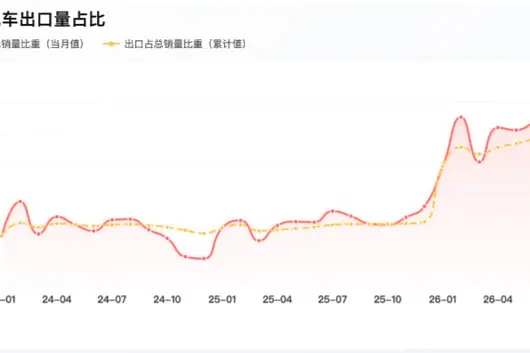

In the first half of 2026, China's car exports reached 4.059 million units, up 63% year-on-year. At this growth rate, breaking 10 million units for the year is almost a certainty — by then China will become the world's first automotive giant to export over 10 million units annually, equivalent to 2.5 times Japan's volume.

But another set of data is not looking so good. From January to May this year, domestic passenger car retail sales reached 7.099 million units cumulatively, down 19.5% year-on-year. Among the five major independent brands, BYD sold 1.8085 million units in the first half, down 15.72% year-on-year. Growth relies mostly on exports. This isn't prosperity; it's like 'starving at home, relying entirely on grabbing from outside'.

Let's first see just how fierce the exports are. Chery exported 940,000 units in half a year, securing the top spot, with a share as high as 74.3% — 3 out of every 4 cars sold were exports. BYD followed with 790,000 units, with 174,800 units exported in June alone. What was most unexpected wasn't the volume, but the direction. In May data from 31 European countries, these five — BYD, SAIC, Geely, Chery, Leapmotor — sold a combined 138,400 units, up 65% year-on-year, surpassing the total of six Japanese brands like Toyota, Nissan, and Honda for the first time. The market share of Chinese brands in Europe jumped directly from 5.6% in May last year to 10.7%. Doubling in one year isn't growth, it's swallowing whole.

But Europeans lost patience. On July 1, the EU's final anti-subsidy duties on Chinese pure electric vehicles officially took effect — 17.4% for BYD, 18.8% for Geely, 35.3% for SAIC, plus a 10% base tariff, pushing the combined tax rate for some manufacturers above 45%. Tougher still, the EU is brewing to include plug-in hybrids in the tax scope. Over the past year, plug-in hybrids were the core channel for Chinese manufacturers to bypass pure EV tariffs; now they're trying to block all paths. But China is not someone to be trifled with. The Ministry of Commerce immediately issued a final anti-dumping ruling on EU pork, with rates ranging from 4.9% to 19.8% for five years. China is the world's largest pork consumer market; the EU's pig feet, ears, and offal rely entirely on China to digest. This blow targets the vote banks of agricultural states. Countermeasures on cognac and dairy products are also coming. Wine merchants in France's Cognac region are already shaking.

But can tariffs really stop us? The Chinese auto manufacturers' response is simple — build factories right at your doorstep. BYD is building a factory in Hungary to start production next year, Chery is laying out plans in Brazil and Spain, and SAIC is deepening roots in Thailand. If tariffs block prices, I'll just bypass your tariff wall. It's exactly the same script as Japanese automakers frantically built factories in the US after the US imposed tariffs back then. The only difference is that Chinese cars going overseas are faster, larger in volume, and the industrial chain is more complete.

Overall, the slump in the domestic car market forces all brands to go outward, and exports have made up for all the growth lost domestically. But the EU's 45% tariff is just the first hurdle; behind it, the door to the North American market is tightly shut, and the fortress of Japanese cars in Southeast Asia won't be breached in a day. The race for Chinese car exports has shifted from 'grabbing incremental growth' to 'fighting hard battles'. 10 million units is inevitable, but the tariff walls, political barriers, and localization difficulties on the road are getting harder and harder.
© 2024 Bitauto.com. All Rights Reserved.
Bitauto (www.yiche.com and www.bitauto.com) is one of the most visited automotive websites in China. We provide detailed info on Chinese car brands available in your area. Please note that the information provided on this website is based on publicly available data and is for reference only. It may not be fully updated or accurate at all times.

Help us improve our website


