

HomeCeiling

Search History
Popular Searches
Dealer Login / Sign Up

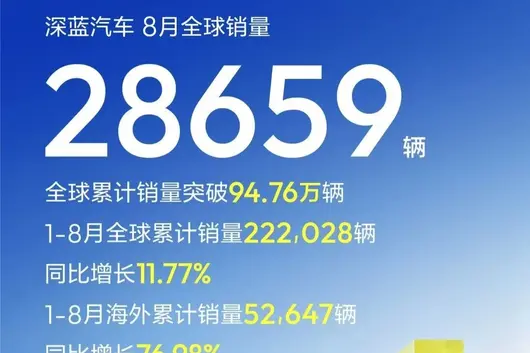
Deepal Automotive delivered its August performance report, with global sales of 28,659 units, cumulative global sales surpassing 947,600 units, leaving a gap of only about 52,000 units to one million.
Looking at the figure for August alone, it dropped slightly compared to 29,213 in July. If you only focus on this one month, you might think it is unremarkable. But what truly matters is the imminent million, and within these 940,000 units, there is far more than just cars.
With Deepal's current pace of nearly 30,000 monthly sales, within at most two months, it will become another brand in China's new energy sector to cross the one million threshold. What is truly worth discussing is not the one million itself, but how this one million was achieved.

The one million for many brands is built up relying on the domestic market. Deepal is not.
Look at a set of numbers, in the first eight months of this year, Deepal's cumulative global sales reached 222,000 units, a year-on-year increase of 11.77%. Among them, overseas cumulative sales reached 52,647 units, with a year-on-year growth of 76.98%, and the overseas growth rate is nearly seven times the overall rate. As of now, Deepal has entered more than 100 countries and regions worldwide, the Thailand base has gone into production, and the right-hand drive market is firmly in its grasp.
What does this mean? It means Deepal's growth is a typical dual-wheel drive, stabilizing the basic domestic market and rapidly opening new overseas markets. This is completely different from the old way of the past where domestic competition became too intense, leading to clearing inventory overseas at low prices.
More critically, Deepal is not sold cheaply overseas; it relies not on price-performance ratio, but on hardcore safety and quality. The Deepal S07 has secured triple five-star safety certifications from Europe's Euro NCAP, Australia's ANCAP, and China's C-NCAP, and is also the individual champion in adult protection for European crash tests. Globally, it has sold over 300,000 units and is popular in more than 80 countries and regions. The Deepal S05 even topped the list for compact pure electric SUV registration for two consecutive months in Spain.
A Chinese brand winning the championship under Europe's most strict safety standards, the significance of this weighs far more than selling tens of thousands of extra cars.

Behind Deepal is Changan, a true central state-owned enterprise.
For a long time in the past, when central enterprises made new energy vehicles, outsiders always had some stereotypes: large ships, slow decisions, hard to turn around, unable to compete with private new forces running fast. But Deepal used four years to go from 0 to 940,000 units, firmly staying in the first tier of central enterprise new energy sales.
There is a background here worth clarifying. Changan's current new energy layout follows a three-pronged approach. Changan Qiyuan is responsible for volume, Avatr aims for the high-end, and Deepal sits in the middle, carrying the tough challenges of mid-to-high-end and globalization.
Where is the difficulty? It lies in that it needs to increase volume, protect profit margins, and expand internationally. Any of these three tasks is not easy on its own, but Deepal has to do them simultaneously. To reach its current position, it relies not on overnight fame from a hit product, but on a complete system: self-developed technology foundation, multiple product matrices, refined channels, plus simultaneous advancement in domestic and international markets.
This is the most important aspect of Deepal worthy of industry attention. In the first half of new energy, one hit product is enough to take off; in the second half, it is about the system. Deepal happens to be a central enterprise model that has perfected the system.
Zooming out a bit, the new energy market in 2026 has actually entered a transparent phase. The price war has gone on until now, with diminishing marginal returns. Relying solely on price cuts to exchange for sales volume makes the path narrower. Those that can truly survive are car companies with complete product matrices, self-developed technology barriers, and global layouts. Deepal covers all three.
In terms of products, it does not rely on one car to survive. Deepal S05 has cumulatively sold 250,000 units, S07 has sold over 300,000 units globally. Added with G318, L06, and S09, it covers multiple segments including mainstream household, sport coupe, and mid-to-large SUV, with success in multiple areas, if one market fails, another succeeds.
In terms of technology, it also doesn't plan to rely on buying. The Force Super Integrated Electric Drive achieved a working efficiency of 94.13%, the Golden Bell Shield battery has cumulatively installed over one million vehicles with zero overheating, and the Micro-core High-frequency Pulse Heating Technology has won the National Invention Patent Gold Award. Even more rarely, Deepal actively open-sources these core patents to the entire industry, using technology sharing to push the entire Chinese new energy sector forward.
This kind of vision cannot be possessed by a car company that only knows how to engage in price involution.

Another point easily overlooked is the foundation of Deepal, which is Super Range Extender.
When range extenders just became popular back then, many people still thought they were transitional solutions, compromises before pure electrification was mature. But after a few years of fighting, the market has voted with its feet; range extenders and plug-in hybrids have long become the core track of the mainstream market, because they exactly solve the real pain point of ordinary families who want the experience of an electric car but fear range anxiety.
Deepal was one of the earliest players to seriously do range extenders in this track, and it started from a forward-developed pure electric platform to do range extenders, not converting oil to electric. This step allows it to enjoy the smoothness and intelligence of pure electricity, while also obtaining the range freedom of range extenders. Technology accessibility and electric equality, these two phrases Deepal shouted are not slogans, but the product logic that carried it to one million sales.
947,600 units, only one step away from one million. This step will be crossed sooner or later. But more important than crossing it is that Deepal has already used these 940,000 units to answer a question that has always hung over the industry: whether Chinese cars going overseas can truly win without relying on cheapness.
The answer is yes.

Auto Review:
The path Deepal provides is very clear: use self-developed technology to establish the product, use safety standards to gain global discourse power, and use systematic capabilities to withstand elimination rounds. It is not simply selling cars abroad, but taking China's technology, standards, and systems out together.
This is the most worth remembering aspect of this Deepal approaching one million. One million is not the end point; it is a new starting point for Chinese cars moving from selling more to selling with strength. And for the industry, what is most precious about Deepal is proving that the national team can also achieve acceleration on this new energy track, running steadily.

China's auto exports in 2026 are still surging ahead. Monthly exports broke the 1 million mark for the first time, with cumulative exports in the first half exceeding 5.3 million vehicles, a year-on-year growth rate of over 50%. The position of the world's top export nation is becoming increasingly secure.
Behind the dazzling growth figures, a discussion about "when exports will peak" is quietly heating up within the industry chain.
Gu Huai (all names in this article are pseudonyms), who just returned from touring overseas markets, is an insider at a Chinese Tier 1 supplier that began its overseas layout relatively early. In his view, the node for export ceilings is likely to occur in 2029, corresponding to a peak scale of about 12 million vehicles.
This is not just one company's opinion. At a salon event held recently by the Gasgoo Auto Research Institute, several industry insiders from the automotive industry chain converged on the peak window pointing to 2028-2030. As for the peak scale, industry predictions range from 12 million to 15 million vehicles. The core of the disagreement lies in the timing of tightening trade barriers and the speed of overseas capacity implementation.

Image source: Leapmotor
Growth still surging, peak zone emerging
If we rewind time to two years ago, industry predictions on the export peak were earlier.
The logic back then was very clear: overseas factories of leading automakers would concentrate production in 2025-2026, whole vehicle exports would be quickly replaced by localized capacity, and the growth curve would flatten quickly. However, the endurance of exports far exceeded industry expectations. The "ceiling" considered at that time to be about to be touched has now been overturned by actual data that broke through continuously.
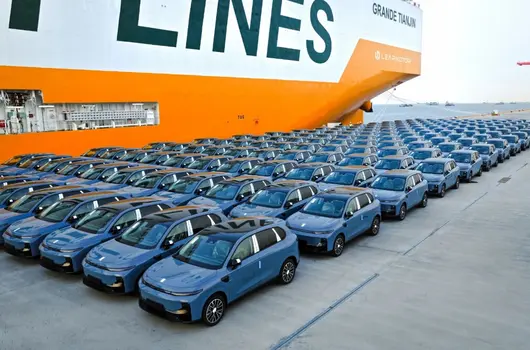
According to data from the General Administration of Customs organized by the China Association of Automobile Manufacturers, China's passenger vehicle exports in January-June 2026 reached 5.307 million vehicles, with year-on-year growth of 52.8%. The export volume for January-July counted by the China Passenger Car Association has reached 6.4 million units, with year-on-year growth of 54%. Extrapolating based on the current pace, breaking through 10 million vehicles for the whole year is almost without suspense.
In front of these scalding data figures, the industry also has more realistic judgments on the point when exports will hit the peak.
Chen Mo, an insider at a global cabin electronics Tier 1 supplier, frankly admitted, "Previously we judged that this year or next year would be the export peak, after all overseas factories have successively started localized production. But now looking at it, this time node needs to be pushed back."
In his view, the resilience of exports comes from a diversified market layout. Leading domestic automakers are expanding simultaneously in Southeast Asia, South America, and Europe. The growth rhythms of different regions are staggered, supporting the overall export scale. "In the future, it won't surge like before, but is likely to remain stable, possibly even a slight decline, with no cliff-like drop."
Similar judgments are not uncommon within the industry chain, just that different enterprises have different observation dimensions.
Jiang Yu, an insider at a domestic automotive semiconductor manufacturer, believes that exports will continue to grow in two to three years, until exports touch around 15 million vehicles, will encounter the true bottleneck. This means China's share of the global automotive market will climb to a higher level, necessarily triggering more intensive trade protection measures.
Lu Ming, head of overseas business at a leading domestic automotive interior and exterior enterprise, values the rhythm of the capacity cycle more. In his observation, Chinese automakers' overseas capacity will be gradually implemented and released in 2027, 2028. Exports won't brake immediately, rather, it will continue to walk along with the capacity ramp-up. The true balance state between exports and overseas capacity will likely appear between 2028 and 2029.
Zhou Yan, head of overseas business at a global automotive parts giant, provided more granular inflection point judgments from observing the supply chain frontlines: Looking at different metrics, pure CBU vehicle exports will likely welcome a scale inflection point in 2028, with export volume seeing a substantive decline. If KD kits are included in the full statistics, data fluctuations will be relatively flat, but the downward trend of pure vehicle exports is quite clear.
Tian Tao, an analyst at a consulting institution in the automotive industry, stated that geopolitics, tariff policies, and localized capacity superimpose three factors, and the export ceiling will likely fall around 2030.

Image source: Chery
Of course, all these industry insiders emphasize: export ceiling does not equal the overseas sales peak of Chinese automakers.
Su Wan, head of overseas business expansion for intelligent cabins at a parts enterprise, said very clearly, "The momentum of exports rushing towards 10 million vehicles this year is indeed astonishing, and in the next few years, export volume will likely enter a bottleneck period, stabilizing growth and no longer skyrocketing. But if sales from localized production are included, the overall scale will still steadily rise. Exports have an upper limit, but the globalization of Chinese automakers has no upper limit. This is not the same thing at all."
Zhao Kai, head of enterprise development at a German automotive parts supplier, also confirmed this from industrial logic. In his view, new energy vehicles becoming the export main force itself extends the growth cycle. The battery technology iteration behind electric vehicles formed a synergy with national energy storage strategies, making China's automotive industrial advantages more solid than in the fuel vehicle era, and the resilience of export growth also far exceeds initial industry expectations.
Barriers and Capacity, Two Major Reality Constraints
Although the momentum of growth is fierce, no one believes exports will always rise. Two ceilings hanging above exports are slowly pressing down. One is the trade policy barrier being built higher and higher, the other is the localized capacity replacement proactively pushed by automakers.
Europe is the market that felt the chill first.
EU anti-subsidy tariffs targeting Chinese pure electric vehicles have taken effect. Multiple domestic automakers apply to different additional tax rates. After adding basic tariffs, comprehensive tariff costs for some brands have risen significantly, valid for as long as several years. This is just the first gate, and more systematic rule reshaping is on the way.
Lin Zhou, an insider at a Spanish-backed joint venture parts enterprise, revealed that the 'Industrial Accelerator Act' the EU is pushing is currently still in the legislative draft stage. According to general extrapolations by industry institutions, the bill is expected to complete legislation in 2027. Constraint clauses related to automobiles will land successively after the bill takes effect, and the overall time window is concentrated in 2027-2028. Final progress still depends on negotiation progress between the European Parliament and Council.
The core logic of the bill is very straightforward: through localized content requirements, public procurement restrictions, investment review means, it aims to protect and support the European local automotive industry.
"2026 is a key node," Lin Zhou added. The head new energy brand's Hungary factory officially operated this year, but carbon emission qualification accounting will land in 2027. The EU will introduce third-party audit agencies to check 2026 data and calculate final carbon emission indicators. And this indicator is tightening year by year; if standards are not met, additional tariffs must be levied. Besides the EU-level unified bill, individual member states are also issuing local policies, explicitly and implicitly guiding Chinese automakers to invest and build factories locally. Essentially, all are using rules to force localization.
Fang Cheng, an insider at a domestic automotive electronics enterprise, spoke even more directly: "We are not just going to earn Europeans' money, but also reconstructing the local industrial landscape. For European players guarding century-old industrial foundations, earning money can be tolerated, but having rice bowls snatched and tracks changed by latecomers equates to slapping in public. Resistance will only get more intense. Trade protection is not a question of whether it will come; it has already come, and it will increase more."
In his view, relying on high-speed growth of whole vehicle exports is naturally unsustainable, will soon touch the policy red line, and localization is the core path to break the situation.
More fundamental than policy barriers is the localization route chosen proactively by automakers. When export scale reaches a certain level, coupled with the rise of tariff costs, building factories locally for production became the inevitable choice.
Currently, overseas factories of leading automakers have already entered the concentrated production launch period.
BYD's Hungary Szeged factory will start whole vehicle assembly in the fourth quarter of 2026. Its Thailand Rayong, Brazil Camacari two factories have already achieved mass production, and capacity is still continuously ramping up. Chery's Spain Barcelona joint venture factory, Malaysia Intelligent Auto Industrial Park, and South Africa Rosslyn factory will all be put into production successively in 2027. SAIC MG's European production base located in Port Ferrol, Spain is planned to officially start operations at the end of 2028.

Image source: BYD
In the industry's view, whole vehicle exports were originally a transitional stage of overseas layout. Once the costs and efficiency of local factories are worked out, combined with the consideration of tariff and logistics costs, the priority of whole vehicle exports will naturally gradually decline.
Lu Ming's viewpoint also confirms this logic: The process of overseas capacity landing and release is the process of exports being gradually replaced. In the initial phase of capacity ramp-up, it may still need to export some parts or whole vehicles to supplement market gaps. After capacity is fully released, the incremental space for exports will be greatly compressed.
But this replacement is not a zero-sum game. Su Wan repeatedly emphasized: Exports and localized production are not a replacement relationship of mutual exclusion; it is a baton-passing progressive relationship. Exports are responsible for quickly opening markets and building brand awareness, localization is responsible for reducing costs and digging deep into user markets, both together expanding the overseas basic board of Chinese automakers.
Exports are not the destination, Going overseas heads to deep waters
When whole vehicle export growth gradually hits the top, China Auto's globalization layout will also synchronously enter the real deep waters.
As Jiang Yu said, when whole vehicle export scale approaches 15 million vehicles level, resistance for further growth will significantly increase. This is not a decline in Chinese automakers' competitiveness, but overseas localized capacity entering a concentrated release period, gradually replacing whole vehicle exports. On the surface, export number growth slows down, but Chinese automakers' global market share is still rising, it is just that the growth carrier has shifted from "whole vehicle exports" to "local manufacturing".
This is also the consensus of all industry chain personnel: The next stage of Chinese auto going overseas is shifting from "selling products" to "outputting industry". Going out with the vehicle factories is not just cars, but also the whole supply chain system.
Gu Huai's overseas survey confirms this trend. He summarized three mainstream models of current automakers going overseas: One is pure whole vehicle exports to fight the market; Two is cooperating with local factories to produce and reduce costs; Three is building factories and ecosystems solely like leading new energy brands. In the process of the three models blending promotion, parts, glass, chips, electronics systems and other supply chain links will also gradually complete localization along with them.
"At normal pace, around 2028, Chinese automakers' overseas industrial layout will be able to reach a relatively large scale. Not just selling cars over there, but moving the whole industrial ecosystem over there," Gu Huai said.
Tier 1 suppliers have already walked ahead. Multiple global parts enterprises are adjusting global capacity layouts, fully cooperating with the overseas rhythm of Chinese mainstream OEMs. Su Wan revealed that factories of the enterprise where he is located around the world are docking with Chinese automakers' overseas projects. Following the customer's factory building rhythm, synchronously landing capacity, from cabin systems to interior modules, are all rapidly promoting localization support capabilities.
The pace of local supply chain going overseas is also accelerating. Fang Cheng revealed that as a chip manufacturer, the company is planning to go overseas with the OEM, partner with domestic parts enterprises, and jointly achieve overseas localized production. "Automaker going overseas is never fighting alone; it must be the whole industry chain going out together to truly take root."

AI Generated Image; Source: Doubao
Of course, challenges are far more than imagined. Moving factories over does not guarantee localization success.
Shen Yan, an insider at an Italian enterprise, reminded that what Chinese brands forbid most is directly moving domestic tactics overseas. European market consumers' sensitivity to vehicle long-term value retention, brand reputation and terminal service is far higher than short-term price. If only relying on price wars, rapid model iteration, without valuing core user maintenance and service system construction, even if completing local factory building, it is also very difficult to truly stand firm in mature markets.
"2028 to 2030, export growth will gradually slow down, but won't immediately hit the ceiling. The real test has never been how much export volume rushes to, but whether China's new energy brands can truly stand in European mature markets," Shen Yan emphasized. Relying on B-side low price volume mode doesn't work in Europe; taking quality route and doing terminal service well is the key to long-term survival.
Zhou Yan suggested that there is no need to fix eyes only on Europe. South America, Africa and other regions' automotive consumption is still in rising period, trade environment is also more friendly, will be a new growth point continuously upwards. Dispersing market layout is itself the best way to hedge single market policy risks.
Zheng Ze, an insider at a German capital parts enterprise, then gave judgment from a more macro perspective: China Auto's product competitiveness is already strong enough. The one truly deciding ceiling height has never been the product itself, but national strategy and industrial discourse power. Whether can break trade barriers, strive for more fair market environment, is the core variable deciding China Auto globalization upper limit.
From a longer term industrial cycle perspective, the peak of China Auto exports is essentially a switch of growth mode. In the past few years, we relied on whole vehicle export's high growth to take the position of the world's top export nation. Next, we will through localization's deep layout, gradually strive for global automotive industry's discourse power.
Under the ceiling of export numbers is a wider globalization space.
(Note: All names in this article are pseudonyms, and some personally identifiable information has been blurred)

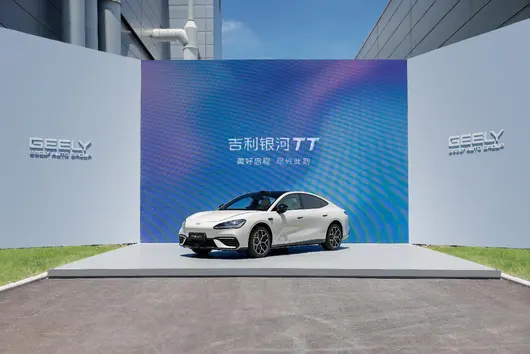
3 Guinness World Records in Hand! Geely's "Thunder 16-in-1" Electric Drive, Welds Shut the Global E-Drive Ceiling

On July 16, Geely Automobile Group officially released Geely Galaxy's world's first "Thunder 16-in-1 Intelligent Electric Drive". Relying on Xingqu Technology's years of technical accumulation and complete industrial layout, this new electric drive achieved a generational breakthrough in energy saving, performance, and reliability, directly pulling the daily usage experience of pure electric vehicles to a new height. The Geely Galaxy TT, equipped with this electric drive for the first time, won two Guinness World Records at once: "Lowest Energy Consumption for Driving a Production Pure Electric Sedan Around Qinghai Lake" and "Longest Continuous Dual-Car Drift on Slippery Roads (Electric Vehicle)", proving the global leading strength of Chinese brands in the electric drive field with solid results.

The "Thunder 16-in-1 Intelligent Electric Drive" released this time has the most intuitive feature of integrating 16 hardware and software functions that were previously scattered into one, equivalent to packaging several independently working devices into one highly collaborative unit. It not only has over 180 fewer scattered parts, but its weight is also 15% lighter than mainstream industry products, and can free up an additional 28L of trunk space inside the vehicle. For ordinary car owners, it means carrying more luggage and being more practical for daily travel.

In terms of the most concerned matter of saving power, this electric drive achieved the industry's first place in mass production of the same level with a 93.8% comprehensive efficiency. Simply put, from current transmission, energy conversion to daily full-scenario driving, every link is "picking details" to reduce waste: 800V high-voltage platform plus shortened conduction paths directly reduce current transmission loss by 80%; more advanced silicon carbide chips, thinner silicon steel sheets, and high-precision gears further minimize losses in the electricity, magnetism, and force conversion process; plus the support of Geely Xingrui AI Cloud Power Intelligent Energy Management Large Model, when turning on heating in winter, driving long distances on highways, or commuting during city rush hours, the system will automatically find the most power-saving operation mode. Car owners don't need to deliberately control their footwork, they can find a balance between comfort and power saving. It is precisely thanks to this extreme energy-saving design that the Galaxy TT achieved an ultra-low power consumption of 8.20 kWh/100km in the test run around Qinghai Lake, setting a Guinness World Record for lowest energy consumption for production pure electric sedans around Qinghai Lake.

In terms of power performance, it achieved the level of the top tier of the same level. The four-wheel drive version reaches a comprehensive power of 425kW, and 0-100 acceleration only takes 3.8 seconds. The rarest thing is "fast and stable": the average command response of traditional electric drives is 40ms, it relies on the design of one-chip integration to compress it directly to the fastest 2ms, the power follows the moment the accelerator is stepped on, truly achieving "hits exactly where pointed"; AI algorithms can also reduce real-time torque deviation from 3% to 1%, greatly improving the accuracy of power output of the wheels; plus 54-channel directional cooling technology, the maximum temperature of the motor can be reduced by 15 degrees Celsius, even if driving intensely for a long time, there will be no power attenuation or system torque limit situation.

It is precisely relying on this performance of "performance without interruption throughout the process" that the Galaxy TT completed over 46km of continuous dual-car drift on slippery roads, breaking the record set by Porsche in 2020. Many people may not know that drifting pure electric vehicles is much more difficult than fuel cars: at the moment of starting drift, precise torque must be exploded in milliseconds to allow the car body to smoothly enter the sliding state; during the drift process, power output must be constantly finely adjusted, a slight deviation will cause loss of control; under extreme working conditions of continuous tens of kilometers, the electric drive must withstand continuous high speed and high thermal load, and cannot trigger protection due to overheating. This successful challenge is equivalent to giving all ordinary car owners a reassurance: even if encountering heavy rain and slippery roads, continuous climbing, or long-time intense driving, this electric drive can still output stably and won't let you down.

In terms of reliability, this electric drive has undergone an "over-standard level" test. From single parts to complete electric drive assembly, to the whole vehicle on the road, covering 9000+ tests in 15 areas, cumulatively completing 5 million kilometers of durability verification, and also obtained the authoritative certification of CAERI "High Quality Electric Drive". It also comes with a cloud "online doctor" - Smart Health Management System, relying on AI life prediction model to actively give key components a "checkup", not waiting for parts to break to warn maintenance in advance, turning the past "repair after break" into "active care", reducing the failure probability in the process of using the car from the root.

On the day of launch, Xingqu Technology also opened to the outside world for the first time, showing Geely's complete electric drive R&D, intelligent manufacturing and full-chain industrial layout to the outside world. Currently, Xingqu Technology's R&D and manufacturing network spans multiple cities in China as well as Sweden and Malaysia, with cumulative patent applications exceeding 1000, and the highest automation rate of five major intelligent manufacturing bases exceeds 95%, production accuracy reaches micron level, and the whole process of every electric drive can be intelligently traced. In the first half of this year, the motor installation volume of Xingqu Technology has firmly stayed in the industry TOP3. Products not only serve domestic brands like Geely Galaxy and Zeekr, but also supply to many international car companies such as Volvo, Jaguar Land Rover, and Renault, and signed long-term orders with many top European car companies.

At this point, Geely has cultivated three "Hidden Champions" enterprises in the three core fields of hybrid, battery, and electric drive: Haosi Power, Jiyao Tixing, and Xingqu Technology, forming a full-chain autonomous and controllable three-electric technology system. From the Guinness World Record of over 2608km range created by the Thor Intelligent Hybrid before, to the two new records won by this Thunder 16-in-1 Intelligent Electric Drive, Geely is reshaping the global new energy vehicle power technology standards with solid technical breakthroughs, injecting strong Chinese power into the innovation and upgrade of the global new energy industry.


【Lead: On May 16, 200,000 Leapmotor older vehicles received free city pilot assist overnight; on May 18, the MPV D99 interior was unveiled, beginning to advance into the high-end market. When competitors are still dividing classes using intelligent driving and configurations, Leapmotor chooses to make them standard equipment. After monthly sales of 70,000, the question is no longer "how many can be sold", but "is the ceiling high enough".】
Author: Cai Yan
Although sales rank at the top among new forces, Leapmotor reported a loss of 390 million yuan in the first quarter, making the goal of achieving 5 billion yuan net profit this year much harder to reach. When the A10 becomes popular, D99 aims for the high-end, and the second brand is ready to launch, this car company that started relying on "cost-performance" has achieved rapid scale expansion but encountered a bottleneck in profits, and it is working hard to change the situation.

▲ Leapmotor rises to the first echelon relying on independent research and development technology
From "Cost-Performance Catfish" to "Head Goose of New Forces"
Four years ago, Leapmotor was still in the stage of "monthly sales of thousands of units", with attention and volume far less than "NIO, Xpeng, and Li Auto". The arrival of the turning point was much faster than the industry anticipated. In 2025, Leapmotor delivered 596,600 vehicles for the whole year, topping the annual sales list of domestic new force car makers; in the first quarter of 2026, it delivered 110,200 vehicles, ranking first among new forces again; in April alone, monthly sales exceeded 70,000 units, setting a new brand historical record.

▲ Leapmotor's April monthly delivery volume exceeded 70,000 units
Whole-domain independent research is the origin of all Leapmotor stories. Currently, Leapmotor has established 17 parts factories, with the ratio of self-developed and self-made accounting for 65% of total vehicle costs, covering core links such as electronic control modules, lamp controllers, intelligent driving chips, and electric drive systems. With 65% of the total vehicle cost controlled in its own hands, this vertical integration capability means that when the industry is generally constrained by supplier price hikes, Leapmotor can hold the cost initiative in its own hands; when competitors are still using third-party intelligent driving solutions, Leapmotor is already able to push the nationwide city pilot assist function for free to 200,000 older car owners and promises permanent free usage. This major OTA on May 16 pushed urban main roads, elevated roads, roundabouts, and other all-scenario city pilot assist capabilities to the old B series, Lafa5, and 2026 C series LiDAR version models. Leapmotor proved one thing with actions: Intelligent driving is not a "selling point" for new cars, but an "entitled right" for old users.
At the same time, Leapmotor's channel strategy and product strategy formed an exquisite cooperation. As of January this year, Leapmotor's domestic sales and service outlets exceeded 1,000, covering 295 cities. But unlike the practice of traditional car companies concentrating stores in first-tier cities, Leapmotor's channels are highly "sunk" to fifth-tier cities. The sinking market is not Leapmotor's "supplementary channel", but Leapmotor's basic plate. This "surrounding cities by villages" approach has allowed Leapmotor to establish user cognition and channel barriers early in areas where mainstream new forces have not yet reached.
From the product level, Leapmotor has built a complete product ladder from the A platform to the D platform. The A10 is priced at 65,800 - 86,800 yuan, yet pulls hardcore configurations such as LiDAR, spot-to-spot pilot assist, and Qualcomm dual flagship chips into the market under 100,000 yuan. Market response was extremely enthusiastic, daily production capacity has reached the level of thousands of units, entering the "Daily Thousand Club" that only a few hit products like Tesla Model Y have reached. The other end is the first mid-to-large MPV D99, positioned as technological luxury, equipped with dual 8797 chips, 1280 TOPS assisted driving computing power, 800V high-voltage platform, second-row seats support rotation function. Quickly attracted industry attention after the interior release. One end is entry-level ultimate cost-performance, one end is brand bearing towards high-end breakthrough, the middle relies on C and B series to form a stable basic plate — this "blossoming at both ends, supporting in the middle" matrix structure is the structural support for Leapmotor to break through 70,000 units in a single month.

▲ Leapmotor A10 brings high-end configurations down to the 100,000 yuan level market
Competition Intensifies, Can Leapmotor Sales Continue to Rise?
In 2026, the elimination competition in the automotive industry intensified, Leapmotor founder Zhu Jiangming straightly said "There is no future without scale".
However, the current awkward situation for Leapmotor is that volume increases but profit decreases. Its Q1 revenue was 10.82 billion yuan, delivered 110,200 vehicles, overseas sales 40,900 vehicles, year-on-year growth of 442%, accounting for 37.1% of total sales, setting a new historical record. Affected by the increased proportion of low-price models, the gross profit margin dropped sharply from 14.9% in the same period last year to 9.4%, net loss 390 million yuan. However, management maintains Q2 guidance of 240,000-250,000 vehicles, annual sales 1 million vehicles and 5 billion yuan net profit target unchanged. Behind it is the confidence in product rhythm — A10 daily production capacity will reach over 1,000 units, May expected 26,000 units, June aiming for 30,000 units; The D99 about to be pre-sold is positioned as a 300,000 yuan level technological luxury MPV, extended range version equipped with 800V high-voltage platform, pure electric version equipped with 1000V high-voltage platform, and equipped with dual 8797 chips, will become a new growth pole.
Secondly, the launch of the second brand opens up new space. Leapmotor Vice President Li Tengfei confirmed at the Q1 financial report meeting that the new brand will debut as early as the end of 2026 or 2027, expected to launch in mid-2027, aiming at the 300,000 yuan and above high-end market, adopting an independent sales network, helping Leapmotor transform from "sales champion" to "full-spectrum giant".
Furthermore, supply chain independence and global layout are the moat. Whole-domain self-research covers 65% of total vehicle costs, especially valuable against the background of shortages in components such as memory. Leapmotor International has already covered 35 countries, 2026 export target 100,000-150,000 vehicles, promoting localized production of factories in Spain and Malaysia, overseas business has already turned a profit. Leapmotor's true ceiling is not in the delivery numbers, but in whether it can continuously build a "Technology-Product-Brand" positive cycle. The May 16 OTA pushed city pilot assist for free to 200,000 older cars, covering B series, Lafa5, and 2026 C series LiDAR models, achieving nationwide opening (2024 C series LiDAR version will follow in the third quarter); meanwhile, Leapmotor plans to achieve "spot-to-spot" high-level intelligent driving push in the third quarter, intelligent driving team over 700 people, training servers nearly 600 units, achieving full-chain self-research. Converting whole-domain self-research into OTA push, stunning products, and cost pricing, "Good but not expensive" is indeed the deepest moat, Leapmotor's ceiling is far from arriving.

▲ Leapmotor D99 attacks the high-end market
Comment
Leapmotor's immediate task is not about sales, but whether it can find a balance pivot between the original intention of "Good but not expensive" and brand upward, especially against the background of turning from profit to loss in the first quarter and a sharp drop in gross profit margin. When the second brand aims for the market above 300,000 yuan, the underlying capabilities of whole-domain self-research will undergo more severe premium testing. Breaking this hurdle, Leapmotor can truly evolve from "sales champion" to "value benchmark".
(This article is original to "Heyuan Yueche", unauthorized reproduction is prohibited)

As usual, BYD submitted a May sales performance report that left the industry speechless. Not only did domestic new energy vehicle sales reach 383,453 units, ranking first in domestic new energy sales for 60 consecutive months; overseas volume surged 80.7% unexpectedly, sales breaking 160,000 units for the first time. Rumors say BYD's eight roll-on/roll-off ships were not enough, and recently they even rented one to urgently help transport finished cars;
In the domestic market where NEV penetration has exceeded 40%, everyone is extremely sensitive to prices, and the elimination round has been accelerated. Yet BYD still maintains double-digit year-over-year growth. Now with the overseas market gradually becoming the second growth engine, what does this mean? Although this month set a new historical record, it can be confirmed that BYD's "ceiling" in the following period will likely be far higher than most people imagine.

Domestic Foundation: Dynasty and Ocean Stable as Rock, How Thick is the Base with 330,000 Monthly Sales?
Let's look at the domestic foundation first. BYD Dynasty and Ocean Network combined sales 330,215 units, contributing over 86% of sales. This number itself is a watershed because relying solely on these two product sequences, BYD is already a strong contender for Chinese automaker sales champion. Have you noticed this year Dynasty and Ocean models feature technology trickling down, combined with economies of scale suddenly pulling out a virtuous cycle. Sales matching technology lets everyone feel good product experience, naturally reputation spreads, friends' introductions dispel concerns about EVs, even concerns about BYD, naturally people walk into the stores.
Results found: Fifth Gen DM, e-Platform 3.0, Second Gen Blade Battery these core technologies, already downgraded from high-end models to 100,000-level products,实质上 means making technology affordable. Monthly 330,000 volume, means single car R&D cost, mold cost, supply chain cost are maximally spread thin. Opponents want to fight BYD price war, will find their costs cannot hold up. More critically, these two product sequences still continue iteration. 3rd Gen Yuan PLUS, Seal 08, Sea Lion 08 etc new cars launching soon, flash charging technology also accelerating popularization. Foundation not aging, but constantly refreshing.
May Fang Cheng Bao sales 30,186 units, YoY growth 139.7%, Denza sales 16,303 units, Yangwang sales 286 units, YoY growth 105.8%. Actually Fang Cheng Bao explosion not accidental, Leopard 5, Leopard 8 plus flash charging tech, Fang Cheng Bao in hardcore off-road + NEV niche track, usage experience almost no opponents, more people starting to understand, turning is inevitable.

Overseas Explosion: Single Month 160,000 Units, Globalization from "Story" to "Numbers"
Let's compare 2025 full year first, BYD overseas sales about 800,000 units. But 2026 first 5 months, overseas cumulative sales already quickly approaching 600,000 units. If maintaining current growth rate, full year overseas sales breaking 1.2-1.5 million units not impossible.
Look at a few key regions: Seagull, Song PLUS, Yuan Series in Southeast Asia, Europe, Latin America recognition getting higher and higher. SHARK pickup trucks for two consecutive months break 4,000 units. Domestic pickups one year only 400,000 units. If these single regions can sell one-tenth of domestic, later globally rebuild one much larger than domestic pickup consumption market volume, not what is difficult.
Objectively speaking, past overseas consumers to Chinese cars cognition is "cheap but unsafe", BYD with Blade Battery abroad alone strength gradually reverse this impression, especially in Thailand, Brazil etc, BYD already become EV symbol. Plus BYD already in Brazil, Hungary, Thailand build factories producing, localization is a very good marketing way, more local people understand BYD, understand Chinese cars.

BYD Leadership: Intelligent Driving Safety Net
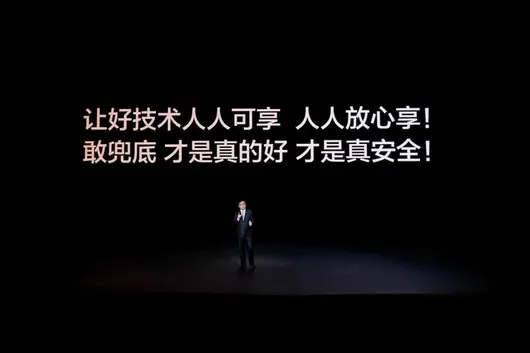
Wang Chuanfu personally announced BYD as City Pilot Safety Net Guarantee Service, his sentence "Dare to Underwrite, is True Safety" is what worth thinking.
Why "Underwrite" so important? Because in intelligent driving popularization today, most auto companies intelligent driving functions are "User Responsibility", system had accident, responsibility on driver. BYD's "Underwrite" means, in specific scenarios, if system failed to respond timely, manufacturer bear corresponding safety responsibility, users can in driving time no need to think whether turn on assist driving, instead get on car press "Intelligent Driving Paddle", user activity high, data model build accelerate, everyone dare use, BYD dare adjust data feedback to serve people, second virtuous cycle again establish.
Data won't lie: BYD this safety net launched after, function usage rate from 21% to over 90%.

Summary:
So BYD's "Ceiling" where? This if-no-if ceiling, BYD through tech R&D and strategy layout, already pushed up or "removed", this group data for BYD tell is like "the light boat has passed ten thousand mountains", and from Panda Speed see: BYD growth not eating NEV dividend, but NEV market eating BYD dividend.
If future every month BYD sales data all climbing, then BYD will from own dividend beneficiary, gradually become rule maker, behind BYD will face ceiling, only own production capacity and delivery capability, but from current situation see, BYD is running faster and faster.
© 2024 Bitauto.com. All Rights Reserved.
Bitauto (www.yiche.com and www.bitauto.com) is one of the most visited automotive websites in China. We provide detailed info on Chinese car brands available in your area. Please note that the information provided on this website is based on publicly available data and is for reference only. It may not be fully updated or accurate at all times.

Help us improve our website


