

HomeDogMY

Search History
Popular Searches
Dealer Login / Sign Up

In Malaysia's SUV market, many buyers compare Proton X70 and Chery Tiggo 7 Pro when choosing a car. These two cars are quite close in price and positioning. Today we will do a detailed comparison from multiple aspects to save you time on research.
Proton X70's OTR price in Malaysia is RM 106,800 - 122,300, with a total of 3 versions, including 1.5L Standard 2WD (RM 106,800), 1.5L Executive 2WD (RM 115,800), 1.5L Premium 2WD (RM 122,300), etc.
Chery Tiggo 7 Pro's OTR price in Malaysia is RM 123,750 - 123,750, with a total of 2 versions, including 1.6L Turbo Standard (RM 125,000), 1.6L Turbo Premium (RM 140,000), etc.
In terms of price, the starting price of Proton X70 is indeed RM 16,950 cheaper than Chery Tiggo 7 Pro. If your budget is limited, Proton's entry-level version can already meet daily needs. But note that the few thousand cheaper might have trade-offs on features, it depends on your specific needs.
Proton X70 is equipped with a 1.5L Turbo, horsepower 140 hp. Official fuel consumption 7.0 L/100km.
Chery Tiggo 7 Pro is equipped with a 1.5L Turbo, horsepower 140 hp. Official fuel consumption 7.0 L/100km.
Both cars use the same powertrain, the driving experience is basically the same. Fuel consumption is also similar, no need to fuss too much about this.
Proton X70's safety rating is 5★ (ASEAN NCAP), active safety system includes ADAS (ACC, AEB, LKA, LDA, BSM, RCTA).
Chery Tiggo 7 Pro's safety rating is TBD, active safety system includes Basic.
In terms of safety features, both cars have received good ratings. However, there are some differences in function between Proton X70's ADAS (ACC, AEB, LKA, LDA, BSM, RCTA) and Chery Tiggo 7 Pro's Basic. If you value active safety, you can compare the function lists of both.
Proton X70 warranty 5 years/150,000km, service interval every 10,000km or 6 months.
Chery Tiggo 7 Pro warranty 3 years/100,000km, service interval every 10,000km or 6 months.
Overall, Proton X70 and Chery Tiggo 7 Pro are both very good car models in the Malaysian market. Which one to choose depends mainly on your personal needs and budget. We suggest doing your homework, comparing quotes from several dealerships, and then test driving to make the final decision. Buying a car is a big matter, spending time doing research will never go wrong.

In 2026, China's intelligent automotive industry is undergoing a deep transformation from feature stacking to experience definition. The key benchmark for measuring its success lies in whether an interactive relationship beyond command input and with richer emotional temperature can be established between humans and vehicles. Whether it is human-machine interaction inside the cockpit or environmental communication outside the cockpit, the implementation of experience ultimately points to the same physical carrier: light.
When intelligent vehicles attempt to establish more natural and efficient communication between humans and machines, optoelectronic systems upgrade from traditional auxiliary components to core requirements that determine the upper limit of experience.
The direct projection of this change is reflected in two key points of two-way communication between humans and vehicles: one is the display interface where the vehicle conveys information to humans, and the other is the light-shadow projection interface where the vehicle expresses intent to the outside world. For the former, AR-HUD has moved from technical verification to mass production; for the latter, smart headlights have completed the extension from simple illumination to information projection and safety interaction.
Of course, under the current industry background, both application scenarios face the same underlying challenges: integration of optical systems, miniaturization, and automotive-grade reliability. This actually means that the logic of competition in in-vehicle optics has undergone a fundamental change—from comparing parameters of single devices to the integration capability contest of system-level optical solutions.
It is at this junction of industrial logic transition that Yipu Optoelectronics' recent strategic layout has taken the lead in providing a system-level implementation plan. This company, which started with freeform optics, not only completed the relocation of its headquarters within a few short months but also successively integrated Suzhou Longma Puxin and Jiangxi De Kai into its territory, consciously building a complete value chain covering optical design, core chips, optomechanical integration, and full-vehicle light-shadow interaction. Adopting the posture of a system integrator, it positions itself for a new round of industrial cycles.
Headquarters Relocation South: Anchoring New Industrial Coordinates for In-Vehicle Photoelectric
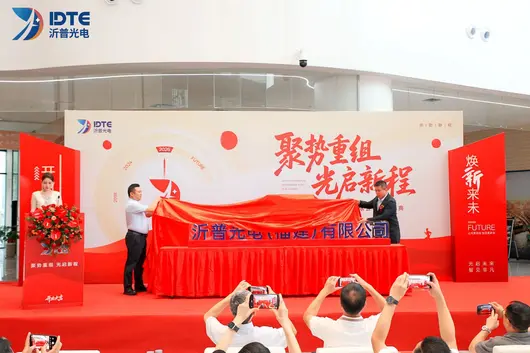
In December 2025, Yipu Optoelectronics completed its headquarters relocation. The new headquarters was established in the Nanxi High-tech Zone, Jinjiang, Fujian. Within the following months, Yipu Optoelectronics' R&D center and core production center were put into operation successively, and on July 28, the headquarters opening ceremony was officially held.

Image Source: Yipu Optoelectronics
For a national high-tech enterprise that was founded in 2018 (core technology accumulation can be traced back to the Tianjin University Micro-Nano Manufacturing Laboratory in 2005) and has deepened in Tianjin for many years, this headquarters relocation south was defined by Guo Yewu, Chairman of Yipu Optoelectronics (Fujian) Co., Ltd., as "a new strategic upgrade".
Currently, Yipu Optoelectronics has achieved complete technical accumulation in key fields such as freeform optical system design, ultra-precision optical component manufacturing and inspection, and optical performance measurement system integration. Moving such technical foundation from Tianjin to Jinjiang, Fujian, its strategic intent far exceeds spatial displacement at the geographical level, but is a strategic choice to re-anchor twenty years of technical accumulation at the industrial highland.

Image Source: Yipu Optoelectronics
The location value of Jinjiang lies in the superposition of multiple advantages.
Jinjiang not only has a complete electronic information and optoelectronic display industry cluster, but also pragmatic and efficient government services and the entrepreneurial spirit of "daring to fight and winning". Guo Yewu stated that Nanyi Xinchuang Port, as an important carrier of regional technological innovation, provides an ideal development platform for Yipu Optoelectronics.
After the headquarters settles in Jinjiang, it will undertake core R&D and operation management functions, forming a collaborative industrial matrix with overseas and domestic production bases and R&D, R&D sales centers located in Shenzhen, Fuyang, Tianjin, Lujiang, Wuhan, Wuxi, Pingxiang, Japan, Malaysia, etc., accelerating the group process of Yipu Optoelectronics. In addition, it is worth mentioning that as a famous hometown of overseas Chinese and a front line of opening up to the outside world, Fujian has natural policy and location advantages in going global, which also forms a high degree of strategic fit with Yipu Optoelectronics' globalization strategy being promoted.

Image Source: Gasgoo
Deeper considerations lie in the convenience of market supply.
Fujian is adjacent to the southern China automotive industry cluster and is the supply chain hinterland of many top new energy vehicle companies. Relocating the headquarters and core processing capabilities here, Yipu Optoelectronics has actually completed a "closer to the market, closer to innovation" strategic upgrade.
In the industrial context where the cycle of in-vehicle optical products is constantly compressed from R&D to mass production, this geographical embedding means faster customer response speed, tighter collaborative R&D rhythm, and lower logistics and communication costs. The overall innovation rhythm of the enterprise will also resonate more in frequency with the industry's iteration cycle.
Strategic Integration: Leap in System Capability by Connecting Points into Chains
If the headquarters relocation south solves the question of "where to compete", then the recent acquisition of Longma Puxin and De Kai better answers the core proposition of "what to compete with".
In May 2026, Yipu Optoelectronics announced the official launch of a strategic acquisition of Suzhou Longma Puxin Technology Co., Ltd. Longma Puxin was initiated by the Chinese Academy of Sciences and an international optics team, focusing on the R&D of MEMS display control chips, passive combiner chips, HUD optomechanics and micro-mirrors, etc. It has mature technology and product layouts in the fields of in-vehicle projection chips, optomechanical integration, and MEMS drive control.

Image Source: Yipu Optoelectronics
Longma Puxin's independently developed LBS (Laser Beam Scanning) MEMS laser scanning core technology has completed automotive-grade reliability and functional safety verification, marking that domestic MEMS optical scanning solutions have entered a new stage of in-vehicle mass production.
The strategic intent of this acquisition is very clear: control core chips upstream. LBS MEMS technology takes MEMS micro-mirrors as the core execution unit, combined with laser light sources and high-speed modulation algorithms, to achieve laser scanning imaging with small volume, low power consumption, no focusing, and high color gamut. Compared with traditional DLP and LCoS solutions, LBS MEMS has better shock resistance, temperature adaptability, and space utilization in harsh in-vehicle environments. For Yipu Optoelectronics, the MEMS chips and micro-mirror capabilities brought by Longma Puxin have enabled it to extend capabilities from optical components to core chips in the optoelectronic display field.
If acquiring Longma Puxin is "controlling upwards", then acquiring Jiangxi De Kai is "expanding downwards".
Recently, Yipu Optoelectronics officially announced the completion of the strategic acquisition of Jiangxi De Kai Auto Lighting Co., Ltd. De Kai has been deeply cultivating in automotive smart lighting for more than ten years, possessing the ability to independently develop full sets of vehicle lamp assemblies, mold development, and automated mass production delivery. Current customers cover more than ten mainstream automotive brands in China.
Yipu Optoelectronics had previously had product layouts in in-vehicle display such as HUD, in-vehicle projection, and out-vehicle projection headlights. The addition of De Kai has helped Yipu Optoelectronics achieve complete coverage in the field of full-vehicle headlights from cockpit display to external lighting, and the systematic competitiveness has undergone a qualitative improvement. As Guo Yewu stated, after this M&A, Yipu Optoelectronics became the only technology enterprise in China currently possessing full-link capabilities from display chips to display modules to display complete machines.
The synergies after the completion of the acquisition are worth deep analysis. Xu Feizhang, CEO of Yipu Optoelectronics (Fujian) Co., Ltd., introduced the actual value of this model to clients to Gasgoo: In the past, customers needed to communicate with multiple suppliers separately, and communication costs and management burdens were quite heavy. Now, Yipu Optoelectronics alone can complete the full-chain collaboration from chips to assemblies, and an internal communication meeting can coordinate the positioning and development of the entire product. This capability is not a simple capacity superposition, but directly responds to the dual demands of partners for delivery efficiency and cost control.
The rhythm of the two acquisitions was compact and the logic was clear — Longma Puxin solves the core chips and scanning technology of "seeing clearly", De Kai solves the out-vehicle light and shadow and mass production manufacturing of "lighting well". Superimposing on Yipu Optoelectronics' original freeform optical design and precision manufacturing capabilities, a full-stack in-vehicle optical capability system covering chips, optics, optomechanics, and full vehicles has already taken shape.
Lu Rui, President of Market Strategy of Yipu Optoelectronics (Fujian) Co., Ltd., further explained the unique value of this system from the perspective of competitive differentiation when interviewed by Gasgoo. After the merger and restructuring, from upstream chips to intermediate optical systems, to manufacturing and overall solutions, Yipu Optoelectronics has formed a complete differentiated layout. Many enterprises in the industry currently neither involve the chip layer nor sink to the bottom-layer optical manufacturing. In the case of missing both ends, even if single solutions can be provided, it is difficult to truly form comprehensive competitive advantages in the three dimensions of technology, processing, and cost. And the superposition of these capabilities is precisely where Yipu Optoelectronics occupies the initiative in the future industrial pattern.
In the past supply chain system, chips, optical devices, optomechanical systems, and full-vehicle applications belonged to suppliers at different levels, with gaps in technical connections and games of commercial interests between each other. When an enterprise can connect from upstream display chips to downstream full-vehicle light-shadow interaction, it gains capabilities extremely scarce in the existing supply system — defining products, optimizing costs, and accelerating iteration from a system-level perspective. This capability is becoming a key variable determining the upper limit of enterprises in the new era defined by experience vehicles.

Image Source: Yipu Optoelectronics
Redefining the Optical "Language" of Human-Vehicle Interaction
While continuously perfecting technical capabilities, Yipu Optoelectronics' understanding of in-vehicle optics is also deepening continuously. This deepening is not only reflected in the expansion of product lines but more in the systematic research and development of common industry problems and the forward-looking layout of future interaction forms.
From the perspective of industry trends, in-vehicle optics is currently at a key node where it transitions from optional configuration to core systems.
With the accelerated arrival of L3 autonomous driving, AR-HUD will provide more intelligent interaction, safety reliability and convenient entertainment scenario applications, and future market potential is expected to continue to be released. In the field of smart headlights, intelligent vehicle light technology such as million pixels has become a main product highlight on many domestic high-end new energy models. In the future, with the market penetration of this configuration, it will inevitably lead the acceleration of in-vehicle interaction and entertainment functions towards personalization and customizability. And in-vehicle projection is gradually becoming an important option for rear screens in mid-to-high-end models with advantages such as large screen format, multi-scenarios, and playability.
These trends all point to a core proposition: light is becoming the core interaction medium between cars and humans. In-vehicle light is expected to become a potential new growth curve for the automotive industry.
But the clarity of trends does not mean the path is smooth. Common problems facing the industry are still prominent: compatibility of safety and regulations, breakthroughs in technical barriers, balance of cost and performance, etc., are all realistic obstacles restricting the large-scale popularization of in-vehicle optics. Taking AR-HUD as an example, larger screen format, smaller volume, higher image quality are future development directions, but how to achieve these goals in limited in-vehicle space while meeting automotive-grade reliability requirements tests the system capabilities of every participant.
Of course, it is precisely in the face of these industry problems that Yipu Optoelectronics' full-stack capabilities highlight the value even more. Guo Yewu clearly pointed out that for people doing precision optics, there is no shortcut, only continuous innovation. "Cars are turning from original driving tools into a mobile home", Guo Yewu stated that after becoming a mobile home, vehicles need to provide more emotional value to guests. As a photoelectric display supplier, we need to continuously provide innovative products from display, sound, haptics and other aspects.
Yipu Optoelectronics is promoting a series of innovation directions. For example, on the car, Yipu Optoelectronics innovatively proposed ultra-short throw partition projection. While meeting user experience, it can also reduce volume and facilitate installation. Xu Feizhang demonstrated the underlying logic of this technology in the product exhibition hall — introducing the ultra-short throw display technology of laser TV into the car, not only achieving higher color gamut, brightness and resolution, but more importantly, the all-in-one design thoroughly solves the pain point of personnel walking and blocking the optical path in traditional projection solutions. Yipu Optoelectronics is also exploring another forward-looking application innovation — integrating LiDAR with digital smart headlights. Traditional LiDAR is installed on the car roof, not only is the shape abrupt, but it also faces safety hazards of inability to self-clean. Since headlights themselves possess mature self-cleaning functions, after embedding LiDAR into the headlight assembly, it can not only guarantee the all-weather reliability of the sensor but also significantly optimize the smoothness of the overall vehicle appearance.

Image Source: Yipu Optoelectronics
Using the latest technology and highest performance to meet the superior experience of terminal users on in-vehicle and out-vehicle display, as Guo Yewu said: "Only continuous innovation can move consumers and inject new vitality into this highly competitive industry."
Lu Rui supplemented Yipu Optoelectronics' differentiated thinking from the perspective of technical routes. In the past, Yipu Optoelectronics focused on optical component manufacturing, lens solutions and optomechanical system delivery, etc., more playing the role of a processing solution provider. With the completion of capabilities such as LBS MEMS chips, Yipu Optoelectronics has also become capable of outputting complete solutions such as micro-projection, ultra-short throw, and high-brightness direct projection in the consumer field, completing the positioning leap from a processing solution provider to a complete solution provider.
Behind this transformation is the re-upgrading of corporate value positioning, entering the higher-value system integration link, and possessing the ability to define product forms and interaction experiences.

Image Source: Yipu Optoelectronics
Summary:
Starting from freeform optics technology, to possessing full-link capabilities covering HUD, optical chips, headlights, etc., Yipu Optoelectronics has taken an evolutionary path from single-point technical breakthroughs to system capability construction. Behind it reflects not only the enterprise's keen grasp of optical technology generational substitution, but also a deep understanding of the underlying trend of the intelligent automotive industry moving towards experience definition.
The headquarters relocation south does not solve simple spatial displacement, but embeds R&D decisions, customer response, and supply chain collaboration into the industrial hinterland, making the enterprise's innovation rhythm and the industry's iteration cycle resonate more in frequency. The strategic integration of Longma Puxin and De Kai completes a complete optical ecology "puzzle", obtaining a capability combination extremely scarce in the existing in-vehicle optical supply system: from optical chips to optical components, from optomechanical systems to full-vehicle light-shadow interaction, all integrated into one, realizing independent and controllable core technologies, and building a unique industrial ecology advantage.
The current automotive industry has a consensus that the first half of intelligent vehicle competition revolves around "three-electric systems", competing in range and acceleration; the contest in the second half anchors on experience and interaction, and all experiences — whether navigation guidance projected by HUD, safety light carpets spread by headlights, or flowing ambient light shadows inside the cockpit — must ultimately be conveyed through light.
Whoever can achieve full-stack control from source to terminal in the light chain will possess the capability foundation to define the next generation of human-vehicle interaction. The "Chip-Optics-Optomechanics-Headlights" full-chain system constructed by Yipu Optoelectronics is precisely building the underlying base for this new era of photoelectric-defined experience that is arriving.
When the light chain extends from components to scenarios, and connects from inside the cabin to outside the cabin, what an enterprise can define is not only product parameters but also a completely new industry trend.

Dalam pasaran SUV di Malaysia, ramai pembeli akan membandingkan Proton X70 dan Mazda CX-3 ketika memilih kereta. Kedua-dua kenderaan ini agak hampir dari segi harga dan penstratan, hari ini kita akan buat perbandingan terperinci dari pelbagai aspek untuk membantu anda menjimatkan masa membuat penyelidikan.
Proton X70 harga OTR di Malaysia ialah RM 106,800 - 122,300, terdapat 3 versi, termasuk 1.5L Standard 2WD (RM 106,800), 1.5L Executive 2WD (RM 115,800), 1.5L Premium 2WD (RM 122,300) dan lain-lain.
Mazda CX-3 harga OTR di Malaysia ialah RM 126,159 - 139,159, terdapat 2 versi, termasuk 2023 2.0L High (RM 139,159), 2023 2.0L Plus (RM 126,159) dan lain-lain.
Dari segi harga, harga permulaan Proton X70 memang lebih murah RM 19,359 berbanding Mazda CX-3. Jika bajet anda terhad, versi permulaan Proton sudah boleh memenuhi keperluan harian. Namun, perhatikan juga, beberapa ribu ringgit yang lebih murah itu mungkin melibatkan kompromi pada pelengkapan, bergantung pada keperluan anda.

Proton X70 dilengkapi enjin 1.5L Turbo, kuasa 140 hp. Penggunaan minyak rasmi 7.0 L/100km.
Mazda CX-3 dilengkapi enjin 1.5L Turbo, kuasa 140 hp. Penggunaan minyak rasmi 7.0 L/100km.
Kedua-dua kereta menggunakan sistem kuasa yang sama, pengalaman memandu harian pada dasarnya tiada perbezaan. Dari segi penggunaan minyak juga hampir sama, tidak perlu terlalu bimbang tentang hal ini.

Penilaian keselamatan Proton X70 ialah 5★ (ASEAN NCAP), sistem keselamatan aktif termasuk ADAS (ACC, AEB, LKA, LDA, BSM, RCTA).
Penilaian keselamatan Mazda CX-3 ialah 5★ (ASEAN NCAP), sistem keselamatan aktif termasuk i-Activsense.
Penilaian keselamatan kedua-dua kereta adalah sama, dalam kelas ini pelengkapan keselamatan dianggap cukup lengkap. Keselamatan kereta baru sekarang tidaklah buruk, tidak perlu terlalu bimbang tentang hal ini.

Proton X70 menggunakan sistem pemacu FWD.
Mazda CX-3 menggunakan sistem pemacu FWD.
Sistem pemacu kedua-dua kereta adalah sama, iaitu FWD, pengalaman memandu harian tidak akan terlalu berbeza.
Proton X70 dan Mazda CX-3 kedua-duanya pilihan popular di pasaran Malaysia, sesuai untuk kegunaan keluarga, perjalanan harian. Jika anda lebih mengutamakan reputasi jenama dan nilai jual semula, boleh terutamanya pilih yang mempunyai reputasi lebih baik; jika anda lebih mementingkan nilai harga dan pelengkapan, maka pilih model yang lebih banyak kelengkapan. Akhir sekali, disarankan untuk mencuba kedua-dua model, pengalaman langsung adalah yang paling penting.
Secara keseluruhan, Proton X70 dan Mazda CX-3 adalah model kereta yang sangat baik di pasaran Malaysia. Memilih mana satu, intinya bergantung pada keperluan dan bajet peribadi anda. Kami cadangkan anda menyiapkan kajian, membandingkan harga di beberapa kedai kereta, kemudian buat test drive untuk membuat keputusan akhir. Membeli kereta adalah perkara besar, meluangkan masa untuk kajian tidak akan salah.


In Malaysia's SUV market, many buyers compare Proton X50 and Mazda CX-3 when choosing a car. These two cars are quite close in price and positioning. Today we will make a detailed comparison from multiple aspects to help you save time on research.
Proton X50 OTR price in Malaysia is RM 89,800 - 113,300, with a total of 4 versions, including 1.5T Executive (RM 89,800), 1.5T Premium (RM 101,800), 1.5T Flagship (RM 113,300) etc.
Mazda CX-3 OTR price in Malaysia is RM 126,159 - 139,159, with a total of 2 versions, including 2023 2.0L High (RM 139,159), 2023 2.0L Plus (RM 126,159) etc.
From the price perspective, Proton X50 starting price is indeed RM 36,359 cheaper than Mazda CX-3. If your budget is limited, Proton entry-level version already meets daily needs. But also note, the few thousand saving might involve trade-offs in features, specifically depends on your needs.

Proton X50 safety rating is 5★ (ASEAN NCAP), active safety systems include ADAS (ACC, AEB, LKA, LDA, BSM, RCTA).
Mazda CX-3 safety rating is 5★ (ASEAN NCAP), active safety systems include i-Activsense.
Both cars have the same safety rating, safety features in this class are quite complete. New cars nowadays are generally safe, no need to worry too much about this.

Proton X50 body length 4400 mm, trunk 400 L.
Mazda CX-3 body length 4500 mm, trunk 450 L.
In terms of space, Mazda CX-3 body is 100 mm longer than Proton X50, seating space has more advantage. However Proton X50 is more flexible for parking in the city, both have trade-offs.

Proton X50 and Mazda CX-3 are both mainstream choices in the Malaysian market, suitable for family use, daily commute. If you value brand reputation and resale value more, prioritize the one with better reputation; if you care more about value for money and features, choose the one with richer configuration. Finally suggest test driving both, firsthand experience is most important.
Overall, Proton X50 and Mazda CX-3 are both very good models in the Malaysian market. Which one to choose depends on your personal needs and budget. Suggest doing research, compare quotes from multiple dealers, then test drive to make final decision. Buying a car is a big matter, spending time doing research will definitely not be wrong.


喺馬來西亞嘅 SUV 市場,好多買家喺揀車嘅時候都會拿 Proton X70 同 Honda CR-V 嚟比較。呢兩款車喺價位同定位上都幾接近,而家我哋就從多個方面做一个詳細嘅比較,幫你節省做功課嘅時間。
Proton X70 喺馬來西亞嘅 OTR 售價係 RM 106,800 - 122,300,一共有 3 個版本,包括 1.5L Standard 2WD(RM 106,800)、1.5L Executive 2WD(RM 115,800)、1.5L Premium 2WD(RM 122,300) 等。
Honda CR-V 喺馬來西亞嘅 OTR 售價係 RM 178,200 - 195,900,一共有 4 個版本,包括 2026 e:HEV 2.0L 2WD RS(RM 195,900)、2026 1.5T 4WD V(RM 181,900)、2026 e:HEV 2.0L 2WD E(RM 178,200) 等。
從價錢嚟睇,Proton X70 嘅起步價確實比 Honda CR-V 平咗 RM 71,400。如果你預算有限,Proton 嘅入門版已經可以滿足日常需求。但都要注意,平嗰幾千蚊,可能喺配備上有取捨,具體要看你嘅需求。

Proton X70 嘅安全評級係 5★ (ASEAN NCAP),主動安全系統包括 ADAS (ACC, AEB, LKA, LDA, BSM, RCTA)。
Honda CR-V 嘅安全評級係 5★ (ASEAN NCAP),主動安全系統包括 Honda SENSING (ACC, CMBS, LKAS, RDM)。
兩款車嘅安全評級一樣,喺呢個級別入面安全配備都算俾得好齊全。依家嘅新車安全性都不差,唔使太擔心呢一點。

Proton X70 車身長 4400 mm,行李廂 400 L。
Honda CR-V 車身長 4500 mm,行李廂 450 L。
空間方面,Honda CR-V 嘅車身比 Proton X70 長咗 100 mm,乘坐空間更有優勢。不過 Proton X70 喺城市入面泊車會靈活啲,各有取捨。

Proton X70 同 Honda CR-V 都係馬來西亞市場嘅主流選擇,適合家庭使用、日常通勤。如果你更重視品牌口碑同二手價,可以優先考慮口碑更好嗰一款;如果你更在意性價比同配備,那就揀配置更豐富嗰款。最後都係建議兩款都去試車,親身體驗先係最重要嘅。
總括嚟講,Proton X70 同 Honda CR-V 都係馬來西亞市場好唔錯嘅車型。揀邊一輛,關鍵都係要看你嘅個人需求同預算。建議大家做好功課,多比較幾間車行嘅報價,再去試車做最終決定。買車係件大事,花少少時間做功課絕對唔會錯。


喺馬來西亞嘅 SUV 市場,好多買家喺揀車嘅時候都會拿 Perodua Ativa 同 Proton X90 嚟比較。呢兩部車喺價位同定位上都幾近嘅,今日我哋就由多個方面做個詳細嘅比較,幫你節省咗做功課嘅時間。
Perodua Ativa 喺馬來西亞嘅 OTR 售價係 RM 62,500 - 73,400,一共有 3 個版本,包括 1.0L Turbo X(RM 62,500)、1.0L Turbo H(RM 67,300)、1.0L Turbo AV(RM 73,400) 等。
Proton X90 喺馬來西亞嘅 OTR 售價係 RM 106,800 - 122,800,一共有 4 個版本,包括 2026 1.5T Prime X(RM 122,800)、2026 1.5T Prime(RM 116,800)、2026 1.5T Lite(RM 106,800) 等。
由價錢睇,Perodua Ativa 嘅起步價確實比 Proton X90 平咗 RM 44,300。如果你預算有限,Perodua 嘅入門版已經可以滿足日常需要。但亦要注意,平嗰幾千蚊,可能喺配備方面有取捨,具體要睇你嘅需要。

Perodua Ativa 配備 1.5L 4-cyl,馬力 105 hp。官方油耗 6.0 L/100km。
Proton X90 配備 1.5L Turbo,馬力 140 hp。官方油耗 7.0 L/100km。
動力方面,Proton X90 嘅 1.5L Turbo 比 Perodua Ativa 嘅 1.5L 4-cyl 多咗 35 匹馬力。不過日常喺市區行,兩部車嘅動力都夠用,唔會覺得夠唔到力。
Perodua Ativa 車身長 4400 mm,行李廂 400 L。
Proton X90 車身長 4400 mm,行李廂 400 L。
兩部車嘅尺寸幾乎一樣,車內空間分別唔大。呢級別嘅車,日常使用完全夠用。

Perodua Ativa 保固 5 年/150,000km,保養間隔 每 10,000km 或 6 個月。
Proton X90 保固 5 年/150,000km,保養間隔 每 10,000km 或 6 個月。
兩部車嘅保固條件一樣,呢方面唔使糾結。實際保養成本仲要睇品牌嘅服務網絡同零件價格,建議去車友群問下真實車主嘅經驗。

總體嚟講,Perodua Ativa 同 Proton X90 都係馬來西亞市場好唔錯嘅車型。揀邊一部,關鍵仲係要睇你嘅個人需要同預算。建議大家做好功課,多比較幾間車行嘅報價,再去試駕先至做最終決定。買車係件大事,花少少時間做功課絕對唔會錯。

喺馬來西亞嘅 SUV 市場,好多買家喺揀車嗰陣都會拿 Mazda CX-30 同 Mitsubishi Xforce 做比較。呢兩款車喺價位同定位上都幾接近,今日我哋就從多個方面做一個詳細嘅比較,幫你節省做功課嘅時間。
Mazda CX-30 喺馬來西亞嘅 OTR 售價係 RM 122,409 - 146,409,一共 4 個型號,包括 2025 2.0L High+ Premium(RM 146,409)、2025 2.0L High+(RM 138,409)、2025 2.0L High(RM 130,409) 等。
Mitsubishi Xforce 喺馬來西亞嘅 OTR 售價係 RM 109,930 - 119,930,一共 2 個型號,包括 2026 1.5L Ultimate(RM 119,930)、2026 1.5L Urban(RM 109,930) 等。
從價錢嚟睇,Mitsubishi Xforce 嘅起步價比 Mazda CX-30 平咗 RM 12,479。老實講,喺呢個價位段,幾千蚊嘅差距其實唔算大,關鍵都係睇整體嘅性價比同長期使用成本。

Mazda CX-30 搭載 1.5L Turbo,馬力 140 hp。官方油耗 7.0 L/100km。
Mitsubishi Xforce 搭載 1.5L Turbo,馬力 140 hp。官方油耗 7.0 L/100km。
兩款車用嘅係同一套動力系統,日常開起嚟嘅感覺基本無咩分別。油耗方面都差不多,唔使太糾結呢一點。

Mazda CX-30 保修 5 年/150,000km,保養間隔 每 10,000km 或 6 個月。
Mitsubishi Xforce 保修 3 年/100,000km,保養間隔 每 10,000km 或 6 個月。
Mazda CX-30 同 Mitsubishi Xforce 都係馬來西亞市場嘅主流選擇,適合家庭使用、日常通勤。如果你更睇重品牌口碑同二手價,可以優先考慮口碑更好嗰款;如果你更在意性價比同配備,就揀配備更豐富嗰款。最終都係建議兩款都去試駕,親身感受先係最緊要嘅。

總體嚟講,Mazda CX-30 同 Mitsubishi Xforce 都係馬來西亞市場幾唔錯嘅車型。揀邊架,關鍵都係要睇你嘅個人需求同預算。建議大家做好功課,多比較幾間車行嘅報價,先去試駕做最終決定。買車係件大事,花少少時間做功課絕對唔會錯。


在马来西亚的汽车市场,很多买家在选车的时候都会拿 Honda Civic Type R 和 Volkswagen Golf GTI 来做比较。今天我们从多个方面做一个详细的对比,帮你省下做功课的时间。


Honda Civic Type R 在马来西亚的 OTR 售价是 RM 399,900 - 399,900,一共有 3 个版本,包括 2023 2.0T Standard(RM 399,900)、OTR NI(RM 399,900)、Volvo ES90(RM 339,888) 等。
Volkswagen Golf GTI 在马来西亚的 OTR 售价是 RM 256,962 - 256,962,一共有 3 个版本,包括 2025 2.0T Sepang Edition(RM 262,990)、2025 2.0T Standard(RM 256,962)、DCT(RM 219,800) 等。
从价钱来看,Volkswagen Golf GTI 的起步价比 Honda Civic Type R 便宜了 RM 142,938。老实讲,在这个价位段,几千块的差距其实不算大,关键还是看整体的性价比和长期使用成本。

Honda Civic Type R 的安全评级是 5★ (ASEAN NCAP),主动安全系统包括 Brand ADAS。
Volkswagen Golf GTI 的安全评级是 5★ (Euro NCAP),主动安全系统包括 IQ.Drive。
安全配备方面,两款车都拿到了不错的评级。不过 Honda Civic Type R 的 Brand ADAS 和 Volkswagen Golf GTI 的 IQ.Drive 在功能上有些差异,如果你比较看重主动安全的话,可以仔细对比一下两者的功能列表。

Honda Civic Type R 车身长 4450 mm,后备箱 470 L。
Volkswagen Golf GTI 车身长 4400 mm,后备箱 400 L。
空间方面,Honda Civic Type R 的车身比 Volkswagen Golf GTI 长了 50 mm,车内乘坐空间会稍微宽裕一些,尤其是后座腿部空间。如果你经常载家人或者需要放婴儿车,大一点的车身确实更实用。

Honda Civic Type R 保修 5年/无限制里程,保养间隔 每10,000km或6个月。
Volkswagen Golf GTI 保修 3年/100,000km,保养间隔 每10,000km或6个月。

总的来说,Honda Civic Type R 和 Volkswagen Golf GTI 都是马来西亚市场很不错的车型。选择哪一辆,关键还是要看你的个人需求和预算。建议大家做好功课,多比较几间车行的报价,再去试驾做最终决定。买车是件大事,花点时间做功课绝对不会错。

© 2024 Bitauto.com. All Rights Reserved.
Bitauto (www.yiche.com and www.bitauto.com) is one of the most visited automotive websites in China. We provide detailed info on Chinese car brands available in your area. Please note that the information provided on this website is based on publicly available data and is for reference only. It may not be fully updated or accurate at all times.

Help us improve our website


