

HomeDomestic Cars

Search History
Popular Searches
Dealer Login / Sign Up


Recently, impressive data emerged from the Central Asian automotive market. The latest sales report released by the Kazakhstan Auto Alliance shows that new car sales in the local area reached 21,860 units in June 2026. Chinese brand sales totaled 12,276 units, commanding a market share as high as 56.2%, officially taking hold of half of the local car market.
The car market overall showed steady growth in July, with the market share of Chinese brands falling back to 48.3%. It continues to firmly hold the first tier, completely rewriting the pattern where Korean brands had long dominated the local market.
In the Kazakhstan market, Changan performed the most outstandingly, with 2,565 units sold in June and 2,456 units in July, ranking fourth in local brand sales for two consecutive months. SUV models such as CS35 Max and CS55 Plus became household bestsellers locally.
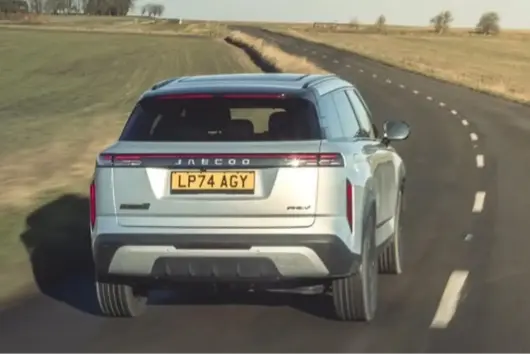
Chery and Geely followed closely, establishing their footing with the Tiggo series and Galaxy series products respectively. Jetour, JAC, and Haval also secured a niche with high cost-performance household SUVs. New energy brands like BYD and Li Auto are laying out plans simultaneously, gradually opening up the electrification market space.
Multiple automakers have launched localized assembly cooperation. Li Auto reached a strategic partnership with a leading local automotive enterprise, achieving localized production at the Kostanay plant to further reduce tariff costs and consolidate market advantages.
It is not just the Central Asian market; Chinese cars have achieved strong breakthroughs in multiple regional markets globally. The Russian market quickly recovered after a short-term adjustment. From January to July 2026, China exported 542,900 cars to Russia, a year-on-year increase of 136%, returning to being the number one destination for Chinese car exports.
Currently, the five major Chinese brands Chery, Great Wall, Geely, Changan, and GAC firmly rank in the top ten Russian sales, with an overall market share exceeding 45%. The Great Wall Tula factory and Geely Belarus base continue stable mass production, effectively countering local policy barriers and filling the market gaps left after the exit of European, American, Japanese, and Korean automotive enterprises.
The Southeast Asian market has become the core position for Chinese new energy vehicles. In Thailand's pure electric car market, the market share of Chinese brands exceeds 86%. Models such as BYD, Neta, and MG occupy the top of the local new energy sales list. Taxis and official vehicles are purchasing Chinese new energy vehicles on a large scale.

The Brazilian market also performed brilliantly. From January to July, China exported 427,700 cars to Brazil, a year-on-year increase of 144%. New energy models accounted for more than 70%. The BYD Dolphin won the local new energy sales champion. Chinese brands as a whole occupy more than 77% of the Brazilian pure electric market, gradually breaking through the monopoly barriers of traditional joint venture brands.
In Australia, Oceania, Chinese brands ended the 28-year market monopoly of Japanese brands, raising the overall market share to 25%, becoming the mainstream choice for local families purchasing cars. In Mexico's new energy market, the share of Chinese electric vehicles is close to 90%, with orders continuously in high demand.
From fuel vehicles to new energy models, from developing countries to developed markets, Chinese cars rely on complete three-electric technology, high cost-performance products, and mature after-sales systems. They are gradually getting rid of the low-price label and winning the recognition of global consumers with hard-core product power.
With the overseas mode shifting from whole vehicle export to localized factory construction and localized operations, Chinese cars are shifting from simple product output to the global output of technology, production capacity, and service systems.
Against the industry background of monthly exports breaking one million vehicles for two consecutive months, the pattern of overseas markets blooming in multiple points not only provides stable growth momentum for the domestic car market but also continuously reshapes the competitive landscape of the century-old global automotive industry.

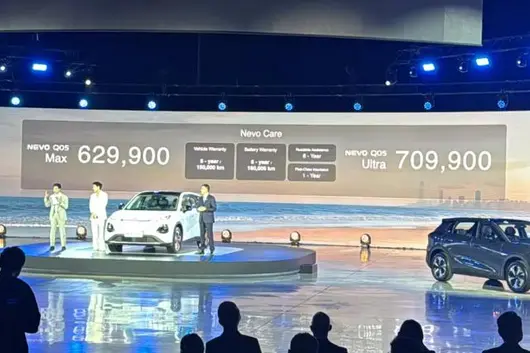
Recently, news that Changan Qiyuan Q05 officially launched in Thailand has sparked considerable discussion in the automotive community. In the past, people might have said, "BYD already did this, what is so new about that?" But bear in mind, this is not just a new car release overseas; it is a significant move in the global layout for domestic new energy vehicles. After all, Changan Qiyuan represents a state-owned manufacturer breaking through fierce competition in China's compact pure-electric SUV market to target Southeast Asia, a region with massive growth potential for global new energy. The Q05 demonstrates not just product strength, but also the shift of intense domestic new energy market competition to the overseas arena.

Let's first look at the market positioning and pricing strategy that concerns everyone most. In the Thai market, Changan Qiyuan Q05 is named "NEVO Q05", with two versions launched: Max and Ultra, priced at 629,900 to 709,900 Thai Baht respectively, roughly equivalent to 130,000 to 147,000 RMB. However, hold on. Regarding pricing strategy, the new car also adopted the domestic "promotional price" scheme. If purchased before June 30, limited-time promotional prices apply, corresponding to 599,900 to 679,900 Thai Baht, reducing it to 120,000 to 137,000 Yuan. Thai local consumers haven't seen joint-venture brands employ such tactics, they might easily get swayed.

It is worth noting that this pricing for the NEVO Q05 has clear targeting in the local Thai new energy vehicle market, directly competing with rivals like the BYD Yuan UP (ATTO 2). Compared to the domestic version, the pricing does see a certain increase, mainly due to cost factors such as tariffs, logistics, localization adaptation, and the establishment of service systems. However, from a product strategy perspective, Changan implements a dual-brand layout in Thailand: Deepal targets young, tech-savvy consumers, while Qiyuan focuses more on family users prioritizing practicality and value. This differentiated complementarity helps cover a broader consumer base within a limited price range, marking a relatively prudent move.

At the core hardware level, the NEVO Q05 comes standard with CATL battery cells and is equipped with Changan's self-developed "Golden Bell" 2.0 battery technology, providing a solid foundation for battery safety and stability. Tailored for usage scenarios in Thailand, the pure electric range version can effectively cover daily commuting and inter-city travel needs. Notably, regarding charging efficiency, the vehicle features 3C ultra-fast charging technology; under ideal conditions, the battery can charge from 30% to 80% in just about 15 minutes. This partially alleviates charging anxiety for pure electric models during long-distance travel, as charging infrastructure in the Southeast Asian market is still being improved, making fast charging capability particularly crucial.


Intelligent configurations are also a key chip for NEVO Q05 in competing in overseas markets. The new car is equipped with automotive-grade cockpit chips paired with ample operating memory, performing well in multi-task processing and system fluidity. Additionally, targeting Southeast Asia's high-temperature and high-humidity climate characteristics, engineers conducted targeted tuning on the battery thermal management system and increased the battery pack's waterproof rating to ensure range stability during the tropical rainy season and under congested road conditions. Such localized adaptations in details often resonate more with local consumers than simply stacking specifications.


Additionally, as a pure electric SUV targeted at family users, the NEVO Q05 also performs well in space utilization. Its wheelbase reaches 2735mm, providing a foundation for passenger space inside the car. The trunk has a standard capacity of 540 liters, expandable to 1380 liters with the rear seats folded down, meeting the needs for daily family hauling, outdoor camping, and other diversified scenarios. For the interior, referencing the domestic version, it features a wraparound cockpit design paired with a central control screen and LCD instrument cluster, supporting mainstream smartphone connectivity functions, balancing technology and practicality.
Conclusion
It is worth mentioning that Changan Automobile has established a new energy vehicle manufacturing base in Rayong Province, Thailand, fully pushing for the localized production of the Q05. While localized manufacturing helps reduce production costs and avoid certain trade barriers, entering a brand new overseas market means brand awareness, the density of after-sales service networks, and long-term accumulated user reputation are all realistic challenges the NEVO Q05 must face. With the subsequent deployment of Changan New Energy in more markets such as Indonesia, Europe, and others, the actual effectiveness of its global strategy still requires further observation through long-term market testing.

Written by | AUTO Xinqiu
Author | AUTO Xinqiu Team
In the vast family of Chinese automobiles, there is a "non-typical" leading enterprise.
It has ranked first in exports among Chinese brand passenger cars for 23 consecutive years, with almost half of its annual sales sold abroad, recognized as the No. 1 exporter.
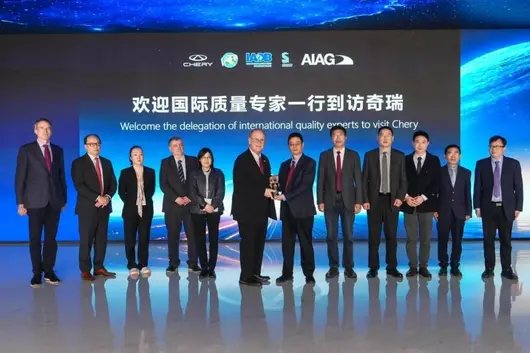
You might not know, what is the status of it in the hearts of overseas consumers? On April 23 this year, the International Automotive Quality Expert Group, consisting of the International Automotive Task Force (IATF), International Automotive Oversight Bureau (IAOB), Automotive Industry Action Group (AIAG), and Society of Motor Manufacturers and Traders (SMMT), followed it, personally visited and presented the "Automotive Industry Peak Award: Quality Innovation Figure" to the chairman of this enterprise.

Not to mention, winning the ICQCC Quality Gold Medal, regarded as the "Olympic" grade of international quality, for three consecutive times, proved its popularity in overseas markets has already "far surpassed" domestic peers.
If the above does not give you a sense, let me tell you, the recently in-the-spotlight Land Rover Freelander's engine is manufactured by it.
Congratulations, you answered correctly! Yes, what I am referring to is Chery Automobile.
So, why is Chery so radiant? What did Chairman Yin Tongyue do right?
"Technology Fanatic" Dual-Drive: R&D Obsession, Honest Collaboration
Yin Tongyue graduated from Hefei University of Technology, known as the "Huangpu Military Academy" of Anhui's automotive industry. After graduating in automotive manufacturing major in 1984, Yin Tongyue directly joined FAW Hongqi Sedan Plant, working as an automotive process engineer. Due to his diligence and outstanding performance, he was quickly identified as core talent and sent to Germany and the US for further study.
After returning to China, Yin Tongyue served as Director of the Final Assembly Workshop and Chief of the Logistics Section at FAW-Volkswagen. He was also awarded the "FAW Top Ten Outstanding Youth" title, with a bright future ahead.

However, a visit and study tour organized by Wuhu City completely changed Yin Tongyue's life trajectory.
At that time, Wuhu City was planning to build an Auto City, and also received strong support from the provincial government. Yin Tongyue, who had already shown his锋芒, was talent scarce in Wuhu City. Thus, the visit group invited him to return home to develop and lead the local auto project. What truly moved Yin Tongyue was a sentence from the visit group: Always working for foreigners is not worthwhile. It was this sentence that ignited his "Dream of Domestic Brand" deep in his heart.
So, he quit and handled the procedures, carrying luggage from Changchun, the Automobile Capital of China, to Wuhu which seemed unrelated to automobiles.
Heaven will assign great responsibility to this person. Yin Tongyue deeply felt the heavy responsibility, only able to exert all efforts and give whole heart.
Chery started from the "Heart of the Automobile", the engine. To ensure this project would be won, Yin Tongyue even made a hardcore commitment: If it failed, I would jump into the Yangtze River.
Possessing this persistence and resilience, he recruited 288 cadres and over 1,000 employees from FAW. It was also with this persistence and resilience that, facing a foreign production line assembly team shirking and slacking, they loudly shouted: "Get back to your home, let us do it ourselves!"
Thus, after 500 days of hard fighting, on April 27, 1999, Chery's first engine successfully rolled off the line, ignited successfully in one try. 7 months later, the first Chery sedan - Fengyun 000001 successfully rolled off the line.

From then on, under Yin Tongyue's leadership, Chery hit models emerged one after another. In 2003, Chery launched the generation mythic car Chery QQ, with annual sales revenue exceeding 8 billion RMB.
How popular was Chery QQ back then? Describing it as a "Phenomenal National Mythic Car" was no exaggeration, because it was the first true "Hit" among Chinese independent brands. Before Chery QQ ceased production in 2014, cumulative sales reached 1.40-1.54 million units, exported to over 100 countries and regions, with cumulative exports exceeding 500,000 units.

In 2013, under a new system and process, Chery created another classic model - Tiggo 5. To strictly control quality, before listing, Yin Tongyue even invited a Japanese expert for acceptance check. This Japanese expert scratched the inside of the car door handle with his fingernail and found a mark, saying: "This is unacceptable."
So without a word, they remade it. During the second inspection, the Japanese expert said the material formula needed re-adjustment and re-certification.
Thus, Yin Tongyue led the team to repeatedly tear down and start over. When Tiggo 5 passed rigorous verification, it also meant Chery bid farewell to the primary stage of "Assembling Parts to Build Cars", and car manufacturing technology and systems truly approached international standards.
Taking engine thermal efficiency as an example, this is a hard indicator measuring core capability of fuel vehicles. Currently, mainstream engine thermal efficiencies mostly range between 38%-45%, while Chery Kunpeng Tiqing Engine achieved 48%. According to Chery internal data, cumulative global installations of its Kunpeng Power Engine Upgraded Version has exceeded 3.1 million units. So, does Made in China fuel engine work? Currently, only Chery dares to pat their chest and say "Yes".
Nowadays, Chery engine thermal efficiency has stabilized at 44.5%, which is top-tier in the industry. With this unique skill, Chery won the favor of two major international luxury car benchmarks, Jaguar and Land Rover. Both parties jointly established a new company, and the new energy vehicle brand "Freelander" directly equipped with Chery's 1.5-Liter Range Extender.
The cooperation with Huawei is a strong alliance. Yin Tongyue has a sentence often mentioned: "When opinions differ, listen to Huawei; when opinions align, listen to Chery." This is not surface-level flattery nor deliberate humility, but a truest respect for technology and the most pragmatic posture of an entrepreneur with an engineer background.
In fact, since Zhijie S7/R7, both sides have been satisfied and mutually appreciative. Why did HarmonyOS Intelligent Mobility select Zhijie V9 as its first MPV? It is precisely due to comprehensive consideration of Chery's manufacturing hard power, a need for deep integration of "Technology Definition + Top Manufacturing".

Firstly, in capacity and quality control aspects, Chery specially created a Super Factory and Brand New Welding Line for Zhijie V9, investing over 20 billion RMB in special funds, capable of delivering this large size MPV and models with high craft requirements with quality and quantity. Secondly, in supply chain cost control, Chery possesses a perfect supply chain system, capable of effectively balancing the high BOM cost brought by Huawei Advanced Smart Driving (such as 896-line LiDAR), supporting V9 being fixed in the 389,800 RMB starting price range, possessing strong market impact.
Global Layout: Not "Sold Out", but "Grown Out"
As early as 1999, Yin Tongyue determined one thing: Chinese automobiles must go out, but not in the way of dumping at cheap prices, but in the way of long-termism.
What was the result? Chery has held the No. 1 position in Chinese brand passenger car exports for 23 consecutive years. In 2025, exports reached 1.344 million units, nearly half of annual sales, cumulative exports exceeding 5.85 million units. More rarely, for Chery exported new energy vehicles, for every 5 sold, 1 is sold to Europe with the strictest regulations, meaning Chery Automobiles' quality is globally top-tier.
Yin Tongyue summarized Chery's globalization philosophy with one sentence: "In somewhere, For somewhere, Be somewhere — Wherever, For Wherever, Become Part of Local." Considering deep integration into local market as the core goal of car exporting.
This is not a slogan. Chery has 10 overseas factories globally. Like Russia, Brazil, Egypt, etc. KD factories achieved "Parts Export, Local Assembly", which both avoids tariffs and drives local employment, deeply welcomed and supported by local governments.
For the extreme cold of Russia and Middle East, Chery strengthened car AC and engine cooling functions; for Brazil and Latin America market, Chery developed flexible fuel engines capable of adding ethanol and gasoline; for Europe market, entering with OMODA, JAECOO New Brands, fully meeting Euro NCAP 5-Star Safety Standard; for Southeast Asia market, Chery developed RHD models using local factories.

Besides, Chery developed multiple modular platforms like T1X, M1X, Mars Architecture, letting products quickly adapt to different countries' regulations, road conditions, and climate.
In April this year, Chery established its first Overseas Regional Operation Center in Barcelona, Spain, and simultaneously launched Spain Research Institute, main focus is Electrification, Smart Mobility and Sustainable Development, with the goal to develop "Cars with More Local Flavor".
In the overseas market, Chery did not consider itself as a "Foreign Manufacturer", but also voluntarily undertook corporate social responsibility for locals. For example, cooperated with World Conservation Union (IUCN), conducted a Mediterranean Posidonia Seagrass Bed Restoration Project, to protect local "Lungs of the Ocean"; Chery also organized local owners in Malaysia, conducted Afforestation Public Welfare Activities, doing all for protecting local ecological environment.

When many companies still "Chase Trends, Make Quick Money", Chery has already built supply chain and layout R&D network overseas for years. This persistence has now finally turned in a shining report card.
Conclusion: Not a Stroke of Genius, but 23 Years of "Hard Work"
What Yin Tongyue did right was never any one "Stroke of Genius", but determined 23 years ago that "Chinese Automobiles Must Go Out", then using Engineer's Rigor, Merchant's Patience, Long-termist's Steadfastness, brick by brick built the "Made in China" reputation into Global Market.
When domestic car companies still race price and configuration, Chery has already completed the transformation from "Cheap Alternative" to "Quality Choice" in overseas market - this is the fundamental reason and confidence of the International Quality Expert Team "Chasing Awards": Not because of what you said, but because in the global market, using over 20 years time, you truly achieved what.
Objectively speaking, Chery Helmsman Yin Tongyue is not only the Top Domestic Car Exporter, but also the Founder and Torchbearer Promoting Chinese Cars to the World, this honor will be written into Chinese Auto Industry Chronicles.
Hope Chery Automobiles Advance Further!
*Images in this article sourced from Internet
Focusing on Smart Cars, Assisting Key Decisions.

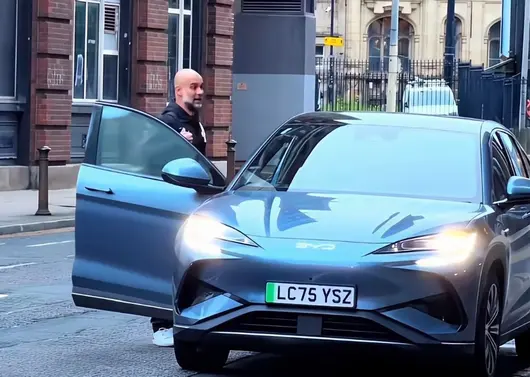
On May 24, Manchester City played against Aston Villa at home, which was Guardiola's final match managing Man City, also a farewell full of ritual. No matter how reluctant fans were, the 10-year Blue Moon Dynasty finally reached the time to say goodbye.
In this farewell atmosphere, Coach Guardiola drove away in that blue Sea Lion 07, showing unprecedented presence in front of billions of fans globally.

Many people saw this scene and were shocked, some wiped their eyes, finding it really was BYD. Another part sighed, changed person, changed scene, how did this BYD suddenly become high-end. Some others dug out information, this car sells for £44,990 in UK, truly a high-end car in name and reality.
Actually while Guardiola left driving BYD, the overseas road of domestic cars was surging. Why say this? Let Kung Fu Auto take everyone to have a look.
(1) Break Through Plateau, Domestic Car Exports Continue Significant Growth
On May 25, Cui Dongshu, Secretary-General of China Passenger Car Association, announced the latest export information.
This year January-April, domestic car exports reached 3.26 million, up 51% compared to same period in 2025. Among them April export volume was 940,000, nearly 1 million single month, up 52% year-on-year. This data is too exaggerated. It is known that Chinese car exports experienced many years of million-level plateau, breaking through only in 2021, yet now nearly 1 million vehicles exported in single month.

More specifically, Brazil surpassed Russia as China's largest car export country. April single-month exports reached 121,766 vehicles. Russia ranked second at 77,524 vehicles. Additionally, Belgium, Australia, UK exports were all around 50,000.
Key point domestic car exports highlight "selling everything". April BEV share was 31%, PHEV 18%, HEV 7%, traditional fuel cars only 34%. This also shows one point, NEVs not only popular domestically, also competitive in international market. Meanwhile, domestic fuel cars going international, still have competitiveness.

Also another trend, previously domestic car key markets concentrated on Russia and Middle East. Initially thought this Middle East tension would greatly affect exports. Unexpectedly reality situation was opposite, Western Europe (UK, Belgium, Germany, Italy) and South/Central America (Brazil) markets became core increases, domestic car export share to developed countries increased significantly.
Whether Middle East geopolitical impact or EU/US trade barriers, cannot say no impact on domestic cars, but none touched root. Core is one point, domestic car product strength truly strong.

BEV, PHEV, HEV three routes all landed, adapting to different regional oil quality, road conditions, recharging conditions. Global adaptability far exceeds overseas competitors. Ability to enter German, UK, Belgium and other European developed markets in bulk, means vehicles in safety, energy consumption, durability, regulations fully benchmark or even exceed local mainstream models. Hard power recognized.
(2) Pure Electric Growth Slows, Is it an Open Strategy?
Cui Dongshu gave NEV export situation. This year January-April, Brazil was undoubtedly pure electric largest market, sold 222,000 NEVs vast majority were BEV. Belgium as European gateway, 130,000 NEVs almost all pure electric.
UK, Australia, Thailand, UAE these markets also focus on BEV, PHEV gradually penetrating.

In this way, pure electric market actually divided into three blocks. Europe is high-end pure electric main battlefield, requiring highest quality, intelligence, safety. Even Guardiola drives BYD. Brazil, Australia mid-high-end pure electric combined with some economy pure electric. Southeast Asia started economy pure electric gradual volume release.
Mainly due to supply chain maturity, same spec BEVs generally 30%–50% cheaper than Europe/Korea/Japan BEVs. Especially some A00/A0 Class, like Wuling Hongguang MINI, BYD Seagull etc., in emerging markets very competitive, account for over half BEV exports. If subsequent Geely Star Wish can also go out, believe will also have good market performance.

Speaking Zeekr plus Galaxy combination, high-end pure electric plus economy family car, really perfectly suits overseas market. No wonder Geely export growth so fast. January-April 2026, Geely NEV exports year-on-year increased by full 624.5%, growth rate industry first, just because product too adaptable.
Of course, some people mention, entering 2026, pure electric export growth slowed, while PHEV share reached 18%, already exceeded half of pure electric. This mainly due to recharging infrastructure differences. Many countries charging piles insufficient, more prefer PHEV, HEV, drag pure electric penetration rate.

Domestic also experienced this stage. On one hand infrastructure must follow up gradually. On other hand ideas "follow up". Why did domestic range extenders experience several years big growth then shrink? Because people who bought range extenders early finally realized using electricity too "addictive", subsequent car replacement only considers pure electric. Expected overseas market also this sequence.
(3) Tech, Brand Dual Output, Becoming Steadier and Steadier
In 2023, Chinese car export volume reached 4.91 million, surpassed Japan for first time, became world's largest car export country. These two years gap always widening. This year expected to reach 10 million scale, already far ahead.

Also many people worry, domestic cars will repeat domestic motorcycle fate. Early 2000s, domestic fuel motorcycles in Southeast Asia market share once reached 80%+. Result few years time dropped to 1%. Now domestic cars also this driving. Exports seem unstoppable. Will it also on some day directly collapse.
This actually completely need not worry. Now domestic cars, walk tech, brand dual output high-end road. Why Guardiola chose Sea Lion 07, because dual motor 4.2s 0-100, Blade Battery, Cell to Body car body. Although in domestic only 200,000 level car, but product strength can benchmark Porsche Taycan, Tesla Model S.

Even Coach himself frankly, "After test driving in Manchester for few weeks, performance, comfort and tech completely moved me". Getting recognition from football "Tactical Master", equivalent to having authority endorsement. Domestic cars in UK pure electric market share, also long ago surpassed American, German, Japanese cars, topped first. In Europe, Japan often won professional awards.
Before relied on price war to enter Southeast Asia, Middle East markets, image low-end. Nowadays use tech strength directly benchmark luxury brands, no longer just rely on low price compromise. In recent years, domestic cars start to brand implant into Europeans daily focus football, racing scenes. Also started production in Brazil, Thailand, Hungary etc., not to grab one time, but truly root locally.

Nowadays domestic cars, long ago no longer hide behind curtains OEM, but with independent brands face global consumers, start truly realize from "Made in China" to "Created in China". NEV track overtake on change of track, let Chinese car first time in global mainstream market own discourse power.
(4) Kung Fu Commentary
When Guardiola drove blue BYD waving goodbye to Blue Moon field, this vehicle sailing to world, also became vivid footnote for Chinese cars setting sail overseas.
From previous low price volume, image limited, to now rely on hardcore tech stand firm EU US high-end markets, multiple power routes comprehensive bloom domestic cars, overseas map is continuously expanding, completely jumped out past development predicament.
Once looked up at full street overseas luxury cars, now looking at world full of Chinese sedans. Push forward five years ago, who could think today?
© 2024 Bitauto.com. All Rights Reserved.
Bitauto (www.yiche.com and www.bitauto.com) is one of the most visited automotive websites in China. We provide detailed info on Chinese car brands available in your area. Please note that the information provided on this website is based on publicly available data and is for reference only. It may not be fully updated or accurate at all times.

Help us improve our website


