

HomeEU

Search History
Popular Searches
Dealer Login / Sign Up

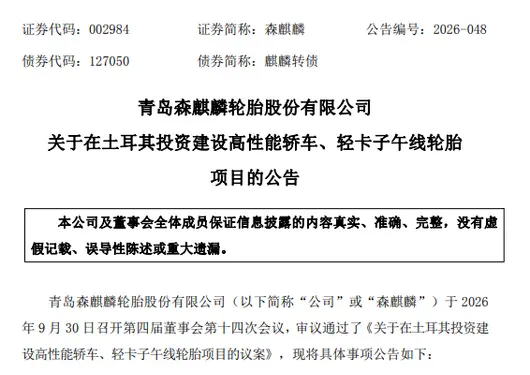
On October 8, Qingdao Sentury Tire Co., Ltd. (002984.SZ) issued an announcement to partner with top Turkish tire distribution enterprise TATKO Group, investing $272.82 million (equivalent to 1.824 billion RMB) to build a high-performance passenger and light truck radial tire project with an annual output of 7 million tires. This is Sentury's third overseas intelligent manufacturing base after Thailand and Morocco, and the first Chinese tire enterprise to officially launch operations in Turkey, adding a critical move to its "833Plus" global strategy.

Stable Accounts, Promising Returns
The project is held 90.1% by Sentury and its wholly-owned subsidiary (approx. $246 million), with TATKO holding 9.9% (approx. $27.01 million). Funded entirely by internal resources, the low debt structure ensures controllable financial risk. Construction period is 18 months. After reaching full capacity, normal operations are expected to generate annual revenue of $204.62 million, net profit of $42.11 million, with a net profit margin reaching 20.58%. The break-even point is only 39.75% — operating at 40% capacity is enough to break even. Combined with Turkey's 2025 new investment incentive policy (equipment imports qualify for duty and VAT exemptions, 60% income tax reduction), actual returns still have room for upward revision.
Especially notable are the efficiency indicators: For a factory producing 7 million tires annually, total workforce is only about 400 people, meaning 17,500 tires per person annually. Intelligent central control, production execution, warehousing logistics, inspection scanning, and dispatch warning systems run through the entire process — this intelligent manufacturing template, validated twice in Thailand and Morocco, will be fully transferred to Turkey this time.

A "Zero-Tariff Ticket" to Enter the EU
The consideration of selecting Turkey strikes at industry pain points. In July this year, the EU's anti-dumping final ruling on Chinese passenger and light truck tires took effect, with tax rates ranging from 4.3% to 45.3%, Sentury subject to a 24.4% rate. Chinese tire exports to Europe saw a significant decline. However, according to the EU-Turkey Industrial Goods Customs Union, industrial manufactured goods taxed in Turkey can be exempt from tariffs and enter the EU directly with an A.TR certificate. Interestingly, the surrogate country used for EU anti-dumping calculations is exactly Turkey — producing in Turkey equals exchanging domestic manufacturing status for EU market access.
At the same time, Turkey is a major European complete vehicle base: 2025 car production is about 1.42 million units, export rate about 74.5%, with automakers such as Ford, Toyota, Hyundai, Renault gathered. Chery and BYD have also announced building factories. There are about 1,100 parts supporting enterprises. The new factory can achieve a closed loop for both original equipment and replacement tire markets.

9.9% Equity, Nationwide Shelves Secured
Partner TATKO was founded in 1927, is one of Turkey's largest independent multi-brand tire distributors, network covers 81 provinces nationwide, 850 sales points, and holds cross-border export channels facing the Balkans and Central Asia. Products can reach target markets directly via its distribution system from the day they leave the line. The cold start problem of "who to sell production capacity to" is readily resolved.

Tripod Stance, Global Synergy
With the Turkey base landing, Sentury will form a pattern where Thailand serves North America and Asia-Pacific, Morocco radiates Europe and Africa, and Turkey connects the EU and Central Asia, effectively dispersing trade policy risks. Referencing Morocco base's trajectory of turning profit within two years of production and obtaining Renault and Stellantis supplier qualifications, the Turkey project outlook is promising.
From Thailand to Morocco to Turkey, Sentury uses the strategy of "holding control + equity for channels + location positioning" to write another benchmark sample for Chinese tires moving from "product going overseas" to "overseas manufacturing + local service".

European Tyre Association (Tyres Europe) released sales data for member replacement tyres in the second quarter of 2026 and the first half of the year, as well as tyre import data for January to May. Association Secretary General Adam McCarthy stated: "Replacement tyre demand in Europe strengthened in the second quarter of 2026, especially for truck and passenger car tyres."
Overall Recovery of the EU Market
Passenger car tyre salesincreased by 3% compared to the second quarter of 2025, with cumulative sales in the first half of the year growing by 2%.
Among them,all-season tyres led the market again, with quarterly sales increasing by 15%, and 9% growth in the first half; summer tyre sales dropped by 2%, continuously losing market share to all-season tyres; winter tyre quarterly sales decreased slightly by 1%, and cumulative sales in the first half were still 5% lower than the same period last year.

Mileage driven decreased this quarter, reflecting a significant rise in average fuel prices and weakened consumer confidence due to the ongoing conflict in the Middle East. After a sharp decline in import volume in the first quarter, imports rebounded this quarter.
Truck and passenger car tyre sales grew by 13% in the second quarter, with cumulative growth of 7% in the first half. Despite geopolitical issues and high fuel and energy costs, freight activities and business confidence remained resilient. Truck tyre imports rose significantly in both the first and second quarters.

Agricultural tyre sales declined again, with a quarterly drop of 7%. However, this decline slowed significantly compared to the first quarter.Motorcycle and scooter tyre sales increased by 1% in the quarter, with cumulative growth of 4% in the first half.
China's Share of EU PCLT Imports Dropped Significantly
On July 7, 2026, the European Commission concluded its anti-dumping investigation into imports of Chinese PCLT tyres (passenger car and light truck tyres), determining that Chinese tyres entered the EU at dump prices and caused material injury to the EU tyre industry.
The European Commission imposed final duties of 4.3% to 45.3% on the products concerned, effective July 8, 2026, for a period of five years, with no retroactive effect.
Due to concerns about tariff retroactivity, importers hoarded inventory during the first three quarters of 2025 (when China accounted for 70% of EU imports).As inventory was drawn down, Chinese tyre imports in the first quarter of 2026 fell by 57%, with share dropping to 42%.Import volumes remained flat in April-May, with a cumulative share of 51% for January to May.

Import volumes from other sources increased by approximately 40% in both quarters, but failed to fully offset the decline from China. From January to May 2026, the EU 27 countries + UK region'sPCLT tyre import volume fell 6% year-on-year. Among them:
Chinese imports dropped by 24%, with share falling to 58% (72% in the same period of 2025), returning roughly to 2019 levels.

ASEAN suppliers filled the gap: share increased from 7.4% to almost 19.9%.Thailand led the growth, with imports rising from 2 million units to nearly 6 million, and Vietnam imports growing more than doubling to over 3 million units.
Cambodia increased from a near-zero base in 2025 to 2.3 million units, becoming a significant supply source; Indonesian import volumes also grew.Many tyres from ASEAN sources are produced in factories held by Chinese enterprises. The combined share of South Korea and Japan remained stable at 14.6%.
The UK was not bound by this tariff regime, and its share of tyres imported from China remained unchanged (approximately 75% in 2026), which boosted the overall share for the "EU 27 countries + UK" region.
TBR Tyre Imports, ASEAN Leads
In TBR (truck and bus) tyre imports,South Korea, Japan, and China lost out to Thailand and Vietnam.
In the first five months of 2026, TBR tyre imports from non-European markets into the EU 27 countries and UKincreased by nearly 27%, with growth rates similar in the first quarter and April-May.

Thailand and Vietnam currently account for nearly 61% of total imports, higher than the combined 57% in the same period last year, and far above the less than 30% in 2019. Within five months,imports from Thailand grew by 33%, and imports from Vietnam grew by 38%.
AlthoughChinese import volume increased by 9%, its share dropped from 19% in 2025 and 2019 to 16%, weakening its position.
Imports from India tripled,becoming the fourth-largest source, with a share of 6%. This overtook Egypt and South Korea – both of which saw a decline in import volume and a significant shrinkage in market share.

The concentration of European truck and passenger car tyre trade supplyis increasingly shifting towards the ASEAN region, a trend that is quite evident. Since 2019, this shift has largely come at the expense of more traditional tyre sources such as South Korea and Japan.
Overall, the latest data paints an industry picture being reshaped by trade policy: moderate recovery on the demand side, while the supply side experiences a drastic structural reshuffle – China's PCLT tyre market share in Europe dropped sharply from 72% to 58%, and ASEAN suppliers achieved a share leap that would have taken a decade in just three years.
Behind this reshuffle lies the "indirect rescue strategy" completed by Chinese tyre enterprises through overseas capacity layout. This is both a test of the globalization capability of the Chinese tyre industry and a report card on supply chain resilience.
© 2024 Bitauto.com. All Rights Reserved.
Bitauto (www.yiche.com and www.bitauto.com) is one of the most visited automotive websites in China. We provide detailed info on Chinese car brands available in your area. Please note that the information provided on this website is based on publicly available data and is for reference only. It may not be fully updated or accurate at all times.

Help us improve our website


