

HomeExports

Search History
Popular Searches
Dealer Login / Sign Up

In the first half of 2026, the overseas export rankings of domestic automakers witnessed profound changes. If excluding Russia and Iran, these two special markets with geopolitical dividends, BYD's overseas sales have already surpassed Chery. This data also reflects the completely different globalization layout strategies of the two automakers.

BYD Chairman and President Wang Chuanfu
Customs export data for the first half shows Chery's overall exports at 944,000 units, among which the Russia and Iran markets contributed a combined 283,000 units. Excluding these two markets, Chery's sales in global marketized regions totaled 661,000 units. Out of strategic considerations, BYD actively abandoned the Russia and Iran markets. On one hand, the geopolitical situation in these two areas is complex, operational stability is very poor, currency fluctuations and sanctions could bring operational risks at any time; more critically, to concentrate all resources on deepening the European mainstream market, avoiding chain reactions in Western public opinion caused by the layout in Russia and Iran which could affect the European layout, BYD chose to strategically exit these two regions. All of BYD's 789,400 unit exports came from fully marketized regions such as Europe, Southeast Asia, Australia, Latin America, etc., and the total amount is already significantly leading Chery after excluding the dividend markets.

For many years, Chery relied on the market dividends of the Russian-speaking region and Iran, long staying at the first place in Chinese car exports. After Western European and American automakers actively withdrew, a huge vacuum appeared in the local fuel vehicle market, and Chery took stable sales through this. However, such markets are greatly affected by geopolitical situations, stability is insufficient, and do not have reference value for the global market. BYD actively gave up short-term dividends and persisted in deepening mainstream mature economies, making the growth more solid.

The European market has become BYD's most important growth engine. In the first half of 2026, BYD new registrations in Europe reached 162,400 units, compared to 70,500 units in the same period last year, with a year-on-year increase of up to 136%, achieving over doubling growth. Breaking it down, DM-i plug-in hybrid models were the largest incremental growth, surging 260% year-on-year, skillfully avoiding the pressure brought by the EU pure electric anti-subsidy measures; pure electric models climbed steadily, rising 78% year-on-year. Germany, Italy, Spain and other core Western European countries all achieved substantial growth, with no weak markets.
BYD's ability to continue rising relies on a complete system layout. Factories in Thailand and Brazil are continuously ramping up, and the Hungarian production base is about to go into production in the fourth quarter, which can avoid EU tariffs and further amplify the advantage in Europe. The independent Ro-Ro fleet is continuously expanding, thoroughly breaking free from the limitations of ocean shipping capacity, laying the foundation for continuous exports. Chery lacks overseas production bases, capacity is already close to the ceiling, superimposed with the Russia-Iran dividend markets showing top growth, subsequent growth will gradually slow down.

Based on the current growth rhythm, even if Russia and Iran sales are fully counted, BYD's total export volume at the end of this year has a high probability of surpassing Chery and taking the number one spot in annual Chinese car exports.
Short-term geopolitical dividends can support the rankings for a while, but cannot support long-term globalization. Looking only at mainstream markets with free competition, BYD has already surpassed, which also means that Chinese automakers going global have officially entered a new stage relying on product power to layout globally.


In 2021, Chinese automotive exports reached $34.5 billion. Five years later, in the first half of 2026 alone, this figure reached $91.8 billion, approaching the hundred-billion-dollar threshold.
From 34.5 billion to $91.8 billion in just half a year, the Chinese automotive industry has completed in five years what many nations accomplished over decades.
Automotive Exports Reshape China's Export DNA
Data from the General Administration of Customs shows that from January to June 2026, China's total merchandise export volume was $2.1258 trillion, a year-on-year increase of 17%. Among them, complete vehicle exports reached $91.8 billion, a significant year-on-year increase of 54%; the monthly export volume in June alone was $18.2 billion, with a year-on-year growth rate rising to 70%.

Source: Huaban Network
In terms of volume, China's automotive achievements remain eye-catching: Statistics from the China Association of Automobile Manufacturers show that the first half saw automotive exports of 5.096 million units, a year-on-year increase of 65.3%. The half-year export volume broke the 5 million unit threshold for the first time in history. June's single-month export volume was 1.037 million units, a year-on-year increase of 75.1%, breaking the 1 million unit mark for a single month for the first time.
Overall export growth was 17%, while automotive export growth was 54%—behind the nearly three-fold "scissors difference" is a profound shift in China's export engine. Cui Dongshu, Secretary-General of the China Passenger Car Association, summarized this change as: "Automotive exports have performed extremely well in recent years, rising from $34.5 billion in 2021 to $117.4 billion in 2024, forming a trend of explosive growth." The full year of 2025 reached $142.4 billion. And in just the first half of 2026, $91.8 billion has been reached, making the annual breakthrough of $150 billion inevitable.

Source: Huaban Network
What truly reshapes the export landscape is not just the automotive category. Customs data shows that the first half saw lithium battery exports of $48.7 billion, a year-on-year increase of 43%; solar cell exports of $32.9 billion, a year-on-year increase of 24%. The "New Three Items" combined exports increased by 51.6% year-on-year to $118.35 billion. Among the three, electric vehicles had the highest growth rate, with cumulative exports of $52.1 billion in the first half, an increase of 75.1% year-on-year. Relying on the first-mover advantage of new energy and intelligent innovation capabilities, Chinese automobiles have not only achieved a leap in export scale but, through deep integration with artificial intelligence, have become an important force driving global automotive R&D and design innovation.
From clothing and home appliances to automobiles, lithium batteries, and solar cells, China's export "main lineup" is being redefined. And automobiles are undoubtedly the absolute core of this new lineup.
Who Is Driving This "Rush"?
The numbers showing growth in both volume and value are only the first layer of the narrative. What is truly worth asking is: Where does this growth momentum come from?
The answer lies within the explosion of new energy vehicles.
Data from the China Association of Automobile Manufacturers shows that new energy vehicle exports reached 2.355 million units in the first half, a 1.2-fold increase year-on-year, accounting for over 46% of total automotive exports. In June alone, new energy vehicle exports were 523,000 units, a 1.6-fold increase year-on-year. Chen Shihua, Deputy Secretary-General of the China Association of Automobile Manufacturers, stated at the monthly information release that automotive exports in the first half were "better than expected and formed a stable support".
Specifically, the passenger car segment exports in June reached $14.5 billion, a year-on-year increase of 84%, representing a 658% increase compared to the same period in 2021. Among these, new energy vehicles are the "main battle horse" pulling the passenger car export rush. New energy vehicle exports in the first half reached 2.355 million units, a 1.2-fold increase year-on-year, accounting for over 46% of total automotive exports. China's new energy vehicle industry chain, from mineral processing and battery manufacturing to complete vehicle integration, has formed the world's most complete and cost-competitive closed loop. If past Chinese automotive exports relied on cost-performance ratio, now it is about technological generation gap.
Many professionals judge thus: Chinese automotive exports are ushering in a critical leap from "scale expansion" to "value export", shifting from the past focus on cost-performance ratio to the trend of technological generation gap. China's new energy vehicle three-electric systems and intelligent supply chains possess stronger product competitiveness overseas.

Source: Geely Automobile
The differentiated pattern of the export market further confirms this trend. From January to May 2026, Brazil surpassed Russia to become China's largest export market with passenger car exports of 372,000 units, a year-on-year increase of 178.7%; Russia followed with 351,000 units, a year-on-year increase of 139.8%.
The two countries combined account for more than 40% of the total top ten in Chinese passenger car exports. Markets such as the UK, Belgium, Italy, and Australia also maintained rapid growth. Analysis by Gasgoo Auto Research Institute pointed out that the European market is "blooming everywhere, and if Russia is included, Europe accounts for over half of Chinese passenger car exports".
In terms of new energy, from January to May 2026, among the top five destinations for Chinese new energy passenger car exports, Brazil ranked first with 283,000 units, followed by Belgium and the UK. New energy exports in Italy and Germany surged by 365.3% and 211.2% year-on-year respectively—Chinese new energy vehicles have successfully entered the hinterland of traditional automotive powerhouse nations.
Meanwhile, the global map of Chinese automotive exports is also undergoing reconstruction. The Latin American market shows a bipolar differentiation—Brazil saw a surge in sales driven by pre-purchases due to expectations of tariff hikes in July; while Mexico saw exports decline by 40% year-on-year due to tariff hikes early in the year and tighter North American trade policies. Markets such as the UAE in the Middle East also entered an adjustment period, down 32.6% year-on-year. This differentiation indicates to some extent that Chinese automotive exports have moved from "indiscriminate" extensive expansion into a new stage of refined operations.

Source: Chery Automobile
Changes at the enterprise level are also worth noting. Data from the China Passenger Car Association shows that among the top ten exporting car companies in the first half, Chery Automobile led with 931,500 units, a year-on-year increase of 70.9%; BYD followed with 769,300 units, a year-on-year increase of 73.6%. The two combined accounted for nearly 40% of the top ten total. Geely Automobile exported 472,500 units in the first half, a year-on-year increase of 158.3%; SAIC Passenger Car 404,200 units; Great Wall Motor 256,000 units; Tesla China 229,000 units.
More worth examining is the export ratio indicator. Chery's exports accounted for 74.3% of its total sales—meaning over 70% of this company's cars were sold overseas; BYD's overseas sales ratio exceeded 40%; Great Wall Motor's export ratio also reached 50%. The ratio of automotive exports to domestic sales in the first half rose to 37%, while the same period last year was only 19%. "Going global" has changed from an "elective course" for individual enterprises to a "compulsory course" for the entire industry, and the overseas market is moving from "icing on the cake" to "half of the business".
Undercurrents and Solutions Beneath the Splendid View
High-growth numbers are indeed exciting, but the structural contradictions hidden beneath the data that cannot be avoided are also worth noting.
Among them, the most prominent is the "ice and fire" situation between complete vehicles and components. Complete vehicle exports in the first half reached $91.8 billion, a year-on-year increase of 54%; component exports were $51.3 billion, a year-on-year increase of only 7%. The "scissors difference" is obvious.
Chen Jingjing, Secretary-General of the Automotive Branch of China Council for the Promotion of International Trade in Machinery and Electronic Products, pointed out in an interview with the media that "the gathering place of automotive component exports is basically traditional automotive manufacturing powerhouse countries, represented by the USA and the EU, where measures to restrict exports to China are being continuously implemented". This forms a stark contrast with complete vehicle exports "basically not going to the USA".
Chen Jingjing further warned that Chinese automotive exports "have left the stage of pure trade driving, and future must shift to localized and systematic deep cultivation". She specifically pointed out that domestic enterprises going global generally have the shortcoming of "emphasizing sales and neglecting after-sales". "Short-term volume boosting will only overdraw the brand. After-sales, spare parts, user repurchase, and local reputation are the core lifeline for long-term deep cultivation in overseas markets." Cui Dongshu's judgment was more direct, stating "must follow the development of independent complete vehicle enterprises".
While the high growth of complete vehicle exports is gratifying, if components lag behind for a long time, the "autonomous and controllable" nature of Chinese automotive exports will face the risk of hollowing out.
Additionally, the continuous escalation of trade barriers is another practical pressure. Starting from October 2024, the EU levied final countervailing duties on Chinese pure electric vehicles for a period of five years, adding an extra tax burden of 7.8% to 35.3% on top of a 10% basic tariff. BYD, Geely, and SAIC were separately subjected to tax rates of 17%, 18.8%, and 35.3%. In June 2026, the European Commission planned to expand the scope of countervailing duties to plug-in hybrid electric vehicles. Xinhua Finance reported that the new rules may refer to pure electric standards, and the maximum comprehensive tax rate can also exceed 45%.
Non-tariff barriers are also upgrading. The EU plans to launch the "Supply Chain Diversification Instrument" and the "Public Procurement Act" in September 2026, requiring enterprises in sensitive industries to establish diversified supply channels in key fields, setting a limit of 30% to 40% on the procurement ratio for single suppliers.
At the same time, Brazil has unified the tariff on imported electric vehicles to 35% starting from July 1st. Thailand implemented a "capacity commitment mechanism", requiring car companies to exchange export volume for localization production indicators. Tariffs and non-tariff barriers are converging and strengthening.
Facing the increasingly high walls, Chinese car companies' answer is not to "go around", but to "dig in"—from "trade export" to "industry export".
For example, a factory of a domestic new energy complete vehicle enterprise in Brazil is the most typical sample. The factory welcomed its 100,000th new energy vehicle off the line in July. It is reported that the factory's first phase plans for an annual capacity of 150,000 to 200,000 units, with a long-term goal to expand to over 500,000 units, and plans to increase the localization procurement rate to 50% by early 2027.

Source: Chery Automobile
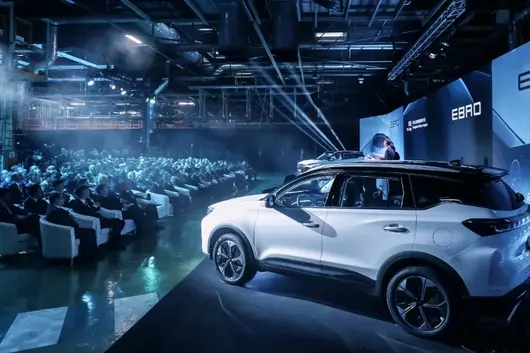
In Europe, Chery's layout is also of landmark significance. In June 2026, Chery and the Ebro Automobile Group started a new M1 production line at a joint factory operating in the Barcelona Free Trade Zone. The production line is 696 meters long, with 97 workstations, and a single vehicle production cycle of about 75 minutes. Rafael Ruiz, President of the Ebro Automobile Group, stated that the company chose Chinese enterprises as technical partners, intending to "introduce new technologies and industrial experience in the automotive field into Spain and convert them into local industrial capabilities and employment opportunities".
From product exports to the localization of capacity, brand, and supply chains, full-chain localization is becoming an inevitable path for Chinese automotive exports from the "first half" to the "second half". This trend is summarized by the industry as "ecosystem export". Under the drive of new energy and intelligent technology advantages, the form of Chinese automotive exports is changing: complete vehicle enterprises take the lead in laying out overseas capacity, supply chain enterprises follow suit, and overseas warehouses and after-sales service networks for components are also being perfected simultaneously.
Product export is just the first step. Full localization of capacity, brand, and supply chain is the key to determining whether Chinese automobiles can truly take root overseas.
Based on the export scale of 5.096 million units in the first half, breaking 10 million units for the year is inevitable. According to international professional agencies, Chinese automotive export volume in 2026 will increase by 41% year-on-year to 10 million units, becoming the first country in the world to export 10 million vehicles, equivalent to about 2.5 times the export volume of Japanese automobiles.
Conclusion
Looking back at 2021, Chinese automotive exports were less than $35 billion, merely an unremarkable footnote in the international trade landscape. Five years later, just half a year has approached the hundred-billion-dollar level—$91.8 billion. Behind this is a systematic explosion of decades of accumulation in Chinese manufacturing, and a historical window for reshuffling the global industrial landscape.
But beneath the halo of numbers, structural concerns are also clearly visible. The "gap" between components and complete vehicles, the comprehensive convergence of trade barriers, and the real test of localization capabilities—each is a threshold that cannot be bypassed. From "trade export" to "industry export", from "scale expansion" to "value deep cultivation", this road has just been paved, but is far from flat.
$91.8 billion is not only a report card but also an entry ticket. For Chinese automobiles to truly go from "big" to "strong", the decisive chapter is yet to come.

The pace of the Chinese automotive industry going global has been faster than anyone anticipated.
On July 9, the China Association of Automobile Manufacturers revealed H1 data: In June alone, Chinese auto exports reached 1.037 million units, a 75.1% year-on-year increase, achieving single-month exports over 1 million for the first time; from January to June, cumulative exports hit 5.096 million units, a 65.3% year-on-year increase, and semi-annual exports broke through 5 million units for the first time.
The full-year export target of 7.4 million units set at the beginning of the year now appears too conservative. Based on current growth rates, achieving 10 million units in full-year exports has become a high-probability event. However, beyond the breakthrough in sales figures, the structural changes behind them are worth more attention. Domestic car sales for the first half of the year were only 9.921 million units, a 21.1% year-on-year decrease, while exports accounted for nearly 40% of passenger car production.

In this magnificent wave of going global, which companies are leading the pack? Which models are selling the best? Which markets are the main drivers for growth? Where is the next trend?
Overview of Company Exports
With the continuous surge in the scale of going global, the overseas layout of domestic automakers has differentiated into clear tiers, with the top tier forming a pattern of "one dominant leader and multiple strong contenders".
Chery Group sat firmly in the top spot with a H1 export figure of 943,800 units, up 71.5% year-on-year. Notably, Chery's exports accounted for 69.5% of its total sales, and for three consecutive months from April to June, overseas sales share exceeded 70%. June single-month overseas sales reached an all-time high of 191,000 units. For every car sold domestically, Chery sold nearly three overseas, showing that exports have become Chery's absolute primary growth pole.

Following closely, BYD delivered a H1 export performance of 789,000 units, up 71% year-on-year, with June single-month exports reaching 170,900 units alone. Especially in the new energy export niche, BYD's advantage is more obvious. In the first half of the year, new energy exports reached 769,300 units, with a market share as high as 34.5%. In other words, for every three exported new energy vehicles, nearly one was a BYD.
Geely Automobile was the most eye-catching dark horse in terms of growth rate: Exporting 474,200 units in the first half of the year, up 158% year-on-year, with a growth rate leading among top automakers; June overseas sales broke 100,000 units for the first time, reaching 102,900 units. In terms of new energy exports, Geely's increase was even more stunning, with H1 new energy exports reaching 275,400 units, surging 601.4% year-on-year.
SAIC, relying on its well-perfect multi-brand globalization matrix, also remains firmly in the first tier. Overseas wholesale sales in the first half of the year reached 735,000 units. Its MG brand has cultivated the European market for many years and has ranked first in Chinese brand sales in Europe for 11 consecutive years. Great Wall Motor has steadily progressed overseas pacing, with H1 exports of 291,400 units, up 47.4% year-on-year, and the overseas market maintained stable expansion.

From the perspective of niche sectors, the competition landscape of new energy exports reflects the strength of each company more. In the top 10 list of new energy export manufacturers in the first half of the year, BYD firmly stayed in the first place, with Chery and Geely in second and third place, corresponding new energy export volumes of 290,300 units and 275,400 units respectively. Following them were Tesla China, SAIC Passenger Car, Leapmotor, Dongfeng, SAIC-GM-Wuling, Changan, and XPeng. Among them, Leapmotor's overseas breakthrough was particularly eye-catching. H1 overseas sales neared 100,000 units, exceeding its own total overseas sales for all of 2025 in just half a year.
Another worth mentioning is that in May 2026, across 31 European markets, BYD, SAIC, Geely, Chery, and Leapmotor, these five Chinese automakers sold a total of 138,400 new cars, up 65% year-on-year. Total sales for the first time exceeded the sum of six Japanese automakers such as Toyota and Nissan. The market share of Chinese brands locally jumped from 5.6% in May of the previous year to 10.7%. This was the first time Chinese automakers hit it out head-on against Japanese rivals in Europe, the world's third-largest automotive market.
Model Breakthrough and Market Map
The success or failure of going global ultimately depends on market acceptance. Focusing eyes from automaker tiers to specific models, from the disclosed market model performance, the outline of hit models is already very clear.
BYD Song Plus is the undisputed star model in the current export camp. In the first half of 2025, it topped the export model list with 134,000 units, a year-on-year increase of 184%; entering 2026, its overseas deployment pace accelerated further, continuously stocking from Southeast Asia to Western Europe, opening the situation with balanced design, extremely low usage costs, and accessible pricing, and is very likely to become the first true "Global Car" among Chinese brands.

From the technology route perspective, emerging markets such as Latin America and Southeast Asia focus on price-performance ratio, with 100,000 yuan range compact pure electric vehicles being the most popular; mature markets such as Europe are more accepting of plug-in hybrid SUVs in the 150,000-200,000 yuan price range under the influence of policies and usage habits. The pattern of pure electric and plug-in hybrid double line breakthrough is very clear.
Meanwhile, the more critical change is in price and technology. China's automotive export is accelerating from the old model of "low-price volume sales" to a leap of "value-based globalization". Zeekr's average export price per vehicle in the first half of the year approached 350,000 yuan, and there are plans to launch high-end models with a starting price exceeding 460,000 yuan overseas; Denza, Yangwang, and other high-end brands have also achieved simultaneous volume and price increases overseas. Intelligence is becoming the "new business card" for China's automotive export—Chery was the first to pass the EU UN/ECE R171 safety management system audit, equivalent to obtaining a "technical pass" for high-level intelligent driving export.

Turning eyes to the overall market map again, according to data from Gasgoo Automotive Research Institute, from January to May 2026, Brazil topped the list of China's passenger car export markets for the first time with an export volume of 372,000 units and a 178.7% year-on-year growth rate; Russia followed closely with 351,000 units and a 139.8% growth rate. These two markets alone contributed more than 40% of the top ten total.
Among them, Brazil's explosive growth was behind a special background: starting July 1, 2026, local new energy vehicle import tariffs will rise from 25% to 35%, causing dealers to focus on抢运 in the first half of the year, pushing up shipment volumes. However, even if the short-term window closes, as the largest economy in Latin America, Brazil's long-term consumption potential remains solid.

The European market showed a situation of multiple points blooming: The UK ranked third with 189,000 units and 82% growth, Belgium, Italy, and Spain recorded export volumes of 156,000, 123,000, and 94,000 units respectively, with Italy's year-on-year increase reaching 140.7%. If Russia is included, the entire Europe has occupied half of China's passenger car exports.
However, under high growth, hidden worries are also showing: UAE export volume decreased by 32.6% year-on-year, and Mexico's drop reached 40%. The former is an adjustment period after high-speed growth, and the latter is directly impacted by the tariff hike in January this year. This also means that going global is no longer a blue ocean with everywhere growth. Tariff policy fluctuations and market cycle rotation shocks will always be normal variables the industry needs to face directly.
Where is the Next Trend?
In the market map of hot and cold differentiation, combined with H1 data trends and policy movements, there are three markets most likely to become the incremental core for the next stage of China's automotive exports.
The first worth mentioning is Brazil. Although new energy vehicle tariffs rose to 35% from July 1st and the short-term rush window is closed, this does not mean the end of market dividends. As the largest economy in Latin America, Brazil's automotive electrification has just started, and Chinese brands have laid the initial user perception with price-performance ratio and product power.
More critically, automakers like Chery have already established production capacity layout locally. Localized production can become a handle to bypass tariff barriers and deeply penetrate the market. Next, competition in the Brazil market will no longer be a simple comparison of export volumes, but a contest of localized operation depth.

The second trend belongs to Europe, which is the most contradictory yet most certain battlefield. The EU's anti-subsidy tariffs on Chinese pure electric vehicles have been in effect for nearly two years. Some automakers' comprehensive tax rates have exceeded 45%. At the moment, they are also brewing to include plug-in hybrid models into the tax scope, and the tariff wall seems to be getting higher and higher. But the actual trend is exactly the opposite: In May 2026, the market share of Chinese brands in Europe had surpassed Japanese automakers.
The more control, the more growth. The logic behind this is: The comprehensive advantages formed by Chinese new energy vehicles in 800V high-voltage platforms, integrated die-casting, self-developed batteries, and other technologies, just filled the supply gap during the global electrification transition period.
Tariffs will temporarily raise costs and compress profits, but cannot reverse product-side advantages. That is why top automakers are accelerating to respond to tariff barriers with localization: BYD's Hungary factory is expected to start whole vehicle assembly in the fourth quarter of 2026. Chery's joint venture factory in Barcelona, Spain achieved mass production by the end of 2025. The new M1 production line officially started production in June this year. "Trading localization for market" is the strategy currently consensus among automakers on the European battlefield.

And the third potential trend is Southeast Asia, traditionally regarded as the "backyard" of Japanese brands. From January to May, Malaysia ranked tenth in export destination countries with 78,599 units of export volume. This volume is not particularly outstanding, but the signal revealed behind is extremely strong: The Southeast Asian market has long been monopolized by Japanese brands. Now Chinese brands have torn a gap here.
SAIC MG has cultivated Thailand for many years and laid the foundation. Leapmotor plans to land European local production through Stellantis's Spain factory. As RCEP tariff dividends continue to be released, this region is very likely to become the next explosive growth point following Europe. Especially countries that have launched new energy vehicle incentive policies such as Thailand, Indonesia, Malaysia, etc.

Overall, the H1 export figure of 5.096 million units marks that China's automotive export has moved from testing the waters to the stage of harvest. But a clearer signal is that the competitive logic of the second half of the game has changed. Tariff barriers, geopolitical fluctuations, localized operations, every level is a hard battle.
As Chen Shihua, Secretary-General of the China Association of Automobile Manufacturers, said, export for the second half of the year should be maintained with "cautious optimism". But without a doubt, Chinese car brands have already stood at the center of the global stage. From "going out" to "going in" and then to "going up", this industry's deep reform has just opened the curtain.
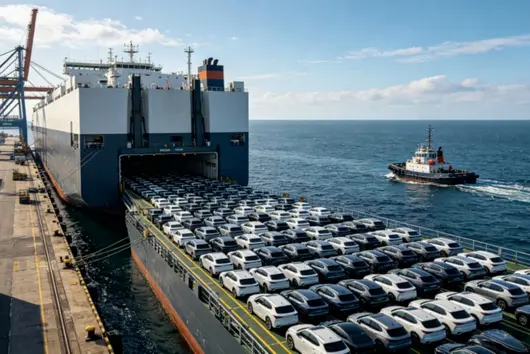

In the first half of 2026, auto sales broke the 15 million mark, and exports are becoming an important growth point.
Data from the China Association of Automobile Manufacturers (CAAM) shows, the monthly auto export volume broke 1 million in June for the first time; from January to June, cumulative auto exports reached 5.096 million, a year-on-year increase of 65.3%, achieving over 5 million in semi-annual exports for the first time. Regarding the annual trend, CAAM remains cautiously optimistic, with full-year exports expected to break 10 million.

In contrast to the frantic expansion overseas, the domestic market can simply be described as bleak. NIO Li Bin called for the industry to prepare for a 15%-20% year-on-year decline in domestic auto retail volume for the full year of 2026. Data shows that the first half of the year became the most prominent feature of the car market: "strong exports, weak domestic sales." Automakers that fail to achieve a global layout in the future will find it difficult to withstand market cycle fluctuations.
1
Auto Exports Exceed Domestic Sales for Some Manufacturers
The domestic auto market is undergoing a deep adjustment. In the first half of the year, auto production and sales reached 14.993 million and 15.017 million respectively, down 4% and 4.1% year-on-year respectively. Against this backdrop, exports became the key engine driving the growth of China's auto industry, and also brought high-speed growth to auto exports after two years of adjustment.
Looking specifically. In June, auto exports were 1.037 million, increasing 11.6% month-on-month and 75.1% year-on-year, with monthly export volume breaking 1 million for the first time. From January to June, auto exports were 5.096 million, up 65.3% year-on-year. More noteworthy is the structural change—the share of export sales in total production has climbed to 39.34%. This means that for every 10 cars produced domestically, nearly 4 are heading to overseas docks.
Against this backdrop, multiple automakers saw overseas market performance hit new highs.
Among them, Chery Group ranked first with export performance of 943,800, a 71.5% year-on-year increase, with overseas sales accounting for more than 70%. This automaker that has long cultivated the overseas market, exported 191,000 units in June alone, a 79.7% year-on-year increase. A more milestone signal is that Chery's cumulative exports have officially broken the 6.78 million mark.

Not just Chery, the current growth momentum of the entire Chinese auto market comes from overseas market export performance. BYD: Overseas exports 789,400, accounting for 43% of total sales; going overseas has become an important certain link; SAIC Motor Group: exported 735,000 in the first half of the year, up 48.7% year-on-year; Since Chen Jiacai took charge of GAC International 8 months ago, GAC Group's overseas offensive speed has significantly accelerated, exporting 121,000 in the first half of the year, up 132% year-on-year, close to last year's full-year level.

Putting the export data of these automakers together, a clear trend can be seen: the overseas market is becoming the core pillar driving the overall growth of automakers. Especially against the backdrop of domestic market demand peaking, profit pressure, and fierce competition, the overseas market has officially upgraded from "incremental supplement" to "core growth pole." It can be said that the more intense the domestic market competition, the stronger the urgency for Chinese automakers to go overseas.
2
Trade Barriers Are an Inescapable Reality
The deep reasons supporting this wave of export explosion are timing, location, and people. First is timing—the global auto industry is transforming towards electrification; second is location—the Chinese auto industry chain is resilient; third is people—independent brand enterprises are working hard. Overall, China's auto going global is at the best time, and presenting a good situation of "blooming in multiple points globally."

In 2023 and 2024, Russia has always been China's number one auto export destination. But looking at the past two years, China's export volume to Russia has declined. In the first five months of this year, Brazil surpassed Russia, becoming China's number one passenger car export market. In addition, the UK, Australia, and Mexico follow closely behind.

Above the top ten overseas markets, the UK, Belgium, and Italy are all located in Europe. In the competitive landscape of the EU auto market, Chinese independent brands have gradually become stronger. In May this year, five Chinese automakers—BYD, SAIC, Geely, Chery, and Leapmotor—sold a total of 138,400 units in Europe, an increase of over 60% year-on-year, while Japanese automakers' sales were 130,000 units, down 3%. Chinese autos surpassed Japan in the European market for the first time, with a market share reaching 12.01%.
Being able to enter Europe shows that our products can already meet the needs of consumers in developed countries, further proving the increasingly solid overseas competitive strength of China's auto industry. However, the hidden realistic challenges behind the high-speed development are equally impossible to ignore. For example, the EU is building walls, Brazil is raising taxes, Thailand is tightening, and the US is blocking. Global major auto markets are all setting up barriers for Chinese cars. The overseas expansion path of Chinese automakers is still full of challenges.

But Chinese automakers' response is much faster than expected, and they are laying out overseas strategies based on their own situations. Including Chery, BYD, Geely, etc., all set up production bases, R&D centers, and service networks overseas. Meanwhile, GAC Group announced plans to deploy 242 fast-charging stations in Brazil before 2030. The overseas competition of Chinese automakers is no longer just about selling cars, but starting to compete on who can truly stay locally, moving towards true globalization management.

Monthly exports breaking 1 million, 5.096 million vehicles exported in the first half of the year—not only is this a beautiful report card, but also a real breakthrough for Made in China in the global market. This year's 10 million export goal is also within reach, but more important than numbers is whether Chinese autos can establish sustainable competitiveness in the global market. In the future, China's auto globalization will enter the deep water zone, competing no longer on short-term sales, but on long-term systemic capability and global operational wisdom.

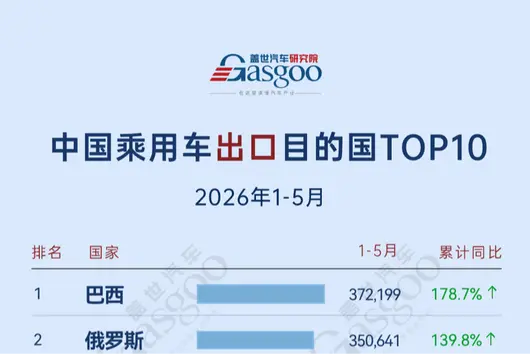
According to Gasgoo Automotive Research Institute data, from Jan-May 2026, exports of Chinese passenger cars and new energy passenger cars continued to show high growth, but regional differentiation intensified further. Regarding passenger car exports, Brazil continued to hold the top spot, with Russia following closely, the two countries accounting for more than 40% of the total in the top ten; the European market performed steadily, achieving high growth; while the Latin America and Middle East markets entered a period of deep adjustment.
New energy passenger car exports performed even more strongly. Brazil led by a large margin, Belgium jumped to second place, highlighting its status as a European transit hub; the European market occupied five seats in the top ten. Among them, Italy and Germany achieved explosive breakthroughs with growth rates of 365.3% and 211.2% respectively, showing that Chinese new energy vehicles have successfully penetrated the heartland of traditional automotive powerhouse countries; additionally, Australia ranked fourth on the list and South Korea eighth, fully demonstrating the core competitiveness and diversified layout capabilities of Chinese new energy vehicles in both traditional automotive powerhouse countries and emerging markets.
TOP 10 Export Destination Countries for Chinese Passenger Cars (Jan-May 2026)
No. 1 Brazil, Jan-May 2026, exported 372,199 passenger cars to Brazil, cumulative year-on-year growth of 178.7%.
No. 2 Russia, Jan-May 2026, exported 350,641 passenger cars to Russia, cumulative year-on-year growth of 139.8%.
No. 3 United Kingdom, Jan-May 2026, exported 188,935 passenger cars to the UK, cumulative year-on-year growth of 82.0%.
No. 4 Australia, Jan-May 2026, exported 158,230 passenger cars to Australia, cumulative year-on-year growth of 59.2%.
No. 5 Belgium, Jan-May 2026, exported 156,364 passenger cars to Belgium, cumulative year-on-year growth of 26.6%.
No. 6 Italy, Jan-May 2026, exported 123,214 passenger cars to Italy, cumulative year-on-year growth of 140.7%.
No. 7 United Arab Emirates, Jan-May 2026, exported 119,179 passenger cars to UAE, cumulative year-on-year decline of 32.6%.
No. 8 Mexico, Jan-May 2026, exported 113,642 passenger cars to Mexico, cumulative year-on-year decline of 40.0%.
No. 9 Spain, Jan-May 2026, exported 94,452 passenger cars to Spain, cumulative year-on-year growth of 56.0%.
No. 10 Malaysia, Jan-May 2026, exported 78,599 passenger cars to Malaysia, cumulative year-on-year growth of 26.9%.

From Jan-May 2026, the landscape of Chinese passenger car export destinations continued to evolve. Brazil maintained the top spot with 372,199 units and a 178.7% year-on-year growth, further consolidating its status as the No. 1 export market. Russia ranked second with 350,641 units and a 139.8% year-on-year growth, showing strong demand for Chinese vehicles.
In terms of regional distribution, the European market showed overall growth. The United Kingdom firmly ranked third with 188,935 units and 82.0% year-on-year growth. Belgium (156,364 units), Italy (123,214 units), and Spain (94,452 units) all achieved year-on-year growth, with Italy's growth reaching as high as 140.7%, reflecting the continuous breakthroughs of Chinese brands in new energy product import and channel construction in Europe. If Russia is included in the European regional consideration, the proportion of the European market in Chinese passenger car exports exceeds half, becoming the absolute core. However, the European market still faces uncertainties in policy environment, trade barriers, and local competition; future growth leans more towards structural opportunities.
The Latin American market showed obvious polarization. Brazil ranked at the top with over 370,000 units and 178.7% year-on-year growth, benefiting from early volume increase before tariff hikes in July. In contrast, Mexican exports declined by 40.0% year-on-year, related to tariff increases effective from Jan 2026, compounded by tightening North American trade policies and adjustments in market expectations, leading to significant demand contraction. This differentiation indicates that the performance of Chinese car companies in the Latin American region is influenced by tariff, trade policy cycles, and local market environments of each country, making operating fluctuations caused by country differences very prominent.
The Middle East market entered an adjustment phase. UAE (119,179 units) declined by 32.6% year-on-year, leaving behind the previous high-speed growth. Regarding the Asia-Pacific market, Australia (158,230 units) grew by 59.2% year-on-year, ranking fourth; Malaysia (78,599 units) grew by 26.9% year-on-year, ranking tenth, showing that the potential of Southeast Asian and Oceania markets is continuously being released. Overall, Chinese passenger car exports are transitioning from relying on a few hotspot markets to a new stage where multiple regions bear pressure together and the structure is becoming increasingly diverse; growth drivers are shifting from quantity expansion to a deeper contest of product strength and brand recognition.
TOP 10 Export Destination Countries for Chinese "New Energy" Passenger Cars (Jan-May 2026)
No. 1 Brazil, Jan-May 2026, exported 283,182 new energy passenger cars to Brazil, cumulative year-on-year growth of 175.6%.
No. 2 Belgium, Jan-May 2026, exported 150,110 new energy passenger cars to Belgium, cumulative year-on-year growth of 25.8%.
No. 3 United Kingdom, Jan-May 2026, exported 129,807 new energy passenger cars to the UK, cumulative year-on-year growth of 81.4%.
No. 4 Australia, Jan-May 2026, exported 111,406 new energy passenger cars to Australia, cumulative year-on-year growth of 168.2%.
No. 5 Italy, Jan-May 2026, exported 67,043 new energy passenger cars to Italy, cumulative year-on-year growth of 365.3%.
No. 6 Germany, Jan-May 2026, exported 65,235 new energy passenger cars to Germany, cumulative year-on-year growth of 211.2%.
No. 7 Thailand, Jan-May 2026, exported 62,316 new energy passenger cars to Thailand, cumulative year-on-year growth of 62.8%.
No. 8 South Korea, Jan-May 2026, exported 60,488 new energy passenger cars to South Korea, cumulative year-on-year growth of 170.3%.
No. 9 Spain, Jan-May 2026, exported 56,953 new energy passenger cars to Spain, cumulative year-on-year growth of 74.9%.
No. 10 United Arab Emirates, Jan-May 2026, exported 53,135 new energy passenger cars to UAE, cumulative year-on-year growth of 45.7%.

From Jan-May 2026, the landscape of Chinese new energy passenger car export destinations changed significantly. Brazil maintained the top spot with 283,182 units and a 175.6% year-on-year growth, further expanding its lead, with new energy becoming the absolute main force for Chinese car exports to Brazil. Belgium leaped to second place with 150,110 units and 25.8% year-on-year growth, highlighting its strategic value as a European new energy transit hub. The United Kingdom ranked third with 129,807 units and 81.4% year-on-year growth, followed closely by Australia with 111,406 units and a 168.2% surge year-on-year, showing that electrification demand in the Oceania market is accelerating.
In terms of regional distribution, the European market showed an overall explosive trend. Including Belgium and the UK, Italy (67,043 units) grew by 365.3% year-on-year, Germany (65,235 units) grew by 211.2% year-on-year, and Spain (56,953 units) grew by 74.9% year-on-year, with growth rates far exceeding the average. Among them, the amazing increases in Italy and Germany show that Chinese new energy vehicles have successfully penetrated the heartland of traditional automotive powerhouse countries, with product strength and brand recognition achieving substantial breakthroughs. However, the European market still faces policy uncertainties such as carbon tariffs and anti-subsidy investigations; future growth relies more on deep integration into local supply chains.
The Asian market is blossoming in multiple points. Thailand (62,316 units) grew by 62.8% year-on-year. As a stronghold of Southeast Asian EV industry, Chinese brands continue to deepen their efforts through localized production layouts. South Korea (60,488 units) grew by 170.3% year-on-year, entering the top ten for the first time, reflecting significantly improved competitiveness of Chinese new energy vehicles in East Asian neighboring countries. Regarding the Middle East market, UAE (53,135 units) grew by 45.7% year-on-year, with new energy becoming a new growth point in this region.
Overall, Chinese new energy passenger car exports have entered a new stage, with market coverage extending from emerging economies to traditional automotive powerhouse countries. Growth dynamics have shifted from price advantages to a deeper contest of technical strength and brand premium. In the future, how to maintain sustainable growth under the intensification of trade barriers and requirements for local production will be a common challenge facing Chinese new energy vehicle companies.

GAC Group released a half-year performance report for 2026. The numbers are quite shocking — net loss for the first half estimated at 4.06 billion to 4.57 billion yuan. The net profit after deducting non-recurring gains and losses was even worse, with a loss of 4.8 billion to 5.6 billion yuan. More than 4 billion yuan, losing over 20 million yuan per day, it doesn't look very ideal.
But look at another set of numbers — GAC sold 773,100 vehicles in the first half, a year-on-year increase of 2.35%. New energy vehicle sales accounted for over 60%. Independent brands sold 346,000 vehicles, a surge of 35.69%. AION was even more fierce, 181,600 vehicles, a year-on-year increase of 67.08%. Overseas exports 121,500 vehicles, a year-on-year increase of 132%, the semi-annual export scale is already close to last year's full year level. Sales are up, new energy transformation is accelerating, and exports are doubling — but the books show an even bigger loss. How is this account calculated?

GAC Group
What does the official say?
GAC's announcement was very straightforward, three reasons:
First, domestic market competition intensified, independent brands continued to increase sales investment, plus changes in product sales structure, and rising upstream raw material costs, leading to a decline in independent brand profits.
Second, joint venture brands are facing operational pressure. Specifically, terminal sales decline, continued increase in sales investment, rising raw materials, etc., are all important factors, and the company's investment income decreased year-on-year.

Reason for Loss
Third, exchange rate fluctuations caused exchange losses, adding another blow. Obviously, GAC Group gave a relatively clear interpretation of the reasons for the loss in the first half.
To translate, it might be that independent brand profits are not as high as before, joint venture brands are under greater pressure, and exchange rates also caused a certain loss to profits.
Combining all the above factors, GAC Group is expected to incur a loss in the first half of 2026. Moreover, the loss amount is expected to reach 4.06 billion to 4.57 billion yuan, which is quite high.
However, Car Universe World believes that if you only focus on the word "loss", you might miss the real story.

Loss Forecast Announcement
Joint Ventures: One "Under Pressure", One "Steady"
GAC Group official data shows, GAC Honda sold 68,300 vehicles in the first half, a year-on-year decline of 55.82%, almost 60% down. June single month 14,000 vehicles, although it increased more than 50% month-on-month, it fell 53% year-on-year.
The joint venture giant that used to sell 700,000 annually, now the average monthly sales of the first half is over 10,000 units. Accord, Fit, Vezel, Integra these classic models, monthly sales generally not as high as before.
Obviously, from the sales perspective, in the first half of 2026, GAC Honda still declined significantly, reaching over 50%, bearing a certain amount of pressure.

Production and Sales Express
But the performance of GAC Toyota is different, the overall performance is still steady. Moreover, under the situation that domestic car market joint venture brands are under pressure overall, its sales volume is stable and rising.
GAC Group official data shows, in the first half of 2025 GAC Toyota sold 356,000 vehicles, monthly average sales close to 60,000 units. Year-on-year increase 3.29%. March, April, May for three consecutive months topped the sales list of joint venture car companies. July 2nd, GAC Toyota also welcomed the 10 millionth mass-produced vehicle rolling off the assembly line, joining the "million-unit level large factory".
Moreover, Car Universe World found, supporting GAC Toyota is not low-price volume-selling cars, but the Camry, Highlander, Sienna three major flagships continuing to exert effort, smart electric hybrid double engine vehicle proportion reached 54% . Boxi brand sold 52,000 units in the first half, Boxi 3X consecutive 10 months holding joint venture pure electric sales champion.
One continues to bear pressure, one steady, this joint venture card, GAC has not finished playing yet.

Boxi 7
Independent and Overseas Markets, The Real Highlights
Car Universe World believes, if there is anything eye-catching in GAC's first-half performance report, it must be the overseas market and the surge in independent sales.
Official data shows, first half of 2026, GAC Trumpchi cumulative sales 164,000 units. Compared to the same period last year, sales increased by 12.36%.
AION rose even harder. Official data shows, first half of 2026, GAC AION cumulative sales 181,000 units. Compared to the same period last year, sales increased by 67.08%.
In terms of overseas markets, first half independent brand exports 121,500 vehicles, year-on-year growth 132%, semi-annual export scale already close to last year's full year. Americas, Asia-Pacific, Middle East, Africa, Europe five major regions simultaneously achieved high-speed growth.

Trumpchi E8
Mexican market, AION ES and AION UT both entered the top ten in new energy BEV sales. Bolivia, GAC brand consecutive months holding China brand passenger car sales champion. Singapore, Thailand, Malaysia, Indonesia — GAC's overseas map is blossoming in multiple points.
GAC's overseas target set at the beginning of the year was 250,000 vehicles for the full year, striving for 300,000 vehicles. First half completed 121,500 vehicles, completion rate close to half. When the domestic market is too hard to compete, overseas became GAC's strongest growth curve.

AION N60
The Account of Transformation, Cannot Look Only at the Present
The "Panyu Action" launched in 2025 is being implemented step by step.
Headquarters moved to Panyu, closer to the production frontline. Feng Xingya said an interesting sentence — "We moved the office to the place closest to the gunfire, so that those who hear the gunfire can call for it." Business Unit (BU) restructuring finished, Hyper AION BU formed first, January 2026 Trumpchi BU also established. GAC independent brands have formed a new operating architecture centered on BU.
Cooperation with Huawei also produced results. Jointly created high-end brand "Qijing" first model GT7, launched in Hangzhou on June 26th. Price 209,900 to 329,900 yuan, launched 24 hours big deposit orders broke 5200 units, Post-90s, Post-00s user proportion over 60%. Pre-sale 5 hours orders broke 10,000. 90 cities nationwide 300 stores gradually launched.
Qijing GT7 is equipped with Huawei Qiankun Intelligent Driving ADS 5. This is GAC's first car with deep cooperation with Huawei, and also a hard battle facing the market after the "Panyu Action".
These moves are all "money" in the short term — R&D needs money, channels need money, brand building needs money. But looking at a longer time dimension, these investments are storing power for the next stage. GAC positioned 2026 as the "Internal Renovation" critical stage, likely this is the meaning — first solidify the foundation, then talk about building high-rise buildings.

AION N60
Conclusion of This Article:
GAC's full-year target set at the beginning of the year was 2 million vehicles, first half completion rate less than 40%. Second half needs to sell nearly 1.23 million vehicles, monthly average over 200,000 vehicles. Under the current situation of joint venture pressure and intensifying new energy competition, how hard this task is, no need to say more.
But Car Universe World believes, the cards GAC holds are not finished playing yet. Joint ventures have GAC Toyota stabilizing, independent brands have AION and Trumpchi rushing, overseas releasing volume, Qijing just started.
How to play these cards, when to play them, perhaps will become an important factor for GAC Group when to walk out of the pain of transformation. These, we still let time give an answer.
Transformation is always bitter first then sweet, and never looking only at the present. What do you think? Let's chat in the comments.
Statement: This article involves relevant events, originating from brand official or authoritative media messages, for reference only, specific based on official information. If there are information, data discrepancies caused by typos, based on official information. Hope everyone looks rationally, do not believe rumors, do not spread rumors.
Article Statement:
This article is original writing of Car Universe World, reviewed by Ling Qing/Liu Shuai, Total Issue 14186, some pictures from the internet, marked source data and related materials are all citations. Car Universe World original copyright owned, infringement will be investigated.


In the first half of 2026, China's car exports reached 4.059 million units, up 63% year-on-year. At this growth rate, breaking 10 million units for the year is almost a certainty — by then China will become the world's first automotive giant to export over 10 million units annually, equivalent to 2.5 times Japan's volume.

But another set of data is not looking so good. From January to May this year, domestic passenger car retail sales reached 7.099 million units cumulatively, down 19.5% year-on-year. Among the five major independent brands, BYD sold 1.8085 million units in the first half, down 15.72% year-on-year. Growth relies mostly on exports. This isn't prosperity; it's like 'starving at home, relying entirely on grabbing from outside'.

Let's first see just how fierce the exports are. Chery exported 940,000 units in half a year, securing the top spot, with a share as high as 74.3% — 3 out of every 4 cars sold were exports. BYD followed with 790,000 units, with 174,800 units exported in June alone. What was most unexpected wasn't the volume, but the direction. In May data from 31 European countries, these five — BYD, SAIC, Geely, Chery, Leapmotor — sold a combined 138,400 units, up 65% year-on-year, surpassing the total of six Japanese brands like Toyota, Nissan, and Honda for the first time. The market share of Chinese brands in Europe jumped directly from 5.6% in May last year to 10.7%. Doubling in one year isn't growth, it's swallowing whole.

But Europeans lost patience. On July 1, the EU's final anti-subsidy duties on Chinese pure electric vehicles officially took effect — 17.4% for BYD, 18.8% for Geely, 35.3% for SAIC, plus a 10% base tariff, pushing the combined tax rate for some manufacturers above 45%. Tougher still, the EU is brewing to include plug-in hybrids in the tax scope. Over the past year, plug-in hybrids were the core channel for Chinese manufacturers to bypass pure EV tariffs; now they're trying to block all paths. But China is not someone to be trifled with. The Ministry of Commerce immediately issued a final anti-dumping ruling on EU pork, with rates ranging from 4.9% to 19.8% for five years. China is the world's largest pork consumer market; the EU's pig feet, ears, and offal rely entirely on China to digest. This blow targets the vote banks of agricultural states. Countermeasures on cognac and dairy products are also coming. Wine merchants in France's Cognac region are already shaking.

But can tariffs really stop us? The Chinese auto manufacturers' response is simple — build factories right at your doorstep. BYD is building a factory in Hungary to start production next year, Chery is laying out plans in Brazil and Spain, and SAIC is deepening roots in Thailand. If tariffs block prices, I'll just bypass your tariff wall. It's exactly the same script as Japanese automakers frantically built factories in the US after the US imposed tariffs back then. The only difference is that Chinese cars going overseas are faster, larger in volume, and the industrial chain is more complete.

Overall, the slump in the domestic car market forces all brands to go outward, and exports have made up for all the growth lost domestically. But the EU's 45% tariff is just the first hurdle; behind it, the door to the North American market is tightly shut, and the fortress of Japanese cars in Southeast Asia won't be breached in a day. The race for Chinese car exports has shifted from 'grabbing incremental growth' to 'fighting hard battles'. 10 million units is inevitable, but the tariff walls, political barriers, and localization difficulties on the road are getting harder and harder.
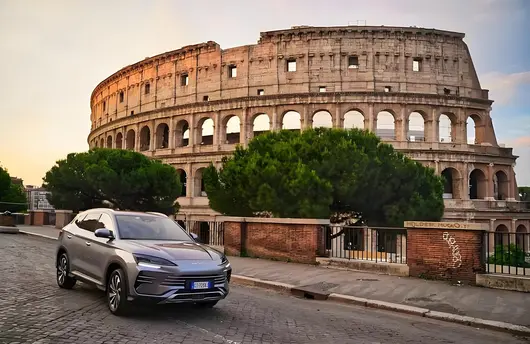

When discussing Chinese automakers going global, the first reaction for most people is the rivalry between Chery and BYD — one spreading globally with fuel vehicles in emerging markets, the other sweeping overseas high and low-end segments with new energy. But after May's export data was released, I feel Geely is the most worth analyzing in detail.

According to the official narrow-sense passenger vehicle metrics, Geely exported 85,144 units in May, a year-on-year surge of 183.7%; if including commercial vehicles and CKD kits for the whole group, the number is 101,000, with the growth rate also reaching 150%. In the top 5 export tier, this growth rate is significantly ahead. Don't think the 100,000 unit level isn't as flashy as Chery or BYD; you must know that a year ago, Geely's monthly exports hovered around 30,000 to 40,000 units. In just a year, it doubled and more. This growth momentum counts as a fierce role in the entire industry. Moreover, more crucially, its growth is not built on dumping low-price inventory, it is truly quality growth.

Many people's impression of Geely going global is still stuck ten years ago: selling cheap fuel cars, relying on cost-effectiveness to smash open Third World markets. In the past, this was indeed correct, but now things have changed. Geely's current exports follow a typical "three-tier pyramid" strategy, very stable. The bottom layer consists of old timers like Emgrand and Binyue (Coolray), named Emgrand and Coolray overseas, targeting the entry-level commuting market, serving as the sales base. For example, Emgrand's month-on-month growth in Mexico can reach 334%, and Coolray in Latin America overall also has 185% growth. Durable, cheap parts, high recognition in emerging markets, responsible for stabilizing the base.

What truly drives growth and supports quality is the middle layer of new energy models, which is the change I think is most core. In May's exports, the proportion of new energy vehicles has approached 48%, almost half the share, where Xingyuan (Star Wish) and Galaxy E5 played key roles. Xingyuan targets entry-level pure EV commuting, in Mexico, Indonesia, Brazil and several other countries it is the Class B pure EV hatchback sales champion; Galaxy E5 is positioned as a compact pure EV SUV, from Australia to UAE, developed markets and Middle East markets can be won as segment first. Simply put, previously Geely exports relied on fuel cars to fill numbers, now it relies on new energy products to truly grab shares, the gold content is completely different. The peak is supported by Zeekr for high-end image. Although absolute sales are not the main share, being able to beat Tesla Model Y in Australia, taking the luxury pure EV MPV sales champion in Malaysia, shows Geely is not just good at making low-price cars; high-end markets can also take a stand.

As for the single country sold the best, the answer is Mexico, and the advantage is not small. But the interesting part lies in Geely not fighting a single market like many automakers do, such as highly relying on Russia or a specific Southeast Asian country. It is a typical full-domain layout, blooming at multiple points. Besides Mexico holding the top market, Indonesia, Brazil, Australia, Kazakhstan are core growth sources, Latin America, Southeast Asia, Oceania, Central Asia four blocks rise synchronously, no obvious weaknesses.
I always feel, going global fears most is putting all eggs in one basket. In previous years, some automakers exploded in popularity via a single market; later when the market fluctuated, sales directly dove, risk extremely high. Geely's net-style layout, short-term explosion power might not be that exaggerated, but risk resistance is much stronger, growth is more solid. Take Mexico as an example, Emgrand and Star Wish high-low combination, can take the entry commuting market, can also take over electrification upgrade demand, selling well is completely within reason.

Many people say Geely's growth this time stepped on a trend, good luck. I feel it is accumulating thickly to burst thinly, seeds buried in previous years now sprout concentrated. The most direct reason is localization production finally works. Building CKD assembly factories in markets like Indonesia and Thailand can not only dodge high import tariffs, but also shorten delivery cycles, fit local industrial policies, much more flexible than simply relying on sea exports. Plus the global experience accumulated from acquiring Proton and Volvo early on, handling regulations and access standards for various countries, Geely is much more convenient than many new exporters.
Second is fixing the old weaknesses of logistics and after-sales. Previously domestic brand exports were often complained that "buying cars is easy, fixing cars is hard", shipping cars takes waiting two or three months, broken parts wait half a year. Geely now built a own RoRo ship plus China-Europe Railway Express, six major sea ports stereo logistics network, transport time for Europe direction directly shortened by 40 days; parts also did a three-level warehousing system, plus super long warranty, overseas consumers' concerns reduced a lot. Most fundamentally still products stepped on the right rhythm, most countries globally electrification just started, traditional joint venture EVs are either ridiculously expensive or configurations are shabby. Geely's models just fit the sweet spot of price and configuration, the effect of dimensional reduction strike is naturally obvious.

Of course, the nearly doubling high growth rate is also related to last year's base not being high. Truly discussing the total export volume, Geely still has a significant gap with Chery and BYD. But compared to single month sales numbers, I value its growth quality more — no longer relying on low-price fuel cars to rush volume, new energy proportion continues to rise, market layout balanced, high-end brands also going out, this is much more valuable than simple number growth.
From acquiring Volvo in the past being questioned for a small snake swallowing an elephant, to now relying on self-developed products to beat globally, Geely's export road was not the fastest, but every step is steady. In the export wave where everyone races low prices and rushes volume, this kind of strategy to stay focused on localization and build systems might walk further after all. After all, going global is not a one-off deal; being able to sell is just the first step, being able to stand firm and live long is the real capability.


The domestic passenger car market has been sluggish since the beginning of this year. Wholesale sales declined 6% year-on-year in the first five months; if exports are excluded, retail sales declined even more by 19% year-on-year.
In sharp contrast to passenger cars, commercial vehicles achieved double-digit growth in sales from January to May, outperforming passenger cars year-on-year and exceeding market expectations.
The performance of leading enterprises was even more impressive. Foton Motor sold 58,000 units in May, ranking first in the industry, with a year-on-year growth of 17.3%. Cumulative sales from January to May exceeded 300,000 units, ranking first in the industry, with a year-on-year growth of 10%.

Among them, light truck sales in May reached 36,000 units, growing 10% year-on-year. Cumulative sales from January to May were nearly 200,000 units, ranking first in the industry for over a decade consecutively.
Heavy truck sales in May reached 16,000 units, surging 37% year-on-year. Cumulative sales from January to May were 76,000 units, growing 37.2% year-on-year, the fastest growth rate among the top five industry leaders.
New energy vehicle sales in May exceeded 12,000 units, surging 52.6% year-on-year. Cumulative sales from January to May exceeded 45,000 units, ranking second in the industry.
May exports exceeded 17,000 units, surging over 64.3% year-on-year, accounting for 30% of the month's sales. Cumulative exports from January to May were nearly 90,000 units, growing 38% year-on-year, ranking first in the industry for 15 consecutive years.
The data shows that the high growth of Foton Motor in May and the first five months is supported by four factors: light trucks continue to lead, heavy trucks grow significantly, new energy vehicles explode across the board, and exports lead and surge.
Foton achieved such impressive data primarily due to the recovery of the economic environment and demand. In terms of heavy trucks, domestic infrastructure construction accelerated, National III replacement for dump trucks and tractors was implemented, and demand for engineering heavy trucks and express tractors was strong, driving May heavy truck sales to grow positively for the fifth consecutive month year-on-year.
In terms of light trucks, peak seasons for express delivery, fresh cold chain, and urban distribution logistics continued, rural-urban freight demand recovered, and national monthly light truck sales stabilized at a high level above 160,000 units, with a robust demand base.
Secondly, Foton's product matrix is complete, with new products and high-end models gaining volume. For heavy trucks, there are Auman Galaxy (9, 7, 5, 3, T) high-end products and Xingyi + Xinghui models for volume, natural gas heavy trucks and battery swap heavy trucks targeting mining areas and trunk logistics markets. Foton Konwei power's fuel-saving advantages are highlighted, high-end heavy truck average prices increased while sales doubled. New energy heavy trucks with full technology routes (pure electric, hybrid, hydrogen fuel) are launched, vehicle-battery separation leasing lowers user purchase thresholds, driving explosive growth in new energy heavy trucks.
For light trucks, relying on the Auling, Aumark, and Time brand matrix and product differentiation to cover the market in layers. Fuel versions focus on cost-performance, new energy versions adapt to urban distribution restriction policies. Coverage ranges from 3.5-ton blue plate to heavy-duty yellow plate. Lightweight body optimized for new blue plate regulations, solving user registration pain points. Zhilan models and Qimingxing pure electric new products were stocked in May, becoming the core source of light truck volume growth.
Regarding new energy, many places nationwide implemented urban fuel truck restrictions, new energy vehicle purchase subsidies, and priority road rights policies. Electric delivery logistics in first-tier cities accelerated. Foton's "New Energy 30·50 Strategy" was implemented, partnering with Huawei Digital Power to build supercharging networks and co-investing with EVE Energy for battery leasing. The vehicle-battery separation model significantly reduces new energy vehicle down payments. In May, new energy light trucks and heavy trucks became the largest source of volume growth.

Additionally, Foton's channel downward move and marketing reform further drove sales through distributor network advantages. Foton has over 3000 sales networks and 10000+ service networks nationwide, extending from counties to township terminals. Time series target third and fourth-tier lines and rural freight, Auling targets city logistics, Aumark focuses on high-end cold chain, with segmented channels precisely split. In May, terminal purchase interest subsidies and financial zero-down payment policies were launched. Relying on light truck products' low maintenance and high fuel-saving TCO advantages, amidst competitor price wars, they gained orders in reverse trend through service and product strength, continuously capturing competitor lost customers.
Finally, exports growing 64% year-on-year and accounting for 30% of the month's sales was Foton's biggest highlight in May.
Overseas Markets Bloom Across the Board
Overseas markets are Foton's traditional strength. Starting from 2011, it became China's number one commercial vehicle exporter, and Foton has never let this title slip away.
In the first four months of this year, Foton whole vehicle exports grew 32% year-on-year, with overseas market share at 17.5%. In May, large batches of light trucks, buses, and pickups were sent to Africa, Southeast Asia, and South America. Electric buses were delivered in batches to Australia, making overseas volume growth more significant.
From the export product structure perspective, heavy trucks mainly Auman grew significantly, May exports exceeded 2,000 units, growing 42.6% year-on-year. Ouhang and Aumark models were even more dramatic, overseas sales exceeded 4,600 units, surging 280% year-on-year. Time and Pickup grew by 47.4% and 60% respectively.
Cumulative exports from January to May exceeded nearly 90,000 units, growing 38% year-on-year, firmly maintaining the lead in domestic commercial vehicle exports.
From the export regional distribution perspective, benefiting from the RCEP tariff exemption policy implementation in Southeast Asia, urban distribution and cold chain demand exploded in Thailand, Indonesia, and Vietnam. Foton Thailand Factory mass-produced right-hand drive light trucks have radiated to Southeast Asian countries, with Auling and Aumark high-end light trucks selling hot.
Africa is the region with the highest export growth rate for Foton. In 2025, Foton sales in the African region grew over 120% year-on-year. In the first quarter of 2026, sales grew 96% year-on-year. Foton Heavy Commercial products were deeply customized and calibrated for Africa's complex road conditions, fuel consumption performance benchmarks European top brands, lowest fuel consumption among domestic commercial vehicles of the same level, balancing power performance and operating costs, perfectly adapted to high-intensity operation scenarios such as cross-border logistics and mine transportation. In May, Heavy Commercial product exports broke 1,000 units, doubling year-on-year, full category exports in January-May broke 10,000 units. Infrastructure and mineral development in countries like Nigeria, Kenya, and Ethiopia drove whole vehicle procurement, relying on 12 local factories to ship whole vehicles and spare parts simultaneously.

In the Middle East region, relying on Saudi Arabia and UAE energy infrastructure and intercity logistics upgrades, Auman high-horsepower tractors and dump trucks signed contracts in batches and landed. Hybrid heavy trucks increased volume relying on local new energy subsidies.
Europe and Australia issued commercial vehicle carbon emission controls, accelerating the elimination of old diesel vehicles. Foton high-end new energy products achieved breakthroughs in Europe and Australia. Toano electric VANs were bulk purchased by Germany and Italy, raising overseas vehicle profitability levels.
Behind Foton's high export growth is the result of long-term sustained deep diving into overseas markets.
For example, in terms of R&D center count, there are 10 domestically and 8 overseas. Manufacturing bases are 20 domestically and 32 overseas, widely distributed in Southeast Asia, Europe, North America, South America, and Africa. Sales and services cover over 140 countries and regions, with overseas sales networks exceeding 1,200 and service networks exceeding 1,500.
Overseas R&D bases cooperate with domestic R&D to localize exported products. For example, optimize chassis and power for overseas road conditions. Aumark high-end light trucks adapt to Southeast Asia cold chain, Auman high-horsepower heavy trucks match Middle East infrastructure, hybrid and pure electric models adapt to overseas new energy subsidy policies.
In production and manufacturing, local factories in multiple countries have started production, reducing tariff costs and shortening delivery cycles. Pickups and light trucks rely on localized production to quickly seize cost-performance markets.
Regarding new energy, Foton fully self-developed three-electric systems, covering pure electric, hybrid, and hydrogen fuel technology routes. The entire series of new energy commercial vehicles passed EU and Australia's strict certifications. 2.2C fast charging and other technologies became differentiated selling points to expand market recognition.
In the coming months, production lines at new local factories in Brazil and Ethiopia will continue to ramp up. Southeast Asian rainy season cold chain stocking, Africa second half infrastructure construction, Foton exports are expected to continue the high-growth trend.
In the medium to long term, European new energy commercial vehicle penetration rates continue to rise, Latin American import substitution demand is released, helping overseas share stabilize above 30%, diversifying domestic stock market competition pressure, and improving a sustainable and healthy global layout.
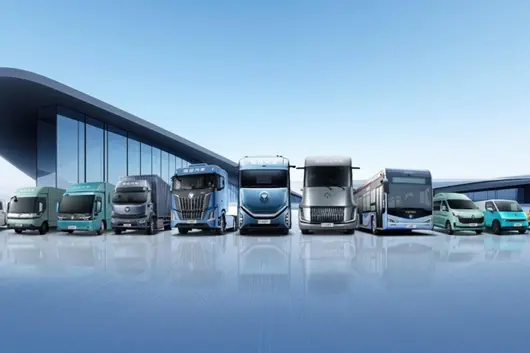


When it comes to domestic car brands, many people's impression may still be stuck at the stage of mainstream family cars. However, this is already old news from a few years ago. You should know that current domestic car brands not only beat joint venture brands in the domestic market, but have also surpassed foreign car brands on multiple tracks such as high-end development and overseas exports. Take the Geely Automobile we are talking about today for example.

Growth Momentum Leads the Industry
According to the latest data released by the official, Geely Automobile's cumulative sales in May reached 237,637 vehicles. It achieved double growth year-on-year and month-on-month for three consecutive months, leading the overall market with stable growth and impressive results. However, compared to this already excellent total performance, many industry insiders, after seeing the sales results of each brand under Geely Automobile, will be amazed that its quality is also getting higher.

As is well known, there are two hardest markets in the automotive industry: the luxury high-end market and the overseas export market.
Taking Geely Automobile as an example, its "Global Luxury Technology Brand" — Zeekr Automobile, reached deliveries of 34,377 vehicles in May, an 81.8% increase year-on-year and an 8.1% increase month-on-month, achieving double growth for four consecutive months. The average transaction price per vehicle also increased by 52.4% year-on-year. What is even more shocking is that the sales share of Zeekr 9 Series and 8 Series, which are priced as high as 400,000 to 500,000, accounts for nearly 50%!

Not only that, Geely Automobile's "Global New Energy High-End Brand" — Lynk & Co, also achieved May sales of 20,732 vehicles, with new energy vehicle sales accounting for 70.8%, and the brand's cumulative sales have broken 1.8 million. This shows that Geely Automobile's high-end models have not only won the recognition of a large number of consumers with excellent product power, but have also completed the transformation of volume and price rising together at the brand level.

Of course, as the undisputed leading automotive enterprise in China, Geely Automobile's focus is no longer limited to the domestic market. It chose to go global to challenge the more difficult overseas market. This is not the case, May's overseas export achievement of 85,144 vehicles set a new record for export sales. It is worth mentioning that the hot-selling products of Geely Automobile brands overseas are also mostly high-end or new energy vehicles.

For example, Zeekr has entered more than 50 countries and regions, and the cumulative global delivery volume of Zeekr 7X has exceeded 160,000 vehicles; Geely Galaxy Starship 7 EM-i remained the champion of new energy plug-in hybrid SUV sales in Kazakhstan for March and April; Geely Galaxy E5 remained the champion of pure electric SUV-C market sales in Australia, Argentina, UAE, Morocco, and Uruguay for the first quarter, and stayed in the top three in Brazil, Uzbekistan, and Indonesia new energy pure electric SUV-C models!

Hardcore Strength Creates Brilliance
Obviously, whether it is the rapid sales growth trend, or the hot sales in new energy, high-end market and overseas market, it is inseparable from hard strength as support. Taking Lynk & Co Automobile as the first car racing brand in China for example, top technology shouldn't just stay on the marketing level, but must be proven on the track. Therefore, it recently announced carrying 03+ TCR Racer, 03++ Racer, and 03 CUP EVO three racing cars to participate in TCR China, CTCC China Cup, and Lynk & Co Cup three major events simultaneously.

With hardcore strength, Lynk & Co naturally fears no high-difficulty tests. In the two-round finals of TCR China, the 03+ TCR Racer achieved the results of 4 championships, 1 runner-up, and 2 third-place finishes with its hardcore performance strength; in the CTCC China Cup, the Lynk & Co Zongheng Racing Team even achieved the results of 2 championships, 2 runner-ups, and 1 third-place finish. At the same time, in the 2026 Season FIA TCR World Tour opener, the Starri TCR Racer of Geely China Star Racing Team (Geely Cyan Racing) also won the race in the final and brought back the historical first win. This not only means that Starri TCR has world-class competitiveness, but also marks that Geely China Star Racing Team has officially completed the first chapter of the Geely Automobile Sports New Era.

At the same time, in technical levels such as intelligence and safety, the Haohan inherited Geely and Volvo safety heritage, assisted driving mileage grew by 215% in one year, leading the entire industry with the fastest growth rate. In the recent Euro NCAP official test, Geely Galaxy Starship 7 EM-i (Geely STARRAY EM-i) successfully completed the exceeding standard bilateral serial limit crash test at the France UTAC Laboratory. This not only intuitively confirms Geely's leading vehicle safety technology and mature systematic safety strength, but also lays a solid foundation for Chinese automotive safety technology to go international and participate in global industry standards!

Daxia Car Talk: I believe many people, after seeing Geely Automobile's sales data, will have the praise "It's too comprehensive" in mind. After all, car enterprises that can achieve impressive results in new energy, high-end, overseas exports, and even on the track at the same time, let alone in the independent domestic brand circle, you can't even find a few car enterprises in the global automotive industry that can achieve these things simultaneously!
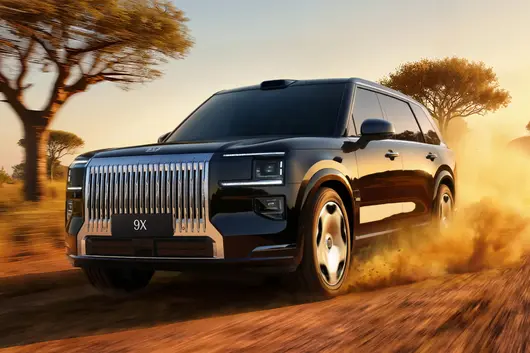

On May 24, Manchester City played against Aston Villa at home, which was Guardiola's final match managing Man City, also a farewell full of ritual. No matter how reluctant fans were, the 10-year Blue Moon Dynasty finally reached the time to say goodbye.
In this farewell atmosphere, Coach Guardiola drove away in that blue Sea Lion 07, showing unprecedented presence in front of billions of fans globally.

Many people saw this scene and were shocked, some wiped their eyes, finding it really was BYD. Another part sighed, changed person, changed scene, how did this BYD suddenly become high-end. Some others dug out information, this car sells for £44,990 in UK, truly a high-end car in name and reality.
Actually while Guardiola left driving BYD, the overseas road of domestic cars was surging. Why say this? Let Kung Fu Auto take everyone to have a look.
(1) Break Through Plateau, Domestic Car Exports Continue Significant Growth
On May 25, Cui Dongshu, Secretary-General of China Passenger Car Association, announced the latest export information.
This year January-April, domestic car exports reached 3.26 million, up 51% compared to same period in 2025. Among them April export volume was 940,000, nearly 1 million single month, up 52% year-on-year. This data is too exaggerated. It is known that Chinese car exports experienced many years of million-level plateau, breaking through only in 2021, yet now nearly 1 million vehicles exported in single month.

More specifically, Brazil surpassed Russia as China's largest car export country. April single-month exports reached 121,766 vehicles. Russia ranked second at 77,524 vehicles. Additionally, Belgium, Australia, UK exports were all around 50,000.
Key point domestic car exports highlight "selling everything". April BEV share was 31%, PHEV 18%, HEV 7%, traditional fuel cars only 34%. This also shows one point, NEVs not only popular domestically, also competitive in international market. Meanwhile, domestic fuel cars going international, still have competitiveness.

Also another trend, previously domestic car key markets concentrated on Russia and Middle East. Initially thought this Middle East tension would greatly affect exports. Unexpectedly reality situation was opposite, Western Europe (UK, Belgium, Germany, Italy) and South/Central America (Brazil) markets became core increases, domestic car export share to developed countries increased significantly.
Whether Middle East geopolitical impact or EU/US trade barriers, cannot say no impact on domestic cars, but none touched root. Core is one point, domestic car product strength truly strong.

BEV, PHEV, HEV three routes all landed, adapting to different regional oil quality, road conditions, recharging conditions. Global adaptability far exceeds overseas competitors. Ability to enter German, UK, Belgium and other European developed markets in bulk, means vehicles in safety, energy consumption, durability, regulations fully benchmark or even exceed local mainstream models. Hard power recognized.
(2) Pure Electric Growth Slows, Is it an Open Strategy?
Cui Dongshu gave NEV export situation. This year January-April, Brazil was undoubtedly pure electric largest market, sold 222,000 NEVs vast majority were BEV. Belgium as European gateway, 130,000 NEVs almost all pure electric.
UK, Australia, Thailand, UAE these markets also focus on BEV, PHEV gradually penetrating.

In this way, pure electric market actually divided into three blocks. Europe is high-end pure electric main battlefield, requiring highest quality, intelligence, safety. Even Guardiola drives BYD. Brazil, Australia mid-high-end pure electric combined with some economy pure electric. Southeast Asia started economy pure electric gradual volume release.
Mainly due to supply chain maturity, same spec BEVs generally 30%–50% cheaper than Europe/Korea/Japan BEVs. Especially some A00/A0 Class, like Wuling Hongguang MINI, BYD Seagull etc., in emerging markets very competitive, account for over half BEV exports. If subsequent Geely Star Wish can also go out, believe will also have good market performance.

Speaking Zeekr plus Galaxy combination, high-end pure electric plus economy family car, really perfectly suits overseas market. No wonder Geely export growth so fast. January-April 2026, Geely NEV exports year-on-year increased by full 624.5%, growth rate industry first, just because product too adaptable.
Of course, some people mention, entering 2026, pure electric export growth slowed, while PHEV share reached 18%, already exceeded half of pure electric. This mainly due to recharging infrastructure differences. Many countries charging piles insufficient, more prefer PHEV, HEV, drag pure electric penetration rate.

Domestic also experienced this stage. On one hand infrastructure must follow up gradually. On other hand ideas "follow up". Why did domestic range extenders experience several years big growth then shrink? Because people who bought range extenders early finally realized using electricity too "addictive", subsequent car replacement only considers pure electric. Expected overseas market also this sequence.
(3) Tech, Brand Dual Output, Becoming Steadier and Steadier
In 2023, Chinese car export volume reached 4.91 million, surpassed Japan for first time, became world's largest car export country. These two years gap always widening. This year expected to reach 10 million scale, already far ahead.

Also many people worry, domestic cars will repeat domestic motorcycle fate. Early 2000s, domestic fuel motorcycles in Southeast Asia market share once reached 80%+. Result few years time dropped to 1%. Now domestic cars also this driving. Exports seem unstoppable. Will it also on some day directly collapse.
This actually completely need not worry. Now domestic cars, walk tech, brand dual output high-end road. Why Guardiola chose Sea Lion 07, because dual motor 4.2s 0-100, Blade Battery, Cell to Body car body. Although in domestic only 200,000 level car, but product strength can benchmark Porsche Taycan, Tesla Model S.

Even Coach himself frankly, "After test driving in Manchester for few weeks, performance, comfort and tech completely moved me". Getting recognition from football "Tactical Master", equivalent to having authority endorsement. Domestic cars in UK pure electric market share, also long ago surpassed American, German, Japanese cars, topped first. In Europe, Japan often won professional awards.
Before relied on price war to enter Southeast Asia, Middle East markets, image low-end. Nowadays use tech strength directly benchmark luxury brands, no longer just rely on low price compromise. In recent years, domestic cars start to brand implant into Europeans daily focus football, racing scenes. Also started production in Brazil, Thailand, Hungary etc., not to grab one time, but truly root locally.

Nowadays domestic cars, long ago no longer hide behind curtains OEM, but with independent brands face global consumers, start truly realize from "Made in China" to "Created in China". NEV track overtake on change of track, let Chinese car first time in global mainstream market own discourse power.
(4) Kung Fu Commentary
When Guardiola drove blue BYD waving goodbye to Blue Moon field, this vehicle sailing to world, also became vivid footnote for Chinese cars setting sail overseas.
From previous low price volume, image limited, to now rely on hardcore tech stand firm EU US high-end markets, multiple power routes comprehensive bloom domestic cars, overseas map is continuously expanding, completely jumped out past development predicament.
Once looked up at full street overseas luxury cars, now looking at world full of Chinese sedans. Push forward five years ago, who could think today?


Currently, the global automotive industry is undergoing triple transformations of electrification, intelligence, and low carbonization. In 2025, China's new energy vehicle exports reached 2.615 million units, a year-on-year increase of 103.7%, ranking first globally for three consecutive years. Against this backdrop, JMC New Energy has clarified the strategic direction of the "15th Five-Year Plan", focusing on "Independent + Co-creation" as the core, and formally entering the new stage of "Value Deepening".
JMC New Energy Reconstructs Systems to Build Global Competitive Barriers
The foundation of "Value Deepening" lies in strategic system reconstruction. JMC New Energy deeply recognizes that true globalization is by no means simple product output, but the deep rooting of a value system. During the "15th Five-Year Plan" period, the enterprise will focus on three major tracks: "Perfecting Small Cars, Strengthening Mobility Cars, Optimizing Autonomous Cars", building six strategic pillars: "Technology Leadership, Model Innovation, Low-carbon Empowerment, Full-chain Strict Control, Digital Intelligence Drive, Talent Storage", comprehensively solidifying development foundations.

Nie Xiaoyong, General Manager of JMC New Energy Overseas Business Division, presented the overseas market report at the newly launched Yizhi EV3 launch event.
On the technology level, JMC New Energy relies on mature three-electric core technologies, paired with intelligent connectivity and lightweight body double empowerment, inheriting JMC Group's "Safe, Reliable, Economical, Durable" quality genes, creating core advantages such as extreme low energy consumption and full-domain safety protection. Yichi 05 meets high standards for collision requirements, won the EU WVTA Certification Certificate, and passed localized regulatory certifications in countries such as Australia, Thailand, UAE, crossing the global's strictest technical thresholds with reliable quality.
From Technology Certification to Ecosystem Co-construction, Globalization Path Clear and Accelerating
Technical capabilities are the "entry ticket" to participate in global competition, but true globalization tests the dimensional upgrade of models. To this end, JMC New Energy focuses on promoting product localization, manufacturing localization, and team localization, building a full-chain globalization system of "R&D - Production - Marketing - Service", joining hands with global partners to co-build energy ecosystems, mobility ecosystems, and intelligent ecosystems, achieving the transformation from single product trade to co-creation and mutual benefit.
Latest data shows that JMC New Energy's overseas market has expanded to 40+ countries and regions, business footprints covering Europe, Africa, Middle East, Southeast Asia, South America five continents. Export business achieved positive growth for three consecutive years, year-on-year growth in 2023 was 70%, in 2024 was 25%, in 2025 was 203%, showing an accelerating leap trend.

Behind this achievement is a clear path of globalization promotion. From the first vehicle landing in Singapore, opening the door to the South Asian market, to Mauritius, Sri Lanka, Nepal, Pakistan listed successively, deeply cultivating the Indian Ocean and Southeast Asia core markets; from Canton Fair first appearance to Yichi 05S officially released, to hundreds of Yichi 05S batches sailing towards the global, JMC New Energy lights up the global map with solid steps. In 2025, Yichi 06 appeared at the WNEVC World New Energy Vehicle Congress, concentrated displaying the enterprise's systematic solutions in the field of intelligent mobility. On May 26, 2026, the all-new Yizhi EV3 launched globally synchronously, bringing new choices for beautiful mobility for global users.

It is worth noting that JMC New Energy is not "fighting alone" in the overseas market. The enterprise actively builds deep cooperation networks with local dealers and service providers, in Southeast Asia, Middle East, Africa and other regions has formed a relatively complete sales and after-sales service system, truly achieving the leap from "Selling Cars" to "Rooting".

Facing the future, JMC New Energy will take technology as the root, model as wings, cooperation as the bridge, steadily promote globalization layout. The great way is simple, hard work is essential, Yizhi Auto is writing a new chapter of Chinese new energy vehicle globalization.
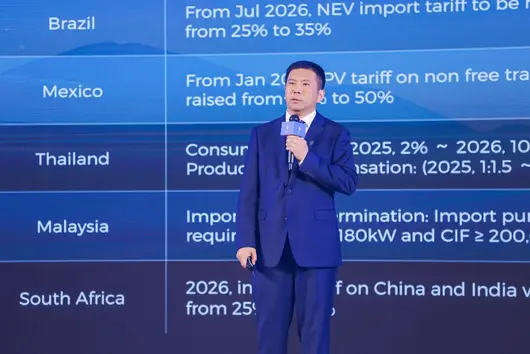

On June 1, Geely Automobile Holdings Co., Ltd. (shturl.) released May sales data, with sales reaching 237,637 units that month, achieving double-digit growth month-over-month and year-over-month for three consecutive months. New energy, overseas exports, and each brand segment delivered outstanding performance, demonstrating strong growth momentum.
Sales Rise Across the Board; New Energy Share Continues to Lead
In May, Geely Automobile's overall sales grew steadily, with its three core brands working in synergy:
Group new energy sales (including Geely, Lynk & Co, ZEEKR) reached 133,355 units, accounting for 56.1%, exceeding 50% for four consecutive months, showing significant results in new energy transformation.
Overseas markets achieved another breakthrough. May export sales reached 85,144 units, a new historical high. Among them, new energy product exports were 40,803 units, accounting for 47.9%, with global layout continuously deepening.

Multiple Brands Work in Unison; Product Matrix Continues to Upgrade
ZEEKR: Luxury Pure Electric Sales and Value Rise Together; Flagship New Product Leads with Power
The refreshed ZEEKR 009 officially launched on May 19, with a limited-time price starting at 413,800 yuan after benefits. The seven-seat Ultra+"Family Edition" order share exceeded 60%. The new car features a full-stack 900V high-voltage architecture, CLTC range of 720 km, adding 510 km of range in 10 minutes of charging, 0-100 km/h acceleration in just 3.9 seconds, paired with a 700 TOPS computing power Thor-U chip, achieving the pinnacle of intelligence and performance.
ZEEKR 7X global cumulative deliveries exceeded 160,000 units, expanding to over 40 regions in one year of going global; ZEEKR 9X cumulative deliveries surpassed 60,000 units, with shooting brake model confirmed orders continuously breaking 10,000.
Lynk & Co: Electrification Transformation Accelerates; Sports Performance Redefined
Lynk & Co May new energy model sales were 14,688 units, accounting for 70.8%. Lynk & Co 10 and Lynk & Co 10+ officially launched at the end of May and started the first batch of deliveries, redefining the standard for mid-to-large size sports pure electric sedans with ultimate driving control.
Coinciding with the brand's 10th anniversary, nearly 100 Lynk & Co stores nationwide completed image refreshes, and channel new energy transformation is landing on a large scale; meanwhile, signing Han Dongjun as the Automotive Sports Ambassador, with frequent race results, winning multiple championships in TCR China and CTCC events.

Geely Brand: Hit Models Frequently; Covering All Sub-segments
Dual Breakthrough in Globalization and Intelligence; Strengthening the Foundation for Development
Overseas markets bloomed in multiple points, with multiple ZEEKR and Geely Galaxy models topping sales lists in sub-segments in countries such as Australia, Mexico, and Malaysia; in May, Geely Automobile reached a strategic cooperation with the England team, continuously expanding the globalization "friend circle."

In the field of intelligence, Qianli Haohan assisted driving cumulative mileage reached 1.38 billion kilometers, activation rate 93.8%, year-on-year growth 215%, cumulative avoidance 8.9 million times, safety strength industry-leading. Geely Galaxy Starship 7 EM-i completed extreme collision tests, demonstrating Chinese automobile manufacturing strength with hardcore safety.
Based on the "One Geely" strategy, Geely Automobile will continue to deepen new energy and intelligence transformation, accelerate global layout, drive the Chinese automobile industry to continue upward with all-round upgrades in products, technology, and brands.
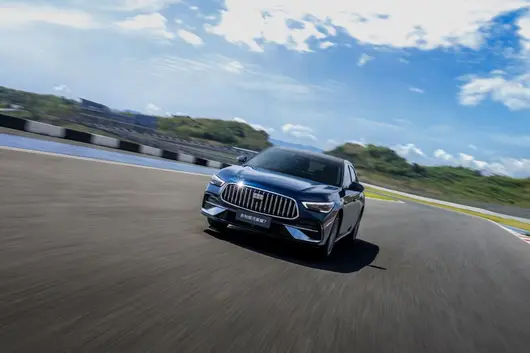
© 2024 Bitauto.com. All Rights Reserved.
Bitauto (www.yiche.com and www.bitauto.com) is one of the most visited automotive websites in China. We provide detailed info on Chinese car brands available in your area. Please note that the information provided on this website is based on publicly available data and is for reference only. It may not be fully updated or accurate at all times.

Help us improve our website


