

HomeFinancial Report

Search History
Popular Searches
Dealer Login / Sign Up

Recently, BYD's first half 2026 financial report was released.
In the first half, BYD achieved operating revenue of 344.815 billion yuan, net profit attributable to parent company of 12.325 billion yuan, scale continued to firmly rank at the forefront of the domestic automotive industry; R&D investment was 28.9 billion yuan, cash reserves 167.4 billion yuan, one side is actual cash technology investment, one side is a solid cash foundation.
On the sales front, in the first half, total vehicle sales exceeded 1.8 million units, continuing to firmly hold the top spot in global new energy vehicle sales. Putting these numbers together, the silhouette of a leader with a massive scale, stable cash flow, and continuing high-intensity investment is basically established.

Everyone has seen this market trend this year. The price war has been raging since the beginning of the year until now. Revenue and profits of mainstream domestic and foreign automakers have been affected to varying degrees. At this time, reviewing the leader's financial report actually best reveals who is holding on hard and who is building momentum.
Why does the current period profit not look impressive?
Many people ask this question; it is actually due to two factors:
First is exchange rates,during the same period last year, the RMB contributed over 3.1 billion yuan in exchange gains to BYD. This year, it recorded losses of several billion in reverse. One in, one out, totaling nearly 8 billion, all reflected in financial expenses. This part has nothing to do with the profitability of the main business;
Second is R&D,the 28.9 billion investment in the first half was 16.5 billion higher than the net profit in the same period, of which the expensed portion directly reduced the current period profit.
One is external disturbance, one is active spending, neither represents a problem with the main business. Whether the main business is actually good or not, Q2 data is the most honest. Single quarter net profit increased 30% year-on-year, gross margin 18.9%, reaching a new high in nearly a year. The signal of profitability recovery is quite clear.

Looking at the sales structure again, in recent years BYD has firmly pursued the premiumization strategy.
These three high-end brands Fang Cheng Bao, DENZA, and YANGWANG sold a combined 228,000 units with a year-on-year growth of 61%, accounting for 12.6% of the group's total sales. On average, 1 out of every 8 cars sold is a premium car.
Fang Cheng Bao is the strongest, 160,000 units in half a year, year-on-year 163%; DENZA monthly sales first broke 20,000 in June, average price stood around 360,000 yuan; YANGWANG in the million-level segment, is the fastest to sell 10,000 units among domestic new energy.
The premium matrix volume increase directly steadily lifted the average price per vehicle. This item is already ranked at the forefront among mainstream automakers.

The internationalization section is the part with the highest value in my opinion.
Overseas sales in the first half reached 790,000 units, a year-on-year increase of 68%. Business expanded to over 120 countries. UK, Brazil, Thailand several core markets directly won new energy sales champions. The more critical watershed is at the revenue end. For the first time, the proportion of overseas revenue in the first half exceeded half, for the first time surpassing the domestic market.
Some institutions calculated a figure. BYD's overseas average vehicle price is about 184,400 yuan, domestic is 127,200 yuan. The difference is nearly half. Selling the same car overseas is more profitable.
BYD is still moving factories overseas. Brazil and Thailand are already in production. Hungary will follow in the second half. Moving from product export to capacity export gives the confidence to bypass the tariff hurdle.

R&D investment of 28.9 billion yuan, where did it all go?
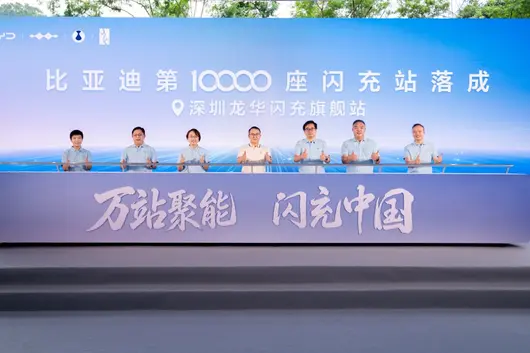
BYD invested 28.9 billion in R&D in the first half, cumulative total exceeds 270 billion. The second-generation Blade Battery and Flash Charging unveiled in March pushed mass production refueling speed to the global top tier. 10,000 Flash Charging stations built, covering 332 cities. In May, it became the only automaker globally to provide backing for both Smart Parking and City Navigation. China's first self-developed 4nm intelligent driving chip Xuanji A3 is already in mass production. By the end of July, 3.52 million vehicles equipped with assisted driving have run on the roads.
These investments consume money in the short term, but looking long-term they are all moats. It was not vague with upstream suppliers either. Payment terms for SMEs suppliers are pressed to 60 days cash payment. Accounts payable and note turnover days are 141 days, which is at a low level among mainstream automakers.

When the industry slows down as a whole, it is precisely the window for companies to separate themselves.
BYD's path in this semi-annual report is clear. On one side, rely on premiumization to raise the vehicle price. On the other side, rely on internationalization to open up profit space. At the same time, use R&D far exceeding current profit to build high future barriers, demonstrating a continuous and steady development foundation.
That profit curve rising again in the second quarter is the first signal that this strategy is starting to pay off. For the following few quarters, it is worth continuing to watch.

“Selling cars doesn't make money" — this industry joke ultimately came true as a prophecy.
The price war has lasted three years, and industry profit margins have fallen from 7.8% ten years ago to 1.5%. "Quantity and profit cannot be had together" changed from a phenomenon into industry consensus.

But Geely overturned this consensus with a set of data — in the first half of this year, automotive sales reached 1.42 million units, a slight year-on-year increase of 1%; revenue was 173.6 billion yuan, a surge of 15% year-on-year; core net profit attributable to the parent company reached 9.68 billion yuan, a surge of 46% year-on-year; core net profit attributable to the parent company per vehicle was 6,806 yuan, an increase of 45% year-on-year.

Sales up 1%, profit up 46%.This isn't piled up by "selling more cars, thin margins on high volume", but every car is earning more money. If you look at it over a longer time, this is Geely's sixth consecutive year of positive revenue growth. In a cycle turning from "incremental competition" to "stock elimination", these five words "Volume, Price, and Profit All Rising" are the most hardcore footnote of this semi-annual report.
One Geely, Clenched Fist
The data is there, anyone can calculate the accounts. But what is more worth asking is — Geely, on what basis?
The answer is hidden in a strategy launched two years ago. In September 2024, Geely released the "Taizhou Declaration", proposing five major measures of "Strategic Focus, Strategic Integration", declaring a move from the expansion era of "raising many children to fight well" to the focus era of "returning to one Geely".

At that time, Geely answered the two questions most focused by the market: Why and How?
The answer to the former is very direct: change the past situation of scattered brands fighting separately, concentrating resources into a fist; the path for the latter is also very clear: Zeekr, Lynk & Co., Galaxy, and China Star, the four major brands, are under one corporate structure, with the Central Research Institute, supply chain, and manufacturing system all connected. In August this year, a General Sales Company was established, with four brand sales companies under it, further coordinating marketing resources. From R&D, manufacturing, procurement, to sales, "One Geely" completed the last piece of the puzzle.
The effect of integration was also directly written into the income statement — administrative expense ratio dropped to 1.7% in the first half of the year, R&D expense ratio dropped to 5.2%, money was spent less, efficiency was higher.

The four brands also have their respective duties. Zeekr carries the profit, selling 178,000 units in the first half of this year, accounting for only 12.5% of total sales, but contributing 31.7% of revenue — this is the power of premiumization; average transaction price 350,000, already exceeding BBA.
Galaxy pursues volume, selling nearly 520,000 units in the first half of the year, breaking into the top three globally in new energy. Running volume in the mainstream market, spreading costs, is Geely's basic foundation.
China Star defends internal combustion, selling over 580,000 units in the first half of the year, securing the first place in Chinese brand internal combustion car sales for the 10th consecutive year. Industry internal combustion cars dropped 31.9%, China Star only dropped 8.8%, holding the internal combustion camp with product power.
Lynk & Co. focuses on differentiation, over 144,000 units in the first half of the year, new energy penetration rate reached 65%, labels of "trendy, sports, individual" are stuck tighter, doing what they are good at in niche markets. "No fighting, no internal friction" — this is not one brand fighting, but four pillars holding up Geely's profit chassis simultaneously.
Second Curve, Expedition Overseas
After stabilizing the domestic market, Geely turned its eyes to further places.

While the domestic auto market is still fighting in price wars, Geely cars are already loaded onto ocean freighters. In the first half of the year, Geely's overseas export sales reached 474,200 units, a 158% year-on-year increase, exceeding the total export volume of the entire year of 2025. In June and July, overseas monthly sales exceeded 100,000 units consecutively.
Horizontal comparison is more intuitive — Geely has the highest export growth rate among mainstream Chinese automakers, total export volume and new energy export volume both ranked in the top three among Chinese automakers. The proportion of exports to total sales was pulled from about 13% last year's same period to 33%.

But more valuable than sales volume is the structure of exports — in the first half of this year, Geely's new energy vehicle exports reached 277,200 units, a surge of 585% year-on-year, accounting for 58.5% of total exports. That is to say, in the cars Geely sells overseas, over half are new energy — not moving domestic fuel cars that can't be sold overseas to clear inventory, but pushing the most advanced products to the global market.
At the same time, Geely's approach is also upgrading: from "whole vehicle export" to "system overseas". In the first half of the year, overseas manufacturing plants put into operation reached 12, overseas capacity exceeded 650,000 units, expected to exceed 840,000 units by year-end. Geely Auto Board Chairman An Conghui disclosed longer-term layouts at the performance meeting: Volvo Europe factory will undertake Geely system's luxury car production; Proton Malaysia factory is undergoing technical transformation, planned for upgrade to 500,000 unit-level Southeast Asia manufacturing base; Ford joint venture Spain factory capacity is also 500,000 units. From "selling cars out" to "building factories out", Geely is completing the leap from product overseas to industrial overseas.

And based on the first half-year growth rate, Geely has raised the full-year overseas sales target from 640,000 units to 920,000 units, and shouted the slogan of sprinting to 1 million units, long-term goal is overseas contributing two-thirds of total sales.
From 13% to 33%, then to two-thirds, a clear upward curve outlines Geely's overseas market growth trajectory, and also marks a key node of a Chinese automaker leaping to a global company.
Smart Track, Heavy Bet on AI
One seeks efficiency inwards, one seeks increment outwards —
Integration is tightening resources, going overseas is opening the market. But this merely solves the problem of getting to the table, wanting to win the game, you still need to place a bigger bet.

Open Geely's R&D ledger: R&D investment 9.06 billion yuan in the first half of the year, year-on-year growth 8%, R&D expense ratio actually dropped 0.3 percentage points. Money was spent more efficiently, but R&D investment absolute value is still rising — this money, most of it thrown to one direction: AI.
In January 2026, Geely announced on US CES that full-domain AI technology system evolved to 2.0 era. Core breakthrough is based on self-developed WAM World Behavior Model, achieving cross-domain fusion of AI technology in various domains of the whole vehicle, allowing automotive intelligence to first possess a continuous evolving "worldview" and "judgment capability".

Based on WAM model, Geely built a so-called "1+2+N" multi-agent collaboration framework, core logic is not complex: one brain unified scheduling, Super Eva and Qianli Haohan G-ASD respectively responsible for "thinking" and "moving", then extended to all vehicle function modules. Simply put, you say a sentence casually, behind there might be several intelligent modules working together — understand intent, plan path, control vehicle, adjust cockpit, all in one go.
On the ground, Qianli Haohan G-ASD already covers Zeekr, Lynk & Co. brand 16 car models, equipped vehicles over 300,000 units. In 2026, Geely plans to push highway L3 and urban L4 functions under legal permission, and realize Robotaxi commercial operation.

Different from the industry's common "Product Intelligence" — adding a pile of functions to the car, Geely embedded AI into the full chain from design, R&D, manufacturing to after-sales. i-HEV Intelligent Engine Hybrid, AI Digital Chassis, 16-in-1 Intelligent Electric Drive launched in the first half, behind them all have shadows of AI large models. At the same time, further chess game has been played: Geely has deepened cooperation with NVIDIA, also plans to establish 2030 Laboratory, layout power semiconductors, embodied intelligence, large models and other frontier fields.
If "One Geely" is the chassis, going overseas is the accelerator, then full-domain AI is the steering wheel — it determines where this company will finally drive to. And Geely official stance on this matter is: Accelerating towards "Full-domain AI Intelligent Vehicle Leader".
Ending:

"This is an eye-catching financial report, but not yet at the level of dazzling." At the performance press conference, Geely Auto Board Vice Chairman and Executive Director Gui Shengyue gave four judgments: Above Expectations, Eye-catching, Not Dazzling, Can Sustain Long Term with Huge Room for Improvement.
And behind this exactly corresponds to the three-fold logic of Geely's semi-annual report: Above Expectations, it is efficiency release brought by integration; Eye-catching, it is growth space opened by going overseas; And Not Dazzling but Huge Room for Improvement, it is sober cognition of this AI marathon — trump card has been shown, but the final outcome is far from coming.
For the industry, the greatest value of Geely's semi-annual report is not providing another "case of making money", but providing a "sample of how to live well in a stock elimination cycle" — not relying on price wars, not relying on stacking configurations, relying on strategic determination, system capability and forward-looking layout. This is Geely's answer, and also its deepest moat.


Suddenly, the "Ning King" came out to make a splash again.
On the evening of July 24, CATL released two major documents simultaneously. One was the 2026 Interim Financial Report. Revenue in the first half was 276.91 billion yuan, a year-on-year increase of 54.80%. Net profit attributable to the parent company was 43.284 billion yuan, a year-on-year increase of 41.98%. Calculated, this means daily earnings of 240 million yuan.
The other was a buyback plan, proposing to use funds not less than 20 billion yuan and not more than 40 billion yuan to buy back A-share shares for cancellation, with a buyback price cap of 573 yuan per share, a premium of nearly 50% compared to the closing price of the day. This amount cap set a record high for single share buybacks in the history of A-shares.
At the same time, multiple new energy vehicle manufacturers successively released half-year profit forecasts, with many facing profit pressure. Industry chain profits are visibly concentrating on the battery segment, and this is indeed a major source of CATL's profits. However, if you turn to the details of CATL's financial report, you will find a fact overlooked by the outside world.
That is CATL's true growth engine is actually not just power batteries. Or rather, the game CATL is playing is far bigger than what the outside world sees.
Beyond Vehicle Power Batteries, Pulling Up a Second Growth Curve
In CATL's financial report, the most worth noting is its healthy revenue structure. In the first half, the power battery business contributed 192.125 billion yuan in revenue, accounting for 69.38%, remaining the absolute major portion. However, the performance of the other two businesses is also inescapable, showing a trend of accelerated growth.

First, energy storage battery business revenue was 53.261 billion yuan, accounting for 19.23%, a year-on-year increase of 87.54%. Battery materials and recycling, mineral resource business revenue was 18.811 billion yuan, a year-on-year increase of 67.23%.
More critically, power battery gross margin of 20.63% and energy storage battery 23.96% both saw year-on-year declines, while the gross margin of battery materials and recycling business reached 27.04%, an increase of 5.81 percentage points year-on-year.
That is to say, among the three major main businesses, the only one achieving gross margin improvement is the "recycling business" that outsiders ignore most easily.
Looking further down, CATL has also accumulated considerable capital in the ship power battery field.
Already cumulatively delivered over 900 ship batteries. The first all-electric inland container ship exported from China delivered in the first half of 2026, also equipped with CATL's battery energy storage system. In July, also acquired a stake in Jiangsu Kaiyang Shipbuilding Company, increasing investment in the technical development of ocean-going ship battery systems.
In the commercial vehicle field, sodium-ion batteries have gone into mass production installation, the Tianxing series covers multiple sub-scenarios from logistics vehicles to heavy trucks. In the battery recycling field, holding company Bangpu Recycling has built the nation's largest directional recycling base, with an annual retired battery processing capacity of 270,000 tons, and nickel, cobalt, and manganese recovery rate is as high as 99.6%. The team also won two honors at the European Patent Office's "2026 European Inventor Award" this year, becoming the first Chinese team to win dual awards since the award's inception.

These businesses together constitute CATL's second growth curve beyond power batteries.
When lithium battery scrap volume grows at a speed of more than 20% annually, when the commercialization window for electric ships opens gradually, and when AI computing power data centers begin to propose new structural demands on energy supply, CATL has already extended its tentacles into these tracks. Company executives also clearly stated at the performance exchange meeting that AIDC presents a clear structural market opportunity. CATL will not just provide single product supply, but wants to provide more comprehensive solutions around new energy scenarios.
Therefore, from the financial report it can be seen that CATL's high-speed profit growth in the first half, a large part comes from storage, from recycling, from overseas, rather than simply "earning one more cent" from vehicle manufacturers.
Of course, a fact must be admitted here. The gross margin of the power battery business is indeed declining, price competition pressure in the domestic market is real. Moreover, CATL also has its shortcomings.
The "poaching talent and stealing technology" publicly condemned by Zeng Yuqun previously, lost orders in the Middle East market, additional costs brought by consumption tax policies, these are challenges on the table. It's just that these challenges have not covered up the longer-term growth curve.
Earn Money from "Foreigners", Also Earn Money for the Future
If diversification is CATL's first line of defense against industry risk, then globalization is the second moat it built. From this point of view, CATL is also half a step ahead of current auto companies. The overseas dividends it received are exactly the "big results" that current auto companies are striving hard to layout overseas business to obtain.

In the first half, CATL overseas revenue reached 87.1 billion yuan, gross margin 29.97%, nearly 9 percentage points higher than domestic business gross margin. Overseas market share 33.7%, Hungary, US, Indonesia three overseas factories successively put into production, Volkswagen, BMW, Toyota and other global mainstream car companies lie in the customer list.
Morgan Stanley gave a judgment in the latest report. Diesel vehicle electrification, storage super cycle, sodium-ion battery product cycle, will jointly support CATL to continue strong growth in 2027.
The key point is, CATL overseas business gross margin is significantly higher than domestic. This means, its bargaining power in the global market is actually stronger than in domestic. This is somewhat different from the common perception that "Made in China conquers the world with low prices".
CATL management gave the explanation at the exchange meeting as "Competing on value, not price". This sounds a bit official, but combining with gross margin data, it indeed has its confidence.
Zeng Yuqun summarized CATL's current strategic positioning into one sentence: From "New Energy Industrialization" to "Industrial New Energyization". The first half is what CATL did in the past ten years, making the concept of new energy into a real industry. The second half is what it plans to do in the future, using new energy to transform more traditional industries.
Ships, commercial vehicles, computing power data centers, mineral resources, these are all the landing points of "Industrial New Energyization". Zeng Yuqun himself judged, the future downstream industry boundaries may reach over a thousand times the current level.
And if this judgment holds, then the 40 billion buyback big move is easy to understand.
The company's current stock price is undervalued, this is the core logic of the buyback. On the day the financial report was released, CATL A-share closing price was 383.01 yuan, while the 52-week high was 468.75 yuan. Performance hit a new high, but the stock price fell nearly 20% in half a year. CITIC Securities gave a target price of 490 yuan, UBS 600 yuan, Macquarie HK stock target price 700 HKD.
Under this premise, the real money 40 billion buyback is an attitude given by management to the market.

More importantly, the implementation, all bought-back shares are used for cancellation, not kept for equity incentives, nor placed in treasury stock accounts. This means total share capital decreases by about 69.8 million shares, rights allocated to each shareholder will rise.
Of course, this confidence also needs some question marks. Lithium prices recently showed a rebound, Yichun Jianxiwo lithium mine resumption approval may bring cost fluctuations, consumption tax phased collection from 2% to 4% test on downstream bargaining power, are realities CATL must face next.
However, compared to challenges, this financial report indeed let us see a strong resilience and strategic vision shown by an industry leader. From this point of view, CATL is still the undoubted leader of the new energy sector, without a doubt.
© 2024 Bitauto.com. All Rights Reserved.
Bitauto (www.yiche.com and www.bitauto.com) is one of the most visited automotive websites in China. We provide detailed info on Chinese car brands available in your area. Please note that the information provided on this website is based on publicly available data and is for reference only. It may not be fully updated or accurate at all times.

Help us improve our website


