

HomeFirst

Search History
Popular Searches
Dealer Login / Sign Up

On November 15, 1977. A customized gas-powered Fairmont Futura rolled off the line at the New Jersey plant. This was Ford's 100 millionth vehicle produced in the US. Under the pressure of the CAFE mandate, the influx of Japanese cars, and controversies over excessive cost-cutting, Ford decided not to sell this car. Instead, it used it to kick off a cross-coast tour to celebrate.
When the Detroit Three and Toyota were staging a showdown of the century in the world's largest auto market, a bold idea appeared on the banks of the Huangpu River, 11,460 kilometers away. The accumulation of handmade Phoenix sedans became the momentum for Shanghai-brand sedans entering a steady development phase. Even with an annual output close to 3,000 units, this still could not meet the soaring demand. The concept of adopting Ford's assembly line operations for China's sedan production was brought back to the agenda.
Joint venture cooperation with transnational automakers became the most realistic option. Across the domestic automotive industry, there was only one place capable of mass-producing sedans and having an assembly line: Shanghai. Next, the story of China's auto industry entered the SAIC Volkswagen (now known as: SAIC Volkswagen) era. Amidst the acclaim of "driving a Santana anywhere is safe", transnational car companies rushed to China to seek fortune. The craze of sedans entering ordinary households caused the world's largest auto market to shift accordingly. After the fierce competition of the fuel vehicle era, the machine changing the world gradually switched to the smart-electric track.

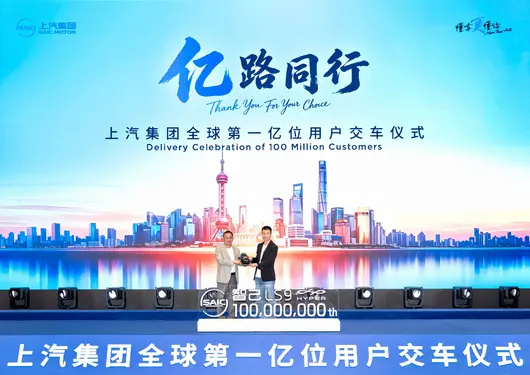
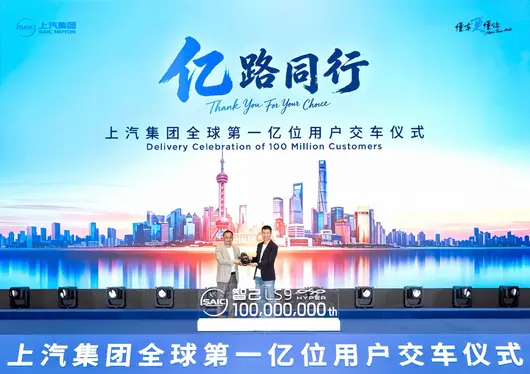
On the afternoon of May 28, 2026. Inside the World Living Room of North Bund, Shanghai. SAIC Group Chairman Wang Xiaoqiu handed an IM LS9 Hyper exclusive custom model to Momenta CEO Cao Xudong. Applause erupted, they shook hands, and SAIC Group's 100 millionth vehicle delivery was frozen in time. Over 70 years of vehicle building journey converged in the giant waves of Shanghai's new era, making SAIC the first Chinese vehicle group to enter the global 100 million-level auto camp: Leading the charge at the forefront of the tide.
In January 1997. Toyota welcomed its 100 millionth car after 50 years. Cross Ford's assembly line operations, Toyota used its unique lean production method to pull the efficiency of the fuel vehicle era to the peak. In the shadow of the Heisei recession and the Asian financial crisis, Japanese cars completed the disassembly of the Euro-American auto myths. Amidst a chorus of praise, Toyota did not indulge in the steel dividends piled by 100 million fuel vehicles. Less than 10 months later, Toyota shocked the world again. The Economist wrote at the turn of the century: When Detroit was still obsessed with the roar of large-displacement SUVs, this Eastern automaker knocked on the door of green and low-carbon early with the Prius.
Now, SAIC IM LS9 Hyper is accelerating the transformation of the auto world with a Chinese way. This car is equipped with the next-generation Star Super Extended-Range Power System, the next-generation Full-Line-by-Wire Four-Wheel Steering System, and the next-generation Intelligent Driving Technology. Every item points to the highest standards of the next generation of electric vehicles. It is both the culmination of SAIC's 70 years of vehicle building foundation and technology, and more importantly, a declaration of China's new energy to the auto world. If the Prius was a gentle reform of the fuel vehicle order, then SAIC IM LS9 Hyper is a breakthrough reshaping of the global automotive gravitational field. Chinese Academy of Engineering academician Wu Wangxing said that LS9 Hyper implants China's original endogenous safety system into the car, which is a very important highlight moment for the whole world: it is the flagship benchmark for the Chinese automotive industry entering the "Fourth Generation Electric Vehicle" era.

Looking back, from a golden phoenix hatched from a grassy nest, to SAIC Volkswagen taking root in Anting, to SAIC GM rising in Pudong, MG, Roewe, IM, Wuling, Baojun, Maxus, etc. have become the backbone of independent brands, Shangjie and Huajing are forging new roads for vehicle building; from fuel vehicles to pure electric; from passenger cars to commercial vehicles; Shanghai's open-mindedness that accepts hundreds of rivers has made SAIC Group different: no technical walls, no ecological islands.
In May 2005. With a silver Touran rolling off the production line, Wolfsburg's 100 millionth car pushed the Volkswagen brand to the 100 million automobile brand club. It is the highest harvest of human mechanical manufacturing system on hardware replication consistency. The golden age of China's automobiles provided even richer dividends for Volkswagen. Crossing the threshold of 100 million automobile scale has never been in the soil of coincidence. In the slice of auto history, it corresponds to three hardcore indicators: anti-risk ability in the face of external changes, industrial consistency under a modern manufacturing system, and strategic agility.
20 years later, these three hardcore indicators welcome a redefinition of smart electrification. Entering 2026, the new energy penetration rate of China's auto market continues to climb. Among them, the penetration rate of passenger cars in April broke through 60 percent for the first time. Standing at the new starting point of cumulative 100 million vehicles, SAIC Group has demonstrated strategic agility in capability output to the global auto market.

This May, SAIC Group's vehicle sales reached 349,000 units, continuing to hold the top position in the industry. In the first five months, independent brand cumulative sales reached 1.173 million units, up 8.6% year-on-year; new energy vehicle sales reached 595,000 units, up 13.2% year-on-year; overseas market sales reached 589,000 units, up 45.9% year-on-year. Independent joint ventures, passenger and commercial vehicles, domestic and overseas working in the same direction, promoting SAIC to continue upward while navigating the cycle.
It is worth mentioning that SAIC's joint venture new energy sector also welcomed new growth points. Joint venture new energy made a strong comeback in May. SAIC GM's new energy vehicle sales in May reached 13,000 units, up 75% year-on-year, with Zhijing E7 deliveries breaking 10,000 in its first month after launch. SAIC Volkswagen's new energy vehicle sales in May reached nearly 10,000 units, up 34.3% year-on-year; the newly launched ID.ERA 9X cumulative deliveries exceeded 7,000 units.
SAIC GM Buick's Series 7 models adopt the locally self-researched Xiaoyao Super Architecture, with the Zhenlong Hybrid Power System. From the three-electric system to high-level intelligent driving with LiDAR redundancy, the underlying R&D logic is realized through localization. SAIC's technology output allowed the Buick brand to be reborn. SAIC Volkswagen's flagship SUV model for the Volkswagen brand, ID.ERA 9X, and Audi's AUDI E7X, are all aggregating global resources and precisely customizing for Chinese users' smart-electric needs.
At this year's Greater Bay Area Auto Show, the AUDI E7X officially launched with a starting price of 269,800 RMB, becoming a new answer for BBA solving the China puzzle. With the dense landing of these models, the cooperation between SAIC Group and General Motors and Volkswagen has completed a transgenerational transition from introducing technology to joint development, to the current "Joint Venture 2.0". Volkswagen's 100 million units in 2005 was built on the fuel dividends of 23 million Golfs and 13 million Passats, erecting the peak of hardware replication consistency.
SAIC Group's 100 million units in 2026, one of its most core contents, is through its own technology and architecture output, restructuring the cooperative division of labor of joint venture brands. This has become the optimal solution for transnational automakers to establish themselves in the Chinese market. This round of new energy transformation in the global auto industry is stormy with uncertainties. Holding the trump cards of technology, SAIC has gradually established a position as a rule maker in the future smart-electric era: Ignore the sound of wind and rain through the woods; why not chant aloud and walk leisurely?
In September 2024. After 57 years of building the factory, a Hyundai IONIQ 5 produced at the Ulsan plant pushed its production record to 100 million. This is the Han River Miracle, a new narrative in the history of the world auto business. The Hyundai Motor Group, therefore, became one of the most globalized automakers. After the export volume of Chinese automakers climbed to the scale of 8 million units, Korea and Japan's auto export records were rewritten. The example of Hyundai and Toyota advancing globally has a new protagonist.

On May 30, 2026. After SAIC Group stood on the first 9-digit delivery volume, the first user of the next 100 million appeared in the UK. London doctor Natalia exchanged her grandfather's MGB from memory for the new generation MG4 EV Urban. The ticking pointer brings a new story. In Shanghai Pudong, in Jakarta, Indonesia, in Lantian, Shaanxi, in Singapore DHL Supply Chain Advanced Regional Center, in Taiyuan, Shanxi, in Hechi, Guangxi, the delivery of 15 brands under SAIC Group is laid out by the second.
Along with the alternating pictures on the screen, SAIC Group's Glocal strategy extends a new outline. It is no longer traditional commodity foreign trade and one-way export of products, but using the whole value chain's Chinese smart-electric core to comprehensively fit the specific lives of different global time zones: Every car of SAIC must turn China's best intelligent technology into steady happiness within reach for every family in the world.
In Oceania, MG's small cars rank at the head of the niche market; in Thailand, MG has become the most stable growing Chinese brand; in 7 countries of South America, MG's sales are approaching the 10,000 unit mark; in Europe, MG has held the European sales champion of Chinese brands for 11 consecutive years, and is also the first Chinese automobile brand with sales breaking 1 million.
In the first five months of this year, cumulative sales exceeded 150,000 units, up 20% year-on-year, continuing to lead Chinese brands. The glory of 100 million+, rushes forward along the Huangpu River. In London's rain, in Bangkok's sunset, in the waves of the Suez Canal, in every corner where Chinese smart-electric solutions take root, it is a new answer sheet of a more international SAIC Group: Stars hang low over the vast plains; the moon surges with the flow of the great river.

For the Chinese automotive industry, May 28, 2026 is a memorable day.
With the "Global 100 Millionth User Handover Ceremony" held at the Shanghai North Bund World Living Room, SAIC Motor Chairman Wang Xiaoqiu handed the 100 millionth vehicle IM LS9 Hyper to Momenta CEO Cao Xudong, marking the birth of the first Chinese automotive group with cumulative production and sales exceeding 100 million units!

This is not only a milestone moment for SAIC, but also a glory belonging to Made in China and the Chinese automotive industry. Looking back at the journey of China's first 100-million-level car manufacturer, SAIC's success is traceable.
Over 70 years of deep cultivation: SAIC achieved a "small goal" of one hundred million
Success never happens overnight. From 0 to "one hundred million", SAIC Group experienced over 70 years of deep cultivation, with generations exerting huge efforts. In 1955, the Shanghai Internal Combustion Engine Parts Manufacturing Company was established, and Shanghai's automotive industry started from there. In 1958, workers knocked out the first "Phoenix Brand" sedan with hammers, achieving a "zero breakthrough" for Shanghai sedan manufacturing.
Then in 1983, the Shanghai Volkswagen Santana came off the line, opening the door for joint venture cooperation; in 1997, Shanghai GM was established, creating the "Shanghai Speed" of 23 months to build a factory and produce vehicles; in 2006, the independent brand Roewe was born, and in 2016, the world's first Internet car Roewe RX5 was launched; in 2020, the high-end smart electric brand IM Motors was established.

From the Santana localization community to joint venture 2.0 technology co-creation, from Internet cars to full wire-controlled chassis, solid-state/semi-solid-state batteries, and AI large models on vehicles. In fact, every leap was an advancement in "knowing cars" capability, a inheritance of the original intention to "know you". SAIC's "Knows Cars, Knows You Better" user philosophy has been consistent throughout.
The 100 Millionth Delivery Vehicle, IM LS9 Hyper!
As SAIC's 100 millionth delivery vehicle, the IM LS9 Hyper's status cannot be underestimated. It is the masterpiece of SAIC's 70 years of technology accumulation, opening a new era for the "New Three Major Components" of new energy vehicles. The IM LS9 Hyper is equipped with next-generation chassis technology, featuring the industry-first full wire-controlled four-wheel steering; next-generation intelligent driving hardware, 520-line ultra-view LiDAR + NVIDIA Thor chip; next-generation three-electric system -- Full-domain 800V high-voltage platform and Star Super Extended Range. It comprehensively pre-embedded redundant capabilities for continuous evolution towards L3 and above advanced intelligent driving. Meanwhile, the IM LS9 Hyper is the first to be equipped with SAIC's Gold Label Hurricane Three-Motor, effortlessly joining the Performance 3-second Club; it also collaborated with Purple Mountain Laboratories to launch the world-first "Endogenous Security" technology, expanding the car safety boundary from "Physical Security" to "Information and System Security", making it an essential security cornerstone of the AI era.

It is worth mentioning that SAIC's 100 millionth user was just Momenta CEO Cao Xudong! Momenta is SAIC's core strategic partner in the intelligent driving field. The intelligent driving technology deeply co-created by both parties has empowered multiple independent and joint venture brands. From partner to car owner, this is a two-way journey between the manufacturer and the user, and even a deep resonance among smart car ecosystem partners.
Global relay delivery staged, SAIC Motor departs for the next 100 million
The 100 millionth delivery is just the beginning. Departing from the Shanghai main venue, relay deliveries took place in multiple domestic cities such as Nanjing, Liuzhou, Taiyuan, as well as countries like the UK, Indonesia, and Singapore. SAIC's full brand and full product matrix worked in synergy, creating a new narrative mode for Chinese car brands.

Among them, independent brands went all out: Shangjie Z7, Huajing S, Roewe M7, MG4 Semi-solid-state Battery Version, Wuling Starlight 560, Maxus eDeliver5, Hongyan Heavy Truck, Yuejin Danan T1, Sunwin Pure Electric Bus, Iveco Juxing EV, etc., were delivered successively, covering diverse scenarios such as personal travel, family life, commercial operations, and logistics transportation. Joint venture brands concentrated on showcasing the achievements of "Joint Venture 2.0": Volkswagen ID. ERA 9X, Audi E7X, Buick Zhijing E7, Cadillac Kaiweide, etc.

Behind the 100 millionth unit lies SAIC's full value chain closed loop covering six sectors: whole vehicles, parts, mobility, services, finance, international operations, and innovative technology. From January to April 2026, SAIC's cumulative sales reached 1.302 million vehicles, ranking as the sales champion of Chinese car companies for four consecutive months. Among them, independent brand sales were 910,000 vehicles, accounting for nearly 70%; New Energy Vehicle sales were 412,000 vehicles; Overseas market sales were 459,000 vehicles, surging by 50.2% year-on-year.
Final Thoughts
After a long run of the real economy spanning over 70 years, SAIC's vehicle manufacturing journey has ushered in a phased victory. As a microcosm and witness of the Chinese automotive industry going from nothing to something, from weakness to strength, SAIC has experienced the transition from scale leadership to quality leadership and technology guidance. Now standing at the new starting point of "100 million units", SAIC is starting a "Second Startup" for the smart electric future, continuing to write the brilliant new chapter for Chinese car companies! (Written by MANGO)

May 28, 2026, on this day, SAIC Group officially became the first enterprise in the history of China's automobile industry to exceed 100 million cumulative production and sales. No speeches from leaders, no product presentations, and no data bombardment on slides. In their place was a "Global Relay Delivery" spanning the Eurasian continent, connecting more than ten brands and nineteen car models. Every delivery moment opened a chapter of someone's life. 100 million vehicles are a number, but more importantly, a mirror. It reflects the ups and downs of an enterprise's seventy-plus years and the microcosm of China's automobile industry knocking out the first "Phoenix" brand from alleyways to standing on the global stage in the Smart Electric Era.

A "Delivery Ceremony" Only SAIC Could Pull Off
If one word were used to define this delivery ceremony, it would be "unreproducible".
It did not take place in a closed convention center but unfolded synchronously in multiple cities worldwide. Beyond the main venue in Shanghai, Nanjing, Liuzhou, Taiyuan, London, Jakarta, Singapore... delivery scenes continued to light up. The countdown went from the 99,999,996th unit to the 100,000,013th unit. Every vehicle delivery opened a real user story.

This "decentralized" ceremony design is not a brand show but an open presentation of system capabilities. Mobilizing a full matrix of 15 brands, from commercial to passenger vehicles, from the 60,000 range to the 500,000 range, from independent to joint venture, from domestic to overseas, and completing delivery under the same time and theme, requires behind-the-scenes whole industry chain collaborative capability.
More critically, it transformed the cold industrial number "100 million vehicles" into personal memories with warmth. For example, a couple returning to their homeland brought MG memories from their stay in the UK back home; a post-85s village party secretary used a Wuling Rongguang Pure Electric to deliver meals to left-behind elderly people; philanthropist blogger Liu Jia cut hair for left-behind children in Guangxi mountains for five consecutive years, and Buick provided immediate aid; he was moved by the "Full-score cabin" of Zhijing E7.
This shift in narrative style is essentially a public test of a "user-centric enterprise". In the past, automotive industry milestone releases were often enterprise-centric—leader speeches, technology presentations, sales data. This time, SAIC handed the stage completely to users, even the 100 millionth user, who was Cao Xudong, CEO of Momenta, a core partner in its smart driving strategy. "Partner becomes owner" is both a coincidence and a metaphor: in the intelligent electric vehicle era, the boundaries between users and enterprises are blurring, and the depth of ecosystem relationships is becoming a new competitive barrier.
The Hidden Card Behind 100 Million Vehicles: System, Globalization, and "Joint Venture 2.0"
If the delivery ceremony is the "face", the "backbone" behind the 100 million vehicles is the whole value chain system built by SAIC over seventy-plus years.

Many people see the data of SAIC ranking first in Chinese automaker sales for the first four months of 2026: cumulative sales of 1.302 million vehicles, independent brands accounting for nearly 70%, new energy vehicle sales of 412,000, and overseas markets surging by 50.2% year-on-year. But more worthy of attention are the structural changes behind these numbers.

Independent brands are no longer the "runner-up" role but the absolute main force. Roewe, MG, IM, Shangjie, Wuling, Maxus... Passenger and commercial lines advance together, covering almost all imaginable scenarios from personal travel to logistics. Joint venture brands have not stayed in the old script of "trading market for technology". Buick Zhijing E7 is based on the "Xiaoyao" Super Fusion Architecture, delivering over 10,000 units within a month of launch; Audi E7X plans to become Audi's first L3 level landing vehicle globally.

As the 99,999,999th delivery vehicle model of SAIC Group, ID. ERA 9X is a sample worthy of separate analysis. This car is not only the flagship for SAIC Volkswagen to counterattack in new energy but also a highly persuasive footnote of the Joint Venture 2.0 era. 11,079 orders locked within 1 hour of launch, 2,326 retail units delivered in 5 days, directly entering the top three of 300,000+ RMB extended-range large high-end SUVs. One month after launch, cumulative deliveries broke 7,000 units. In the high-end extended-range market where joint venture brands have long been suppressed by new forces, this speed breaks the stereotype that "joint ventures can't do new energy well".

Among the first batch of ID. ERA 9X owners, 60% live in first and second-tier cities, over 80% are management elites, over 40% are bosses and company partners, 58% hold a bachelor's degree or above, and average annual family income is 430,000 RMB. Female percentage exceeds 20%, over 85% are married with children, and those aged 25-39 account for more than half. About 40% come from old Volkswagen owners, 20% from traditional luxury brand replacement users. More than half directly chose the high-spec Ultra version. The 6,999th owner is Yang Chen, the first Chinese player in the German Bundesliga. These data point to a clear conclusion: ID. ERA 9X did not trade the market with low prices but truly entered a user group with high education, high income, and complete judgment on products.
From extended-range systems to smart driving algorithms, from chassis tuning to cabin interaction, a large amount of core capabilities come from SAIC and its ecosystem partners' local innovation. This is the most essential change of "Joint Venture 2.0": it is no longer foreign parties giving technology and Chinese parties doing the market, but both sides jointly defining products on the same platform, or even led by Chinese teams on technology routes. Behind these products is SAIC's role transition from "local adaptation" to "technology definition". In the past, joint venture R&D centers were more about executing global headquarters' technology localization, whereas now, SAIC's technical capabilities have started to be output in reverse, participating in the definition of global products. This is what is truly worth paying attention to in "Joint Venture 2.0"—it is not a slogan, but a capability.

Globalization is another hidden card. SAIC is currently the representative with the earliest and largest scale of "going out" among Chinese automobile enterprises. Overseas cumulative sales have exceeded 7 million vehicles. MG has consecutively ranked first in Chinese brand sales in Europe for 11 years, European annual sales in 2025 exceeded 300,000 vehicles, becoming the first Chinese automobile brand to break one million cumulative sales in Europe and the UK. More importantly, SAIC is shifting from "product going overseas" to "value chain going overseas". It possesses over 100 parts production bases, over 3,000 dealer networks overseas, has built three R&D innovation centers including London, and four production manufacturing centers in Thailand, Indonesia, India, and Pakistan. Anji Logistics owns 42 roll-on/roll-off ships, with 8 international routes covering Southeast Asia, Europe, and the Americas.
The depth of this global layout means SAIC is no longer a purely Chinese local automobile enterprise but a true industrial player with global operation capabilities. When many Chinese brands are still discussing how to "go out", SAIC is already thinking about how to "go up".
Technology is Not Just an "Exhibit"
Another key support for 100 million vehicles is the technology landing capability.

SAIC's 100 millionth delivery model—IM LS9 Hyper, is a good observation sample. It is equipped with full steer-by-wire four-wheel steering, 520-line ultra-vision LiDAR, NVIDIA Thor chip, whole domain 800V high-voltage platform, Stellar Super Extended Range, and even jointly premiered the "Endogenous Security" technology with Purple Mountain Laboratories globally, expanding automotive security from the physical level to information and system security. These technical indicators would not be inferior on any international brand's high-end models.

But more worthy of attention is that these technologies do not only exist on IM's flagship models. The Roewe i6 in the 60,000 range comes standard with 8155 chip and Doubao Large Model; the Buick Zhijing E7 in the 150,000 range is the first to equip Doubao Deep Thinking Large Model; the Shangjie Z7 in the 200,000 range carries Huawei ADS 4.1+896-line LiDAR, with 12,000 large orders in 27 minutes of launch. This landing capability of "technological democratization" is the real gold content of SAIC technology breakthrough. It shows that SAIC's technology logic is not "stacking specs" but precise matching around user real scenarios. Whether it is the "Smart Brain" end-to-end smart driving large model, or the "Robust Body" Digital Chassis 2.0, or the "Powerful Heart" thermal efficiency 46.3% DMH hybrid system, they all have to answer the same question: What can users perceive?

SAIC's answer is: From understanding cars to understanding you. Understanding cars is the extreme pursuit of core technology, and understanding you is precisely landing every cutting-edge technology into user-perceivable and enjoyable travel experiences. This sentence sounds like a concept, but from the delivery list of 100 million vehicles, it has been broken down into countless specific product decisions.
From "Leading the Horse Pack" to "Thousands of Galloping Horses"
In 2014, SAIC pioneered a comprehensive transition to new energy. At that time, many in the industry were still watching and waiting. Twelve years later, SAIC gave its own answer with 100 million vehicles. These twelve years happen to be a complete zodiac cycle. From the then "Leading the Horse Pack"—pioneering transformation, pioneering investment, pioneering going overseas, to the current situation of independent, joint venture, commercial, passenger, domestic, overseas "Thousands of Galloping Horses", the road SAIC has walked is almost a microcosm of China's new energy vehicle industry.

Behind 100 million vehicles is nearly 150 billion RMB in R&D investment over the past decade, nearly 26,000 effective patents, and two National Science and Technology Progress Awards. But its more important value lies in answering an industry-level question: When scale expansion meets a ceiling, how should Chinese automobile brands proceed next? SAIC's answer is "Second Entrepreneurship". This word sounds a bit old-fashioned, but placed in today's context, it points to the transition from scale leadership to quality leadership. 100 million vehicles is not the end but a new starting line. Next, what needs to be competed for is not who sells more, but who can define standards in the global market, establish irreplaceable brand assets in users' hearts, and continue to invest in technology no-man's land and achieve a commercialization loop.

From workers using hammers to knock out the first Phoenix brand sedan in 1958 to the IM LS9 Hyper with endogenous security technology driving off the production line in 2026, SAIC completed the leap from zero to 100 million in nearly seventy years. And the true revelation of this leap may not lie in the number itself, but in the fact that it proves one thing: China's automobile industry has the ability to walk a road from following to parallel running, and then to leading in local areas.
The Next 100 Million Vehicles, SAIC's Journey Has Just Begun.
© 2024 Bitauto.com. All Rights Reserved.
Bitauto (www.yiche.com and www.bitauto.com) is one of the most visited automotive websites in China. We provide detailed info on Chinese car brands available in your area. Please note that the information provided on this website is based on publicly available data and is for reference only. It may not be fully updated or accurate at all times.

Help us improve our website


