

HomeGalaxy Starlight 7

Search History
Popular Searches
Dealer Login / Sign Up

Recently, Geely's series of moves were quite aggressive. Besides the adjustments in executive management, the layout and specific operations of the overseas market also have clearer plans. First, regarding sales targets, Geely's 2026 exports were raised from 640,000 vehicles to 920,000 vehicles, challenging an annual sales volume of one million.

In the first half of the year, Geely's overseas sales were approximately 480,000 vehicles, a year-on-year increase of 158%. With the traditional peak season of the second half of the year, Geely's standard for raising the sales target is very pragmatic, and there is a high probability of successfully challenging an annual sales volume of one million vehicles.

Meanwhile, Geely Holding Group CEO An Conghui stated: Volvo's factories in Europe will become an important base for Geely's European strategy, undertaking the production of high-end luxury cars within the Geely Automobile Group, expected to start production in 2028. Looking at the data, Volvo's year-on-year decline in the European market in 2025 was 10%, dropping to approximately 332,700 vehicles.

Entering the first quarter of 2026, Volvo's sales in Europe and other regions worldwide were 95,335 vehicles, a further year-on-year decline of 2%. Global sales from March to May were 179,000 vehicles, a year-on-year drop of 5.5%. The surge in Geely's sales in the overseas market can just utilize Volvo factories' idle capacity, which is quite reasonable.
Meanwhile, regarding layout in other overseas markets, Geely previously acquired Proton's factory in Malaysia. After upgrading, it has an annual production capacity of 500,000 vehicles to meet the needs of the Southeast Asian market. In South America, it relies on Renault Brazil's industrial collaboration, sharing manufacturing resources and market channels between the two parties, significantly reducing the investment cost of building its own factories.

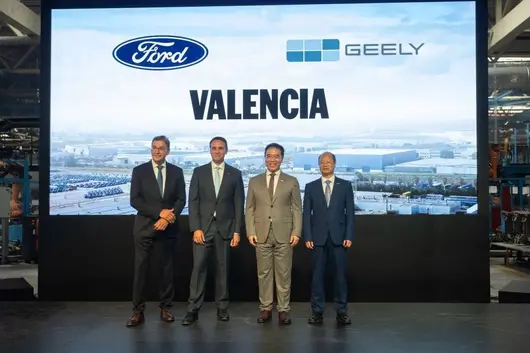
Additionally, in July this year, Geely and Ford also reached an agreement. Both parties will establish a joint venture company in Valencia, Spain. Through capacity sharing, they will create various new energy vehicle models for the Ford and Geely brands for the European market. From this perspective, Geely's layout in the overseas market is mainly to revitalize the group's various brand resources, or establish joint venture companies with other brands, trying to avoid the high investment of building factories alone, and also serving a role in risk avoidance.
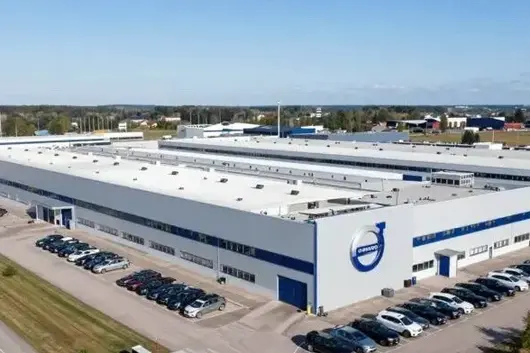


On March 28, 2010, Geely Holding Group and Ford Motor Company signed an agreement in Gothenburg, Sweden, to acquire 100% of Volvo Cars.
At that time, the question almost everyone was concerned about was the same: Could a Chinese private automaker founded only a decade earlier handle a European luxury car brand with deep historical accumulation? For Ford, handing over Volvo was not just completing a transaction, but also entrusting the future of a brand to a Chinese company that had not yet been fully understood by the global automotive industry.
Sixteen years later, on July 23, 2026, in Valencia, Spain, Geely and Ford signed another agreement.
This time, the two sides were no longer buyer and seller, but joint venture partners. According to the plan, both parties will establish a joint venture company at Ford's Valencia plant, share capacity, and produce new energy vehicles for their respective brands for the European market. Geely plans to launch two new energy vehicle models, while Ford plans to produce three new energy vehicle models, with the first product expected to come off the line in 2028.
From Gothenburg to Valencia, from equity acquisition to capacity sharing, sixteen years separate the two handshakes between Geely and Ford. On the surface, these appear to be two independent business collaborations; but what truly connects them is a business credit verified by time and mutual recognition between the two parties.
Looking back at the 2010 acquisition, the biggest test for Geely was not whether it could complete the capital transaction, but whether it could manage the relationship after the acquisition: how to continue respecting Volvo's brand traditions, operational systems, and development laws after obtaining ownership.
Geely ultimately chose to "release the tiger back to the mountains". It did not simply transform Volvo into a brand within the Geely system, nor did it rush to prove its control through integration; instead, it kept its promises, provided space for long-term development based on maintaining Volvo's brand independence.
This approach not only helped Volvo's subsequent brand revival, but also allowed Ford to clearly see how Geely treats an international enterprise, how it understands and practices contracts, and how it fulfills commitments made during transactions.
Commercial trust is rarely truly established at the negotiation table. What contracts can define are nothing more than the boundaries of responsibility between the two parties, but they cannot predict a company's true actions over ten years or even longer. True trust is rooted in specific and minute choices time after time: whether maintaining restraint when facing short-term interests, whether upholding respect when facing cultural differences, and whether sticking to long-term commitments.

In 2010, Geely entered the core stage of the global automotive industry for the first time by acquiring Volvo from Ford; sixteen years later in 2026, Ford was willing to share European manufacturing resources with Geely, regarding Geely as an industrial partner to improve product development efficiency, supply chain capabilities, and global scale. This is not only a "reunion of old friends", but also a business cooperation legend spanning time cycles, rooted in trust accumulation, which is the return of brand credit.
Li Shufu once stated that the fun of business lies in making friends and doing transactions simultaneously, making every transaction achieve win-win or multi-win, and leaving pleasant memories. He believes that business is the most equal and beautiful form of human civilization expression. Placed in the sixteen-year relationship between Geely and Ford, they actually point to a very realistic business logic: the value of a transaction depends not only on what was gained at signing, but also on whether, many years later, the transaction partner is still willing to sit down with you hand in hand.
Jim Baum, Ford's President of Europe, made a clear summary of both sides' capabilities: Geely possesses world-class electrification capabilities, development speed, and global scale; Ford possesses over a century of engineering experience, a European market foundation, and a mature manufacturing team. The combination of the two will form a new competitive advantage. The importance of this statement lies not only in Ford's affirmation of Geely's capabilities, but more importantly in the substantial change that has occurred in the cooperation relationship between the two parties.
In the past, joint ventures in the Chinese automotive industry often involved foreign parties exporting brands, technology, and products, while Chinese parties provided markets, production, and channels. However, in Valencia, the roles of both parties have undergone a "qualitative change": Ford provides a mature European manufacturing foundation to assist Geely's localization production. In the era of new globalization which is regionalized and fragmented, Chinese brands are no longer simply exporting products, but exploring how to serve regional markets with global resources and win global competition with local capabilities.

In the first half of 2026, Geely Auto's overseas sales reached 474,000 units, a year-on-year increase of 158%; among them, new energy product exports reached 277,000 units, a year-on-year increase of 585%, and the proportion of new energy vehicle models reached 58%. These data mean that Geely entering the European local manufacturing stage is not just to circumvent the limitations of product exports, but to further establish long-term operating capabilities after a certain scale has been formed in the overseas market.
But the larger the scale, the more it is needed to answer a more fundamental question: How should Chinese automakers enter the global market? For a long period in the past, going overseas was often described as "entering", "occupying", or even "conquering". This narrative emphasizes sales, share, and competition, but it is easy to ignore the other side of globalization: for a company to exist long-term in an unfamiliar market, it cannot only prove how many products it can sell, but also prove that it can respect local rules, integrate into local industries, and form stable common interests with partners.

From this perspective, Geely's choice to share the Valencia factory with Ford is more worthy of attention than simply building a new factory. It is not about completely copying a mature system from home to Europe, but utilizing Ford's local manufacturing capabilities to collaborate with local existing industrial foundations, employee systems, and market experience.
This is also the latest practice of Geely's globalization thinking. From co-building the Malaysian Automotive High-Tech Valley with Proton, to establishing Holley Power with Renault, to both parties expanding cooperation in regional markets such as South Korea and Brazil, Geely relies less on a single enterprise "going deep alone", but instead recombines technology, capacity, brands, and regional resources by finding partners. This kind of globalization may not be as dramatic as a large-scale acquisition, but it may be closer to the cooperation method truly needed by the global automotive industry today: not one replacing the other, nor one attaching to the other, but putting each other's most valuable capabilities together when both need transformation.
Therefore, Geely and Ford's second handshake fully illustrates one thing: a transaction sixteen years ago did not end with the equity transfer. How Geely treated Volvo that year determined how Ford views Geely today; how Geely fulfilled commitments in the past is also influencing what global cooperation opportunities it can obtain today. Trust might be the most chronic asset in the business world. It cannot be established through a single press conference, nor can it be obtained by a slogan, but can only be accumulated through cooperation and fulfillment time after time.
In 2010, Geely proved through an acquisition that Chinese enterprises have the ability to handle a world-class automotive brand; in 2026, Ford and Geely established a joint venture company, proving that the choice sixteen years ago withstood the test of time. There are no shortcuts between the two handshakes, only the respect and fulfillment of the spirit of contracts. For Chinese automotive enterprises that are entering the deep waters of globalization, this may be more important than any set of sales figures.
© 2024 Bitauto.com. All Rights Reserved.
Bitauto (www.yiche.com and www.bitauto.com) is one of the most visited automotive websites in China. We provide detailed info on Chinese car brands available in your area. Please note that the information provided on this website is based on publicly available data and is for reference only. It may not be fully updated or accurate at all times.

Help us improve our website


