

HomeGrowth Space

Search History
Popular Searches
Dealer Login / Sign Up

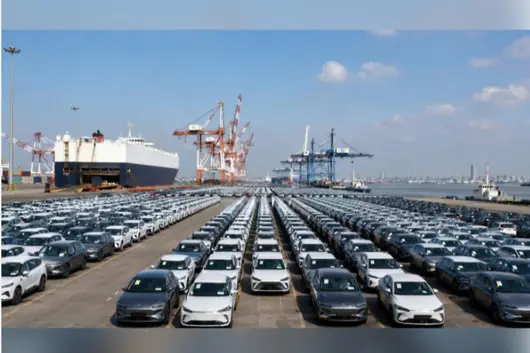
The domestic car market in 2026 is still in a period of deep adjustment. Sales of fuel vehicles continue to shrink. Although new energy penetration continues to rise, differentiation within the industry and price competition have not been alleviated. While domestic demand is under pressure, auto exports have followed a markedly contrasting curve. In the first eight months of this year, Chinese auto exports maintained a relatively high growth rate, with the export volume accounting for nearly 40% of total vehicle production. The overseas market is no longer just a "supplementary channel" for automakers; it is becoming a key variable for digesting capacity, contributing profits, and widening the gap between enterprises.
▍When domestic demand is under pressure, exports become the main growth source for automakers
First, look at the domestic overall market: Monthly data from the China Association of Automobile Manufacturers (CAAM) shows that production and sales of domestic cars in August reached 2.684 million and 2.712 million vehicles respectively, both declining by about 5% year-on-year. Cumulative production and sales scale from January to August were also lower than the same period last year. Weak demand on the demand side led to rising inventory pressure. Data from the China Passenger Car Association (CPCA) shows that at the end of August, national passenger car industry inventory reached 3.14 million vehicles, with an inventory turnover of 56 days, and the inventory index was above the warning line.
Structural differentiation within the market was also significant. In August, retail penetration of new energy passenger cars reached 65.2%, setting a historical record. Fuel vehicle retail sales fell more than 40% year-on-year, and market share continued to shrink. This change forced automakers to reallocate capacity. Cui Dongshu, Secretary-General of the Passenger Car Division of CPCA, pointed out in a public analysis that exports have become the primary growth source for domestic automakers, with the export sales volume share of some leading enterprises exceeding 40%.

As domestic demand growth slows, the incremental increase in exports becomes even more critical. According to CAAM statistics on customs complete vehicle exports, exports reached 7.153 million vehicles in the first eight months, a year-on-year increase of 66.7%, with August single month breaking through 1 million vehicles. CPCA's scope of statistics is slightly wider, with exports reaching 7.45 million vehicles from January to August, a year-on-year increase of 51%, and the full year is expected to approach 12 million vehicles. The absolute values of the two sets of numbers have gaps, but the growth direction is consistent. Looking at CAAM's data for the first half of the year, export volume accounted for 39.34% of total domestic vehicle production, approaching 40%.
Such data is first reflected in capacity utilization rates. According to data from the China Automotive Industry Association, China's automotive production in 2025 reached 34.53 million vehicles, with an annual capacity utilization rate of 73.20%. An analysis report from East Money Securities points out that the prosperity of the overseas market can make up for the weakness of domestic sales and avoid a decline in capacity utilization rate. For automakers, production lines must be kept running to dilute fixed costs; this is the most direct effect of exports.
On the profit side, the domestic profit space for automakers was greatly compressed in the market environment of price wars, but the situation for exports is different. Terminal selling prices in overseas markets are generally higher than domestic prices. The BYD ATTO 3 (Yuan PLUS overseas version) converts to over 300,000 RMB in the European market, offering a larger profit margin. The report also points out that export profits can make up for the decline in domestic profits to a certain extent.
At the same time, differentiation between enterprises is also intensifying. Enterprises with earlier export layouts and higher proportions have shown stronger resilience in this round of adjustment. Reports show that Chery Group's total sales in the first half of 2026 were 1.3575 million vehicles, of which 943,800 were exports, accounting for about 69.5%. BYD's overseas sales from January to June 2026 were about 790,000 vehicles, accounting for nearly 44% of total sales of 1.81 million vehicles. Industry analysis also points out that enterprises with higher export proportions saw a significantly smaller decline in overall production and sales compared to enterprises deeply rooted in the local market. In other words, export capability is becoming a key variable to widen the gap between automakers.

However, the support of exports for the domestic market also has boundaries. Cui Dongshu stated that going global is a "must-do" for automakers, but not the "only solution." Going global can solve the incremental problems of sales volume and profits, but cannot make up for the shortcomings in product strength and independent R&D capabilities. Core enterprise competitiveness still needs to be accumulated relying on technical iterations in the domestic market. If going global is treated as a "refuge" for domestic competition, it might instead delay its own adjustments.
Regarding product structure, new energy vehicles are the core support for export growth. In the first eight months, new energy vehicle exports reached 3.435 million vehicles, more than doubling year-on-year, accounting for nearly half of the total export volume. Differentiation between technical routes is quite clear: Plug-in hybrid models had the highest growth rate, with a year-on-year increase of 121% in the first eight months, mainly driven by the release of European market demand; pure electric models were relatively stable, with a year-on-year increase of 50%. Fuel vehicle exports continued to grow, with a year-on-year increase of 27% in the first eight months, but the structure was upgrading, with mid-to-high-end models with displacements of 1.5 to 2 liters recovering relatively quickly. Among commercial vehicles, truck exports grew by 42%, while bus growth was relatively flat at 26%.
▍From Russia to Europe: Map Adjustment and Realistic Challenges
While Chinese auto exports increased, the structure of export destinations has been changing in the last two years. Early on, it mainly relied on South America and Russia/Central Asia; now it is gradually tilting towards the European market. Since the beginning of this year, independent automakers exported 777,000 vehicles to the EU, a year-on-year increase of 106%. The EU surpassed South America and Russia/Central Asia, becoming the number one region for independent brand exports.
From a single country perspective, Russia returned to the top position. Exports from China to Russia exceeded 630,000 vehicles in the first eight months, a year-on-year increase of over 350,000 vehicles. The background for this change is not complex: In previous years, foreign automakers withdrew from Russia, leaving a market vacuum, which Chinese automakers quickly filled. The Russian market underwent de-stocking in 2025, and exports once declined. In 2026, demand stabilized plus the low base effect, and the growth rate rose again. Brazil is another highlight, with cumulative exports approaching 480,000 vehicles in the first eight months. The effect of Chinese automakers building factories locally is gradually becoming apparent. After localized capacity is released, the export scale expands accordingly.
Within the European market, the UK, Belgium, Germany, and Italy all achieved high-speed growth. Data from the European Automobile Manufacturers Association shows that in August, the combined market share of Chinese brands such as BYD and Chery in the EU and UK markets reached 11.3%, compared to 7.1% in the same period last year. The reasons European consumers choose Chinese cars are mainly concentrated in three aspects: cost-performance advantage, product innovation capability, and the popularization of intelligent driving configurations.

The performance in emerging markets showed obvious differentiation. Southeast Asia maintained steady growth, with export scales in the Philippines and Thailand continuing to expand; the African market grew relatively fast, becoming an important destination for fuel vehicle exports; the Middle Eastern market was affected by geopolitical conflicts, with exports in August dropping significantly, and the UAE's single month declined by more than 30%.
At the same time, the export mode of Chinese automobiles is also changing. Early on, it was mainly direct product exports; now more and more automakers are starting to build factories overseas and promote localized operations. In Brazil, both BYD and Chery have built complete vehicle factories, and the supply chain is gradually becoming localized, avoiding trade barriers while improving market response speed. In Europe, Chinese automakers are gradually building brand awareness by establishing R&D centers, expanding dealer networks, and improving after-sales systems.
Although the growth trend of Chinese auto exports is currently good, there are still many challenges to face, first and foremost is the continuous escalation of trade barriers. The EU imposed additional tariffs on Chinese electric vehicles citing overcapacity and subsidies; after the expansion of the Carbon Border Adjustment Mechanism, compliance costs for export enterprises will also rise. The certification process in the Canadian market is complex, with strict safety and emission requirements, and a high entry threshold.
Secondly, there are geopolitical and policy risks, with uncertainty regarding industrial policies for overseas markets and attitudes towards China. As more and more automakers advance overseas factory construction, the scale of capital investment is large. Once the local political situation changes or policies shift, previous investments may face losses. Overseas heavy asset investment has become the most critical risk that current automakers going global need to guard against. Regarding brand and service systems, after-sales networks in some regions are not sound, and supply chain collaboration capabilities are insufficient. If not kept up with in time, it may affect the overall reputation of Chinese automobiles.
Comprehensive view: the high growth of Chinese auto exports in 2026 is the result of multiple factors acting together. Domestic demand is under pressure, and enterprises actively explore overseas markets; there is demand space in the global market; the competitiveness of Chinese auto products continues to improve. The impact of exports on enterprises has gone beyond the "increment" itself; it has played a practical role in improving capacity utilization rates and improving enterprise profitability. However, the boundaries of exports are also clear; it cannot replace domestic market technical iterations and product upgrades. Issues such as escalating trade barriers, geopolitical fluctuations, heavy asset investment risks, and brand service shortcomings remain the realistic constraints on export growth.
© 2024 Bitauto.com. All Rights Reserved.
Bitauto (www.yiche.com and www.bitauto.com) is one of the most visited automotive websites in China. We provide detailed info on Chinese car brands available in your area. Please note that the information provided on this website is based on publicly available data and is for reference only. It may not be fully updated or accurate at all times.

Help us improve our website


