

HomeLandak

Search History
Popular Searches
Dealer Login / Sign Up

在马来西亚的SUV市场,很多买家在选车的时候都会拿 Proton X90 和 Toyota Yaris Cross 来做比较。这两款车在价位和定位上都蛮接近的,今天我们就从多个方面做一个详细的对比,帮你省下做功课的时间。
Proton X90 在马来西亚的 OTR 售价是 RM 106,800 - 122,800,一共有 4 个版本,包括 2026 1.5T Prime X(RM 122,800)、2026 1.5T Prime(RM 116,800)、2026 1.5T Lite(RM 106,800) 等。
Toyota Yaris Cross 在马来西亚的 OTR 售价是 RM 99,900 - 109,900,一共有 2 个版本,包括 2026 1.5L Standard(RM 99,900)、2026 HEV 1.5L Standard(RM 109,900) 等。
从价钱来看,Toyota Yaris Cross 的起步价比 Proton X90 便宜了 RM 6,900。老实讲,在这个价位段,几千块的差距其实不算大,关键还是看整体的性价比和长期使用成本。

Proton X90 的安全评级是 5★ (ASEAN NCAP),主动安全系统包括 ADAS (ACC, AEB, LKA, LDA, BSM, RCTA)。
Toyota Yaris Cross 的安全评级是 5★ (ASEAN NCAP),主动安全系统包括 TSS。
两款车的安全评级一样,在这个级别里面安全配备都算给得很齐全了。现在的新车安全性都不差,不用太担心这一点。

Proton X90 车身长 4400 mm,后备箱 400 L。
Toyota Yaris Cross 车身长 4400 mm,后备箱 400 L。
两款车的尺寸几乎一样,车内空间差别不大。这个级别的车,日常使用完全够用。

Proton X90 和 Toyota Yaris Cross 都是马来西亚市场的主流选择,适合家庭使用、日常通勤。如果你更看重品牌口碑和二手价,可以优先考虑口碑更好的那一款;如果你更在意性价比和配备,那就选配置更丰富的那款。最终还是建议两款都去试驾,亲身体验才是最重要的。

总的来说,Proton X90 和 Toyota Yaris Cross 都是马来西亚市场很不错的车型。选择哪一辆,关键还是要看你的个人需求和预算。建议大家做好功课,多比较几间车行的报价,再去试驾做最终决定。买车是件大事,花点时间做功课绝对不会错。


车型概览

Mercedes-Benz Maybach GLS 值不值得买,关键不是它看起来有多吸引,而是它能不能解决你的真实用车需求。这篇文章会把重点放在整体购车判断。
价格落在 RM 1,918,888,买家可以先用它判断预算压力和同级定位。
购车价格指南
Mercedes-Benz Maybach GLS 的购车预算可以先从 RM 1,918,888 开始衡量。这个数字真正影响的是月供、保险和现金流,而不只是展厅里的标价。
如果你在几个版本之间犹豫,可以把 2025 GLS 600 4MATIC(RM 1,918,888) 放在同一张清单里比较。日常通勤买家优先看舒适与安全,常跑高速的买家则更应重视动力、辅助驾驶和座舱便利。
核心参数汇总
看 Mercedes-Benz Maybach GLS 的核心规格,最重要是把数字翻译成生活里的感受。
Twin-Turbocharged、8缸、3982 mL 排量的动力底子,适合拿来判断市区跟车和高速巡航是否轻松。 557 Ps的输出,真正意义在于满载、上坡和超车时不会太吃力。 13.9 L/100km的油耗,对每天通勤的人来说会直接影响加油频率。 车长 5208 mm、车宽 2030 mm、车高 1838 mm,可以帮助你预判停车难度和后排乘坐空间。
优缺点分析
Mercedes-Benz Maybach GLS 的优点不必夸张,真正有价值的是它能不能让日常使用更省心:预算位置清楚,方便和同级车直接比较、日常能源成本有明确参考、动力输出能支撑高速和超车需求。
需要留意的是,市区停车和狭窄路段仍要看个人驾驶习惯。这些不是扣分项,而是下订前应该先想清楚的生活细节。
购车常见问题解答
购买 Mercedes-Benz Maybach GLS 前,买家最常问的不是单一规格,而是它能不能融入自己的生活。
这辆车适合谁?适合把整体购车判断放在首位的买家。 家庭用户要看什么?优先看后排乘坐、儿童座椅、行李和日常上下车是否顺手。 每天开会不会麻烦?13.9 L/100km 的油耗参考让通勤成本更容易预估。
竞品对比内容
把 Mercedes-Benz Maybach GLS 放进同级车名单时,不建议只看品牌或外形。真正有用的比较顺序是:先用 RM 1,918,888 锁定预算圈、再看动力是否足够应付高速和满载、接着比较能源成本和补能便利、最后看空间是否适合家人和行李。
这样筛选出来的结果更贴近日常生活。你会更清楚它是适合城市通勤、家庭代步、长途巡航,还是更适合作为一辆讲求个性的选择。
用车全周期指南
拥有 Mercedes-Benz Maybach GLS 的日常成本,最直接会反映在燃油、保险、轮胎和定期保养上。13.9 L/100km 的油耗让通勤预算更容易掌握。
如果你常跑南北大道,动力和座舱舒适度会比单纯低价更重要;如果主要在市区,停车灵活性、视野和低速顺滑度会更影响心情。


车型概览

Exeed VX 值不值得买,关键不是它看起来有多吸引,而是它能不能解决你的真实用车需求。这篇文章会把重点放在它是否容易融入日常生活。
版本方面,Exeed VX 目前可围绕 2025 Standard 来比较。
购车价格指南
评估 Exeed VX 的购车预算时,建议先从版本定位和后续拥车成本下手。价格不是唯一重点,真正决定是否划算的是每天会不会用到那些配置。
如果你在几个版本之间犹豫,可以把 2025 Standard 放在同一张清单里比较。日常通勤买家优先看舒适与安全,常跑高速的买家则更应重视动力、辅助驾驶和座舱便利。
核心参数汇总
看 Exeed VX 的核心规格,最重要是把数字翻译成生活里的感受。
Exeed VX 的核心价值应回到日常场景判断:你要它负责通勤、家庭出行、长途,还是作为更有个性的选择。
优缺点分析
Exeed VX 的优点不必夸张,真正有价值的是它能不能让日常使用更省心:车型定位清楚,适合先作为同级比较对象。
需要留意的是,最终取舍会落在版本配置、保险和长期保养成本。这些不是扣分项,而是下订前应该先想清楚的生活细节。
购车常见问题解答
购买 Exeed VX 前,买家最常问的不是单一规格,而是它能不能融入自己的生活。
这辆车适合谁?适合把它是否容易融入日常生活放在首位的买家。 家庭用户要看什么?优先看后排乘坐、儿童座椅、行李和日常上下车是否顺手。 每天开会不会麻烦?如果能源成本、停车便利和版本配置都符合你的生活节奏,它会比较容易相处。
竞品对比内容
把 Exeed VX 放进同级车名单时,不建议只看品牌或外形。真正有用的比较顺序是:先从版本定位、品牌售后和日常用途开始比较。
这样筛选出来的结果更贴近日常生活。你会更清楚它是适合城市通勤、家庭代步、长途巡航,还是更适合作为一辆讲求个性的选择。
用车全周期指南
拥有 Exeed VX 的重点,是确认保险、路税、保养和轮胎成本都在可接受范围内。买车不是一次付款结束,而是每天都要相处。
如果你常跑南北大道,动力和座舱舒适度会比单纯低价更重要;如果主要在市区,停车灵活性、视野和低速顺滑度会更影响心情。


车型概览

Audi S8 值不值得买,关键不是它看起来有多吸引,而是它能不能解决你的真实用车需求。这篇文章会把重点放在长期相处时会不会带来额外压力。
版本方面,Audi S8 目前可围绕 2025 Standard 来比较。
购车价格指南
评估 Audi S8 的购车预算时,建议先从版本定位和后续拥车成本下手。价格不是唯一重点,真正决定是否划算的是每天会不会用到那些配置。
如果你在几个版本之间犹豫,可以把 2025 Standard 放在同一张清单里比较。日常通勤买家优先看舒适与安全,常跑高速的买家则更应重视动力、辅助驾驶和座舱便利。
核心参数汇总
看 Audi S8 的核心规格,最重要是把数字翻译成生活里的感受。
Audi S8 的核心价值应回到日常场景判断:你要它负责通勤、家庭出行、长途,还是作为更有个性的选择。
优缺点分析
Audi S8 的优点不必夸张,真正有价值的是它能不能让日常使用更省心:车型定位清楚,适合先作为同级比较对象。
需要留意的是,最终取舍会落在版本配置、保险和长期保养成本。这些不是扣分项,而是下订前应该先想清楚的生活细节。
购车常见问题解答
购买 Audi S8 前,买家最常问的不是单一规格,而是它能不能融入自己的生活。
这辆车适合谁?适合把长期相处时会不会带来额外压力放在首位的买家。 家庭用户要看什么?优先看后排乘坐、儿童座椅、行李和日常上下车是否顺手。 每天开会不会麻烦?如果能源成本、停车便利和版本配置都符合你的生活节奏,它会比较容易相处。
竞品对比内容
把 Audi S8 放进同级车名单时,不建议只看品牌或外形。真正有用的比较顺序是:先从版本定位、品牌售后和日常用途开始比较。
这样筛选出来的结果更贴近日常生活。你会更清楚它是适合城市通勤、家庭代步、长途巡航,还是更适合作为一辆讲求个性的选择。
用车全周期指南
拥有 Audi S8 的重点,是确认保险、路税、保养和轮胎成本都在可接受范围内。买车不是一次付款结束,而是每天都要相处。
如果你常跑南北大道,动力和座舱舒适度会比单纯低价更重要;如果主要在市区,停车灵活性、视野和低速顺滑度会更影响心情。


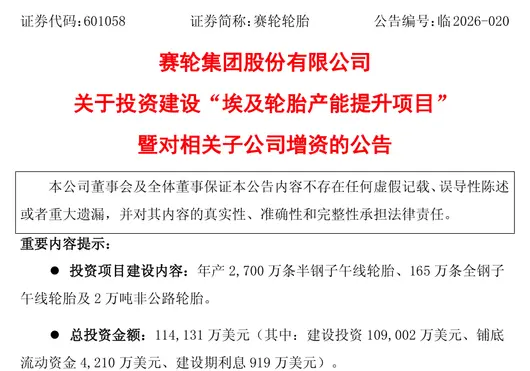
Baru-baru ini, Kumpulan Sailun mengeluarkan pengumuman, bercadang melabur 11.41 bilion dolar AS (anggaran sama dengan 7.8 bilion Renminbi) untuk membina "Projek Peningkatan Kapasiti Tayar Mesir". Ini adalah kali ketiga Sailun bertaruh besar di Mesir, mendorong penempatan kapasiti luaran ke tahap baharu, lebih lagi meluahkan isyarat mendalam mengenai syarikat tayar China menyusun semula rantaian bekalan global dan menghadapi halangan perdagangan antarabangsa.

Tiga Fasa Pelaburan Berat, Lonjakan Kapasiti Tapak Mesir
Pengumuman menunjukkan, projek baharu kali ini merancang hasil tahunan 27 juta unit tayar radial separuh baja, 1.65 juta unit tayar radial baja penuh dan 20,000 tan tayar bukan jalan raya. Projek akan dilaksanakan di Zon Perindustrian TEDA Wilayah Ekonomi Terusan Suez, dibahagikan kepada dua bahagian pelaksanaan: bahagian 9 juta unit tayar separuh baja yang telah dilaksanakan ditangani oleh anak syarikat asal Mesir, Shams El Sherouk; baki 18 juta unit tayar separuh baja, 1.65 juta unit tayar baja penuh dan 20,000 tan tayar bukan jalan raya, akan dijayakan oleh anak syarikat sepenuhnya dimiliki yang dicadangkan ditubuhkan, Senro Tyre.
Melihat kembali penempatan Sailun di Mesir, ia boleh dianggap sebagai langkah demi langkah. Ogos 2025, Sailun pertama kali melabur 2.91 bilion dolar AS memulakan pembinaan kilang di Mesir; April 2026, sekali lagi menambah modal 2.85 bilion dolar AS untuk pengembangan; ditambah pelaburan berat 11.41 bilion dolar AS kali ini, jumlah pelaburan Sailun di Mesir sudah melebihi 100 bilion Renminbi.

Selepas projek tiga fasa siap sepenuhnya, tapak Mesir Sailun akan mempunyai kapasiti besar hasil tahunan 36 juta unit tayar separuh baja, 3.3 juta unit tayar baja penuh dan 20,000 tan tayar bukan jalan raya, kapasiti tayar separuh baja mencapai lonjakan beberapa kali ganda.
Elak Risiko Perdagangan, Susun Semula Penghantaran Rantaian Bekalan
Beberapa tahun kebelakangan ini, industri tayar berulang kali menguji satu masalah utama: kapasiti yang bergantung tinggi pada eksport, risiko terbesar bukan kerana talian pengeluaran tidak cukup besar, tetapi asal dan laluan penghantaran dijepit oleh halangan perdagangan. Siasatan anti-dumping/anti-subsidi di Eropah dan Amerika kerap berlaku, peraturan asal semakin ketat, membuat struktur tunggal "Buatan China, Edaran Global" semakin rapuh.
Sailun melabur berulang kali di Mesir, logik teras ialah menukar kapasiti menuju Eropah dan Timur Tengah dari "Eksport Jarak Jauh" kepada "Pengilangan Rantau". Mesir terletak di simpang pengangkutan tiga benua Afrika, Asia, Eropah, mempunyai kelebihan logistik yang unik Terusan Suez. Pada masa yang sama, Mesir mempunyai sumber perjanjian perdagangan yang kaya, melalui "Perjanjian Rakan-Eropah-Mediterrania" boleh masuk Eropah dengan tarif rendah, sebagai ahli Zon Perdagangan Bebas Arab dan Zon Perdagangan Bebas Benua Afrika, lebih lagi lompatan terbaik meliputi Timur Tengah dan Afrika.

Dengan menubuhkan kilang di sini, Sailun dapat menukar rantai lebih pendek dengan kepastian lebih tinggi, bukan sahaja mengoptimumkan laluan pembelian bahan mentah dan eksport produk siap, malah lebih berkesan mengelak halangan perdagangan antarabangsa sedia ada dan berpotensi.
Matriks Kapasiti Terbentuk, Dari Pengembangan Ke Susun Semula Rantaian Bekalan
Menurut Sailun, pengembangan kapasiti hanyalah permukaan, teras ialah memajukan rantaian bekalan dari "Struktur Eksport Kos Rendah" ke "Struktur Penghantaran Berpusat Berbilang". Dengan kemajuan projek Mesir, Sailun telah membina enam tapak pengeluaran globalisasi meliputi China, Vietnam, Kemboja, Mexico, Indonesia dan Mesir.
Struktur "Penghantaran Berpusat Berbilang" ini membahagikan kapasiti global mengikut kawasan tarif dan pasaran pengguna dengan tepat: Tapak Asia menjamin laluan Asia dan Amerika, Mexico memerhatikan Amerika Utara, Mesir meliputi Eropah, Timur Tengah dan Afrika. Walaupun kawasan tertentu terkena halangan tarif atau guncangan pengangkutan laut secara mengejut, Sailun boleh menerima pesanan dan menghantar melalui tapak lain, fleksibiliti ini sendiri adalah mekanisme perlindungan keuntungan yang kuat.

Analisis dalam industri percaya, jika projek Mesir berjalan lancar, Sailun akan mendapat bukan sahaja kapasiti beberapa talian pengeluaran, tetapi sebuah tapak globalisasi yang sukar dipotong secara "satu pisau" oleh tarif. Ini bukan sahaja mekanisme pengagihan semula pesanan, malah merupakan amalan mendalam bagi transformasi syarikat tayar China keluar ke luar negara dari "Pemacu Kos" ke "Pemacu Ketahanan Rantaian Bekalan", boleh diibaratkan pelaburan yang paling mempengaruhi struktur persaingan jangka panjang dalam beberapa tahun kebelakangan ini.


Less than half of 2026 has passed, but one thing can be concluded in advance: without the support of overseas markets, the production and sales data of China's automotive industry this year will look very bad.
First, let's look at the domestic market.
Jan-April, domestic passenger car cumulative retail sales reached 5.604 million, down 18.5% year-on-year. Among them, fuel vehicle sales fell by approximately 19.8%, while new energy vehicles also declined by 17.2%. April retail sales alone were 1.384 million, down 21.5% year-on-year and down 16.0% month-on-month.
This is not a problem of a specific segment, but rather the entire market is contracting.
Now let's look at exports.
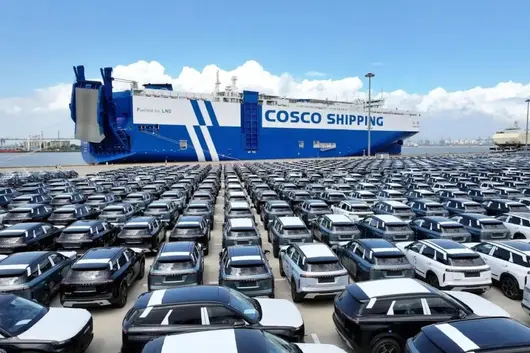
For the same period, China's cumulative auto exports reached 3.25 million, a year-on-year increase of 50.6%. New energy vehicle exports were nearly 1.5 million, accounting for 48%, up 69% year-on-year.
In April alone, passenger car exports accounted for 36% of manufacturer sales, compared to only 19% at the same time last year. It was precisely the strong performance of exports that stabilized the slowdown in the domestic market.
In Jan-April this year, China's auto production and sales overall declined year-on-year by 4.8% to 5.5%. Although this negative growth is rare in recent years, it is still a single digit. Without exports, this number would look much worse.
Auto exports are no longer an optional peripheral business; they are profoundly changing the business structure of Chinese automakers.
So the question arises: Where exactly did these cars go?
Brazil: A Qualitative ChangeLet's look at two rankings first.
In the top ten exports of all passenger car categories, Brazil ranks first, and Russia ranks second.
In the top ten new energy vehicle exports, Brazil is still first. 280,000 and 210,000 vehicles—these two numbers added to Brazil's account, with year-on-year growth rates reaching 226.1% and 220.9% respectively.
What does this mean?
BYD alone exported nearly 90,000 units to Brazil in the first quarter of this year, including battery electric and plug-in hybrid models. Great Wall Motor has already built two factories in Brazil, with the second one having an annual capacity as high as 200,000 units.
But the signal truly worth remembering is not these numbers.
In April this year, BYD sold 14,911 units in Brazil, surpassing Volkswagen to take the first place on the total monthly retail sales list for the first time.

The Brazilian market has long been dominated by European, American, and Japanese brands. This is the first time Chinese new energy vehicle brands have surpassed traditional fuel giants in monthly sales.
The psychological impact of this event in Brazil is no less than when Apple first surpassed Nokia in China back then.
And this result was not unexpected.
First, Chinese automakers entered densely. GAC, Chery, Geely, Leapmotor, and Changan have already laid out their plans in Brazil, with a solid grassroots foundation.
Second, local production is accelerating. BYD's factory in Camaçari has already exceeded 4,100 employees and will soon add another 1,600 to start the third shift.
Third, although the policy environment in Brazil has tariffs, it does not engage in backdoor deals. The product competitiveness of Chinese cars is strong enough; no extra privileges are needed, only fair rules.

From 2026 onwards, Brazil will no longer be an overseas market in the conventional sense; it has become the second home market for Chinese automakers.
Local market refers to the qualitative change from "export destination" to "production and sales integrated market", representing a fundamental shift in the logic of China's automotive going global.
Now let's look at Europe.
In the all-category rankings, the UK ranks third with 151,000, up 99.3%; Belgium ranks fourth with 130,000, up 40.3%; Italy ranks seventh with 92,000, up 121.2%.
If looking at the new energy rankings alone, Italy grew by 460.7%, Germany by 295%. From the UK to Spain, growth rates were all above 80%.
The data for the European market is very impressive. Behind this lies a key factor: Chinese-style hybrid.
Data from the China Passenger Car Association shows that in the export structure in April, the share of plug-in hybrids has reached 18%, up 4 percentage points year-on-year.
This is a move of avoiding the strong and striking the weak adopted by Chinese automakers facing tariff barriers from Europe and the US.

The EU began implementing anti-subsidy tariffs on April 15, raising the comprehensive tax rates for BYD, Geely, and SAIC to 27% to 45.3%. This greatly weakened the price advantage of pure electric models.
However, hybrid models equipped with engines are not subject to the same degree of tariff constraints. Chinese automakers quickly adjusted their strategy to penetrate the European market with hybrid models.
No need for direct confrontation, but to find loopholes within the rules.
This ability to adapt flexibly is built on the strong R&D and manufacturing capabilities of Chinese automakers. This is also the biggest hidden advantage of China's automotive going global.
Amidst the growth, two markets declined: the UAE down 13.2%, and Mexico down 46.6%.
The UAE's new energy data is still surging, balancing the trend, but Mexico's decline is more pronounced.
Analysis reveals two reasons.
Subjectively, the substitution rate of local production in Mexico is increasing.
More and more Chinese automakers are building factories in Mexico, so the volume of complete vehicle exports naturally declines. This is essentially not a bad thing, but rather a necessary stage for the upgrade of China's automotive going global.

Objectively, the uncertainty of US policies has increased investment risks in the Mexican market. The closer to the US, the harder the business, and this does exist.
In the future, when looking at China's auto export data, one cannot simply assume something is wrong when seeing a decline in a certain market. First, check if the power of local production has become stronger, rather than looking at new things with old eyes.
In the rankings, only Malaysia from Southeast Asia ranks tenth.
This does not mean the Southeast Asia market is declining. On the contrary, the current performance of Southeast Asia is a typical case of "surface slowdown, actual transformation".
In 2025, the market share of Chinese brands in Thailand, Indonesia, and Malaysia reached 22%, 22.8%, and 26% respectively, with Japanese brand shares falling completely.
In January this year, the share of Chinese brands in Thailand's pure electric market approached 50%.

The export volume did not make the top ten not because Chinese cars could not sell there, but because a large number of products have achieved local production and are no longer counted in the data in the form of complete vehicle exports.
This is a signal sent in advance: in the future, the "cooling" of many markets may actually be an "upgrade".
Through these data, we can see deeper industrial changes.
On one hand, exports drive wholesale.
The China Passenger Car Association clearly pointed this out. Since the beginning of this year, exports have continued to strengthen, forming a clear trend of "exports driving wholesale". Top automakers rely on exports to digest capacity and reduce inventory backlog.
On the other hand, 2026 is the watershed from complete vehicle exports to supply chain going global. Whether active or passive, Chinese automakers are shifting from simply selling products to building factories, supply chains, and after-sales service systems in target countries.
Finally, and most crucially, the logic of making money has finally been established, and the model of making money has finally been proven.
In the past, when discussing going global, everyone was used to calculating sales volume and market share.
But from Jan-April 2026, the automotive industry profit margin was only 3.4%, at a historical low. If we simply copy the domestic price wars overseas, blindly pursuing sales growth without contributing to profits, that is fake globalization.
True globalization is like Toyota, building sustainable profitability in different markets.

BYD and Great Wall's localization in Brazil, Chery's deep cultivation in Europe, Geely's precise efforts in emerging markets, are all essentially doing the same thing: shifting from scale-oriented to profit-oriented.
The destinations of Chinese automotive exports in the first four months of 2026 tell us that Brazil, Russia, and the EU are all very important, but whoever can let us complete the loop of industry chain, service chain, and marketing chain faster beyond just selling cars is the true favorable land.
Like Southeast Asia.
© 2024 Bitauto.com. All Rights Reserved.
Bitauto (www.yiche.com and www.bitauto.com) is one of the most visited automotive websites in China. We provide detailed info on Chinese car brands available in your area. Please note that the information provided on this website is based on publicly available data and is for reference only. It may not be fully updated or accurate at all times.

Help us improve our website


