

HomeLotus

Search History
Popular Searches
Dealer Login / Sign Up

From 'Last Generation of Fuel Cars' to 'Multi-Energy Coexistence', Lotus Sports Cars clarifies in the 2030 Strategy: Lotus will no longer make all-electric sports cars; hybrid proportion will reach 60%, and annual sales of 30,000 units will achieve profitability.

On June 1, Lotus Group CEO Feng Qingfeng announced the brand's core plan for the next four years at the Focus 2030 Strategy Media Communication Meeting held in Beijing. Facing the reality of slowing global electrification policies, uneven charging infrastructure, and diverging consumer usage scenarios, Lotus actively adjusted the aggressive path of 'Full Electrification' since 2018, shifting to a multi-energy strategy of fuel, hybrid, and all-electric in parallel.
"What changes is happening in the market? Consumers have become clearer about usage scenarios for electric vehicles, hybrids, and fuel vehicles."
Feng Qingfeng stated at the communication meeting, "As a daily driving vehicle, electric vehicles are very suitable, but as a long-distance vehicle or a performance car, electric vehicles undoubtedly will face some challenges."
From five core sections: strategic adjustment, core technology, product matrix, global layout, to commercial goals, Feng Qingfeng detailed the clearer strategic layout of Lotus Cars.
I. Strategic Shift: No Longer Making All-Electric Sports Cars! From 'Full Electrification' to 'Multi-Energy Parallel'
Lotus announced in 2018 that Emira would become the last pure fuel car model, fully betting on electrification. However, in the Focus 2030 Strategy, the brand made a significant pullback.

Feng Qingfeng frankly stated that the global environment has changed: "In the past, governments, whether in Europe, UK, etc., all proposed strategies to support future electrification development, even governments proposing restrictions on fuel cars in a certain year, but undoubtedly all governments are postponing."
He gave examples, saying Italy's charging piles are mainly low power, and the Middle East has almost no commercial charging facilities, 'with no layout of charging facilities in action'.
Based on this, Lotus established a new power route combination: about 60% plug-in hybrid models, 40% all-electric models, and pure fuel only retains a small number of special markets (such as the Middle East).
Feng Qingfeng clearly stated: "For sports cars, we will pass on the all-electric road." Life vehicles will continue to develop all-electric, but sports cars will only do fuel and hybrid.
"The penetration rate of all-electric vehicles above $80,000 is less than 10%, even strong China is the same." Feng Qingfeng said, "In this market range, hybrids still have a lot of growth."
II. Core Technology: Self-developed V8 engine and torque gearbox, hybrid 'not a worm', chassis 'comes alive'
Lotus named its super hybrid technology 'Luyao', with the core selling point being no performance attenuation under no-fuel state.
Feng Qingfeng summarized the industry pain point and Lotus' solution with one sentence: "We used to say 'Full charge a dragon, depleted charge a worm', in the future depleted charge will no longer be a worm."
Take For Me (European name Eletre X) as an example; the car is equipped with a 900V Luyao Super Hybrid Architecture, total system power 952 horsepower, 0-100km/h acceleration 3.3 seconds with full charge, 3.5 seconds when battery power is only 10%, comprehensive range over 1400 km.
In the powertrain field, Lotus announced it will jointly develop a new V8 engine and large torque DCT gearbox with HORSE (Joint venture of Geely, Renault, Saudi Aramco). Feng Qingfeng called the large torque DCT 'The pearl on the crown of the automotive industry', 'To achieve over 900 Nm, this is also a very difficult, very big challenge'.
The new V8 hybrid supercar Type 135 is planned for launch in 2028, targeting 'Above 10,000 RPM', larger horsepower, lighter weight, and exploring the downscaling of F1 track technology (such as MGU-K) to mass production vehicles.
Regarding the chassis, Lotus emphasized that its core tuning capabilities are evolving through intelligence. "In the past, once a chassis was tuned, it basically became fixed... but with active chassis, changes are infinite."

Feng Qingfeng compared Lotus chassis tuning to a "Top-tier Conductor": "An orchestra can have any instrument, but only a good top-tier conductor can conduct a perfect symphony."
Lightweighting is still the bottom line for Lotus. Evija sets the benchmark with 2000 horsepower and 1.6 tons weight, "To surpass 1.6 tons, I think it is extremely extremely difficult". Feng Qingfeng explicitly refused to add weight-increasing configurations like refrigerators on sports cars.
III. Product Matrix: Fuel, Hybrid, All-Electric Each in Its Place
Under the Focus 2030 Strategy, Lotus forms three clear product lines:
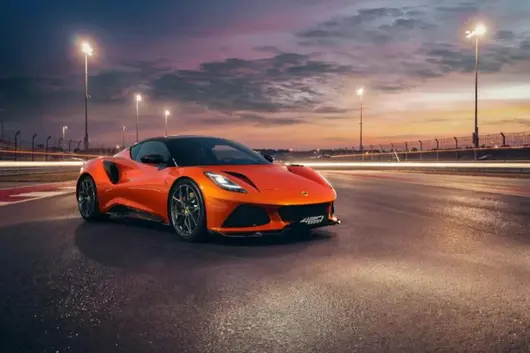
Fuel Sports Cars: Emira 420 Sport launched globally in May 2026, known as "The Emira model with the strongest power, lightest weight, and best aerodynamic performance to date".
Super Hybrid: For Me (China) has been launched and delivered; European version Eletre X will be released in Summer 2026, deliveries start in the fourth quarter. The car is evaluated by some European media as "A car that will change the European power landscape".
All-Electric Life Vehicles: Eletre, Emeya, and supercar Evija continue to be on sale. Among them, Eletre received UN R171.01 certification in May 2026, becoming the first China-manufactured electric vehicle to receive this certification.
Future Flagship: Type 135 V8 Hybrid Supercar, planned for 2028 launch, produced in Europe.

Feng Qingfeng emphasized that sports cars will no longer explore the all-electric route, while life vehicles retain all-electric. "There is still much all-electric technology worth us researching and exploring... We focus on life vehicles."
IV. Global Market: Regional Differentiated Layout, Channels Continued Expansion
To date, Lotus has a total of 216 sales stores globally, among them 67 in Europe, 63 in China, 48 in North America, 38 in other regions. The number of stores in China has increased from about 50 in 2025 to 63, with year-end target of 80, "Basically consistent with Porsche's channels".
Regional strategies show obvious differences:
China: As the main sales growth engine, Wuhan Factory and China R&D Center play core roles. User proportion after For Me launch increased by 50%, high-spec models over 70%, old owner repurchase rate reaches 20%. Customer group expanded from business owners, second-generation entrepreneurs to corporate executives and financial professionals, proportion of financial industry executives among small reservation users is about 30%.
Europe: UK Hethel is the sports car manufacturing and performance engineering center. Lotus will use Eletre X to enter the European hybrid market, filling the local hybrid blank of 'Fuel-based'. New markets like Berlin will enter soon.
North America: Restricted by 125% tariff and ICTS Act, China-produced all-electric models cannot enter the US, only UK-made sports cars can be sold. Canada becomes the breakthrough point — in May 2026, the first batch of 18 Eletre units exported to Canada, becoming the first mass-exported Chinese brand after tariff reduction. Lotus has 6 dealerships in Canada, planning to expand to 12 by the end of the year.
Brazil: On May 27, 2026, Lotus launched the brand in Sao Paulo, officially entering South America's largest market. Feng Qingfeng mentioned the deep local brand recognition: "Two Brazilian F1 drivers—Senna and Fittipaldi—were both Lotus F1 drivers." Lotus directly started operations with Emira, Eletre, Emeya full product line, Eletre PHEV expected to launch in 2027.
Middle East and Asia-Pacific: Middle East network is relatively complete; right-hand drive markets (Malaysia, Australia, etc.) wait for 2027 For Me right-hand drive model launch before expansion.
"Lotus was born global." Feng Qingfeng said, "We want to reutilize Geely's R&D system, supply chain system, and global manufacturing system for collaboration, so as to maximize Lotus' benefits."
V. Commercial Goal: 30,000 Units Break-even, Profit Path Clear
Lotus explicitly proposed that with Geely synergy and efficiency improvement, annual sales reaching 30,000 units can achieve continuous profitability.
"In the past, our break-even point was relatively high, had to achieve 50,000, 80,000 units to reach break-even point." Feng Qingfeng said, "Now through Geely's empowerment, Geely's synergy, and through our own collaboration between China and UK, let Lotus become a small but beautiful company, achieve 30,000 units can let the company gain good returns."
Ideal global sales structure is '3331': China 30%, Europe 30%, US 30%, other regions 10%. Due to US policy restrictions, US share will decrease, taken over by China and Europe.
Cost control aspects, Lotus and Geely have deep synergy in electronic architecture, intelligence, joint procurement and other fields, "Below the iceberg common costs greatly reduced, while above the iceberg retain 100% of personalized investment" — including chassis tuning, aerodynamics, lightweight materials, etc. Wuhan Digital Twin Factory will compress new car production cycle from 8-12 months to 3 months, engineer onsite requirement reduced from 200 people to a dozen people.
"With Geely, Lotus finally has bullets to counter Porsche." Feng Qingfeng said, "30,000 units can profit, this is rare in the automotive industry, but Lotus can."
Focus 2030 Strategy marks Lotus shifting from single electrification route to more pragmatic, more flexible global multi-power strategy. In the context of super luxury car market growth slowing, policy rhythm differentiation, Lotus relies on complete coverage of three power lines: fuel, hybrid, all-electric, and Geely system technology and supply chain synergy, trying to run out a sustainable profit path in the sub-division track of personalized driving experience.
As Feng Qingfeng said at the end of the communication meeting: "We haven't learned how to cash in on online traffic yet, need to learn a bit more." But for a brand that has always taken handling, lightweight, and aerodynamics as faith for 78 years, traffic might never have been its most concerned — what it truly cares about is, whether drivers can find that unique, unhomogenized feeling on every Lotus.


Editor | Klein
Produced by | Road Coffee in
Lotus Cars is trending again due to executive remarks.
On June 3, CEO Feng Qingfeng threw out the "1.8-ton watershed" theory during an interview, stating "If the weight exceeds 1.8 tons, it's a junk car." This statement quickly topped the Weibo trending list, becoming the rare No. 1 trending topic in the automotive circle. As the controversy spread, Lotus officially abandoned the Vision80 full electrification strategy, switching to a "Focus 2030" route running fuel, hybrid, and pure electricity lines in parallel.

From being acquired by Geely in June 2017 to now, Lotus has gone through nine full years. But there aren't many product highlights people remember; executive "extreme statements" and marketing failures often go viral. This Sino-foreign "hybrid" has "mixed" for nine years, and it seems to have only "mixed" for nothing?
The Divide of the "Junk Car" Theory
New energy vehicles are getting heavier, which is indeed a hot topic in the industry. If Feng Qingfeng only advocated that pure electric sports cars should focus on weight reduction, there would be no problem. But his expression was too aggressive, and the "targeting scope" was too broad.
More awkwardly, Lotus's own pure electric sedan Emeya's curb weight is 2455-2590 kg, and the limited supercar Evija also reached 1887 kg, both exceeding 1.8 tons. Performance models of the brother brand Zeekr are also "over the limit".

Considering the context, Feng Qingfeng probably meant that pure electric sports cars are hard to replicate the driving feel of traditional fuel sports cars, and the contradiction between performance and vehicle weight is sharper on electric vehicles, so Lotus abandoned the pure electric sports car route.
The corporate strategic judgment itself is beyond reproach, but making such "self-torn" extreme statements will inevitably provoke controversy. Judging by the result of topping the trending list and netizen mockery, this wave of "public opinion setup" clearly failed.
Looking back at Lotus's nine years, it is regrettable.
This brand known for extreme lightweighting, aerodynamics, and pure handling, instead of letting new products regain glory, relied on executive "extreme statements" and marketing failures to go viral frequently.
Feng Qingfeng's sharp remarks are not just this time.

In February 2025, he posted on Weibo saying "Only Lotus and Porsche are fast on corners," at that time Lei Jun claimed Xiaomi SU7 Ultra is "The fastest four-door mass-produced car on the surface," which was interpreted by netizens as a subtle mockery of Xiaomi, triggering Mi fan counterattacks.
More absurdly, some netizens mistakenly took "Lotus Holdings" (seller of MSG) as Lotus Cars, ran to Lotus MSG Douyin account to attack, forcing them to issue a video clarification: "I'm an honest man, I don't sell sports cars."
In July 2024, Feng Qingfeng promised Lotus "Positioned as a million-level luxury brand, will never participate in price wars". Only half a year later, new Eletre and Emeya prices dropped significantly, old owners collectively protested. At the same time, Eletre Chinese name "Summer Blossom" was boycotted due to homophone with "Sliding Down", Lotus was forced to apologize and stop using it.

The 2023 failures were even denser: Wuhan Lotus test drive cars sold as new cars, Eletre reduced configuration three times without informing owners, Suzhou Lotus center held a 50 million capital verification matchmaking event.
With so many "viral" events, it is hard not to feel that this enterprise has formed a path dependence relying on extreme remarks to grab eyeballs.For new brands, this may be an adventure under involution; but for luxury brands, this method is extremely damaging to the brand.
Forced Strategic Shift
Accompanying these viral events is tepid performance.
Lotus was acquired by Malaysia Proton Group in 1996, switched to Geely in June 2017. Before Geely took over, Lotus annual sales were only over 1,600 units. In 2018, Lotus released the Vision80 strategy, promising full electrification by 2027, and subsequently launched three pure electric models: Evija, Eletre, and Emeya.
In 2024, Lotus annual sales reached 12,134 units, up 74% year-on-year, achieving the best in history. But this momentum could not be maintained, 2025 full year sales were only 6,520 units, down 46% year-on-year. From 2021 to 2025, cumulative losses exceeded 3.1 billion USD.

Low sales forced the enterprise to shift strategy, in 2024 the official team had actually abandoned the full electrification strategy.
According to the new Focus 2030 strategic requirements, in the short term the enterprise needs to achieve a production mix of about 60% plug-in hybrids and 40% pure electricity. Feng Qingfeng predicted 2026 sales will reach over 10,000 units, and claimed that benefiting from Geely system support, through platform sharing, joint procurement, collaborative R&D, annual sales of 30,000 units can break even.
"Mixed" for Nothing?
Reviewing Lotus's transformation, the failure is essentially the result of "era misjudgment" combined with "structural vulnerability".
Lotus Cars deciding on a full pure electricization strategy at that time was not "radical", because this was almost the "political correctness" of the automotive industry at the time, transnational giants successively threw out more and more radical electrification transformation goals, Lotus can at most be considered a "follower".
In the past two years, transnational giants successively withdrew/adjusted electrification transformation goals, indicating that this is an "era misjudgment", not the mistake of Lotus Cars alone.

But the problem is, everyone being wrong doesn't mean everyone pays the same price. When the whole industry collectively readjusts strategy, different brands' risk tolerance and room for error correction vary greatly. BBA also paid a high price for failed transformation, but still have the fuel vehicle base to support them and still have room for adjustment.
As a small-scale brand, Lotus Cars does not have such large room for maneuver. If not for major shareholder Geely's electrification transformation success in recent years, Lotus Cars probably would not have had the chance for this strategic shift at all.
Specifically,Pure electrification and Lotus brand gene's "lightweighting" exist an irreconcilable contradiction. This contradiction exists in other brands known for performance, but no brand is more passive than Lotus Cars, but coincidentally it chose full electrification with an "all-in" posture at the very beginning, even leaving no transition space for itself.

Fair to say, Eletre and Emeya's chassis tuning and aerodynamic design are not inferior in the same class, but Lotus did not convert these technical advantages into brand stories, instead using "Junk Car Theory" such a rough way to self-denial, this is the biggest waste.
Another layer is that Lotus Cars, this Sino-foreign "hybrid", has inherent defects.
Looking now, a sports car brand famous globally + China leading new energy vehicle technology/supply chain, simply a "heaven chosen" match; but at that time, this model was not accepted by the market, the market viewed Lotus still in the "Geely rebadged"/"Zeekr rebadged" stage, for it obviously had no upward pulling power at all, instead more of a drag.
A luxury sports car brand with no leading story to tell, wanting to be reborn is hard as climbing to heaven, so it is no wonder Lotus Cars chooses to grab eyeballs with "extreme statements".

However, the situation is changing. The global automotive market has reached a deep consensus that "transformation must rely on the Chinese supply chain", and Chinese local brands' high-end transformation has also successfully achieved a counterattack against transnational giants. The global frenzy in grabbing Zeekr 9X, Lynk & Co 900 and other models means that at this time, the label of "Zeekr rebadged" is even a weapon for Lotus Cars to pass the level.
Nine years later, this "hybrid" Lotus Cars, its bloodline might be more "noble" than any pure-blooded transnational giant. At this time, stepping away from pure electricity obsession, turning to hybrid and fuel, instead might be its best time window.
However, if continuing to rely on "extreme statements" to grab eyeballs, instead of using products to rebuild the brand faith of "lightweighting" and "pure handling", any good window will be wasted. Lotus does not need trending topics, but a car that makes people forget trending topics.
© 2024 Bitauto.com. All Rights Reserved.
Bitauto (www.yiche.com and www.bitauto.com) is one of the most visited automotive websites in China. We provide detailed info on Chinese car brands available in your area. Please note that the information provided on this website is based on publicly available data and is for reference only. It may not be fully updated or accurate at all times.

Help us improve our website


