

HomeOil Price

Search History
Popular Searches
Dealer Login / Sign Up

On the afternoon of September 9, international crude oil prices surged again, with Brent crude breaking through the $100 per barrel mark. Meanwhile, natural rubber is approaching the 20,000 yuan threshold, and carbon black is nearing the "10,000 yuan era". With raw materials rising across the board, Zhongce, Giti, Wanli, Primus Chengshan and about 30 other tire enterprises released price hike letters in succession, and the industry's third price hike wave of the year is surging.

Oil Price Breaks 100, Supply Gap Widens
As of press time, both Brent and New York crude oil prices rose, with Brent's year-to-date cumulative increase exceeding 60%. The continuous escalation of the Middle East situation is the direct driver: US forces destroyed 5 Iranian tankers carrying crude oil, and multiple Saudi energy facilities were attacked by Houthi forces. According to Rystad Energy data, daily crude oil transport volume in the Strait of Hormuz has plummeted from 8 million-9 million barrels before hostilities reignited to below 2 million barrels; IEA estimates global oil supply will decrease by 4.3 million barrels per day this year, a decrease of about 4%.


Goldman Sachs, Bank of America, HSBC and other institutions have successively raised oil price forecasts. Goldman Sachs warned that if the situation escalates further, oil prices could rise to $120 per barrel. At 24:00 on September 11, domestic oil prices will face a price adjustment window. According to Jinlianchuang calculations, retail prices for gasoline and diesel should be increased by 260 yuan per ton.
Rubber and Carbon Black Surge on Two Fronts
The rubber market surged simultaneously. Closing on September 9, the Shanghai Futures Exchange natural rubber main contract quoted 19,770 yuan per ton, just one step away from the 20,000 yuan threshold; the day before, the No. 20 rubber main contract refreshed the record since listing, synthetic rubber rose 4.59% in a single day, and the rubber family's "three brothers" rose together.

Carbon black price trends were even more fierce. Upstream coal tar auction transaction prices rose nearly 1,500 yuan compared to the same period last week, approaching historical highs; the market price of N220 was about 9,628 yuan per ton, a year-on-year increase of nearly 36%, and the daily increase of N330 once reached 550 yuan, with market discussions about the carbon black "10,000 yuan era" rapidly heating up. Coal tar accounts for about 70%-80% of carbon black costs, and carbon black accounts for about 15% of tire costs. Price hikes are being transmitted along the industrial chain level by level.

According to Zhuochuang Information data, compared with a month ago, mixed rubber, styrene-butadiene rubber, polybutadiene rubber, and carbon black N330 rose by 8.75%, 16.67%, 20.65%, and 16.89% respectively—the four core raw materials surged across the board. GTJA Futures analysts pointed out that oil prices pushing butadiene, supply contraction, Thai rubber tapping hindered, combined with El Niño production cut expectations, and the industrial chain price hike atmosphere strengthening, constitute a triple drive.
30 Enterprises Jointly Announce Price Hikes, Third Price Hike Wave of the Year
Under heavy cost pressure, price hike letters landed densely:
Zhongce Rubber increased all-steel engineering tire prices by 3%-5% from September 15; from October 1, other off-road products increased by 3%. Giti from September 27, all replacement market brand products overall adjusted up by 2%-4%. Wanli from September 23, some domestic semi-steel tire products adjusted up by 3%-5%, subsequent price adjustments cannot be ruled out. Primus Chengshan from September 26, replacement market all-steel tires, bias tires overall adjusted up by 3%. Fangxing Rubber, Weihai Rubber, Jianxin Rubber and others also followed successively.


According to incomplete statistics, since late August, Aeolus, Triangle, Cheng Shin, Maxxis and more than 20 other enterprises have released price adjustment notices. The total number of enterprises adjusting prices this round reached about 30, with mainstream increases of 2%-5%.




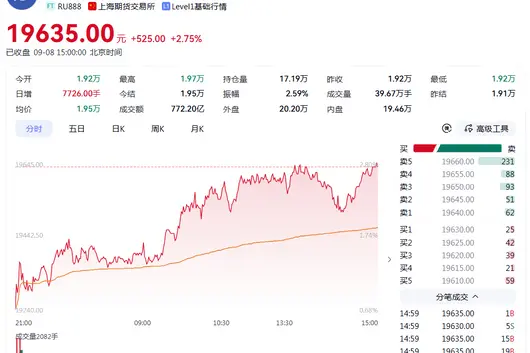
September 8, two "heavy bombs" landed simultaneously: Brent crude approached $100/barrel intraday, natural rubber main contract closed up 2.75%, quoted at 19,635 Yuan/ton, both hitting new phase highs. Under the surge of raw materials' "dual engines", two tire companies announced price hike letters on the same day. The third round of price hikes in the tire industry this year is now unstoppable.

Rubber Approaches 20,000 Yuan, Rubber Series "Three Brothers" Surge Together
September 8 closing, Shanghai Futures Exchange natural rubber main contract quoted at 19,635 Yuan/ton, up 2.75%, intraday high touched around 19,700 Yuan, one step away from the 20,000 Yuan threshold, single day turnover reached 77.22 billion Yuan.
The day before (September 7), the rubber series had already staged a collective surge: Natural rubber main contract closed at 19,180 Yuan/ton, up 2.18%; No. 20 Rubber main contract set a new record since listing, closed at 16,345 Yuan/ton; Synthetic rubber intraday approached 8%, closed at 15,605 Yuan/ton, up 4.59% for the day. Three varieties surged collectively and broke through the high-level oscillation zone within a day, which is rare in the past two years.

Guotai Junan Futures Analysts Point to Three Drivers:
First, synthetic rubber fundamentals are relatively strong. High oil prices pushed up the core raw material butadiene price, synthetic rubber processing profits continued to decline, some private enterprises operated at reduced capacity, supply side shrank, and market anxiety over spot liquidity intensified.
Second, natural rubber raw material side is firm. Hat Yai main producing areas had excessive rainfall and tapping was hindered, Hat Yai rubber glue prices rose from 75 Baht at the start of the month to 77.7 Baht; El Niño production cut expectations continued to ferment, impact intensity expected to peak in September-November, production cut logic difficult to disprove in the short term.
Third, the price hike atmosphere in the industrial chain is formed. Around September 1, over 25 tire enterprises such as Triangle, Double Star, Aeolus centrally adjusted prices by 2%-3%, strengthening bullish sentiment.
Different from the price hike wave in March-April, this time natural rubber and synthetic rubber resonated synchronously. According to Zhuochuang Information data, comparing September 3 with August 3, Shandong STR20# Blended Rubber rose 8.75%, Styrene Butadiene Rubber 1502 rose 16.67%, Polybutadiene Rubber rose 20.65%, Carbon Black N330 rose 16.89% — the four major core raw materials all surged heavily, none were "gentle".

Oil Price Nears $100, Goldman Sachs Forecasts $120
September 8, Brent crude intraday high touched $99.42/barrel, one step away from the $100 threshold, year-to-date gain nearly 100%; NY crude futures rose over 3%. On the same day, A-share oil and gas sector surged, Huajin Shares, Heshun Petroleum, Zhongman Petroleum hit limit up, Tongyuan Petroleum, Guanghui Energy and other stocks rose over 5%.
The direct trigger is the rapid escalation of the Middle East situation: Saudi energy facilities attacked by Houthis, partial facility operations interrupted, causing 73 injuries; meanwhile, US-Iran standoff over the Strait of Hormuz continued, US military required 94 commercial ships to alter course in blockade actions.
Goldman Sachs warned that if attacks escalate further, oil price may rise to $120/barrel; China Merchants Futures pointed out that if Yanbu Port exports continue to be hindered, supply reduction could expand to 3-4 million barrels/day. Plus OPEC+ announced October production halt — this is the first since production increase started in April this year, oil price upside risk is significant.

Price Hike Letters Land Again, Another "3% Hike"
Under cost pressure, two tire companies announced price hikes simultaneously on September 8:
Fangxing Rubber announced that due to continued rise in raw material prices such as rubber, carbon black, steel cord, starting from September 12, semi-steel, full-steel, and engineering tire series prices were adjusted upward by 3%;

Shandong Weihai Rubber announced that "Hongying", "OPALS", "HIMALAYA" brand full-steel radial tires increased by 3% starting from September 12.

This is the third centralized price hike in the tire industry since late August this year. But the gap between cost and selling price remains glaring: Zhuochuang Information calculates that on September 3, production cost of a single full-steel tire was about 984.97 Yuan, up 9.21% in one month, up 13.87% year-on-year. Cost rose nearly 10 points, selling price only rose 2-3 points, some economic tires already showed real losses like "losing 80 Yuan per tire sold". Some enterprises said frankly: Tire prices need to rise at least another 16% to cover costs, and 20% increase is needed to achieve profitability.
Industry insiders point out that raw materials are unlikely to fall in the short term, but weak demand constrains transmission, price hikes will show a pattern of "multiple batches, small amplitude" rotation, industry reshuffling accelerates. For dealers, the dense period of price hike letters is both opportunity and trap, reasonable stocking, cash flow is king, maintain flexibility to navigate the cycle.

Influenced by disturbances in the Middle East situation and a sharp rise in international fuel prices, the Australian automotive market is undergoing profound structural changes. Local residents' vehicle usage costs and living costs continue to rise, driving consumer demand to accelerate towards high cost-performance electric models.
Against this backdrop, Chinese automakers quickly seize the market with mature new energy technologies and affordable pricing, achieving significant sales growth and continuously squeezing the survival space of Japanese automakers. This year, Australia's vehicle imports from China exceeded imports from Japan for the first time, marking a fundamental shift in the Australian car market landscape that has persisted for many years.
Chinese Automakers Break Through Strongly, Traditional Japanese Advantages Continue to Loosen
The Australian car market has long been dominated by Japanese brands like Toyota, but market influence has accelerated in changing since the beginning of this year. Data from automotive research institution Cox Automotive shows that from January to April this year, BYD became the automaker with the largest sales growth in Australia, selling 13,269 more new cars year-on-year. Chery, Geely, Great Wall, and Jaecoo followed closely, jointly joining the top five spots for sales growth in Australia.

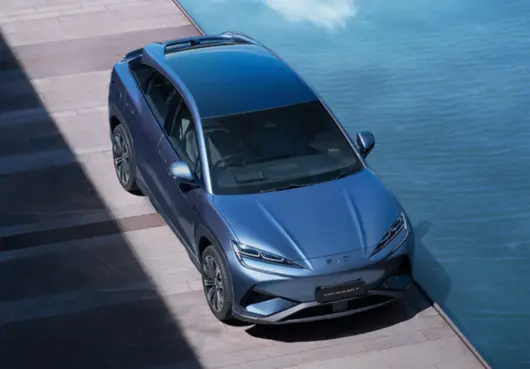
Sealion 7; Image Source: BYD
In stark contrast, Toyota, the market leader in Australia, saw a significant drop in sales, decreasing by 17,502 year-on-year, the largest decline in the industry. Japanese brands such as Mitsubishi, Nissan, and Mazda, as well as American Ford, all experienced varying degrees of sales contraction.
In recent years, the layout pace of Chinese automakers in Australia has continued to accelerate, with market penetration achieving leapfrog growth. From 2022 to date, the number of Chinese models on sale in Australia has grown more than five times, reaching 70 models, with a total of 11 Chinese automakers and 22 brands taking root in the local market.
From January to April this year, the overall sales share of Chinese brands in Australia rose to 25%, a significant leap from less than 15% in the same period last year. In contrast, Japanese automakers, despite occupying 40% of the Australian market share in the first four months of this year, having deep roots, and Toyota remaining the highest-selling automotive brand in Australia, growth has basically stalled under the continuous impact of Chinese cars, and market share is being gradually eroded.

Image Source: Toyota
The trend of changing the global automotive industry landscape is becoming increasingly obvious: this year, the total volume of cars imported by Australia from China exceeded the number imported from Japan for the first time, which includes both domestic Chinese brand models and foreign brand models produced in factories in China.
In the first four months of this year, Australia imported 107,196 vehicles from China, up 60% year-on-year; imported 94,500 vehicles from Japan, down 23% year-on-year; China surpassed Japan for the first time to become Australia's largest automotive import source country; meanwhile, Australia imported 72,689, 47,492, and 17,569 vehicles from Thailand, South Korea, and Germany respectively, all lower than the import scale from China, and the market competitiveness of Chinese cars significantly improved.
Cox Automotive analyst Mike Costello analyzes that Australia's new car annual sales are stable at around 1.2 million units, the market volume is solid, and with more Chinese automakers continuing to enter the field, the market share of traditional automakers will be further squeezed. "Chinese rise, Japanese decline" has become one of the core trends of the Australian car market.
Mike Costello said: "Simply put, the current market pattern shows the characteristics of rising market share for Chinese automakers and declining market share for Japanese automakers. Japanese brands still have substantial overall depth, but the overall growth rate of the Australian car market is only a few percentage points."
Oil Prices and Cost-Performance Resonate, Chinese Enterprises Lead the Australian New Energy Track
In this round of market changes, new energy vehicles have become the core force leveraging the change in the pattern. Previously, Australia's electrification progress lagged behind the global mainstream market for a long time, with consumers preferring traditional fuel vehicles. However, the skyrocketing oil prices triggered by the Middle East situation, combined with government car purchase subsidy policies, significantly activated local new energy consumption potential, and the electric vehicle market welcomed explosive growth.
In March this year, sales of electric vehicles in Australia accounted for nearly 20% of total passenger car and SUV sales, and market penetration speed significantly accelerated. Industry predictions suggest that sales of electric vehicles in Australia in 2026 are expected to reach 150,000 units, achieving an increase of about 50% compared to last year.
Relying on dual advantages of technology and price, Chinese automakers have already occupied a dominant position in the Australian new energy track. Data shows that Chinese automakers hold a 54% share of the Australian pure electric vehicle market, and the share in the plug-in hybrid market is as high as 76%.
In terms of specific sales dimensions, Tesla Model Y slightly leads the pure electric vehicle sales list, with BYD Sealion 07 (Sealion 7) following closely; in the overall electric vehicle sales list, BYD leads by a wide margin with cumulative sales of 14,406 units, leading the second-place Tesla's 8,485 units.

Image Source: Tesla
The new energy trend has covered the entire market of new and used cars. According to data from the Australian Automobile Dealers Association, the transaction volume of local used electric vehicles doubled in March compared to February, and market consumption heat continued to heat up.
James Voortman, CEO of the Australian Automobile Dealers Association, stated that rising oil prices, policy subsidy support, combined with the entry of a large number of high cost-performance Chinese electric vehicles, multiple factors jointly accelerated the popularization process of local pure electric and hybrid models.
James Voortman said: "Many people ignore one point: electric vehicles pouring into the Australian market have seen a significant price drop, and one core reason is the entry of a large number of high cost-performance Chinese models. Lowering the threshold for car purchase, no need to bear high fuel costs daily, and combined with policy subsidies, for consumers planning to buy new or used cars, electric models already possess extremely strong purchase attraction."
Compared to the high usage costs of traditional fuel vehicles, Chinese hybrid and pure electric models balance the core advantages of low purchase price and low-cost maintenance, precisely matching the current Australian public's need to reduce living expenses.
Mike Costello stated: "Currently, there is increased pressure on people's living costs, and more and more people tend to choose electric vehicles, and Chinese automaker products just fit these two major market demands. Chinese vehicle pricing is generally more advantageous, hybrid and pure electric vehicle technologies are mature, and product strength is outstanding."
From a market logic perspective, the fuel-saving and durability advantages of Japanese fuel vehicles are gradually being offset by the comprehensive cost-performance of electric vehicles in the era of high oil prices, which is also one of the core underlying logics of the continued weakness of Japanese brands and the rapid rise of Chinese automakers. As the electrification wave continues to deepen, the market position of Chinese brands in the Australian market is expected to be further consolidated.
© 2024 Bitauto.com. All Rights Reserved.
Bitauto (www.yiche.com and www.bitauto.com) is one of the most visited automotive websites in China. We provide detailed info on Chinese car brands available in your area. Please note that the information provided on this website is based on publicly available data and is for reference only. It may not be fully updated or accurate at all times.

Help us improve our website


