

HomeOpen the door

Search History
Popular Searches
Dealer Login / Sign Up

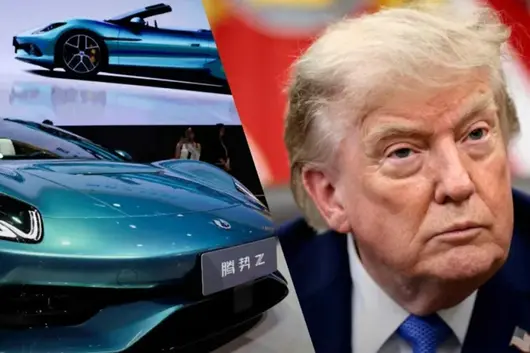
On September 11, during an interview on Fox News, Trump said a rather conspicuous remark: "If China wants to come here to build factories to produce cars, I will not object."
For Chinese automakers that have already been blocked at the door by the US with tariffs exceeding 100%, bans on connected cars, and a series of bills, this sounds like Washington has finally cracked open a sliver of a door.
But Trump immediately added: Japan is doing the same thing; the key is hiring Americans. He does not want Chinese cars to bypass into the US via Mexico, nor does he plan to let cars made in China flood the US market directly.

So, this is not a welcome invitation, but more like an investment explanation with very clear conditions: factories can come, investment can come, technology can come, but jobs, tax revenue, and production must remain in the US.
Trump might not have suddenly fallen for Chinese cars; he just still believes in the business model he is most familiar with — putting market access on the table to get back factories and jobs.
However, a president's "OK" is still far from Chinese cars actually getting US license plates.

Early in 2025, the Biden administration landed connected car rules before Trump took office, which in fact already blocked the path for Chinese automakers to produce and sell passenger cars in the US. Under the current arrangement, software restrictions will take effect from the 2027 model year, while hardware restrictions will take effect from the 2030 model year.
In July 2026, the US Senate Commerce Committee passed another bill, intending to ban enterprises with over 15% Chinese capital ownership from entering the US market. The Auto Innovation Alliance, representing automakers such as GM, Ford, Toyota, Volkswagen, Hyundai, Honda, and Stellantis, is still urging Congress to add a "permanent ban" on Chinese cars as soon as possible.
Thus, a rather absurd picture appeared in US auto policy:
The president tells Chinese automakers they can come on TV, while the Transportation Secretary is writing letters scolding Ford, accusing it of being too close to Chinese technology; the White House just promoted Ford's Marshall battery plant in Michigan, but the Transportation Secretary turned around and listed the same project as a negative example.
And this factory happens to fit the conditions Trump mentioned most. The factory belongs to Ford, is operated by Ford, hires American workers, but just uses battery technology licensed by CATL.

Ford CEO Jim Farley thus asked in return: claims of "relying on Chinese enterprises" can be cleared up with a five-minute phone call. About 80% of cars sold by Ford in the US are produced in the US, and domestic manufacturing workers and automotive export numbers are also among the top US automakers, but once the name of a Chinese company appears on the technology licensing document, it can still be pulled into Washington's political spotlight.
No wonder Farley, while constantly reminding that Chinese cars will bring a "survival threat" to US automakers, on the other hand admits that if Ford wants to maintain competitiveness in the global market, it must cooperate with Chinese companies to some extent.
Last year, Ford only accounted for about $19.5 billion in related expenses for electric vehicle investments, and subsequently put forward $2 billion to launch energy storage business; in Europe, it also needs to rely on the Spanish factory to cooperate with Geely to produce and develop new cars for overseas markets.
Politically wanting to keep Chinese cars out, yet industrially finding it harder and harder to bypass Chinese technology, this is where Trump's "I will not oppose" is truly worth looking at.

Chinese cars are no longer imaginary opponents sitting in US hearing documents; they have already appeared in battery technology in US factories, production lines in European factories, and in the car buying lists of more and more overseas consumers.
Previous data has already shown that in May 2026, the market share of Chinese brands in Europe reached 12%, exceeding Japanese brands' 11%; in the UK, the share of Chinese brands reached 15.4%, higher than Japanese's 12.4%.
In addition, the overseas expansion methods of Chinese automakers are no longer just putting cars on Ro-Ro ships: XPeng acquired 90.1% of Indonesia EIDO's equity to get the first overseas factory, and Geely and Ford are looking for cooperative ways where each gets what they need in Spain. The higher the tariffs, the more complex the rules, the more Chinese automakers actually need to move from "selling cars" to truly keeping factories, supply chains, and jobs locally.

Of course, the US is still one of the world's most important and profitable auto markets. Whether it can enter the US will affect a Chinese automaker's global map.
But, it long ago could not decide whether Chinese cars have a global map. Trump's statement could be a probe before the summit, or maybe just a countermove against domestic election rumors.
Washington opens a crack in the door today, might hang another lock tomorrow; Chinese automakers do not need to cheer for an "OK", and even less so hand over their course to American political weather.

Editor's Comment
Whether Chinese cars are sold, whether they are sold overseas, how well they sell overseas, ultimately does not rely on a US president's "OK", nor on the US market granting a spot out of charity.
It relies on whether Chinese batteries can be safer, whether hybrids can be more efficient, whether software can be more reliable, whether brands can make foreign consumers willing to pay willingly.
Trump can decide when Chinese cars drive onto US roads, but cannot decide whether Chinese cars will drive to the world. Tickets might be held in others' hands, but the steering wheel is always held in the hands of the Chinese themselves.
© 2024 Bitauto.com. All Rights Reserved.
Bitauto (www.yiche.com and www.bitauto.com) is one of the most visited automotive websites in China. We provide detailed info on Chinese car brands available in your area. Please note that the information provided on this website is based on publicly available data and is for reference only. It may not be fully updated or accurate at all times.

Help us improve our website


