

HomePassat

Search History
Popular Searches
Dealer Login / Sign Up

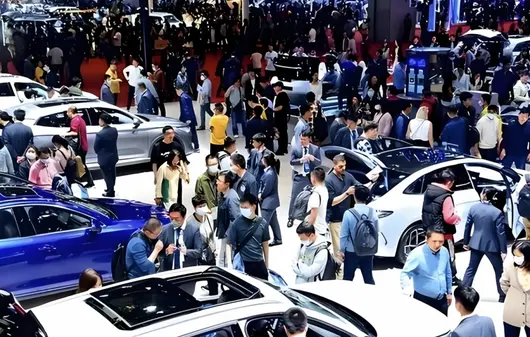
In June, automakers mass-announced impressive production and sales data. BYD, Leapmotor, NIO, and XPeng all submitted growth reports, with single-brand sales figures rising steadily, creating a boom-like scene. However, data shows domestic passenger car retail sales dropped 21% year-on-year. Since the end of last year, the domestic auto market has been stuck in a double-digit decline range, with the drop in February touching 25.3% at one point.

On one side, brands are constantly releasing good news to the outside world; on the other, the overall market continues to shrink. Behind this seemingly contradictory collective carnival lies a picture of industry segmentation woven together by the struggle for existing market share and breakthroughs in overseas markets.
Domestic Auto Market Slows Down
Looking solely at the delivery speed reports released by various automakers to the public, the domestic auto industry in June still seemed to be on an upward trajectory, with head-brand sales figures showing red across the board. However, after terminal retail data was finalized, the 21% year-on-year decline indicates that the contraction of overall industry demand is already a set fact.

Many people interpret the positive growth of head brands as breaking the situation against the trend brought by the company's product power breakthrough. In the current market environment, this judgment is incomplete. With overall domestic terminal demand continuously shrinking and the total market volume continuously falling, the reason head automakers can achieve growth against the trend is partly due to incremental offset from overseas exports, and partly due to grabbing shares in the domestic existing stock market. The extra sales volume of head brands mostly comes from stock orders diverted from weak brands, which also leads to SME automakers lacking capital, technology, and channel support having actual decline rates far higher than the industry average of 21%.
Factors such as capital chains, R&D reserves, offline channels, and many others determine whether an automaker can survive this downturn cycle. This year, many marginal automakers have stopped planning annual facelifts and new models, and dealer stores in various places have successively closed down and withdrawn networks. Consumers naturally avoid these risky brands when purchasing new cars, so customer sources naturally tilt towards enterprises with scale advantages such as BYD and Geely. All global mature auto markets have gone through a brand clearance stage; the domestic auto market has simply compressed the time of this process. The more depressed the market is, the more solid the barriers of scale advantages for head enterprises become.

The 150,000 to 250,000 RMB price range, which is the main interval, is becoming the most brutal battleground in this entire stock war, and the collapse of the intermediate market is hard to reverse. This range was once the foundation for joint-venture fuel vehicles and the core battlefield for independent brands to achieve scale. Currently, user willingness to upgrade has weakened significantly, and hesitation has surged. To save sales, joint ventures rely heavily on deep price cuts to clear stock; discounts for classic family cars like Accord and Passat keep widening, completely loosening traditional pricing systems. Independent automakers, on the other hand, are densely launching hybrid and BEV models in this segment. LiDAR and advanced intelligent driving features are trickling down. Highly homogenized products combined with endless price wars compress the profit margins across the entire market.
Consumer hesitation is strongest in this price segment. Most potential car buyers worry about receiving a new model replacement or a new round of price cuts shortly after getting their cars, so they hesitate to finalize orders. The recent pressure on orders for the BYD Qin and Song pillars exactly proves the congestion level of this red sea track.
Head Automakers Profit Overseas
Domestic competition is cutthroat, while overseas markets have become a panacea for head automakers.
For a long time, the model for domestic automakers going overseas was simple and direct: assemble complete vehicles domestically, ship them in containers, and rely on low prices to open up sales channels in markets like Southeast Asia and Latin America. Essentially, it was just digesting excess capacity. This unidirectional commodity export method has a very low error tolerance. Once the target market implements tariff restrictions or import quota policies, the entire export sales chain will be directly blocked. Not long ago, the new policy introduced by Malaysia was an example.

Now, head automakers are starting to land complete manufacturing, supply chain, and service ecosystems overseas, thereby breaking away from the fragile model that relies solely on exporting complete vehicles, and establishing a long-term stable operational foundation in overseas markets.
From a technological development perspective, over the past few years, basic electrification hardware such as battery packs, drive motors, and hybrid architectures have become highly mature, with solutions converging. Head automakers have basically leveled out the generation gap at the hardware level, making it hard to gain a long-term advantage based on single hardware parameters alone. True differentiation is gradually shifting to intelligent driving algorithms, vehicle architecture tuning, global thermal management, and other soft capabilities. Under the premise of hardware homogenization, scale-based cost control has become the core decisive factor for automakers. BYD reduces manufacturing expenses through its vertical industrial chain, CATL has become a top player in power batteries. New entrant brands find it difficult to bridge the software system gap and replicate scale cost advantages. Achieving a curve overtaking on the hardware side is extremely difficult.
Speaking of this, everyone should be able to see clearly: the overseas expansion of an automaker's supply chain is essentially the outward extension of its own industrial chain capabilities. Against the backdrop of domestic technological homogenization and intensified market involution, what truly widens the final gap between automakers is the control over the core supply chain.
If an automaker only retains body manufacturing and complete vehicle assembly business, it is essentially just an assembly OEM for the upstream supply chain. If upstream raw materials or core parts prices fluctuate slightly, the pricing and profit margin of the terminal model will be directly squeezed. It cannot create unique configurations distinct from competitors, nor does it have the confidence for autonomous pricing.

The industry has gradually differentiated into two response modes. Some automakers go deep internally in self-research, keeping key parts in their own hands; others actively bind with top supply chain enterprises, locking in priority supply qualifications to avoid supply disruption and price hike risks. Those SME automakers that cannot land on either side have neither the capital to invest in upstream R&D nor stable parts orders. Not to mention participating in overseas market layouts, they can hardly withstand the price involution in the domestic market either.
Global layout and deepening of the upstream supply chain are essentially two sides of the same coin. Opening up incremental markets outwardly and safeguarding the profit foundation inwardly; missing either one makes it difficult for an automaker to stabilize its position in the upcoming industry reshuffling.
Public Car Review
In the future, electrification hardware will tend towards homogenization, and the competitive barriers of automakers will shift from parameter stacking to cost control, software capability, and supply chain control. Head enterprises will guard the domestic foundation relying on the full-chain system while overseas expanding with localized ecosystems to hedge risks. In the future, industry victory and defeat will no longer depend on the explosive power of a single product, but on the system showdown of supply chain barriers superimposed with global capabilities. The polarized pattern will continue to solidify.



















© 2024 Bitauto.com. All Rights Reserved.
Bitauto (www.yiche.com and www.bitauto.com) is one of the most visited automotive websites in China. We provide detailed info on Chinese car brands available in your area. Please note that the information provided on this website is based on publicly available data and is for reference only. It may not be fully updated or accurate at all times.

Help us improve our website


