

HomePerfecting

Search History
Popular Searches
Dealer Login / Sign Up

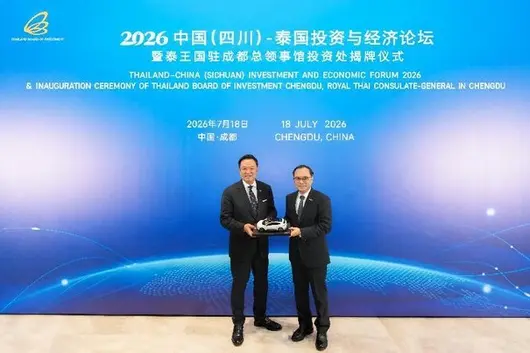
Global electrification is reconstructing the automotive industry division of labor system. The dividend of the single complete vehicle export model is gradually fading. Full-value-chain localized operational capability has become the core watershed for Chinese automakers participating in global market competition. Southeast Asia, relying on free trade agreement networks, mature automotive supporting foundations, and new energy policy support, has become the core battlefield for new energy vehicle capacity deployment for independent brands. As the core hub of the ASEAN automotive industry, Thailand continuously attracts domestic top automakers to establish manufacturing bases. Industrial cooperation has progressed from simple product trading to deep binding stages of supply chain co-construction, technology localization, and talent localization. The 2026 China-Thailand Sichuan Economic and Trade Investment Forum landed. Changan Automobile, as the only Chinese automaker invited to operate in Thailand, completed a high-level meeting with the Prime Minister of Thailand. Its three-year industrial landing results in Thailand and medium-to-long-term capacity R&D planning clearly show the underlying logic of the current top independent brand's globalization strategy, and also provide a typical sample for the industry to observe the outbound transformation of Chinese automakers.

Localized Capacity Forms a Closed Loop, Complete Industrial Landing Reshapes Regional Supply System
Since entering the Thai market in 2023, Changan Automobile has continuously promoted full-chain localized investment. With an investment of 9 billion Thai Baht, it built the Rayong overseas new energy complete vehicle factory, completing the complete loop of local supply for production and cross-border export. This changed the market pattern where Southeast Asian new energy complete vehicles relied on imports. As of now, the brand's cumulative sales of complete vehicles in Thailand have exceeded 41,000 units. 13 new energy models have been launched, covering local mainstream niche markets. 2 local mass-produced models have achieved export supply targeting 18 countries. Thailand has officially become the manufacturing hub for Changan to radiate the global right-hand drive market.
At the level of industrial synergy, the brand collaborates with over 40 local parts enterprises operating simultaneously, and simultaneously introduces 10 domestic core supporting enterprises to build factories in Thailand, making up for the shortcomings of Thailand's new energy three-electric systems supporting facilities, and promoting the transformation of the local traditional fuel vehicle industry chain towards electrification. Operational data intuitively reflects the value of industrial symbiosis, with cumulative tax contributions exceeding 1.6 billion Thai Baht, absorbing over 1,900 local jobs, and the talent localization rate is close to 90%. From an industry perspective, this model breaks out of the superficial layout of simply building factories for production. By driving the landing of upstream supporting industries, it helps the host country improve its new energy industry foundation, while reducing cross-border supply chain costs for automakers, forming a balanced mode of mutual empowerment between automakers and local industries, distinct from the lightweight layout of many overseas brands that only perform complete vehicle assembly.
Medium-to-Long Term Planning Anchors Regional Leader, R&D, Capacity, and Talent Three-Dimensional Investment Deeply Binds Industry
The medium-to-long term development plan released by the talks clearly conveys Changan's strategic orientation to deeply cultivate Southeast Asia rather than seeking short-term arbitrage. Goals in four dimensions—market, capacity, R&D, and talent—are implemented simultaneously to build a sustainable localized operation system. On the market side, it is planned to exceed 70,000 annual sales in Thailand by 2030, aiming for the second position among Chinese brands and the fourth position in the industry locally, continuously squeezing the market space for traditional foreign fuel vehicles and Japanese/Korean new energy brands. On the capacity side, the Rayong Factory Phase II expansion demonstration will be launched in 2028. Relying on the existing mature factory area, a larger manufacturing scale will be released to match the growing new energy consumption demand in ASEAN.

Localization of R&D and supply chain has become a core focus. The enterprise plans to land a Thailand regional R&D center, simultaneously setting a target for local parts procurement rate to exceed 60% by 2028, achieving technology adaptation to local road conditions and climate needs, and reducing overseas technology adaptation costs. In terms of talent, the plan is to expand the local employee scale to 3,000 by 2030, maintaining the proportion of local personnel in technical and management positions above 90%, building an autonomous and controllable local operation team. Analyzed from an industry perspective, this plan breaks the traditional mode where overseas automakers are dominated by expatriate operations. It reduces cross-border management costs through long-term talent cultivation. At the same time, it adapts to regional markets through local R&D, which is a characteristic feature of the improved maturity of independent brands' globalization.
Government-Enterprise Two-Way Synergy Builds Development Foundation, Southeast Asia Becomes Core Pivot of Chinese Automakers' Global Strategy
At the Thai government level, Changan is clearly regarded as the core partner for the country's new energy industry upgrade, committing to continuously improve the industrial infrastructure, logistics supporting, and talent cultivation systems, and issuing special policies to support enterprises in completing medium-to-long term market goals. The local government clearly recognizes the shortcomings of the local new energy industry. Relying on the complete three-electric manufacturing system of Chinese-owned automakers, it quickly makes up for the shortcomings of electrification transformation, and uses foreign production capacity to enhance the global export competitiveness of its own automotive industry.
The Changan Southeast Asia Division shared industry judgments at the economic and trade forum. Currently, Chinese new energy brands have mastered the dominant position in the Thai electric vehicle market. The export advantages brought by multiple free trade agreements fully cover the global right-hand drive market, which is the core logic for the brand to firmly root locally. From the perspective of top-level corporate strategy, the Thailand layout is the key landing carrier for Changan's 1445 Global Strategy and the Inclusive Plan 2.0. The brand has officially completed the transformation from export trade to an integrated system of manufacturing investment and service operation. Relying on the global collaborative R&D system of 6 countries and 10 locations, 24,000 cross-border R&D personnel continuously output core new energy technologies. Superimposed on the nearly 3 million units of production and sales volume globally in 2025, the overseas market has become the brand's second growth curve. The Thailand base is exactly the benchmark carrier for the landing of this globalization system.

Placing it from a macro industry perspective, the Southeast Asian market competition has already moved beyond simple price competition of product prices. Whether it can drive host country industry chain upgrades, build local R&D and talent systems, and achieve long-term stable industry investment determines the brand's regional long-term competitiveness. A large number of overseas foreign automakers only layout assembly factories, lacking upstream supporting industries and local R&D investment. In the long run, they will find it difficult to adapt to the regional electrification rapid iteration demand. The complete industry chain advantage of Chinese independent brands forms a differentiated competitive barrier here.
Conclusion: Industrial Symbiosis Reshapes New Paradigm of Independent Brand Global Competition
Changan Automobile's deep localization layout in Thailand represents a fundamental iteration of the outbound logic of Chinese automakers, thoroughly saying goodbye to the superficial trade model of single complete vehicle exports, and walking out an industrial symbiosis path with multi-dimensional synergy of manufacturing, supporting, R&D, and talent. Relying on the dividends of China-Thailand economic and trade cooperation, Changan uses the Rayong new energy base to open up export channels for the ASEAN and even global right-hand drive markets. It not only helps Thailand make up for the shortcomings of the new energy industry chain and drives local employment and tax growth, but also relies on the host country's industrial policy and location advantages to solidify its own Asia-Pacific regional hub positioning. Against the backdrop of global automotive electrification reconstructing the division of labor, this long-term operation idea that deeply binds to the local, balancing enterprise development and host country industry upgrade, builds a differentiated barrier distinct from the lightweight assembly model of traditional overseas automakers. It provides a mature industry model for the systematic global layout of domestic independent brands and continuously promotes the advancement of China's automotive industry from product output to full industry chain global operation.
© 2024 Bitauto.com. All Rights Reserved.
Bitauto (www.yiche.com and www.bitauto.com) is one of the most visited automotive websites in China. We provide detailed info on Chinese car brands available in your area. Please note that the information provided on this website is based on publicly available data and is for reference only. It may not be fully updated or accurate at all times.

Help us improve our website


