

HomePolisEvo

Search History
Popular Searches
Dealer Login / Sign Up

喺馬來西亞嘅 SUV 市場,好多買家喺揀車嘅時候都會拎寶騰 X90 同豐田 Yaris Cross 嚟做比較。呢兩款車喺價位同定位上都幾近嘅,而家我哋就由多個方面做一次詳細嘅比較,幫你省下做功課嘅時間。
寶騰 X90 喺馬來西亞嘅 OTR 售價係 RM 106,800 - 122,800,合共有 4 個版本,包括 2026 1.5T Prime X(RM 122,800)、2026 1.5T Prime(RM 116,800)、2026 1.5T Lite(RM 106,800) 等。
豐田 Yaris Cross 喺馬來西亞嘅 OTR 售價係 RM 99,900 - 109,900,合共有 2 個版本,包括 2026 1.5L Standard(RM 99,900)、2026 HEV 1.5L Standard(RM 109,900) 等。
從價錢睇,豐田 Yaris Cross 嘅起步價比寶騰 X90 平咗 RM 6,900。講真嘅,喺呢個價位段,幾千蚊嘅差距其實唔算大,關鍵仲要睇整體嘅性價比同長期使用成本。

寶騰 X90 嘅安全評級係 5★ (ASEAN NCAP),主動安全系統包括 ADAS (ACC, AEB, LKA, LDA, BSM, RCTA)。
豐田 Yaris Cross 嘅安全評級係 5★ (ASEAN NCAP),主動安全系統包括 TSS。
兩款車嘅安全評級一樣,喺呢個級數入面安全配備都算好齊全。而家嘅新車安全性都唔錯,唔使太擔心呢一點。

寶騰 X90 車身長 4400 mm,後廂 400 L。
豐田 Yaris Cross 車身長 4400 mm,後廂 400 L。
兩款車嘅尺寸幾乎一樣,車內空間差別唔大。呢個級數嘅車,日常使用完全夠用。

寶騰 X90 採用 FWD 驅動方式。
豐田 Yaris Cross 採用 FWD 驅動方式。
兩款車嘅驅動方式一樣,都係 FWD,日常駕駛感受唔會有太大分別。

總體嚟講,寶騰 X90 同豐田 Yaris Cross 都係馬來西亞市場好唔錯嘅車型。揀邊一輛,關鍵仲要睇你嘅個人需求同預算。建議大家做足功課,多比較幾間車行嘅報價,先至去試駕做最終決定。買車係件大事,花啲時間做功課絕對唔會錯。


In the SUV market in Malaysia, many buyers compare Perodua Ativa and Honda WR-V when choosing a car. These two models are quite close in terms of price and positioning. Today, we will make a detailed comparison from multiple aspects to help you save time on research.
The OTR price of Perodua Ativa in Malaysia is RM 62,500 - 73,400, with a total of 3 versions, including 1.0L Turbo X (RM 62,500), 1.0L Turbo H (RM 67,300), 1.0L Turbo AV (RM 73,400), etc.
The OTR price of Honda WR-V in Malaysia is RM 89,900 - 107,900, with a total of 4 versions, including 2023 1.5L V (RM 99,900), 2023 1.5L E (RM 95,900), 2023 1.5L S (RM 89,900), etc.
In terms of price, the starting price of Perodua Ativa is indeed RM 27,400 cheaper than Honda WR-V. If your budget is limited, Perodua's entry-level version can already meet daily needs. However, note that the difference of a few thousand may involve trade-offs in features, which depends on your specific needs.

Perodua Ativa's safety rating is 5★ (ASEAN NCAP), active safety systems include ASA 3.0 + ACC + LDA + LKA + BSM + RCTA.
Honda WR-V's safety rating is 5★ (ASEAN NCAP), active safety system includes Honda SENSING.
Both cars have the same safety rating, and safety features are quite comprehensive for this class. New cars nowadays generally have good safety, so there's no need to worry too much about this point.

Perodua Ativa body length is 4400 mm, trunk capacity 400 L.
Honda WR-V body length is 4400 mm, trunk capacity 400 L.
The dimensions of both cars are almost identical, with little difference in interior space. For this class of car, it is more than enough for daily use.

Perodua Ativa warranty 5 years/150,000km, maintenance interval every 10,000km or 6 months.
Honda WR-V warranty 5 years/unlimited mileage, maintenance interval every 10,000km or 6 months.

Overall, Perodua Ativa and Honda WR-V are both quite good models in the Malaysian market. Which one to choose depends mainly on your personal needs and budget. It is recommended to do your research, compare quotes from multiple dealerships, and then test drive to make a final decision. Buying a car is a big deal, taking time to do research will definitely not be wrong.


在馬來西亞的 SUV 市場,很多買家在選車的時候都會拿 Audi Q5 和 Land Rover Defender 來做比較。這兩款車在價位和定位上都蠻接近的,今天我們就從多個方面做一個詳細的對比,幫你省下做功課的時間。
Audi Q5 在馬來西亞的 OTR 售價是 RM 354,174 - 423,174,一共有 2 個版本,包括 40 TDI(RM 320,000)、45 TFSI(RM 350,000) 等。
Land Rover Defender 在馬來西亞的 OTR 售價是 RM 688,000 - 688,000,一共有 1 個版本,包括 Standard(RM 688,000) 等。
從價錢來看,Audi Q5 的起步價確實比 Land Rover Defender 便宜了 RM 333,826。如果你預算有限,Audi 的入門版已經可以滿足日常需求。但也要注意,便宜的那幾千塊,可能在配備上會有取舍,具體要看你的需求。

Audi Q5 搭載 2.0L Turbo,馬力 220 hp。官方油耗 9.5 L/100km。
Land Rover Defender 搭載 3.0L Turbo,馬力 350 hp。官方油耗 12.0 L/100km。
動力方面,Land Rover Defender 的 3.0L Turbo 比 Audi Q5 的 2.0L Turbo 多了 130 匹馬力。不過日常在市區開,兩款車的動力都夠用,不會覺得不夠力。

Audi Q5 的安全評級是 5★ (Euro NCAP),主動安全系統包括 Pre Sense + ACC。
Land Rover Defender 的安全評級是 TBD,主動安全系統包括 Basic。
安全配備方面,兩款車都拿到了不錯的評級。不過 Audi Q5 的 Pre Sense + ACC 和 Land Rover Defender 的 Basic 在功能上有些差異,如果你比較看重主動安全的話,可以仔細對比一下兩者的功能列表。

Audi Q5 保修 5 年/150,000km,保養間隔 每 10,000km 或 6 個月。
Land Rover Defender 保修 3 年/100,000km,保養間隔 每 10,000km 或 6 個月。

總的來說,Audi Q5 和 Land Rover Defender 都是馬來西亞市場很不錯的車型。選擇哪一輛,關鍵還是要看你的個人需求和預算。建議大家做好功課,多比較幾間車行的報價,再去試駕做最終決定。買車是件大事,花點時間做功課絕對不會錯。


In 2021, Chinese automotive exports reached $34.5 billion. Five years later, in the first half of 2026 alone, this figure reached $91.8 billion, approaching the hundred-billion-dollar threshold.
From 34.5 billion to $91.8 billion in just half a year, the Chinese automotive industry has completed in five years what many nations accomplished over decades.
Automotive Exports Reshape China's Export DNA
Data from the General Administration of Customs shows that from January to June 2026, China's total merchandise export volume was $2.1258 trillion, a year-on-year increase of 17%. Among them, complete vehicle exports reached $91.8 billion, a significant year-on-year increase of 54%; the monthly export volume in June alone was $18.2 billion, with a year-on-year growth rate rising to 70%.

Source: Huaban Network
In terms of volume, China's automotive achievements remain eye-catching: Statistics from the China Association of Automobile Manufacturers show that the first half saw automotive exports of 5.096 million units, a year-on-year increase of 65.3%. The half-year export volume broke the 5 million unit threshold for the first time in history. June's single-month export volume was 1.037 million units, a year-on-year increase of 75.1%, breaking the 1 million unit mark for a single month for the first time.
Overall export growth was 17%, while automotive export growth was 54%—behind the nearly three-fold "scissors difference" is a profound shift in China's export engine. Cui Dongshu, Secretary-General of the China Passenger Car Association, summarized this change as: "Automotive exports have performed extremely well in recent years, rising from $34.5 billion in 2021 to $117.4 billion in 2024, forming a trend of explosive growth." The full year of 2025 reached $142.4 billion. And in just the first half of 2026, $91.8 billion has been reached, making the annual breakthrough of $150 billion inevitable.

Source: Huaban Network
What truly reshapes the export landscape is not just the automotive category. Customs data shows that the first half saw lithium battery exports of $48.7 billion, a year-on-year increase of 43%; solar cell exports of $32.9 billion, a year-on-year increase of 24%. The "New Three Items" combined exports increased by 51.6% year-on-year to $118.35 billion. Among the three, electric vehicles had the highest growth rate, with cumulative exports of $52.1 billion in the first half, an increase of 75.1% year-on-year. Relying on the first-mover advantage of new energy and intelligent innovation capabilities, Chinese automobiles have not only achieved a leap in export scale but, through deep integration with artificial intelligence, have become an important force driving global automotive R&D and design innovation.
From clothing and home appliances to automobiles, lithium batteries, and solar cells, China's export "main lineup" is being redefined. And automobiles are undoubtedly the absolute core of this new lineup.
Who Is Driving This "Rush"?
The numbers showing growth in both volume and value are only the first layer of the narrative. What is truly worth asking is: Where does this growth momentum come from?
The answer lies within the explosion of new energy vehicles.
Data from the China Association of Automobile Manufacturers shows that new energy vehicle exports reached 2.355 million units in the first half, a 1.2-fold increase year-on-year, accounting for over 46% of total automotive exports. In June alone, new energy vehicle exports were 523,000 units, a 1.6-fold increase year-on-year. Chen Shihua, Deputy Secretary-General of the China Association of Automobile Manufacturers, stated at the monthly information release that automotive exports in the first half were "better than expected and formed a stable support".
Specifically, the passenger car segment exports in June reached $14.5 billion, a year-on-year increase of 84%, representing a 658% increase compared to the same period in 2021. Among these, new energy vehicles are the "main battle horse" pulling the passenger car export rush. New energy vehicle exports in the first half reached 2.355 million units, a 1.2-fold increase year-on-year, accounting for over 46% of total automotive exports. China's new energy vehicle industry chain, from mineral processing and battery manufacturing to complete vehicle integration, has formed the world's most complete and cost-competitive closed loop. If past Chinese automotive exports relied on cost-performance ratio, now it is about technological generation gap.
Many professionals judge thus: Chinese automotive exports are ushering in a critical leap from "scale expansion" to "value export", shifting from the past focus on cost-performance ratio to the trend of technological generation gap. China's new energy vehicle three-electric systems and intelligent supply chains possess stronger product competitiveness overseas.

Source: Geely Automobile
The differentiated pattern of the export market further confirms this trend. From January to May 2026, Brazil surpassed Russia to become China's largest export market with passenger car exports of 372,000 units, a year-on-year increase of 178.7%; Russia followed with 351,000 units, a year-on-year increase of 139.8%.
The two countries combined account for more than 40% of the total top ten in Chinese passenger car exports. Markets such as the UK, Belgium, Italy, and Australia also maintained rapid growth. Analysis by Gasgoo Auto Research Institute pointed out that the European market is "blooming everywhere, and if Russia is included, Europe accounts for over half of Chinese passenger car exports".
In terms of new energy, from January to May 2026, among the top five destinations for Chinese new energy passenger car exports, Brazil ranked first with 283,000 units, followed by Belgium and the UK. New energy exports in Italy and Germany surged by 365.3% and 211.2% year-on-year respectively—Chinese new energy vehicles have successfully entered the hinterland of traditional automotive powerhouse nations.
Meanwhile, the global map of Chinese automotive exports is also undergoing reconstruction. The Latin American market shows a bipolar differentiation—Brazil saw a surge in sales driven by pre-purchases due to expectations of tariff hikes in July; while Mexico saw exports decline by 40% year-on-year due to tariff hikes early in the year and tighter North American trade policies. Markets such as the UAE in the Middle East also entered an adjustment period, down 32.6% year-on-year. This differentiation indicates to some extent that Chinese automotive exports have moved from "indiscriminate" extensive expansion into a new stage of refined operations.

Source: Chery Automobile
Changes at the enterprise level are also worth noting. Data from the China Passenger Car Association shows that among the top ten exporting car companies in the first half, Chery Automobile led with 931,500 units, a year-on-year increase of 70.9%; BYD followed with 769,300 units, a year-on-year increase of 73.6%. The two combined accounted for nearly 40% of the top ten total. Geely Automobile exported 472,500 units in the first half, a year-on-year increase of 158.3%; SAIC Passenger Car 404,200 units; Great Wall Motor 256,000 units; Tesla China 229,000 units.
More worth examining is the export ratio indicator. Chery's exports accounted for 74.3% of its total sales—meaning over 70% of this company's cars were sold overseas; BYD's overseas sales ratio exceeded 40%; Great Wall Motor's export ratio also reached 50%. The ratio of automotive exports to domestic sales in the first half rose to 37%, while the same period last year was only 19%. "Going global" has changed from an "elective course" for individual enterprises to a "compulsory course" for the entire industry, and the overseas market is moving from "icing on the cake" to "half of the business".
Undercurrents and Solutions Beneath the Splendid View
High-growth numbers are indeed exciting, but the structural contradictions hidden beneath the data that cannot be avoided are also worth noting.
Among them, the most prominent is the "ice and fire" situation between complete vehicles and components. Complete vehicle exports in the first half reached $91.8 billion, a year-on-year increase of 54%; component exports were $51.3 billion, a year-on-year increase of only 7%. The "scissors difference" is obvious.
Chen Jingjing, Secretary-General of the Automotive Branch of China Council for the Promotion of International Trade in Machinery and Electronic Products, pointed out in an interview with the media that "the gathering place of automotive component exports is basically traditional automotive manufacturing powerhouse countries, represented by the USA and the EU, where measures to restrict exports to China are being continuously implemented". This forms a stark contrast with complete vehicle exports "basically not going to the USA".
Chen Jingjing further warned that Chinese automotive exports "have left the stage of pure trade driving, and future must shift to localized and systematic deep cultivation". She specifically pointed out that domestic enterprises going global generally have the shortcoming of "emphasizing sales and neglecting after-sales". "Short-term volume boosting will only overdraw the brand. After-sales, spare parts, user repurchase, and local reputation are the core lifeline for long-term deep cultivation in overseas markets." Cui Dongshu's judgment was more direct, stating "must follow the development of independent complete vehicle enterprises".
While the high growth of complete vehicle exports is gratifying, if components lag behind for a long time, the "autonomous and controllable" nature of Chinese automotive exports will face the risk of hollowing out.
Additionally, the continuous escalation of trade barriers is another practical pressure. Starting from October 2024, the EU levied final countervailing duties on Chinese pure electric vehicles for a period of five years, adding an extra tax burden of 7.8% to 35.3% on top of a 10% basic tariff. BYD, Geely, and SAIC were separately subjected to tax rates of 17%, 18.8%, and 35.3%. In June 2026, the European Commission planned to expand the scope of countervailing duties to plug-in hybrid electric vehicles. Xinhua Finance reported that the new rules may refer to pure electric standards, and the maximum comprehensive tax rate can also exceed 45%.
Non-tariff barriers are also upgrading. The EU plans to launch the "Supply Chain Diversification Instrument" and the "Public Procurement Act" in September 2026, requiring enterprises in sensitive industries to establish diversified supply channels in key fields, setting a limit of 30% to 40% on the procurement ratio for single suppliers.
At the same time, Brazil has unified the tariff on imported electric vehicles to 35% starting from July 1st. Thailand implemented a "capacity commitment mechanism", requiring car companies to exchange export volume for localization production indicators. Tariffs and non-tariff barriers are converging and strengthening.
Facing the increasingly high walls, Chinese car companies' answer is not to "go around", but to "dig in"—from "trade export" to "industry export".
For example, a factory of a domestic new energy complete vehicle enterprise in Brazil is the most typical sample. The factory welcomed its 100,000th new energy vehicle off the line in July. It is reported that the factory's first phase plans for an annual capacity of 150,000 to 200,000 units, with a long-term goal to expand to over 500,000 units, and plans to increase the localization procurement rate to 50% by early 2027.

Source: Chery Automobile
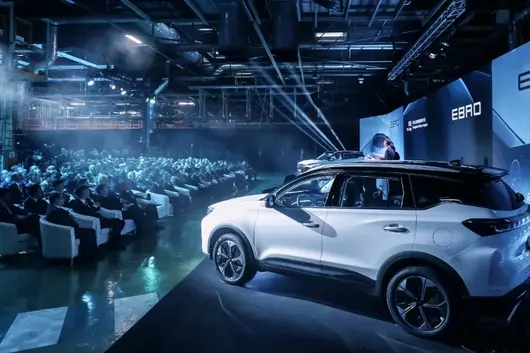
In Europe, Chery's layout is also of landmark significance. In June 2026, Chery and the Ebro Automobile Group started a new M1 production line at a joint factory operating in the Barcelona Free Trade Zone. The production line is 696 meters long, with 97 workstations, and a single vehicle production cycle of about 75 minutes. Rafael Ruiz, President of the Ebro Automobile Group, stated that the company chose Chinese enterprises as technical partners, intending to "introduce new technologies and industrial experience in the automotive field into Spain and convert them into local industrial capabilities and employment opportunities".
From product exports to the localization of capacity, brand, and supply chains, full-chain localization is becoming an inevitable path for Chinese automotive exports from the "first half" to the "second half". This trend is summarized by the industry as "ecosystem export". Under the drive of new energy and intelligent technology advantages, the form of Chinese automotive exports is changing: complete vehicle enterprises take the lead in laying out overseas capacity, supply chain enterprises follow suit, and overseas warehouses and after-sales service networks for components are also being perfected simultaneously.
Product export is just the first step. Full localization of capacity, brand, and supply chain is the key to determining whether Chinese automobiles can truly take root overseas.
Based on the export scale of 5.096 million units in the first half, breaking 10 million units for the year is inevitable. According to international professional agencies, Chinese automotive export volume in 2026 will increase by 41% year-on-year to 10 million units, becoming the first country in the world to export 10 million vehicles, equivalent to about 2.5 times the export volume of Japanese automobiles.
Conclusion
Looking back at 2021, Chinese automotive exports were less than $35 billion, merely an unremarkable footnote in the international trade landscape. Five years later, just half a year has approached the hundred-billion-dollar level—$91.8 billion. Behind this is a systematic explosion of decades of accumulation in Chinese manufacturing, and a historical window for reshuffling the global industrial landscape.
But beneath the halo of numbers, structural concerns are also clearly visible. The "gap" between components and complete vehicles, the comprehensive convergence of trade barriers, and the real test of localization capabilities—each is a threshold that cannot be bypassed. From "trade export" to "industry export", from "scale expansion" to "value deep cultivation", this road has just been paved, but is far from flat.
$91.8 billion is not only a report card but also an entry ticket. For Chinese automobiles to truly go from "big" to "strong", the decisive chapter is yet to come.
Dalam pasaran SUV di Malaysia, ramai pembeli akan membandingkan Perodua Aruz dan Kia Sportage ketika memilih kereta. Kedua-dua kereta ini mempunyai harga dan posisi yang sangat hampir, hari ini kita akan membuat perbandingan terperinci dari pelbagai aspek, membantu anda menjimatkan masa membuat penyelidikan.
Perodua Aruz di Malaysia harga OTR adalah RM 72,900 - 77,900, terdapat 2 varian, termasuk 1.5L X (RM 72,900), 1.5L AV (RM 77,900) dan sebagainya.
Kia Sportage di Malaysia harga OTR adalah RM 129,639 - 179,320, terdapat 4 varian, termasuk 2025 1.6T DCT 4WD High (RM 179,320), 2025 1.6T DCT 2WD High (RM 159,320), 2025 2.0L AT 2WD High (RM 139,639) dan sebagainya.
Dari segi harga, harga permulaan Perodua Aruz memang lebih murah RM 56,739 berbanding Kia Sportage. Jika anda mempunyai bajet terhad, versi permulaan Perodua sudah boleh memenuhi keperluan harian. Tetapi perlu diingat, perbezaan harga ribuan ringgit itu, mungkin ada pengorbanan dalam peralatan, bergantung kepada keperluan anda.

Perodua Aruz dilengkapi enjin 1.5L 4-cyl, kuasa 105 hp. Penggunaan bahan api rasmi 6.0 L/100km.
Kia Sportage dilengkapi enjin 1.5L Turbo, kuasa 140 hp. Penggunaan bahan api rasmi 7.0 L/100km.
Dari segi kuasa, Turbo 1.5L Kia Sportage mempunyai 35 hp lebih berbanding 1.5L 4-cyl Perodua Aruz. Namun, untuk penggunaan harian di bandar, kuasa kedua-dua kereta sudah memadai, tidak akan rasa kurang tenaga.

Perodua Aruz panjang badan 4400 mm, bak muatan 400 L.
Kia Sportage panjang badan 4400 mm, bak muatan 400 L.
Saiz kedua-dua kereta hampir sama, ruang dalam kereta tidak banyak berbeza. Kereta kelas ini, untuk penggunaan harian sudah memadai sepenuhnya.
Perodua Aruz menggunakan cara pemacu FWD.
Kia Sportage menggunakan cara pemacu FWD.
Cara pemacu kedua-dua kereta sama, semuanya FWD, pengalaman memandu harian tidak akan banyak berbeza.

Perodua Aruz jaminan 5 tahun/150,000km, jarak servis setiap 10,000km atau 6 bulan.
Kia Sportage jaminan 5 tahun/300,000km, jarak servis setiap 10,000km atau 6 bulan.
Secara keseluruhan, Perodua Aruz dan Kia Sportage kedua-duanya model kereta yang bagus di pasaran Malaysia. Memilih mana satu, penting untuk lihat keperluan dan bajet peribadi anda. Disarankan untuk melakukan riset teliti, bandingkan harga dari beberapa dealer kereta, kemudian pergi uji pandu untuk membuat keputusan akhir. Membeli kereta adalah perkara penting, meluangkan masa membuat riset pasti tidak salah.


Dalam pasaran SUV Malaysia, ramai pembeli membandingkan Perodua Aruz dan Proton X90 ketika memilih kereta.
Perodua Aruz dijual di Malaysia dengan harga OTR RM 72,900 - 77,900, terdapat 2 varian, termasuk 1.5L X (RM 72,900), 1.5L AV (RM 77,900) dan lain-lain.
Proton X90 dijual di Malaysia dengan harga OTR RM 106,800 - 122,800, terdapat 4 varian, termasuk 2026 1.5T Prime X (RM 122,800), 2026 1.5T Prime (RM 116,800), 2026 1.5T Lite (RM 106,800) dan lain-lain.
Dari segi harga, Perodua Aruz benar-benar lebih murah sebanyak RM 33,900 berbanding Proton X90. Jika bajet terhad, varian entry Perodua sudah boleh memenuhi keperluan harian. Tetapi perlu diingat, perbezaan harga beberapa ribu ringgit ini mungkin ada kompromi pada spesifikasi, bergantung pada keperluan anda.
Perodua Aruz panjang badan 4400 mm, ruang bagasi 400 L.
Proton X90 panjang badan 4400 mm, ruang bagasi 400 L.
Dimensi kedua-dua kereta hampir sama, ruang dalaman tidak banyak berbeza. Kereta dalam kategori ini cukup untuk penggunaan harian.
Perodua Aruz warranty 5 tahun/150,000km, selang penyelenggaraan setiap 10,000km atau 6 bulan.
Proton X90 warranty 5 tahun/150,000km, selang penyelenggaraan setiap 10,000km atau 6 bulan.
Kondisi warranty kedua-dua kereta adalah sama, tidak perlu bimbang tentang ini. Kos penyelenggaraan sebenar bergantung pada rangkaian servis jenama dan harga bahagian, disyorkan bertanya pengalaman pemilik sebenar dalam kumpulan pemilik kereta.
Perodua Aruz dan Proton X90 adalah pilihan utama di pasaran Malaysia, sesuai untuk kegunaan keluarga dan perjalanan harian. Jika anda lebih mengutamakan reputasi jenama dan harga jualan semula, pertimbangkan model yang mempunyai reputasi lebih baik; jika anda lebih mengutamakan nilai dan spesifikasi, pilih model yang lebih lengkap. Akhir sekali, disyorkan untuk memandu uji kedua-dua model, pengalaman peribadi adalah yang paling penting.
Secara keseluruhannya, Perodua Aruz dan Proton X90 adalah model yang sangat baik di pasaran Malaysia. Memilih mana satu, utama bergantung pada keperluan peribadi dan bajet anda. Disyorkan untuk membuat kajian, bandingkan harga antara beberapa pengedar kereta, baru kemudian memandu uji untuk membuat keputusan akhir. Membeli kereta adalah perkara besar, meluangkan masa untuk kajian tidak akan salah.

在马来西亚的轿车市场,很多买家在选车的时候都会拿 Lexus ES 和 Audi A3 来做比较。这两款车在价位和定位上都蛮接近的,今天我们就从多个方面做一个详细的对比,帮你省下做功课的时间。
Lexus ES 在马来西亚的 OTR 售价是 RM 320,888 - 371,888,一共有 4 个版本,包括 2025 250 F Sport(RM 371,888)、2025 250 Luxury(RM 356,888)、2025 250 Premium(RM 320,888) 等。
Audi A3 在马来西亚的 OTR 售价是 RM 340,112 - 340,112,一共有 2 个版本,包括 1.5L SkyActiv-G(RM 135,000)、2.0L SkyActiv-G(RM 155,000) 等。
从价钱来看,Lexus ES 的起步价确实比 Audi A3 便宜了 RM 19,224。如果你预算有限,Lexus 的入门版已经可以满足日常需求。但也要注意,便宜的那几千块,可能在配备上会有取舍,具体要看你的需求。

Lexus ES 车身长 4400 mm,后备箱 400 L。
Audi A3 车身长 4400 mm,后备箱 400 L。
两款车的尺寸几乎一样,车内空间差别不大。这个级别的车,日常使用完全够用。

Lexus ES 保修 3年/100,000km,保养间隔 每10,000km或6个月。
Audi A3 保修 5年/150,000km,保养间隔 每10,000km或6个月。

Lexus ES 和 Audi A3 都是马来西亚市场的主流选择,适合家庭使用、日常通勤。如果你更看重品牌口碑和二手价,可以优先考虑口碑更好的那一款;如果你更在意性价比和配备,那就选配置更丰富的那款。最终还是建议两款都去试驾,亲身体验才是最重要的。

总的来说,Lexus ES 和 Audi A3 都是马来西亚市场很不错的车型。选择哪一辆,关键还是要看你的个人需求和预算。建议大家做好功课,多比较几间车行的报价,再去试驾做最终决定。买车是件大事,花点时间做功课绝对不会错。


在马来西亚的轿车市场,很多买家在选车的时候都会拿 Mazda Mazda 6 和 Volkswagen Golf R 来做比较。这两款车在价位和定位上都蛮接近的,今天我们就从多个方面做一个详细的对比,帮你省下做功课的时间。
Mazda Mazda 6 在马来西亚的 OTR 售价是 RM 240,848 - 240,848,一共有 1 个版本,包括 Standard(RM 240,848) 等。
Volkswagen Golf R 在马来西亚的 OTR 售价是 RM 338,812 - 338,812,一共有 2 个版本,包括 2026 2.0T Standard(RM 338,812)、DCT(RM 294,800) 等。
从价钱来看,Mazda Mazda 6 的起步价确实比 Volkswagen Golf R 便宜了 RM 97,964。如果你预算有限,Mazda 的入门版已经可以满足日常需求。但也要注意,便宜的那几千块,可能在配备上会有取舍,具体要看你的需求。

Mazda Mazda 6 的安全评级是 5★ (ASEAN NCAP),主动安全系统包括 Brand ADAS。
Volkswagen Golf R 的安全评级是 5★ (Euro NCAP),主动安全系统包括 IQ.Drive。
安全配备方面,两款车都拿到了不错的评级。不过 Mazda Mazda 6 的 Brand ADAS 和 Volkswagen Golf R 的 IQ.Drive 在功能上有些差异,如果你比较看重主动安全的话,可以仔细对比一下两者的功能列表。
Mazda Mazda 6 车身长 4400 mm,后备箱 400 L。
Volkswagen Golf R 车身长 4400 mm,后备箱 400 L。
两款车的尺寸几乎一样,车内空间差别不大。这个级别的车,日常使用完全够用。

Mazda Mazda 6 保修 5年/150,000km,保养间隔 每10,000km或6个月。
Volkswagen Golf R 保修 3年/100,000km,保养间隔 每10,000km或6个月。
Mazda Mazda 6 和 Volkswagen Golf R 都是马来西亚市场的主流选择,适合家庭使用、日常通勤。如果你更看重品牌口碑和二手价,可以优先考虑口碑更好的那一款;如果你更在意性价比和配备,那就选配置更丰富的那款。最终还是建议两款都去试驾,亲身体验才是最重要的。
总的来说,Mazda Mazda 6 和 Volkswagen Golf R 都是马来西亚市场很不错的车型。选择哪一辆,关键还是要看你的个人需求和预算。建议大家做好功课,多比较几间车行的报价,再去试驾做最终决定。买车是件大事,花点时间做功课绝对不会错。


在马来西亚的SUV市场,很多买家在选车的时候都会拿 Toyota Harrier 和 Hyundai Palisade 来做比较。这两款车在价位和定位上都蛮接近的,今天我们就从多个方面做一个详细的对比,帮你省下做功课的时间。
Toyota Harrier 在马来西亚的 OTR 售价是 RM 289,000 - 289,000,一共有 1 个版本,包括 2026 HEV 2.5L Standard(RM 289,000) 等。
Hyundai Palisade 在马来西亚的 OTR 售价是 RM 368,838 - 399,838,一共有 4 个版本,包括 2023 3.8L 2WD Luxe 7 Seats Petrol(RM 399,838)、2023 2.2T 4WD Executive 7 Seats Diesel(RM 389,838)、2023 3.8L 2WD Luxe 8 Seats Petrol(RM 378,838) 等。
从价钱来看,Toyota Harrier 的起步价确实比 Hyundai Palisade 便宜了 RM 79,838。如果你预算有限,Toyota 的入门版已经可以满足日常需求。但也要注意,便宜的那几千块,可能在配备上会有取舍,具体要看你的需求。

Toyota Harrier 的安全评级是 5★ (ASEAN NCAP),主动安全系统包括 Brand ADAS。
Hyundai Palisade 的安全评级是 TBD,主动安全系统包括 Basic。
安全配备方面,两款车都拿到了不错的评级。不过 Toyota Harrier 的 Brand ADAS 和 Hyundai Palisade 的 Basic 在功能上有些差异,如果你比较看重主动安全的话,可以仔细对比一下两者的功能列表。

Toyota Harrier 车身长 4400 mm,后备箱 400 L。
Hyundai Palisade 车身长 4400 mm,后备箱 400 L。
两款车的尺寸几乎一样,车内空间差别不大。这个级别的车,日常使用完全够用。

Toyota Harrier 保修 5年/无限制里程,保养间隔 每10,000km或6个月。
Hyundai Palisade 保修 5年/300,000km,保养间隔 每10,000km或6个月。

Toyota Harrier 和 Hyundai Palisade 都是马来西亚市场的主流选择,适合家庭使用、日常通勤。如果你更看重品牌口碑和二手价,可以优先考虑口碑更好的那一款;如果你更在意性价比和配备,那就选配置更丰富的那款。最终还是建议两款都去试驾,亲身体验才是最重要的。
总的来说,Toyota Harrier 和 Hyundai Palisade 都是马来西亚市场很不错的车型。选择哪一辆,关键还是要看你的个人需求和预算。建议大家做好功课,多比较几间车行的报价,再去试驾做最终决定。买车是件大事,花点时间做功课绝对不会错。

© 2024 Bitauto.com. All Rights Reserved.
Bitauto (www.yiche.com and www.bitauto.com) is one of the most visited automotive websites in China. We provide detailed info on Chinese car brands available in your area. Please note that the information provided on this website is based on publicly available data and is for reference only. It may not be fully updated or accurate at all times.

Help us improve our website


