

HomeSAIC Motor

Search History
Popular Searches
Dealer Login / Sign Up
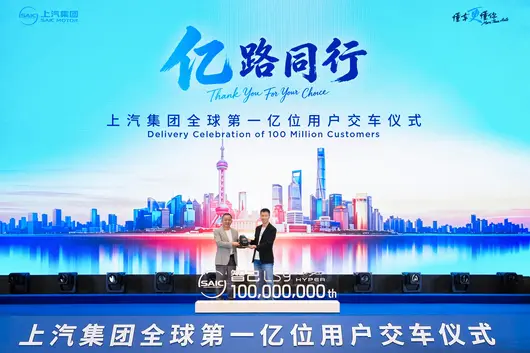
May 28, 2026, SAIC Motor Milestone Celebration grandly opened at the Shanghai North Bund World Living Room, with the world's 100 millionth user officially completing delivery. With over 70 years of dedicated effort, SAIC Motor successfully became the first automotive manufacturer in China to achieve cumulative production and sales exceeding 100 million units, setting a new height for the development of China's automotive industry. This delivery event involved over ten full-vehicle brands and nineteen main models under SAIC Motor, marking a new milestone in the development of China's automotive industry through a global relay delivery format linking domestic and international regions and continents.

Seventy Years of Legacy Continuation: From Domestic Market Breakthrough to Leading the Era of Intelligent Electrification
SAIC Motor's development trajectory is a condensed history of China's automotive industry rising. The company traces its origins to the Shanghai Internal Combustion Engine Parts Manufacturing Company in 1955, with the first "Phoenix" sedan handcrafted in 1958, achieving a breakthrough in Shanghai's independent car manufacturing and starting the curtain on domestic car production. For over 70 years of hard work, SAIC Motor has always resonated with China's automotive industry, witnessing and promoting the industry's leap-and-bound transformation from nothing to something, from weak to strong, from following joint ventures to independent leadership.

Looking back on the development journey, every iteration of SAIC Motor has anchored industrial opportunities and closely tied to the pulse of the times: In 1983, the Santana went off the assembly line officially, opening a new era of domestic automotive joint ventures; In 1997, SAIC-GM went into production, creating a 23-month industry miracle of factory construction to vehicle output, casting the nationally renowned "Shanghai Speed"; In 2006, the independent high-end brand Roewe was heavily launched, blowing the horn for independent brands to break through upward; In 2016, the world's first mass-produced internet car Roewe RX5 was launched, leading the way for intelligent automotive transformation; In 2020, the high-end intelligent electric brand IM Motors was established, fully developing the new intelligent electric track, completing a strategic transformation to New Quality Productive Forces.

Cultivating the industry for decades, SAIC Motor has always adhered to the core brand concept of "Understands Cars, Knows You Better", insisting on dual empowerment through technical deep-dive and user-first. From joint efforts in Santanna localization to technology co-creation and win-win in the joint venture 2.0 era; from pioneering new internet car forms to the implementation and application of cutting-edge technologies such as full wire-control chassis, solid-state/semi-solid-state batteries, and in-car AI large models, SAIC Motor continues to convert hardcore technology into perceivable, implementable, and inclusive mobility experiences. The eye-catching performance of 100 million units of production and sales is the highest recognition of billions of users for SAIC Motor's quality and service, and the best witness of the brand's original intention and strength.

Million-Level Benchmark Heavy Delivery: IM LS9 Hyper Carries the Accumulation of Seventy Years of Technology
The 100 millionth vehicle delivered at this celebration is SAIC Motor's high-end flagship model, IM LS9 Hyper. This vehicle concentrates SAIC Motor's 70 years of car manufacturing technology accumulation, reconstructs the core configuration system for new energy vehicles, and opens a new era of the industry's "New Three Major Components", representing the culmination of SAIC Motor's technological iteration and quality upgrade.
In terms of core hardware and intelligent configuration, the IM LS9 Hyper is equipped with multiple first-in-class technologies: The full lineup comes standard with a full wire-control four-wheel steering system, paired with a 520-line Super-View LiDAR and NVIDIA Thor top-tier intelligent driving chip. It also carries a global 800V high-voltage platform and the Stellar Super Range-Extending System, with hardware pre-embedded for L3 and higher-level intelligent driving upgrade redundancy capabilities, bringing users a full-scenario, high-safety, and evolutive intelligent mobility experience. In terms of performance, the model is the first to be equipped with SAIC Gold Badge Hurricane Three-Motor, successfully entering the 3-second supercar performance tier. In the safety field, SAIC Motor partnered with Purple Mountain Laboratory to globally launch "Endogenous Security" technology for the first time, breaking traditional automotive safety boundaries and building a dual security system of physical protection + information protection, consolidating the security foundation of the AI intelligent mobility era.

It is worth noting that SAIC Motor's global 100 millionth owner is Momenta CEO Cao Xudong. As a core strategic partner in SAIC Motor's intelligent driving field, the two parties have long collaborated deeply and co-created technology, with jointly developed intelligent driving technology widely empowering the implementation of multiple brand models for SAIC Motor. This time, an industry partner changing into a brand user is not only a vivid demonstration of the results of their ecological co-building, but also interprets SAIC Motor's brand core of being technology-based and value symbiosis.
Full-Chain Synergy Global Layout: Hardcore Strength Fortifies Industry Leading Position
Behind the 100 million units production and sales milestone is SAIC Motor's hardcore strength of synergy across six business sectors and full value chain closed-loop operations. Relying on the linkage empowerment of six core sectors: complete vehicle manufacturing, core parts, mobility, automotive finance, global operations, and technological innovation, SAIC Motor has built a stable, complete, and sustainable industrial ecosystem system, providing solid support for continuously leading the industry.

Market data validates strong development momentum: In January to April 2026, SAIC Motor's cumulative sales reached 1.302 million units, ranking first in Chinese automaker sales for four consecutive months. Among them, domestic brand sales reached 910,000 units, accounting for nearly 70%, with a significant trend of domestic rise; New energy vehicle sales reached 412,000 units, highlighting the results of electrification transformation; Overseas market performance was particularly impressive, with cumulative sales of 459,000 units, a year-on-year significant growth of 50.2%, with rapid momentum of global development.

This delivery celebration had a complete lineup and numerous highlights, with SAIC Motor's domestic and joint venture brands fully launching and appearing together. Domestic brands Shangjie Z7, Huajing S, Roewe M7, MG4 Semi-Solid State Battery Version, Wuling Starlight 560, and other models comprehensively cover diverse mobility scenarios such as family, commuting, performance, and business; Joint venture brands Volkswagen ID. ERA 9X, AUDI E7X, Buick Zhijing E7, and other new models made a collective appearance, fully showcasing the new results of SAIC Motor joint venture 2.0 era technology co-creation and value upgrade. This delivery took Shanghai as the main venue, coordinating with domestic core production bases such as Nanjing and Liuzhou, synchronously linking key overseas markets such as the UK, Indonesia, and Singapore, launching global synchronous relay delivery, comprehensively highlighting SAIC Motor's deep foundation and systemic strength in global layout.

As a pioneer and leader in China's automotive going global, SAIC Motor has long established a perfect global industry system. Currently, it has laid out over 100 parts production bases, 3,000 terminal distribution outlets, built 3 overseas R&D centers, 4 overseas complete vehicle manufacturing centers, achieving full-chain localization operations of R&D, production, sales, and service. Relying on Anjie Logistics' 42 ro-ro ships and 8 international routes global logistics network, products and services cover over 170 countries and regions worldwide, with overseas cumulative sales breaking 7 million units. Among them, the MG brand has consecutively won the China Brand Europe sales champion for 11 years; In 2025, annual European sales broke 300,000 units, becoming the first Chinese automotive brand with cumulative sales exceeding one million in the UK and Europe markets, promoting China's automotive industry from single product export to technology export, brand export, and value chain export comprehensive upgrade.


Starting with a Billion for Second Entrepreneurship: Original Intention Reaches Far, Building a New Mobility Future Together
This delivery celebration always centered on users, with diverse guests including tech bloggers, industry experts, public welfare representatives, and domestic and overseas veteran car owners gathering on site; Every user's trust and choice is a vivid interpretation of SAIC Motor's original intention "Understands Cars, Knows You Better". For many years, SAIC Motor has always taken user demand as the core orientation, deep diving into technological innovation, refining product quality, and optimizing mobility services, allowing cutting-edge technology to walk out of the laboratory and truly benefit the public's mobility life.

The 100 million units production and sales achievement is SAIC Motor's glorious answer sheet of over 70 years of continuous cultivation, and more importantly, a brand new starting point for the brand moving towards a new journey. Standing at a new trend in industry development, SAIC Motor will take this milestone as an opportunity, launching a new journey of second entrepreneurship in the intelligent electrification era, and continuing to deep dive into the core tracks of automotive intelligence and electrification. In the future, SAIC Motor will rely on full value chain core strength, partner with global users and billion-strong partners to move forward together, continue to lead the transformation and upgrading of China's automotive industry, go global, and write a brand new chapter for the high-quality development of China's automotive industry.
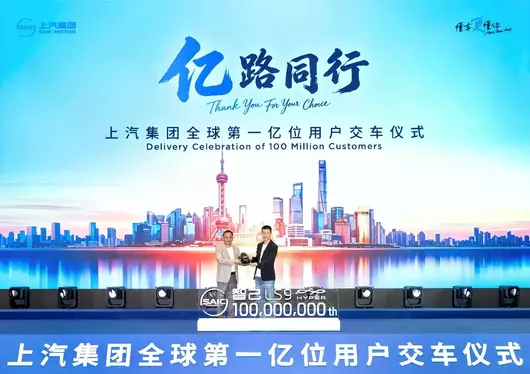

For the Chinese automotive industry, May 28, 2026 is a memorable day.
With the "Global 100 Millionth User Handover Ceremony" held at the Shanghai North Bund World Living Room, SAIC Motor Chairman Wang Xiaoqiu handed the 100 millionth vehicle IM LS9 Hyper to Momenta CEO Cao Xudong, marking the birth of the first Chinese automotive group with cumulative production and sales exceeding 100 million units!

This is not only a milestone moment for SAIC, but also a glory belonging to Made in China and the Chinese automotive industry. Looking back at the journey of China's first 100-million-level car manufacturer, SAIC's success is traceable.
Over 70 years of deep cultivation: SAIC achieved a "small goal" of one hundred million
Success never happens overnight. From 0 to "one hundred million", SAIC Group experienced over 70 years of deep cultivation, with generations exerting huge efforts. In 1955, the Shanghai Internal Combustion Engine Parts Manufacturing Company was established, and Shanghai's automotive industry started from there. In 1958, workers knocked out the first "Phoenix Brand" sedan with hammers, achieving a "zero breakthrough" for Shanghai sedan manufacturing.
Then in 1983, the Shanghai Volkswagen Santana came off the line, opening the door for joint venture cooperation; in 1997, Shanghai GM was established, creating the "Shanghai Speed" of 23 months to build a factory and produce vehicles; in 2006, the independent brand Roewe was born, and in 2016, the world's first Internet car Roewe RX5 was launched; in 2020, the high-end smart electric brand IM Motors was established.

From the Santana localization community to joint venture 2.0 technology co-creation, from Internet cars to full wire-controlled chassis, solid-state/semi-solid-state batteries, and AI large models on vehicles. In fact, every leap was an advancement in "knowing cars" capability, a inheritance of the original intention to "know you". SAIC's "Knows Cars, Knows You Better" user philosophy has been consistent throughout.
The 100 Millionth Delivery Vehicle, IM LS9 Hyper!
As SAIC's 100 millionth delivery vehicle, the IM LS9 Hyper's status cannot be underestimated. It is the masterpiece of SAIC's 70 years of technology accumulation, opening a new era for the "New Three Major Components" of new energy vehicles. The IM LS9 Hyper is equipped with next-generation chassis technology, featuring the industry-first full wire-controlled four-wheel steering; next-generation intelligent driving hardware, 520-line ultra-view LiDAR + NVIDIA Thor chip; next-generation three-electric system -- Full-domain 800V high-voltage platform and Star Super Extended Range. It comprehensively pre-embedded redundant capabilities for continuous evolution towards L3 and above advanced intelligent driving. Meanwhile, the IM LS9 Hyper is the first to be equipped with SAIC's Gold Label Hurricane Three-Motor, effortlessly joining the Performance 3-second Club; it also collaborated with Purple Mountain Laboratories to launch the world-first "Endogenous Security" technology, expanding the car safety boundary from "Physical Security" to "Information and System Security", making it an essential security cornerstone of the AI era.

It is worth mentioning that SAIC's 100 millionth user was just Momenta CEO Cao Xudong! Momenta is SAIC's core strategic partner in the intelligent driving field. The intelligent driving technology deeply co-created by both parties has empowered multiple independent and joint venture brands. From partner to car owner, this is a two-way journey between the manufacturer and the user, and even a deep resonance among smart car ecosystem partners.
Global relay delivery staged, SAIC Motor departs for the next 100 million
The 100 millionth delivery is just the beginning. Departing from the Shanghai main venue, relay deliveries took place in multiple domestic cities such as Nanjing, Liuzhou, Taiyuan, as well as countries like the UK, Indonesia, and Singapore. SAIC's full brand and full product matrix worked in synergy, creating a new narrative mode for Chinese car brands.

Among them, independent brands went all out: Shangjie Z7, Huajing S, Roewe M7, MG4 Semi-solid-state Battery Version, Wuling Starlight 560, Maxus eDeliver5, Hongyan Heavy Truck, Yuejin Danan T1, Sunwin Pure Electric Bus, Iveco Juxing EV, etc., were delivered successively, covering diverse scenarios such as personal travel, family life, commercial operations, and logistics transportation. Joint venture brands concentrated on showcasing the achievements of "Joint Venture 2.0": Volkswagen ID. ERA 9X, Audi E7X, Buick Zhijing E7, Cadillac Kaiweide, etc.

Behind the 100 millionth unit lies SAIC's full value chain closed loop covering six sectors: whole vehicles, parts, mobility, services, finance, international operations, and innovative technology. From January to April 2026, SAIC's cumulative sales reached 1.302 million vehicles, ranking as the sales champion of Chinese car companies for four consecutive months. Among them, independent brand sales were 910,000 vehicles, accounting for nearly 70%; New Energy Vehicle sales were 412,000 vehicles; Overseas market sales were 459,000 vehicles, surging by 50.2% year-on-year.
Final Thoughts
After a long run of the real economy spanning over 70 years, SAIC's vehicle manufacturing journey has ushered in a phased victory. As a microcosm and witness of the Chinese automotive industry going from nothing to something, from weakness to strength, SAIC has experienced the transition from scale leadership to quality leadership and technology guidance. Now standing at the new starting point of "100 million units", SAIC is starting a "Second Startup" for the smart electric future, continuing to write the brilliant new chapter for Chinese car companies! (Written by MANGO)
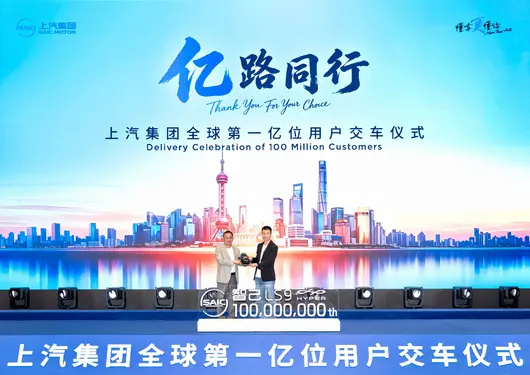

May 28, SAIC Motor completed delivery of its 100 millionth new vehicle, becoming the first domestic automotive group to exceed 100 million in cumulative production and sales, resetting the production and sales record of Chinese automakers.

The vehicle model delivered this time is the IM LS9 Hyper, the top-spec version of the IM LS9. It features a full wire-controlled four-wheel steering system, equipped with a 520-line ultra-vision LiDAR, Nvidia Thor chip, and the Momenta intelligent driving large model.
Regarding power, the vehicle is built on an all-domain 800V high-voltage platform, equipped with the Star Super Range Extender System, and features the Gold Badge Hurricane Three-Motor System. The peak power of the motors reaches 160kW (Front), 195kW (Rear Left), and 195kW (Rear Right) respectively. The comprehensive range exceeds 1400 kilometers.

In 1955, the Shanghai Internal Combustion Engine Parts Manufacturing Company was established, marking the formal start of the Shanghai automotive industry; in 1958, the first "Phoenix" sedan went off the line, achieving a zero breakthrough in Shanghai sedan manufacturing. In the 1980s, SAIC introduced the Santana model through joint ventures and cooperation, promoting the scaled development of China's sedan industry. In 1997, Shanghai GM was established, setting a record of 23 months from factory construction to vehicle delivery. The Roewe brand was born in 2006, and the first Internet car, Roewe RX5, was launched in 2016. In 2020, IM Motors was established, positioning itself in the high-end intelligent electric vehicle track.
In terms of overseas markets, SAIC Motor has already established over 100 parts production bases and a dealer network of more than 3000, with products and services covering more than 170 countries and regions globally. Additionally, 3 major R&D and innovation centers, including London, have been built, along with 4 production and manufacturing centers in Thailand, Indonesia, India, and Pakistan. The owned Anji Logistics operates 42 various Ro-ro ships, with 8 international routes covering Southeast Asia, Europe, and the Americas.

From the "Phoenix" hammered out of "alley workshops" using hammers, to the "IM LS9 Hyper" relayed by users globally, SAIC ran a 100-million-unit "marathon" for China's automotive industry in 70 years.

On May 28, 2026, at the World Living Room of North Bund, Shanghai, an IM LS9 Hyper slowly drove to the center of the stage. This was not only the 100 millionth vehicle delivered by SAIC Motor, but also the birth of the first "100-million-level car manufacturer" in the history of China's automotive industry. At this moment, SAIC not only refreshed the production and sales records of a single car manufacturer, but also pushed the capability level of China's automotive industry to the global top tier.

From the faltering start of the first "Phoenix" sedan in 1958, to the vast portfolio today with over a dozen brands under its umbrella spanning fuel and new energy, covering the entire passenger and commercial sector, why could SAIC reach the finish line first? Behind this lies the strategic determination of "joint ventures nurturing independent brands", the system resilience of the "whole industry chain", and the forward-looking layout of "global expansion".
· The Evolution from "Hammer-made Cars" to "System-made Cars"

SAIC's "100-million-level" journey was not accomplished overnight, but is a microcosm of three key stages of China's automotive industry.

In 1958, workers of SAIC's predecessor "hammered out" the first Phoenix sedan, filling the gap in domestic sedans. But what truly gave SAIC modern industrial capabilities was the establishment of China's first sedan joint venture — SAIC Volkswagen — with German Volkswagen in 1985. The localization of Santana was exceptionally difficult; the initial localization rate was only 2.7%. SAIC took the lead in forming a localization community and hard-pushed the localization rate above 90%, establishing the first set of modernized parts systems and quality management standards for China's automotive industry. Subsequent cooperation with General Motors and the establishment of the Pan Asia Technical Automotive Center (PATAC) further transformed "making without R&D" into "joint development", laying the foundation for China's automotive industry to align with international standards.
Entering the 21st century, SAIC realized that the ultimate goal of "market for technology" is to cultivate independent capabilities. In 2006, after acquiring Rover technology, SAIC launched the Roewe brand, firing the "first shot" of independent brands targeting the mid-to-high end. Thereafter, brands like Baojun, Maxus, and Wuling successively laid out, forming an independent matrix covering different niche markets. Especially in 2016, the globally first internet car Roewe RX5 launched in cooperation with Alibaba not only created a sales myth but also led the industry transformation from "car making" to "making intelligent terminals", opening a new era of software-defined vehicles.
Facing the new energy wave, SAIC took the lead in launching the "New Four Strategies" (electrification, connectivity, intelligence, and sharing) strategy in 2014. Cumulative R&D investment of over 150 billion yuan in the nearly past decade has built a technological moat ranging from chips, batteries to complete vehicles. The 100 millionth delivered IM LS9 Hyper, equipped with full steer-by-wire, LiDAR, and the IM AD intelligent driving system deeply co-created with Momenta, is precisely the embodiment of SAIC's technological integration. From January to April 2026, SAIC's new energy vehicle sales reached 412,000 vehicles, with independent brands accounting for nearly 70%, proving its successful shift from "joint venture dependency" to "technology-driven".
· The Moat of "Whole Industry Chain" System Capability

In the current landscape of price wars and internal involution, the ability to break through 100 million units first does not rely on a single breakout product, but on the profound system capability of "All Categories + Whole Industry Chain".
SAIC owns joint venture brands such as Volkswagen, General Motors, and Audi, as well as independent brands such as Roewe, MG, IM, and Wuling, covering the full price range from 50,000 yuan commuter cars to 500,000 yuan luxury cars. This "thousands of horses galloping" pattern enables it to traverse different economic cycles and reach the widest user base. Whether for first-time family purchase, commercial logistics, or high-end upgrade, SAIC has corresponding products to support, a scale advantage that a single brand finds hard to compare.
SAIC not only builds complete vehicles but also nurtures parts giants like Huayu Automotive. From seats, headlights to chassis modules, SAIC has built the most complete parts system in China, ensuring supply chain stability and controllable costs. Meanwhile, through the Innovation Research and Development Headquarters to integrate R&D resources, it avoided repeated investment by each brand, achieving sharing and iteration of underlying technologies. This closed loop of "complete vehicles driving parts, parts nourishing complete vehicles" is the confidence behind SAIC's ability to continue large-scale deliveries.
· Global Influence from "Made in China" to "Smart Made in China"

The value of 100 million vehicles lies not only in deepening the domestic market but also in "creating another SAIC" in the overseas market.
SAIC is the "textbook" for Chinese car exporting. From early product exports (KD kit assembly), to establishing overseas bases (Thailand, Indonesia), to today's "R&D, production, sales" integrated local operations, SAIC has explored a mature global path. The MG brand has become a phenomenon-level product in Europe, and the MG4 is the first true "global car". From January to April 2026, SAIC's overseas sales reached 459,000 vehicles, up 50.2% year-on-year, ranking first in overseas sales among Chinese car manufacturers for consecutive years.
SAIC's globalization is not just selling cars, but also driving the entire Chinese automotive industry chain to go global. Its layout of more than 100 overseas parts bases, self-built Ro-Ro fleet, and global R&D centers outputs Chinese manufacturing standards and technical solutions to the world. This "chain master" responsibility has made a big step for China to move from a large automobile exporting country to an automobile industry powerhouse.
· The "Ballast Stone" of China's Automotive Industry

SAIC's 100 million vehicles hold milestone significance for China's automotive industry.
First, through the localization of Santana, China cultivated the first batch of modern automotive industry workers and supply chain systems.
Furthermore, from joint venture technology introduction to independent forward-looking R&D, to smart-electric transformation, every step of SAIC has been stepped on key nodes of industrial upgrading.
Finally, it proved that independent brands can not only compete with foreign capital in the Chinese market but also go global with high-end and intelligent images.

The delivery of SAIC Motor's 100 millionth vehicle is not the end, but a new starting point. It marks that China's automotive industry has entered the "quality leading" stage from "scale catching up". SAIC used 70 years to prove that a true "100-million-level car manufacturer" is not only the accumulation of quantity but also a comprehensive embodiment of system resilience, technological thickness, and global vision. In the future, with the further explosion of smart-electric technology, this aircraft carrier of SAIC will continue to carry the dream of Chinese cars, sailing towards a broader blue ocean.
© 2024 Bitauto.com. All Rights Reserved.
Bitauto (www.yiche.com and www.bitauto.com) is one of the most visited automotive websites in China. We provide detailed info on Chinese car brands available in your area. Please note that the information provided on this website is based on publicly available data and is for reference only. It may not be fully updated or accurate at all times.

Help us improve our website


