

HomeSmart Cars

Search History
Popular Searches
Dealer Login / Sign Up


A set of numbers puts another side of Chinese smart cars going global on the table.
Data shows that among Chinese exported cars, about 70% are in a disconnected state; among the remaining 30% connected vehicles, only about 10% continue to pay for network renewal in the second year. More awkward cases have already occurred in Europe; after delivery of certain Chinese brand electric vehicles, assisted driving frequently brakes erroneously. Carmakers cannot provide software patches complying with EU WVTA certification for a long time, finally having to permanently disable multiple intelligent driving functions via OTA and provide cash compensation to car owners.
In the past few years, the main narrative for Chinese carmakers going global was "local manufacturing": factories landing, channels spreading, supply chain following up. But this "disconnected" problem cannot be solved by building factories.
It exposes a supply chain that has been long ignored — the data supply chain.
· Disconnection is not a network issue, it is a broken loop

In China, the core selling point of smart cars is "always fresh and up-to-date". One intelligent connected car generates about 10TB of data daily, 5 to 10 times that of traditional fuel cars, covering road environments, driving behavior, and vehicle status, serving as the "fuel" for algorithm continuous iteration.
After cars are sold overseas, this loop breaks: network infrastructure is immature, connectivity is inherently limited; according to industry research data, about 30%—40% of exported cars flow to B-end scenarios such as ride-hailing and rental cars, operators do not renew or maintain; road data involves facial features, license plates, and geographic information, raw images cannot be directly exported according to GDPR and other regulations; carmakers lack data centers overseas, with insufficient motivation for intelligent driving infrastructure investment.
The result is: from the day of delivery, the car is "fixed". Overseas real road conditions: European narrow lanes, Middle Eastern ceramic stud markings, German unrestricted highways, Southeast Asian motorcycles weaving through, all fail to enter the R&D models.
Product supply chains determine whether cars can go global, while data supply chains determine whether cars can continue to evolve after going global.
· The true meaning of "Standing Firm and Returning"

Sun Xiaohong, former secretary-general of the Automotive Division of the China Chamber of Commerce for Import and Export of Machinery and Electronic Products, set a coordinate for going global in the "15th Five-Year Plan": "Stand Firm and Return".
"Stand Firm" means the market established during the "14th Five-Year Plan" must not be lost again. According to data from the China Chamber of Commerce for Import and Export of Machinery and Electronic Products, currently China has about 30 overseas spare parts warehouses, while international brands have 600, a difference of 20 times; the density of service outlets is about 1/8 to 1/10 of competitors.
"Return" does not mean sending cars back, but overseas revenue, data, and experience feeding back into domestic R&D to form a loop.
This shifts the issue from "how many cars are sold" to the level of "is operational capability sufficient". The logic of traditional automotive trade is "delivery marks the end", while the logic of smart cars is "delivery marks the beginning".
· Data Collection: From "Full-Volume Unprotected Transmission" to "Vehicle-Side Preprocessing"

The first step to breaking the situation is redesigning the data collection architecture.
Overseas data cannot follow domestic habits of "collect everything then transmit back". The correct approach is to move processing to the vehicle and local premises: Sensitive information is locally desensitized: faces, license plates are irreversibly masked, tokenized; Key scenarios are directed for transmission back: only desensitized fragments of long-tail scenarios are sent, not complete trip data; Whitelist of necessary fields: which data can cross borders and which must be stored locally is defined item by item at the design stage; Full-link audit trails: every step of collection, transmission, and use is traceable, ready to对接 regulatory audits at any time.
NavInfo's proposed "Data Localization, Globalization of Models" is essentially this logic — data is processed according to local rules, model capabilities are reused across markets.
· Compliance Processing: "Layered Architecture" Under Dual Constraints

Carmakers now face dual compliance: Outbound side: EU GDPR, local data localization regulations in various countries, extremely sensitive to personal information and geographic information; Inbound side: Domestic "Data Security Law" and "Guidelines for Security of Cross-border Transmission of Automotive Data (2026 Edition)" define important data boundaries, clarifying 27 categories and 51 items of important data and judgment rules.
The solution is not "not transmitting", but "transmitting in layers": Raw images, personal data: Local storage, local training; Desensitized features, model gradients: Cross-border via compliant channels; Aggregated statistics, scenario libraries: Transmit back to domestic R&D middle platform; Dedicated cross-border channels: As of October 2026, Hainan Free Trade Port has already run successful samples of test data transmission back from multiple countries including South Korea, Germany, Brazil, Mexico, UAE, and Indonesia, forming a "Overseas Testing, Domestic R&D" collaborative model.
Jointly issued by the Ministry of Commerce, Ministry of Industry and Information Technology, and State Administration for Market Regulation, "Guidelines on Overseas Competitive Behavior and Compliance Construction in the Automotive Industry" also lists cross-border data processing for connected vehicles and autonomous driving as the bottom line for compliant operations.
· Cross-border Collaboration: Letting Go of the Obsession with Full-Stack Self-Development

A recent obvious signal: Chinese carmakers are starting to actively seek international partners in intelligent strengths.
This is not a technical concession, but commercial rationality: Full-stack self-developed systems going global must carry three mountains simultaneously: cross-border data, local cybersecurity, and WVTA certification; Leveraging local giants, compliance costs are lower and access is faster.
At the same time, intelligent driving solution providers, data compliance service providers, and cloud infrastructure providers must "follow the cars out". This is the 3.0 stage from "Product Going Global" to "Technology Going Global, Ecosystem Going Global, Rules Going Global". Distributed data processing, local storage, local training, maintaining global algorithm iteration within a compliant framework.
The 70% disconnection rate is a "tuition fee" paid for smart cars going global, but it also points out the direction. It reminds the industry of one thing: Chinese carmakers were good at building cars, shipping them out, and selling them cheaply in the past; but the "15th Five-Year Plan" aims to solve making cars continue to live, evolve, and be serviced overseas.
Future dimensions of going global competition will be completely reconstructed: It's not about who exports more, but whose overseas cars can receive continuous OTA; It's not about whose intelligent driving parameters are higher, but whose data loop runs smoothly; It's not about who builds more independently, but who can weave local partners, compliant channels, and R&D middle platforms into a net.
Product supply chains deliver cars globally, data supply chains make cars truly belong globally.
"Standing Firm" relies on service and infrastructure, "Returning" relies on data and collaboration. Once both supply chains are connected, Chinese smart cars can truly cross the threshold of going global, not just driving cars out, but continuing to grow in every market.
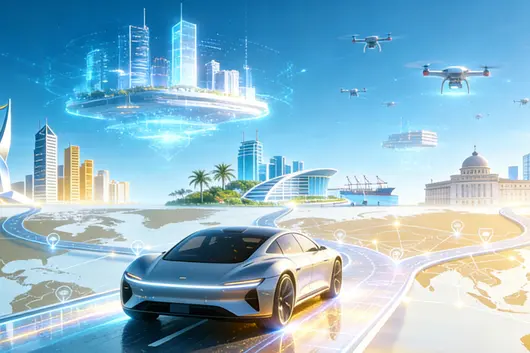


At a conference, the first and second halves of China's smart car industry were broken down and laid out on the table.
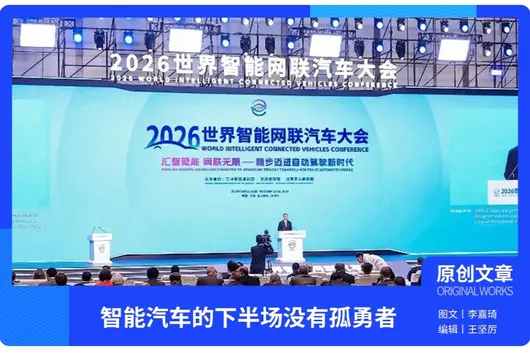
Beijing in October, the 2026 World Intelligent Connected Vehicle Conference. This stage is a bit different this year.
Lei Jun stood on stage, behind him was the report card of Xiaomi Auto's cumulative delivery exceeding 800,000 vehicles. He said, cars today are simplified embodied AI physical terminals. This sentence sounds a bit academic, but looking closely, the meaning is straightforward. Cars are no longer phones with four wheels; they are becoming mobile terminals capable of perception, thinking, and action.
Li Shufu wore a dark suit, spoke at a moderate pace, but every sentence carried the weight of thirty years of Geely. He said there should be no duplicated construction. Geely and Nio signed a battery swap cooperation agreement, but he turned the topic, if everyone sets up their own standards, what is wasted in the end is the industry's money.
Zhang Xinghai showed the data that AITO had cumulatively traveled 40 billion kilometers. He said driving is a marathon, you can't be too fast or too slow. Yin Tongyue had just rushed back from Malaysia, and on stage he stated directly that he had met the Malaysian Minister of Industry and apologized face-to-face. He said going overseas is not harvesting, it is taking root.
Big shots from the German trio also came. VW's Oliver Blume announced achieving L3 readiness by 2027. Mercedes' Tong Ofu said the Chinese market is an important innovation center in the electric vehicle field. BMW's Ke Ruichen proposed three claims, the core is one, safety and quality cannot be compromised.
There were also He Xiaopeng, Yu Kai, Yang Dongsheng, Jin Yuzhi, and Li Bin. Each person held a card, some were technical routes, some were business models, some were understandings of safety.
This conference was like a mirror, revealing the true outline of the second half of the smart car industry. In the first half, the competition was about who ran faster; in the second half, it's about who sees further and who survives longer.
From 'Adding Functions' to 'Changing Brains'
When Lei Jun went on stage, someone in the audience quietly calculated. Xiaomi Auto deliveries exceeded 800,000 vehicles, average price over 260,000. If this report card was from three years ago, no one would dare to believe it.
But Lei Jun didn't spend much time talking about sales. He focused on two areas. One is safety, the other is ecosystem.

First, let's talk about safety. Lei Jun said, if the automotive industry lacks safety, everything else is 0. He said this before, but this time he was more specific. Xiaomi established the VSR Automotive Safety Research Center internally, which is an independent R&D institution. How independent? It independently investigates backend-to-end analysis issues and feeds back into the R&D system for improvement. In other words, this department is not hijacked by product development progress; it only looks for flaws.
In addition, Xiaomi Auto established a Global Security Department, specifically designing the whole vehicle security system. It also established a dedicated Security Department, led by security experts, to coordinate security matters overall. It also strengthened the leadership role of the Auto Safety Committee. Finally, it set up an Automotive Safety Advisory Committee, bringing in experts from industry organizations, universities, and research institutions to participate.
Five-layer security architecture, adding layers on layers. Lei Jun's intention is clear: safety of smart cars is not a task for a single department, but a systematic engineering project from top to bottom of the entire company.
Next, the ecosystem. Lei Jun judges that in the second half of smart connected cars, it's not just about how smart the car is, but how powerful the ecosystem is. Behind this viewpoint is Xiaomi's confidence. By the end of this year's second quarter, the number of device connections in Xiaomi's global AIoT exceeded 1.1 billion. This is the largest scale consumer IoT platform globally.
Lei Jun said, from the first day of making cars, Xiaomi has attached great importance to safety. But safety alone is not enough; there must also be an ecosystem. The Human x Car x Home full ecosystem is Xiaomi's core strategy. In the past five years, Xiaomi invested 105 billion in hard tech R&D; in the next five years, it will exceed 200 billion. Where is this money spent? Chips, operating systems, AI, embodied intelligence.
Lei Jun's logic chain is very clear. AI has driven smart connected cars from isolated intelligence to whole vehicle intelligence. Past innovations were mostly concentrated on single functions and single scenarios. But combining AI and cars is not adding functions to cars; it is changing brains. To achieve whole vehicle intelligence experience upgrades, one must rely on a unified, powerful base large model.
This judgment is critical. Many car companies are still struggling with whether to add one LiDAR or two, or implement city NOA or perfect highway NOA first. Lei Jun jumped straight to the next layer. Future competition is not about the strength of a certain function, but the degree of unification of the whole brain.
Zhang Xinghai's perspective is different from Lei Jun's, but the conclusions converge. Seres and Huawei have deep cross-boundary integration, AITO models have cumulatively traveled over 40 billion kilometers. Among them, extended-range pure electric driving mileage is 28.5 billion kilometers, accounting for 70%. Active assisted driving users broke the million level, cumulative assisted driving mileage broke 10 billion kilometers, cumulative avoided potential collision times exceeded 4.3 million times.

Zhang Xinghai said, adhere to long-termism, safety is the greatest luxury. AITO insists that safety is the greatest luxury, always putting user personal safety first. Relying on Industry Brain plus Super Factory and Super Lab, Seres built an end-to-end digital quality management system, every process has clear quality control standards, every inspection point has strict control.
By the end of September, among AITO's 1.2 million sold vehicles, extended-range models accounted for 70%, pure electric cars 30%. What does this structure indicate? It indicates users vote with their feet; extended range is still the most pragmatic choice now. But Zhang Xinghai didn't say it definitely, he said facing the new era of autonomous driving, the connotation of safety is extending, quality standards are upgrading, and the company is also actively laying out L3, L4 high-level autonomous driving.
Li Shufu's speech was more like an admonition from an industry veteran. Geely and Nio signed a battery swap cooperation agreement, but he immediately added, there should be no duplicated construction. Intelligent technology should also be coordinated to reduce repeated investment.
Li Shufu's original words were, small and weak will inevitably lead to chaos and inferiority; only big and strong can lead the industry to better development. This sounds impolite, but the logic is clear. If every car company builds its own swap stations, develops its own smart driving chips, and develops its own operating systems, the final result will be industry-wide overcapacity, resource waste, and no one can form a scale effect.

Li Shufu also mentioned capacity issues. Geely's global capacity is also cooperating with others, not buying land, building houses, buying equipment, and hiring workers on their own. This investment is too big, risks are too big. Make the best use of others' existing capacity to cooperate, grow slowly step by step, this is relatively stable.
Yin Tongyue spoke about going overseas, his viewpoint was also very practical. He said internationalization is a complex systematic engineering project. Selling cars is far from enough; one must integrate into local industry systems, supply chains, technology chains, and value chains. He proposed standards must align with international levels, especially with the EU. Deeply understand localization, R&D locally, manufacture locally, procure locally, sell locally, absorb local culture and talent.
Yin Tongyue said, going overseas is not harvesting, but going to take root. Respect local laws and regulations and business rules, truly deeply integrate into local culture. Respect is not enough; one must integrate into local culture and truly achieve localized development.

These people standing together pieced out a complete picture. Lei Jun spoke from a tech company's perspective, how AI reshapes cars. Zhang Xinghai spoke from a manufacturing enterprise's perspective, how safety and quality are implemented. Li Shufu spoke from the industry's overall perspective, about coordination and avoiding waste. Yin Tongyue spoke from a global perspective, about how to truly go out.
The competition in the second half is not a single car company fighting alone, but a collaborative operation of the entire industry chain. Whoever can take the initiative in the ecosystem will get the entry ticket to the second half.
The Localization Turnaround of the German Trio
If Chinese car companies talked about ambition and scope on stage, then the German trio talked about survival and turnaround.
VW's Oliver Blume was the first to speak. He said that three years ago, VW launched the largest transformation in the group's history, shifting from making cars in China to carrying out R&D in China. The weight of this sentence is heavy. In the past forty years, VW's role in China was a manufacturer, taking German technology to China for production. But now, VW wants to do R&D on Chinese land.

Blume provided a set of numbers. In Hefei, VW has more than 3,000 colleagues participating in decision-making, hardware and software parallel development. VW Group is already one of the few car companies mastering full-stack technology for new energy vehicles, including whole vehicle platforms and electrical/electronic architectures. The self-developed assisted driving scheme achieved through the joint venture 'Core Process' has cumulative training mileage exceeding 100 million kilometers. These technologies are all R&D in China.
VW Group China CTO Wu Borui added a detail. VW, together with joint venture partners, shortened the product development cycle from 5 to 6 years to 3 years or even shorter. VW built a local car development platform covering all key new energy vehicle segments. VW and XPeng built a completely new computing power and regional control electronic architecture. Through Core Process, VW and partners like Horizon Robotics developed new products.

L2++ full scenario assisted driving has begun deployment; L3 readiness will be achieved by 2027. From 2027 to 2028, VW will strive to achieve L3 readiness and develop L3 to L4 level products through joint venture systems for deployment in the Chinese market.
More noteworthy is that VW will take architectures and platforms developed in China to the global market. Currently, car exports to the Middle East have begun; in the future, it will expand to ASEAN and South American markets. What does this mean? It means R&D technology from China is exported globally. This was unimaginable ten years ago.
Mercedes' Tong Ofu spoke on behalf of Kang Lin Song. Mercedes' logic differs from VW. Mercedes emphasizes learning and cooperation. Tong Ofu said, the Chinese market has always been an important innovation center in the EV field and an important innovation center for intelligent technology. Mercedes is one of the first car companies to obtain conditional L3 level autonomous driving certification. Currently, over 2,000 engineers are engaged in local R&D, continuously committed to upgrading systems.

Mercedes' cooperation with Tsinghua University developed a visual language AI model, already applied to Mercedes' rear seat systems, to be deployed and sold globally in the future. Mercedes cooperates with Momenta to develop assisted driving systems, currently deployed on pure electric vehicles, to be expanded to the entire vehicle product line in the future.
Mercedes already has a large amount of real driving data of 17 billion kilometers in China, and conducted extensive real vehicle testing. Mercedes customers will enjoy new world models, and campus-to-campus pilot functions, able to run perfectly on highways, ETC, urban roads, and parking lots.
BMW's Ke Ruichen proposed three claims. First, a fair, open, healthy, and predictable competitive environment is needed. Second, an open attitude should be maintained towards different technical routes, choosing solutions that create the maximum value. Third, quality and safety must never be compromised in the process of pursuing innovation and speed.

BMW cooperates with Chinese leading tech companies such as Alibaba, Huawei, Tencent, jointly developing smart cockpits, personal assistants, and connectivity solutions. BMW also joined hands with Momenta to develop the next generation of driving assistance systems targeting China's complex road and traffic environments.
Ke Ruichen said, artificial intelligence is no longer just an auxiliary technology; it reshapes the way car R&D, production, and customer travel. In R&D, BMW is using AI to accelerate complex analysis, automatically execute repetitive tasks, and optimize the R&D process. AI agents can combine BMW's decades of engineering knowledge, existing data, and AI systems, giving engineers brand new capabilities. But engineers always maintain control, not replacing human responsibility.
BMW's i Factory production system, AI-driven digitization has become a core component, covering virtual factories, digital twins, AI-assisted quality inspection, and smart logistics. Ke Ruichen believes that the combination of AI digital agents and intelligent robots will bring huge opportunities to improve production flexibility and efficiency.
The speeches of the German trio have one common point. They are all emphasizing the uniqueness and importance of the Chinese market. Not treating China as a sales market, but as an R&D center and innovation center. VW has a 3,000-person R&D team in Hefei, Mercedes has over 2,000 engineers in China, BMW cooperates comprehensively with China's tech giants.
What is the logic behind this transformation? China is the largest new energy vehicle market globally and also the most competitive market. Technologies and models that work here, when placed in other global markets, are dimensional reduction strikes. The German trio sees clearly: if they fall behind in the Chinese market, they cannot hold the global market either.
But their turnaround is not easy. Blume said, VW launched the largest transformation in the group's history. The cost behind this sentence is huge. Organizational structure needs adjustment, supply chain needs reconstruction, R&D system needs rebuilding. VW's ability to reach this step today relies on the foundation accumulated in China over 30+ years.
Mercedes and BMW's routes are more pragmatic. They do not pursue full-stack self-research, but choose to cooperate with local Chinese tech companies. Momenta, Tencent, Huawei, Alibaba, these names appearing in the partner lists of German car companies are signals in themselves. The maturity of China's smart car industry chain has reached the level where international giants actively seek cooperation.
Three Major Questions for the Second Half
In the latter half of the conference, He Xiaopeng, Yu Kai, Yang Dongsheng, Jin Yuzhi, Li Bin spoke in succession. From different angles, they posed three questions for the second half of intelligent driving.

The first question is the technical route. He Xiaopeng believes the intelligent driving industry is approaching an inflection point. The first half mainly relied on software and algorithms, implementing L2 level assisted driving in local scenarios. The second half will have three huge changes. Technical main line shifts from traditional software-driven to AI model and data core. Rule system expands, explored by China and some countries first for assisted driving related regulations, moving towards global collaborative improvement of L2, L3, L4 regulatory frameworks. Evaluation ruler updates, three major core quantitative indicators appear that the first half didn't have: safety collision mileage, user full scenario coverage rate, user payment willingness and payment rate.

He Xiaopeng's judgment is that this quantitative indicator system will guide the industry's second half to balance experience improvement, safety assurance, and commercial returns. This viewpoint is critical. In the first half, everyone compared whether they had the function; in the second half, it's about whether it's good to use, safe, and if users are willing to pay.

The second question is safety standards. Yang Dongsheng spoke for BYD. He said the biggest change in the second half of intelligence is that a mutual trust was formed between car company technology, products, and users. Whether it is intelligent driving assistance, or L3, L4, it is more like high-level automatic transmission, having two attributes, comfort attribute and more important safety attribute. Car companies take safety attribute as a mission, not as a certain technical indicator, so consumers can dare to use it. From the consumer's perspective, first is it usable, second is it dare-to-use, third is daily use.

Jin Yuzhi supplemented the importance of safety from Huawei's perspective. He said in the second half from an industry perspective, assisted driving is accelerating towards autonomous driving. L2 level combined driving assistance function passenger car penetration rate exceeds 70%, Ministry of Industry and Information Technology is also organizing orderly admission of L3 level autonomous driving. But autonomous driving will have higher safety requirements. At L2 stage, the responsible subject in case of accidents is the driver; at L3 level and above, the responsible subject shifts to the autonomous driving system.
What does this change mean? It means car companies can no longer treat smart driving as a marketing gimmick. If something happens, they must bear it themselves; this puts extremely high requirements on technical maturity and safety redundancy.

The third question is business models. Li Bin said, the value of autonomous driving is to free up energy and reduce accidents. Two indicators are very important. First, if users are unwilling to pay, no matter how well done, it cannot create true user value; the business model closed loop is very important. Second, safety, whether there are quantitative indicators for users to significantly perceive that autonomous driving is truly safer than human driving; this requires insurance companies to give true feedback on accident probability and ratios.
Yu Kai's viewpoint is more calm. He said smart driving is now usable, but distance to 'good to use' still requires crossing several Pacific Oceans. How does MPCI (Miles Per Critical Handover) cross from 100 km to 1000 km? Are all technical problems solved? After crossing 1000 km, when moving towards 10,000 km, are we walking further along that extension line?

Yu Kai believes, be optimistic, but also see that the matter itself is still very difficult. Every 10x magnitude MPCI mileage leap is crossing the Pacific. Current smart driving is usable; next stage MPCI to 1000 km, 10000 km is good to use; truly loving to use might be 100,000 km level. He hopes that in the next 4 to 5 years, the industry can cross it.
Cao Xudong took this question, the angle was clever. As Momenta's CEO, he looked at the second half from the supplier position.
Cao Xudong defined 2026 as the dividing line between the first and second halves of smart driving. Momenta internally originally had a smart driving Moore's Law, meaning capabilities improve tenfold every two years. He judges that in the second half this pace will accelerate to tenfold annually; 2027 to 2028 will be the inflection point for significantly increased L3, L4 penetration rates.

His harshest sentence is: even if regulations are still L2 assisted driving, do it according to L4 level safety and experience. Users don't care if you call it L2 or L3; they only care about braking stability, long-tail scenario safety, and if long-distance driving is tiring.
He used Tesla as an example. After FSD safety improvement, subscription rate rose from 20% to 55%. Logic is simple: only when experience truly goes up will users be willing to pay. So Cao Xudong predicted, after 2028, subscription models facing L3 will gradually become mainstream; suppliers and car companies operate together and build conversion rates together.
He also pointed out the change in upstream and downstream relationships. First half is buying and selling solutions; second half is co-creation and win-win. Momenta is testing a new approach with a European customer: develop L3 products for the Chinese market using L4 architecture, sensors and domain controllers made based on L4 foundation; regulations allow L3 first, then software upgrade when L4 matures; one architecture graded landing, no need to develop twice.
Putting these three questions together outlines a complete portrait of the second half. Technical routes must shift from software-driven to AI and data-driven. Safety standards must upgrade from technical indicators to corporate missions. Business models must shift from burning money subsidies to user payments and insurance closed loops.
None of these questions are easy. But precisely these difficult problems distinguish truly powerful players from followers.
Returning to the sentence Lei Jun said at the beginning, if the car industry lacks safety, everything else is 0. This sentence applies especially in the second half. No matter how advanced smart driving is, no matter how powerful the ecosystem is, if safety cannot hold, everything returns to zero. Zhang Xinghai said safety is the greatest luxury, Yang Dongsheng said car companies must take safety as a mission, Jin Yuzhi said the shift of L3 responsible subject raises higher requirements for safety. Everyone's consensus is, safety is not a certain function, it is the bottom line of the whole vehicle.
Li Shufu's opposition to duplicated construction also gained new meaning in the second half. When technical routes gradually converge, when standards gradually unify, those repeated investments in capacity and technology will eventually become sunk costs. Coordination, sharing, openness, are not sentiments, but survival rules.
The German trio's localization turnaround indicates the Chinese market has transformed from a follower to a leader. VW's 3,000-person R&D team in Hefei, Mercedes' visual language AI model cooperating with Tsinghua, BMW and Momenta's jointly developed smart driving system, all these are evidence of the maturity of China's smart car industry chain.
The whistle for the second half has already blown. In the first half, it was about who runs out first; in the second half, it's about who runs steadily and far. Ecosystem, safety, coordination, these three keywords will determine the industry pattern for the next five years. Players who are still fighting alone, still treating smart driving as a gimmick, still duplicating construction, their time is running out.
© 2024 Bitauto.com. All Rights Reserved.
Bitauto (www.yiche.com and www.bitauto.com) is one of the most visited automotive websites in China. We provide detailed info on Chinese car brands available in your area. Please note that the information provided on this website is based on publicly available data and is for reference only. It may not be fully updated or accurate at all times.

Help us improve our website


