

HomeTitanium 9

Search History
Popular Searches
Dealer Login / Sign Up

As the influence of Chinese new energy vehicles in the global market continues to expand, how to truly integrate into the local industrial system and achieve long-term sustainable development is becoming an issue that Chinese automakers must think about.
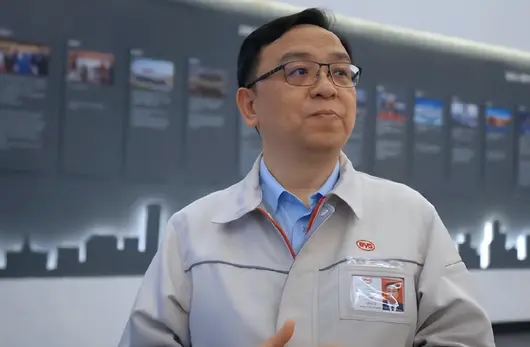
On November 17, at the 2026 APEC Business Leaders Summit held in Shenzhen, BYD Chairman and President Wang Chuanfu shared his views on sustainable development and global cooperation.
Among them, there is a sentence worth noting.
Only sustainable development can achieve long-term development, the path of "I Win, You Lose" won't go far.

Wang Chuanfu stated that BYD hopes to bring Chinese new energy vehicle technology to the world through technological innovation, while achieving common development with the local market through local production, local sourcing, and job creation.
From this statement, it is clear that BYD's understanding of globalization is obviously not simply about selling cars overseas.
Chinese New Energy Vehicles Are Contributing to Global Green TransitionThis APEC Business Leaders Summit took "Promoting Prosperity Together, Winning the Future Together" as its theme, with sustainable development becoming one of the important topics.
As a representative enterprise of China's new energy vehicle industry, BYD also displayed the development results of China's new energy industry in recent years at the meeting.
Wang Chuanfu stated that currently, China's new energy vehicle scale accounts for about two-thirds of the global market, and the proportion of the relevant supply chain is also above two-thirds, making an important contribution to global sustainable development and energy saving and emission reduction.
For BYD itself, these achievements are also reflected in the constantly expanding new energy vehicle production scale.
According to data disclosed by Wang Chuanfu, so far, BYD's cumulative production of new energy vehicles has exceeded 19 million units. According to relevant calculations, cumulative emission reduction is about 150 million tons, equivalent to planting 2.4 billion trees for the earth.

From the popularity of new energy vehicles to the development of power battery, energy storage, and solar technology, China's new energy industry has gradually formed a relatively complete industrial chain system.
In particular, BYD, after forming a scale advantage in the new energy vehicle field, is now taking Chinese new energy technology to more countries and regions through technological research and industrialization applications.
Wang Chuanfu also specifically mentioned Shenzhen at the meeting.
As a representative city for the development of China's new energy vehicle industry, Shenzhen promoted public transport electrification earlier, and the electrification of buses and taxis became an important practice for the city's green development.
From the traffic transformation of one city to the continuous expansion of the global new energy vehicle industry scale, it also reflects that China's new energy vehicle industry has moved from early technological exploration to large-scale application, and has begun to provide more support for global green traffic transformation.
From Exporting Cars to Building Factories Overseas, BYD's Globalization Is UpgradingSmart Electric Commercial Car Magazine believes that compared with the sales scale achieved by BYD, what is more worth noting in Wang Chuanfu's speech this time is his understanding of global cooperation.
Currently, Chinese automakers "going overseas" are mostly in the stage of complete vehicle export, that is, selling cars produced domestically to overseas markets.
But with the continuous expansion of overseas scale, simply relying on complete vehicle exports is actually not enough to support the long-term globalization development of an automaker.
Especially in different countries and regions, new energy vehicle industry foundations, employment demands, and policy environments all exist significant differences.
Then the question arises, how to truly integrate into the local industrial system is definitely one of the important tests for Chinese automakers' globalization.
And BYD has long been trying to move from complete vehicle export towards the transformation of localized production and industrial chain cooperation.
Wang Chuanfu gave several examples at the meeting.
In Thailand, BYD has already built a new energy vehicle factory with an annual production capacity of about 150,000 units, providing about 6,000 job positions for the local area, of which more than 95% are local Thai employees.
In Indonesia, BYD has also planned a new energy vehicle manufacturing factory, of which about 6,000 employees, 95% are local Indonesian employees.

In addition, BYD also has a similar layout in Brazil.
This means that BYD's global business has involved multiple links such as production and manufacturing, personnel employment, and industrial supporting.
Wang Chuanfu also used the Chile market as an example to introduce BYD's industrial cooperation model.
On one hand, BYD purchases copper resources from Chile; on the other hand, BYD provides electric buses to Chile to support the green transformation of local public transport.
This cooperation method actually forms a complementary relationship.
Chinese enterprises obtain the resources needed for industrial development, and the local market obtains new energy vehicle products, technologies, and industrial development opportunities.
It can be foreseen that this mutually beneficial cooperation will not only help Chinese automakers expand overseas markets, but also establish a more stable foundation for long-term sustainable development for enterprises.
Going Global, Sustainable Development Is Also a Long-term CompetitivenessIt is worth noting that Wang Chuanfu also revealed at the meeting that currently BYD has about 12,000 suppliers globally, and hopes to further promote global industrial cooperation through local sourcing, local research and development, and other methods.
This also reflects the continuous deepening of BYD's globalization strategy.
For an industry as large as automobiles, with a huge industrial chain, complete vehicle manufacturing is just one link. From raw material procurement, parts and components supporting, to research, production, sales, and after-sales service, the automotive industry requires a large number of enterprises to participate jointly.
Therefore, the globalization of automakers largely depends on the effective synergy of the supply chain.

For BYD, continuing to promote local procurement, local production, and technical cooperation will undoubtedly further improve the overseas industrial system and improve the operational efficiency of international business.
There are views from many industry insiders that, in the long term, only by truly rooting in the local market and forming stable relationships with local industries and consumers will the enterprise's globalization development be more sustainable.
This might be the important significance of Wang Chuanfu emphasizing "I Win, You Lose Won't Go Far" this time.
The development of the new energy vehicle industry should not just be a struggle for market share, but should also become a joint opportunity to promote technological progress, industrial upgrading, and green transformation.
Wang Chuanfu stated that BYD not only exports technology to the world, but also leaves jobs and tax revenue locally. As a leading enterprise in the global new energy vehicle industry, BYD hopes to rely on technological innovation to make up for industrial shortcomings in various places, Chinese new energy assists global emission reduction, and builds a long-term win-win development pattern.
Conclusion: Finally, we shift our focus from BYD to the entire Chinese automotive industry.
In the past, Chinese automotive enterprises going overseas relied more on rich product configurations + low prices to open the market. Now, with the continuous development of the new energy vehicle industry, Chinese automakers have begun to have the strength to export core technologies, manufacturing capabilities, and complete industrial chain solutions overseas.
Wang Chuanfu's statement at the 2026 APEC Business Leaders Summit this time actually also sent out a signal worth noting.
The globalization of Chinese automotive enterprises is gradually shifting from simply pursuing sales volume and market share to a new stage of technical output, local manufacturing, and industrial cooperation for common development.
This is probably the development idea behind Wang Chuanfu emphasizing "Win-Win" and "Sustainable Development" this time.

9 November, kenderaan elektrik ke-19 juta BYD keluar dari kilang di Xi'an, model yang keluar ialah Fang Cheng Bao Titanium 9, dipositkan sebagai SUV Flagship Mewah Teknologi Baharu, saluran tempahan dibuka secara serentak. Daripada ke-10 juta ke ke-19 juta hanya mengambil masa dua tahun. Kelajuan ini lebih menjelaskan masalah berbanding nombor: peningkatan kapasiti, pengagihan rantai bekalan, dan penyerahan melalui saluran sudah masuk ke dalam irama keadaan stabil yang tinggi, penanda aras boleh terus digunakan sebagai titik pemanasan produk. Letakkan Titanium 9 di lokasi ini untuk bermula, menunjukkan BYD ingin memanfaatkan penanda aras untuk meningkatkan suara jenama baharu, bukannya sekadar menyambut perayaan.

Titik Perpusingan BYD Bukan Pada Wabak, Tetapi Pada Dua Produk Pada Tahun 2020
Meninjau kembali lukisan jualan BYD, titik putus sebenar bukan harga minyak 2021, tetapi Bateri Bilah dan DM-i Hybrid Super yang serentak turun padang pada 2020. Sebelum ini, BYD dari 2009 hingga 2020, jualan tahunan berayun-ayun antara 400,000 hingga 500,000 buah selama tepat sebelas tahun.
Jualan 2021 melonjak ke 730,000 buah, Mac 2022 berhenti menjual kereta bakar, jualan kenderaan elektrik tahun penuh 1.8635 juta, kadar meningkat tahun ke tahun 208.6%, untuk pertama kali meraih juara jualan kenderaan elektrik global mengatasi Tesla.

Kenaikan harga minyak selepas wabak dan gangguan rantai bekalan adalah pemecut luaran, tetapi jika Bateri Bilah tidak menyelesaikan kebimbangan keselamatan, DM-i menekan kecekapan bahan api masa tanpa cas ke 2—3 liter, walaupun harga minyak lebih tinggi, pengguna tiada sebab untuk masuk ke kedai BYD. Era memberi percikan, tetapi kayu kering sudah ditimbun oleh BYD sendiri sebelum tahun 2020.
Gen Bateri Wang Chuanfu Menentukan Lokasi Garis Pencetus BYD
"Bateri dahulu, kenderaan elektrik kemudian", ayat ini dalam industri hanya BYD yang layak. Wang Chuanfu 1995 memulakan perniagaan bateri cas semula, sebelum 2003 mengambil alih Qinchuan Automotive, BYD sudah menjadi pembekal bateri litium-ion Motorola dan Nokia.
Ini bermaksud apabila syarikat automotif lain mulai berfikir "sama ada perlu penyelidikan bateri sendiri" pada dekad 2010, pasukan bateri BYD sudah menambahbaikan hampir dua puluh tahun.

Realiti industri 2026 adalah: Li Auto, Xiaomi, XPeng "penyelidikan bateri sendiri" belum menyentuh pengeluaran sel bateri, sel bateri Nio masih dihasilkan oleh EVE Energy dan Gotion High-Tech, satu-satunya syarikat kenderaan lengkap industri yang mencapai pengeluaran sel bateri sendiri dan bekalan skala besar, masih hanya BYD.

Bukan perbezaan yang boleh ringkaskan dengan tiga perkataan "perancangan awal" — bateri adalah bahagian 30%—40% kos kenderaan lengkap, siapa yang memilikinya sejak hari pertama, siapa yang memilikinya sejak hari pertama kuasa mentakrifkan struktur kos.
Yang boleh disalin oleh BYD ialah Hasil, Yang Tidak Boleh Disalin ialah Permulaan dan Masa
Syarikat automotif lain boleh belajar BYD buat integrasi menegak, tetapi tidak boleh belajar permulaan "dari bateri". Kitaran tertutup BYD bukan menukar pembekal kepada anak syarikat, tetapi dari pemprosesan lombong lithium, bahan positif dan negatif, membran dan cecair elektrolit hingga penyelidikan sel bateri, kitar semula pakej bateri rantaian penuh, sebelum membuat kereta sudah dijalankan sekali.

Data Syarikat Konsultasi Rhodium menunjukkan, harga asas BYD Seal lebih rendah daripada Model 3 hampir dua pertiga, margin kasar 2025 masih mencapai 20%, lebih tinggi daripada 18% Tesla; berbanding Tesla, setiap kereta Jimat sekitar 2,369 USD premium pembekal; hanya两项 penyelidikan bateri dan chip sendiri, kos pembuatan setiap kereta lebih rendah daripada rakan sejawat yang membeli luar sepenuhnya 2,000—4,000 Yuan.
Lebih kritikal, stesen cas pantas BYD sudah dibina 12,165 buah, pelaburan aset berat yang menjadikan pengisian tenaga menjadi infrastruktur, sekali lagi membentuk satu lapisan penghalang baharu yang memerlukan masa dan skala untuk ditimbus. Yang syarikat automotif lain boleh gunakan ialah "menggunakan teknologi mentakrifkan kos, menggunakan skala memberi makan teknologi" logik kitaran, tetapi tidak boleh kembali ke 1995 pilih semula titik permulaan.
Menang Dalam Skala, Tidak Bermaksud Menang Dalam Keuntungan dan Jenama
Makna sebenar 19 juta perlu dilihat dalam konteks yang lebih jujur. Daripada 10 juta ke 19 juta hanya menggunakan 23 bulan, 17 juta ke 19 juta hanya berjarak 4 bulan, jualan 2025 keseluruhan 4.602 juta untuk pertama kali mencecah lima teratas syarikat automotif global.

Tetapi di sebalik satu set data yang sama, jualan BYD Januari hingga Oktober dalam negara menurun kira-kira 30% tahun ke tahun, keuntungan bersih induk tiga suku tahun pertama 22.345 bilion Yuan, menurun 4.24% tahun ke tahun. Model yang keluar ke-19 juta memilih Fang Cheng Bao Titanium 9 berharga 350,000 hingga 400,000 Yuan berbanding kereta jualan tinggi, isyarat sangat jelas: skala sudah tidak perlu lagi dibuktikan, seterusnya perlu dibuktikan ialah keupayaan premium.
Kadar penetrasi kenderaan elektrik dalam negara sudah hampir jenuh, pertambahan mesti datang dari luar negara — Januari hingga Oktober jualan luar negara 1.513 juta, kadar meningkat tahun ke tahun 93.75%, nisbah mencecah 42.7%, kilang Thailand, Brazil, Hungary sedang dibangunkan. 19 juta adalah kemenangan pasaran China, kunci 30 juta berada di luar negara.
Daripada 19 Juta Ke 30 Juta: 2 Hingga 3 Tahun Boleh Dijangka, Tetapi Logik Sudah Bertukar Gear
Daripada 19 juta ke 20 juta, mungkin hanya memerlukan 4 hingga 6 bulan — mengikut irama biasa "sejuta sekuartal", separuh pertama 2027 boleh mencecah. Ujian sebenar berada pada satah 20 juta ke 30 juta. Asas tempatan sudah sangat besar, ruang yang terus bergantung pada peningkatan kadar penetrasi menarik agak terbatas; kilang luar negara dari pengeluaran ke pengeluaran penuh memerlukan 12—24 bulan peningkatan, dan berhadapan dengan ketidakpastian cukai import, geopolitik dan pematuhan tempatan.

Jika jualan luar negara tahunan boleh dari tahap 1.5 juta sekarang dinaikkan kepada lebih 3 juta dalam tiga tahun, 30 juta mungkin dicapai antara 2029—2030, menghabiskan masa kira-kira 2.5 hingga 3 tahun.

Sasaran rasmi BYD 2030 ialah pengeluaran dan jualan tahunan 10 juta buah/tahun (sepadan dengan kadar pertumbuhan purata kira-kira 16.8%), manakala ramalan optimis institusi seperti DBS memberikan 12.7 juta. Daripada 19 juta ke 30 juta, yang dibandingkan bukan berapa banyak lagi boleh dijual di dalam negara, tetapi kilang Hungary, Brazil, Thailand boleh menjalankan 'ekspor industri' dalam masa tiga tahun. Jika berjaya dijalankan, 3 tahun; jika gagal dijalankan, kelajuan akan dikalahkan oleh keuntungan, naratif skala juga akan diletakkan di belakang naratif jenama.
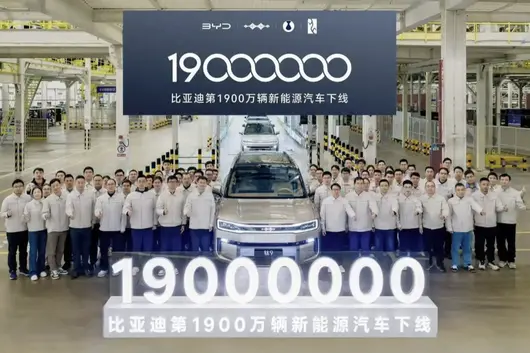

On November 9, BYD's 19 millionth new energy vehicle rolled off the line at the Xi'an factory. The model produced was the Fang Cheng Bao Titanium 9, positioned as a tech-luxury flagship SUV. Reservation channels opened simultaneously. It took only two years to go from the 10 millionth to the 19 millionth unit. This speed illustrates the point better than numbers: production ramp-up, supply chain scheduling, and channel throughput have entered a highly steady-state rhythm. Milestones can be used directly as nodes for product hype. Placing the Titanium 9 on stage at this position shows BYD wants to leverage the milestone to amplify the new brand's voice, rather than just for celebration.
BYD's inflection point was not the pandemic, but those two products in 2020
Looking back at BYD's sales curve, the true inflection point was not the 2021 oil prices, but the simultaneous launch of the Blade Battery and DM-i Super Hybrid in 2020. Before this, from 2009 to 2020, BYD's annual sales hovered between 400,000 and 500,000 units for a full eleven years.
Sales skyrocketed to 730,000 units in 2021. In March 2022, sales of fuel vehicles were halted. New energy vehicle sales for the full year reached 1.8635 million, a year-on-year increase of 208.6%, surpassing Tesla for the first time to take the global new energy vehicle sales crown.
Oil price hikes and supply chain disruptions after the pandemic were external accelerators. But without the Blade Battery solving safety anxiety, and DM-i bringing fuel consumption when power is low down to 2—3 liters, no matter how high oil prices were, consumers had no reason to walk into a BYD store. The Era gave the matches, but the dry wood was stacked by BYD itself before 2020.
Wang Chuanfu's battery DNA determined BYD's starting position
"Batteries first, then new energy vehicles," this sentence can only be claimed by BYD in the industry. Wang Chuanfu started with secondary rechargeable batteries in 1995. Before acquiring Qinchuan Automobile in 2003, BYD was already a lithium-ion battery supplier for Motorola and Nokia.
This means when other car companies started thinking "whether to self-develop batteries" in the 2010s, BYD's battery team had already iterated for nearly twenty years.
The industry reality in 2026 is: Li Auto, Xiaomi, and XPeng's "self-developed batteries" have not touched cell manufacturing; NIO's cells are still manufactured by EVE Energy and Gotion High-tech. The only complete vehicle enterprise in the entire industry that has achieved self-manufactured cells and large-scale supply is still BYD.
This is a gap that cannot be summarized by the three words "early layout"—batteries are 30%—40% components of the total vehicle cost. Whoever owns it from day one has the power to define the cost structure from day one.
What is replicable about BYD is the result, not the starting point and time
Other car companies can learn vertical integration from BYD, but cannot learn the starting point of "starting from batteries". BYD's closed loop is not replacing suppliers with subsidiaries, but the entire chain from lithium ore processing, cathode/anode materials, separators, electrolytes to cell development, and battery pack recycling, which has already been tested once before building cars.
Data from Rhodium Group shows that the basic version of BYD Seal is priced nearly two-thirds lower than the Model 3. In 2025, the gross margin still reached 20%, higher than Tesla's 18%; compared with Tesla, approximately $2,369 of supplier markup is saved per vehicle; just in the two items of self-developed batteries and chips, the manufacturing cost per vehicle is 2,000—4,000 yuan lower than peers who purchase purely externally.
More crucially, BYD's flash charging stations have reached 12,165 units. This heavy asset investment in turning energy replenishment into infrastructure constitutes a new layer of barrier that takes time and scale to stack. What other car companies can learn from is the cycle logic of "defining cost with technology, feeding technology with scale", but they cannot go back to 1995 to choose a starting point again.
Winning in scale does not equal winning in profit and brand
The true meaning of 19 million units needs to be viewed in a more honest context. It took only 23 months from 10 million to 19 million. From 17 million to 19 million, it took only 4 months. In 2025, total annual sales of 4.602 million units ranked in the top five global car companies for the first time.
But behind the same set of data, BYD's domestic sales from January to October declined year-on-year by about 30%. Net profit attributable to the parent company for the first three quarters was 22.345 billion yuan, a year-on-year decrease of 4.24%. Choosing the Fang Cheng Bao Titanium 9, priced at 350,000—400,000 yuan, as the 19 millionth unit model instead of volume-selling cars sends a very clear signal: scale no longer needs proving; what needs to be proven next is premium pricing power.
Domestic new energy penetration is approaching saturation; growth must come from overseas—Overseas sales from January to October were 1.513 million units, a year-on-year increase of 93.75%, accounting for 42.7%. Factories in Thailand, Brazil, and Hungary are being implemented. 19 million units is a victory in the Chinese market; the key to 30 million units lies overseas.
From 19 million to 30 million: 2 to 3 years are expected, but logic has shifted gears
From 19 million to 20 million, it may only take 4 to 6 months—following the normal rhythm of "one million per quarter", 2027 in the first half should be reached. The true test lies in the segment from 20 million to 30 million. The domestic base is already huge, and there is limited space to continue being driven by penetration rate increases; overseas factories need 12—24 months of ramp-up from production start to full capacity, and face uncertainties regarding tariffs, geopolitics, and local compliance.
If overseas annual sales can be pushed from the current 1.5 million level to over 3 million within three years, 30 million units might be achieved between 2029—2030, taking about 2.5 to 3 years.
BYD's official goal for 2030 is an annual production and sales of 10 million vehicles/year (corresponding to an average annual growth rate of about 16.8%), while optimistic forecasts from institutions like DBS give 12.7 million vehicles. From 19 million to 30 million, it is not about how much can still be sold domestically, but whether factories in Hungary, Brazil, and Thailand can complete the "industry going global" within three years. If completed, 3 years; if not completed, speed will yield to profit, and the scale narrative will yield to the brand narrative.
© 2024 Bitauto.com. All Rights Reserved.
Bitauto (www.yiche.com and www.bitauto.com) is one of the most visited automotive websites in China. We provide detailed info on Chinese car brands available in your area. Please note that the information provided on this website is based on publicly available data and is for reference only. It may not be fully updated or accurate at all times.

Help us improve our website


