

Homeacceleration

Search History
Popular Searches
Dealer Login / Sign Up





BYD's 2026 first-half financial report shows, during the first half, overseas sales of BYD passenger cars and pickups approached 790,000 units, up 67.9% year-on-year, business covering over 120 countries and regions globally, topping the new energy vehicle brand sales chart in core markets such as the UK, Brazil, and Thailand. On top of the rapidly growing global baseline, BYD's new energy government vehicle business is entering a new stage of "blossoming at multiple points" domestically and internationally: from receiving "national-level" recognition from Uzbekistan, to mass implementation in markets such as Pakistan and Mexico; from bulk procurement by capital city agencies to the gradual perfection of the police vehicle matrix, this "overseas benchmark leading, continuous domestic expansion" government vehicle expansion path is becoming increasingly clear.
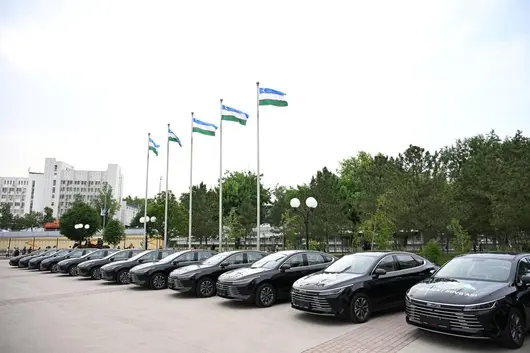
Recently, President Shavkat Mirziyoyev of the Republic of Uzbekistan signed a presidential decree, awarding the BYD team the Republic of Uzbekistan's national-level medal - "Friendship Medal". This honor becomes the most powerful testament to BYD's deep cultivation of the Central Asian market. This is following the commissioning of the local new energy factory and the selection of BYD models for presidential official vehicles, another high-level endorsement given by the country's authorities to BYD, and also becoming a vivid microcosm of Chinese new energy vehicles winning trust in the overseas government market through strength.

Recognition in Uzbekistan is not an isolated case, BYD's overseas government vehicle layout is penetrating from benchmark markets to a wider scope. Nearly 100 BYD pure electric government vehicle orders in Pakistan have been delivered and put into use on a large scale, this is Pakistan's first large-scale procurement of new energy government vehicles, marking Pakistan as a landmark market for BYD's overseas police vehicle cooperation. In addition, the Cape Verde government official vehicle fleet has fully switched to BYD, Hungary, Austria and other countries have also successively included BYD models in official vehicle systems such as diplomatic reception.

In this specialized segment of police vehicles, BYD's overseas layout is accelerating further. In September, BYD delivered a batch of Dolphin police cars to the Philippine police, promoting the continued electrification of public official vehicles in the Philippines. Recently, dozens of Destroyer 05s were also formally added to the Mexican police force as police vehicles. So far, BYD has delivered multiple models including BYD SHARK pickup, Seal, Yuan UP, Seagull, etc. to police in multiple places in Mexico, covering diverse duty requirements. The continuous implementation in the two markets marks that BYD's new energy police vehicles are moving from single-point demonstration to large-scale and normalized application.

In the domestic market, BYD also firmly stays at the top position of new energy government vehicle procurement. An announcement on the China Government Procurement Network shows that since the second half of the year, government agencies in many places across the country have completed bulk procurement of BYD government vehicles, this is following BYD retaining the first place in domestic new energy government vehicle government procurement sales with a market share of over 22% in the first half of the year, another affirmation given by the domestic government market.
In the field of police vehicles, Fang Cheng Bao Titanium 7 and other police vehicles have also completed bulk delivery in many places across the country. BYD has built a full-category product matrix covering sedans, SUVs to pickups, capable of fully adapting to diverse police scenarios such as security patrols, traffic police enforcement, emergency response, etc., helping upgrade police transportation to electrification.

From being monopolized by joint venture brands to becoming the Chinese option for global government electrification, BYD is writing a new testament for Chinese manufacturing with hard strength. On this high-end track measuring the comprehensive strength of automobile brands, accelerating the global government layout of Chinese new energy vehicles with technical hard strength and brand credibility.

These days, breaking 100,000 units in single-month domestic sales is already big news. But for Geely's overseas market alone, 110,094 units were sold in August, a year-on-year surge of 205%. If only one month looked impressive, it could be attributed to luck. But maintaining sales above 100,000 units for three consecutive months indicates only one thing: Geely's globalization has truly hit the accelerator. Even more exciting, Geely casually raised its 2026 overseas sales target from 640,000 to 920,000 units, aiming to surge past 1 million. Some feel this stride is too big, but after analyzing the overseas battle reports, my conclusion is: This isn't a bluff, it's confidence.

I. Behind Breaking 100,000 Exports, New Energy is the Ace
Checking Geely's August export bill, the most impactful part isn't the total volume, but the structure: New energy exports hit 70,629 units, surging 446% year-on-year, accounting for a high 64% of exports. This means what Geely sells best overseas isn't "cheap and generous" low-end fuel cars, but NEVs with higher technical content. Overseas market response is direct enough: From Jan-July, ZEEKR topped Australia's luxury pure electric sales chart, and sat firmly as the luxury pure electric sales champion in Malaysia; Lynk & Co 08 took the top spot in Tunisia for high-end PHEV sales; Geely Xingyuan won the championship in Thailand and Jordan, and also broke into the top three in Mexico's pure electric market. Look at data before discussing going global, this is globalization that can fight, not just raising a fuss with low prices.

II. From Selling Cars to Rooting Down, Geely Plays a Big Game
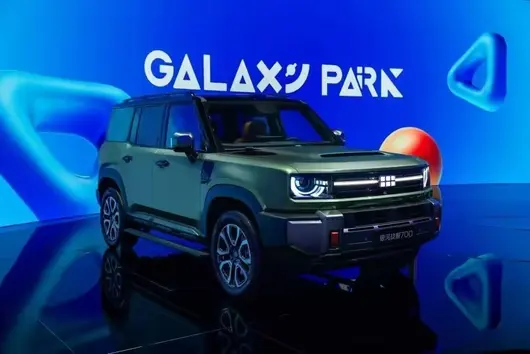
Geely's current going-global strategy is long past the days of just dragging cars to the port and calling it a day. In the European direction, it officially announced entry into Austria, sales outlets in Spain broke 50, and Xingyuan also stormed into France; In the Latin America direction, Lynk & Co landed in Argentina, Lynk & Co 01 launched in Chile, and local business was converted to Geely Auto Chile Co., Ltd. direct operation, grabbing service initiative in its own hands; In the Middle East and Africa, ZEEKR 9X started pre-sale, Lynk & Co moved into Jordan, and the first D-segment SUV global car Monjaro EM-i premiered in Egypt. Looking at it this way, it's clear: single-point trial has upgraded to a systematic layout, sales, service, channels, and racing all link together. Lynk & Co boosted brand awareness with CRC champion titles, ZEEKR opened the high-end market with luxury products, Geely main brand used the Galaxy series to seize new energy mindshare—three brands going global synergistically, the speed is naturally different.

III. Target Raised to 920,000, Where Does the Confidence Come From
Someone might ask: With such a large overseas frontline, can the funds withstand it? Geely just released its mid-2026 interim performance in mid-August, total revenue 173.6 billion yuan, core net profit attributable to parents 9.68 billion yuan, sales, price, profit all went up collectively. To put it plainly, fighting overseas needs continuous blood transfusion from domestic markets, and Geely's current cash flow is thick enough to support the global frontline. Plus exports breaking 100,000 for three consecutive months has already run through this going-global model, raising the target isn't a whim. Looking at Jan-July performance, ZEEKR 7X took the Australia medium luxury SUV sales champion, Galaxy Starship 7 EM-i took the Poland C-segment PHEV sales champion and Spain C-segment SUV first, blockbuster models fully possess the ability for global replication. 920,000 units looks like a bold slogan, actually it's just amplifying the already validated tactics further.
Many are used to understanding China car exports as "selling to developing countries", Geely's answer is: Hit developed countries with new energy, deepen emerging markets with systems, build reputation with quality and intelligence. August exports of 110,094 units is a milestone, but definitely not the end. When a Chinese auto company dares to set annual export targets to 920,000 units, then surge to 1 million, the old structure of the global auto industry has started to loosen.











© 2024 Bitauto.com. All Rights Reserved.
Bitauto (www.yiche.com and www.bitauto.com) is one of the most visited automotive websites in China. We provide detailed info on Chinese car brands available in your area. Please note that the information provided on this website is based on publicly available data and is for reference only. It may not be fully updated or accurate at all times.

Help us improve our website


