

Homeengine

Search History
Popular Searches
Dealer Login / Sign Up

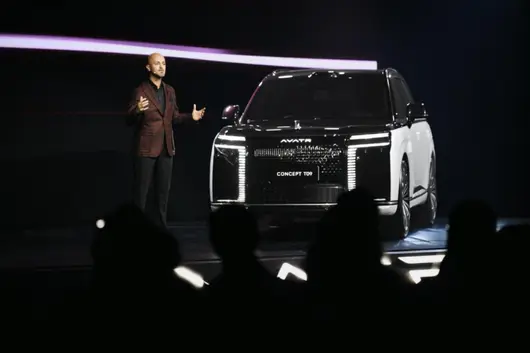
On October 11, the Avatr T09 Concept Version completed its global premiere in Paris, and the cockpit design was also unveiled for the first time. As the pioneering work of the Avatr flagship product series, the new car aims at the 500,000 yuan-level flagship luxury SUV market, plans to officially launch in 2026, and will appear at the Paris Motor Show from October 12 to 18. From original design to intelligent technology, to the overall layout of the powertrain system, the Avatr T09 carries the brand's product goal of further expanding into the high-end flagship market, and has also become another observation sample for Chinese automotive brands participating in global luxury car competition.

This Paris premiere is not only a concentrated display of new car design and technical solutions, but also reflects Avatr's further sorting of the brand's product system. Avatr Technology Chairman Chen Zhuo stated that with the arrival of the T09, the brand will build two product series: Digital and Flagship. Among them, the Digital series focuses on "Casual Luxury", focusing on sports and individuality; the Flagship series takes "Respectful Luxury" as the direction, emphasizing calmness, prestige, and presence. The two product series have different positioning, but jointly continue Avatr's persistence in original design.

Avatr Executive Vice President and Chief Designer Nader Faghihzadeh introduced that the T09 Concept Version will further implement the brand's VISION XPECTRA design vision, expanding the "Respectful Luxury" direction for flagship models on the basis of the "Emotional New Luxury" design philosophy. This means Avatr is trying to establish clearer design identity through different product series, forming a corresponding relationship between brand concepts and model positioning.

Starting from Architectural Aesthetics, How to Express Flagship Presence?
The appearance of the T09 does not simply rely on size and decoration to create a sense of luxury, but establishes visual distinctiveness through the combination of structure, lines, and light/shadow. The front face adopts a 3D relief structure grille, composed of 362 brand logo elements of varying heights and positions, presenting rich layers with changes in observation angle and light. The Crystal Diamond Array Light Group adopts double-layer diamond cutting craftsmanship, echoing the clamshell front hood with an area of 2.1 square meters; the island-style humps on both sides of the front hood further enhance the sense of three-dimensionality and power of the vehicle's head.

The side profile forms a distinct contour change through blade lines and waisted curves, while the D-pillar aluminum trim panel is used to create the visual effect of a floating roof. The rear end adopts integrated crystal diamond taillights, echoing the design language of the front light group, presenting a layered light and shadow effect when lit. Overall, the T09 attempts to integrate the sense of structure and sculpture from building architecture into automotive styling, maintaining Avatr's consistent original design characteristics while emphasizing flagship presence.
Cockpit Design Extends from Visual Interaction to Emotional Experience
Compared to the exterior, the interior revealed for the first time this time emphasizes the combination of cockpit atmosphere and interaction methods. The T09 adopts a cockpit design philosophy focused on serenity and comfort, among which the liftable Vortex Emotional Vortex Interaction System is particularly noteworthy.
This system is equipped with 118 RGB LED matrix light sources, which can link with the overall vehicle status and ambient lighting, and is equipped with a silent mechanism and anti-pinch protection. Unlike traditional fixed decorations, this set of devices attempts to combine dynamic lighting effects with cockpit interaction, presenting the vehicle status in a more perceptible way. Its actual experience still needs further verification by mass-produced models, but from the design philosophy, Avatr hopes to add more emotional expression and scenario adaptability to the cockpit beyond functionality.

The cockpit is also equipped with an immersive integrated triple screen, composed of a 10.25-inch instrument cluster and two 17.2-inch center console and passenger screens. The screen and air vents adopt an integrated design and support NFC tap-to-connect. Through the combination of screen layout, lighting effect system, and interconnection functions, the T09 attempts to find a balance between information interaction, visual integrity, and riding atmosphere, responding to the diverse needs of flagship SUVs in business travel and family use scenarios.
Three-party Technical Collaboration, Power and Intelligence Become Key Product Variables
If original design determines the first impression of the T09, then the technology system constitutes an important support for it to enter the 500,000 yuan-level flagship SUV market. As the vehicle with the highest technology density in Avatr so far, the T09 integrates Changan, Huawei, and CATL's three-party technical resources, equipped with Huawei Qiankun Intelligent Driving, HarmonyOS Cockpit, Taixing Intelligent Control, and other technologies, and adopts a new intelligent super hybrid system.
Regarding power, the new car is composed of a 2.0T hybrid engine and a tri-motor distributed electric drive, with a system total power breaking through 1000 horsepower. At the same time, the vehicle is equipped with a 71.24kWh CATL Xiaoyao Super Hybrid Battery, with a CLTC pure electric range of up to over 400km. From the parameters, this power combination balances performance output and pure electric driving capability, providing different usage choices for daily commuting and long-distance travel. However, specific driving performance, energy consumption levels, and range performance under different conditions still need to be further judged in combination with mass-produced versions and actual tests.

At the intelligence level, Huawei Qiankun Intelligent Driving, HarmonyOS Cockpit, and Taixing Intelligent Control jointly constitute the technical foundation of the T09. For flagship SUVs, intelligent driving assistance, cockpit interaction, and vehicle dynamic control are not isolated configurations; their collaborative performance will directly affect daily convenience and driving experience. Whether the T09 can convert technical configurations into stable, user-friendly practical experience will be an important link for its future market test.
From Paris to the Globe, Avatr's Exam Goes Beyond a Single New Car
The global premiere of the T09 also echoes Avatr's overseas layout. According to brand planning, Avatr will officially enter the European market in 2027, with the Avatr 06T and 07L planned as the first batch of models to enter countries such as Norway and Spain. So far, Avatr's business has covered 70 countries and regions, the product average selling price exceeds 300,000 yuan, and profitability has been achieved; the market share of the high-end electric vehicle market in Egypt has reached 10%, and the Avatr 11 has achieved the top sales of luxury pure electric SUV in Thailand.

For longer-term development, Avatr proposed to expand its business to over 110 countries and regions by 2030, with overseas sales accounting for over 50% of total sales. With the expansion of market coverage, product adaptation, service network construction, and brand awareness improvement will also become work that needs to continue to be promoted in the globalization process.
Taking the flagship concept model to Paris to complete the global premiere, Avatr hopes to express its own brand proposition through original design and intelligent technology. For Chinese automotive brands, entering the luxury market not only requires competitive product parameters, but also requires design philosophy, technology experience, quality performance, and service capability to form synergy.
Summary: From "Casual Luxury" to "Respectful Luxury", the Avatr T09 provides a new product expression direction for the brand. Planned to be launched within 2026, can it establish a competitive advantage in the 500,000 yuan-level flagship luxury SUV market relying on original design, three-party technical collaboration, and intelligent super hybrid system? The answer still needs to wait for mass-produced models and true market performance to give verification, and this is exactly the next step that is more worth focusing on after the Avatr T09 global premiere.



















© 2024 Bitauto.com. All Rights Reserved.
Bitauto (www.yiche.com and www.bitauto.com) is one of the most visited automotive websites in China. We provide detailed info on Chinese car brands available in your area. Please note that the information provided on this website is based on publicly available data and is for reference only. It may not be fully updated or accurate at all times.

Help us improve our website


