

Homeprice

Search History
Popular Searches
Dealer Login / Sign Up

The Xpeng G9L is priced at over 470,000 RMB in Thailand and Indonesia. With this price back home, it is enough to buy more than two G9s.

On November 22, the Xpeng Official Account announced that this car was launched simultaneously in Bangkok and Jakarta. Thailand price is about 471,500 RMB, Indonesia about 476,000. This is the first time Xpeng launches the same flagship model simultaneously in two core Southeast Asian markets.

First, let's look at this car. The G9L is equipped with the Turing AI Chip, possessing full-stack intelligent driving capabilities. Officially, this hardware is prepared to cope with Jakarta's urban congestion and Bangkok's complex mixed traffic, aiming to reduce daily driving burden. For power supply, it has a full-domain 800V high-voltage platform plus 5C supercharging. The space features a six-seat layout, accommodating family multi-passenger travel, business reception, and daily commuting.
The platform shares the same origin as Xpeng Tech's flagship GX, sold in 64 countries and regions worldwide. This simultaneous launch in Bangkok and Jakarta effectively pulls the core Southeast Asian markets into its global flagship layout.

Actually, the number 470,000 is worth pondering not for whether it is expensive, but whether they dare to set this price. Perception of Chinese brands in the Southeast Asian market is still stuck on cost-performance. Xpeng directly sells the flagship SUV to a price range close to local luxury brands; this is a bet on brand power supporting the premium. What supports it is clear: intelligent driving, 800V, 5C supercharging, large six-seat space, plus localized production and channel distribution across Thailand, Indonesia, Malaysia, etc. It is not just shipping cars to sell and leave, but truly planning to take root. This strategy is completely different from the early path of Chinese cars going global relying on low prices for volume.
Of course, risks are real. What 470,000 can buy in Thailand and Indonesia, local consumers know well. Whether these selling points like the Turing Chip and 5C supercharging can convert into reasons to pay depends on actual experience and reputation. Xpeng X9 has already taken the sales leader spot in the sub-segment in Thailand and Indonesia, which is a good start. Whether G9L can catch this momentum and stabilize the flagship price point will be seen in the next one or two years. As for going global, selling at a high price is not rare; only when people still buy when it is expensive is it true skill.








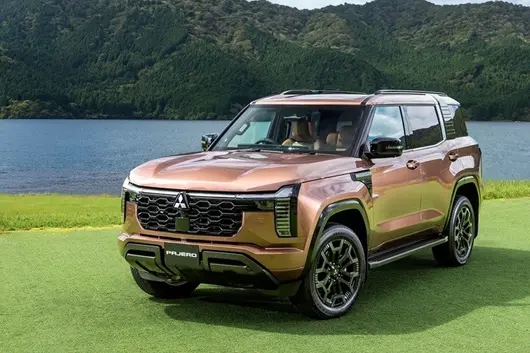
Mitsubishi officially unveiled the new generation Pajero in early September, followed by the Thailand market launch on October 19, and today (October 29) Mitsubishi also announced the new car will be sold in Japan on December 17, with 4 models offered in the lineup: GLS, GSR, Exceed, and Super Exceed, all models feature four-wheel drive, prices range from 6.193 million yen to 7.9508 million yen, the manufacturer stated that after opening pre-orders for the new Pajero starting October 1, accumulated about 5,500 orders by October 28, exceeding the annual sales target.

As the flagship off-road SUV Pajero, the 5th generation model is about to launch in the Japanese market in mid-December, offering a total of 4 models to choose from: GLS, GSR, Exceed, and Super Exceed, with slight differences in equipment among the models. Starting with the exterior, the new generation Pajero features two types of grille designs on the front: horizontal slat and honeycomb, among them only the top-spec Super Exceed model features the honeycomb style, while the other models all feature the horizontal slat design; additionally, Exceed and Super Exceed models are equipped with ALH intelligent headlights.
Regarding the wheels, Exceed and Super Exceed share the same wheel design with a size of 255/55R20, but differ in wheel color, while GLS and GSR models share the same wheel design with a size of 255/65R18.

Regarding colors, the entire lineup has 7 solid color options available, including newly developed Armored Metal Copper and Iridescent Metal Blue, additionally, the top-spec Super Exceed offers 4 two-tone versions with black roofs. Regarding body dimensions, the new generation Pajero length and width are 4,920mm and 1,925mm respectively, GLS and GSR height is 1,900mm, while Exceed and Super Exceed are 1,910mm.

Inside the cabin, the new generation Pajero features a digital tech layout, depending on the model grade, the central control screen has 12.3-inch and 14.3-inch configurations, while the top-spec Super Exceed interior combines camel and black colors, additionally Super Exceed models come standard with panoramic electric sunroof, front seat ventilation, 12-speaker Yamaha audio, and other exclusive features; front and rear seat heating functions are standard on all models except the entry-level, additionally, the entire lineup is configured as 3 rows with 7 seats, the manufacturer emphasizes that except for the windshield, the front and rear use sound-insulated glass designs, further enhancing the quietness inside the cabin.

The new generation Pajero adopts a high-rigidity ladder frame chassis architecture, regarding power specifications, the 2.4-liter turbo diesel engine delivers a maximum of 204 horsepower and 480 Nm of torque, paired with an 8-speed automatic transmission, the average fuel consumption measured locally in Japan is 12.1 km/L. The Japanese-spec Pajero entire lineup is equipped with the S-AWC four-wheel drive system, offering 4 drive modes to choose from: 2H, 4H, 4HLc, 4LLc, as well as 7 driving modes: Normal, Eco, Gravel, Snow, Mud, Sand, and Rock, further enhanced by AYC active yaw control and ASTC active stability and traction control systems, creating excellent handling performance.
Additionally, the Japanese-spec new generation Pajero entire lineup comes standard with the Mi-Pilot driver assistance system and 8 airbags, including the SRS center airbag adopted by Mitsubishi Motors for the first time.

© 2024 Bitauto.com. All Rights Reserved.
Bitauto (www.yiche.com and www.bitauto.com) is one of the most visited automotive websites in China. We provide detailed info on Chinese car brands available in your area. Please note that the information provided on this website is based on publicly available data and is for reference only. It may not be fully updated or accurate at all times.

Help us improve our website


