

Hometrail

Search History
Popular Searches
Dealer Login / Sign Up

Four years ago, BYD's monthly sales in Australia were zero, as it only officially entered the Australian market in November 2022.
But no one expected that in less than four years, this new Chinese brand established in the Australian market actually cornered the Japanese car brands that had been operating in Australia for 28 years.
According to Nikkei China, in June this year, BYD's sales in Australia reached 19,000, with a gap of only 243 units compared to the local number one, Toyota, meaning the two are nearly level.
Data from the Australian Federal Automotive Industries Chamber is even more direct: in the first seven months of this year, BYD's cumulative sales broke 60,000, with a market share of up to 8.5%, leaving behind old faces like Ford, Mazda, and Hyundai, second only to Toyota.
Additionally, Chinese cars and Japanese cars in the Australian market show completely different trends. According to the Australian Broadcasting Corporation, compared to the same period last year, Mazda sales dropped 17%, Toyota dropped 21%, Subaru and Mitsubishi both dropped 25%, while BYD increased by 124% year-on-year, with Chery and Geely also achieving varying degrees of growth.

But data is ultimately just appearance. What is truly worth pondering is, why does a brand that had nothing to do with this market four years ago manage to create such a stir on someone else's turf? Why does this country, accounting for less than 2% of global new car sales, warrant Chinese car companies breaking their heads to rush in? What does conquering Australia really mean for Chinese cars making their way into the world?
Reading this article you will understand:
1. What is the landscape of the Australian automotive market?
2. Why is it specifically Australia?
3. What irreplaceable strategic value does the Australian market hold for the global expansion of Chinese cars?
Three keywords to fully explain the Australian automotive market
To understand the Australian automotive market, three keywords are enough: Monopoly, Rise, Siege.
Monopoly, refers to Japanese cars.
Using "Monopoly" to describe Japanese cars is not an exaggeration. Taking sales in 2025 as an example, Australia's total new car sales for the year reached 1.241 million, with Toyota alone accounting for 239,000 units, becoming the sales champion of the Australian automotive market for 23 consecutive years, with a market share close to 20%. Besides Toyota, Mazda, Mitsubishi, Isuzu, Subaru, and Nissan all ranked in the top ten of the 2025 Australian automotive sales brand list.
In the entire Australian market, only American Ford, Tesla, Korean Hyundai, Kia, German Volkswagen, Chinese BYD, Great Wall, Chery, and MG can compete with Japanese cars, but sales have never managed to exceed Japanese cars. Exaggerating, take a glance at a gas station, seven out of ten cars display Japanese car logos.
Rise, it's time for Chinese brands to take the stage.
In the Australian market, although Chinese cars have never managed to surpass Japanese cars, their strong growth momentum has been narrowing the gap between the two.
From January to July 2026, among the top ten car brands in Australia, Chinese brands accounted for four, namely:
BYD ranked second, sales were 60,192 units;
Great Wall Motor ranked seventh, sales were 34,877 units;
Chery Automobile ranked eighth, sales were 29,579 units;
MG ranked tenth, sales were 27,430 units.

In addition, there is Geely with sales of 14,655 units, OMODA & JAECOO with sales of 10,943 units (Chery's J&O dual-brand matrix for overseas markets), and Zeekr with sales of 7,950 units. Moreover, both Chery and Geely are building multi-brand matrices. If sub-brand sales are combined, the share would be even larger. The question is no longer about Chinese cars "whether they exist," but "how much share they can seize."
Siege, that is the third keyword.
This is not one brand fighting Japanese cars alone, but a group of Chinese brands rushing into the Japanese brand's territory. BYD tears open a gap with EVs and PHEVs, Great Wall uses hard hits with pickups and SUVs, Chery spreads the line of battle with multi-brand matrices, Geely and Zeekr attack from the high-end and intelligence angles. Meanwhile, for Japanese cars this year, except Honda, Toyota dropped 21%, Mazda dropped 17%, Subaru and Mitsubishi both dropped 25%, the gap will only widen.
So, what do Australian consumers actually think? Can Chinese cars surpass the deeply rooted Japanese cars in Australia?
This question has already been answered by local authoritative institutions. According to research by AADA (Australian Automotive Dealers Association), China's momentum in supplying vehicles to the Australian market is strengthening. It is expected to become the main source of vehicle imports by 2035, accounting for 43% of all new car sales by 2035.
That is to say, Chinese cars topping Australia has almost become a foregone conclusion.
Why is it Australia?
Chinese cars breaking the monopoly in the local market in Australia is clearly not a coincidence, but a superposition of three characteristics.
The first characteristic is that Australia does not have well-known local automobile enterprises.
As early as 1948, the "Holden 48-215" came off the production line, this is the first car independently manufactured in Australia. For a long time, Holden was the mainstream in the local automotive market. However, Australia has a vast land and sparse population, with an annual scale of just over 1 million units, which cannot be compared with huge markets like China and Southeast Asia, leaving extremely limited growth space.

(Holden Auto Logo)
On the other hand, Australian labor costs are extremely high, while there are no particularly leading technical advantages, and they cannot compete with giants in the US, Germany, Japan, etc., in terms of going global.
Finally, on October 20, 2017, the last car came off the line for Holden Motor Company, and Australia's automotive industry was declared ended. The then Prime Minister Malcolm Turnbull even stated: "This is the end of an era."

The lack of local brands instead cleared the track for latercomers. Whoever has good products, fair prices, and fast delivery can get a seat at the table.
To put it plainly, this is a place where you eat based on your skills.
The second characteristic is zero tariffs.
In June 2015, the China-Australia Free Trade Agreement was officially signed. After that, tariffs for Chinese complete vehicles entering Australia gradually dropped to zero.
That is to say, Australia is willing to "open its doors" to Chinese cars. While Chinese cars were blocked by tariffs in other markets, in Australia they only had to worry about "is the product good enough". This also gave Chinese car companies great development space.
Finally, the forced push from high oil prices.
Since the Hormuz Strait channel was blocked this year, global oil prices soared directly, and Australia even released heavy news that fuel reserves were in complete emergency.
Under this situation, Australian consumers turned to new energy vehicles with lower travel costs, and this happens to be the strong suit of Chinese car companies, offering not only better experience but also more competitive prices.
Taking BYD as an example, according to "Nikkei China", Toyota RAV4 starts from about 46,000 AUD, while BYD's Sealion 6 starts from about 43,000 AUD. Consumers will choose the lower-priced one after comparison.
No local car companies, no tariff thresholds, and oil prices constantly hindering, these three characteristics superimposed together equal paving a shortest and most fair track for Chinese new energy vehicles.
But running smoothly does not mean winning. Even if the track is flat, if the car is bad, it's useless. Chinese brands' ability to go from "getting in" to "standing firm" in Australia relies not only on external conditions but also on the capabilities of the products themselves.
Next, let's talk about what this market in Australia really means for Chinese car export.
Strategic value behind sales
If attention is only focused on sales, the perspective is too small. The value of the Australian market for Chinese car export is far more than just a "place to sell cars".
In the early years, there were actually Chinese brands entering Australia, but due to Australia's strict quality standards, they were eventually forced to withdraw. This time, the fact that Chinese brands can collectively achieve growth in Australia is actually the most powerful proof that "Made in China is moving towards high-end".
It should be known that Australia's vehicle standards are mainly safety crash tests (ANCAP) and vehicle design rules (ADR). ANCAP was established in 1992, it is the second new car safety evaluation system globally, cross-referencing and benchmarking with Europe's E-NCAP, with data interconnection. ADR is even more of a mandatory technical standard; if not met, you cannot even enter the market. It has requirements for active safety, passive safety, environmental protection requirements, special vehicle specifications, etc.
It is visible that Chinese car companies being able to stand their ground in the Australian market is itself a pass with extremely high gold content.
In addition, success in the Australian market also completed a psychological wall-breaking for the old order.
Japanese cars ruled the Australian market for decades, so long that Australians themselves almost forgot that the "top spot could change hands", but Chinese brands pried open this iron plate in just a few years.

This is not only a fight for share, but also an embodiment of the strength of the Chinese automotive industry, which is that in a mature market with no trade protection and fully free competition, Chinese cars can fight head-on with any century-old brand.
This reversal of psychological expectation has extremely high value for the future acceleration of Chinese car exports.
Epilogue
A few years ago, probably no one dared to think Chinese cars could force Japanese cars to this extent in Australia, but Chinese brands achieved it.
What is even more anticipated is that this is just the beginning. As early as May 2026, the European Automobile Manufacturers Association stated that Chinese brands exceeded Japanese brands in market share for the first time in 31 European countries in May 2026. Similarly, in the Thai market, which is also a "Japanese car backyard", Chinese brands are gradually breaking the Japanese car monopoly pattern. Now in the Australian market, Chinese brands are about to "capture another city".
The signals conveyed by these victories are far more weighty than the sales numbers themselves. It proves that Chinese cars' export is not relying on the luck of one or two markets, but a structural, irreversible industrial force.
After all, winning a tough battle head-on in a fully free-competition mature market is more effective than any advertising placement.
References:
1. [Reviewing Export|Chinese Car Companies Occupied Nearly 18% of Australian Auto Market in 2025], Zhineng Auto
2. [Major Reshuffle in Australian Auto Market for First 7 Months: Chinese Brands Account for 4 of Top 10!], Australian Auto Magazine
3. [China EV Sales Surge in Australia, BYD Approaches Toyota], Nikkei China
4. [New Research Maps Australia’s Automotive Future], AADA
5. [Australian Auto Market, Chinese Car Companies Strongly Breakout], Global Times
6. [As a Resource Powerhouse, Why Does Australia Not Manufacture Cars], Automotive Business Review Magazine

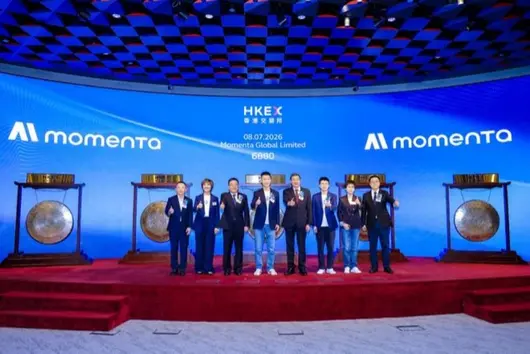
2026年7月8日,全球领先的物理AI公司Momenta正式在港交所挂牌上市,股票代码6880.HK,成为港股“物理AI第一股”。首日开盘股价涨超6%,总市值突破700亿港元。
本次IPO发行价定为295.6港元/股,若全额行使绿鞋期权,全球发售约2293万股,募资总额约68亿港元。市场认购极为踊跃:公开发售超额认购414倍;国际发售获超1000亿港元机构订单,覆盖15个国家和地区的主权基金与长线基金,剔除基石后超额认购约44倍。

Momenta引入14家基石投资者,认购总额约30亿港元。新加坡政府投资公司(GIC)和富达国际各领投1亿美元;贝莱德出资2500万美元,橡树资本出资2000万美元。产业资本方面,梅赛德斯-奔驰出资2500万美元、比亚迪出资1500万美元——两家全球顶级车企既是老股东也是合作伙伴,此次作为基石继续加码。奔驰与比亚迪的联手加持,在近年港股IPO中并不多见。此外,高毅、博裕、华夏基金、广发基金、太平洋保险等中资机构各出资1000万美元。
Momenta与汽车产业的深度绑定是其核心价值所在。截至目前,搭载Momenta系统的量产车辆已突破100万台,成功交付超100款量产车型,累计定点车型超210款。客户已覆盖国内全部主流乘用车企业,全球排名前10大车企中已有9家与其开展合作。合作品牌包括奔驰、宝马、奥迪、上汽大众、广汽丰田、东风日产等合资及豪华品牌,以及红旗、奇瑞风云、广汽昊铂、智己汽车等自主品牌。量产交付效率持续跃升——2022年完成首个10万台耗时24个月,如今最快不到40天即可完成同等规模交付。

财务数据显示,2023年至2025年,Momenta营收从7.43亿元增长至24.13亿元,年均复合增长率超80%;毛利率从17.5%提升至71.6%,三年翻四倍。截至2025年底,公司现金储备超100亿元。在第三方城市NOA市场,Momenta占据65%份额。
技术层面,Momenta以R7世界模型为基座,支撑乘用车、无人驾驶出租车(Robotaxi)、无人物流车(Robovan)及无人驾驶卡车(Robotruck)等多场景规模化落地。量产方案已在亚洲、欧洲、大洋洲、拉美和北非等10多个国家和地区落地;Robotaxi已与Uber、Grab、Lumo、享道出行等全球出行平台及奔驰等车企建立合作。
上市仪式上,CEO曹旭东表示:“过去十年,我们让AI学会驾驶,为每个家庭带来了专职的司机;未来十年,我们将为每个家庭带来专职的阿姨、医生、教师等机器人的服务场景”。此次IPO募资将用于推进新一代智能驾驶解决方案、无人业务扩张与全球化布局。Momenta的上市,不仅是物理AI赛道资本化的里程碑,更彰显了中国智能驾驶技术以“中国方案”走向全球的产业力量。

在马来西亚的汽车市场,很多买家在选车的时候都会拿 BMW X7 和 Porsche Macan 来做比较。今天我们从多个方面做一个详细的对比,帮你省下做功课的时间。


BMW X7 在马来西亚的 OTR 售价是 RM 635,800 - 694,800,一共有 3 个版本,包括 1.5L Standard 2WD(RM 106,800)、1.5L Executive 2WD(RM 115,800)、1.5L Premium 2WD(RM 122,300) 等。
Porsche Macan 在马来西亚的 OTR 售价是 RM 469,000 - 469,000,一共有 4 个版本,包括 2025 55 quattro S line(RM 467,285)、2025 50 quattro Advanced(RM 361,135)、PMT 1874, Lorong IKS BukitTengah 14000 Bukit Mertajam(RM 296,610) 等。
从价钱来看,Porsche Macan 的起步价比 BMW X7 便宜了 RM 166,800。老实讲,在这个价位段,几千块的差距其实不算大,关键还是看整体的性价比和长期使用成本。

BMW X7 的安全评级是 5★ (ASEAN NCAP),主动安全系统包括 ADAS (ACC, AEB, LKA, LDA, BSM, RCTA)。
Porsche Macan 的安全评级是 5★ (Euro NCAP),主动安全系统包括 InnoDrive。
安全配备方面,两款车都拿到了不错的评级。不过 BMW X7 的 ADAS (ACC, AEB, LKA, LDA, BSM, RCTA) 和 Porsche Macan 的 InnoDrive 在功能上有些差异,如果你比较看重主动安全的话,可以仔细对比一下两者的功能列表。

BMW X7 保修 5年/无限里程,保养间隔 每10,000km或6个月。
Porsche Macan 保修 3年/100,000km,保养间隔 每10,000km或6个月。

BMW X7 和 Porsche Macan 都是马来西亚市场的主流选择,适合家庭使用、日常通勤。如果你更看重品牌口碑和二手价,可以优先考虑口碑更好的那一款;如果你更在意性价比和配备,那就选配置更丰富的那款。最终还是建议两款都去试驾,亲身体验才是最重要的。

总的来说,BMW X7 和 Porsche Macan 都是马来西亚市场很不错的车型。选择哪一辆,关键还是要看你的个人需求和预算。建议大家做好功课,多比较几间车行的报价,再去试驾做最终决定。买车是件大事,花点时间做功课绝对不会错。


在马来西亚的汽车市场,很多买家在选车的时候都会拿 Chery Tiggo 8 Pro 和 Volkswagen Tiguan 来做比较。今天我们从多个方面做一个详细的对比,帮你省下做功课的时间。

Chery Tiggo 8 Pro 在马来西亚的 OTR 售价是 RM 159,750 - 159,750,一共有 2 个版本,包括 1.6L Turbo Standard(RM 130,000)、1.6L Turbo Premium(RM 145,000) 等。
Volkswagen Tiguan 在马来西亚的 OTR 售价是 RM 206,540 - 260,024,一共有 2 个版本,包括 2025 Allspace 2.0T R-Line(RM 260,024)、2025 Allspace 1.4T Elegance(RM 206,540) 等。
从价钱来看,Chery Tiggo 8 Pro 的起步价确实比 Volkswagen Tiguan 便宜了 RM 46,790。如果你预算有限,Chery 的入门版已经可以满足日常需求。但也要注意,便宜的那几千块,可能在配备上会有取舍,具体要看你的需求。

Chery Tiggo 8 Pro 搭载 2.0L 4-cyl,马力 170 hp。官方油耗 8.0 L/100km。
Volkswagen Tiguan 搭载 2.0L 4-cyl,马力 170 hp。官方油耗 8.0 L/100km。
两款车用的是同一套动力系统,所以日常开起来的感受基本没有差别。油耗方面也差不多,不用太纠结这一点。

Chery Tiggo 8 Pro 保修 3年/100,000km,保养间隔 每10,000km或6个月。
Volkswagen Tiguan 保修 3年/100,000km,保养间隔 每10,000km或6个月。
两款车的保修条件一样,这方面不用纠结。实际保养成本还要看品牌的服务网络和零件价格,建议去车友群问问真实车主的经验。
Chery Tiggo 8 Pro 和 Volkswagen Tiguan 都是马来西亚市场的主流选择,适合家庭使用、日常通勤。如果你更看重品牌口碑和二手价,可以优先考虑口碑更好的那一款;如果你更在意性价比和配备,那就选配置更丰富的那款。最终还是建议两款都去试驾,亲身体验才是最重要的。
总的来说,Chery Tiggo 8 Pro 和 Volkswagen Tiguan 都是马来西亚市场很不错的车型。选择哪一辆,关键还是要看你的个人需求和预算。建议大家做好功课,多比较几间车行的报价,再去试驾做最终决定。买车是件大事,花点时间做功课绝对不会错。


车型概览

Jaguar E-PACE 值不值得买,关键不是它看起来有多吸引,而是它能不能解决你的真实用车需求。这篇文章会把重点放在整体购车判断。
版本方面,Jaguar E-PACE 目前可围绕 2025 Standard 来比较。
购车价格指南
评估 Jaguar E-PACE 的购车预算时,建议先从版本定位和后续拥车成本下手。价格不是唯一重点,真正决定是否划算的是每天会不会用到那些配置。
如果你在几个版本之间犹豫,可以把 2025 Standard 放在同一张清单里比较。日常通勤买家优先看舒适与安全,常跑高速的买家则更应重视动力、辅助驾驶和座舱便利。
核心参数汇总
看 Jaguar E-PACE 的核心规格,最重要是把数字翻译成生活里的感受。
Jaguar E-PACE 的核心价值应回到日常场景判断:你要它负责通勤、家庭出行、长途,还是作为更有个性的选择。
优缺点分析
Jaguar E-PACE 的优点不必夸张,真正有价值的是它能不能让日常使用更省心:车型定位清楚,适合先作为同级比较对象。
需要留意的是,最终取舍会落在版本配置、保险和长期保养成本。这些不是扣分项,而是下订前应该先想清楚的生活细节。
购车常见问题解答
购买 Jaguar E-PACE 前,买家最常问的不是单一规格,而是它能不能融入自己的生活。
这辆车适合谁?适合把整体购车判断放在首位的买家。 家庭用户要看什么?优先看后排乘坐、儿童座椅、行李和日常上下车是否顺手。 每天开会不会麻烦?如果能源成本、停车便利和版本配置都符合你的生活节奏,它会比较容易相处。
竞品对比内容
把 Jaguar E-PACE 放进同级车名单时,不建议只看品牌或外形。真正有用的比较顺序是:先从版本定位、品牌售后和日常用途开始比较。
这样筛选出来的结果更贴近日常生活。你会更清楚它是适合城市通勤、家庭代步、长途巡航,还是更适合作为一辆讲求个性的选择。
用车全周期指南
拥有 Jaguar E-PACE 的重点,是确认保险、路税、保养和轮胎成本都在可接受范围内。买车不是一次付款结束,而是每天都要相处。
如果你常跑南北大道,动力和座舱舒适度会比单纯低价更重要;如果主要在市区,停车灵活性、视野和低速顺滑度会更影响心情。

© 2024 Bitauto.com. All Rights Reserved.
Bitauto (www.yiche.com and www.bitauto.com) is one of the most visited automotive websites in China. We provide detailed info on Chinese car brands available in your area. Please note that the information provided on this website is based on publicly available data and is for reference only. It may not be fully updated or accurate at all times.

Help us improve our website


