
Search History
Popular Searches
Dealer Login / Sign Up


Author | Chen Pingan
Produced by | Roadside Coffee in
Summary: A global automaker needs smooth edges.
The European battle for Chinese automakers is not in the bustle of the Paris Motor Show, but in the steady, incremental cultivation of the European market.
Through this year's Paris Motor Show, we may need to rethink a question: When Chinese automakers go global comprehensively, should they use Chinese solutions to reshape the global market, or should they transform themselves into a puzzle piece embedded in the global market?
The former implies stronger aggressiveness and more rework work, while the latter requires an enterprise to fundamentally transform itself into a true global automaker, polishing its edges to seamlessly integrate into the global market, though this puzzle piece will inevitably carry a new image.
Currently, all Chinese automakers are shouting "Localization" strategies, but obviously not all automakers have the capability for "Localization", and "Localization" also has a hierarchy of superiority, such as global cars and special market cars, while the former essentially requires the "foundation" of a true global automaker.
After watching the "showing off of uniqueness" of major automakers at the Paris Motor Show, I believe Geely Automotive can be said to be a firm practitioner of the "Embedded Global Market Strategy".
No consumer filtering
Although we have always used Chinese automaker globalization to describe the overseas development of China's automotive industry, in reality the center stage of Chinese automakers' current overseas expansion is new energy vehicles. Some products capable of going overseas for some automakers need to filter markets and consumers, while Geely's uniqueness lies in the fact that it can provide products of any power form for any market demand globally.

Geely has always adhered to parallel multiple power technology routes, covering five major technology routes: pure electric, plug-in hybrid, extended-range, fuel hybrid, and alcohol hydrogen, and the core three-electric systems are fully self-developed in stacks, allowing flexible adaptation to differentiated needs of different global markets. Taking fuel vehicles as an example, in China fuel vehicles have become "non-mainstream", but globally they still account for over 70%.
Chinese new energy vehicles can of course go replace those fuel vehicles, but if we can also grab a piece of the cake from within fuel vehicles, isn't it more efficient? This is the advantage Geely possesses. The Geely China Star products displayed at the Paris Motor Show are equivalent to showing off strength head-on on the battlefield where opponents are most proficient, the difficulty behind this is not necessarily higher than just showing off new energy vehicles.
Geely's i-HEV technology, just released in April this year, also targets the fuel-electric hybrid technology popularized by Japanese brands globally. Geely has determined a strategy to fully adopt i-HEV for fuel vehicles and will accelerate pushing to the global market subsequently.
Even more astonishing is that Geely has even become a key member in the global fuel power supply chain. Its Haoshi Power, jointly built with Renault, has become one of the top five power units globally, with products supplied to many global well-known brands.
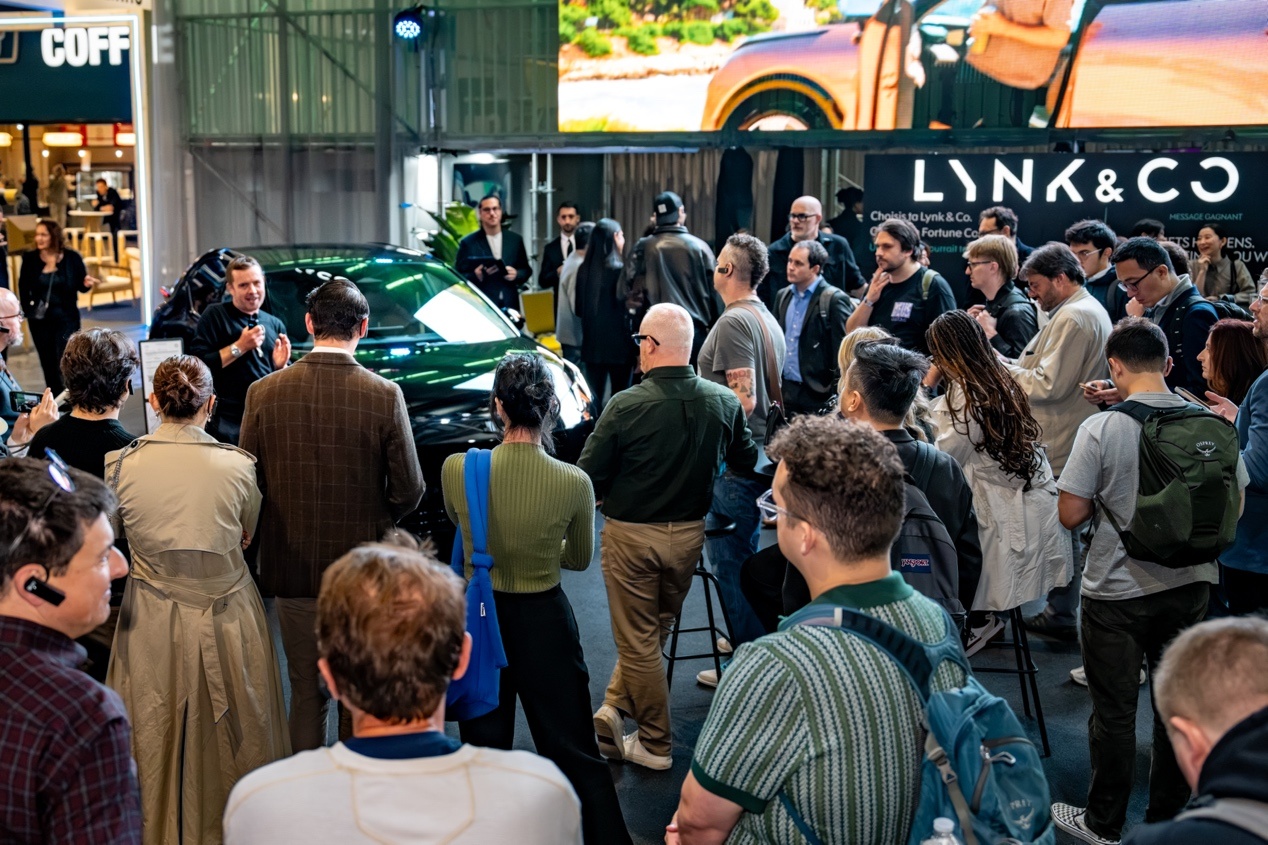
At the same time, Geely does not pick price segments. It owns multiple brands such as Geely Automobile, Geely Galaxy, Lynk & Co, Zeekr, Proton, Volvo, etc., forming a global brand matrix ranging from mainstream to luxury. Geely's multi-brand participation in the Paris Motor Show is not just to assemble a lineup. The multiple exhibition models brought by these brands either are already hot-selling in Europe, or are about to launch to the market, or are already well-known.
The spectacle of the Zeekr brand booth being packed is more convincing than any boasting words.

More importantly, none of these models are Europe-exclusive cars; they all have corresponding models found domestically, because Geely has already entered the "Global Car" era, and every car was designed considering the global market from the start, so they can cover the global market with an extremely short "time gap", and can even launch simultaneously in China and abroad.
The above are just the "appearances" of Geely as a global automaker. Supporting these appearances is the fully self-developed global technology foundation, the "One Geely" multi-brand coordinated combat system, and even more, the corporate aspiration that lets Chinese cars run around the globe.
"Embedded" Local Ecosystem
The other deeper meaning of "Localization" is how to participate in the game using the "rules of the game" of the local market and score high, so the importance of "Compliance" keeps highlighting, in this aspect Geely is also in the front line.
First, because there are brands like Volvo and Proton within the system, Geely possesses richer experience in global operations than other automakers. Especially the development after Geely acquired Volvo, it can be called a model case for Chinese enterprises' overseas M&A.

Secondly, in terms of implementing the global production and manufacturing system, Geely adopted an asset-light model distinct from other Chinese automakers, not building new factories/capacity, but sharing capacity, sharing markets, and sharing results with global peers.
In Europe, Geely can leverage Volvo's capacity and channels. In September 2026, both parties completed the agreement. Starting from January 2027, Volvo Cars will become the exclusive dealer for Lynk & Co in Europe.
In the first few months of this year, Geely also officially reached a cooperation with Ford. Geely acquired 34% equity of Ford's Valencia factory for 221 million euros and established a joint venture. The joint venture will start operations in the first half of 2027, and the first car will come off the line in 2028.
With a small cash investment, you can obtain the capacity of a factory with an annual output of about 500,000 vehicles. It only takes about one and a half years to put into production, and can directly connect to the existing supplier system, has a mature industrial worker foundation. Product maturity and capacity ramp-up speed are more guaranteed.
In Brazil and South Korea, Geely conducts production and sales by leveraging Renault's local capacity and channels through cooperation with Renault. In Malaysia and the broader ASEAN market, Geely relies on Proton's capacity.
This asset-light model can not only effectively respond to tariff and investment barriers but also rapidly increase the scale of localization.

Finally, entering the overseas market requires various qualifications/regulatory compliance certifications, this is a hard threshold, and Geely has already taken the lead in action.
Geely is the only Chinese automaker selected for S&P Global's "Sustainability Yearbook 2026". In March 2026, Geely's Qianli Haohan G-ASD system under Geely obtained UN R171 certification, becoming the first Chinese automaker to obtain this certification. There are already 10 models from Geely Holding Group that have received Euro NCAP 5-star ratings. Geely also became the first Chinese automaker to join the European Road Safety Information System (DFRS).
All this demonstrates Geely's determination and execution ability to integrate into the global market.
Conclusion
China's automotive globalization must be a long and torturous process. Different routes will have their own challenges to face. We cannot judge their pros and cons, but from the basic logic of business, shared prosperity and win-win cooperation must be the most long-lasting and stable.
Moreover, only by first becoming the underlying foundational force of the global market can we talk about how to use Chinese wisdom to reshape it.
© 2024 Bitauto.com. All Rights Reserved.
Bitauto (www.yiche.com and www.bitauto.com) is one of the most visited automotive websites in China. We provide detailed info on Chinese car brands available in your area. Please note that the information provided on this website is based on publicly available data and is for reference only. It may not be fully updated or accurate at all times.

Help us improve our website


