

HomeAuto Going Global

Search History
Popular Searches
Dealer Login / Sign Up
This year, China's auto export volume is expected to exceed 10 million vehicles, and it may enter a faster track in the future. August 20, at the Global New Energy Vehicle Cooperation and Development Forum (GNEV2026), Chebai International Chief Expert Zhang Yongwei stated as such.
He reminded that the global development of Chinese autos is no longer just China's own matter, but has largely become a matter of global concern. Doing this well requires internal and external linkage. Relying on a single party alone, this task cannot be done well.
The window period will not be long; differentiation has already begun
Chinese brands are growing rapidly in various major overseas markets.
It is worth noting that China's auto exports hovered around the 1 million vehicle mark for about ten years, after which the curve rose steeply: 4.91 million vehicles in 2023, 7.098 million in 2025, with growth accelerating continuously.
Data from the China Association of Automobile Manufacturers and the General Administration of Customs shows that in the first half of this year, China exported 5.096 million complete vehicles, a year-on-year increase of 65.3%. Single-month exports in June reached 1.037 million, breaking the 1 million mark for the first time in history. New energy vehicle exports reached 2.355 million, with a growth rate of 120%, accounting for 46% of total exports.
Multiple forecasts predict that complete vehicle exports will reach 10 million in 2026, with about 5 million being new energy vehicles.

The changes in the European market are very convincing. In June this year, Chinese brands' single-month market share in Europe exceeded 11%, with pure electric share at 15% and plug-in hybrid share at 34%, setting a historic high.
In the ranking of registration growth in Europe for the first six months, BYD grew 145%, Chery grew 305%, and Leapmotor even reached 558%. Chery Jaecoo 7 topped the UK monthly sales list in March; BYD's order schedules in Germany, France, and Spain have been extended.
Belt and Road Initiative countries form the basic foundation of exports, with 3.381 million vehicles exported in the first half of the year, growing at 48.1%.
In the Southeast Asian market, Chinese brands dominate the electric vehicle markets in Thailand and Indonesia, shifting from complete vehicle exports to building factories locally.
Latin America and the Middle East are quickly scaling up; Brazil has already become the largest overseas market for several Chinese automakers. BYD, Chery, and Leapmotor have all entered local best-selling lists in both mature markets and emerging countries.
Facing this speed, the world's attitudes are not unified. Zhang Yongwei categorized these reactions into three types.
One type is restriction. Some countries feel fear, believing Chinese autos entering will cause impact, so they use barriers to delay Chinese enterprises' entry. Means include increasing localization requirements, raising import tariffs, and imposing anti-subsidy taxes.
One type is embrace. Treat the rise of Chinese autos as an opportunity, attracting Chinese automakers to build factories locally, create regional export bases, and even undertake Chinese automaker capacity as a European Bridgehead to achieve mutual win-win.
Another is anxiety. Wanting cooperation but fearing being surpassed. Local automakers watch the market being diverted and cannot keep up with the pace. At the government level, there is worry about risks, yet there is a genuine need for industrial chain cooperation. The sense of anxiety is unprecedented.
"This is a dynamic attitude change. Restrictions today, opening up tomorrow. If you can't figure it out now, you will soon understand." Zhang Yongwei said. With three attitudes coexisting, using one strategy to cover the world is definitely not viable; policies must be tailored by country.

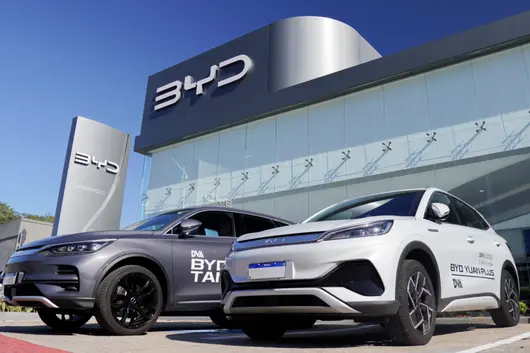
Image Source: BYD
It's not just that overseas attitudes are significantly diverging; Chinese automakers themselves stand at a crossroad of globalization.
One type of enterprise launched a globalization strategy years ago, now accelerating overseas layout and supply chain implementation, shifting from export-focused to localized operations, aiming to become global enterprises.
Another type saw the opportunity, realizing developing only domestically is becoming harder, but lacks international foundation. They have ideas but find it hard to decide. They worry about external environmental uncertainty, fear falling into the globalization trap if international capability is insufficient, and even some enterprises that have already gone overseas are starting to feel uneasy about overseas development.
Zhang Yongwei gave a direct reminder to this waiting mindset: This globalization window period will not be long because there are too many enterprises going global. Hesitation will likely cause loss of opportunity.
From 1.0 to 2.0, China Lacks No Hard Capital
Why can this round of going global trigger such a big global response? Zhang Yongwei summarizes it as China Opportunity 2.0.
The past forty years were the 1.0 era. China opened its market to multinational enterprises, becoming the world's auto manufacturing base, bringing in, doing well the local industrial chain. Global automakers enjoyed a 40-year dividend in the Chinese market. The essence of 1.0 is Building factories in China, For China in China. Multinational automakers were the protagonists, and China provided an open big market.
2.0 is unfolding. Doors must continue to open, global factors must continue to be introduced, but China must also go out, taking accumulated manufacturing, technology, and management experience out. In the past, we passively integrated into the world; now we must actively layout globally. The auto industry can at least undertake the mission of global strategy.
The players on the stage have also changed; Chinese enterprises and multinational enterprises act together. The typical model has changed from In China for China to Utilizing China's Capacity, In China for the World.
Grasping 1.0, sharing China's market growth; Grasping 2.0, sharing China's capacity dividend. Zhang Yongwei summarized the difference between the two stages this way.
Behind this is a resource pool accumulated by China's auto industry over the past decade or more, giving China the confidence to participate globally and layout globally.

The most focused is the supply chain. China's power battery and upstream materials global capacity share exceeds 60%, possessing the world's most complete electrified supply chain. The one question that overseas-going enterprises feel most deeply is I am out, can I take China's supply chain out. Being able to ask this question itself explains that this supply chain cannot find a second home worldwide. Conversely, this supply chain must also contribute to the global auto industry. Zhang Yongwei stated as such.
Technology is also concentrating in China. Frontiers of electrification and intelligence are increasingly born, original, and installed in China. AI large model integration is shifting from following to defining directions. Smart driving and intelligent cockpits are iterating rapidly. According to Zhang Yongwei, China is becoming the source of incremental automotive technology.
Changes in product development rhythm are more intuitive. Domestic new car development cycles have been compressed to 18 to 24 months; European automakers require about 45 months. Past conventions are being broken by the Chinese rhythm.
The manufacturing end is equally tough. Among the global 201 Lighthouse Factories, China accounts for 85. Digitalized line remote control and software upgrades, automated line robots and embodied robots, constitute a vast and efficient manufacturing system.
Zhang Yongwei emphasized, 2.0 is not a shock, but a win-win. Some regard China auto's globalization as a shock, this is a misreading. For the global industry, using China's capabilities well, docking well with its own development strategy, can achieve win-win; this is the most crucial point of 2.0. If not used well, one may lose China's opportunity, missing the development dividend of this round of electrification and intelligence.
For China's industry, itself must also change thinking, walking the path of win-win cooperation. He admitted that past win-win cooperation often had cooperation but not true win-win, unable to drive mutual development. If a truly win-win path cannot be found, 2.0's opportunity will be discounted. If the relationship between external environment and self-development is not handled well, the advantages in hand may not be realized.
Revitalizing Others Also Achieves Oneself
2.0 is two-way. The world must find the docking point with China's industry, and Chinese enterprises must also find the way of win-win cooperation.
Standing from the perspective of other countries, Zhang Yongwei believes finding strategic docking points is not difficult.
The premise is to thoroughly understand the latest changes in China's auto industry; there cannot be information gaps, let alone misjudgments. The depth of China's capacity, meaning cost, speed, and the pace of technology iteration, must be seen clearly. The width of China's industry, from complete vehicles, supply chain to software, ecosystem, must also be seen fully. Misjudgment or lack of understanding makes it easy to miss opportunities.
Based on this, accurately find the strategic docking point, docking the country's market, location, and industrial endowment with China's capacity.
There are many specific docking points. For example, at the market level, the two markets can be connected; this has many practices in emerging countries. At the industrial chain level, importing China's supply chain can achieve localized manufacturing. Some countries can leverage location advantages to act as transit hubs for trade exports and manufacturing, and can also undertake global capacity reshaping to create manufacturing bases. Finding the right docking point makes win-win easier.
Placing it on Chinese enterprises themselves, win-win cooperation also has several paths to walk, and there are already cases running.
Complete vehicle traction driving supporting parts is the most direct one. This round of going global coincides with the global reshuffling of manufacturing capacity; there is much idle capacity overseas. Using a global vision to revitalize this capacity benefits both sides, not necessarily building too much new. Building complete vehicle factories locally, supporting parts follow, prioritizing joint venture cooperation to revitalize local existing factories.

Geely and Ford's joint venture factory in Spain is a typical example; joint ventures revitalize European existing complete vehicle capacity, driving supply chain localization, expected to go into operation in 2027.
Overseas capacity of parts enterprises can also be used directly. Many enterprises completed overseas layout years ago, do not need too much new building; expanding capacity can connect with this round of complete vehicle going global. China's complete vehicle going global combined with parts globalization layout together, a batch of China's global parts enterprises may run out from here.
Yanfeng is the representative, ranking 15th in global auto parts, overseas layout over 220 institutions, overseas employees about 25,000.
The role of multinational parts enterprises is worth valuing. Almost all multinational parts enterprises have realized localized development in China. In the past it was outside in, now can turn around inside out, following or supporting China's 10 million level complete vehicles to go out.
They have ready-made global networks and certification channels, can achieve seamless connection. Magna is transforming into a global service provider for Chinese automakers, Autoliv is practicing In China for the World.
A higher level idea is to empower and transform overseas local enterprises. Using OEM to revitalize idle factories, output China's manufacturing capacity, form a shared supporting system.
Zhang Yongwei gave an analogy, overseas factories do limbs and hands factories, China does brain factories. Not making overseas partners disappear, but helping them meet Chinese automaker requirements on one hand, and transform and upgrade themselves, jump in place on the other, deeply participating in China's auto industry globalization. In this way, our partners will increase, and friends overseas will also increase.
He finally raised a few specific suggestions.
At the national level, a strategic docking mechanism for the auto industry must be established, doing well bilateral coordination around industrial planning, market access, and investment policies.
At critical points like tariffs and localization rate boundaries, standard mutual recognition, cross-border data, and carbon footprint, form predictable rules, so enterprises dare to invest and dare to invest long-term. This matter, ultimately still relies on national level strategic docking to underwrite.
Falling to enterprise level, must jointly shoulder China auto brands' global responsibility. In the past everyone was used to fighting alone, now must cooperate to go global, and cooperating to go global cannot stop at verbal, must be hard constraints. Do not cluster development, do not fight evil price wars in the same market, avoid Chinese enterprises' value devaluing in internal friction.
Enterprises must also root in the local, localized operations, contribute local employment and tax, do good local enterprises. In his view, individual enterprise reputation bias affects not just itself, but the entire China auto industry brand.
100-1=0, he advocates implementing global responsibility to every going global enterprise, every product, every destination market, establishing responsibility constraint mechanisms. Global responsibility has just started, already some potential, local negatives have emerged; preventing trouble before it happens is more important than anything.
In Zhang Yongwei's view, the core landing point of China Opportunity 2.0 is to bring advanced green intelligent mobility technologies and products globally, and achieve win-win with local industries.

Written by | Wu Jing
Edited by | Huang Dalu
Designed by | Zhen Youmei
"In the current international market, the essence of 'going global' has fundamentally changed. Previously, it was called 'export', selling a car to different countries and different overseas markets. Now, with changes in the geopolitical landscape and economic and trade situation, this way is slowly becoming unfeasible."
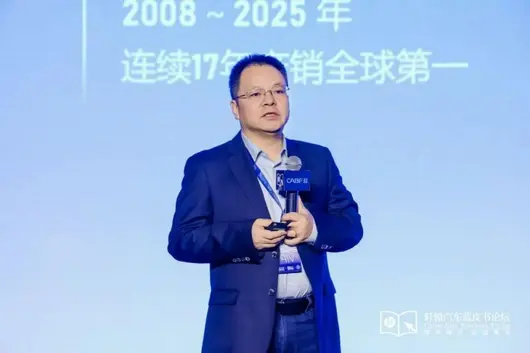
On May 15, 2026, at the 18th Xuan Yuan Auto Blue Book Forum, Chen Jiadang, Deputy General Manager of Geely International, pointed out the turning point facing Chinese car exports.
In the past 17 years, China's automobile production and sales have maintained the top spot globally. In 2025, China's automobile exports exceeded 7 million units, ranking first globally for 3 consecutive years. Chen Jiadang pointed out that China's automobile going global has entered a new development stage. The traditional 'one-size-fits-all' product export model is unsustainable. The core of globalization has shifted to regionalization, fragmentation, and localization.
He summarized car company going global into four major stages:
The first is the trade export stage. Selling complete vehicles overseas to achieve growth from 0 to 1. However, this stage lacks sufficient brand accumulation. Channel and service networks in the region are incomplete, and the risk resistance capability is weak.
The second stage is brand going global. Car companies build marketing companies overseas, spreading and building their own brands in overseas markets through a combination of general agency and direct distribution.

The third stage is capacity and industry going global. Layoutting KD factories overseas, breaking through trade barriers in supply chains. Relying on regional R&D centers to develop exclusive overseas version models and synchronizing the localization of full value chain services.
The fourth stage is ecosystem going global. Promoting the going global of ecosystem services such as finance, insurance, and used cars. Simultaneously participating in the formulation of industry standards in core areas of local safety, intelligence, and energy, creating local national brands.
Based on the new era landscape, Geely has set a goal of 6.5 million group sales by 2030, with overseas sales accounting for 1/3, new energy accounting for 75%, and entering the top five global automakers. In 2026, it strives to achieve 750,000 overseas sales.
Finally, Chen Jiadang also summarized the five major shifts in Geely's internationalization and globalization: the shift in market layout, the shift in product structure, the shift in business model, the shift in business philosophy, and the shift in strategic goals.
The essence of globalization is regionalization. The goal of regionalization is to make localized operations deep and thorough, taking root downwards. Chen Jiadang stated that on this strategic cognition, Geely is experiencing a transition from past technology output to value co-creation.
"In the past, we quickly made up for shortcomings in competitiveness through core technology investment and R&D. Currently, we need to enter a higher-order stage of value co-creation, sharing our core technology, outputting mature management systems and corporate values with global partners," he said.

The following is the transcript of Chen Jiadang's speech, organized by "Automotive Business Review," with minor deletions here:
Hello everyone! I am Chen Jiadang from Geely International.
Today's forum theme is 'shift', which I feel is very meaningful and aptly reflects the current stage of Chinese car brands 'going global'. I will mainly combine Geely International's practice and thinking in going global in recent years, as 2026 is also the first year of the entire Geely Internationalization future five-year strategic plan.
The essence of 'going global' has fundamentally changed
In the past 17 years, China's automobile production and sales have maintained the top spot globally without doubt. China is the world's largest automobile market. In 2025, China's automobile exports exceeded 7 million units, also ranking first globally for 3 consecutive years.
Relying on a complete industrial system and strong technological innovation capabilities, Chinese automobiles have not only achieved leapfrog development themselves but also promoted the global automotive industry towards a new era in the fields of new energy, including intelligent driving and intelligent cockpits.
On the eve of the just-concluded 2026 Beijing Auto Show, we convened overseas dealers to attend the Geely Dealers Conference and visited the Beijing Auto Show. Based on the feedback from all foreign dealer partners, the eyes of the whole world are focusing on the Chinese market as never before.

Geely Automobile is one of the most technology-innovative and intelligently leading car brands in China. We just invited dealer partners from more than 100 countries and more than 1,000 partners to Hangzhou at the end of April, holding a dealer partners conference with the theme 'Jointly Embarking on the Era of Smart Vehicles'.
Overseas dealers came to China. We showed them our full range of products, technology, and R&D strength. This exhibition was very important for Geely. Our overseas partners also saw the strength of Chinese automobiles in the field of smart technology.
High attention from the global market makes us clearly see that the international influence of Chinese automobiles is rapidly rising. In the past, Chinese brands only participated in the competition of the global market. Now it has gradually shifted to leading the transformation of the automotive industry.
Chinese automobile going global has entered a new stage. In the current international market, the essence of 'going global' has fundamentally changed. Previously, it was called 'export', selling a product to different countries and different overseas markets. Now, with changes in the geopolitical landscape and economic and trade situation, this way is slowly becoming unfeasible.
New globalization, we define it as regionalization, trending towards fragmentation and localization.
Every region, when we go to every country, the differences in policies, regulations, user needs, and industrial support changes are very obvious. In the current environment, no brand can achieve the goal of globalization with the past 'one-size-fits-all' way. So, the essence of 'globalization' has changed.
The competitive logic of the global automotive industry is迎来 a shift. This means Chinese car companies' going global is no longer simple trade expansion. It is a journey from simply going out, to going in with quality, to going up; from past product output to future technology and system output; from past 'following' to future 'leading'. I think this is a challenge for Chinese automobiles.
But this also creates an opportunity for us, an opportunity for Chinese automobile brands to stand in the mid-to-high-end positions of the global value chain.
Four stages of Chinese car companies going global
Facing such a major industry trend, we combined past car company going global and summarized it into several stages:
The first stage, we define it as trade export. In the past, we sold complete vehicles overseas, found general agents overseas, set targets, confirmed FOB price, basically selling cars to achieve growth from 0 to 1. This method actually lacked brand accumulation. Channel and service networks in the region were incomplete, and risk resistance capability was weak.
The second stage we define as brand going global. Car companies build overseas marketing companies overseas. Through a combination of general agency and direct distribution, spreading and building their own brands in overseas markets.

The third stage is actually the current stage, capacity and industry going global. Layoutting KD factories overseas, doing manufacturing overseas, layoutting supply chains to break through trade barriers. Relying on regional R&D centers, developing overseas exclusive versions, developing overseas exclusive models, defining user needs for each country according to local conditions, and developing competitive products, synchronizing the localization of full value chain services.
The fourth stage we define as ecosystem going global. This is also the stage Chinese brands are currently and will experience in the future. Promoting the going global of the entire finance, insurance, used cars, and other ecosystem services. You can also participate in the formulation of industry standards in core fields such as local safety, intelligence, and energy. We output technology, output standards, output solutions to help local countries build so-called national brands. This might be the future stage of ecosystem going global.
The above four stages are summarized through practice exploration by top global car companies, and are also a compass for Chinese car companies' going global path.
Conforming to the general trend, Geely Automobile also layoutted future five-year internationalization goals starting from 2026. The entire Big Geely proposed the strategic goal 'One Geely, Comprehensive Leadership'. By 2030, it aims to achieve 6.5 million units for the entire automobile group.
In this goal, overseas sales are to account for 1/3, and the brand should occupy the top five strategic position globally. According to such strategic planning, we also sorted out global and internationalization goals. This year we strive to achieve 750,000 units. Next year we sprint for higher targets.
Five major shifts in Geely going global
Against this background, based on Geely going global practice, I will share the following with everyone. I summarize it into Geely's internationalization, globalization going global five major shifts:
First, the shift in market layout. 80 million capacity global market, for example, USA, Canada, India, Japan & Korea might be temporarily unreachable. Other regions I think might be the main battlefield for Chinese brands overseas. Market layout shifted from past 'going out' to 'going in'. We need to deepen core regions, operate with quality. Under the new globalization background, only focusing is possible to achieve high-quality growth.
We established 'Two Alliances, Two Regions', i.e., European Union, ASEAN, North America, South America are our main battlefield. Europe is the world's most mature automobile market and also a highland for car brands. The entire market capacity is about 15 million unit volume.

We started entering Europe layoutting a few subsidiaries last year. France, Germany, UK, Spain, Netherlands, Hungary. These subsidiaries all realized opening and operation listing in the first quarter of this year. First quarter sales also performed well. The entire growth rate was as high as 400%, also becoming one of the fastest-growing brands among Chinese brands in the European market.
In ASEAN, we cooperated with Proton, deepening the market of Malaysia. Simultaneously, Indonesia KD factory landing. Simultaneously, we continue to deeply cultivate key markets such as Philippines, Thailand, Vietnam, comprehensively consolidate the ASEAN market.
North America and South America. North America is Mexico. The current market sales are also not bad. Because we layoutted a subsidiary in Mexico, and also set a relatively challenging goal. In South America, we did strategic cooperation with Renault, established a joint venture subsidiary with Renault, promoting localized production. Simultaneously relying on Renault channels, we also challenge the goal of monthly sales breakthrough 10,000 units.
From 'going out' to 'going in' then to 'going up', we realized steady overseas business growth. This year past 4 months, the entire Geely achieved 286,000 units target internationally, year-on-year growth exceeded 150%. This is the first shift, regarding the shift in market layout.
Second, the shift in product structure. In the past, Chinese automobile brands going out, most sold were fuel vehicles. We need to move from fuel-dominated to fuel and electricity together. In the fuel vehicle field, we need energy efficiency and also intelligence.
This year January-April, we new energy field export contributed 174,000 units target. The entire growth is very rapid, performance is also quite bright. But more importantly, we need to adhere to brand premiumization. Because we have the entire international, have Geely, fuel vehicles, electric vehicles, Lynk & Co, Zeekr. Zeekr brand positioning is brand upward breakthrough. With technology strength to reshape the global value of Chinese brands.
Third, the shift in business model. From past 'product output' to 'full value chain localized output'. Facing global trade barriers and regional market demands, past simple complete vehicle export has become unsustainable. Geely firmly promotes the entire business model shift. From past product output to R&D, production, sales system output. Realizing full value chain localization.

R&D end, we have R&D resources in Germany, Sweden. Integrate them into Geely's European Technology Center. Truly research and develop in the region, develop products needed in the region.
Production end, we layoutted many manufacturing bases overseas. In Malaysia, mainly taking Proton as the core, established Automotive High-tech Silicon Valley. We internally call it AHEV. Building a regional hub with 500,000 capacity.
Additionally, in sales end, we layoutted subsidiaries in many places. Building brand marketing, channel development, and after-sales service localized operating capabilities. So, globalization is not simply copying the Chinese model overseas. But landing in overseas, suitable local models. Only this way can it take root downwards in regional markets.
Fourth, the shift in business philosophy. From 'single globalization mindset' to 'depth of localized operations'. The going global of automobiles is actually also very key.
The essence of globalization is regionalization. Actually, the goal of regionalization is how to do localized operations deep and thorough, take root downwards. So, we need to co-build value ecosystem with the local. On strategic cognition, we are experiencing a transition from past technology output to value co-creation stage. In the past, we made up for competitiveness shortcomings quickly through core technology investment and R&D. Currently, we need to enter a higher-order value co-creation stage. Sharing our core technology, outputting mature management systems and corporate values with global partners.
In brand operation, we define it as the 'T' Plan for going global. 'T' is equivalent to a unified global tag for a brand. 'T' vertical can be compared to doing brand marketing in every market. Local operation takes root downwards, promoting localized brand construction, localized marketing, localized user operation. Simultaneously need to build good partner relationships with localized dealers. We pursue beauty shared by all, realizing landing and deep cultivation in the region, taking root and growing.
Actually, the root of localized operation is talent. Including regional regulations, local culture, local user preferences, product definition differentiation, even compliance, risk control, etc. Only by using local talent well can we effectively break cultural barriers, bridge the communication between brand and users.
Talent culture integration, recruiting local talent, training local talent is the true criterion for taking root overseas markets and operations.

Fifth, the shift in strategic goals. From past calling 'scale priority', going out to see how many markets, sell how many cars, to 'high-quality globalization'. Doing such strategic goal changes.
Internationalization business is the top priority for Geely's future development. So overseas business must adhere to high-quality development. We rely on brand construction, technology accumulation, product quality, and after-sales service system construction to build sustainable long-term competitiveness.
But on the development road, do not blindly pursue expansion speed. Strictly abide by the bottom line of compliance. Walk a steady and sustainable development road. Always adhere to user-centered, with globally unified strict standards for global users to provide consistent high-quality travel experience. This is about the entire strategic goal shift.
Ladies and gentlemen, we stand at the critical juncture of the era of global industry landscape reshaping. We should not only be grateful for the development advantages endowed by the era but also actively grasp the major opportunities within it. Let us use long-termism as the spear, technology innovation as the square, walk a path from following to leading, from products to brand upgrading. Geely Automobile is willing to walk towards newness together with all Chinese car companies, letting the world see the power of Chinese automobiles!
Let's let the world be full of Geely together. Thank you all!
Thank the following partners for strong support. Let us face 'shift' together and win the future together.

Article | Auto Expert Compilation
Welcome Submissions | Please add WeChat auto188
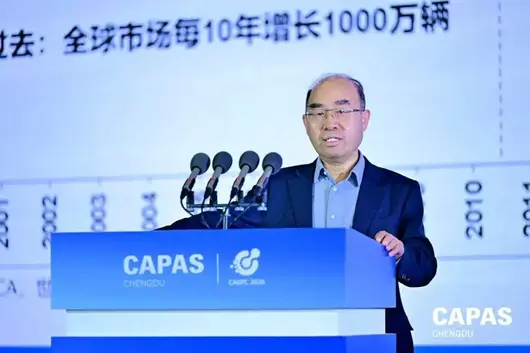
May 21, the opening ceremony of the 12th Chengdu International Auto Parts and Aftermarket Service Exhibition and the China Auto Ecosystem Partners Conference was held at Century City New International Conference and Exhibition Center in Chengdu. This event, themed "Leading the Trend 2026: A Must-Do, Taking a Step Ahead", focused on two current hot topics "Automotive Modification Industry Supply Chain" and "Automotive Complete Vehicle & Parts Industry Going Global", gathering industry elites to discuss the industry's future, injecting strong momentum into the high-quality development of the Southwest automotive industry.

During the keynote speech session, Xu Changming, former Deputy Director of the National Information Center and Senior Economist (Positive Level), believed that China's auto exports are at a historical leap stage, and the underlying logic for future growth is solid - release of demand in emerging global markets, qualitative change in competitiveness of Chinese brands, and active going global of the whole industry chain. Despite volatile factors such as trade friction and local protection, the trend of internationalization is irreversible. Enterprises should focus on quality and service, avoid vicious competition, promote the upgrade from "Complete Vehicle Export" to "Ecosystem Going Global", and achieve sustainable, upward global development amidst fluctuations.
The following is the speech transcript (compared based on recording by Auto Expert):
Respected guests, good morning! I am very happy to share my views on auto export and internationalization trends with you today.
This chart shows that during the "14th Five-Year Plan" period, China's auto exports achieved leapfrog development. Before 2020, for about ten-plus years, auto exports were stable at around 1 million vehicles. In 2021 it reached 2 million vehicles, and last year it reached 7.1 million vehicles. In five years, it increased by 6 million vehicles, which is a major trend. In the first four months of this year, exports reached 3.18 million vehicles, up 62% year-on-year, another year of rapid growth. China has large export volumes in major global regions and countries. Among them, exports to Asia are the highest, reaching 3 million vehicles last year, followed by Europe. At the country level, exports to three countries exceed 500,000 vehicles, exports to five countries are at the 300,000 vehicle level, and exports to more than ten countries are between 100,000 and 200,000 vehicles. Overall, China's export distribution globally is relatively balanced.
Everyone is concerned about the export trend in the next five years. We judge that in the next few years, China's auto internationalization will still maintain a relatively good development trend. There are three reasons:
Reason One: The potential of international markets is huge, providing potential opportunities for China's auto exports.
This chart shows the change in global auto market sales over the past twenty-plus years. Actually, going back forty years, from 1960, global total auto sales increased by 10 million vehicles every ten years. The fastest recent growth was from 2011 to 2017, increasing by 20.2 million vehicles in seven years. Why so fast? Because China and India, two major population countries, saw synchronous market growth in these seven years - China doubled, and India's market also rose. During the "14th Five-Year Plan" period, the past five years saw recovery growth from the pandemic, with the global market increasing by 13 million vehicles, of which China accounted for over 6 million vehicles, and we shared a larger portion of the increase. More critically, the growth of the global market mainly comes from emerging market countries. The two curves in the chart, blue represents mature markets, red represents emerging markets. Mature markets are stable at 40 million vehicles, no growth in twenty years, and even slightly declining in recent years; while emerging markets grew from over 9 million vehicles to over 40 million vehicles. Starting from 2021, consumption in emerging market countries surpassed mature markets. The characteristic is: purchasing power is not strong enough, but they want to buy cars. Therefore, Chinese cars have a market in models with moderate prices and higher performance/quality, and this market will grow relatively fast in the future.
Research on the basic law curve of auto demand: The horizontal axis is GDP per capita, the vertical axis is vehicle ownership per 1,000 people. The basic law is: when GDP per capita is between 1,000 and 3,000 USD, as long as the economy grows, ownership per 1,000 people rises, generating a large amount of new demand every year; after exceeding this range, ownership per 1,000 people no longer grows, mainly shifting to replacement demand. There are still many countries in the world at the bottom left - low GDP per capita, low ownership per 1,000 people. As long as these countries' economy grows in the future, demand will grow.
Looking at specific regions: Latin America, 660 million people, total sales last year 4.25 million vehicles. China has 1.4 billion people, Latin America is about half of China, according to China's per capita purchasing level, its sales should reach 12 million vehicles, but now it is only over 4 million vehicles, huge potential. Middle East region, 380 million people, sales last year 3.43 million vehicles, according to China level should reach around 7 million vehicles. ASEAN region, nearly 700 million people, sales last year only 2.8 million vehicles, sales corresponding to half of China's population should be 12 million vehicles, therefore huge growth space. Africa 1.5 billion people, more than China, sales last year only 1 million vehicles, not even a fraction of China's, potential is even greater. Of course, the prerequisite is economic growth. So, as long as the global economy, especially emerging market countries' economy grows, auto demand has great space, and these markets are exactly where Chinese cars have competitiveness.
Reason Two: The competitiveness of Chinese brand cars globally has improved rapidly, reflected in data performance and reputation.
First look at data: In 2020, for every 100 cars sold in overseas markets, Chinese brands only accounted for 0.8 cars. By last year, this number rose to 6.5 cars, growth was very fast. The share in emerging markets is higher, slightly worse in mature markets. The line below is our share per 100 cars in developed country markets, although also rising, overall share is low, less than 3 cars. But in emerging markets, for every 100 cars sold, we account for 13.6 cars, basically reaching Japan's level. Look at EVs, competitiveness is stronger: for every 100 EVs sold in overseas markets, we account for 18.7 cars; for every 100 fuel cars sold, we only account for 4 cars. EVs also account for nearly 10% in mature markets, and still growing. In emerging markets, for every 100 EVs sold, we account for over 50 cars, more than half are Chinese brands. Thirty years ago, the EV market was dominated by Germany, Japan, South Korea, and the USA, now in emerging markets more than half are Chinese brands.
Just having data is not enough. If the reputation is poor, it will repeat the fate of motorcycles - in 2002, 2003 we quickly became first in the Vietnam motorcycle market, but surpassed by Japan after three or four years because quality was not good. Now our reputation is very good. For example in Thailand, for every 100 EVs sold, Chinese brands account for 86 cars; in Indonesia, account for 92 cars. User evaluation is very high: Great Wall Motor customer feedback, Chinese EV safety systems are done very well, automatic follow, braking, anti-collision technologies are almost all present.
Fuel car reputation is also very good: 23.6% share in Malaysia fuel car market, 38.5% in Egypt. A multi-brand dealer in Malaysia evaluated, Chinese car prices are close to local brands, but configurations are far superior, especially in smart cockpits, sunroofs, electric seats, LED lights, etc., extremely attractive to young consumers. Egypt users say, initially felt owning Chinese cars was risky because Chinese cars often had faults before, but this view changed over the past five years, Chinese auto quality has significantly and unexpectedly improved.
These are conclusions obtained by the National Information Center through in-depth research. Good quality, good reputation, next step if spare parts supply and after-sales service system can be significantly improved, China's auto going global will be unstoppable - this is the extension of domestic competitiveness. Five years ago exports stayed at 1 million vehicles, because domestic competitiveness was not enough. Last year, independent brand domestic market share already reached 64%, while in 2020 it was only 33%.
Reason Three: Industry chain entities represented by complete vehicles are all actively promoting internationalization.
In terms of complete vehicles, three enterprises with million-unit exports: Chery 1.33 million vehicles, BYD 1 million vehicles, SAIC Passenger Vehicle plus Commercial Vehicle close to 1 million vehicles. Half million level: Geely, Great Wall, Changan. 100,000 level: JAC, Dongfeng, GAC, FAW. Enterprise distribution is also relatively balanced, will not affect overall exports due to individual enterprise issues. Chery has ranked first among Chinese brands in exports for 23 consecutive years, overseas sales revenue exceeded 100 billion yuan last year, overseas dealers reached 3,000. During Beijing Auto Show, Chery set up a separate hall, inviting overseas dealers to China to visit Wuhu factory. BYD chased very fast in the recent two years: 400,000 vehicles exports in 2024, reached 1 million vehicles in 2025, relying on EVs to open international market, brand reputation has formed. Others like SAIC, Changan, Great Wall also have unique advantages.
In addition, parts enterprises, logistics, dealers, automotive financial institutions, service agencies, etc. are all actively going global - as experts said "Ecosystem Going Global", although slightly weaker compared to complete vehicles, overall trend is good. Joint venture brands are also doing exports, last year reached 830,000 vehicles, Tesla, Kia, Volvo, Hyundai, Ford leading the way. Many joint venture enterprises see sales decline in China market, only relying on domestic market difficult to sustain, therefore all make export a strategy. Kia is most typical: domestic sales 100,000+ vehicles, exports 170,000 vehicles, maintain 300,000 vehicle scale, realized profit last year, became "Small but Refined" case. Volkswagen, Toyota, etc. are also researching how to utilize China production capacity and manufacturing capability for export, especially new energy vehicles.
As overall export volume rises, professional niche markets will also follow. For example, off-road vehicles, started two years late, accelerated starting 2023, reached 500,000+ vehicles last year, increased more than double for consecutive years. This March off-road vehicle exports 80,000 vehicles, at this scale annual is expected to reach 1 million vehicles. Next step, modified cars will also have good development. Used car exports will also increase. Therefore, future export forms will be diversified, both complete vehicles, also industry chains and ecosystem chains, can build factories themselves, also can utilize local production capacity, etc.
Of course, I also agree with the views of the two experts: exports will not rise in a straight line, but develop amidst fluctuations. Because auto is very important to any country, only exporting complete vehicles opponents will definitely not be willing, and cannot crush local industry. So, my confidence in exports is firm - it will definitely develop gradually forward amidst fluctuations.
Thank you all!
© 2024 Bitauto.com. All Rights Reserved.
Bitauto (www.yiche.com and www.bitauto.com) is one of the most visited automotive websites in China. We provide detailed info on Chinese car brands available in your area. Please note that the information provided on this website is based on publicly available data and is for reference only. It may not be fully updated or accurate at all times.

Help us improve our website


