

HomeSales Volume

Search History
Popular Searches
Dealer Login / Sign Up

On October 1, Geely Automobile Holdings Limited (0175.HK) announced the latest sales data: September sales reached 292,168 units, setting a new high for the year, with consecutive 7 months of Year-over-Year (YoY) and Month-over-Month (MoM) growth, increasing 7% YoY and 8% MoM. September new energy product sales (including Geely, Lynk&Co, Zeekr) totaled 190,868 units, setting a single-month new energy sales record high, increasing 16% YoY, accounting for 65% of new energy sales. Cumulative sales from January to September reached 2,235,481 units, setting a record high for the same period, increasing 3% YoY. In terms of new energy, total new energy sales from January to September reached 1,326,364 units, increasing 14% YoY.
Overseas business product structure and operational capabilities continue to optimize, with overseas export sales exceeding 100,000 units for 4 consecutive months. September overseas export sales reached 106,685 units, increasing 162% YoY. New energy product export sales grew rapidly; September new energy product export sales reached 73,664 units, a surge of 403% YoY, accounting for 69%. This year, Geely's overseas business accelerated growth; from January to September, overseas export sales reached 797,670 units, increasing 169% YoY. New energy product export sales reached 484,086 units, a surge of 531% YoY. New energy product export proportion was 61%, a significant increase compared to the same period last year.
A single Geely, with a stronger posture, is promoting overall high-quality development with an upward trend. Geely Automobile is using a diverse product matrix, continuous technological innovation, and a steady global path, advancing on three lines simultaneously and delivering a combination punch for high-quality development: Luxury, High-end, and Mainstream three brands coordinate development; Sedan, SUV, MPV, Off-road and other full-category in-depth layout, giving every user better choices; Building a foundation with AI Smart Technology, AI Smart Architecture, Qianli Haohan, Geely AI Smart Charging, etc., continuously expanding the boundaries of product capabilities, forming a positive cycle of "Technology Breakthrough—Product Leap—User Recognition"; Globalization deepens from "Product Going Global" to "System Going Global", localizing channel construction and local manufacturing are promoted in synergy, global momentum accelerates expansion.

Star Products Growth Momentum Continues to Be Released, Product Matrix Optimization Meets More Diverse Needs
Three major brands maintain growth momentum, core products steadily increase volume, new products continue to launch, further improving product structure and market layout, enhancing coverage of diverse user needs.
Global luxury tech brand Zeekr recreated a single-month record high, September delivery volume reached 37,216 units, increasing 104% YoY. This year January-September Zeekr delivery volume reached 288,404 units, increasing 101% YoY. Star product growth momentum continues to be released, further solidifying the top position in luxury new energy. January-August this year, Zeekr 9X sales, reputation, and resale value remain first among domestic large SUVs above 500,000 yuan; Zeekr 7X delivery volume broke 10,000 for 3 consecutive months, global cumulative delivery exceeded 200,000 units. The 2027 model Zeekr 7X will launch in the fourth quarter of this year, adding 85kWh Gold Brick Battery version vehicles.

Global new energy high-end brand Lynk&Co market competitiveness continues to improve; September sales reached 18,493 units, increasing 9% MoM, new energy product sales 17,039 units. Year-to-date January-September cumulative sales reached 196,117 units, new energy product sales 140,209 units. Lynk&Co 08 EM-P global cumulative delivery close to 200,000 units; Lynk&Co 06 global cumulative delivery exceeded 300,000 units; Lynk&Co 07 GT whole vehicle delivery broke 10,000, becoming the fastest to complete 10,000 unit delivery of Chinese wagons. In August, ranked first in Chinese wagon market share in 26 provinces and cities, achieving a dual lead in delivery speed and market share.
Lynk&Co brand multi-line advancement, product matrix and sporting genes further strengthened. The new Lynk&Co 20 officially launched on September 28. As a new product of Lynk&Co's Electric Sense Era, it comprehensively advanced in three-electrics, intelligence, design, and experience, further expanding the urban young user market, bringing a comprehensive leap from "enough" to "fully equipped". Major orders broke 14,633 units in the first hour of launch. Lynk&Co Automobile simultaneously competed in TCR China Shanghai Station and CTCC China Cup Shanghai Station two core events, achieving 2nd runner-up 5th place and 2nd champion 2nd runner-up 5th place results. Additionally, famous actor and professional driver Daniel Wu, as Lynk&Co Special Guest Driver, drove Lynk&Co 03+ TCR racing car to compete in TCR China Shanghai Station, winning the Rookie Group Runner-up in the debut race.

Geely brand multi-energy matrix coordinated development; September sales 236,459 units, January-September cumulative sales 1,750,960 units.
Among them, mainstream new energy brand Geely Galaxy set a single-month new high for the year. September sales 130,479 units, achieving YoY and MoM double growth, increasing 8% YoY, increasing 10% MoM. Geely Star Wish continuous 4 months sales over 50,000 units, September sales 60,871 units, cumulative sales over 950,000 units; Galaxy Starship 7 sales 22,059 units; Geely Galaxy E5 sales 12,695 units, single sales over 10,000 for 4 consecutive months. January-September this year, Geely Galaxy cumulative sales 877,184 units.
Product competitiveness and user value continue to improve. Geely Galaxy continues to expand urban commuting, new energy off-road, pure electric mainstream and other travel scenarios, further meeting diverse market needs. In September, Geely Galaxy multiple new cars launched: Geely Panda Mini "Micro-Electric Urban Kart" Panda Kart Ningde Edition officially launched, becoming an essential "picking up kids and commuting tool" for the start of school season; New Class C AI Pure Electric Sports Sedan Geely Galaxy TT with "Entry-level with High-spec, Start with 640km Long Range" advantages, establishing a new value benchmark for 150,000-level pure electric sports sedans; New Geely Galaxy E5 achieved five upgrades in Three-Electric, Rear-drive Architecture, Smart Travel Experience, Smart Cockpit, All-domain Security, establishing a new global mainstream pure electric SUV value benchmark.
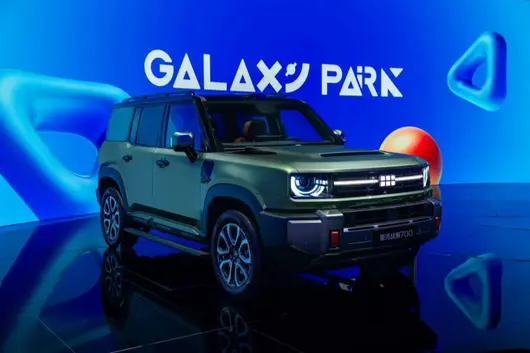
At the same time, Galaxy Warship 700 started global pre-sale with a price range of 199,800 - 389,800 yuan, creating the optimal solution for new energy era off-road vehicles for users. Pre-sale opened 9 minutes orders broke 10,000 units, 60 minutes orders broke 43,900 units, becoming the most popular new energy hard-core off-road vehicle.

Multi-energy paths developed together. Geely China Star remains at the top of China's fuel vehicle brands, September sales 105,980 units, achieving YoY and MoM double growth, increasing 9% YoY, increasing 5% MoM. Among them, China Star High-end Series sales 35,174 units, Boyue Family 25,110 units, Double Bin Family 28,879 units. January-September this year, Geely China Star cumulative sales 873,776 units.
Geely China Star continues HEV-ization, Intelligence. Classic products new series hybrid performance, intelligence comprehensively upgraded. Preface L PLUS started pre-sale. Taking i-HEV Smart Power Hybrid technology as fulcrum, built comprehensively with new AI technology, leading B-class fuel sedans into a new era of full hybridization, full intelligence; New Fourth Gen Boyue L launched. With Geely i-HEV Smart Power Hybrid, New Gen 1.5TD Pro High-Performance Engine, Qianli Haohan H5 Assist Drive Solution three strongest tech points of the same class, achieving over 200 function upgrades.

Multiple Overseas Markets Erupt with Vitality, Localized Operation System Further Improved
Three major brands overseas markets multi-regional coordinated development, overseas export sales exceeded 100,000 units for 4 consecutive months. September overseas export sales 106,685 units, increasing 162% YoY. This year first three quarters overseas export sales set historical same-period high, January-September overseas export sales 797,670 units, increasing 169% YoY.
New energy product overseas export sales maintain high speed. September new energy product export sales 73,664 units, surge 403% YoY, proportion reached 69%. January-September new energy product export sales 484,086 units, surge 531% YoY, new energy product export proportion 61%, significantly higher than last year.
Zeekr high-end attributes continue to strengthen. Zeekr 9X officially started large-scale shipment to UAE. Local pre-sale orders exceeded 700 units. Local price equivalent to over 800,000 yuan RMB, leading Chinese brands high-quality going global; Zeekr 009 multiple months consecutively won Thailand, Malaysia pure electric MPV sales champion. Lynk&Co high-end market continues to exert effort. August achieved Ecuador high-end sub-market sales first, Tunisia PHEV SUV brand sales third. Jan-August, Lynk&Co 08 Tunisia high-end PHEV market sales second, Mexico high-end PHEV sub-market total sales second. August, Geely brand Australia sales broke 4,500 units, ranked first in Panama passenger car market Chinese brand sales, Brazil cumulative sales over 36,000 units, UK cumulative sales over 10,000 units.
With product structure and operational capabilities continuously improved, Geely Automobile influence continues to rise. Geely Automobile Group subsidiary Geely, Lynk&Co two brands with Geely Star Wish, Geely Galaxy Starship 7 EM-i, Geely Galaxy E5, Galaxy Warship 700, Lynk&Co 02 (Lynk&Co Z20), Lynk&Co 08 debuted at 2026 Turin Motor Show, comprehensively showcasing Chinese automobile brand design aesthetics and technology innovation achievements.
In September, Geely Automobile overseas rhythm accelerated, global product layout continuously improved. Geely first D-class PHEV global model Geely Monjaro EM-i debuted in Egypt. Positioning "High-End Electric Hybrid SUV". Future will land UAE, Mexico, Kazakhstan and other countries, steadily entering European market; Zeekr 9X as first batch large-scale going global Chinese flagship SUV, officially shipped to UAE, accelerating expansion to Middle East, Central Asia, Europe, Latin America and other core markets; Geely Star Wish (Geely E2) became winner of 2026 Euro NCAP and ANCAP Five-Star Safety Rated A, B class vehicles, and consecutively launched in Spain, Switzerland and other places. Additionally, Galaxy E5 (Geely E5) and Geely Galaxy Starship 7 EM-i (STARRAY EM-i) simultaneously landed Switzerland market.
Overseas channel construction and local operation continue to deepen. Geely Automobile signed strategic cooperation agreement with Cyprus famous auto general agent KKS Mobility Ltd., who will serve as importer and general agent for Geely brand in Cyprus market, expanding Geely in Southern Europe and Mediterranean market map. Geely Automobile and Volvo Cars reached final agreement on Lynk&Co brand Europe market business cooperation plan: From January 2027, Volvo will become Lynk&Co exclusive dealer in Europe, fully responsible for brand local commercial and brand operation.
Globalization system upgraded again, first Brazil local manufactured automobile production went online. September 15, first Brazil local manufactured Geely Galaxy Starship 7 (Geely EX5 EM-i) went offline at Elton Senna Industrial Park. Geely Galaxy Starship 7 production not only improved Geely Automobile in Brazil local ecosystem system, improved local manufacturing, supply chain, sales and service capabilities, but also laid foundation for subsequent pure electric vehicle Geely Star Wish local manufacturing.

Full-domain AI Bolsters Technical Strength, Technology Innovation Improves Smart Travel Full Layout
As China AI Car Making No.1 Auto Enterprise, Geely not only accelerates intelligent scale application, but also continues to build leading technology, providing support for product experience upgrades.
As one important part of Geely Automobile full-domain AI, this year Qianli Haohan Assist Drive Solution achieved million-unit installation volume achievement with the fastest rate of自主品牌 installation volume growth. After achieving "Assist Drive Mileage Growth First" achievement in May, Qianli Haohan achieved scale increase and usage mileage growth "Double First", growth momentum continuously released. At the same time, Qianli Haohan Assist Drive activation rate reached high 93.8%, and daily usage frequency continued to climb. Million installation scale and high usage rate accelerated Qianli Haohan "Data Flywheel" rotation, further strengthening technology barriers and leading advantages, bringing users smoother, safer, more efficient assist drive experience.

While technical capabilities continue to transform into user value, new technologies continue to emerge. September 23, Geely Automobile Group officially released new generation AI Recharging Technology — "Geely Smart Charging", achieving single gun peak charging power reaching 2250kW for the first time. Creating global mass-production fastest recharging speed while maintaining highest charging temperature always within 65°C, battery cycle life increased 20%. Relying on StarRui PowerMind Energy Brain jointly developed by Geely and StepFun Star, Geely Smart Charging with "Faster Better Safer" disruptive experience, solved fast charge unsafe, fast charge harming battery and other industry problems, reshaping global new energy recharging new benchmark.

While sales scale develops steadily, Geely Automobile sustainability capabilities gained authoritative recognition again. Geely Automobile became the only auto enterprise selected in Hang Seng Sustainable Development Corporate Index for 4 consecutive years, ESG rating improved for 2 consecutive years, rising from "A+" to "AA", and selected in Hang Seng ESG 50 Index and Hang Seng Sustainable Development Corporate Benchmark Index for 6 consecutive years. In the future, Geely Automobile will continue to drive product innovation and business growth with ESG concept, continuing to anchor long-termism to achieve high-quality development.
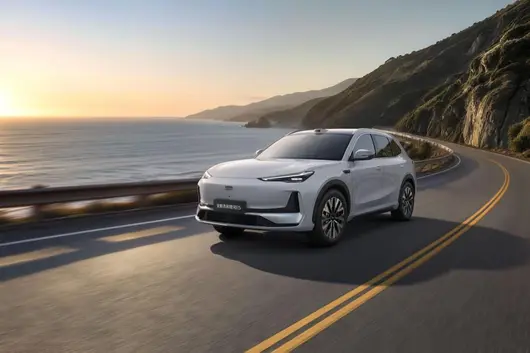

August 2026, BYD sold 440,300 vehicles, a year-on-year increase of 17.84%. This number itself isn't surprising, after all, BYD has held the top spot in China's new energy vehicle monthly sales for 63 consecutive months. The real highlight lies in the structure.

In August, BYD's overseas sales reached 189,500 units, a surge of 134.45% year-on-year, accounting for 43.03% of total sales. This marks the fifth consecutive month BYD's overseas sales set a historical record. From January to August this year, BYD's overseas cumulative sales reached 1.158 million units, surpassing the 1.0496 million units level of the full year 2025.
Completing last year's full overseas volume in eight months indicates that the overseas market is becoming the biggest variable for BYD's growth. Against the backdrop of slowing domestic market growth, the significance of these 189,500 units is far more worth analyzing than the total of 440,000 units.
What Is Sold Overseas Is Not "Domestic Inventory", But Localized Products
Many people have a misconception about BYD's overseas expansion, thinking it is simply loading cars sold domestically onto ships for export. Actually, it is not like that.
Let's look at several key models: Yuan Plus (called ATTO 3 overseas), Dolphin, Song PLUS, Yuan UP. These are the mainstays of the overseas market, but for every regional market, BYD has implemented deep localization adaptation. This is much harder than simply selling cars.
First, let's talk about ATTO 3. This model underwent a comprehensive evolution in the European, UK, and Australian markets from 2025 to 2026. It was not just a simple logo change, it involved re-adapting at the product capability level. The European market has high standards for safety certification and energy consumption, so BYD had to make adjustments according to the EU certification system. In terms of pricing, ATTO 3's starting price in many European countries is about 38,000 euros, approx. 270,000 RMB; in Australia 45,000 AUD, approx. 208,000 RMB; in Colombia, the starting price is approx. 213,000 RMB. Same product, three markets, three pricing logics. This was not decided casually, calculated based on local purchasing power, competitor prices, and tariff costs.

Next, Southeast Asia. The Rayong factory in Thailand started production in 2024, with an annual capacity of 150,000 units, specially producing right-hand drive models like Dolphin and ATTO 3, covering the entire ASEAN market. Localized delivery share is close to 40%. Why build a factory locally? Transporting RHD cars from domestic sources is costly, local production saves on freight and enjoys tax incentives under Thailand's EV 3.0 policy.

Over in Europe, the Hungary factory is not just for building cars but also positioned as the European headquarters, responsible for EU certification testing, model localization design, and function development. Simply put, BYD is not in Europe to "sell and leave", it is to take root. So you see, BYD's overseas expansion is not just moving domestic models overseas intact, but relying on a mature product system -- e-Platform, Blade Battery, DM-i Hybrid Technology -- for localization matching. The product foundation is its own, but targeted adjustments were made for different regional users' range needs, configuration preferences, and regulatory standards. This is "product export," not "inventory liquidation."
Domestic Competition Intensified to the Extreme, Overseas Opens Second Growth Curve
Why is BYD so aggressive in overseas markets? Because the domestic market has indeed reached the limit of competition.
In 2025, BYD's global sales were 4.602 million units, a year-on-year growth of 7.7%. Compared to the performance of doubling growth in previous years, this growth rate has significantly slowed down. The penetration rate of the domestic new energy vehicle market has passed 60%, and the incremental space is narrowing. The price war has lasted from the beginning to the end of the year, profits are getting thinner. Under these circumstances, "seeking increments overseas" is not an optional question, but a mandatory one.
Of course, BYD is not the only one thinking this way. Currently, multiple automakers are competing in overseas markets. Chery has always been the "leader in going overseas", BYD's 189,500 units overseas in August are already closing in on Chery. The competition between the two in the overseas market is essentially a contest of globalization capabilities among Chinese automakers. Whoever can truly export the product system globally will get the entry ticket to the next decade.

But BYD's approach has its uniqueness. It does not rely on low-price dumping, but on product system output. In terms of pure electric vehicles, BYD's pure electric sales in 2025 exceeded 2.25 million units, a year-on-year increase of 28%, exceeding Tesla's 1.64 million units at the same time. This product capability foundation is the premise for its global localization adaptation. If the product is not good, localization adaptation is empty talk.
The logic of the overseas market is different from the domestic one. In the domestic market, "cost-performance ratio is king", overseas markets value brand, after-sales, and localized services more. BYD building factories, dealership networks, and localized designs overseas is essentially catching up on these lessons. Short-term investment is large and results are slow, but long-term, this is the only path to building brand barriers.
Opportunities Are Real, Challenges Are Also Significant
Saying BYD's overseas expansion is going great is flattery. Objectively speaking, opportunities and challenges coexist.
Opportunities are very significant. BYD new energy vehicles have entered 120 countries and regions globally, January to August overseas sales 1.158 million, year-on-year growth 134.6%, this growth curve is indeed steep. The overseas market's recognition of Chinese new energy products is improving, this is a fact. European consumers are starting to accept Chinese electric vehicles, Southeast Asian and Latin American markets are becoming more open to Chinese brands.

But challenges also exist. Trade barriers are the first hurdle. The EU has imposed additional tariffs on Chinese electric vehicles, the US market is basically closed off, these cannot be solved just by having good products. Localization factory investment is huge; Hungary factory, Thailand factory, Brazil factory, each is a heavy asset investment with a long payback period. Brand recognition also takes time to accumulate; European consumers' bias against "Chinese cars" cannot be eliminated in a day.
However, BYD's product export path does provide a reference sample for independent brand globalization.
Its core has three points: First, the product system must be mature, and the technology foundation must be strong, which is the basis for localization adaptation; Second, cannot simply export, must make localization adjustments for products, configurations, and range for different markets; Third, must be prepared for long-term investment, building factories, building networks, building brands, cannot be rushed.
Final Thoughts
BYD's August overseas sales of 189,500 units is not the end, but a new starting point. Chinese new energy vehicles moving from domestic competition to global competition, this road has just begun. BYD is running ahead, but the road ahead is long. The real test of the overseas market is not whether it can be sold, but whether it can take root. This point is more worthy of attention than single-month sales figures.
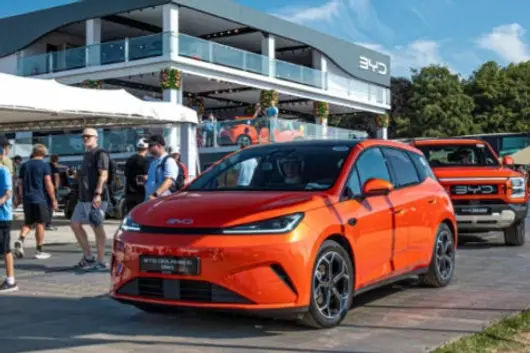

In the beginning of September, Geely Automobile Holdings Limited (0175.HK) presented a substantial report card as usual: August single-month sales reached 270,194 vehicles, continuing the momentum of month-on-month and year-on-year growth for six consecutive months, up 8% both year-on-year and month-on-month. The new energy segment was particularly bright; new energy sales from the three major brands Geely, Lynk & Co, and Zeekr reached 175,877 vehicles, up 19% year-on-year, with the share of the total rising to 65%. In other words, for every ten cars sold, more than six are "electric", and Geely's transition to full new energy is becoming clearer.

The quality of sales is not just reflected domestically. Overseas exports in August showed a result of 110,094 vehicles, up 205% year-on-year, marking month-on-month and year-on-year growth for the eighth consecutive month, and single-month exports broke 100,000 for three consecutive months. New energy exports that month were 70,629 vehicles, surging 446% year-on-year, accounting for 64% of all exports. From "product globalization" to "system globalization", Geely's global moves are upgrading from scattered nodes to a complete localized operational ecosystem.

Supporting the steady climb in sales is the continuous release of technological momentum. From August 21 to 30, Geely, Zeekr, Lynk & Co, Geely Galaxy and Geely China Star appeared at the 2026 Chengdu International Auto Show, with over 49 intelligent products appearing together, with pure electric, hybrid, and fuel multiple energy sources on stage together, fully displaying the ecosystem of "Leader in Full-Domain AI Intelligent Cars". Almost simultaneously, Geely released AI new energy off-road technology, gathering GTA native new energy off-road architecture, all-wheel drive AI electric hybrid Thunder EM-T and AI all-terrain digital chassis, three globally first technologies, completing a systematic reshaping from body structure to intelligent chassis. Among them, Thunder EM-T relies on Xingrui AI Cloud Power scenario engine to accurately match the best fuel-electricity solution, with energy consumption optimization exceeding 15%; the all-terrain digital chassis built based on Quantum-level AI EEA 4.0 can recognize road conditions via AI and automatically switch intelligent scenario modes. These technologies are first mounted on Galaxy Battleship 700, redefining the global benchmark for intelligent new energy off-road technology.
The three brands exerted force in sync on both the auto show and the market. Global luxury tech brand Zeekr delivered 36,981 vehicles in August, up 110% year-on-year; Zeekr 7X sales continued to break 10,000, with global orders breaking 200,000; Zeekr Touring sales exceeded 10,000 for three consecutive months, with global cumulative deliveries exceeding 400,000; Zeekr 009 took the dual crown of sales and reputation for pure electric MPVs above 400,000 RMB in mainland China for three consecutive months.

Global new energy high-end brand Lynk & Co continues to expand widely, with August sales of 17,027 vehicles, up 4% month-on-month, among which new energy products were 15,504 vehicles, up 10% month-on-month. At the Chengdu Auto Show, the new Lynk & Co 20 and Lynk & Co 20 Sprint Edition appeared simultaneously, with Lynk & Co 10, Lynk & Co 07GT and concept car Time to Shine on stage together, displaying layout covering multiple energy sources and adapting to diverse scenarios. In terms of sports map, Lynk & Co expanded from circuit racing to rally; from August 28 to 30, 07GT Rally Academy Racing Car went to the 2026 China Automobile Rally Championship Huairou Station, winning S7 category and Lynk & Co Rally Challenge double champion.

Geely brand solidified its growth basic board, with August sales of 216,186 vehicles, up 5% year-on-year and 9% month-on-month. Mainstream new energy brand Geely Galaxy had monthly sales of 119,115 vehicles, up 8% year-on-year and 10% month-on-month respectively. Star model Geely Star Wish sold 60,955 vehicles in a single month, standing on the 50,000 vehicle stage for three consecutive months, with cumulative sales approaching 900,000. Regarding new products, the new C-class AI pure electric sports sedan Galaxy TT started pre-sales on August 13, redefining the value benchmark of 200,000 yuan class pure electric sports sedan starting at 145,900 yuan; the AI all-terrain hardcore SUV Galaxy Battleship 700 that appeared on August 21 became the auto show focus and will start pre-sales in September. In terms of fuel market, Geely China Star had August sales of 97,071 vehicles, up 8% month-on-month; the new fourth generation Boyue L i-HEV series is equipped with i-HEV smart hybrid and Qianli Haohan H5 solution, consolidating fuel SUV champion status with three cross-level strengths: energy saving, performance, and intelligence; on August 31, the new flagship Xingyue L PLUS was officially announced and will debut on September 5.

In terms of globalization, the three brands bloom at multiple points overseas. Zeekr topped the list of Australian luxury pure electric sales for January-July; Lynk & Co ranked first in Tunisia July high-end PHEV brand; Geely brand won Panama China brand sales champion. Core models also show global competitiveness: Zeekr 7X topped Australian mid-size luxury SUV first; Zeekr 009 took Thailand and Malaysia pure electric MPV market first; Geely Star Wish topped Thailand electric car sales champion; Galaxy Starship 7 EM-i won Poland C-class PHEV sales champion. Channel construction accelerated simultaneously: in Europe, Geely landed in Austria, Spain sales network broke 50 stores, Star Wish officially listed in France; in Latin America and Southeast Asia, Lynk & Co landed in Argentina, Chile business turned to Geely direct operations; in Middle East and Africa, Zeekr 9X started pre-sales, Lynk & Co entered Jordan, first D-SUV global car Geely Monjaro EM-i launched in Egypt at the end of August. Based on long-term confidence in overseas growth, Geely adjusted 2026 overseas sales target from 640,000 to 920,000, aiming for annual sales of one million vehicles.

Operating quality and technical strength advanced simultaneously. On August 17, Geely released 2026 interim results, with total revenue of 173.6 billion yuan, core net profit attributable to parent company of 9.68 billion yuan, achieving volume, price, and profit rise together. Relying on the "One Geely" strategy, this enterprise is embedding full-domain AI into design, R&D, manufacturing and after-sales full link, traveling through the cycle with the determination of high-quality development, steadily moving towards the goal of a global intelligent new energy vehicle leader.

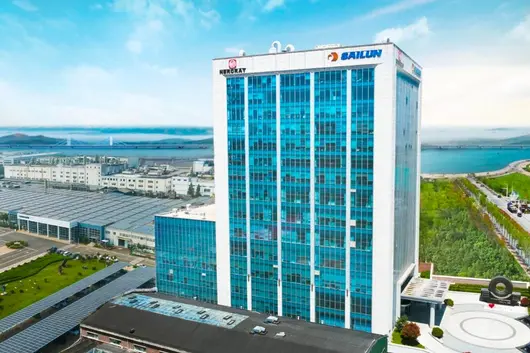
Evening of August 30, Sailun Group disclosed the 2026 semi-annual report, delivering a brilliant performance report with rising volume and profit: Revenue reached 20.027 billion yuan in the first half, up 13.88% year-on-year; Net profit attributable to shareholders of the listed company was 2.16 billion yuan, up 17.97% year-on-year—Average daily earnings exceed 10 million. As of June 30, total assets of the company were 51.359 billion yuan, net assets attributable to shareholders of the listed company were 22.662 billion yuan.
The growth momentum in the second quarter further accelerated: Single quarter revenue was 10.566 billion yuan, up 15.16% year-on-year, up 11.68% quarter-on-quarter; Net profit was 1.103 billion yuan, up significantly 39.26% year-on-year. The group simultaneously unveiled the semi-annual dividend proposal, proposing to pay 0.15 yuan per share (inclusive of tax), expected to distribute 493 million yuan, implementing interim dividends for three consecutive years.

Production and Sales Both Break Records, Global Capacity Accelerates Release
With global capacity gradually releasing, Sailun's production and sales in the first half both refreshed historical same-period levels: Tire production 46.9749 million units, up 15.70% year-on-year; Sales 45.0135 million units, up 14.99% year-on-year, both domestic and international markets saw simultaneous volume increases.
Currently, factories in Vietnam and Cambodia have entered a stable high-output phase, Indonesian and Mexican factories' capacity continues to climb, Egypt project construction is proceeding in an orderly manner. Overseas base planning totals 12.75 million all-steel radial tires, 89 million semi-steel radial tires and 130,000 tons of off-road tire annual capacity. In 2025 and the first half of 2026, the group's exported radial tire delivery volume and overseas factory production/sales volume both ranked first in the Chinese tire industry. Amid frequent trade barriers, proactive global layout is becoming Sailun's core moat to traverse cycles.

R&D Iteration Lands, Digitalization Leads the Industry
The group has 4 R&D centers globally. The 'R&D and Application of High-end Tire Intelligent Manufacturing Equipment without Personnel Forming' project jointly tackled in August won the First Prize of Shandong Province Science and Technology Progress. Product end, all-steel tires launched new products for new energy, heavy load, mine conditions, etc.; semi-steel tire high-end UHP product US61 put into production, multiple winter tires passed European TÜV certification; Off-road tire revenue ranked first in the 2026 domestic engineering tire enterprise leaderboard.
In terms of digitalization, the group implemented systems such as AI visual quality inspection, AGV automatic logistics, APS intelligent scheduling, etc., and built a self-developed AI matrix including Rubber Chain Cloud Chat industry large model, Sailun Lobster, Sailhorse agent, etc., rated as one of the first batch of enterprises with level 5 digital transformation maturity in the industry, selected into the Ministry of Industry and Information Technology's Digital Navigator Enterprise List.

Brand Value Climbs, ESG Sets Industry Benchmark
In 2026, Sailun ranked 10th globally in the Brand Finance Global Most Valuable Tire Brands list, the highest-ranked Chinese tire brand; Entered the 'Top 500 Most Valuable Brands in China' list for the first time with a brand value of 125.189 billion yuan, ranked on the 'Fortune China 500' list for two consecutive years.
In terms of ESG, the group is the first domestic tire enterprise to pass SBTi Science Based Targets verification, MSCI ESG rating reached AA level, the highest level in the Chinese tire industry. Liquid Gold Tire carbon reduction results are outstanding, carbon emissions per 1000 kilometers over the full life cycle for truck/bus tires and car tires decreased by 39% and 27% respectively compared to ordinary tires.
Under the general dilemma of 'revenue growth without profit increase' in the global tire industry, Sailun's semi-annual report of 'revenue growth and profit increase' is particularly rare. In the future, the group will continue with the mission of 'Making a Good Tire', strengthen core competitiveness through global layout and R&D technology, submit a better answer to global consumers.

August 26, summer vacation is nearing its end, schools at all levels are about to start. Some car companies have also released their first-half performance reports. Let's see who performed well in the first half, and then roll up their sleeves to work hard, charge up, and do well in the second half.
Against the backdrop of intensified competition in China's auto industry, increasing involution in the new energy track, and an industry predicament where most car companies face rising revenue but stagnant profits, Dongfeng Shares has delivered a high-quality mid-year report showing stable sales growth, rising revenue, soaring profits, and accelerated transformation.
(I) Can't Live Like That Anymore
Different from the abnormal competition path of some new forces and old forces trading scale for market, even sacrificing revenue and profits to block competitors, Dongfeng Shares is based on the main business of light commercial vehicles, deeply cultivating scenario-based new energy, intelligence, and overseas markets, forging a stable profitability, pragmatic transformation, technology implementation new path for SOE car transformation, providing a new model for traditional car company new energy upgrades.

From the core operating data, Dongfeng Shares' operational resilience in the first half of 2026 is highlighted, with growth quality far exceeding the industry average. In the complex environment of industry demand structure adjustment and continuous intensification of market competition, through comprehensive transformation reform, innovation empowerment, and refined operations, it has achieved stable and high-quality growth.
During the reporting period, the company achieved operating revenue of 5.516 billion yuan, a year-on-year increase of 9.64%;
Total profit was 169 million yuan, a significant year-on-year increase of 83.56%;
Net profit attributable to shareholders of the listed company was 124 million yuan, a year-on-year increase of 27.83%. The profit growth rate far outpaced the revenue growth rate, with the results of full-chain cost reduction and efficiency enhancement, as well as product structure optimization, landing effectively.
Total vehicle sales were 69,000 units, a slight year-on-year increase of 0.44%, outperforming the overall flat commercial vehicle market against the trend.
The core growth segment performed exceptionally well, with new energy vehicle sales reaching 18,000 units, a year-on-year increase of 99.2%. The doubled growth rate significantly led the industry's overall new energy commercial vehicle growth of 40.2%;
Overseas vehicle exports were 13,000 units, a year-on-year increase of 81.4%, significantly higher than the industry's commercial vehicle export growth of 32.5%, becoming the company's two core growth poles.
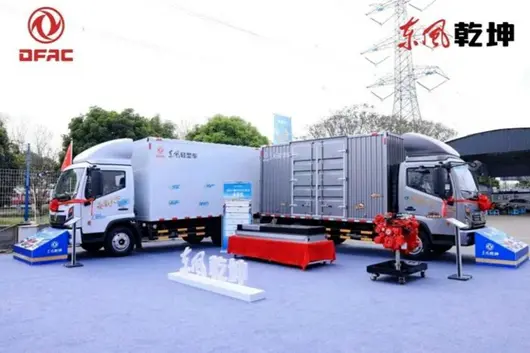
At the same time, the core parts and components segment steadily empowered. Dongfeng Cummins engines sold 134,000 units in the first half, a year-on-year increase of 18.39%. The generator set supporting business also grew significantly, solidifying the power performance and cost advantages of complete vehicles, and building a good pattern of synergistic revenue growth between complete vehicles and parts.
(II) Look at Dongfeng from Outside Dongfeng
We change perspectives, comparing Dongfeng Shares horizontally across the entire new energy vehicle industry. Its development logic, growth structure, and business philosophy form a distinct differentiation with new and old forces like Leapmotor, Xpeng, Seres, and GAC, also interpreting the two survival tracks for car companies today.

In terms of sales volume, the industry shows a distinct differentiation of "new forces chasing scale, SOE car companies focusing on quality".
In the first half of 2026, Leapmotor topped the new force sales list with a cumulative delivery volume of 356,500 units, a year-on-year increase of 60.8%, achieving a gap-leading scale through extreme price-performance strategies, large product matrix, and overseas volume release.
XPeng Motors focuses on intelligent driving iteration, with sales steadily recovering in the first half of the year.
Seres relies on Huawei's deep empowerment, deeply cultivating the 300,000-plus level premium passenger car market, focusing on high-end intelligent premium pricing.
GAC Group relies on the Aion brand support, with overall new energy sales firmly standing in the first tier of traditional car companies, with stable growth.
In contrast, Dongfeng Shares does not pursue the massive scale of passenger cars. The overall sales volume of 69,000 units is far less than mainstream passenger car enterprises, but the quality of the incremental gains leads the industry.

Its new energy growth focuses on vertical commercial scenarios such as urban distribution, cold chain, and urban-rural distribution. New energy light truck sales surged 573.4% year-on-year, Furuitong VANs deliveries increased by 153.9% year-on-year, achieving explosive growth in niche tracks, avoiding the red ocean involution of passenger cars, and carving out a growth curve exclusive to commercial vehicle new energy.
In terms of profitability, Dongfeng Shares' advantage is more prominent, solving the common problem in the new energy industry of "the larger the scale, the higher the loss".
Most new forces are still in the scale expansion phase, relying on high sales to grab market share, with huge investments in R&D, channels, and marketing in the early stages, facing profit pressure for a long time. This belongs to the development model of "trading scale for the future".
While Dongfeng Shares relies on the mature commercial vehicle industry chain, stable large customer systems, and extreme full-chain cost reduction strategies to achieve a virtuous cycle of stable sales, increased revenue, and increased profit. The 83.56% year-on-year profit growth rate is extremely rare among new and old new energy car companies, showing the solid operating foundation and strong risk resistance ability of traditional SOE car companies.
The difference in business strategies and transformation concepts is the core distinction between Dongfeng Shares and new forces and mainstream car companies.
Leapmotor and Xpeng's core logic is full-domain R&D, scale breakout, global volume release, capturing the mass passenger car market with intelligence and price-performance, spreading R&D and production costs through massive volume; Seres focuses on tech empowerment, high-end premium, ecosystem synergy, creating high-end smart car brands relying on Huawei technology; GAC persists in multi-brand, full-category, full-track layout, covering low-end to high-end passenger cars and the full new energy market.
Dongfeng Shares follows a vertical deep cultivation, scenario implementation, pragmatic technology, steady iteration SOE stability route, does not blindly follow the passenger car track involution, focusing on its own light commercial vehicle main business advantages.
(III) Transform Just Like This
On the path of transformation, Dongfeng Shares adheres to the integrated promotion of R&D empowerment, technology implementation, and manufacturing upgrade, building strong long-term development barriers.
The company continued to increase sci-tech investment, with R&D expenses reaching 213 million yuan in the first half, a significant year-on-year increase of 74.48%, with R&D intensity making a leap-forward improvement.

Relying on its own independent R&D center, the company focuses on pure electric platform models, Hydrogen Fuel Trucks, skateboard chassis, high-order intelligent driving, and other frontier tracks to deeply cultivate R&D and production, building an autonomous and controllable core technology system. At the product end, it continues to improve the new energy matrix, while heavily launching the OpenVAN unmanned logistics capacity brand, landing multiple L4-level high-order intelligent logistics products, realizing the normalized demonstration operation of autonomous driving logistics vehicles and intelligent sanitation vehicles, winning over 4,000 strategic orders, transforming intelligence from technical concepts into commercial increments, and completing the deep iteration of products towards green and intelligent directions.
The manufacturing end further complements hardcore strength. The company takes "Green Environmental Protection, Digital Integration, Flexible Manufacturing, Platform Sharing" as core goals, builds a new generation of complete vehicle integrated manufacturing platforms, creates an LCV digital-intelligence benchmark factory, and continuously improves product quality, operational efficiency, and market reputation through strict quality control systems and optimized terminal after-sales services, providing solid intelligent manufacturing support for transformation quality improvement and sales growth.
The dual growth of overseas business and core parts and components business further solidifies Dongfeng Shares' development confidence.

Vehicle exports in the first half were 13,000 units, a year-on-year increase of 81.4%. Continuous breakthroughs were made in markets such as Malaysia, Cuba, Latin America, and Southeast Asia, with overseas brand influence rising rapidly;
Engine business sales increased by 26% year-on-year, generator set supporting business grew significantly. Core powertrain technology accumulation provides dual guarantees for complete vehicle quality and profit space.
Different from the model of most car companies relying solely on complete vehicle sales, Dongfeng Shares has formed a diversified profit structure of "Complete Vehicles + Core Parts + Overseas Exports + Intelligent New Business", with anti-cycle ability far exceeding the industry average.
(IV) "Incremental Growth Also Brings Profit"
Looking at the 2026 car company mid-year exam, industry involution intensifies, price wars continue, the red sea competition in the passenger car track becomes more intense, and most car companies fall into the predicament of "incremental growth without profit increase".
New forces like Leapmotor and Xpeng win in scale speed, Dongfeng Shares wins in operating quality; GAC and Seres win in brand momentum, Dongfeng Shares wins in steadiness and pragmatism.
As a traditional SOE car company, Dongfeng Shares has not stuck to the fossil fuel comfort zone, nor blindly followed the cross-industry trend. Instead, based on its own endowments, it accurately grasps the opportunities of commercial vehicle new energy, intelligence, and internationalization, achieving high-quality transformation through structure optimization, technology innovation, cost reduction and efficiency enhancement, and ecosystem expansion.

From the perspective of long-term industry development, the competition in the second half of the auto industry has long bid farewell to pure sales battles. Profitability, transformation quality, technology implementation, and risk resistance resilience have become core competitiveness.
Dongfeng Shares' semi-annual report confirms the transformation potential of traditional commercial vehicle car companies and provides new ideas for mainstream car companies:
Only by not blindly chasing scale, not following the price involution, deeply cultivating niche tracks, solidifying technology implementation, and solidifying the profit foundation, can one stand firm and continue to lead in the fierce industry reshuffling. Facing
Dongfeng Shares stated that it will continue to focus on the five major core development directions of New Quality Goods, Marketing Capability, High-Quality Operation, Ecosystem Integration, and Value Creation and Sharing, continuously accelerate new energy and intelligent transformation, continuously optimize product structure, strengthen industrial ecosystem layout, grasp new opportunities for industry transformation, and steadily promote high-quality development.

Author | Zhang Rui
Editor | Zhi Hao
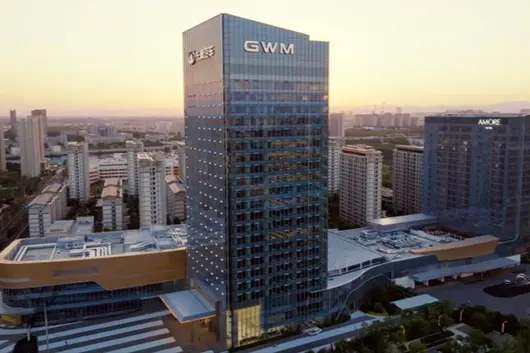
Great Wall Motor's first-half revenue increased year-on-year by nearly 10 billion yuan, and net profit attributable to parent company decreased year-on-year by 3.872 billion yuan.
Chexidong on August 25 reported, just now, Great Wall Motor Co., Ltd. (hereinafter referred to as Great Wall Motor) released its 2026 half-year report.
In the first half of 2026, Great Wall Motor'srevenue was 102.101 billion yuan RMB, a year-on-yearincrease of 10.58%,net profit attributable to parent company was 2.465 billion yuan, a year-on-yeardecline of 61.11%.

▲ Great Wall Motor's 2026 First-Half Major Financial Data
In terms of sales volume, Great Wall Motor's new carsales volume was 575,800 units in the first half of 2026. Among them,domestic sales volume was 286,700 units,overseas sales volume was 289,000 units, based on the dataoverseas sales volume has surpassed domestic.
Overall, Great Wall Motor's financial performance in the first half of 2026 had both good and bad aspects, with opportunities and challenges coexisting. Currently, overseas sales volume has seen a significant growth, even surpassing domestic sales volume. Whether Great Wall Motor can make further progress in performance in the second half of the year will make the overseas market even more critical.
01.
Revenue of 102.101 billion yuan RMB
Net profit attributable to parent company declined 61.11% year-on-year
In the first half of 2026, Great Wall Motor'srevenue was 102.101 billion yuan RMB, an increase of 9.766 billion yuan compared to the same period last year,representing a year-on-year increase of 10.58%.

▲ Great Wall Motor's 2026 First-Half Major Financial Data
Regarding net profit attributable to parent company, Great Wall Motor's first-half of 2026net profit attributable to parent company was 2.465 billion yuan, a decrease of 3.872 billion yuan compared to 6.337 billion yuan in the first half of 2025,a year-on-year decline of 61.11%. Great Wall Motor explained that the year-on-year decline in net profit attributable to parent company was mainly due to the delayed recovery of overseas tax policy subsidy income, as well as exchange rate fluctuations.
Regarding gross margin, in the first half of 2026, Great Wall Motor'sgross margin was 18.37%, a year-on-year decrease of 0.01 percentage points from the same period last year's 18.38%.
In terms of sales volume, in the first half of 2026, Great Wall Motor achieved new carsales of 575,800 units, a year-on-yearincrease of 1.22%. Among them,domestic cumulative new car sales were 286,700 units, a year-on-yeardecrease of 22.53%,overseas cumulative new car sales were 289,000 units, a year-on-yearincrease of 45.46%. From the results, currently Great Wall Motor's overseas sales volume has surpassed domestic.

▲ Great Wall Motor 2026 First-Half Sales Volume
Breaking down by vehicle category, Great Wall Motor's pickup sales volume declined 3.71% year-on-year in the first half of 2026, SUV sales volume declined 1.12% year-on-year, and sedan and others (mainly new energy vehicles) sales volume increased 58.80% year-on-year.
02.
3 Full-Process Complete Vehicle Production Bases Established Overseas
Overseas Sales Channels Exceed 1600
In addition to releasing first-half financial data, Great Wall Motor also revealed the company's development situation in the report.
Currently, Great Wall Motor owns brands such as Haval, Tank, WEY, ORA, Great Wall Pickup, Great Wall Soul Motorcycle, Great Wall Commercial Vehicle, etc. Products mainly cover categories such as SUV, Sedan, Pickup, MPV, Motorcycle, Heavy Truck, etc. Power includes gasoline, diesel, hybrid, plug-in hybrid, pure electric, and hydrogen energy.

▲ Great Wall Motor 2026 First-Half Development Situation
Great Wall Motor stated that its global layout has been fully implemented. In terms of production, Great Wall Motor has established 3 full-process complete vehicle production bases in Thailand, Brazil, etc., and owns multiple KD factories in Ecuador, Malaysia, Pakistan, etc.
In terms of market expansion, Great Wall Motor products cover more than 170 countries and regions such as Europe, Australia, Africa, Central and South America, Southeast Asia, and the Middle East; in terms of channel construction, nearly 200 new stores were added. As of June 2026, overseas sales channels exceeded 1600.
Great Wall Motor also provided possible risks and challenges faced in the report. Internationally, international environment changes, increased trade barriers, etc., bring risks of international trade uncertainty, which may cause fluctuations in the automotive industry. In the domestic market, Great Wall Motor stated that the domestic automotive market is in stock competition, and homogenization competition is intensifying.
Facing the above risks and challenges, Great Wall Motor stated that it will mainly take the following measures to cope:
1. Deepen the "ONE GWM" global strategic layout, with "regional deep dive + localization operation" as the core, expand high momentum and emerging markets such as Europe, reduce dependence on a single market; promote localization production and supply chain support of overseas factories, avoid geopolitical risks and the risks of deepening trade barriers; create big single products suitable for diverse needs of global users, achieve "one car multiple power" global product model.
2. Continue technology and category innovation, optimize product matrix. With Guiyuan Platform, Hi4 Hybrid, Coffee Intelligent Driving Technology, achieve multi-power compatibility and AI empowerment, launch more competitive products to the market; relying on off-road, high-end, new energy MPV, box-like four major tracks, launch high value-added models; strengthen Tank brand off-road ecosystem barriers, consolidate high-end market; WEY brand seeks high-end differentiated breakthrough by building "Guiyuan S Technology Platform + Full Industry Chain Ecosystem + Trust Mindset"; ORA achieves global growth with new models, low cost, high adaptability global vehicles.
3. Deeply cultivate core technology, brand service, product quality, carry out long-term value communication, resource tilt towards brand upward, user service, digital middle platform long-term construction, rely on brand, channel, user long-term assets to traverse industry cycles, achieve sustainable high-quality growth.
03.
Conclusion: Great Wall Motor Begins to Seek New Growth Points
Overall, Great Wall Motor's report card for the first half of 2026 was mixed.
In the first half of 2026, Great Wall Motor's revenue increased 10.58% year-on-year, sales volume increased 1.22% year-on-year, overseas sales volume increased 45.46% year-on-year, but Great Wall Motor's net profit attributable to parent company decreased 61.11% year-on-year.
And next, Great Wall Motor stated to reduce dependence on a single market, optimize product matrix, and launch more competitive products to the market. In the fierce competition in the auto market, what performance Great Wall Motor will bring next, we wait and see.

Fu Rong, Interns Fang Weibo, Cheng Siyu
According to data from the China Passenger Car Association, domestic car sales continued to decline under pressure in July, while overseas markets maintained significant growth, especially the overseas sales of several top automakers have accounted for "half of their total sales". Car going global has leaped from a supplementary channel to the core engine for automakers to digest capacity and maintain growth.
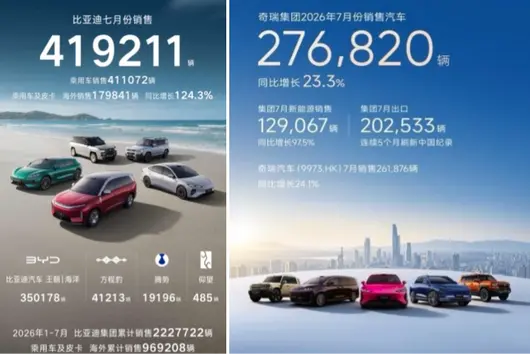
From July data: Chery Holding total sales 276,800 units, exports 202,500 units, overseas share as high as 73%, nearly 3 times the domestic market; BYD total sales 419,200 units, exports 179,800 units, overseas share 42.8%; Geely Auto sales 250,200 units, exports 106,700 units, share 42.6%; SAIC Group sales 338,600 units, exports 141,700 units, share 41.9%. In comparison, sales of various automakers in the domestic market showed different degrees of decline, one rising and one falling, allowing the overseas market to leap from being a "minor player" in the past to become the pillar supporting performance growth for mainstream automakers.

According to data from the China Association of Automobile Manufacturers, domestic car sales in July were 1.541 million units, down 13.1% month-on-month and down 23.6% year-on-year. Data from the China Association of Auto Trade Dealers shows the auto dealer inventory warning index climbed to 61.1% that month, far exceeding the 50% threshold, with over 60% of dealers finding it hard to be optimistic about the market trend in the second half of the year, and industry inventory reduction pressure increased significantly.
In stark contrast, overseas markets continued to perform well during the same period. Mainstream automakers that implemented the going global strategy all saw significant growth in overseas sales. Data from the China Association of Automobile Manufacturers also shows: In July, China's car export volume reached 1.043 million units, surging 81.3% year-on-year, breaking the million-unit mark for two consecutive months. Among them, new energy vehicle exports reached 553,000 units, a surge of 145.5% year-on-year, with their share exceeding 50% for two consecutive months, becoming the absolute main force of exports. From January to July, China's cumulative car exports reached 6.14 million units, a 66.8% year-on-year increase, among which new energy vehicle exports increased 1.2 times year-on-year.
Behind this structural change lies the deep layout of global strategies by top automakers. The going global model of Chinese automakers is gradually shifting from "complete vehicle exports" to combining with "industrial rooting". BYD's factories in Brazil and Thailand have started production successively; Chery is advancing multi-base projects in Spain, Vietnam, etc.; Changan's factory in Brazil has also been completed and put into production. Top automakers are rooting deeply in global core markets through a "three-in-one" approach of building factories, laying out channels, and integrating supply chains. Europe, Southeast Asia, and South America have become the three major core pivots of Chinese automaker globalization. Looking forward, tariff barriers and local operational capabilities will become the watershed of competition. From satisfying domestic demand to driving the global market, a profound transformation from "Made in China" to "Chinese Globalization" is taking place.


In the first half of this year, Chinese automakers simultaneously reached three historical milestones — single-month exports broke the 1 million mark for the first time, sales in Europe exceeded Japanese brands for the first time, and the EU's final anti-subsidy duty case on PHEVs came into effect. The "highlights" of scale and the "reefs" of rules appeared simultaneously. This is not the end of the overseas expansion story, but the watershed moment shifting from "fighting for incremental growth" to "upholding rules".
1 Million Units Were Not Snatched with Low PricesProduction and sales data for June disclosed by the China Association of Automobile Manufacturers on July 9 showed that June car exports reached 1.037 million vehicles, a 11.6% month-on-month increase and a 75.1% year-on-year increase, the first time in China's automobile industry history that single-month exports exceeded 1 million. From January to June, cumulative exports reached 5.096 million vehicles, a 65.3% year-on-year increase. Chen Shihua, Deputy Secretary-General of CAAM, was very confident in his judgment — full-year car exports are expected to break 10 million. This means China is becoming the first country in the world to break 10 million in annual export volume.
More worth noting than the numbers is the structure behind them. Data released by the Liaison Committee on Passenger Cars on the same day showed that June new energy passenger car exports were 499,000 vehicles, a 152.7% year-on-year increase, accounting for 56.9% of passenger car exports, nearly 16 percentage points higher than last year. The main force of Chinese car overseas expansion has shifted from early oil car surplus capacity to new energy regular army.

The significance of exports to leading automakers is also changing. BYD first half sales 1.8085 million, of which 790,000 were exports, accounting for nearly 44%; Chery first half exports 940,000, accounting for 74.3% of its total sales. For these two, overseas markets are no longer supplementary, but the main battlefield.
Worth mentioning separately is the joint venture camp. June joint venture and luxury brand exports 114,000 vehicles, a 61% year-on-year increase. Foreign brands such as Volkswagen, Toyota, and Nissan are treating Chinese factories as global electrification supply centers, exporting back to Europe and Southeast Asian markets.
Breaking 1 million is just a footnote on quantity. The true turning point is in Europe.
Won Once on Japanese Turf, Then Hit a WallIn May this year, five Chinese automakers — BYD, SAIC, Geely, Chery, and Leapmotor — sold a combined 138,400 vehicles in 31 European countries, a 65% year-on-year increase, exceeding the combined sales of six Japanese brands including Toyota in the region for the first time. Chinese brand European market share rose from 5.6% in May 2025 to 10.7% in May 2026 — doubling in one year.
The weight of this reversal is not light. Japanese brands have cultivated Europe for over 40 years, while Chinese brands have entered Europe on a large scale for less than 5 years, completing share switches that once took a generation. This is a rare restructuring of patterns in the European car market since World War II. Mercedes-Benz's Q2 data released in the same period formed a contrast — global sales down 6%, China market down 30%, while pure electric models grew 50% globally. Between one advance and one retreat, the center of gravity of the global auto industry is being reweighed.

But Europe will not sit idly while share is taken away. The EU's final anti-subsidy duties on Chinese-made pure electric vehicles officially took effect from October 2024, for five years; the EU summit in June 2026 also finalized the anti-subsidy duty case on Chinese plug-in hybrid vehicles. This means the PHEV export route to which Chinese automakers collectively added efforts over the past year has also had its threshold raised directly.
The killing power of this tariff wall does not lie in uniform pressure, but in stratification: BYD comprehensive tax rate 27%, Geely 28.8%, NIO and XPeng 30.7%, SAIC highest 45.3%, while Tesla produced locally in Shanghai only 7.8% early on. Cooperating with the EU investigation and enterprises with higher localization have relatively lower tax rates; enterprises that did not cooperate were pushed to the top. The rules themselves favor the leading players and those with higher localization; small players will be squeezed out. The Chinese "Oil car — PHEV transition — Pure electric upgrade" three-step overseas expansion path may also be compressed to two steps.
In response, China's Ministry of Commerce has made a final anti-dumping ruling on pork products originating from the EU, levying tariffs of 4.9% to 19.8% for five years, and is preparing further countermeasures on products such as brandy and dairy products. Both sides are using agricultural products and light industrial products as chips — precisely controlling, avoiding complete loss of control — but this is the beginning of a long game.
Three Ways to Bypass the Tariff WallOnce tariffs land, localization is no longer a choice. The current three leading Chinese automakers have given three solutions.
BYD Model: Local Heavy Assets. Hungary factory under construction, expected to start production in 2027, completing the production and sales loop directly within the EU. This road is most resistant to tariffs, but investment cycle is long and political sensitivity is high, requiring enterprises to have sufficient patience and cash flow to support.

Chery Model: Third Country Jumping Board. Chery has already set up a factory in Brazil, and on the Europe side, layout in Spain. Using a non-EU or EU-edge market as a jumping board, balancing Latin American growth and Europe entry, high flexibility, but relies on the long-term stability of the host country's policies.
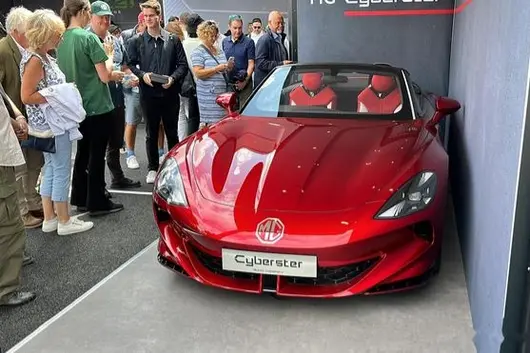
SAIC Model: Deep Cultivation in Multiple Markets, Localization Advancing Together. SAIC is the most complete among the three in organized and systematic overseas expansion, Europe is its core battlefield — MG has been the sales champion of Chinese brands in Europe for 11 consecutive years, cumulative sales broken 1 million vehicles. Its response logic is "Full Spectrum + Localization" walking on two legs: Europe supplies fuel, hybrid, plug-in hybrid, and pure electric simultaneously, avoiding single path policy risks; Spain factory production end of 2028 can directly avoid high tariffs within the EU; Thailand, Indonesia factories mass produced, as the radiation base for Southeast Asia, Aus/NZ, S.America. Highest risk dispersion, but also the highest requirement on global synergy capability.

I lived in Thailand for three years, and I could clearly feel the texture of this road. MG stores opened from Bangkok city center all the way to Chiang Mai old town. Southeast Asia is not an alternative to Europe, but another battlefield outside Europe. The scale base formed by Chinese automakers in Southeast Asia will become the reserve hand for the next round of global games.
Need to remind that EU tariffs are just "the first wall". North America's potential blockage risk, Southeast Asia Japanese brands' counterattack, are all on the way.
Qi Shi View: 10 Million is Just the Starting PointBreaking 1 million is an "adult ceremony" for China's automobile industry. But after the adult ceremony, one must face the rules of the adult world — anti-subsidy, anti-dumping, localization, labor compliance, and environmental regulations. Victory in data can be completed within a few months, but victory in rules may take decades.
10 million is not the end, but the starting line for Chinese automakers from "selling cars" to "operating globally". Whether one can stand, stay, and go far, the answer is not in the CAAM data, but in the assembly lines of Hungary factories, in the taillights of Chinese cars in Munich evening rush hour, and also in the account books of Lisbon dealers.

August has just begun, Geely has made two moves.
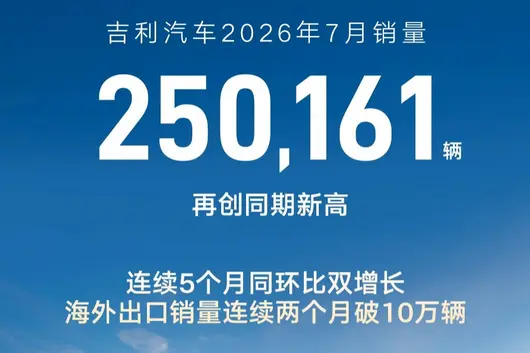
First, July sales report reached 250,161 units, with same-period and month-on-month growth for 5 consecutive months, new energy vehicles accounting for 64%.
Following closely, on August 2, Geely Automobile Group Sales Headquarters was officially launched.
To be honest, restructuring when sales are at a high point is harder than radical treatment when sales are low.
Geely's step of "retracting the fist to strike harder" reveals a rare composure and puts the industry's chronic issue of multi-brand management on the table.
 250,000+ Units: Refusing Imbalanced Growth for Balanced Development
Zeekr delivered 35,837 units, a 111% increase year-on-year.
The 9X secured the 500,000+ RMB range, the 7X delivery exceeded 10,000.
This proves that Zeekr's foothold in the high-end market is not a fleeting phenomenon.
Galaxy withstood the fire of the mainstream market, Star Wish sold 55,105 units individually, cumulative sales broke 800,000.
A7 EM's Guinness Record of 2,608 kilometers negated range anxiety at its source.
Lynk & Co 07GT had over 10,000 major orders within 27 minutes of launch, and immediately plans to compete in rally racing. This contrast of half-home, half-racing is exactly the scarcity Lynk & Co found in the red ocean.
 More worth mentioning is the overseas market.
Exports reached 106,663 units, breaking 100,000 for two consecutive months, with new energy vehicles accounting for 59%.
Star Wish topped charts in Thailand and Brazil, Zeekr 7X led in Australia and Malaysia.
This shows Geely is no longer solely dependent on domestic involution, but has built a multi-tiered brand echelon in the global market.
This pattern of internal and external cultivation is more valuable than sales numbers alone.
 Sales Headquarters: From Warlord Division to Legion Warfare"
This establishment of the Sales Headquarters is by no means a simple departmental merger, but a closure of a Geely strategy in the "Taizhou Declaration."
Lin Jie leads, also managing Zeekr; Fan Junyi serves as Executive Vice President, managing Lynk & Co on one hand and Galaxy on the other, preserving Zeekr's independence and premium tone, while enabling Lynk & Co and Galaxy, two brands with similar tones and slightly overlapping price bands, to achieve synergy in the middle and back office.
Wang Bo manages China Star, Guan Jiuyang serves as Executive Vice President of Galaxy.
 In this era of micro-profits with vehicle gross margins falling to 1.5%, the enemy of multi-brands is often themselves.
In the same city and on the same street, Galaxy and Lynk & Co compete for customers. Repeated channel construction devours profits. This is a common disease of many car companies.
Geely's move to retract its fist is essentially treating front-office brands as special forces to maintain flexibility, while managing channel, data, budget, and other middle and back-office resources as a unified logistics army.
This "split front office, unified middle and back office" model can effectively solve internal friction and improve marginal efficiency.
 Zhang Guan Commentary: Geely's "Entropy Reduction" Experiment
In my opinion, this step by Geely is an "entropy reduction" experiment on automotive industry involution.
Previously, when discussing multi-brands, the talk was about differentiation; now discussing multi-brands, efficiency must be discussed.
Referring to the previous experience of integrating Zeekr and Lynk & Co, the sales expense ratio dropped to 5.9%, which is actual profit.
With the operation of the Sales Headquarters, Geely's channel reuse rate overseas will increase significantly. Selling multi-brand models at a single set of outlets can greatly dilute overseas costs.
 Of course, organizational change inevitably accompanies pain.
Six originally independent sales systems need to divide budgets and set strategies at one table; an adaptation period is inevitable.
But Geely chooses to act when winning, rather than passively putting out fires. This strategic resolve deserves praise.

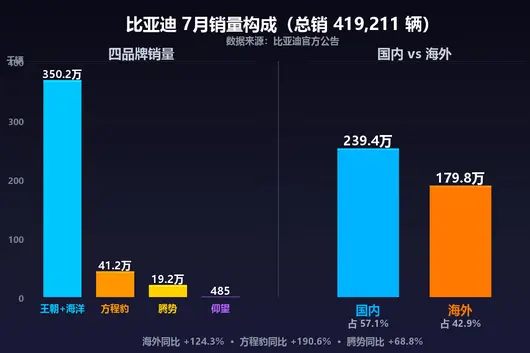
【Auto Market Expert】BYD sold 419,211 units in July, a year-on-year increase of 21.76%. Cumulative sales from January to July reached 2,227,722 units.
Total volume hit a new high again. Structural changes are more noteworthy than total volume: Overseas markets are becoming the largest growth engine, while the domestic market is shifting from rapid expansion to refined cultivation.

Dynasty + Ocean: 350,178 units. Absolute mainstay, accounting for over 80%. Qin, Song, Dolphin, Seagull have secured a solid share in the 100,000-200,000 RMB range. With a massive base, the growth rate naturally slowed—this is a stage any major product goes through after maturation. More importantly, the foundation remains solid, and competitive barriers stay firm.
Fang Cheng Bao: 41,213 units, a year-on-year increase of 190.6%, and a month-on-month increase of 15.7%. Fastest growth rate within BYD. Leopard 5 and Leopard 8 Super Fast Charging versions established themselves in the 300,000-500,000 RMB range, indicating that premiumization is not about stacking specs to compete on price, but about product strength. What does monthly sales of 40,000+ mean in the market above 300,000? NIO's main brand monthly sales are about 10,000, Li Auto about 30,000—Fang Cheng Bao achieved the combined volume of both with just one brand.
Denza: 19,196 units, a year-on-year increase of 68.8%. D9 firmly holds the top spot in MPV sales, Z9GT contributes steadily in the coupe market. Z9S started pre-sales today; after adding the sedan line, the product matrix is more complete.
Yangwang: 485 units. Nearly 500 units sold monthly at the million-level price point, comparable to Mercedes-Benz S-Class, BMW 7 Series. Yangwang is not about volume; it is a technology flagship, endorsing brand upward movement.
Overseas: 180,000 units, growth rate 124%Overseas sales in July reached 179,841 units, a year-on-year increase of 124.3%. Cumulative overseas sales from January to July were 969,208 units; the full year is likely to exceed 1.5 million units.
It's not just numbers rising; the model is upgrading too. The Thailand factory with an annual capacity of 150,000 units is already in production, the Brazil factory is under construction, and the Uzbekistan factory is operational—from exporting complete vehicles to local manufacturing, this step determines whether overseas growth can continue. In overseas markets, BYD is not just selling cars; it is building factories, channels, and brand awareness.
Global car sales in July were about 7 million units, with BYD accounting for around 6%. There is huge room for improvement overseas—not a one or two-year matter, but a ten to twenty-year growth track.

July domestic sales were about 240,000 units. Behind this number is the new normal for the domestic new energy vehicle market—penetration rate has exceeded 60%, the high-growth dividend period is transitioning to a stock competition period.
For BYD, this is not a challenge, but an industry rule. The market share in the 100,000-200,000 RMB range is already high, and marginal expansion space naturally narrows. The domestic strategy is also adjusting: not pursuing further significant share increases, but securing the foundation through new products (Qin MAX, Seal 08) and new technologies (Second-generation Blade Battery, Super Fast Charging), while allocating more resources to overseas markets and premiumization.
Simply put: domestically shifting from grabbing territory to holding ground, overseas shifting from testing waters to aggressive offense.

Three stages are becoming clearer.
Stage 1 "Domestic Competition King" (2021-2023): Blade Battery and DM-i swept the 100,000-200,000 RMB market. Stage 2 "Brand Upward" (2024-2025): Denza, Fang Cheng Bao, Yangwang targeting the premium sector, basically completed. Stage 3 "Global Expansion" (2026-Present): Overseas share rises rapidly, moving from "Chinese BYD" to "World BYD".
Fang Cheng Bao monthly sales broke 40,000, overseas monthly sales approached 180,000—these numbers were unthinkable a year ago. Stage 2 is concluding, Stage 3 is accelerating.
Next highlight: When will overseas monthly sales exceed domestic? With the current growth rate difference, this might be seen in the fourth quarter of this year.

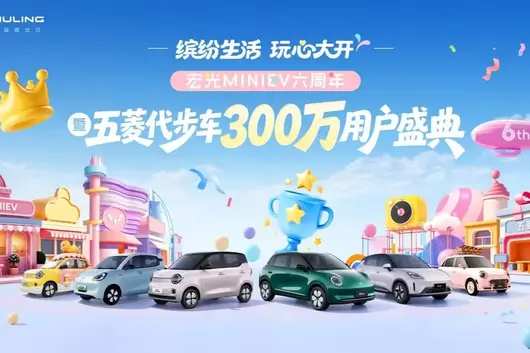
SAIC-GM-Wuling's commuter cars are about to cross the 3 million unit milestone in cumulative sales. To commemorate this highlight, on August 7, Wuling official will launch a grand celebration at the Chengdu Outdoor Music Park — the Hongguang MINIEV 6th Anniversary and Wuling Commuter Car 3 Million User Celebration. At that time, Meng Ziyi, the global image spokesperson for the Bingo family, will make a surprise appearance and join countless car owners for this carnival feast.

While waiting for this feast, let's first take a look at how many solutions for ordinary people's daily travel are hidden within this upcoming trust of 3 million users.
Parking Hard, Costs High, Driving Scared? These Three Cars Are the Cure for Every 'Complaint'
For ordinary people like us, purchasing a vehicle involves 90% usage scenarios being daily commuting, picking up and dropping off children, grocery shopping, or short trips around the weekend. However, reality often falls short: the body is wide and hard to park in narrow alleys; refueling a fuel car hurts the wallet; new drivers shake their legs just sitting in the driver's seat. At this moment, the Wuling commuter car series fully reveals its unique advantages.
If you are a corporate worker rushing between city skyscrapers, a new driver holding the steering wheel for the first time, or a frugal calculator upholding the concept of high cost-performance ratio, the 5th Gen Hongguang MINIEV is undoubtedly the key to unlocking a pleasant travel experience. It accurately interprets the core advantages of "Easy Control, Easy Parking, Ultra Energy Saving". An extremely small turning radius helps you turn around easily in narrow streets and park calmly in tight spaces; ultra-low energy consumption makes the travel cost per kilometer negligible, and daily commute expenses are even more affordable than taking the subway. To me, it is by no means a simple commuter tool, but a flexible mobile space for urban youth to escape congestion and rush towards freedom.

If you need to find a balance between family and vehicle usage needs, yearning for exquisite style without compromising on smart experience, Bingo Pro undoubtedly shows full sincerity. Retro-style high-value design endows every trip with a strong atmosphere; 12.8-inch smart screen equipped with Lingyu AI, voice wake-up is very fast, even if dialects are used, it can recognize quickly and accurately. For mom groups or those troubled by parking difficulties, 540° panoramic image paired with automatic parking assistance system, lets you not be flustered when parking at a narrow school gate. Added 30L front trunk and six-way electric adjustment seats, make this small car on practicality and comfort level, not inferior to higher-class family sedans.

If your vehicle usage needs are stricter, such as frequent suburban travel, holding an almost extreme persistence for safety guarantee and range capability, then Bingo S is undoubtedly the undisputed "All-Round Performer". It is equipped with A0-level top safety body, high strength steel ratio up to 72%, paired with multiple airbags, building a security fortress that follows you; maximum range of 525km, lets you not calculate for range when going to neighboring city for vacation on weekends, remote car control and scheduled charging thoughtful configuration, further interprets practical essence thoroughly.

Small Cars Don't "Settle", Wuling Makes Commuter Cars Also Sophisticated
In the past, many people always thought that choosing a commuter car was just settling for the best among limited choices, merely for transition use. However, Wuling, relying on the upcoming 3 million sales achievement, powerfully interprets that the true national commuter choice is by no means a helpless compromise, but just the right amount of peace of mind and comfort.

When you don't need to spend tens of thousands of extra yuan for flashy configurations, when you don't need to worry about parking difficulties anymore, when you realize the monthly vehicle usage expense is negligible, you can deeply understand the true meaning of "User Thinking". Wuling decisively jumps out of the inner consumption loop of invalid configurations and focuses on cultivating users' core rigid needs. From MINIEV's super high quality-price ratio, to Bingo Pro's smart family attributes, to Bingo S's long-range safety guarantee, Wuling relies on dual family product layout to convey to you: no matter what stage of life you are in, there is always a Wuling commuter vehicle that can precisely fit your life rhythm.

From Chinese Streets to Overseas Avenues, "People's Commuter Car" Has Truly Gone Global This Time
Worth noting is that on July 29, the 5th Gen Hongguang MINIEV (Wuling Air ev) officially debuted and went on sale at the Indonesia International Auto Show, with a starting price set at 155 million Indonesian Rupiah. The car not only integrates the practical layout of "Four Doors Four Seats", but also launches a cross-border cooperation with Disney-Pixar's "Toy Story 5", composing a new chapter of linkage.

This compact vehicle praised domestically as the "People's Exclusive Commuter Car" is rushing towards the global market with a more fashionable, more youthful style. It is by no means simply exporting products overseas, but deeply implanting the travel philosophy of "Simple, Free, Burden-Free" advocated by people into the hearts of global consumers.
Closing Remarks:
Sales have surged from 2 million to approaching the 3 million milestone, Wuling commuter cars rely on hardcore strength, securely sitting in the king position of the subdivision market. August 7, Chengdu Outdoor Music Park, a grand event integrating fun and trust is about to begin. If you are still hesitating over the choice of a commuter car, it is advisable to direct your gaze here — the common choice of 3 million users is the most convincing answer, far surpassing advertisements of a thousand words.


The European automotive market in 2026 is undergoing a subtle shift in power dynamics.
Data from the European Automobile Manufacturers Association (ACEA) shows that in May this year, the combined new car registrations of five Chinese automakers—BYD, SAIC MG, Geely, Chery, and Leapmotor—in 31 European countries reached 138,400 units, up 64.59% year-over-year. This achievement marks the first time Chinese cars have surpassed Japanese cars in Europe. In the pure electric segment, the share of Chinese brands in European pure electric sales has approached 15%.
JPMorgan's research report suggests that the share of Chinese automakers in the Western European market could reach 20% by 2028. Accelerated European electrification and the generational advantage in product definition by Chinese automakers are the core supports for this structural growth.
Along with sales growth, the overseas prices of Chinese cars also seem to prove the strength of this European strategy: the BYD Dolphin, starting domestically under 120,000 RMB, sold in the UK for 270,000 RMB. The Denza Z9GT, priced at 360,000 RMB domestically, was priced in Europe at over 900,000 RMB. BYD Seal and XPeng G6 prices were also generally 50% to even 100% higher than domestic.

Prices doubled, yet sales are skyrocketing. In this prosperous scenario, many views optimistically believe that Chinese EVs have successfully broken into the European market.
But in reality, have Chinese automakers truly taken root in Europe?

Sales prosperity supported by 'Relative Value'
The 'expensiveness' of Chinese EVs in Europe is largely a currency illusion.
Taking the BYD ATTO 3 sold in the German market (known as Yuan PLUS domestically) as an example, its terminal selling price is about €38,000. This includes the EU 10% base tariff, up to 35.3% countervailing duties on Chinese EVs, and Germany's 19% VAT. Plus WVTA EU Type Approval, Euro NCAP crash test compliance, logistics, and local marketing costs. After a Chinese EV crosses the ocean to arrive in Europe, the cost structure has undergone drastic changes.

Rhodium Group analysis believes that even with the EU 10% base tariff and up to 35.3% countervailing duties added, Chinese automakers' per-vehicle profit in Europe remains significantly higher than domestic. This 'European premium' constitutes a short-term profit buffer.
But if the reference is switched from 'domestic price' to 'local European market', Chinese cars in Europe have not departed from the old route of ultimate cost-performance.
The starting price of the Volkswagen ID.4 in the German market is about €45,000, which is about €7,000 more than the same-class BYD ATTO 3. In terms of configuration, the ID.4 base version often lacks panoramic sunroofs and heated seats; these require consumers to pay extra thousands of euros for option packages.
In contrast, Chinese cars usually adopt a 'fully equipped' strategy. Dataforce data shows that Chinese brand pure electric sales in Europe doubled year-on-year, and market share surpassed 15% for the first time. The core driver is precisely this 'same price, higher spec' relative cost-performance.
However, in the high-end market representing brand height, the situation is completely different.

Products like Denza Z9GT and NIO ET7 are widely discussed in the media, and their pricing also rivals same-class models of BBA (Mercedes-Benz, BMW, Audi), but actual sales are still in the climbing phase. In the first half of 2026, NIO's sales in Europe were only in the hundreds, while Zeekr and XPeng sales were only in the thousands.
Behind the huge gap in high-end product sales lies a gap in brand awareness. Most European users are still completely unfamiliar with Chinese cars. With brand awareness nearly at 0, there is no foundation for discussing brand premium and so-called 'premium'. Market research firm Civey data shows that BYD's aided awareness in Germany reached 64%, MG was at 26%, but most new Chinese brands entering Europe (Leapmotor, Lynk & Co, Deepal, Jaecoo, etc.) awareness remains between 1%-11%, mostly under 10%.
It is worth noting that in mature European markets, 'premium' is the collective subconscious forged by century-old reputation + racing history + celebrity owners + magazine long-term tests + used car value retention. The 'premium' of Mercedes-Benz, BMW, and even DS did not start in 2020; it is the accumulation of nearly a century of development and generations of use.
Denza Z9GT product strength is extremely high, but when it appears on European streets, passersby will not automatically think 'this car is really expensive' as they do seeing a Panamera.

So, the prosperity of sales data did not change a fact: the underlying color of the offensive of Chinese automakers in Europe remains cost-performance. In the past few years, the relative advantage built by Chinese cars in supply chain efficiency and technology happened to hit the window period of sluggish electrification transformation by European local automakers, but this still cannot be said to be the strategic foothold of Chinese cars in Europe.
While brand awareness is still climbing and the residual value system still needs to be established, holding the basic platform of cost-performance and respecting the mature rules of the local market is more important than hastily declaring 'conquering Europe'. After all, sales can be leveraged by pricing, but brands can only be boiled out by time.

Beware of 'Involution' Spillover
For Chinese automakers going overseas on a large scale, the real test lies not in whether high prices can create the illusion of 'high-end', but in whether they can restrain the impulse to trade short-term share using 'involution' logic.
'We need to be vigilant about signs of involution; we must not bring price wars to Europe,' said a Chinese automaker's German sales head.
The strategy of 'losing money to gain praise' might swap for beautiful report data in the short term, but in the long run it is no different than quenching thirst with poison.

Europe is a mature and rational market. Consumers, dealers, and industry associations have extremely high sensitivity to 'predatory competition'. Once Chinese automakers are seen as 'troublemakers' disrupting market order, what will follow will be stricter trade barriers and public opinion counterattacks.
The EU 'Industrial Accelerator Act' has attempted to link public subsidies with 'Made in EU' localization content. This is exactly a defensive reaction to market disorderly shocks.
Leapmotor Senior Vice President Xu Jun believes that if the price war prevalent domestically is copied overseas, it could lead to overseas profit margins lower than domestic, and brand Chinese brands with the 'low price low quality' label. Any company having issues overseas could affect the reputation of the entire Chinese brand, creating a situation of 'glory for one, glory for all; damage for one, damage for all'.
Looking back at history, the rise path of Korean cars in Europe has extremely strong reference value for Chinese automakers.
When Hyundai-Kia first entered Europe in the 1980s, their situation was more difficult than today's Chinese automakers, called 'refrigerators on wheels'. To open the market, Hyundai-Kia adopted an extremely long 'water storage' strategy. Over a period of 15 to 20 years, Korean cars were basically in a no-profit state in Europe.

They invested nearly €2 billion to build production bases in Czechia and Slovakia, set up R&D centers in Frankfurt, Germany, and employed a large number of European local engineers, just to build a car that fits European tastes. Facing consumer doubts on quality, Hyundai-Kia launched unprecedented '5 year/10 year super long warranty', using corporate credit to endorse products, rather than relying on bottomless price cuts.
Subsequently, they poached Audi designer Peter Schreyer, established family design language, set up a test center at Nürburgring Nordschleife, and hired BMW engineers to tune the chassis, gradually taking off the 'cheap' hat. Hyundai-Kia's European R&D branch also developed exclusive Hyundai Kona and Kia Ceed products for European users.
To this day, Korean cars are already an undeniable force in the European market. In 2025, the European market share of Korean pure electric cars reached 8%, second only to Volkswagen, Stellantis, and BMW Group. EV6 and IONIQ 5 even won the 'European Car of the Year' award.
In a mature automotive market, there are no shortcuts for brand elevation, only 'slow work'. Korean cars' data today is exchanged for the persistence of quality, R&D, and service for decades like one day. Current popularity of Chinese EVs in Europe is undoubtedly a phased victory achieved by industry lane change overtaking. However, high sales growth does not equal brand foundation, and price advantage does not equal brand premium.
'We would rather go slower, clumsier, but must hold the red line. For example, we registered subsidiaries in Thailand to deepen local management. Forecasting possibly losing for 8 years, but still building the system solidly, rather than trading for scale with low prices,' said Xu Jun.

Beware of involution spillover and adhere to long-termism. This should not just be a slogan. It means respecting local market rules and cultural customs, taking the time to build localized R&D, production, and after-sales service networks, and daring to sacrifice short-term sales benefits to maintain brand health.
After all, Korean cars took 45 years to get to today. The marathon of Chinese automakers in Europe might have just finished the first five kilometers.
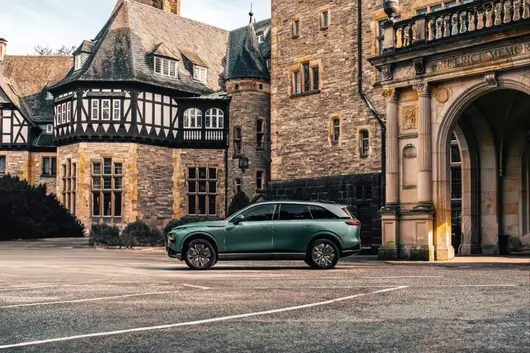


In the first half of 2026, it's not just automotive stocks that kept falling. Data from the China Passenger Car Association shows that cumulative retail sales of passenger cars declined over 20% year-on-year, and industry profit margins have dropped to a historic low of 3.4%. The new energy vehicle penetration rate surged from 39% at the beginning of the year to 63% in June. Every number needs digesting, but there isn't much time left for participants.
Against this background, Changan Automobile released its semi-annual report: overseas sales reached 454,700 units, a 51.87% year-on-year increase; but net profit attributable to shareholders is expected to decline by 57% to 67% year-on-year. 7 July 16, Tan Benhong, Deputy Secretary of the Party Committee and Director of China Changan Automobile Group, used an analogy that ran through the whole session to respond to all doubts at the mid-year media communication meeting.
"The strategy for pacing in the first 5 kilometers versus the last 5 kilometers must be completely different. At this stage, Changan is in a critical cycle of the second phase, gathering strength and adjusting structure." In his words, Changan is in a critical period of fighting a marathon.
Cutting 70,000 Units of Sales, What is Changan Swapping For?
When an automaker with 3 million annual sales chooses to actively discontinue a product with about 200,000 annual sales, what is it thinking?
In the first half of 2026, Changan decisively cut off the micro EV Lumin priced below 50,000 yuan. This single decision directly resulted in a sales gap of about 70,000 units. But this was not all.
In the "1445" global strategy released in April, Changan streamlined its product line from 63 models down to 36 models, a compression of 43%, while clearly aiming to build "one global blockbuster with annual sales of 500,000 units, and five with 300,000 units annually."

This courage to do subtraction is rare in the current Chinese automotive market. Many brands practice crazy product line expansion, stacking sales volume with SKU quantity, while Changan chose to operate in the opposite direction.A noteworthy detail is that, excluding the reduction impact of Lumin, Changan's new energy vehicle sales actually grew by 11.2% year-on-year in the first half of the year.
Changan Qiyuan's new Q05 cumulative deliveries broke 80,000 units in the first half of the year, with 21,137 vehicles delivered in June alone, winning the compact pure electric SUV sales champion for 3 consecutive months; Deepal S05 global cumulative sales broke 240,000 units, up 78.86% year-on-year. These numbers indicate that Changan's new energy business is actively choosing "what to sell".
In addition, Changan has established an internal "operational co-investment" mechanism. If a product does not make money, even if it sells enough volume, the people who invested in the project must bear the loss.

In the frenzied expansion of China's automotive industry over the past three years, "raising more children for better fighting" was almost the consensus among all players.
Now Changan is the first to call a halt, which is not only due to the SOE gene of "quality first, stability first", but also a clear judgment on the competition logic of the second half of the industry.When the industry profit margin has been compressed to the limit of 3.4%, the game of exchanging losses for scale will eventually see someone exit first. Tan Benhong obviously does not want that person to be Changan.
Start the "Second Half", Changan Digs Deep into Three Moats
If "doing subtraction" is Changan's move on the defensive end, then on the offensive end, Changan's three moats are also very clear: technical self-research, globalization, and refined operations, none of which can be missing.
Among them, the most unexpected is Changan's firm attitude towards autonomous driving self-research. There are plenty of mature autonomous driving supplier solutions available on the market. External procurement and integration is the lowest cost and fastest path, but Tan Benhong gave a judgment that left almost no room: "If automakers abandon autonomous driving self-research and rely solely on external supply, essentially they are just retaining assembly factories with car shells, without core technology barriers."

Currently, Changan's intelligent R&D team has exceeded 7,500 people, with cumulative investment exceeding 10 billion yuan in the past five years. Its self-developed "Tian Shu Pilot" system was officially unveiled at the Chongqing Auto Show in June and will be mass-produced on Changan Qiyuan Q06 in September.
Tan Benhong calls himself a "heavy autonomous driving user". When driving Avatr daily, autonomous driving is enabled in 90% of scenarios. His core positioning for his own products is safety rather than aggression: "Not following the aggressive involution route, focusing core energy on raising the safety ceiling and polishing the user experience."
This choice may not bring too much value at the market level in the short term, but Tan Benhong's ambition clearly extends beyond automobiles himself. He revealed that Changan is extending AI capabilities to more intelligent terminal fields such as intelligent robots: "In the next one to two years, everyone will see Changan's new products and landed experiences in the fields of artificial intelligence and intelligent robots."
Globalization is then the most eye-catching growth pole of Changan at present.In the first half of the year, overseas sales accounted for about 33.6% of total deliveries, equivalent to one out of every three cars sold went overseas. Four deputy general managers of the group are leading overseas business lines at the same time, and the Thailand base has achieved large-scale production.
Tan Benhong made it clear: "In the future, achieving a 50/50 ratio of domestic and overseas market sales." For Changan, it has already achieved full-chain overseas expansion covering product planning, regulation adaptation, supply chain procurement, and local operations.
When the domestic market falls into a zero-sum game, the incremental space overseas is almost an "oxygen tank" for every Chinese automaker, and Changan is clearly already ahead.

As for the strategic integration of Avatr and Deepal, Tan Benhong gave a framework of "Three Unchanged, Three Shared": the front-end brand and channel remain independent, while mid-to-back-end technology, supply chain, and ecosystem resources are fully shared. The synergy in platform architecture and supply chain procurement between the two is expected to bring a cost reduction effect of 20% to 30%.
This multi-brand operation model of "front-end in full bloom, back-end intensive and efficient" is also an embodiment of the scale management capability unique to Changan as a large group. In the future, what Changan needs to do is further bring it to the extreme.
Written at the end:
At this media communication meeting, Tan Benhong said a sentence worth thinking about: "In favorable industry conditions, enterprises still harbor hidden risks; it is easier to see their own shortcomings during industry stress periods."
This sentence can almost be considered the footnote to all of Changan's current strategic actions. Cutting products, adjusting structure, investing long-term, controlling rhythm, these decisions are hard to "prove correct" in a semi-annual report, and may even be interpreted as "stalled speed".
But if the perspective is extended to three or even five years, an enterprise choosing not to follow the herd when the industry is at its craziest, choosing not to lie flat when profits are under pressure, and choosing to adjust pacing when everyone is sprinting, this strategic stability can be seen as a scarce capability.
Of course, all strategic narratives must eventually accept the test of market results.In the second half of the year, mass production of the Tian Shu Pilot autonomous driving system, centralized launch of multiple new products, and continuous increase in overseas business volume, whether these can be converted into real market data is the key evidence for whether Changan's "marathon pacing theory" can hold water.
Tan Benhong also admitted himself: "All strategic adjustments and resource tilt will eventually fall to business performance and market results, this is the assessment goal we always do not change."
Although marathons are never won by sprinting, the audience's patience is always limited. Changan needs to prove in the following race that it not only runs steadily but also runs far.


Cover Image Source | Future Auto Daily
Author | Li Ranran
Editor | Su Peng
"In the second half of this year, domestic car retail sales will not grow counter-trendly; the entire industry must prepare mentally for a year-over-year decline in annual sales of 15% to 20%." This is Li Bin, founder, chairman, and CEO of NIO, recently stated at the 2026 China Automotive Chongqing Forum. He believes the automotive industry has entered the fiercest stage of the final competition, and the market environment this year will be very difficult.
According to data from the China Passenger Car Association, domestic car retail volume in January-May declined nearly 20% year-over-year, with the drop in early June exceeding 22%. The entire automotive industry has yet to shake off the overall pressure operating state, consumption demand recovery pace is lower than industry expectations, price internal competition, consumer wait-and-see, heavy concentration of new car releases, and their homogenization factors continue to affect the terminal market.
In the context of overall car market sales volume pressure, some structural changes are also accelerating evolution. In May, domestic new energy penetration reached 62.9%, creating a historical high, rising nearly 10 percentage points year-over-year; pure electric models penetration in the entire car market reached 42.2%, rising 10.8 percentage points compared to the same period last year. Additionally, among the top ten sales rankings in the SUV sub-market, there were also 9 new energy models, while pure electric models locked the top three, "oil retreats, electricity advances" trend becoming clearer.
Li Bin believes the automotive industry has entered the critical stage of pure electric inflection point climbing, various car manufacturers' market performance cannot rely solely on single hit products or unique configurations. Affected by fast technical iteration speed, serious new product homogenization and other factors, new car effect death valley appears constantly, traditional fuel car "one trick fresh" competition model must give way to brand influence, product definition, technical depth, supply chain capability, cost control, sales service system and other comprehensive strength competition.
Car manufacturers' final competition results will be intuitively reflected in sales and financial report data. In Q1 2026, NIO revenue was 25.53 billion yuan, growing 112.2% year-over-year, gross margin 19%, also creating a new high in the past two years. In January-May this year, NIO's sales volume also grew 68%.
The eye-catching performance behind the Q1 financial report离不开 ES8 support, NIO brand delivered 58,500 units in Q1, ES8 about 45,000 units, occupying the lion's share of total sales, while as a flagship product, it also raised the company's overall gross margin.
But one product hot success cannot replace the company's stable development, Li Bin hopes NIO, Onvo, Firefly three brands advance together, maintaining high-end positioning and technical leadership in their respective target markets: Firefly in small car market still is high-end positioning, price about 50% more expensive than same-level small cars, main sales over 120,000 yuan, configuration and service can support this price; Onvo emphasizes technology for family, safety quality, technical architecture no sacrifice; NIO targets high-end market, providing all-scenario tech experience and better emotional experience.
Regarding sales volume, each brand of NIO temporarily does not set single model fixed sales target, "Hope NIO after entering three brand development stage, can maintain 40%-50% growth". Although Onvo sales this year appeared volatility, overall this newly established two-year brand already has initial scale. NIO side revealed, after Onvo L90 launch, in pure electric large three-row SUV market area sales volume first, Onvo L60 after launch, in same-level cars also ranking top three.
"Establishing a new brand is not easy, difficulty is bigger than imagined." Li Bin said, originally thought Onvo brand awareness could be quickly established, but research data showed many people simply don't know Onvo brand, "Awareness equivalent to NIO 6 years ago or even earlier."
However, from sales perspective, Onvo current sales volume is more than NIO brand delivered 2 years sales. Onvo Auto President Shen Fei said, "Originally Onvo overall sales volume climbed fast, one year achieved NIO 4 years volume."
With new Onvo L60 release launch, first half of this year, NIO new models basically released finished, next will use more energy on selling cars and serving users. New Onvo L60 purchase starting price 202,800 yuan, battery rental solution starting price 142,800 yuan, integrated NIO's several flagship smart technologies: NIO self-developed 5nm smart driving chip Shenji NX9031, full domain 900V high voltage architecture, latest version NIO World Model NWM and SkyOS·Tianshu system etc.
June 11 launch evening, new Onvo L60 had over 90% orders concentrated on Max+ and Ultra+ versions, over 90% users chose Coconut+ smart driving system, Shenji NX9031 chip with LiDAR full configuration combination.
Lightweight is also new Onvo L60 major highlight, body white weight is 377kg, lightweight coefficient 2.22, whole vehicle unsprung mass 198kg, compared to ordinary steel structure weight reduction 20kg.
Data statistics show, 2026 Jan to April, China new energy passenger car average curb weight reached 1,939.3 kg, increased 27.5% compared to 2020, short 6 years time cumulative weight increase over 400 kg. Big car increase continuously compress road life, car weight every increase 20%, on road destruction rate will become original 1.2 to the fourth power, i.e. 2.07 times.
Additionally, with new energy penetration rate continuously rising, space big, battery many, configuration full etc user demand rise, also inevitably to vehicle handling, safety, durability, service life etc produce a series of impact, body weight reduction inevitable, lightweight is inevitable road.
Li Bin said, lightweight has become industry consensus, can considerate user and social value, also reflect a car manufacturer's comprehensive R&D capability. He believes lightweight has four difficulties: first is trade-off, battery choice is relatively restrained, not blindly pursue "big"; second is systematic engineering, such as smart fuse needs whole car high voltage architecture, low voltage architecture all aspects can support; third is engineering capability, need considerate safety and structure; fourth is cost, 85 kWh ternary lithium vs lithium iron phosphate light 100+ kg, but must bear higher cost.
Speaking of cost problem, this year, raw materials price rise wave, car-grade memory, lithium carbonate etc cost pressure transmit to terminal, Onvo single car cost also price rise over 10,000 yuan, calculated to final selling price about 15,000 yuan. Li Bin confessed, now supply chain price rise more, "Onvo L60 has gross margin but very miserable, so this year gross margin and profit growth mainly look at total amount."
On user aspect, according to Shen Fei introduction, Onvo Auto repeat purchase users, traditional luxury brand owner proportion 35%, joint venture brand owner proportion 30%, NIO system inside repeat purchase user proportion 10%, other new energy friend user proportion 10%, total about 85%. This shows, Onvo attracted many fuel car customers.
From user perspective view, now new energy infrastructure perfect, EV product power leading, fuel car user swap buy new energy car is general trend. Li Bin believes, "Previous years because infrastructure not developed, charging swap conditions not full, user choose range extended, choose plug-in hybrid all reasonable. But now user easily can make choice, choose pure electric, choose smart EV is natural thing."
Shen Fei also calculated a detailed account: even plus battery rent, electricity fee, NIO select rent power solution still saves thousand eight hundred yuan compared to fuel fee. Currently, NIO, Onvo battery rental solution penetration rate already over 90%, Li Bin judge, industry overall penetration rate will with model sales volume improvement synchronously rise.
Below is NIO Company Founder, Chairman and CEO Li Bin, Onvo Auto President Shen Fei accept Future Auto Daily and other media interview transcript (edited):
Q: What is biggest difficulty for car achieving lightweight? Is enterprise for config trade-off, or R&D accumulation or route choice, this biggest difficulty where?
Li Bin: Lightweight meaning in automotive engineering field is consensus, lightweight is automotive comprehensive R&D capability manifestation, because indeed can actually bring benefits for user and society, including for whole vehicle handling, whole vehicle safety, structure durability and whole vehicle long-term life, indeed many benefits, this is Onvo including NIO always persist lightweight area important reason.
Lightweight do well is very not easy, first need make trade-off. If blindly pursue very long range, will definitely use very big lithium iron phosphate battery, like Onvo, Tesla all lightweight better, in battery choice relatively restrained, this is not stealing material reduce work, but need make trade-off, because cost boundary is limited.
Second, smart fuse problem, not just replace traditional fuse with smart fuse so simple, whole car high voltage architecture, low voltage architecture all aspects can support, this is systematic engineering, behind big technical content. Additionally, there is integrated design, make better space, bring better lightweight, including full domain 900V technology on lightweight also benefits, technology entrance threshold very high, need bottom-level R&D capability.
Third, engineering capability. Like new Onvo L60 white body lightweight coefficient to 2.22, more rely on engineering capability, need ensure safety structure considerate situation achieve, sometimes material usage transition mostly no safety gain, like some house although look wall very thick, not represent must structure solid.
Finally, cost also important, need bear lightweight technology bring cost rise. Like NIO, Onvo long range version, if don't want add too much weight must use ternary lithium battery, this is very big money. Ternary lithium battery energy density high, same battery capacity weight lighter, basically than lithium iron phosphate light, like 85 kWh ternary lithium battery vs 85 kWh lithium iron phosphate battery reduce weight 100+ kg. Therefore, lightweight need comprehensive consider many things.
Q: NIO recently participated in formulating Singapore swap standard, global first batch of passenger car swap written into national standard case, this means NIO swap model from enterprise standard go to national standard? NIO swap ecology overseas situation how?
Li Bin: We in Europe already have over 60 swap stations, mainly in Northern Europe like Norway, Germany etc 5 countries, among Norway has over 20 swap stations, Firefly also in Singapore market sell. We with Europe some countries, Singapore etc, always and relevant department in swap station standard aspect have very active exchange.
At that time Shen Fei still in charge of NIO Energy, NIO and national relevant department push swap standardization, participated very many standards, go all out push swap standardization, not only in domestic, also include international, because indeed can solve EV "only charge cannot swap", car battery different life etc many problems.
Q: Onvo L60 initial launch mainly against fuel competitors, this time obviously path adjustment, overall product strategy what? L60 on user attraction how?
Shen Fei: From Onvo whole brand user repeat purchase data view, our user group is from relatively high-end brands, BBA and traditional luxury brands roughly proportion 35%, joint venture brand owner account 30%, other new energy friend user proportion 10%, NIO community repeat purchase also nearly 10% proportion, from traditional fuel car camp quite many.
From user perspective this account very easy to calculate, from fuel car transfer over, originally second hand swap also can worth some money; from monthly car use cost say, NIO select rent power solution even plus battery rent, electricity fee, still saves thousand eight hundred yuan compared to fuel fee, so no reason not to convert.
I go frontline run down feel, everyone consumption habit is hand has one car still can好好 drive, go understand other new car driving performance not so strong. But everyone still have way to exchange, including like this time cave smart driving video, will let potential consumers touched.
Li Bin: Our user source among, BBA, joint fuel proportion and NIO system user repeat proportion, add together about 85%, that is new purchase less, whole market already entered stock era, many families have not just one car, mostly are swap.
From user perspective view, with today new energy infrastructure and EV product competitiveness, fuel user swap also likely will choose new energy car. Previous years because infrastructure not developed, charging swap conditions not full, user choose range extended, choose plug-in hybrid all reasonable. But now user easily can make choice, choose pure electric, choose smart EV is natural thing.
This year Jan-May, whole car market total volume year-over-year decline about 20%, especially May fuel down 40%, but pure electric overall is growth, deeply reflect car market already entered stock era, repeat purchase, repeat, swap become mainstream, under this situation, I believe smart EV pure electric technology route will definitely get more user choice.
Q: NIO Company first half this year basically release new models concentrated finished, but friends still have many new models poised to go, will this make NIO already released models receive impact?
Li Bin: Every car have very strong competitiveness, Onvo L60 although on 2024 released, still now has very strong competitiveness. We in tech leadership have confidence, recently released models in longer time period will maintain competitiveness.
2022 released ET7, smart driving still continuously improve, its hardware capability not fully dug out. In tech layout aspect we always relatively advanced some, for next products on market competitiveness very confident, not because second half no new car release worry order problem.
No new car rather can down-to-earth sell cars, serve users. Firefly is example, release over one year, middle some small iterations, now order waiting cycle again become longer.
Q: Onvo L60 smart driving level compared to Tesla FSD where level?
Li Bin: Tesla FSD latest version I haven't experienced,正式发布 will go experience, good study. Tesla smart driving in model and compute etc aspect indeed very leading, have many places worth learn.
But NIO from self-developed chip to sensors, to whole world model + reinforcement learning route, and new car through extreme narrow cave crossing, explain we also possess such capability. Later will increase in compute aspect input, perfect data loop training, continuously improve smart driving experience upper limit, we on later continuous progress very confident.
Smart driving fully reflect each family's comprehensive tech capability, this you chase I catch situation also quite good, hope everyone also go experience experience, including new Onvo L60 smart driving.
Q: First half this year Onvo released three new models, all use flagship smart three major components, dense update behind consideration what? These technologies in latest industry competition state can establish which moats?
Li Bin: From release speed view, originally not provide radar Coconut, Coconut+ and NIO Gen 2 platform cars, these smart driving baselines, basically can in plus minus not exceed few weeks time window simultaneously release. This very not easy, because in time span and hardware difference have challenge.
Reason because through full stack self-research from internal can unify places all unified together, this point very important. From ET7 start to Onvo L60, visual sensor layout relatively advanced, 7 8-megapixel camera + 7 surround camera, including sensors also consider long-term standardization.
Onvo plus LiDAR, with NIO in planning aspect more consistent. Whole tech baseline can reuse represent data and tool chain reusable, model deployment and variation relatively easier manage. So from Gen 2 product start whole smart driving bottom-layer hardware self-research advantage show: memory bandwidth very important, often underestimated; ISP multi-mode signal processing ability in extremely dark, extremely strong light environment clarity, resolution and image restore ability very strong.
Comprehensive speak, this reflect NIO in smart driving hardware, data loop long-term thinking. So now Gen 2 car group intelligence capability bring data loop capability, same make Coconut etc benefit, this is engineering system and architecture thinking.
Q: New Onvo L60 after launch, this year Onvo all new models release finished, order situation how? Onvo monthly sales expectation? Increment price drop impact on gross margin how?
Li Bin: We on current market trend attitude relatively cautious, rarely say NIO each brand individually need reach how much sales. But still hope NIO enter three brand development stage after, can maintain 40%-50% growth, this year Jan-May NIO growth 68%, performance quite good.
Second half start, more energy will be used sell cars, serve users. Onvo these several cars market competitiveness all very strong, I believe can reach internal预定 target.
Gross margin aspect, now supply chain price rise more, Onvo L60 has gross margin but very miserable, so this year gross margin and profit growth mainly look at total amount.
Q: Will Onvo optimize rental solution, reduce user rental rate? Currently battery rental overall penetration rate how?
Li Bin: Battery rental solution penetration rate over 90%. As for industry penetration rate, we cars sell well, penetration rate high. CATL etc friends also have swap solution, participants more market penetration rate naturally rise. We with many friends in swap aspect have strategic cooperation, but friends whether do swap need relatively long time make decision and product and business preparation, our swap ecology always open.
Q: Car-grade memory price rise to Onvo cost gross margin actual impact? CXMT cooperation progress how? After can imagine space how big?
Li Bin: This round price rise impact big. Taking Onvo example, single car cost rise 10,000+ yuan, calculated to final selling price plus tax etc impact about 15,000 yuan. Non-chip part like battery raw material lithium also rise many, this year indeed cost pressure very big.
CXMT plant distance us very close, all in Economic Development Zone North District, distance maybe just 1 km. Currently cooperation LPDDR5X vehicle verification progress smooth.
Q: Can detailed interpret Onvo user source?
Li Bin: Just Shen Fei also said a bit, BBA and traditional luxury brand user about 35%, joint fuel car user 30%, early pure electric and range extended car repeat purchase swap about 10%, other source including new purchase etc.
Q1 Onvo average selling price 240,000 yuan, higher than some traditional luxury brands, so Onvo indeed is a family-oriented high-quality brand. New Onvo L60 main sales version Max+ starting price 202,800 yuan, last night orders over 90% choose Max+ and Ultra+, over 90% choose Coconut+, Shenji NX9031+ LiDAR version. Onvo in 200,000-300,000 yuan area product layout and brand positioning, quite fit target users and consumption trend.
Q: Beginning of this year BYD release flash charging whole market think will affect NIO swap, but from first half data view, flash charging and swap products also still maintain growth. Next in technology convergence process, efficiency still charging replenish aspect inviolable truth? How judge future replenish direction?
Li Bin: Happy to see more and more car manufacturers charge swap infrastructure aspect investment, flash charging industry have good promotion role, let each party more focus infrastructure investment, no longer simply rely public charging piles.
NIO in charging pile construction aspect very active, persist chargeable, swapable, upgradeable. Of course our construction idea with others also differ, currently already have 86 charge road landscapes, charging piles built in others don't want build places, like Inner Mongolia Expressway, Jilin Expressway earliest all we built. Our starting point very simple: user go where, if there no infrastructure, at least guarantee. We early also have mobile charging car, now dispatch rate lower, mainly use Xinjiang, Tibet etc remote area emergency rescue.
I also want to emphasize, swap and charging not opposite. We very early required, user home, unit where can install charging pile, definitely help install, so our user charging pile installation proportion industry leading, because have national energy service team push, higher efficiency. Behind thinking also simple: home install charging pile, can charge night, day to unit charge, is best experience.
Our swap process not get off car, experience better, including swap station some other dimension value:
First, thoroughly solve car battery different life problem, separate car and battery, for user and society long-term interest have benefit. Buy battery not only look short-term experience, look 8 years, 10 years even 15 years, not arrived time just abandon. Swap station internal smart charging strategy for battery life very important, through operation extend life, basically can every battery life improve 1.5 years and above.
Second, energy attribute. Swap station is natural energy storage facility, we 3900+ swap stations equivalent to 7 GWh energy storage. In China new energy power ratio more and more high background, value will gradually reflect. Many swap stations already participate grid response, every day do energy storage, as energy infrastructure efficiency very high.
Therefore, super charge, flash charge and swap not opposite. Swap indeed can solve many flash charge can't solve problems, everyone now see fast or shallow fast. Fast charge to certain speed and time after, boundary benefit not so big, at home or unit slow charge also completely fine.
More important swap for car battery different life, battery life and safety meaning, and as distributed energy storage facility in new power system value, these hard to charging solve.
Q: Now industry among other manufacturers also prepare release second brand or new series, Onvo these two years more exploration have what experience worth external share?
Li Bin: We feel still underestimate establish a brand difficulty. NIO brand on 2016 first release, until now 10 years, that year market attention high, easy as new force representative, have heavenly time geographical people factors.
Onvo as new brand, originally thought brand awareness can quickly build. But research data show, many people simply don't know Onvo brand, awareness equivalent to NIO 6 years ago or even earlier. Today market environment, new brand hard get attention, establish brand than imagined hard, difficult.
But Onvo in brand concept build aspect do well: serve who, what positioning very clear—"Make family life better", May 15 we speak "Every journey, all Onvo", Onvo is a family service high-quality brand. Quality and safety, vitality community etc brand pillars also clear, user also will response.
But market challenge indeed very big, how make brand be remembered, touch heart, not only product config and performance how, more is can cause everyone resonance. L90, L80, new L60 launch on, all spend large time through user scene and real stories reflect brand bottom layer thinking, spiritual layer thinking, we also hope and target user resonate.
Q: Onvo initial goal is volume, but from recent few months sales volume situation look seems not reached expectation height?
Shen Fei: About sales volume expectation, I with internal colleagues often share, need firm confidence, don't underestimate. Onvo is 2 years brand, current sales volume than NIO delivered 2 years still more. Originally Onvo overall sales volume climb fast, one year achieved NIO 4 years volume.
But we need face still have many problems need solve, continuously go progress. Of course external won't see so, single user buy one car must choose one suitable for oneself, for whole industry say, including sit media teachers, everyone will put Onvo and NIO together look. So I hope whole team in keep confidence, keep have right cognition to self when can continuously progress.
Li Bin: Supplement, L90 after launch, in pure electric large three-row SUV market area sales first, Onvo L60 after launch same level also top three, so performance thing depends on how look. We now still need face brand construction and sales system capability construction, it have a process.
Q: Onvo L60 value retention not bad specific reason? World model scheme after, smart driving team compute and manpower input and later plan?
Shen Fei: About value retention, Onvo L60 product power is fundamental reason, user on this car various aspects very satisfied. Second is price policy etc aspect relatively stable, including new L60 pricing also in very hard balance new car, second hand car etc aspect factors.
This is multi-effort result, including our direct sales model, swap capability etc aspect all have contribution, everyone focus value retention right, it reflect brand comprehensive competitiveness.
Li Bin: In speak hardware and model competitiveness when, everyone don't forget compute. Why beginning of last year everyone worship DeepSeek, core is need training resources far less than US peers.
Last year, compared to domestic do well peers, NIO smart driving training compute indeed only their one fifth or one tenth, and top peers compared even less, with Tesla even cannot compare.
Compared last year, this year we roughly increase several times input, see effect still very good. This year second half will have larger compute input, overall compute operation relatively stable.
Q: New Onvo L60 price and NIO ES6 differ 100,000 yuan, tech equipment already relatively close, NIO three brands between how define market?
Li Bin: NIO, Onvo, Firefly in their respective target market all keep high-end positioning. Like Firefly in small car market still is high-end positioning, compare same level small car price high 50% roughly, domestic many pure electric small car roughly 70-80,000 yuan, Firefly main sales is over 120,000 yuan. Its product and service can support this price, so small car safety so good, 9 airbags etc create many safety test score records.
Onvo target family market, also keep high-end positioning. Q1 Onvo average selling price 240,000 yuan, most mainstream family brands cannot reach this average price. Onvo positioning have enough tech and product support, new Onvo L60 is mid-size SUV tech flagship, emphasize tech for family concept, safety quality foundation. We think, family car user very care these, like some luxury config optional, but safety quality and tech architecture no trade-off, this keep brand color.
NIO target high-end market, adapt user group more, like all-scenario tech experience, ES9 executive flagship, ET5 all have their unique emotional experience, also Horizon etc have special tech atmosphere, let user have better mood and emotion experience.
These three brands common point: keep high quality, keep in their respective sub-market high-end positioning and tech lead. On this basis again revolve user needs solve, we won't blindly pile config, will look which points can with target user group produce emotional resonance, function experience sort, different target market priority different.
Q: New Onvo L60 officially release, three flagship tech down to 200,000 yuan market, is out of what judgment? Stand at this time point to NIO how judge?
Li Bin: Onvo L60 from birth day, use very many NIO first launch tech, full domain 900V is NIO first is L60 on mass production, including high performance, high efficiency drive and smart fuse all first mass production, SkyOS·Tianshu full domain application first mass production car model also Onvo L60.
Smart driving aspect, chip exist a ramp process, first on ET9 carry, then to NIO Gen 3 ES8, gradually push to Onvo brand, every car target market must apply best tech. New Onvo L60 is mid-size SUV tech flagship, in many tech aspect is currently industry best, this is fact.
Q: Many brands release their smart driving chip, NIO chip what advantage?
Li Bin: Make a smart driving chip, have many methods, let others help define design, this is not what hard matter, industry many people all do. But important is this chip not that chip, like one car you find engineering design company make it, or through yourself full stack self-research, this involves enterprise own complete engineering capability, many core parts need self-research, input larger, difficulty also larger.
NIO Shenji NX9031 team 600+ people, from front-end to back-end have complete design capability, build this capability very not easy, with simple define params others do difference very big.
Additionally, smart driving chip performance evaluation cannot simply compare one point, need from multi-dimension view: First, inference compute; Second, memory bandwidth, on support model size and run speed very important, we memory bandwidth basically is industry 2 times; Third, multi-mode signal processing ability, need very detailed work, cave crossing performance good also and this have relation.
Smart driving foundation is vision, cannot just look light good when, many scenes light not good, this test bottom whether can very well process. Also chip redundancy backup when need achieve millisecond level hot switch, two chips interlink, interface and ability strong, for future L4, L3 smart driving also very important.
Q: Onvo L60 cave crossing creative reaction very good, biggest reason what?
Li Bin: New Onvo L60 whole smart driving baseline basically with NIO ES9 aligned, use latest version NIO World Model. In various extreme conditions, especially extremely dark light environment image processing ability, NIO World Model inference ability, in actual test include in cave show安心感 still quite good.
From chip, OS, reinforcement learning etc, our smart assist driving route foundation build relatively deep. Before everyone feel iteration slow, just like build swap stations, also have many doubts, but I think sharpening axe not delay woodcutting.
Auto industry is marathon, not one day, is very long competition. If short-term goal build 100 floor high building, then we build can support 150 floor foundation; If build 10 floor fast can let people see live in, impossible on 10 floor, 50 floor foundation build 100 floor high building. Everyone work thinking when assess time dimension not same, so到底 use how long time assess one thing, decide everyone see NIO work reasonableness and behind logic.
Sometimes use one quarter, half, one year time assess, feel NIO this company quite silly. But if use 3 years, 5 years look seem still have reason, if use longer time look, feel quite reasonable.
We want to put long-term thinking, long-term goal and short-term exec how combine good, these two years also push user value all-staff operation org reform. This is management solve things, in smart driving also same, smart driving also whole company tech innovation, system innovation miniature.
Q: My friend is Hefei local, want buy new Onvo L60, but his wife Model Y brand worship, if you are sales how persuade him?
Shen Fei: From conversion rate speak, Onvo brand and Model Y is number one, different months inside, actually from brand consumption say, earliest batch like tech taste user already towards domestic brand switch.
Now market new energy penetration rate reach 60%, user swap car know buy electric car. Actually these consumption groups relatively steady, conservative, unwilling make mistake, Tesla as exist time relatively long brand, easy become "buy this possibly no mistake" choice, this is we need breakthrough point, need invite these users come experience.
Onvo in whole NIO 11 years tech basis above, new Onvo L60 is 200,000 yuan level most tech competitiveness, most tech feel one car, comfort experience all super class. But car advantage rely language say always one-sided, really need to scene come experience.
Li Bin: New Onvo L60 size and Model Y similar, now new Onvo L60 have 60% optional, 200,000 plus have fridge, TV, sunshade, comfort big sofa don't say, also small table, back also can install 52L freezer, sun protection, fridge, rear screen drama needs all solved, also adjustable seat, lie inside very comfortable.
And cheaper than Model Y much, whole car buy cheap 60-70,000. Tesla domestic FSD subscription is 64,000 yuan, same smart driving experience choose us save 100,000+; if buy car rent battery, diff more, we also can swap, so don't compare. Simple speak is luxury config + space big + smarter.
—END—
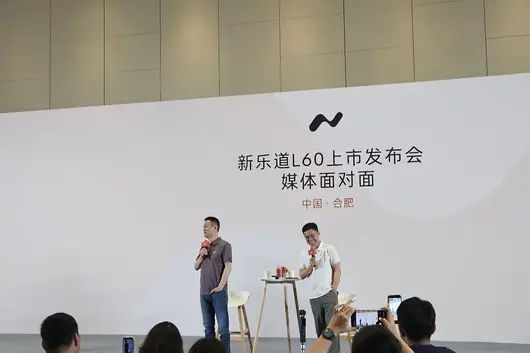

At the beginning of June, various automakers successively released their sales performance reports for May 2026. According to the forecast data released by the CPCA (China Passenger Car Association) on May 23, domestic new energy passenger car retail volume was expected to reach 950,000 units, penetration rate approximately 62.5%, setting a new historical high. This data further confirms the continued deepening of electrification transformation, as the new energy vehicle market is steadily transitioning from "policy-driven" to "market-driven".
Looking at specific sales data, the top tier pattern of new forces experienced severe differentiation in May - Leapmotor led by a "huge gap" with monthly sales exceeding 80,000 units. At the same time, traditional auto groups represented by BYD, Changan, Geely, etc., saw their self-incubated new energy brands also show a collective surge in volume in May, and the strategic value of multi-brand matrices is accelerating realization.
New Forces Matrix: Leapmotor 80,000+ "Huge Gap Lead", Multiple Brands Gathered in the 30,000 Bracket

The new forces market pattern in May showed distinct tiered characteristics: Leapmotor exceeded 80,000 units in a single month, forming a leading advantage; NIO, relying on three-brand synergy, reached sales volume of 37,700 units; Li Auto, Xpeng, Xiaomi, AITO, and other brands were concentrated in the 30,000-35,000 unit range, forming the most competitive core battlefield.

Image Source: Leapmotor
Leapmotor became the undisputed biggest highlight of May. According to Leapmotor official data, May total delivery volume reached 81,569 units, year-on-year growth 81%, month-on-month growth 14.26%, once again breaking the brand's single-month delivery historical record. Leapmotor also became the first enterprise among Chinese new automakers to exceed 80,000 units in single-month delivery.
Looking at specific models, Leapmotor A10 exceeded 20,000 units in single-month delivery, D19 new orders continued to maintain above 10,000 units, C Series global cumulative sales already exceeded 800,000 units. By the end of May, Leapmotor cumulative delivery in the first five months exceeded 300,000 units.
Leapmotor's 2026 annual sales target is 1.05 million units. Behind this ambition is Leapmotor Chairman Zhu Jiangming's proposed "2026 Sprint to 1 Million Units" strategic goal. With June C Series refresh, D99 pre-sale, and Lafa5 large-scale overseas expansion, Leapmotor is expected to launch a shock at the new milestone of 90,000 units monthly delivery.

Image Source: NIO
NIO Company also showed steady performance in May. Data shows, NIO May delivery of new cars 37,705 units, year-on-year growth 62.3%, month-on-month growth 28.4%.
NIO's growth benefits from the strategic effectiveness of three brands working together - NIO brand delivered 20,013 units, year-on-year growth 50.8%; ONVO brand delivered 12,029 units, year-on-year growth 91.5%, month-on-month increase as high as 124.8%; Firefly brand delivered 5,663 units, year-on-year growth 53.9%.
From the product level, flagship SUV NIO ES8 sold 11,475 units in May, maintaining competitiveness in the high-end market above 400,000 yuan. By the end of May, NIO company cumulative delivery this year reached 150,500 units, year-on-year growth 68.7%, cumulative delivery total has reached 1.148 million units.
Li Auto May delivery 33,350 units, by end of May historical cumulative delivery volume has reached 1.703 million units. Li Auto Chairman and CEO Li Xiang stated, since first quarter this year delivery volume has entered a growth track, among them Li Auto i6 delivered volume exceeded 20,000 units for three consecutive months, stable in top three pure electric SUV sales; May, new Li Auto L9 officially released and started delivery, L Series models entered new upgrade cycle, new L9 Livis order volume exceeded 10,000 units within two weeks of release.

Image Source: Xpeng
Xpeng Group May delivery 32,158 units, month-on-month growth 3.7%, creating a new monthly delivery high since 2026. This growth mainly stems from the continuous effort of existing product matrix - 2026 Model P7+, G6, G9 and G7 Super Range Extender versions etc. models have completed capacity ramp-up, MONA M03 maintains hot sales in 150,000 yuan level pure electric market.
On May 20, new tech flagship Xpeng GX officially launched and started delivery, providing pure electric and super range extender two power, total 8 models, 12 hours after launch firm orders reached 24,863 units, among them Ultra flagship version ratio exceeds 80%.
Xiaomi Auto May delivery volume continued to exceed 30,000 units, holding steady the "30,000+" step for the second consecutive month. Xiaomi has evolved from early SU7 "single product holding the flag" to SU7 Series and YU7 Series dual-line parallel product pattern.
By end of May, Xiaomi Auto first five months cumulative delivery volume approx 140,000 units, completed full year 550,000 units delivery target 25.5%. As a new force entered market only two plus years, Xiaomi maintaining monthly sales 30,000+ level already belongs to difficult, but second half year average monthly delivery needs to reach approx 55,000 units to achieve full year target, challenge still exists.

Image Source: HarmonyOS Intelligent Alliance
May 2026, HarmonyOS Intelligent Alliance single month delivery volume reached 46,122 units, achieving year-on-year and month-on-year dual growth. Among them, AITO Auto full series models May delivery 34,320 units, month-on-month growth 48.2%, 1-5 months cumulative year-on-year growth 28.7%.
New generation AITO M9 launched 24 hours firm orders exceeded 20,000 units, and achieved launch and delivery immediately; AITO M6 launched first month delivery exceeded 20,000 units.
From competitive landscape perspective, besides Leapmotor, remaining several new force brand delivery volumes front and back gap not big, ranking may interchange at any time, pattern highly dynamic. From this "30,000 bracket cluster", it can be seen, new forces from "break 30,000" to "stand firm 40,000" still need to cross growth threshold - this both tests product matrix richness, and puts higher requirements on supply chain management and delivery system.
Domestic New Energy: Multiple Brands Work Together, Enter Fast Lane

In the domestic new energy brand matrix that traditional auto groups are accelerating promoting, May also handed in an outstanding answer sheet. Looking at overall data released by major vehicle groups, the trend of steady improvement in new energy penetration rate is converting into tangible sales volume scale.

Image Source: BYD Auto
BYD May sales 383,000 units, ranking first in industry, among them passenger car sales 377,000 units. Dynasty Network and Ocean Network sales 330,200 units, still BYD sales cornerstone; Fangchengbao sales 30,186 units; Denza sales 16,303 units; Yangwang sales 286 units.
In terms of overseas market, BYD May export new energy vehicles total 160,600 units, year-on-year growth 80.7%, creating new historical high again.
Geely Auto May group total sales volume 238,000 units, realized same month-on-month dual growth for three consecutive months. That month new energy model sales volume 133,000 units, accounted for sales volume ratio 56.1%, exceeded 50% for four consecutive months.
Underlying Zeekr brand May delivery 34,377 units, year-on-year growth 81.8%, creating new historical high again - Zeekr 009, 9X, 8X etc. models ratio nearly 50%, driving brand single car transaction average price year-on-year increase 52.4%, holding steady in luxury brand camp.
Lynk & Co brand May sales 20,732 units, new energy sales 14,688 units, month-on-month growth 17%, new energy sales ratio as high as 71%.

Image Source: Changan Auto
Changan Auto May global delivery 209,000 units, new energy vehicle delivery 92,000 units. Changan electrification transformation shows multi-brand matrix head-to-head competition characteristic: Changan Qiyuan May delivery 34,528 units, among them new Q05 delivery 15,812 units, Thailand launch three days orders exceeded 3,000 units; Deepal Auto May global sales 33,243 units, year-on-year growth 30%, 1-5 months overseas cumulative sales 28,704 units, year-on-year growth 167%; Avatr May delivery 7,336 units, showing continuous upward trend. Sorting out data of each month this year, Avatr from January 2,216 units, February 4,033 units, March 5,143 units, April 5,279 units climbed up to May 7,336 units, visible its growth momentum.
SAIC Motor Group May vehicle sales volume 349,000 units, among them new energy vehicle sales 182,000 units, year-on-year growth 46.49%. Underlying IM Motors May delivery 10,023 units, holding steady 10,000 unit gateway for two consecutive months, 1-5 months cumulative sales year-on-year growth 115%; SAIC Passenger Car new energy 1-5 months cumulative reached 174,000 units, year-on-year surge 195%, MG4 Family 8 months sales broke 10,000.

Image Source: eπ Tech
Dongfeng system domestic new energy brands also performed outstandingly. Dongfeng eπ Tech May delivery 24,830 units, year-on-year growth 42%, 1-5 months cumulative delivery 109,600 units, overseas market year-on-year growth 194%. Voyah Auto May delivery 13,003 units, year-on-year growth 30%, 1-5 months cumulative delivery 62,041 units, year-on-year growth 35%.
Hyper Aion BU May sales 33,140 units, year-on-year growth 23.76%, among them Aion i60 monthly sales continued over 10,000. Arcfox Auto May sales 17,943 units, year-on-year growth 32.82%, overall performance steady, Alpha S5, Koala etc. models are its main force models, May started pre-sale Arcfox Beta S3 and launched Wayfind V9 future will further support its overall sales.
Conclusion:
From overall industry view, May new energy penetration rate approx 62.5%, new high again. Domestic brands have become important market force, traditional big factory late advantage showed - Geely new energy ratio exceeded 56%, Changan new energy approaching 100,000 units, SAIC new energy year-on-year increase over 46%. But there is a problem still cannot ignore, multi-brand matrix at the same time covering segmented markets, also faces resource integration and internal friction control test.
Looking forward subsequently, as multiple new models enter delivery cycle, new energy market expected to continue growth. Can Leapmotor stabilize "One Super" status? Who in 30,000 bracket cluster will break out first? These will be the highlights coming next.
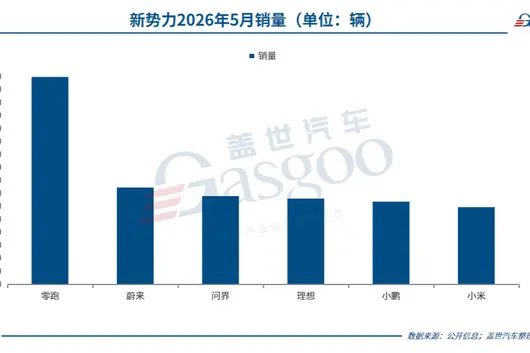

[First Commercial Vehicle Network Original]
Since the beginning of this year, Foton Motor's overseas business has continued the strong growth trend of last year, and the "Comprehensive Internationalization" strategy has entered a new phase.
In May 2026, Foton Motor's total sales exceeded 58,000 units, up 17.3% year-on-year; among them, overseas sales broke through again, with a single-month sales volume of 18,000 units, up 64.3% year-on-year. Cumulative sales from January to May reached 89,000 units, up 38% year-on-year, continuing to lead China's commercial vehicle exports. This report card is not only a rise in numbers but also the inevitable result of its years of adhering to strategic stability and deepening localized operations, marking that Foton's globalization process has steadily entered the harvest period of high-quality development.
For details, please refer to the latest report brought by First Commercial Vehicle Network.
Structural Growth Drives May Sales to New Highs
In May, Foton Motor's overseas single-month sales exceeded 18,000 units, up 64.3% year-on-year, continuing to lead the Chinese commercial vehicle overseas export industry. Cumulatively, from January to May 2026, Foton's total overseas exports exceeded 89,000 units, up 38% year-on-year, maintaining strong growth momentum on the basis of last year's high base, showing the resilience and vitality of its global market layout. This series of positive signals has laid a solid foundation for achieving its annual overseas goals.

Behind the high growth is the continuous optimization of the export structure and the full-scale effort of high-value-added models. The May data continued the strong momentum of the previous high-end transformation, among which the high-end product line represented by Auman heavy trucks grew particularly outstanding. In May, driven by large order deliveries in strategic markets such as Africa and Central Asia, the Auman heavy truck product line's growth also reached a new high. In addition, Foton Cavan CAVAN C1 recently appeared at the German IFAT Exhibition, receiving high attention from the European market, and also added support for the export of high-end new energy products.
From the perspective of regional markets, Foton's global map presents a gratifying situation of "blooming in multiple points and comprehensive breakthroughs". The high-end strategy in the European market has shown initial results. With the brand effect brought by the TUNLAND V9 pickup winning international awards, as well as the batch delivery of electric light trucks in Spain, European orders continued to maintain high growth from January to May. In Africa, with the successive delivery of the Dangote Group's order of more than a thousand trucks in Nigeria, and the capacity release of the local factory in South Africa, Foton has become a key participant in infrastructure construction and logistics transportation in that region. This full-spectrum breakthrough from points to surfaces, from traditional power to new energy, makes the foundation of Foton's overseas market growth more solid.
Localization Operations Build Competitive Barriers
The secret to sales continuously leading lies in Foton's deep insight into overseas market laws and the solid cultivation of "long-termism". Unlike simple trade models, Foton takes "putting global scenarios into the database" as the origin of product competitiveness. Relying on overseas technology centers spread across the globe, Foton has established a "Global Adaptability Compendium" covering 59 countries and 140 high-frequency markets, transforming 16 typical scenarios such as high temperature, high cold, and dusty into technical standards of 49 key modules and 91 quantitative performance elements, thereby ensuring that every product launched overseas can accurately adapt to local complex working conditions and user habits.

This R&D model based on big data and scenario-driven makes Foton thoroughly say goodbye to "passive fire-fighting" style after-sales rectification. For example, for the heavy load and long downhill operating conditions in the African market, Foton started from selection and verification requirements and provided a complete solution for heavy truck models; and in the high-temperature desert environment in Saudi Arabia, by optimizing the air conditioning system and thermal management scheme, the cooling effect of the bus was significantly improved. It is this extreme pursuit of details that made Foton products win the trust of global top customers such as Dangote Group and Central Asian port operators, continuously winning thousand-level large orders, and converting technical standards into real market share.
More critically, Foton's localization operations have been upgraded from "product adaptability improvement" to "whole industry chain rooting". Whether in manufacturing bases in Brazil and Thailand, or KD factories in South Africa and Saudi Arabia, Foton has not only achieved localized production but also driven the full localization of supply chains, services, and talent. In South Africa, relying on the Port Elizabeth factory, Foton provided customized heavy truck and pickup products for the local area; in Thailand, the launch of the 2000th heavy truck marked that it had deeply integrated into the local logistics system. In March this year, Foton and COSCO SHIPPING Special Carriers established a joint company to build a self-controllable sea transport supply chain system, further consolidating the logistics base for global development. This deeply bound industrial ecosystem effectively avoids trade barriers and builds a "moat" that competitors find difficult to replicate in the short term.

"Comprehensive Internationalization" Strategy Leads to Accelerate towards World-Class Commercial Vehicle Enterprises
From "Product Going Global" to "Brand Going Global", and then to "Ecosystem Going Global", Foton Motor's clear strategic path is the key to its continuous leadership in the industry. Facing global industrial changes, Foton firmly promotes the "Comprehensive Internationalization" strategy, positioning overseas business as the core growth pole and giving resource allocation. Since 2026, Foton has steadily promoted strategic execution, achieving rapid response to global market demands by strengthening the collaborative efficiency of market, product, service, and technology platforms.
Looking to the future, Foton's global layout is still pushing towards depth—in the industrial end, the local factories in key markets such as Indonesia and Saudi Arabia will accelerate production, and the local matching ratio of key components will also be further improved. This not only helps reduce production costs and risks but also deeply integrates into the local industrial chain, transforming from a purely vehicle enterprise to a provider of regional traffic solutions. At the same time, Foton is actively collaborating with excellent domestic supply chain partners to "go out together" and jointly build a more resilient global industrial system.
In terms of technology and products, Foton's "Comprehensive New Energy" and "Comprehensive Intelligentization" strategies are accelerating to extend overseas. Relying on independent three-electric core technologies, Foton is accelerating the promotion of electric, hybrid, and fuel cell commercial vehicle products' overseas coverage, and deeply integrating intelligent technologies with local needs. From the pure electric light truck eMiler listed in Singapore and the new generation medium truck Auman D series, to the TUNLAND V series hybrid pickups landing in Europe, Foton's high-end and new energy product matrix has been implemented in multiple overseas regions. Recently, the Foton brand officially landed in Suriname, further improving its strategic layout in Central America and the Caribbean. It can be foreseen that with the continuous promotion of the strategy, Foton will not only lead in sales volume but also occupy a more core position in the global commercial vehicle value chain.
Concluding Remarks
Looking back from the bright performance in May, Foton Motor's globalization journey has entered the fast lane. It has proved by practice that Chinese commercial vehicle enterprises are fully capable of competing with international giants on the global stage with technological innovation and systemized operations. Time has passed half of 2026, and Foton's overseas business is going towards the annual goal with an irresistible momentum.
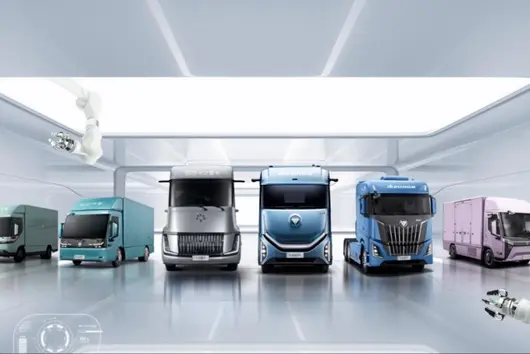

Author | Guo Yue
Editor | Zhihao
He Xiaopeng: Not only looking at scale but also long-term development, three new cars queued up in the second half of the year, welcoming the strongest sales growth.
CarDaily reported on May 28. Just now, Xpeng Group Chairman and CEO He Xiaopeng spent most of the time on the first-quarter earnings conference call responding to Xpeng's business layout in intelligent cars, Robotaxi, humanoid robots, and other aspects.
Regarding new cars, three new cars will be released globally in the second half of this year, and Xpeng will welcome the strongest sales growth curve in history.
Regarding overseas business, in April this year, Xpeng's overseas sales volume broke through 6,000 units for the first time, with a goal to continue exceeding 10,000 units per month in the fourth quarter. Starting from the second quarter, the revenue contribution from international business is expected to exceed 20%.
Regarding Robotaxi, the Xpeng GX fleet has already started small-scale L4 testing. Xpeng's goal is to start Robotaxi demonstration operation services in Guangzhou in the third quarter of this year. After the second-generation VLA lands overseas, Xpeng will also actively explore deploying affordable Robotaxis in both domestic and overseas markets.
Regarding humanoid robots, the software and hardware R&D progress of Xpeng's new generation IRON humanoid robots for mass production version is proceeding smoothly, planned to debut officially in the third quarter of this year. Xpeng aims to achieve mass production of high-end humanoid robots by the end of this year, first trial commercialized in Xpeng stores, and delivered to Chinese and overseas commercial customers starting next year.
Starting next year, humanoid robot hardware revenue and AI model revenue will become one of the important drivers of Xpeng Group's revenue and gross profit growth.
Just today, Xpeng Group released the Q1 2026 financial report.

▲ Xpeng Q1 2026 Financial Data
Specifically, Xpeng's Q1 2026 delivery volume reached 62,700 units, a year-on-year decline of 33%, total revenue of 13.03 billion Yuan, a year-on-year decline of 17.6%; gross margin improved year-on-year by 5 percentage points to 20.6%, net loss increased to 1.78 billion Yuan. These performances are partly due to the continued increase in R&D investment. In the first quarter of this year, its R&D expenses were 2.91 billion Yuan, a year-on-year increase of 46.8%, and further increased compared to the 2.87 billion Yuan in the fourth quarter of last year.
Regarding Q1 performance, He Xiaopeng stated that Xpeng did not just focus on scale when the market challenge was downward, but focused more on the balance between sales volume and operating quality and long-term development. He is very confident that the sales volume of every quarter in the rest of this year will grow significantly quarter-on-quarter.
As of the time of reporting, Xpeng Group's US stock price was reported at $16.845 (approximately 114.2 RMB) / share, up 2.4%, with a market cap of $16.124 billion (approximately 109.3 billion RMB).

▲ Xpeng Group US Stock Price as of Publication Time
01.
He Xiaopeng 11 Questions Show Determination:
New Cars, Robotaxi, and Robots Will All Be Globalized Well
On the Xpeng Group earnings conference call held tonight, Xpeng Group Chairman and CEO He Xiaopeng and Executive Vice Chairman and Co-President Brian Gu provided detailed responses on the key focus and planning for future development.

▲ Xpeng Group Chairman and CEO He Xiaopeng (right in picture), Executive Vice Chairman and Co-President Brian Gu (left in picture)
Below is the main content of this conference call, edited by CarDaily without changing the original meaning:
Q1: After the new model GX was on the market for a week, the response was enthusiastic. What is the current total order volume? What is the single-unit gross margin level? What is the expectation for its monthly sales target?
He Xiaopeng: As of now, the order performance of GX has exceeded our expectations, and the situation is very good. We observed some interesting data: First, the waiting time for the pure electric flagship model has exceeded 30 weeks, and orders for the flagship version are still growing rapidly.

▲ Xpeng GX
From the order structure, in the early stage of GX launch, the flagship version accounted for more than 80% of the share, and it is still the model with the highest sales proportion. At the same time, the sales proportion of GX's Max version is less than 5%, lower than our initial expectations.
In terms of powertrain type, the initial order volume of the extended-range version was lower than the pure electric version, but it is now gradually moving closer to the pure electric version, especially after we strengthened marketing in areas where we were originally not good at marketing, such as the north and west, this trend is more obvious.
For GX, our primary task is to push for capacity ramp-up to the fullest extent, while adhering to providing high-quality service and quality, ensuring GX can achieve long-term stable delivery. I am most concerned about the sustained performance of GX.
As a flagship model of Xpeng, GX's gross margin is very good. Previously, when I communicated with the media, I mentioned that if there is only one SKU, the gross margin may not meet expectations; but in reality, GX's gross margin is better than our overall gross margin level.
I also want to add a point: Starting from this year, all new cars of Xpeng will focus on two new priorities. First, how to pursue commercial quality in commercial configuration and commercial pricing. Second, we do not pursue an initial sales surge followed by a decline, but pursue a more stable sales performance.
To this end, we have established a new system in supply chain management, modularization, ramp-up processes, and supply chain security.
I believe that starting from GX, we will be able to better balance business benefits and scale, achieving more stable long-term sales.
Q2: What are the plans for Robotaxi business operations domestically and going global? Has the recent tightening of domestic regulations affected business progress? How do you view the potential impact of B-side business on Xpeng's C-side passenger vehicle sales?
He Xiaopeng: We noticed the recent tightening of domestic regulations on autonomous driving, but this has not affected our overall pace.
From my perspective, the real business opportunity for Robotaxi will arrive in 2028. Currently, Xpeng is trying to run through this model both domestically and globally, landing and implementing the VLA 2.0 system in China and overseas.
In China, we will conduct rapid R&D and testing through existing models and plan to launch an economy vehicle for Robotaxi scenarios in 2027.
Regarding the business model, I want to emphasize two points: First, we only provide products and offer a commission model, not participating in operations directly, so we will have a large number of partners. Second, the main battlefield for Robotaxi is the global market, and I believe the global market has huge business value.
Regarding your concern about the impact of B-side Robotaxi on C-side sales, I want to add a few points of view.
First, Robotaxi testing at the current stage is actually having a positive impact on the C-side, because the future VLA system will provide various different intelligent assisted driving strategies.
Secondly, as policies and regulations gradually relax and commercial operation gradually lands, Robotaxi vehicles will gradually separate from C-side vehicles, forming a second independent vehicle track, becoming a new type of transportation tool.
Q3: In the second half of this year to about a year in the future, what important trends and changes will the VLA 2.0 OTA bring?
He Xiaopeng: I think that within this year, Xpeng's VLA capabilities will experience two important nodes.

▲ Xpeng VLA 2.0 Push First Month Assisted Driving Mileage Proportion Breaks 50%
The first node may appear in the third quarter of this year.
In the past period, Xpeng VLA mainly focused on engineering, safety, and basic customer experience, without focusing on improving performance upper limits. In the third quarter of this year, we will greatly improve the performance upper limit of VLA. The user experience will manifest as vehicles being smarter, having stronger generalization capabilities, and greatly reducing the disengagement rate.
The second node is the end of this year.
We hope to fuse VLA and VLM capabilities through organizational mergers. At that time, vehicles will not only have the "driver ability" of autonomous driving but also possess language communication capabilities, and even lay the foundation for future "car butler" capabilities.
We believe this will be the preliminary form of L5 level capabilities. We hope to gradually achieve this goal.
Q4: What differentiation advantages does the humanoid robot have in hardware costs in the next year? What is the business model overseas?
He Xiaopeng: The mass production version of IRON is designed according to automotive-grade safety and reliability. Recently, we have completed the development of self-developed dexterous hands. Flexibility has significantly improved, while costs have significantly decreased.
In the process of robot mass production, we encountered many challenges different from car mass production. For example, the hardware of current humanoid robots does not fully consider safety, reliability, stability, and maintainability—it does not follow automotive-grade standards.

▲ Xpeng Plans to Mass Produce Humanoid Robots by the End of 2026
In addition, many energy groups have not considered how to scale, how to solve supply chain yield rate and quality issues, nor have they considered whether the underlying architecture of hardware and software should be placed locally or in the cloud, and if placed in the cloud, how to solve a series of issues such as data privacy, traffic, computing power, latency, etc.
For this reason, we have become a robot company that almost self-develops core hardware and software in full-stack (except for battery cells) since the beginning of last year. This enables us to achieve high integration.
I believe the initial hardware cost structure of robots will be close to a car, but in the long run, we will gradually obtain more economical scale solutions. But today, the robot's cost structure is very close to a car.
Regarding overseas markets, just like our car business, our robots have considered globalization from the first product.
The sales logic of robots may be more adaptable globally than in China, and acceptance among grassroots employees overseas is higher.
We have done a lot of work on how hardware meets overseas policies and how software and data meet local regulations.
For example, Xpeng's current VLA data processing volume is about 200 million Tokens per hour. If the robot model is placed in the cloud, it is estimated that 500 million to 1 billion Tokens per hour will be required, and traffic costs may exceed 100GB. Therefore, completely relying on cloud computing power is not feasible.
We comprehensively considered overseas hardware, software, data privacy, comprehensive usage costs, and commercial logic from the beginning. As domestic business advances, we hope to see new changes in robot business overseas next year as well.
Q5: Besides Guangzhou, can you reveal the Robotaxi city expansion plan and timeline as well as progress in applying for the corresponding license?
He Xiaopeng: Currently, our Robotaxi business only considers Guangzhou. We have already obtained the Guangzhou testing operation license and hope to run through the complete technology, product, and business model in Guangzhou first.
Afterwards, we will find more partners domestically and overseas for them to operate locally.
Since announcing this plan, we have received a large number of requests from overseas and some domestic partners. They are very interested in observing our overall progress in the next year.
After we launch economy vehicles suitable for Robotaxi scenarios and better overall solutions in 2027, I believe everyone will see our continuous improvement in Robotaxi commercialization capabilities.

▲ Xpeng Will Launch Three Robotaxis in 2026
Q6: What are the guidance for vehicle gross margin and company overall gross margin in the second quarter?
Brian Gu: Our overall gross margin in the first quarter is very close to the fourth quarter of last year. We indeed observed a trend of rising raw material costs, some of which have been reflected in the first quarter. We expect these cost factors to continue in subsequent quarters of this year.
In the second quarter, we launched the full-size SUV GX, and delivery will start in subsequent quarters. GX's gross margin is at the highest level in our entire product portfolio.
From the product structure perspective, we expect to see better model combinations in the second quarter and the second half of the year. Comprehensive factors, we expect the company's total gross margin in the second quarter to maintain a level roughly similar to the first quarter.
Q7: Can you talk about the growth catalysts for the overseas market, as well as sales and profit contributions in the next three years? Also, which model's profit is better, export or local production?
He Xiaopeng: The overseas market is one of the most important strategic directions for Xpeng. I hope that in the next five years, the sales volume of the overseas market will account for half of our total sales volume. At that time, the revenue and profit contribution from overseas will exceed domestic.
I am very confident that as Xpeng launches multiple global models in the second half of this year, Xpeng's globalization speed will be significantly improved in the next two years.
Whether in hardware, AI software, channels, services, or supercharging capabilities, we will make huge investments overseas, and overseas profit performance will also be very good.
Our R&D investment in cars this year is mainly concentrated in the overseas market. Therefore, I am very confident about achieving accelerated growth in the overseas market in the next three years.
Brian Gu: I will add a few points. First, from the latest international sales figures, overseas sales volume has accounted for nearly 20% of our total sales volume. And last year, international sales volume accounted for about 10% of the global total sales volume.
Second point, even when facing some tariff issues and cost increases this year, the single-vehicle profit of our international business is still significantly better. The contribution of international business to our profit is very considerable.
We expect this growth momentum to last throughout the year. I believe maintaining the proportion of overseas sales volume at around 20% throughout the year is sustainable. Of course, the Chinese market itself is also expected to have significant growth.
Regarding going global, we are increasing overseas localization investments. The overseas market will make an important contribution to the company's overall momentum and profitability.
Q8: In this year and next year, what proportion of models is expected to be produced in local factories? Will this proportion differ across different regions?
Brian Gu: Currently, we have two factories in Southeast Asia, located in Indonesia and Malaysia, mainly serving the local markets. In addition, we cooperate with Magna in Austria to produce vehicles for the European market.
These three manufacturing bases will increase capacity this year, and there will be new models produced in those local markets.
For Southeast Asian countries, localized production mainly satisfies local market demands; while the Austria factory serves the European market.
I expect most of our European sales will come from localized production. In other regions where manufacturing facilities have not been established, we will continue to maintain the current business model.
As we improve sales and market share in these large markets, we are actively exploring ways to increase localized production capabilities to meet localization content rules and gradually move towards a deeper localized production model.
Q9: Can you give a few specific examples to explain the commercial functions and application scenarios of Xpeng robots in its own stores and customer stores? What is the price strategy for sales to the outside? Since its cost structure is close to a car, can the sales strategy also be analogous to cars?
He Xiaopeng: Our robots are different from most robots. We hope it is used in an environment interacting with humans. Therefore, we first consider commercial environments, and the initial application scenarios are tour guide, sales guide.

▲ Xpeng New Generation IRON Service Scenario
Whether in China or overseas, robots can introduce products in stores, for example, introducing vehicles in our stores. Although the final transaction may still need to be handled by humans, company introduction, product introduction, performance explanation, and other work can be assisted by robots.
Based on the fact that tour guiding and sales guiding have been verified in a large number of jobs globally, we hope to expand to deeper scenarios of sales retail, such as cashier positions. The number of cashier and retail sales positions is very large globally.
Therefore, from the commercialization path perspective, Xpeng will focus on deepening from the sales guide perspective, while we will open up a lot of cooperation.
If our partners have different job requirements, they can generate data with us, perform pre-training and post-training, and thus generate different models. These models can be placed on our external cooperation platform for users to download and activate.
Regarding future commercialization pricing, we are still discussing. But it can be seen that our robots are very similar to cars, so their sales price will certainly be more expensive than an ordinary car.
There will be good gross margins on hardware in the early stage. At the same time, our robots also have a large amount of data processing in the cloud, so we hope to take a faster step in software charging.
We believe that break-even targets can be achieved within a few months in the overseas market, while it may take slightly longer in the domestic market.
Therefore, we are constantly thinking about the commercial logic of robots from the perspective of how customers use them, why they buy them, and how they get value.
Q10: Can you share your thoughts on the evolution of the group's long-term business model? How do you view the timing of revenue generation from various strategic sectors, as well as changes in the medium-to-long-term revenue structure?
He Xiaopeng: At the current stage, the group's main revenue source is certainly scale effects, mainly from hardware; if looking at the ecosystem, it is system effects.
But looking globally, very few car manufacturers can build a software platform on top of the scale effect of hardware to form the next level of network effects - that is, achieve software charging and multi-sided network effects.
Further back, with the rise of overall intelligent AI capabilities, there will also be ant colony effects. Just like ant colonies, forming new synergy between centralized and decentralized.
These three effects will gradually overlap. Each effect involves different competitive barriers and corresponds to different business logic.
Q11: How is the service revenue trend this year? Is there a possibility for technical licensing or technical services with our partners to expand overseas?
Brian Gu: We continue to maintain the previous guidance: In 2026, the total revenue from technology, services, and IP licensing will be roughly the same as in 2025.
Starting from the second quarter of this year, we will scale up delivery of Turing Chips to partners.

▲ Xpeng Turing Chip Obtained Volkswagen Confirmation
We continue to believe that achieving technology commercialization and monetization through such cooperation is a very attractive business model for us.
Given that Xpeng internally possesses a large amount of proprietary technology, we hold a very open attitude towards expanding such technology commercialization opportunities.
02.
Gross Margin Growth Highlights Operating Resilience
Expected Delivery Volume and Revenue to Increase Significantly in Second Quarter
From the Q1 2026 financial report of Xpeng Group, the total revenue of Xpeng Group in Q1 2026 was 13.03 billion Yuan, down 17.6% compared to Q1 2025, and down 41.4% compared to Q4 2025.

▲ Xpeng Q1 2026 Financial Data
Among them, Xpeng's automotive sales revenue in Q1 2026 was 11.0 billion Yuan, down 23.5% compared to the same period of Q1 2025, and down 42.3% compared to Q4 2025.
Regarding net loss, its net loss in Q1 2026 was 1.78 billion Yuan. In Q1 2025, this figure was 660 million Yuan. Net profit in Q4 2025 was 380 million Yuan.
Regarding gross margin, Xpeng Group's gross margin in Q1 2026 was 20.6%, exceeding Li Auto (7.9%) and NIO (19.0%), with automotive gross margin at 12.1%. In comparison, it was 10.5% in the same period of Q1 2025, and 13.0% in Q4 2025.

▲ Xpeng Q1 2026 Gross Margin Steady
As of Q1 2026, Xpeng's cash on hand was 42.09 billion Yuan.
For the second quarter of this year, Xpeng Group expects delivery and revenue scale to achieve significant increases.

▲ Xpeng Q2 2026 Performance Guidance
Regarding delivery volume, the official forecast expects vehicle deliveries for the quarter to reach 100,000-106,000 units, with a year-on-year change of approximately -3.08% to 2.73%, and a quarter-on-quarter growth of approximately 59.54% to 69.11%.
Regarding revenue, the official forecast expects total revenue for the quarter to be 19.6 billion to 20.8 billion Yuan, with a year-on-year increase of 7.25% to 13.82%, and a quarter-on-quarter increase of 50.38% to 59.59%.
Brian Gu stated: "We will accelerate the large-scale commercialization of Physical AI applications with company-level strategic priority."
03.
Conclusion: Xpeng Accelerates Towards the End Game of Physical AI
From the information disclosed in the Q1 2026 financial report and conference call, Xpeng is on the eve of Physical AI applications moving from mass production landing to explosive scale growth.
Its Physical AI layout is welcoming a historic breakthrough in commercialization mass production: The proportion of second-generation VLA smart driving mileage broke through 50%, the first full-stack self-developed Robotaxi has rolled off the production line, the humanoid robot goal is to mass produce by the end of the year, flying cars are entering the eve of mass production. Multiple business lines are simultaneously approaching explosive scale growth, jointly building a solid foundation for Xpeng to move towards the era of Physical AI.
Under this circumstance, Xpeng Group's gross margin still maintained at a high level of 20.6%, showing strong operating resilience. From the obvious rebound in delivery guidance in the second quarter, Xpeng is expected to welcome strong sales growth.
With VLA architecture iteration, the successive landing of multiple new cars and robot products, Xpeng is expected to build a more complete business ecosystem in the fields of intelligent mobility and embodied intelligence. Its future development potential is worth continuous observation.
© 2024 Bitauto.com. All Rights Reserved.
Bitauto (www.yiche.com and www.bitauto.com) is one of the most visited automotive websites in China. We provide detailed info on Chinese car brands available in your area. Please note that the information provided on this website is based on publicly available data and is for reference only. It may not be fully updated or accurate at all times.

Help us improve our website


