

HomeTiggo 5X

Search History
Popular Searches
Dealer Login / Sign Up

ZhiLiao Auto / Chen Yi
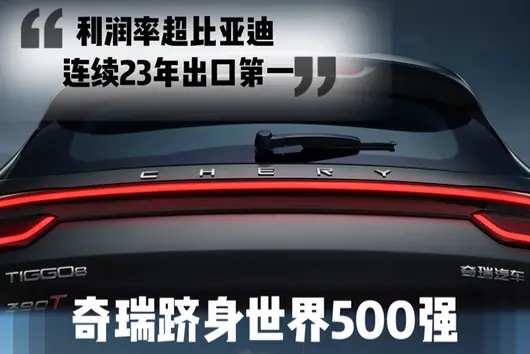
Recently, "Fortune" magazine released the latest Fortune Global 500 ranking, Chery Automotive ranked 383rd with revenue of $41.778 billion.

Actually, Chery was already on the Fortune Global 500 list last year, ranked even higher at 233rd. The difference is, this year Chery is evaluated independently as a listed company entity, after all, it went public on the HKEX last September.
In other words, although Chery was on the Fortune Global 500 list for two consecutive years, the significance differs. This year, Chery must undergo comprehensive scrutiny from the capital market and industrial sector.

Worth noting is, among Chinese automakers and auto parts companies entering the Fortune Global 500 this year, there are 10 in total. Besides Chery, there are BYD, CATL, Geely, SAIC, etc., all very well-known. Among them, BYD ranks highest, with revenue of $111.853 billion, ranking 91st.
Domestically, BYD is now the undisputed "leader". Cars sell well, and profits are high. Last year, BYD's NEV sales reached 4.6 million units, securing the global NEV sales champion title for consecutive years, annual revenue 804 billion yuan, net profit 32.6 billion yuan.
Moreover, it is willing to invest heavily in R&D. For example, in 2025, BYD invested as high as 63.4 billion yuan in R&D, ranking first among A-share listed companies for two consecutive years. So far, BYD's cumulative R&D investment has exceeded 250 billion yuan.

The key point is, BYD's batteries, chips, motors, electronic control, etc., are all self-made. In the past, people thought this "doing everything oneself" model was too asset-heavy and too slow, but facts prove that as long as you can survive, you can use economies of scale to further reduce costs.
What is BYD's moat? Cost and scale. Others spend 100 to make a car, BYD might only need 80; others sell 100 cars a year, BYD can sell 200.
What about Chery? It is a different model.

Starting from 2001, Chery was already selling cars overseas. At that time, most Chinese automakers were still competing domestically. So strictly speaking, Chery counts as one of the first batch of "going global" Chinese automakers.
Of course, it was indeed difficult at first. In 2001, Chery's export volume didn't even exceed 100 units. But it proceeded steadily, continuously expanding its overseas map. To date, Chery's business covers more than 130 countries and regions, ranking first in Chinese brand passenger car exports for 23 consecutive years.
Chery's "going global" is not a one-off deal. It has 16 production bases globally, with over 3,100 overseas dealer outlets. Brazil, Indonesia, Thailand, Malaysia, etc., all have Chery's localized manufacturing networks.

Foreign media summarized Chery's "going global" model as "encircling cities from the countryside". This is not wrong, after all, it first went to markets with lower thresholds like the Middle East, Latin America, Southeast Asia to build brand awareness, selling mature fuel models like Tiggo and Arrizo, and later penetrated into high-regulation markets like Europe.
In 2025, Chery exported 1.344 million vehicles, equivalent to a Chery being sold overseas every 23 seconds on average. Annual total revenue 300.29 billion yuan, breaking the 300 billion yuan threshold for the first time. Net profit 19.51 billion yuan, overseas revenue 157.42 billion yuan.
To put it plainly, Chery is now completely a Chinese automaker where "selling cars relies half on overseas markets".

More worth noting is, Chery's overall average vehicle price is about 103,500 yuan, overseas average vehicle price is 121,600 yuan. The same car sells nearly 20,000 yuan more overseas than domestically.
So you see, Chery's success logic is simple: if you can't compete domestically, go sell abroad.
Compared to BYD, Chery's moat is built up over time. Over 20 years of accumulation, Chery's overseas channels, brand recognition, and localized operational capabilities are not something that can be easily replicated.

This shows that the path to success is not singular. The "BYD model" can succeed, and the "Chery model" can also succeed.
However, both have their own problems to face. For example, how can BYD replicate its domestic model in the global market? How can Chery boost domestic sales? ... These are all issues that must be resolved.
ZhiLiao Auto original article, if reprinting is needed please contact us
*Pictures from the internet, if infringing please contact author to delete*

Ziliao Auto / Chen Yi
Baru-baru ini, Majalah Fortune mengeluarkan senarai Fortune Global 500 terkini, Kereta Chery berada di tempat ke-383 dengan pendapatan 417.78 bilion USD.
Sebenarnya tahun lalu Chery sudah berada dalam Fortune 500, pengelasan masa itu lebih tinggi, tempat ke-233, berlainan, tahun ini Chery dinilai secara bebas sebagai entiti syarikat tersenarai, kerana ia telah disenaraikan di Bursa Saham Hong Kong pada September tahun lalu.
Artinya, walaupun selama dua tahun berturut-turut berada dalam Fortune 500, tetapi nilainya berbeza, tahun ini Chery perlu menerima penilaian menyeluruh dari pasaran modal dan sistem industri.
Perlu diketahui, pada tahun ini syarikat automobil dan komponen di China yang memasuki Fortune 500, terdapat 10 syarikat, selain Chery, terdapat juga BYD, CATL, Geely, SAIC dan lain-lain, semuanya terkenal, di antaranya, BYD memiliki pengelasan tertinggi, pendapatan 1118.53 bilion USD, terletak di tempat ke-91.
Di dalam negara, BYD sekarang adalah "Bos Utama" yang sesuai dengan reputasi, kereta dijual dengan baik, wang diperoleh banyak, tahun lalu penjualan kereta elektrik baharu BYD 4.6 juta unit, merebut kembali juara penjualan kereta elektrik baharu global, pendapatan tahunan 804 bilion Yuan, keuntungan bersih 32.6 bilion Yuan.
Dan, ia juga perbelanjaan banyak untuk penyelidikan dan pembangunan, seperti tahun 2025, BYD melabur hingga 63.4 bilion Yuan untuk penyelidikan dan pembangunan, selama dua tahun berturut-turut di kalangan syarikat tersenarai Saham A menempati tempat pertama, sehingga kini, jumlah perbelanjaan penyelidikan dan pembangunan BYD telah melebihi 250 bilion Yuan.
Pokoknya apa, bateri BYD, cip, motor, kawalan elektrik dan lain-lain, semuanya buatan sendiri, dulu orang rasa, model "lakukan semua sendiri" ini terlalu berat aset dan terlalu perlahan, tetapi bukti membuktikan, selama anda bertahan, anda boleh menggunakan kesan skala untuk menekan kos lebih lanjut.
Apa benteng BYD? Kos dan skala, orang lain buat kereta habiskan 100 Yuan, BYD mungkin hanya perlu 80 Yuan; orang lain jual 100 unit kereta setahun, BYD boleh jual 200 unit.
Chery pula? Ia adalah model lain.
Mulai tahun 2001, Chery sudah menjual kereta ke luar negara, pada masa itu kebanyakan syarikat automobil China masih bersaing dalam negara, jadi secara tegas, Chery dianggap sebagai satu daripada syarikat automobil China "keluar negara" pertama.
Tentu saja, pada mulanya memang susah, tahun 2001 eksport Chery bahkan tidak melebihi 100 unit, tetapi ia kukuh dan stabil, terus mengembangkan wilayah luar negara, sehingga kini, perniagaan Chery telah meliputi lebih 130 negara dan wilayah di seluruh dunia, selama 23 tahun berturut-turut tetap pertama eksport kereta penumpang jenama China.
Eksport "keluar negara" Chery bukan jenis satu kali jualan, ia mempunyai 16 pusat pengeluaran di seluruh dunia, lebih 3,100 cawangan pengedar luar negara, Brazil, Indonesia, Thailand, Malaysia dan lain-lain mempunyai rangkaian pembuatan tempatan Chery.
Media asing meringkaskan model "keluar negara" Chery adalah "luar bandar mengelilingi bandar", berkata begitu juga tidak salah, kerana ia dahulu ke Timur Tengah, Amerika Latin, Asia Tenggara, pasaran ambang rendah ini untuk mengenali nama, jual Tiggo, Arrizo model kereta pembakaran yang matang, kemudian baru menembusi pasaran seperti Eropah dengan peraturan tinggi.
Tahun 2025, eksport kenderaan Chery 1.344 juta unit, sama dengan purata setiap 23 saat satu kenderaan Chery dijual ke luar negara, pendapatan tahunan keseluruhan 300.29 bilion Yuan, pertama kali melangkaui 300 bilion Yuan, keuntungan bersih 19.51 bilion Yuan, pendapatan luar negara 157.42 bilion Yuan.
Beritahu begitu saja, Chery sudah sepenuhnya menjadi syarikat automobil China yang "jual kereta separuh bergantung luar negara".
Lebih bernilai diperhatikan, purata harga satu kenderaan Chery keseluruhan kira-kira 103,500 Yuan, purata harga satu kenderaan luar negara 121,600 Yuan, satu unit kereta yang sama, dijual ke luar negara lebih mahal hampir 20,000 Yuan daripada dalam negara.
Maka anda lihat, logik kejayaan Chery sangat mudah, jika tidak boleh menang di dalam negara, maka keluar jual.
Berbanding dengan BYD, benteng Chery ditimbun berdasarkan masa, lebih 20 tahun pengumpulan, saluran Chery di luar negara, pengiktirafan jenama dan keupayaan operasi tempatan, bukan sesuatu yang mudah boleh disalin.
Berarti ini, laluan kejayaan bukan tunggal, "Model BYD" boleh berjaya, "Model Chery" juga boleh berjaya.
Tetapi, kedua-duanya mempunyai masalah masing-masing perlu dihadapi, contohnya, bagaimana BYD menyalin model domestik di pasaran global? Bagaimana Chery mengangkat jualan domestik? ...... Ini, semuanya perlu diselesaikan.
Artikel Asli Ziliao Auto, jika perlu terbitkan semula sila hubungi kami
*Gambar dari Internet, jika ada pelanggaran sila hubungi penulis untuk pemadaman*
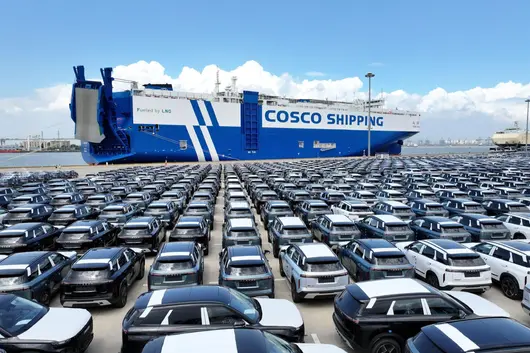
May 2026, data from the China Association of Automobile Manufacturers refocused the industry's attention overseas. From January to May, cumulative exports of Chinese automobiles exceeded 4.25 million vehicles, a year-on-year increase of over 50%. Annual exports are expected to break through the 10 million mark.
Last year, Chinese automobiles with a total export volume of 7.098 million units (data from CAAM) suppressed Japan for the third consecutive year, reclaiming the global first place, surpassing Japan's historical export record of 6.85 million units set in 1985.

Previously, logos of Toyota, Honda, and Nissan were found everywhere in streets and alleys across Southeast Asia. Suzuki dominated the South Asian market, while Mazda was highly sought after in Europe. Japanese cars relied on a reputation for reliability, fuel efficiency, and value retention to weave a global sales network over the course of four decades.
Now, this network is being torn apart by Chinese carmakers one opening at a time.
BYD, Geely, Chery, three Chinese carmakers with annual sales exceeding 1 million vehicles, are launching a "group charge" in overseas markets. Why these three? Because their internationalization paths are quite representative in different fields: one attacks Europe with strong vertical integration of new energy technology, one weaves a brand matrix through global M&A, and one ground out export volume first through the hard work of building channels overseas for twenty years.
This is no longer a question of "whether China can export", but "among the fleet of Chinese carmakers going overseas, who is the most capable"?
But at the same time, the volume of exports is just one side of a mirror. The final victory in the battlefield lies in: among these three export "giants" BYD, Geely, and Chery, who can be the first to complete the qualitative change from "trade export" to "industrial export" and become a new generation of global car giants? The answer to this question will determine the final move of the Chinese automotive industry in the world map.
# Overseas Markets, Chinese Cars Successively Take Positions #
From importing complete vehicles in the early 21st century to establishing joint ventures in the 2010s, Chinese automobiles went through a long and helpless period of "trading market access for technology". For 30 years, domestic carmakers were technology importers, and reverse exports were basically zero.
But in recent years, this trend is reversing. In 2025, Chinese automobile exports reached 7.098 million vehicles, a year-on-year increase of 21.1%. Among them, new energy vehicle exports reached 2.615 million vehicles, doubling year-on-year, accounting for about 36.8% of the total export volume; traditional fuel vehicles were 4.483 million vehicles, a decrease of 2% year-on-year. Under the CAAM statistical caliber, in 2025, the share of complete vehicle exports in wholesale exceeded 20% for the first time.
Entering 2026, the export growth rate accelerated further. From January to May 2026, cumulative passenger vehicle exports reached 2.649 million vehicles, a year-on-year increase of 61.7%. Among them, new energy passenger vehicle exports were 1.732 million vehicles, a year-on-year increase of 117.3%. The proportion in passenger vehicle exports jumped from about 37% in 2025 to over 65%.

In May alone, new energy passenger vehicle exports reached 424,000 vehicles, a year-on-year increase of 112.6%, accounting for 54.1% of passenger vehicle exports. For every 10 vehicles exported, more than 5 are electric vehicles. At the same time, the average price per exported vehicle has risen from about 100,000 yuan five years ago to the 300,000 yuan level. Export products are accelerating towards mid-to-high ends.
Except for the growth in volume, Chinese car exports have moved from "single dependence" to "blooming in multiple points".
In 2025, the top ten destinations for Chinese passenger vehicle exports were: Russia (555,400 vehicles, -46.1% YoY), UAE (539,700 vehicles, +74.3%), Mexico (490,800 vehicles, +44.2%), UK (320,800 vehicles, +70.3%), Brazil (299,900 vehicles, +34.6%), Belgium (289,500 vehicles, +4.5%), Saudi Arabia (250,500 vehicles, +11.2%), Australia (246,200 vehicles, +59.3%), Kazakhstan (187,000 vehicles, +74.3%), Iran (164,100 vehicles, -31.6%).
Except for exports to the CIS region dominated by Russia, which declined due to policy and inventory impacts, other regions showed a growth trend: exports to Europe reached 1.51 million vehicles, a 32% increase year-on-year; exports to the Middle East and West Asia reached 1.27 million vehicles, a 48% increase year-on-year; exports to South and Central America reached 1.01 million vehicles, a 49% increase year-on-year; exports to Southeast Asia reached 1.98 million vehicles, a 57% surge year-on-year; exports to Africa reached 800,000 vehicles, a 119% increase year-on-year.
Europe, as a critical breakthrough market, saw Chinese exports to the EU exceed 1 million vehicles for the first time in 2025, reaching 1.0062 million vehicles, a year-on-year increase of 30.7%, with an export value of 13.72 billion euros.
Currently, China is the number one source of automobile imports in the EU region, and also the fifth largest supply source for the European automotive market. In statistics with a broader caliber, it is shown that in 2025, Chinese brand automobiles sales in the European market reached 811,000 vehicles, a year-on-year increase of 99%, with market share rising to above 7%.
The Middle East, currently arguably one of the important markets for Chinese carmakers to earn high profits. In 2025, Chinese exports to the Middle East region reached 1.4 million vehicles, among which 570,000 in UAE and 300,000 in Saudi Arabia combined contributed over 60% share. The market share of Chinese carmakers in this market has approached 30%. Benefiting from the high unit price market characteristics, the profit margin of Chinese carmakers in this market is significantly higher than in other countries and regions.

The Mexico market in the Latin America region, surpassed Russia last year to become China's largest export country. In 2025, Mexico's cumulative exports reached 625,200 vehicles. Mexico has always been regarded as an important stepping stone for Chinese cars to enter the Americas market, and now has an increasingly higher proportion.
As for Southeast Asia, Japanese carmakers have previously established market barriers belonging to them, but now the entry of Chinese cars is eroding the inherent market share of Japanese cars. Data shows that the market share of Japanese brands in Thailand has dropped from 90% to 70%. The main reason for this data change is the entry of Chinese cars; furthermore, the share of Japanese brands in Indonesia fell below 81%, while Chinese brands reached 14%. Currently, the number of Chinese automobile exports accounts for about 27% of the sales in the Southeast Asian market.
Currently, the overseas expansion of Chinese carmakers is basically concentrated in the top few, such as Chery, SAIC, BYD, Geely, etc. Among them, as representative of private enterprises, BYD, Chery, and Geely actually have different overseas strategies, and also represent three paths of Chinese cars going overseas at present.
# Rivalry of the Three Powers, Who Will Be the Future Overseas Leader? #
Chery is currently the leader in Chinese car exports and also the carmaker with the largest export volume.
In Q1 2026, Chery exported 393,000 vehicles, a year-on-year increase of 54%, with an export proportion as high as 67%. Such a number means that in Chery's sales structure, overseas sales have exceeded domestic sales, and its average price per vehicle at the export end reached 121,600 yuan, about 14,700 yuan higher than domestic. The performance of the overseas market is directly linked to Chery's profitability.
According to different market regions, Chery's advantage in the European market is quite prominent. From January to April 2026, Chery's export volume in Europe reached 147,000 vehicles, firmly occupying the first tier of Chinese brands. The European market grew year-on-year by over 200% for the full year and has entered 16 countries including the UK and Italy.

In the Middle East market, Chery still took the export top spot with 56,000 vehicles in the first quarter. As for the Southeast Asian market, Chery exported 24,000 vehicles from January to April 2026, a year-on-year increase of 18.2%. Chery's export path is mainly "fuel + hybrid" side-by-side. Among the current exported models, the Tiggo series is very competitive in the Russian and Latin American markets, while OMODA and JAECOO are accelerating penetration into the European market.
BYD ranked second to Chery in export volume in May this year, with a strong potential to surpass. First, look at the data. BYD's overseas sales reached about 1.1 million vehicles in 2025. This year's first quarter exports were about 320,000 vehicles, with an export proportion exceeding 46%. On this basis, BYD has increased its 2026 export target to 1.5 million vehicles, which is the most aggressive target among the three.

BYD's overseas exports not only grew in scale but also optimized in structure. Currently, Brazil is its largest overseas market. From January to April, export volume reached as high as 148,000 vehicles, among which pure electric and plug-in hybrid accounted for almost half each. The European market exported nearly 100,000 vehicles from January to April, a year-on-year increase of 29.7%; the Middle East market exported 26,000 vehicles from January to February; in terms of Southeast Asia, BYD exported 32,000 vehicles from January to April, a year-on-year decrease of 25%.
As for Geely, it is exchanging quality for quantity. If looking at shipment volume alone, Geely cannot compare with Chery and BYD. In May 2026, Geely exported 85,100 vehicles, a year-on-year increase of 183.7%; cumulative exports from January to May reached 371,400 vehicles, a year-on-year increase of 157.7%. Its export plan for this year is 750,000 vehicles.

But it is worth noting that Geely's average price per overseas vehicle has approached 180,000 yuan, and the export gross profit margin is 9 percentage points higher than domestic. The average price per vehicle in the first quarter reached 118,100 yuan, a year-on-year increase of nearly 15,000 yuan, with growth leading among domestic brands.
In terms of overseas regional distribution, Geely is the most balanced among the three. In the North American Mexico market, it grew over 3 times with 16,000 vehicles; in South America Brazil, it first broke 7,000 vehicles; in Southeast Asia, it firmly occupies the Chinese brand top spot with 46,000 vehicles export volume from January to April leading Chinese brands; in Europe, Geely exported 40,500 vehicles from January to April, a year-on-year increase of 63.6%, and the absolute volume of exports is still rising rapidly.
# Three Paths, Three Strategies? #
Combining the previous content, we will find that these three carmakers represent the three mainstream internationalization models currently domestic, they each have their focus on the overseas path, and the strategies are completely different.
BYD takes the new energy full supply chain overseas route, which is closely related to its brand development path. Currently, its exported models are mainly pure electric and plug-in hybrid, with a price range covering 15,000 to 80,000 Euros.
BYD's logic is very clear: utilize China's full supply chain advantage in the electrification field to quickly seize the overseas market with technological leadership and cost advantage. In the two electrification frontier markets of Europe and Southeast Asia, BYD chose the asset-heavy model of self-built factories plus own channels.

The advantage of this model is strong brand control and complete profit chain. The disadvantages are large investment, long return cycle, and high sensitivity to local policy environments. The electric vehicle tariff policy just implemented in Europe might be the greatest uncertainty BYD faces for a period of time.
Geely takes the multi-brand matrix + overseas brand leveraging route. Through acquiring Volvo, investing in smart, and establishing Polestar as a joint venture, Geely has already possessed a brand matrix spanning Europe, Asia, and the Americas.
This matrix allows Geely to send different brands for different markets. Europe is led by Volvo and Polestar, Southeast Asia by Geely's mother brand and Proton, smart serves as global urban premium EVs, while the Middle East and Latin America are promoted synchronously by Geely's mother brand and Lynk & Co.

This model allows Geely to rapidly enter the high-end market by leveraging Volvo's dealer network, after-sales system, and brand premium, while using the Geely main brand and Lynk & Co to fight for the mainstream market. However, multi-brand synergy itself is a high-difficulty management art. If brand differentiation is unclear, left-hand vs right-hand fighting may occur.
Chery takes the high cost-performance fuel vehicle + wide channel coverage route. Export main force is still fuel SUVs, with a price range concentrated between 12,000 to 25,000 USD.
Chery's advantage lies in its product pricing and developing countries' purchasing power matching highly. These markets like South America, Middle East, Russia, North Africa have imperfect charging infrastructure, consumers are highly sensitive to price, and brand loyalty has not solidified. Chery has almost no direct electrification competitors here.

The export route is the simplest, but also the easiest to replicate. When more Chinese brands bring fuel vehicles of similar high cost-performance to flood these markets, Chery's first-mover advantage will sooner or later be diluted. Chery is trying to open new space with new energy products like Exeed, but from the current situation, the proportion of new energy in Chery's total exports is still far lower than BYD and Geely.
As for these three overseas paths, who can win the future overseas center spot battle, it cannot be easily concluded.
Chery's biggest advantage is the largest export base, difficult to surpass in the short term. But it also has concerns, such as its current export structure, which is highly dependent on the Middle East and Eastern European markets. Once geopolitical or trade policy changes, the impact may come.
Geely's overseas profit level is relatively the highest, and multi-brand differentiation overseas is also the most mature. Its problem lies in whether it can form true confrontation with BYD and Chery in scale. Even if the 2026 export target is increased to 750,000 vehicles, there is still a significant gap compared to BYD's 1.5 million.
BYD has the strongest long-term momentum for overseas expansion because it is not just selling cars, but exporting the standards of the new energy industry chain globally. As long as new factories are built in markets, the cost efficiency advantage of "Made in China" can quickly convert to cost-performance advantage. The uncertainty is BYD's overseas brand recognition. Among mainstream consumer groups in Western Europe, BYD's brand premium has not yet been established. Once trade barriers are encountered, whether BYD can maintain profit levels per vehicle overseas still poses a challenge.
# Overseas Localization Level Determines Future Ranking #
Global largest car exporter, this laurel was previously hanging on the head of the Japanese automotive industry. But from 2023, it finally changed hands, and China surged to become the world's largest car exporter. In the subsequent 2024 and 2025, this status remained firmly in place.
This is a milestone event. At the same time, we also need to clearly recognize that this overseas expansion is just the first step for Chinese cars to go international. And regarding the issue of complete internationalization, there is still a gap compared to Japanese brands.
Why say this? Setting aside the single data of export volume, there are many other data determining whether internationalization is successful. A very important point is overseas capacity.

Through data showing 2025 full year, Chinese carmakers' overseas production was 8 million units. Although this data rose relatively clearly compared to before, looking at Japanese carmakers' overseas capacity, it was as high as 20.4 million units. Although Chinese cars' total volume went up, it was more relied on domestic markets and whole vehicle exports to absorb, far from the complete overseas production system of Japanese carmakers.
So how important is overseas localized production?
A simple example can figure it out. For example, it's the same opening a restaurant. Relying purely on imports requires making food into finished products and transporting them completely to the local place. This involves not only considering transportation quality but also even higher costs. If using locally available ingredients and cooking on site, costs are not only lower, but taste will also be more suitable for local consumers.
The automotive market is the same. Taking Toyota as an example, according to the group's externally announced news, in 2025 Toyota Group's global total sales reached 11.323 million units. Among them, Toyota and Lexus brand Japan domestic sales were 1.5013 million units, overseas sales were 9.0355 million units. If counting all sub-brands like Daihatsu, Hino, etc., overall overseas sales would increase further, overall scale approaching 10 million units, accounting for about 85% of the group's total sales.
It is known that although Toyota currently appeared profit decline, it is still the world's most profitable carmaker without question. A very important point in this is its global localized system ecosystem.
At this stage, most of our independent brands' overseas localization layout is mostly an "extension" of exports. For example, many factories are mainly assembly, core component supply is still exported from domestic to local, and sales networks are also slightly thin. There is still a distance from a complete industry ecosystem.
As for the future, establishing local system ecosystems will naturally be the focus. As for BYD, it has already had three mass production complete vehicle factories in Thailand, Uzbekistan, and Brazil. As for the Hungary factory, it is a key step for BYD to enter Europe. Planned annual capacity 150,000 vehicles. After production starts in Q2 2026, it will achieve zero tariff entry to Europe, cost reduced by 20%-30%. The Indonesia factory also plans to start production in 2026.
BYD's global factory map covers the three core regions of Asia, Europe, and South America. It is the Chinese carmaker with the most active overseas capacity.
Geely has a mature production system overseas. Malaysia's Proton factory has been deeply localized for many years and has launched new energy Proton X70; Belarus BELGEE joint venture CKD factory annual capacity 60,000 units, can directly radiate Russia and Eastern European markets.
Geely is currently investing in Renault Brazil factory. In 2026, Geely brand models are expected to be produced. Factories in Belgium and the UK are more focused on high-end model localization. Geely is not simply newly building capacity but cutting into global layout with existing capacity renovation + equity investment hybrid mode. Cost controllability is stronger.
Chery has established a complete full process and CKD factory matrix overseas. It has four major production bases in Russia; Brazil has two CKD factories with a combined annual capacity of 236,000 vehicles; Spain has an European Industrial Base; Iran, Thailand, and Vietnam also have layouts. Among them, the Vietnam factory claims to be the largest in ASEAN. Chery is also seeking strategic alliances with Renault in Colombia and Argentina to further expand the Latin American market.
BYD invests heavily in new factories to quickly seize zero tariff channels; Geely is good at integrating existing resources to quickly revitalize existing capacity through equity cooperation; Chery relies on early cultivation to form capacity networks in key regions. The three can be said to have their own focuses. Regarding the future, localization speed will determine the sustainability of overseas sales. Currently, it looks like BYD invests the heaviest, determination is greatest; Geely leverages the most, model is most flexible; Chery outlets are densest, but depth needs strengthening.

This Chinese car internationalization competition is not a sprint but a global marathon spanning several years.
Short term, Chery is the champion of current scale. Million-vehicle level export volume, twenty years of overseas deep cultivation, no one can match in the short term; Medium term, growth rate and brand momentum are these two key points. BYD is quickly catching up. The global wave of new energy is its biggest tailwind; Long term, system capability is Geely's advantage. Brand matrix, Volvo's global layout, Proton's Southeast Asian foundation, construct a relatively balanced and risk-resistant globalization system.
Ultimately, who can take the lead depends on a deeper question. Who can truly win hearts after selling to the globe?
Chinese carmakers have proved we can conquer the market with cost and efficiency. But we have not yet fully proved we can conquer users with brands and trust. Toyota's globalization took half a century, Volkswagen's European foundation took decades. Chinese carmakers' overseas expansion has just begun.
In this sense, the competition between BYD, Geely, and Chery is not who defeats who, but who can win a true position for Chinese automobiles in global consumers' minds.
The fundamental victory of Chinese carmakers going overseas is not export volume surpassing Japan. It is when global consumers choose a premium electric car, "Chinese Brand" can sit on equal footing with "Made in Germany" and "Made in Japan". In this critical period of moving from an automotive big power to a powerhouse, for every solid stake Chinese carmakers drive overseas, it means shortening the distance from a big power to a powerhouse.
© 2024 Bitauto.com. All Rights Reserved.
Bitauto (www.yiche.com and www.bitauto.com) is one of the most visited automotive websites in China. We provide detailed info on Chinese car brands available in your area. Please note that the information provided on this website is based on publicly available data and is for reference only. It may not be fully updated or accurate at all times.

Help us improve our website


