

Homeenvironment

Search History
Popular Searches
Dealer Login / Sign Up

“Bring In” and “Go Out”, China’s Auto Industry Starts Reaping Benefits from Both Ends
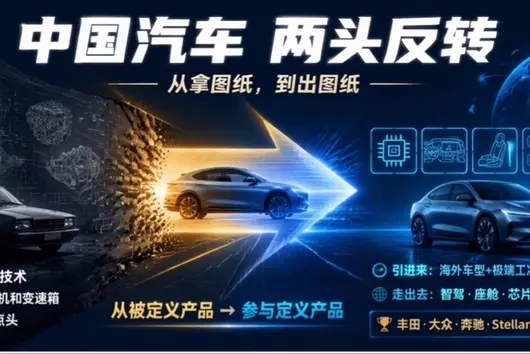
40 years ago, China’s auto industry traded market access for technology; joint venture factories installed foreign engines and transmissions; model updates and pricing required external approval. Now, this trend is reversing at both ends.
China’s auto industry begins “Bring In” and “Go Out”.
The “Bring In” dimension involves taking models released and verified overseas back to sell domestically, moving extreme working conditions, design talent, and certification standards back together.
The “Go Out” dimension involves selling smart driving, cockpits, chips, chassis, and the entire industry chain; Toyota, Volkswagen, Mercedes-Benz, and Stellantis have all started buying Chinese solutions.
The position of China’s auto industry in the global division of labor has adjusted, shifting from the party receiving blueprints to the party providing them, from products defined by others to participating in product definition.

However, the profit structure of domestic brands has not been effectively improved with adjustments in production, sales, and supply chains. Data from the China Association of Automobile Manufacturers (Jan-Sept not yet released) shows exports from Jan to Aug were 7.153 million units, a YoY increase of 66.7%, exceeding last year’s full-year 7.098 million units; but the industry profit margin in the first half was about 3.8%, with the vehicle manufacturing segment at only 1.5%, a new low for the past decade.
Scale and technology are two different things, money is the third thing; the more sold in exports, the more profit isn’t necessarily higher.
"Overseas Returns" have become a popular strategy
When the Chery Fengyun T7 launched, Chery presented not a spec sheet but a verification list: 81 dedicated durability test cars ran 1.45 million km of special durability tests; overall vehicle comprehensive road tests reached 6 million km; temperature range from minus 40°C to 55°C. This car launched domestically only on August 26, while its homologous model Lepas L6 had already been sold in South Africa and Thailand earlier, entering Indonesia, the EU, and the UK from August. The conditions in the list are also overseas data: high-speed bumps in Brazil, high-curvature bends at 180 km/h on German Autobahns, 40°C scorching sun in the Middle East. For detailed content, read our special feature article "Chery Fengyun T7 Returns from Global Trial, Exclusive Swap Price from 94,900 Yuan for Official Launch".
BYD Denza Z launched at the Goodwood Festival of Speed in the UK on July 9, with pre-sales opening domestically only on July 13. Overseas price ranges from 142,900 to 172,900 GBP, roughly triple the domestic price. The Fang Cheng Bao Shark earlier premiered globally as the BYD SHARK 6 at the Mexico launch in May 2024, later entering Australia, Brazil, and the Middle East, only appearing in MIIT declarations and being incorporated into Fang Cheng Bao this July. The domestic version max speed reaches 180 km/h, one level higher than the overseas version’s 160 km/h; what is brought back is the strengthened version, not a downgraded one. Geely’s Lynk & Co Z20 followed the same path, making its global debut in Milan in October 2024 and announcing its European launch, priced at 35,495 Euros, brought back to the domestic market within a year.
Why bring things back? Chery’s own sales volume speaks most plainly. In the first three quarters of 2026, Chery Group exported about 1.55 million units, a 65.6% YoY increase; September single-month exports reached 208,000 units, a new record for single-month exports by Chinese automakers, with exports accounting for over 70% of total sales; domestic sales calculated as total sales minus exports were about 656,000 units, a drop of about 40% YoY. First-half revenue from the Chinese market dropped from 76.055 billion yuan to 44.312 billion yuan; overseas revenue was 98.968 billion yuan, accounting for 69.1% of total revenue. Domestic is dropping, overseas is rising; bringing back brands and products established overseas has become the most hassle-free path. OMODA and JAECOO, which focus on overseas markets, are also planning to return; selling products that have been fully verified and achieved success overseas in the domestic market is also highly topical in marketing.
Previously, export-turned-domestic sales were for clearing inventory; now, what was honed overseas has become a selling point domestically; R&D sequence has changed; Chinese automakers can finally treat global standards as a starting point rather than an endpoint.
It’s not just vehicle models that are being brought in
Hainan established China’s first export vehicle type approval and humid-warm road test base on July 9. 40% steep slopes and bumpy roads simulating Mexican road conditions were brought in; equivalent testing can be done without leaving the country; testing costs dropped by nearly half, effectively moving the entire overseas humid-warm working condition segment back domestically.
BYD’s foreign design iron triangle is equally clever. Former Audi Design Director Ettinger, former Mercedes-Benz Interior Design Director Paganetti, former Ferrari Exterior Design Director Lopez; Ettinger output the Dragon Face design language within less than half a year of joining. What Chinese brands paid for wasn’t just a few renderings, but the qualification to participate in defining global aesthetics.
Results from overseas R&D centers are also turning back; Chery set up the Raunheim R&D Center near Frankfurt. Yin Tongyue’s view is he hopes cars from Chery there are more German than German cars. What Lynk & Co brought back from the track is equally hardcore; starting WTCR in 2019, accumulating 9 championships in 7 years by 2025; released the world’s first mass-produced TCR racing car of a Chinese brand, Lynk & Co 03+ TCR, in December 2025, priced at 1.4 million yuan, started the Nürburgring 24 Hours in 2026. Data and driver feedback from the races and teams were systematically fed back to the R&D department.
Easier to understand when applied to products; BYD made a K-Car RACCO for the Japanese market with integrated tray tables in the seat back.
Whether global stories can be directly converted into sales figures is currently hard to say. CACSI 2025 data from the China Association for Quality shows the weight of high brand awareness in purchase consideration factors has dropped for three consecutive years, declining 6 percentage points in 2025 compared to 2023. The driving effect of perceived quality on satisfaction exceeded brand image for the first time since 2017. Awareness can be raised through storytelling; satisfaction must rely on perceived quality.
Chinese Parts Installed in Joint Venture Factories
Laying out the parts list for GAC Toyota Bozhi 3X reveals it is hard to say which country this car is from. There are 106 Chinese brand suppliers, accounting for 65%. Among all 1,009 parts, imported parts account for only 1%. Voice is iFlytek Spark, LiDAR is Hesai ATX, Smart driving algorithm is Momenta, Domain controller is Desay SV.
The proportion of Chinese parts in this car, according to the Nikkei Asian Review quoting analysts, is speculated to be close to 90%, but Toyota denies it. The situation with the bZ7 is even more complex; according to Nikkei, its Japanese parts account for 30%, an increase rather than a decrease compared to the previous generation, but looking at intelligent configurations, it is indeed more aggressive, using Huawei Harmony Cockpit, Huawei Motors, and Xiaomi Human-Car-Home ecosystem. On September 16, Honda China Executive Vice President Hiroshi Ito said that the localization procurement rate for models launched in China in 2028 is planned to rise to over 99%; strategic cooperation agreements have already been signed with Momenta and Huawei respectively, to be introduced starting with 2027 models. Hiroshi Ito added a limitation to this statement himself; 99% is just a target, Honda is not fixed on the number itself, local suppliers are not limited to Chinese companies; as long as they can provide cost competitiveness locally in China, they are within scope. GM’s localization rate in China’s supply chain has already exceeded 95%; Volkswagen’s localization parts rate exceeds 90%. Lexus Shanghai factory started construction in June, production starts autumn 2027; total investment about 14.6 billion yuan. This is Toyota’s first overseas 100% wholly-owned integrated base for pure electric vehicles and batteries; target local parts usage rate is over 95%.
In terms of intelligence, it is even more thorough; cars sold by foreign brands in China are beginning to replace smart driving and large models with Chinese ones. Audi splits into two lines here; four-ring branded Q6L e-tron, A5L, and Q5L are equipped with Huawei Qiankun; A5L Sportback is the world’s first fuel vehicle equipped with Huawei Qiankun; alphabetic branded AUDI E5 Sportback and E7X are entrusted to Momenta; cockpits access ByteDance’s Doubao large model. Mercedes-Benz’s approach is similar; the MB.OS of the all-new pure electric GLC SUV deeply integrates Doubao AI large model; smart driving uses Momenta’s solution. When the two parties signed a upgrade cooperation memorandum in Beijing in February 2026, German Chancellor Merz test-rode the new S-Class, leaving a comment: “Glad to see the tight integration between German manufacturers and Chinese technology.” Mercedes-Benz’s performance in the domestic market is elaborated in detail in “Lost and Self-Salvage, Mercedes-Benz at the Crossroads of the Chinese Market”.
These parts are not only used in China; Toyota promoted Chinese interior material supplier Wuhu Yuefei in Thailand; the two enterprises had already set up a joint venture company in Thailand in January 2025. Toyota plans to start purchasing Chinese parts on new electric vehicles in Thailand from 2028, and also recommends Japanese suppliers adopt products from Zhejiang Kaihua Mold and Kingfa Science & Technology. Chinese supply chains are going overseas with the foreign enterprise’s global map, which is much bigger than grabbing Japanese orders in China.
Whether reverse adoption can continue, analyst Tadashi Nakanishi of China-West Automotive Industry Research gave another explanation; Japanese vehicle factories increasing Chinese parts intends to awaken Japanese parts manufacturers, allowing them to be exercised. If true, this is just phased pressure, not a permanent shift. Although there are examples of Japanese companies taking Chinese orders in reverse, Toyota has already received airbag orders from IM Motors. Nissan N7 is another reminder; GLOCAL mode, China team led development, Momenta smart driving, Qualcomm 8295P cockpit, orders in 1 hour after launch 10,138 units, but monthly sales dropped from 10,148 units in August 2025 to 928 units in August 2026; changing the supply chain alone cannot save product strength.
If parts can enter foreign factories, the next step is whether the technology itself can be sold.
Japanese Brands Installed with Chinese Chips
On February 20, Nikkei disclosed that Toyota and Suzuki have confirmed adopting Horizon Robotics’ Journey 6B in global markets outside China; replaced are Renesas R-CAR and Mobileye EyeQ. Suzuki implemented first in India, Toyota plans scaled promotion from 2028 to 2029. This path relies on Tier 1 endorsement; Bosch changed the main control chip of the next-generation multi-function camera from Renesas to Horizon Robotics; Horizon Robotics and Denso jointly adapt to the Toyota system. This is the first time Chinese smart driving chips enter Toyota and Suzuki’s overseas supply chains; Japanese brands using Chinese chips in the Chinese market has long happened.
Harder evidence than Japanese media is in Horizon Robotics’ semi-annual report. Journey 6B achieved global premiere production on GAC Toyota models; lifecycle fixed points broke through 20 million units; already obtained fixed points from over 25 mainstream global automakers; forward-looking integrated machine based on Journey 6B secured a global platform fixed point from a certain major German automotive group, sold to Australia, New Zealand, and India. Getting an order for one model and being written into the other party’s platform architecture have completely different gold content; the latter means this Chinese supplier walks with the other party’s global models together.
Volkswagen goes deeper than Japanese brands. Co-engineering program established in November 2023; CARIAD and Horizon Robotics hold 60% and 40% stakes respectively. July 22 deepened to white-box authorization; Volkswagen obtained Horizon Robotics AI base large model underlying architecture permissions for self-developed L3 and L4. Hesai supplying Mercedes-Benz has been officially announced; Q1 report on May 19 confirmed becoming Mercedes-Benz LiDAR strategic partner, supplying its L3 autonomous driving vehicles, covering Europe and China; capacity provided by Thailand Galileo Manufacturing Center. Horizon Robotics indeed has more ideas “After 15 Million Chips, Horizon Robotics Wants to Sell More Than Just Chips”, this article details the cooperation details between Horizon Robotics and Volkswagen and Horizon Robotics’ thoughts.
Regarding cockpits, Ecarx obtained Volkswagen Group fixed point in March 2025, supplying global models for Volkswagen and Skoda; first batch landed in Brazil and India. iFlytek secured Honda’s overseas interaction project in Thailand in May; this is the first time overseas Japanese car companies are provided with smart cockpit solutions by Chinese AI enterprises.
On September 30, JAC Motors released an announcement on abnormal stock price fluctuation; after verification, the company and Huawei, Stellantis indeed have cooperation intentions, but cooperation content, form, etc., are not yet confirmed, nor any binding formal agreements signed; future promotion exists with great uncertainty. Rumors circulated for nearly a month; this is the first official document from the parties involved. According to Reuters and Italian media, the discussed solution is to install Huawei Harmony Smart Cockpit platform into Maserati; JAC relies on Hefei’s Zunjie factory to undertake manufacturing; China market挂着 Zunjie, overseas market挂着 Trident; target to launch the first joint-development mass-produced vehicle by end of 2027. Stellantis APAC Communications Vice President Wang Chao stated twice to the outside world that they do not comment on market rumors; Maserati’s complete strategy will be announced only on December Modena Investor Day.
An Italian ultra-luxury brand wants to turn around by borrowing China’s smart driving platform and manufacturing platform; from selling a single chip to selling a whole car platform; what separates them is not just technology.
How to Collect Money from Selling Technology
XPeng holds the most complete financial sample currently; service and other revenue rose from 5.037 billion yuan in 2024 to 8.341 billion yuan in 2025; Q2 2026 single quarter 2.7 billion yuan; gross margin 75.1%; service business gross profit in the quarter was about 2.03 billion yuan, already close to the same period’s car selling gross profit of 2.06 billion yuan. In March 2026, He Xiaopeng announced Volkswagen became the first customer for XPeng’s second-generation VLA; a detail he mentioned is more interesting than numbers; before investing in XPeng, Volkswagen bought an XPeng car, drove about 500,000 km, then dismantled it, watched thoroughly, then came back to talk.
CATL is taking another path; LRS model invests no money, holds no equity, only outputs technology licenses, engineering training, and manufacturing process support; collects patent licensing fees and technical service fees. After Ford’s European electric vehicle project adopted this model, battery costs dropped 22% compared to self-developed solutions. Zeng Yuqun’s statement is: “We will sell Chinese products to the whole world, and we will also promote technology and standards to the whole world.” Panshi Chassis cooperation with Turkey’s Togg opened a new dimension; signed April 29; jointly developed 3 B-class cars; first mass-produced in 2027; CATL’s own qualitative definition is the first project in China’s auto industry to supply integrated intelligent chassis hardware overseas.
Leapmotor and Stellantis have used the joint venture model from 40 years ago in reverse. In October 2023, Stellantis acquired about 21% of Leapmotor for 1.5 billion euros, established LPMI held 51% by Stellantis, enjoying exclusive sales and manufacturing rights outside Greater China; deepened further in May this year; Zaragoza factory added production line to produce Opel C-class pure electric SUV based on Leapmotor architecture; development cycle less than two years; Leapmotor International has achieved profitability. Zhu Jiangming spoke more plainly; 40 years ago China developed auto industry hoping foreign automakers would joint venture operate; now we go out, also adopt this model. SAIC-GM’s contract extension signed until 2047, signed August 5, 2026; cooperation focus shifted from technology introduction, scale manufacturing to local decision making, capability co-building, from meeting China market to serving global market; landing point is Buick Zhijing E7 officially exported overseas in October 2026.
Audi simply moved the R&D center here; Innovation Technology Center AITC established September 3, 2026; about 300 people; this is Audi’s first overseas intelligent electric technology center; results are reversely supplied to Audi global model R&D system.
Technology service fees are not affected by price wars, not constrained by production capacity, nor limited by tariff barriers; for the first time, money of this nature appears in the revenue structure of Chinese automakers.
Making Money Going Overseas is Not Easy
First half of 2026 China auto industry overall profit margin about 3.8%; vehicle manufacturing segment low to 1.5%, new low for nearly ten years, while 2017 profit margin was still 8%.
Domeestic market is getting more competitive; going overseas is an inevitable choice; can boost sales volume, and also rely on healthier overseas competition environment to bring better profit margins.

However tariffs and technology barriers are rising simultaneously; Brazil in August raised electric and hybrid vehicle import tariffs to 35% cap; EU countervailing final ruling rates: SAIC 45.3%, Geely 28.8%, BYD 27%; January 2026 China-EU reached consensus on price commitment; July plans to expand scope from pure electric to plug-in hybrid; US BIS connected car rules software from 2027 model, hardware from 2030 model comprehensive prohibition. MIT calculated that if completely divest Chinese supply chain, single vehicle comprehensive cost rises 30% to 50%.
Cultural shock is hidden in finer places; in University of Leeds 2026 survey of eight countries, 93% of Chinese respondents held positive attitudes towards autonomous driving, skeptics only 1%; UK and US each had 40% and 41% people holding skeptical attitudes.
If one enterprise has problems, the impact may not be on a single enterprise, but on the entire China auto industry brand.
Sharp Perspective: The Second Half of Going Overseas is Reaping Benefits from Both Ends
Cars and technology are simultaneously moving back and out; the market-for-technology from 40 years ago is being rewritten in reverse; Toyota is using Chinese chips; Volkswagen is using Chinese architectures.
What Chinese auto enterprises can offer now is different from ten years ago; on development cycle, McKinsey’s data says Chinese automakers 20 to 24 months, Western automakers 40 to 50 months; on cost, material and capital expenditure are both about 30% lower; behind stands the world’s largest verification field. Volkswagen’s R&D cycle in China shortened 30%; platform development cost reduced 50%; this is admitted by Oliver Blume himself.
Scale has arrived, system has not yet; after-sales, cross-cultural marketing, high-end brand accumulation are the three weaknesses of Chinese brands overseas.
Volkswagen’s Oliver Blume says China is like a gym for the auto industry; nowhere else can see such fast technology iteration and demand changes. Whether things trained in this gym can be sold to the whole world depends on whether in the next three to five years we can turn selling products into building systems.

Dalam pasaran SUV di Malaysia, ramai pembeli ketika memilih kereta sering membandingkan Toyota Corolla Cross dan Mercedes-Benz GLA. Kedua-dua kereta ini dalam segi harga dan penilaiannya agak hampir, hari ini kita akan buat perbandingan terperinci dari pelbagai aspek, untuk membantu anda menjimatkan masa membuat kajian.
Toyota Corolla Cross mempunyai harga OTR di Malaysia sebanyak RM 133,800 - 148,800, terdiri daripada 3 varian, termasuk 2026 HEV 1.8L GR Sport (RM 148,800), 2026 HEV 1.8L Standard (RM 140,800), 2026 1.8L Standard (RM 133,800) dan lain-lain.
Mercedes-Benz GLA mempunyai harga OTR di Malaysia sebanyak RM 258,888 - 295,888, terdiri daripada 1 varian, termasuk Standard (RM 258,888) dan lain-lain.
Dari segi harga, harga permulaan Toyota Corolla Cross memang lebih rendah sebanyak RM 125,088 berbanding Mercedes-Benz GLA. Jika bajet anda terhad, varian pemula Toyota sudah cukup untuk memenuhi keperluan harian. Namun, perlu diingat, beberapa ribu ringgit yang lebih murah itu mungkin ada kompromi pada kelengkapan, bergantung pada keperluan anda.

Toyota Corolla Cross dilengkapi dengan 1.5L Turbo, kuasa 140 hp. Penggunaan minyak rasmi 7.0 L/100km.
Mercedes-Benz GLA dilengkapi dengan 2.0L Turbo, kuasa 220 hp. Penggunaan minyak rasmi 9.5 L/100km.
Dari segi kuasa, 2.0L Turbo Mercedes-Benz GLA mempunyai 80 kuasa kuda lebih daripada 1.5L Turbo Toyota Corolla Cross. Namun, penggunaan harian di bandar, kuasa kedua-dua kereta ini sudah memadai, tidak berasaan kurang tenaga.

Panjang badan Toyota Corolla Cross 4400 mm, bak bagasi 400 L.
Panjang badan Mercedes-Benz GLA 4400 mm, bak bagasi 400 L.
Saiz kedua-dua kereta hampir sama, ruang dalaman tidak banyak berbeza. Kereta dalam kategori ini sudah cukup untuk penggunaan harian.

Toyota Corolla Cross menggunakan pemacu FWD.
Mercedes-Benz GLA menggunakan pemacu FWD.
Kedua-dua kereta menggunakan cara pemacu yang sama, iaitu FWD, pengalaman memandu harian tiada perbezaan besar.

Toyota Corolla Cross mempunyai jaminan 5 tahun/jarak tanpa had, selang penyelenggaraan setiap 10,000 km atau 6 bulan.
Mercedes-Benz GLA mempunyai jaminan 3 tahun/100,000 km, selang penyelenggaraan setiap 10,000 km atau 6 bulan.

Secara keseluruhannya, Toyota Corolla Cross dan Mercedes-Benz GLA kedua-duanya adalah model kereta yang sangat baik di pasaran Malaysia. Memilih yang mana satu, utamanya bergantung pada keperluan dan bajet peribadi anda. Kami sarankan anda melakukan kajian terlebih dahulu, bandingkan harga antara beberapa dealer, kemudian buat ujian memandu untuk membuat keputusan akhir. Membeli kereta adalah perkara penting, meluangkan masa untuk kajian tidak akan rugi.


在馬來西亞嘅 SUV 市場,好多買家喺揀車嗰陣都會拿 Toyota Fortuner 同 Mazda CX-30 黎做比較。這兩款車喺價位同定位上都幾接近,而家我哋就從多個方面做一次詳細嘅對比,幫你慳翻做功課嘅時間。
Toyota Fortuner 喺馬來西亞嘅 OTR 售價係 RM 195,880 - 241,880,合共 3 個版本,包括 2024 2.8T VRZ Diesel(RM 241,880)、2024 2.7L SRZ Petrol(RM 202,880)、2024 2.4L Standard Diesel(RM 195,880) 等。
Mazda CX-30 喺馬來西亞嘅 OTR 售價係 RM 122,409 - 146,409,合共 4 個版本,包括 2025 2.0L High+ Premium(RM 146,409)、2025 2.0L High+(RM 138,409)、2025 2.0L High(RM 130,409) 等。
由價錢睇落,Mazda CX-30 嘅起步價比 Toyota Fortuner 平咗 RM 73,471。老實講,喺呢個價位段,幾千塊嘅差距其實唔算大,重點仲係睇整體嘅性價比同長期使用成本。

Toyota Fortuner 搭載 2.5L Diesel,馬力 187 hp。官方油耗 8.5 L/100km。
Mazda CX-30 搭載 1.5L Turbo,馬力 140 hp。官方油耗 7.0 L/100km。
動力方面,Toyota Fortuner 嘅 2.5L Diesel 比 Mazda CX-30 嘅 1.5L Turbo 多咗 47 匹馬力,中段加速更有信心,尤其係跑高速公路超車嘅時候。不過 Mazda CX-30 嘅油耗可能更經濟,日常市區通勤差別唔會太大。

Toyota Fortuner 車身長 4400 mm,行李廂 400 L。
Mazda CX-30 車身長 4500 mm,行李廂 450 L。
空間方面,Mazda CX-30 嘅車身比 Toyota Fortuner 長咗 100 mm,乘坐空間更有優勢。不過 Toyota Fortuner 喺城市入面停車會靈活啲,各有取捨。

Toyota Fortuner 同 Mazda CX-30 都係馬來西亞市場嘅主流選擇,適合家庭使用、日常通勤。如果你更睇重品牌口碑同二手價,可以優先考慮口碑更好嗰一款;如果你更在意性價比同配備,嗰就揀配置更豐富嗰款。最終仲係建議兩款都去試駕,親身感受先係最重要嘅。

總括嚟講,Toyota Fortuner 同 Mazda CX-30 都係馬來西亞市場幾唔錯嘅車型。揀邊一輛,關鍵仲係要睇你嘅個人需求同預算。建議大家做好功課,多比較幾間車行嘅報價,再去試駕先至做最終決定。買車係件大事,花少少時間做功課絕對唔會錯。

In the Malaysian SUV market, many buyers tend to compare the Toyota Corolla Cross and Ford Everest when choosing a car. Both models are quite close in terms of price and positioning, today we will do a detailed comparison from multiple aspects, to help you save time on research.
The Toyota Corolla Cross OTR price in Malaysia is RM 133,800 - 148,800, there are a total of 3 versions, including 2026 HEV 1.8L GR Sport (RM 148,800), 2026 HEV 1.8L Standard (RM 140,800), 2026 1.8L Standard (RM 133,800), etc.
The Ford Everest OTR price in Malaysia is RM 266,338 - 430,838, there are a total of 6 versions, including 2026 3.0T 4WD Platinum (RM 430,838), 2026 2.0T 4WD Platinum (RM 348,838), 2026 2.0T 4WD Sport (RM 316,838), etc.
In terms of price, the Toyota Corolla Cross starting price is indeed RM 132,538 cheaper than the Ford Everest. If your budget is limited, Toyota's entry-level version is already enough to meet daily needs. But keep in mind, that few thousand difference might involve trade-offs in features, depending on your specific needs.
The Toyota Corolla Cross comes with a 1.5L Turbo, power 140 hp. Official fuel consumption 7.0 L/100km.
The Ford Everest comes with a 2.5L Diesel, power 187 hp. Official fuel consumption 8.5 L/100km.
In terms of power, the Ford Everest's 2.5L Diesel has 47 more horsepower than the Toyota Corolla Cross's 1.5L Turbo. However, for daily city driving, both cars have sufficient power, you won't feel like it lacks power.
The Toyota Corolla Cross safety rating is 5★ (ASEAN NCAP), active safety systems include TSS (PCS, LDA, ACC, LTA).
The Ford Everest safety rating is 5★ (ASEAN NCAP), active safety systems include Co-Pilot360.
Both cars have the same safety rating, safety features in this class are quite comprehensive. New cars nowadays generally have good safety standards, no need to worry too much about this.
The Toyota Corolla Cross warranty 5 years/unlimited mileage, service interval every 10,000km or 6 months.
The Ford Everest warranty 3 years/100,000km, service interval every 10,000km or 6 months.

Both the Toyota Corolla Cross and Ford Everest are mainstream choices in the Malaysian market, suitable for family use and daily commuting. If you value brand reputation and resale value more, you can prioritize the one with better reputation; if you care more about value for money and features, then choose the one with richer configuration. Ultimately, it is recommended to test drive both, experiencing it firsthand is the most important.
Overall, both the Toyota Corolla Cross and Ford Everest are excellent car models in the Malaysian market. Which one to choose depends on your personal needs and budget. It is recommended to do your homework, compare quotes from several dealerships, and then test drive to make the final decision. Buying a car is a big decision, spending time on research is never wrong.

In Malaysia's SUV market, many buyers compare the Toyota Corolla Cross and Hyundai Tucson when choosing a car. These two cars are quite close in price and positioning. Today, we will make a detailed comparison from multiple aspects to help you save time on research.
The OTR price of Toyota Corolla Cross in Malaysia is RM 133,800 - 148,800, with a total of 3 variants, including 2026 HEV 1.8L GR Sport (RM 148,800), 2026 HEV 1.8L Standard (RM 140,800), 2026 1.8L Standard (RM 133,800), etc.
The OTR price of Hyundai Tucson in Malaysia is RM 143,888 - 197,888, with a total of 5 variants, including 2025 HEV 1.6T AT 2WD Prestige (RM 197,888), 2025 1.6T DCT 4WD Prestige (RM 186,888), 2025 1.6T DCT 2WD Prime (RM 164,888), etc.
From a price perspective, the starting price of Toyota Corolla Cross is indeed RM 10,088 cheaper than Hyundai Tucson. If your budget is limited, Toyota's entry-level version can already meet daily needs. However, note that the few thousand difference may involve trade-offs in features, depending on your specific needs.
Toyota Corolla Cross is equipped with a 1.5L Turbo, 140 hp. Official fuel consumption 7.0 L/100km.
Hyundai Tucson is equipped with a 1.5L Turbo, 140 hp. Official fuel consumption 7.0 L/100km.
Both cars use the same powertrain, and the driving experience feels basically the same. Fuel economy is also similar, so no need to worry too much about this.
Toyota Corolla Cross safety rating is 5★ (ASEAN NCAP), active safety systems include TSS (PCS, LDA, ACC, LTA).
Hyundai Tucson safety rating is 5★ (ASEAN NCAP), active safety systems include SmartSense.
Both cars have the same safety rating, and safety features are quite comprehensive in this class. New cars nowadays generally have good safety, so no need to worry too much about this.
Toyota Corolla Cross body length 4400 mm, trunk 400 L.
Hyundai Tucson body length 4400 mm, trunk 400 L.
Both cars are almost the same size, and interior space differences are not significant. This class of cars is more than enough for daily use.

Toyota Corolla Cross uses FWD drive mode.
Hyundai Tucson uses FWD drive mode.
Both cars have the same drive mode, both are FWD, and there should not be a huge difference in daily driving experience.

Overall, both Toyota Corolla Cross and Hyundai Tucson are excellent models in the Malaysia market. Which one to choose mainly depends on your personal needs and budget. We suggest doing your homework, comparing quotes from several dealerships, and then test driving to make the final decision. Buying a car is a big matter, spending time doing research will never be wrong.

喺馬來西亞嘅SUV市場,好買家喺揀車嘅時候都會拿豐田 Corolla Cross 同 Kia Sportage 來做比較。呢兩款車喺價位同定位上都幾接近,今日我哋就從多個方面做一个詳細嘅比較,幫你省下做功課嘅時間。
豐田 Corolla Cross 喺馬來西亞嘅 O T R 售價係 RM 133,800 - 148,800,合共 3 個版本,包括 2026 HEV 1.8L GR Sport(RM 148,800)、2026 HEV 1.8L Standard(RM 140,800)、2026 1.8L Standard(RM 133,800) 等。
Kia Sportage 喺馬來西亞嘅 O T R 售價係 RM 129,639 - 179,320,合共 4 個版本,包括 2025 1.6T DCT 4WD High(RM 179,320)、2025 1.6T DCT 2WD High(RM 159,320)、2025 2.0L AT 2WD High(RM 139,639) 等。
由價錢睇,Kia Sportage 嘅起步價比豐田 Corolla Cross 平咗 RM 4,161。老實講,喺呢個價位段,幾千蚊嘅差距其實唔算大,關鍵都係睇整體嘅性價比同長期使用成本。
豐田 Corolla Cross 嘅安全評級係 5★ (ASEAN NCAP),主動安全系統包括 TSS (PCS, LDA, ACC, LTA)。
Kia Sportage 嘅安全評級係 5★ (ASEAN NCAP),主動安全系統包括 Drive Wise。
兩款車嘅安全評級一樣,喺呢個級別入面安全配備都算俾好齊全。而家嘅新車安全性都唔差,唔使太擔心呢一點。
豐田 Corolla Cross 車身長 4400 mm,后备箱 400 L。
Kia Sportage 車身長 4400 mm,后备箱 400 L。
兩款車嘅尺寸幾乎一樣,車內空間差別唔大。呢個級別嘅車,日常使用完全足夠。
豐田 Corolla Cross 同 Kia Sportage 都係馬來西亞市場嘅主流選擇,適合家庭使用、日常通勤。如果你更重視品牌口碑同二手價,可以優先考慮口碑更好嗰款;如果你更在意性價比同配備,嗰就揀配置更豐富嗰款。最終始終建議兩款都去試駕,親身體驗先至最重要。

總括嚟講,豐田 Corolla Cross 同 Kia Sportage 都係馬來西亞市場幾唔錯嘅車款。揀邊部,關鍵都係睇你嘅個人需求同預算。建議大家做好功課,多比較幾間車行嘅報價,再去試駕做最終決定。買車係件大事,花少少時間做功課絕對唔會錯。

喺馬來西亞嘅 SUV 市場,好多買家喺揀車嘅時候都會拿豐田 Corolla Cross 同現代 Tucson 嚟做比較。呢兩款車喺價位同定位上都相當接近,而家我哋就從多個方面做一個詳細嘅對比,幫你節省咗做功課嘅時間。
豐田 Corolla Cross 喺馬來西亞嘅 OTR 售價係 RM 133,800 - 148,800,一共有 3 個版本,包括 2026 HEV 1.8L GR Sport(RM 148,800)、2026 HEV 1.8L Standard(RM 140,800)、2026 1.8L Standard(RM 133,800)等。
現代 Tucson 喺馬來西亞嘅 OTR 售價係 RM 143,888 - 197,888,一共有 5 個版本,包括 2025 HEV 1.6T AT 2WD Prestige(RM 197,888)、2025 1.6T DCT 4WD Prestige(RM 186,888)、2025 1.6T DCT 2WD Prime(RM 164,888)等。
由價錢睇,豐田 Corolla Cross 嘅起步價確實比現代 Tucson 平咗 RM 10,088。如果你預算有限,豐田嘅入門版已經可以滿足日常需求。但都要注意,平嗰啲幾千蚊,可能喺配備上有取舍,具體要睇你嘅需求。
豐田 Corolla Cross 搭載 1.5L Turbo,馬力 140 hp。官方油耗 7.0 L/100km。
現代 Tucson 搭載 1.5L Turbo,馬力 140 hp。官方油耗 7.0 L/100km。
兩款車用同一套動力系統,日常開起嚟嘅感覺基本冇分別。油耗方面都差唔多,唔使太糾結呢一點。
豐田 Corolla Cross 嘅安全評級係 5★ (ASEAN NCAP),主動安全系統包括 TSS (PCS, LDA, ACC, LTA)。
現代 Tucson 嘅安全評級係 5★ (ASEAN NCAP),主動安全系統包括 SmartSense。
兩款車嘅安全評級一樣,喺呢個級別入面安全配備都算好齊全。而家嘅新車安全性都唔差,唔使太擔心呢一點。
豐田 Corolla Cross 保養 5 年/無限里程,保養間隔 每 10,000km 或 6 個月。
現代 Tucson 保養 5 年/300,000km,保養間隔 每 10,000km 或 6 個月。
豐田 Corolla Cross 同現代 Tucson 都係馬來西亞市場嘅主流選擇,適合家庭使用、日常通勤。如果你更看重品牌口碑同二手價,可以優先考慮口碑更好嗰款;如果你更加在意性價比同配備,嗰就揀配備更豐富嗰款。最後都係建議兩款都去試駕,親身體驗先係最重要嘅。
總括嚟講,豐田 Corolla Cross 同現代 Tucson 都係馬來西亞市場好好嘅車型。揀邊架,關鍵仲係要睇你嘅個人需求同預算。建議大家做好功課,多比較幾間車行嘅報價,再去做試駕做最後決定。買車係件大事,花少少時間做功課絕對唔會錯。

喺馬來西亞嘅 SUV 市場,好多買家喺揀車嘅時候都會拿 Toyota Corolla Cross 同 Mitsubishi Xforce 嚟做比較。這兩款車喺價位同定位上都好接近,今日我哋就從多個方面做一個詳細嘅比較,幫你省返做功課嘅時間。
Toyota Corolla Cross 喺馬來西亞嘅 OTR 售價係 RM 133,800 - 148,800,合共 3 個版本,包括 2026 HEV 1.8L GR Sport(RM 148,800)、2026 HEV 1.8L Standard(RM 140,800)、2026 1.8L Standard(RM 133,800) 等。
Mitsubishi Xforce 喺馬來西亞嘅 OTR 售價係 RM 109,930 - 119,930,合共 2 個版本,包括 2026 1.5L Ultimate(RM 119,930)、2026 1.5L Urban(RM 109,930) 等。
由價錢睇,Mitsubishi Xforce 嘅起步價比 Toyota Corolla Cross 平咗 RM 23,870。講真嘅,喺呢個價位段,幾千蚊嘅差距其實唔算大,關鍵仲係睇整體嘅性價比同長期使用成本。
Toyota Corolla Cross 搭載 1.5L Turbo,馬力 140 hp。官方油耗 7.0 L/100km。
Mitsubishi Xforce 搭載 1.5L Turbo,馬力 140 hp。官方油耗 7.0 L/100km。
兩款車用嘅係同一套動力系統,日常開落嚟嘅感受基本上無分別。油耗方面都差唔多,唔使太糾結這一點。
Toyota Corolla Cross 嘅安全評級係 5★ (ASEAN NCAP),主動安全系統包括 TSS (PCS, LDA, ACC, LTA)。
Mitsubishi Xforce 嘅安全評級係 5★ (ASEAN NCAP),主動安全系統包括 MI-PILOT。
兩款車嘅安全評級一樣,喺呢個級別裡面安全配備都算好齊全。而家嘅新車安全性都唔差,唔使太擔心這一點。
Toyota Corolla Cross 採用 FWD 驅動方式。
Mitsubishi Xforce 採用 FWD 驅動方式。
兩款車嘅驅動方式一樣,都係 FWD,日常駕駛感受唔會有太大分別。

Toyota Corolla Cross 同 Mitsubishi Xforce 都係馬來西亞市場嘅主流選擇,適合家庭用、日常通勤。如果你更睇重品牌口碑同二手價,可以優先考慮口碑更好嗰款;如果你更在乎性價比同配備,就揀配備更豐富嗰款。最終仲係建議兩款都去試駕,親身體驗先至最重要。

總括嚟講,Toyota Corolla Cross 同 Mitsubishi Xforce 都係馬來西亞市場好唔錯嘅車型。揀邊輛,關鍵仲係睇你嘅個人需求同預算。建議大家做足功課,多比較幾間車行之報價,再去試駕先做最終決定。買車係件大事,花少少時間做功課絕對唔會錯。

喺馬來西亞嘅 SUV 市場,好多買家喺揀車嗰陣都會拿 Toyota Corolla Cross 同 GWM Haval H6 嚟做比較。呢兩部車喺價錢同定位上都幾接近,今日我哋就從多個方面做一次詳細比較,幫你省咗做功課嘅時間。
Toyota Corolla Cross 喺馬來西亞嘅 OTR 售價係 RM 133,800 - 148,800,一共有 3 個版本,包括 2026 HEV 1.8L GR Sport(RM 148,800)、2026 HEV 1.8L Standard(RM 140,800)、2026 1.8L Standard(RM 133,800)等。
GWM Haval H6 喺馬來西亞嘅 OTR 售價係 RM 139,750 - 139,750,一共有 2 個版本,包括 1.5L Turbo Standard(RM 140,000)、1.5L Turbo Premium(RM 155,000)等。
從價錢睇,Toyota Corolla Cross 嘅起步價確實比 GWM Haval H6 平咗 RM 5,950。如果你預算有限,Toyota 嘅入門版已經可以滿足日常需要。但都要注意,平嗰幾千塊,可能喺配備上會有取舍,具體就要睇你嘅需求。
Toyota Corolla Cross 搭載 1.5L Turbo,馬力 140 hp。官方油耗 7.0 L/100km。
GWM Haval H6 搭載 Hybrid,馬力 170 hp。官方油耗 4.5 L/100km。
動力方面,GWM Haval H6 嘅 Hybrid 比 Toyota Corolla Cross 嘅 1.5L Turbo 多咗 30 匹馬力。不過日常喺市區開,兩部車嘅動力都夠用,唔會覺得唔夠力。
Toyota Corolla Cross 車身長 4400 mm,車尾箱 400 L。
GWM Haval H6 車身長 4400 mm,車尾箱 400 L。
兩部車嘅尺寸幾近一樣,車內空間分別唔大。呢個級別嘅車,日常使用完全夠用。
Toyota Corolla Cross 保用 5 年/無限里程,保養間隔 每 10,000km 或 6 個月。
GWM Haval H6 保用 7 年/150,000km,保養間隔 每 10,000km 或 6 個月。
總括嚟講,Toyota Corolla Cross 同 GWM Haval H6 都係馬來西亞市場幾唔錯嘅車型。揀邊一部,關鍵都要睇你嘅個人需求同預算。建議大家做好功課,多比較幾間車行之報價,再去做試駕做最後決定。買車係件大事,花啲時間做功課絕對無錯。
In Malaysia's SUV market, many buyers compare the Toyota Corolla Cross and Chery Tiggo 8 Pro when choosing a car. These two cars are quite close in price and positioning. Today, we will make a detailed comparison from multiple aspects to help you save time doing research.
The Toyota Corolla Cross OTR price in Malaysia is RM 133,800 - 148,800, with a total of 3 versions, including 2026 HEV 1.8L GR Sport (RM 148,800), 2026 HEV 1.8L Standard (RM 140,800), 2026 1.8L Standard (RM 133,800) etc.
The Chery Tiggo 8 Pro OTR price in Malaysia is RM 159,750 - 159,750, with a total of 2 versions, including 1.6L Turbo Standard (RM 130,000), 1.6L Turbo Premium (RM 145,000) etc.
From a price perspective, the starting price of the Toyota Corolla Cross is indeed RM 25,950 cheaper than the Chery Tiggo 8 Pro. If your budget is limited, Toyota's entry-level version can already meet daily needs. But note, that few thousand difference might involve trade-offs in features, it depends on your specific needs.
Toyota Corolla Cross safety rating is 5★ (ASEAN NCAP), active safety system includes TSS (PCS, LDA, ACC, LTA).
Chery Tiggo 8 Pro safety rating is TBD, active safety system includes Basic.
In terms of safety features, both cars received good ratings. However, there are some differences in functionality between Toyota Corolla Cross's TSS (PCS, LDA, ACC, LTA) and Chery Tiggo 8 Pro's Basic. If you value active safety more, you can compare the feature lists of both carefully.
Toyota Corolla Cross body length 4400 mm, trunk 400 L.
Chery Tiggo 8 Pro body length 4400 mm, trunk 400 L.
The dimensions of both cars are almost the same, with little difference in interior space. For cars in this class, it is more than enough for daily use.
Both Toyota Corolla Cross and Chery Tiggo 8 Pro are mainstream choices in the Malaysian market, suitable for family use and daily commuting. If you value brand reputation and resale price more, prioritize the one with better reputation; if you care more about value for money and features, choose the one with richer configuration. Ultimately, it is suggested to test drive both, personal experience is the most important.
Overall, both Toyota Corolla Cross and Chery Tiggo 8 Pro are very good models in the Malaysian market. Which one to choose depends on your personal needs and budget. It is recommended to do your homework, compare quotes from a few car dealerships, and then test drive to make a final decision. Buying a car is a big matter, spending time doing homework is never wrong.

Dalam pasaran SUV di Malaysia, ramai pembeli membandingkan Toyota Corolla Cross dan Chery Tiggo 8 PHEV semasa memilih kereta. Kedua-dua model ini mempunyai harga dan kedudukan yang agak serupa, hari ini kita akan melakukan perbandingan terperinci dari pelbagai aspek untuk membantu anda menjimatkan masa membuat kajian.
Harga OTR Toyota Corolla Cross di Malaysia ialah RM 133,800 - 148,800, terdapat keseluruhan 3 versi, termasuk 2026 HEV 1.8L GR Sport (RM 148,800), 2026 HEV 1.8L Standard (RM 140,800), 2026 1.8L Standard (RM 133,800) dan lain-lain.
Harga OTR Chery Tiggo 8 PHEV di Malaysia ialah RM 159,750 - 159,750, terdapat keseluruhan 2 versi, termasuk 1.6L Turbo Standard (RM 130,000), 1.6L Turbo Premium (RM 145,000) dan lain-lain.
Dari segi harga, harga permulaan Toyota Corolla Cross memang lebih murah RM 25,950 berbanding Chery Tiggo 8 PHEV. Jika bajet anda terhad, versi asas Toyota sudah boleh memenuhi keperluan harian. Namun perlu diingat, beribu ringgit yang lebih murah itu mungkin ada kompromi pada kelengkapan, ia bergantung pada keperluan anda.
Gred keselamatan Toyota Corolla Cross ialah 5★ (ASEAN NCAP), sistem keselamatan aktif termasuk TSS (PCS, LDA, ACC, LTA).
Gred keselamatan Chery Tiggo 8 PHEV ialah TBD, sistem keselamatan aktif termasuk Basic.
Dari segi peralatan keselamatan, kedua-dua kereta menerima gred yang baik. Namun TSS (PCS, LDA, ACC, LTA) Toyota Corolla Cross dan Basic Chery Tiggo 8 PHEV mempunyai perbezaan dari segi fungsi, jika anda lebih mementingkan keselamatan aktif, boleh bandingkan senarai fungsi kedua-duanya dengan teliti.
Toyota Corolla Cross panjang kenderaan 4400 mm, Trunk 400 L.
Chery Tiggo 8 PHEV panjang kenderaan 4400 mm, Trunk 400 L.
Saiz kedua-dua model hampir sama, perbezaan ruang dalaman tidak ketara. Kereta pada tahap ini, penggunaan harian sudah memadai.
Toyota Corolla Cross dan Chery Tiggo 8 PHEV adalah pilihan utama pasaran Malaysia, sesuai untuk penggunaan keluarga, perjalanan harian. Jika anda lebih mementingkan reputasi jenama dan harga kereta terpakai, boleh utamakan yang mana satu mempunyai reputasi lebih baik; jika anda lebih mempedulikan nilai dan kelengkapan, pilih yang mana satu mempunyai kelengkapan lebih lengkap. Akhir sekali disarankan kedua-dua model dicuba memandu, pengalaman langsung adalah yang paling penting.
Secara keseluruhannya, Toyota Corolla Cross dan Chery Tiggo 8 PHEV adalah model kereta yang cukup baik di pasaran Malaysia. Memilih mana satu, kunci utamanya bergantung pada keperluan peribadi dan bajet anda. Disarankan membuat kajian terlebih dahulu, bandingkan tawaran harga beberapa dealer kereta, kemudian cuba memandu untuk membuat keputusan akhir. Membeli kereta adalah perkara besar, mengambil masa sedikit untuk mencari maklumat tidak akan salah.

Dalam pasaran SUV di Malaysia, ramai pembeli membandingkan Toyota Corolla Cross dan Chery Tiggo 7 Pro semasa memilih kereta.
Toyota Corolla Cross dijual di Malaysia dengan harga OTR RM 133,800 - 148,800, terdapat 3 varian, termasuk 2026 HEV 1.8L GR Sport (RM 148,800), 2026 HEV 1.8L Standard (RM 140,800), 2026 1.8L Standard (RM 133,800) dan lain-lain.
Chery Tiggo 7 Pro dijual di Malaysia dengan harga OTR RM 123,750 - 123,750, terdapat 2 varian, termasuk 1.6L Turbo Standard (RM 125,000), 1.6L Turbo Premium (RM 140,000) dan lain-lain.
Dari segi harga, Chery Tiggo 7 Pro bermula RM 10,050 lebih murah daripada Toyota Corolla Cross. Sejujurnya, dalam julat harga ini, perbezaan ribuan ringgit sebenarnya tidak besar, yang penting adalah nilai keseluruhan dan kos penggunaan jangka panjang.
Toyota Corolla Cross dilengkapi 1.5L Turbo, kuasa 140 hp. Penggunaan bahan api rasmi 7.0 L/100km.
Chery Tiggo 7 Pro dilengkapi 1.5L Turbo, kuasa 140 hp. Penggunaan bahan api rasmi 7.0 L/100km.
Kedua-dua kereta menggunakan sistem kuasa yang sama, rasa memandu sehari-hari hampir tidak berbeza. Penggunaan bahan api juga hampir sama, tidak perlu terlalu memikirkan hal ini.
Toyota Corolla Cross panjang badan 4400 mm, kapasiti bagasi 400 L.
Chery Tiggo 7 Pro panjang badan 4400 mm, kapasiti bagasi 400 L.
Saiz kedua-dua kereta hampir sama, ruang dalaman tidak banyak berbeza. Kereta dalam kelas ini, untuk penggunaan harian sudah cukup.
Toyota Corolla Cross menggunakan cara pemanduan FWD.
Chery Tiggo 7 Pro menggunakan cara pemanduan FWD.
Kedua-dua kereta menggunakan cara pemanduan yang sama, iaitu FWD, rasa memandu sehari-hari tidak akan berbeza jauh.
Toyota Corolla Cross Jaminan 5 tahun/jarak tanpa had, selang servis setiap 10,000km atau 6 bulan.
Chery Tiggo 7 Pro Jaminan 3 tahun/100,000km, selang servis setiap 10,000km atau 6 bulan.
Secara keseluruhannya, Toyota Corolla Cross dan Chery Tiggo 7 Pro adalah model kereta yang sangat baik di pasaran Malaysia. Memilih mana satu, yang penting adalah keperluan dan bajet peribadi anda. Kami mengesyorkan anda membuat kajian, membandingkan beberapa tawaran dari dealer kereta, kemudian pergi untuk ujian memandu untuk membuat keputusan akhir. Membeli kereta adalah perkara besar, mengambil sedikit masa untuk membuat kajian pasti tidak salah.
Dalam pasaran SUV Malaysia, ramai pembeli yang membandingkan Toyota Corolla Cross dan Mazda CX-60 semasa memilih kereta. Kedua-dua kereta ini mempunyai harga dan kedudukan yang agak sama, hari ini kita akan membuat perbandingan terperinci dari pelbagai aspek, membantu anda menjimatkan masa melakukan penyelidikan.
Toyota Corolla Cross dijual dengan harga OTR di Malaysia sebanyak RM 133,800 - 148,800, terdapat keseluruhan 3 varian, termasuk 2026 HEV 1.8L GR Sport (RM 148,800), 2026 HEV 1.8L Standard (RM 140,800), 2026 1.8L Standard (RM 133,800) dan lain-lain.
Mazda CX-60 dijual dengan harga OTR di Malaysia sebanyak RM 200,510 - 252,873, terdapat keseluruhan 2 varian, termasuk 2026 3.3T 4WD High Plus (RM 252,873), 2025 2.5L 2WD High (RM 200,510) dan lain-lain.
Dari segi harga, harga permulaan Toyota Corolla Cross memang lebih murah RM 66,710 berbanding Mazda CX-60. Jika bajet anda terhad, varian asas Toyota sudah boleh memenuhi keperluan harian. Tetapi perlu diingat, beberapa ribu yang lebih murah itu, mungkin ada pertukaran dalam kelengkapan, lihat keperluan anda sendiri.
Toyota Corolla Cross dilengkapi enjin 1.5L Turbo, kuasa kuda 140 hp. Penggunaan bahan api rasmi 7.0 L/100km.
Mazda CX-60 dilengkapi enjin 2.0L 4-cyl, kuasa kuda 170 hp. Penggunaan bahan api rasmi 8.0 L/100km.
Dari segi kuasa, 2.0L 4-cyl Mazda CX-60 mempunyai 30 kuasa kuda lebih daripada 1.5L Turbo Toyota Corolla Cross. Namun apabila memandu sehari-hari di bandar, kuasa kedua-dua kereta ini sudah mencukupi, tidak akan berasa kurang kuasa.
Toyota Corolla Cross panjang badan 4400 mm, ruang bagasi 400 L.
Mazda CX-60 panjang badan 4500 mm, ruang bagasi 450 L.
Dari segi ruang, badan Mazda CX-60 lebih panjang 100 mm daripada Toyota Corolla Cross, ruang penumpang mempunyai kelebihan. Tetapi Toyota Corolla Cross lebih fleksibel apabila memandu di bandar, masing-masing ada pertukarannya.
Toyota Corolla Cross menggunakan sistem penggerak FWD.
Mazda CX-60 menggunakan sistem penggerak FWD.
Sistem penggerak kedua-dua kereta sama, semuanya FWD, pengalaman memandu sehari-hari tiada perbezaan besar.

Toyota Corolla Cross dan Mazda CX-60 adalah pilihan utama di pasaran Malaysia, sesuai untuk kegunaan keluarga, perjalanan harian. Jika anda lebih mengutamakan reputasi jenama dan harga kereta kedua, boleh utamakan yang mempunyai reputasi lebih baik; jika anda lebih mengambil berat tentang nilai kos dan kelengkapan, maka pilih yang mempunyai konfigurasi lebih lengkap. Akhir sekali disyorkan uji kedua-duanya secara test drive, pengalaman peribadi adalah yang paling penting.
Secara keseluruhan, Toyota Corolla Cross dan Mazda CX-60 adalah model yang sangat baik di pasaran Malaysia. Memilih mana satu, penting bergantung pada keperluan dan bajet peribadi anda. Disarankan membuat kajian awal, bandingkan beberapa tawaran dari dealer kereta yang berbeza, baru pergi uji test drive untuk membuat keputusan akhir. Membeli kereta adalah perkara besar, mengambil masa untuk membuat kajian tidak akan salah.

喺馬來西亞嘅 SUV 市場,好多買家喺揀車嗰陣都會拿 Toyota Corolla Cross 同 Chery Tiggo Cross 嚟做比較。呢兩款車喺價位同定位上都幾接近,今日我哋就從多個方面做一個詳細嘅比較,幫你節省咗做功課嘅時間。
Toyota Corolla Cross 喺馬來西亞嘅 OTR 售價係 RM 133,800 - 148,800,一總有 3 個版本,包括 2026 HEV 1.8L GR Sport(RM 148,800)、2026 HEV 1.8L Standard(RM 140,800)、2026 1.8L Standard(RM 133,800) 等。
Chery Tiggo Cross 喺馬來西亞嘅 OTR 售價係 RM 88,750 - 99,750,一總有 2 個版本,包括 2025 HEV 1.5L CSH(RM 99,750)、2025 1.5T Standard(RM 88,750) 等。
由價錢嚟睇,Chery Tiggo Cross 嘅起步價比 Toyota Corolla Cross 平咗 RM 45,050。老實講,喺呢個價位段,幾千蚊嘅差距其實唔算大,關鍵仲係睇整體嘅性價比同長期使用成本。
Toyota Corolla Cross 嘅安全評級係 5★ (ASEAN NCAP),主動安全系統包括 TSS (PCS, LDA, ACC, LTA)。
Chery Tiggo Cross 嘅安全評級係 TBD,主動安全系統包括 Basic。
安全配備方面,兩款車都拿到唔錯嘅評級。不過 Toyota Corolla Cross 嘅 TSS (PCS, LDA, ACC, LTA) 同 Chery Tiggo Cross 嘅 Basic 喺功能上有些差異,如果你比較看重主動安全嘅話,可以仔細對比下兩者嘅功能列表。
Toyota Corolla Cross 採用 FWD 驅動方式。
Chery Tiggo Cross 採用 FWD 驅動方式。
兩款車嘅驅動方式一樣,都係 FWD,日常駕駛感受唔會有太大分別。
Toyota Corolla Cross 保修 5 年/無限制里程,保養間隔 每 10,000km 或 6 個月。
Chery Tiggo Cross 保修 3 年/100,000km,保養間隔 每 10,000km 或 6 個月。

總體嚟講,Toyota Corolla Cross 同 Chery Tiggo Cross 都係馬來西亞市場幾唔錯嘅車型。揀邊一輛,關鍵係要睇你嘅個人需求同預算。建議大家做好功課,多比較幾間車行嘅報價,再試駕先做最終決定。買車係件大事,花啲時間做功課絕對唔會錯。

In the Malaysian SUV market, many buyers compare Toyota Yaris Cross and Hyundai Tucson when choosing a car. These two models are quite close in price and positioning. Today, we will make a detailed comparison from multiple aspects to help you save time on research.
The OTR price for Toyota Yaris Cross in Malaysia is RM 99,900 - 109,900, with a total of 2 versions, including 2026 1.5L Standard (RM 99,900), 2026 HEV 1.5L Standard (RM 109,900), etc.
The OTR price for Hyundai Tucson in Malaysia is RM 143,888 - 197,888, with a total of 5 versions, including 2025 HEV 1.6T AT 2WD Prestige (RM 197,888), 2025 1.6T DCT 4WD Prestige (RM 186,888), 2025 1.6T DCT 2WD Prime (RM 164,888), etc.
From a price perspective, the starting price of Toyota Yaris Cross is indeed RM 43,988 cheaper than Hyundai Tucson. If your budget is limited, Toyota's entry-level version can already meet daily needs. However, also note that the few thousand ringgit saved might involve trade-offs in features, depending on your specific needs.

Toyota Yaris Cross body length is 4400 mm, trunk 400 L.
Hyundai Tucson body length is 4400 mm, trunk 400 L.
The dimensions of both cars are almost the same, with little difference in interior space. Cars in this class are more than enough for daily use.

Toyota Yaris Cross uses FWD drive type.
Hyundai Tucson uses FWD drive type.
Both cars have the same drive type, both are FWD, so there shouldn't be much difference in daily driving experience.
Toyota Yaris Cross and Hyundai Tucson are both mainstream choices in the Malaysian market, suitable for family use and daily commuting. If you value brand reputation and resale value more, you can prioritize the one with better reputation; if you care more about value for money and features, choose the one with more features. Ultimately, it is recommended to test drive both models, as personal experience is the most important.
Overall, Toyota Yaris Cross and Hyundai Tucson are both very good models in the Malaysian market. Which one to choose mainly depends on your personal needs and budget. It is recommended to do your homework, compare quotes from several dealerships, and then test drive to make the final decision. Buying a car is a big matter, taking time to do research will never go wrong.


“电解液是电芯的‘血液’。电芯要快充、耐低温、长循环,血液配方就得跟着换。”9月16日傍晚,面对《凤凰WEEKLY汽车》等媒体的采访,新宙邦副总裁钱韫娴多次提到这个逻辑。据她介绍,即便是同一款磷酸铁锂电芯,十几年间电解液配方也已经调整了60%到70%,能量密度、快充、低温、长循环,每一项性能诉求都在推着配方向前推进。

十几个小时后,欣旺达动力在9月17日上午开幕的2026新能源电池产业发展大会上发布了智能闪充电池系统解决方案,再度推高了闪充的极限。基于15C峰值闪充倍率,该方案常温下5分钟从10%充到70%,充电1分钟续航100公里,-30℃低温下12分钟从20%充到97%。按官方口径,从2022年量产4C闪充电池算起,欣旺达动力用四年时间把这个数字推到了近四倍。
同日亮相的“全能・无界”光储闪充开放生态平台,将闪充电池、储能柜、充电主机、液冷终端,再加一个AI云平台,打包成一整套面向充电站的解决方案,让充电像加油一样快,让电池全生命周期更可靠,让每一度电更聪明、更高效。欣旺达集团创始人王明旺说,电池正在从一块能量载体,变成连接整车、电网和用户的节点。欣旺达给这个平台定的落地目标是,到2027年底在全国建成10000个兆瓦级闪充站。
闪充越猛,“血液”越要换得勤为什么电解液能决定一块电池充得多快?钱韫娴的解释是,电解液负责传导锂离子,没有它,电芯根本无法完成充放电。它在电芯成本里占比不高,用的是基础化工原料,却直接关系到大电流下电池会不会发热、产气、提前衰减。
新宙邦和欣旺达动力的合作超过十年,最早从消费类电池起步,伴随欣旺达动力走出深圳、布局全国,现在欣旺达动力在国内的各大量产基地基本都有新宙邦配套,旗下消费类子公司锂威的材料配套,新宙邦也深度参与。欣旺达动力同时布局动力、储能多品类电芯,不同产品对电解液的诉求各不相同,有的侧重快充,有的侧重长循环,有的对安全、宽温域有严苛标准。
15C倍率对各项技术提出了更高的要求。大电流快充意味着发热、产气、寿命衰减,要让非营运车在10年30万公里质保期内闪充次数不设限,电芯、热管理和材料方案都得跟上。钱韫娴给出的判断是,想要把电池寿命提升10%到20%,调整电解液方案是有效路径。电解液在电芯成本中占比不高,但对性能改善的性价比很高,主要通过溶剂、锂盐和成膜添加剂(比如常用的VC)去匹配。
这种匹配也不是送样送检那么简单。双方研发团队已经深度融合,欣旺达动力把电芯指标拆给新宙邦,新宙邦再把指标拆成电解液开发目标,做材料创新、配方匹配、样品验证,小试、中试、量产一路走下来。“如果完全依靠盲测、盲目送样,研发失败率会很高。”钱韫娴说。
放在十年前,这种合作不可想象。而现如今,电解液和电芯制造正经历从精细化工迈向大化工的发展阶段。过去是简单的买卖关系,现在动力电池、储能电池年复合增速超过40%,柔性交付、工艺一致性、安全管控、响应效率,全是新课题。
往前看,技术路线也在分叉。钱韫娴提到,过去以为储能电池技术门槛简单,没想到行业发展速度远超预期,电芯尺寸持续做大,磷酸铁锂体系内部也在创新,包括钠离子、半固态、磷酸铁锰锂等方向,新宙邦内部创新团队已经在做研发尝试。
被问起固态电池会不会替代液态电池,她的判断是,未来十年液态电池仍是市场主流,固态只会在特定细分场景发展。另一个新变量是AIDC数据中心和AI数智化场景,智能装备的痛点往往不是动作执行,而是电池续航,这对能量密度和闪充都提出了新要求。
储罐里的出海课今年3月,新宙邦完成了对欣旺达动力泰国基地的电解液批量交付。钱韫娴回忆,欣旺达动力泰国基地的建厂速度“达到世界一流水平”,远超他们的预期。
电解液是一种很难伺候的产品。保质期最短四五十天,最长不超过90天,多数还要低温储运。这意味着新宙邦不可能在国内调好再海运过去,必须在客户建厂时就同步介入,从储罐系统规划、驻场支持到检测实验室全流程建设。
储罐本身就是一道坎。国内团队按国内标准做的储罐,运到泰国过不了当地安环审核,连法兰、接头的规格都和国内不一样,照搬国内设计就没法投用。泰国厂区也不全是中方员工,本地工人对危化品使用的认知有限,新宙邦还得针对危化品使用做培训,同时研读当地法规、尊重本土文化。钱韫娴说,这已经不是一家公司能搞定的事,他们和欣旺达动力组成联合团队,对这个海外大项目做项目化管理。
这种“结伴”是双向的。新宙邦自己的全球化布局起步很早,波兰工厂2021年投产,拥有6万吨产能;美国项目已经拿地开工;马来西亚工厂在规划中,用来辐射泰国、印尼;公司甚至看中了中东的环氧乙烷、乙烯、原油成本优势,在评估当地的电解液项目。电解液上游原料大量集中在中国,但海外市场的本地制造政策要求本地化生产,新宙邦只能把原料、产能、供应链一起往外搬。
在她看来,国内新能源乘用车渗透率已经超过60%,接近65%,海外大部分市场还在10%到15%徘徊,不少发展中国家更低。海外部分地区能源供给稳定性弱,户储、便携储能需求旺盛。增量在海外,挑战也在海外,政策环境复杂,不同国家政策变动风险高。
欣旺达动力在大会上公布的10000个闪充站目标,听起来像是一个基础设施故事。但在产业链的更上游,新宙邦们已经在储罐、配方、化工园区和本地合规这些具体环节里,把中国电池的能力一节一节地往海外铺。从消费电池到动力电池,从4C到15C,从深圳到枣庄再到泰国基地。钱韫娴的观察是,中国新能源产业的竞争力,已经不再是某一家公司的单点技术,而是整条链一起走出去、一起长大的能力。


喺馬來西亞嘅 SUV 市場,好多買家喺揀車嘅時候都會拿 Toyota Yaris Cross 同 Subaru Forester 嚟做比較。呢兩款車喺價位同定位上都幾接近,今日我哋就從多個方面做一個詳細嘅比較,幫你節省咗做功課嘅時間。
Toyota Yaris Cross 喺馬來西亞嘅 OTR 售價係 RM 99,900 - 109,900,一共有 2 個版本,包括 2026 1.5L Standard(RM 99,900)、2026 HEV 1.5L Standard(RM 109,900) 等。
Subaru Forester 喺馬來西亞嘅 OTR 售價係 RM 174,000 - 197,000,一共有 3 個版本,包括 2024 2.0L S EyeSight GT Edition(RM 189,538)、2024 2.0L S EyeSight(RM 177,538)、2024 2.0L L EyeSight(RM 167,538) 等。
由價錢睇,Toyota Yaris Cross 嘅入場價確實比 Subaru Forester 平咗 RM 74,100。如果你預算有限,Toyota 嘅入門版已經可以满足日常需要。但都要注意,平嗰幾千塊,可能喺配備上會有取捨,具體要看你嘅需要。
Toyota Yaris Cross 配備 1.5L 4-cyl,馬力 105 hp。官方油耗 6.0 L/100km。
Subaru Forester 配備 2.0L 4-cyl,馬力 170 hp。官方油耗 8.0 L/100km。
動力方面,Subaru Forester 嘅 2.0L 4-cyl 比 Toyota Yaris Cross 嘅 1.5L 4-cyl 多咗 65 匹馬力。不過日常喺市區行,兩款車嘅動力都夠用,唔會覺得唔夠力。
Toyota Yaris Cross 嘅安全評級係 5★ (ASEAN NCAP),主動安全系統包括 TSS。
Subaru Forester 嘅安全評級係 5★ (Euro NCAP),主動安全系統包括 EyeSight。
安全配備方面,兩款車都拿到唔錯嘅評級。不過 Toyota Yaris Cross 嘅 TSS 同 Subaru Forester 嘅 EyeSight 喺功能上少少分別,如果你比較重視主動安全嘅話,可以仔細比較吓兩者嘅功能列表。
Toyota Yaris Cross 車身長 4400 mm,行李廂 400 L。
Subaru Forester 車身長 4400 mm,行李廂 400 L。
兩款車嘅尺寸幾乎一樣,車內空間分別唔大。呢個級別嘅車,日常使用完全夠用。

Toyota Yaris Cross 採用 FWD 驅動方式。
Subaru Forester 採用 FWD 驅動方式。
兩款車嘅驅動方式一樣,都係 FWD,日常駕駛感受唔會有太大分別。

總體嚟講,Toyota Yaris Cross 同 Subaru Forester 都係馬來西亞市場幾唔錯嘅車型。揀邊部,關鍵都係要看你嘅個人需求同預算。建議大家做足功課,多比較幾間車行嘅報價,再去試駕做最終決定。買車係件大事,花少少時間做功課絕對唔會錯。

In Malaysia's SUV market, many buyers compare Toyota Yaris Cross and Chery Tiggo 7 PHEV when choosing a car. These two cars are quite close in price and positioning, so today we will make a detailed comparison from multiple aspects to help you save time on research.
The OTR price of Toyota Yaris Cross in Malaysia is RM 99,900 - 109,900, with a total of 2 versions, including 2026 1.5L Standard (RM 99,900), 2026 HEV 1.5L Standard (RM 109,900), etc.
The OTR price of Chery Tiggo 7 PHEV in Malaysia is RM 129,750 - 129,750, with a total of 2 versions, including 2025 1.5T 90km CSH (RM 129,750), What charging methods does the Tiggo 7 PHEV support? Can it be charged using a home power socket? (RM 117,478), etc.
From a price perspective, the starting price of Toyota Yaris Cross is indeed RM 29,850 cheaper than Chery Tiggo 7 PHEV. If your budget is limited, Toyota's entry-level version can already meet daily needs. But also note, the few thousand difference may involve trade-offs in features, depending on your specific needs.
The safety rating of Toyota Yaris Cross is 5★ (ASEAN NCAP), and the active safety system includes TSS.
The safety rating of Chery Tiggo 7 PHEV is TBD, and the active safety system includes Basic.
Regarding safety features, both cars have received good ratings. However, the TSS on Toyota Yaris Cross and Basic on Chery Tiggo 7 PHEV have some differences in functionality. If you value active safety, you can compare their feature lists carefully.
Toyota Yaris Cross body length is 4400 mm, trunk 400 L.
Chery Tiggo 7 PHEV body length is 4400 mm, trunk 400 L.
The dimensions of both cars are almost the same, and the interior space does not differ much. Cars at this level are more than enough for daily use.
Toyota Yaris Cross warranty is 5 years/unlimited mileage, maintenance interval every 10,000km or 6 months.
Chery Tiggo 7 PHEV warranty is 3 years/100,000km, maintenance interval every 10,000km or 6 months.

Toyota Yaris Cross and Chery Tiggo 7 PHEV are both mainstream choices in the Malaysian market, suitable for family use and daily commuting. If you value brand reputation and resale value more, prioritize the one with better reputation; if you care more about value for money and features, choose the one with richer configuration. Finally, it is recommended to test drive both, as personal experience is the most important.

Overall, Toyota Yaris Cross and Chery Tiggo 7 PHEV are both very good models in the Malaysian market. Which one to choose depends on your personal needs and budget. It is recommended to do your homework, compare quotes from several car dealers, and then test drive to make a final decision. Buying a car is a big matter, spending time on research will never be wrong.
Di pasaran SUV Malaysia, ramai pembeli sering membandingkan Toyota Yaris Cross dan Chery Tiggo 7 PHEV semasa memilih kereta. Kedua-dua model ini mempunyai harga dan sasaran pasaran yang sangat hampir, hari ini kita akan membuat perbandingan terperinci dari pelbagai aspek untuk membantu anda menjimatkan masa membuat kajian.
Harga OTR Toyota Yaris Cross di Malaysia ialah RM 99,900 - 109,900, dengan keseluruhan 2 varian, termasuk 2026 1.5L Standard (RM 99,900), 2026 HEV 1.5L Standard (RM 109,900) dan lain-lain.
Harga OTR Chery Tiggo 7 PHEV di Malaysia ialah RM 129,750 - 129,750, dengan keseluruhan 2 varian, termasuk 2025 1.5T 90km CSH (RM 129,750), Apakah kaedah pengecasan yang disokong oleh Tiggo 7 PHEV? Bolehkah ia dicas menggunakan soket kuasa rumah? (RM 117,478) dan lain-lain.
Dari segi harga, harga permulaan Toyota Yaris Cross memang RM 29,850 lebih murah berbanding Chery Tiggo 7 PHEV. Jika bajet anda terhad, versi pemula Toyota sudah cukup memenuhi keperluan harian. Tetapi perlu diingat, perbezaan beberapa ribu ringgit itu, mungkin ada kompromi dalam spesifikasi, bergantung pada keperluan anda.
Penarafan keselamatan Toyota Yaris Cross adalah 5★ (ASEAN NCAP), sistem keselamatan aktif termasuk TSS.
Penarafan keselamatan Chery Tiggo 7 PHEV adalah TBD, sistem keselamatan aktif termasuk Basic.
Dari segi peralatan keselamatan, kedua-dua kereta telah mendapat penarafan yang baik. Namun, TSS pada Toyota Yaris Cross dan Basic pada Chery Tiggo 7 PHEV mempunyai perbezaan dari segi fungsi. Jika anda mengutamakan keselamatan aktif, anda boleh membandingkan senarai fungsi kedua-duanya dengan teliti.
Panjang badan Toyota Yaris Cross 4400 mm, tempat letak barang belakang 400 L.
Panjang badan Chery Tiggo 7 PHEV 4400 mm, tempat letak barang belakang 400 L.
Ukuran kedua-dua kereta hampir sama, ruang dalaman tidak banyak berbeza. Kereta kelas ini, untuk penggunaan harian sudah cukup.
Toyota Yaris Cross waranti 5 tahun/jarak tidak terhad, selang penyelenggaraan setiap 10,000km atau 6 bulan.
Chery Tiggo 7 PHEV waranti 3 tahun/100,000km, selang penyelenggaraan setiap 10,000km atau 6 bulan.
Secara keseluruhan, Toyota Yaris Cross dan Chery Tiggo 7 PHEV adalah model yang sangat baik di pasaran Malaysia. Pilihan kereta, penting untuk lihat keperluan dan bajet peribadi anda. Disarankan untuk membuat penyelidikan, bandingkan harga dari beberapa dealer, kemudian uji jalan untuk membuat keputusan akhir. Membeli kereta adalah perkara penting, meluangkan masa untuk penyelidikan pasti tidak akan salah.

喺馬來西亞嘅 SUV 市場,好買家喺揀車嘅時候都會拿豐田 Yaris Cross 同 GWM 哈弗 H6 嚟比較。呢兩款車喺價位同定位上都幾接近,今日我就從多個方面做一個詳細嘅比較,幫喺你省下做功課嘅時間。
豐田 Yaris Cross 喺馬來西亞嘅 OTR 售價係 RM 99,900 - 109,900,一共有 2 個版本,包括 2026 1.5L Standard(RM 99,900)、2026 HEV 1.5L Standard(RM 109,900) 等。
GWM 哈弗 H6 喺馬來西亞嘅 OTR 售價係 RM 139,750 - 139,750,一共有 2 個版本,包括 1.5L Turbo Standard(RM 140,000)、1.5L Turbo Premium(RM 155,000) 等。
從價錢嚟睇,豐田 Yaris Cross 嘅起步價確實比 GWM 哈弗 H6 平咗 RM 39,850。如果你預算有限,豐田嘅入門版已經可以滿足日常需求。但都要注意,平嘅那幾千蚊,可能喺配備上會有取舍,具體要睇你嘅需求。
豐田 Yaris Cross 車身長 4400 mm,尾箱 400 L。
GWM 哈弗 H6 車身長 4400 mm,尾箱 400 L。
兩款車嘅尺寸幾乎一樣,車內空間分別唔大。呢個級別嘅車,日常使用完全夠用。
豐田 Yaris Cross 採用前驅驅動方式。
GWM 哈弗 H6 採用前驅驅動方式。
兩款車嘅驅動方式一樣,都係前驅,日常駕駛感覺唔會有太大分別。
豐田 Yaris Cross 同 GWM 哈弗 H6 都係馬來西亞市場嘅主流選擇,適合家庭使用、日常通勤。如果你更看重品牌口碑同二手價,可以優先考慮口碑更好嗰一款;如果你更在意性價比同配備,就揀配置更豐富嗰款。最終都係建議兩款都去試駕,親身體驗先係最重要嘅。
總嘅嚟講,豐田 Yaris Cross 同 GWM 哈弗 H6 都係馬來西亞市場好唔錯嘅車款。揀邊一輛,關鍵都係要睇你嘅個人需求同預算。建议大家做好功課,多比較幾間車行嘅報價,再去試駕做最終決定。買車係件大事,花少少時間做功課絕對唔會錯。
© 2024 Bitauto.com. All Rights Reserved.
Bitauto (www.yiche.com and www.bitauto.com) is one of the most visited automotive websites in China. We provide detailed info on Chinese car brands available in your area. Please note that the information provided on this website is based on publicly available data and is for reference only. It may not be fully updated or accurate at all times.

Help us improve our website


