

HomeDelivery

Search History
Popular Searches
Dealer Login / Sign Up
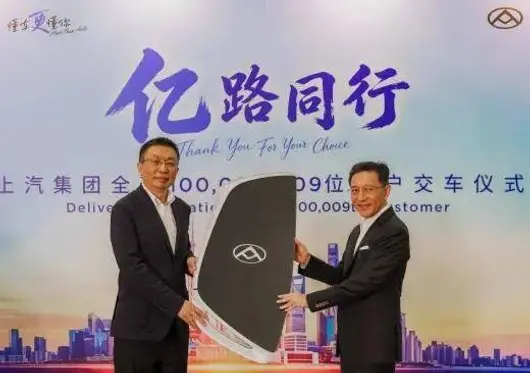
When Wang Xiaoqiu handed the unique "100 Millionth Vehicle" premium customized car model from SAIC Group to Momenta CEO Cao Xudong, there was no deliberate emotional countdown on site, nor a constantly jumping digital screen.

That was a collector's commemorative car model specially created for the "100 Millionth Vehicle", quietly displayed under the spotlight. The camera panned over the scene, some raised phones to take photos, some clapped, and others chatted in whispers. Compared to the usual "milestone moments" of many companies, this ceremony seemed even somewhat restrained.
But precisely this restraint made the event of the "100 Millionth Vehicle" itself appear exceptionally authentic.
Because everyone knows, this is not just SAIC's "100 Millionth Vehicle", in a sense, it is also the "100 Millionth Vehicle" of the Chinese automotive industry.
From producing the first Phoenix sedan by the Huangpu River to Chinese carmakers crossing the "100 Million" threshold for the first time today, the Chinese automotive industry took over 70 years. Rather than "how far we've gone", what outsiders care about more is actually another question: After reaching today, where will the Chinese automotive industry go next?
This is also the true meaning of this delivery ceremony. It seemingly looks back at history, but in reality, it always discusses the future.
Industrial Changes Within a Delivery Ceremony
If you look closely at this livestream, you will find an interesting detail: it did not unfold in the manner of a traditional car launch event. There were no long-term data displays, nor dense parameter explanations. Instead, the entire livestream was more like a "relay" constantly switching scenes.
Shanghai, Liuzhou, London, Jakarta, Singapore... different brands, different models, different users, connected into the same narrative.
And these users are not just car buyers in the traditional sense. Some are tech bloggers, some are public welfare creators, some are overseas young users, some are logistics enterprises, and others are founders of intelligent driving companies.
This arrangement itself actually sufficiently explains the changes in the automotive industry today. In the past, cars were more standardized industrial products, but today, they are beginning to become an entry point connecting lifestyles, technology ecosystems, and intelligent capabilities.
So, why is the 100 Millionth Vehicle the IM LS9 Hyper?
Because it is not a model that solely emphasizes sales significance, nor is it an old car symbolizing "historical collection", but a smart electric vehicle representing SAIC's most core direction today.
It integrates not only new energy powertrains, but also intelligent driving, software architecture, AI interaction, and ecosystem synergy capabilities. In other words, SAIC did not keep the "100 Millionth Vehicle" merely as a tribute to the past, but clearly pointed it towards the future.
The Automotive Industry Is No Longer Traditional Manufacturing
During the livestream, SAIC Group Vice President and Chief Engineer Zu Shijie reviewed SAIC's 70-year development process. He actually did not over-emphasize the keyword "100 Millionth Vehicle", but summarized the whole process into three stages: exploration in the beginning before Reform and Opening-up, joint venture cooperation after Reform and Opening-up, and the development of independent brands starting around 2000.
From Phoenix, to Santana, to Roewe, MG, IM, this actually corresponds to the tasks of different stages of the Chinese automotive industry. First, it was building an industrial foundation; later, it was learning the modern automotive industry system; and subsequently, it was forming its own R&D, brand, and technology capabilities.
And today, the Chinese automotive industry has clearly entered a new stage. In this stage, the question is no longer "whether we can make cars", but: Who should ultimately define the car of the future?
And the various SAIC cars delivered during the livestream may be the answer given by SAIC.
They represent SAIC's judgment, and even the Chinese automotive industry's judgment on the direction of competition in the next stage: Intelligent electric vehicles are becoming a new core competitive field for car companies.
Automotive industry expert Zhao Fuquan said a sentence worth pondering repeatedly: "The automotive industry is no longer traditional manufacturing."
He said that the current automotive industry has changed from the originally simple upstream and downstream relationships into an ecosystemized industry. It involves not only manufacturing but also communication, transportation, urban construction, AI, and the integration of more intelligent industries.
This sentence is the core of the entire industry's change today.
In the past, the most important capabilities of a car were the engine, transmission, and chassis; later, it was the battery, motor, and electronic control; but today, what more and more consumers truly perceive has become intelligent driving, cockpit interaction, software experience, AI capabilities, and continuous OTA iterations of the whole vehicle.
Cars are turning from "mechanical products" into "smart terminals", and this change is also reshaping the automotive enterprises themselves.
Joint Venture 2.0, Not Just "Cooperation"
In the livestream, Zu Shijie said that after entering the intelligent electric era, SAIC's cooperation with global brands has entered the "co-creation" stage. This is actually very important, because for many years in the past, when outsiders talked about the Chinese automotive industry, they always mentioned a sentence: "Market for Technology".
But today, this logic has begun to change. The Chinese market is no longer just a place for global car companies to sell products; it is beginning to become a place to define products.
The reason is actually simple: the world's most complete new energy industry chain is in China; the most fierce intelligent driving competition is in China; the largest smart electric vehicle consumption market is also in China. Therefore, whether it is Volkswagen, Audi, or General Motors, they must all re-understand the Chinese market.
This change is already very obvious in the models delivered that day. AUDI E7X, Buick Zhijing Family, Volkswagen ID. ERA 9X. These products are no longer simple "global model localization" as in the past; they are increasingly deeply integrated into China's intelligent ecosystem, Chinese user needs, and Chinese technical capabilities.
So, talking about "Joint Ventures" today is actually not one-way input, but both parties jointly defining the next generation of products. In a sense, this is also a reflection of the changing position of the Chinese automotive industry.
In the past, the Chinese automotive industry was mostly "learning"; today, Chinese enterprises began to participate in "defining"; and in the future, the Chinese automotive industry will further participate in shaping global intelligent mobility rules and technology directions.
From "Scale" to "Capability"
Interestingly, in the livestream, whether it was Zu Shijie or several experts, they all repeatedly mentioned one word: Ecosystem.
Zu Shijie mentioned that SAIC and Huawei actually started cooperating very early, with a lot of communication since the 5G communication era. Later, with the development of intelligent cars, the cooperation between the two sides naturally became deeper and deeper.
He said that car products have already undergone great changes now; communication technology, internet technology, and electronics technology will all be used in cars. "No single company can do it all." Therefore, we need to jointly make the Chinese new energy intelligent car ecosystem well.
This sentence is actually very realistic. Because in the intelligent car era, it is already very difficult to rely on a single enterprise to build all capabilities.
In the past, traditional car companies were more like a closed system, with the core of competition being manufacturing scale and supply chain efficiency; but today, the automotive industry is becoming more like an open platform. Chips, AI, algorithms, software, cloud, maps, communication... every link requires a new collaborative relationship.
This also means that the Chinese automotive industry is moving from "scale competition" to "capability competition".
In the past years, the Chinese automotive industry has already proved one thing: China can build an automotive industry of world-class scale. The "100 Millionth Vehicle" itself is a concentrated embodiment of this industrial capability.
But today's problem has already changed. Next, the contest is no longer just output, sales, and market share, but who can establish truly sustainable technical capabilities; who can form a global brand; who can master the discourse power of the next generation of intelligent cars; and who can truly integrate manufacturing, software, AI, and ecosystem.
Therefore, today's competition is becoming less and less like the past "company versus company" competition, and more like "ecosystem versus ecosystem" competition. Who can organize more capabilities, who can form more efficient synergy, who can truly establish long-term advantages.
This is also why, the 100 Millionth User choosing Cao Xudong appears symbolic. Because it actually expresses: One of the most important competitive strengths of the future automotive industry is ecosystem capability. And the reason SAIC chose IM LS9 Hyper as the 100 Millionth Vehicle to deliver is precisely because it is itself a product of this capability system.
It is not the result of a single manufacturing capability, but the result of smart driving, AI algorithms, software platforms, supply chain systems, and user data collaborating together.
In a sense, it is more like a "mobile smart terminal", not just a car in the traditional sense.
This is also why, although the entire delivery ceremony constantly reviewed history, it always carried a strong sense of "futurity". Because today's Chinese automotive industry has already reached a new node.
The future will not arrive automatically; it is shaped through repeated technology iterations, industry synergies, and user choices.
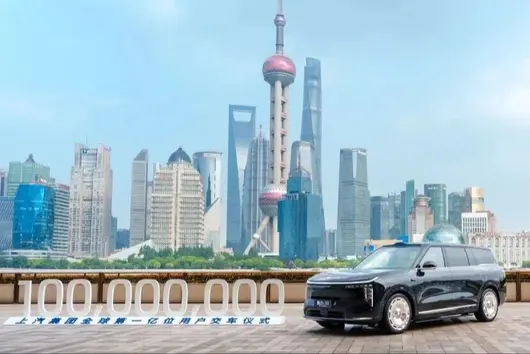

[CNMO Tech News] On May 22, SAIC Group announced that it will welcome the delivery to its 100 millionth global user by the end of this month, becoming the first automotive group in the history of China's automotive industry to achieve cumulative production and sales exceeding 100 million vehicles.

SAIC Group
According to CNMO Tech, in 1955, Shanghai Internal Combustion Engine Parts Manufacturing Company was established; in 1958, the first Phoenix sedan was successfully prototype-made; in 1983, riding the wind of reform and opening up, SAIC pioneered industry joint venture cooperation, and the first domestic Santana was assembled successfully; in 2015, SAIC pioneered the creation of the world's first internet-connected car. For over seventy years, SAIC and numerous Chinese automakers have jointly witnessed and promoted the great journey of China's automotive industry from nothing to something, from weakness to strength, and from "following and learning" to "innovation and leadership".

SAIC is the earliest and largest Chinese automotive enterprise to "go global". In 2001, SAIC achieved passenger vehicle exports for the first time; now its products and services cover over 170 countries and regions globally, with overseas cumulative deliveries exceeding 7 million vehicles. Overseas, SAIC owns over 100 parts production bases, over 3000 dealer networks, has built 3 major R&D innovation centers including London, as well as 4 production and manufacturing centers in Thailand, Indonesia, India, Pakistan, and has established China's first and globally leading self-operated vehicle logistics fleet.
In 2025, SAIC launched the overseas "Glocal Strategy" — "Global + Local" combination strategy. Relying on profound accumulation in electric intelligent connected technology, SAIC will actively create new overseas models including SUVs, sedans, MPVs, pickups. Models equipped with the new HEV hybrid power system will cover mainstream global market segments. Disruptive technologies such as solid-state batteries will also gradually achieve implementation and application, further building a global automobile brand and localized system ecosystem.
SAIC Group stated that 100 million vehicles is a glorious milestone and even more so a new starting point for progress. Standing at this new starting point, SAIC will continue to walk the 100-million journey together with global users, jointly opening the next brilliant chapter of China's automotive industry.

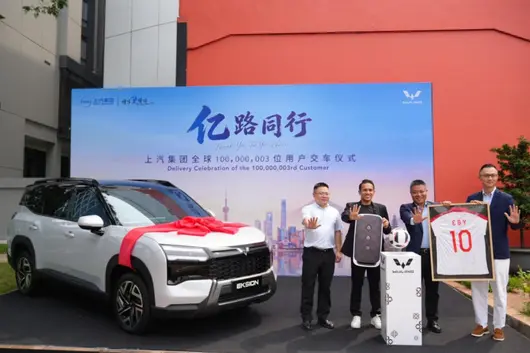
On May 28, SAIC Group welcomed the delivery of the first 100 millionth vehicle globally, becoming the first automotive group in China to cumulatively exceed 100 million units in production and sales. Among them, SAIC-GM-Wuling contributed more than 32 million units cumulatively. On that day, SAIC-GM-Wuling delivered its global car EKSION to the first batch of users in Jakarta, Indonesia.

[SAIC Group's 100,000,003rd vehicle delivered in Jakarta, Indonesia]
"What people need, Wuling builds." SAIC-GM-Wuling precisely grasped market trends, responding to user needs with hit products. Wuling Hongguang, with its versatile characteristics of "suitable for business and home, tough and durable", has become the preferred model for many entrepreneurs and families. As resident consumption gradually upgraded to quality life, Baojun 730 broke the monopoly of joint-venture brands in the household multi-purpose vehicle (MPV) market with its flexible space and high cost-performance ratio. In 2020, during the window period of new energy transformation in China's automotive industry, the launched Hongguang MINIEV became one of the pioneers in the domestic new energy commuting vehicle field. In May this year, the first technology flagship large six-seater SUV jointly created by SAIC-GM-Wuling and Huawei Qiankun, Huajing S, officially launched, breaking the technical premium barrier of high-end intelligent driving with innovative practices of cross-border synergy.
 [Equipped with Huawei Qiankun Technology Flagship Large Six-Seat Huajing S]
SAIC-GM-Wuling accelerated its layout for new energy and intelligence, and while promoting the electrification and intelligence upgrade of its products, deepened and solidified its global market layout. Currently, SAIC-GM-Wuling's cumulative overseas sales have exceeded 1.5 million units, with business covering more than 110 countries and regions globally.
The company has built a full-dimensional core competitiveness covering the intelligent manufacturing system, product matrix, and industrial ecosystem. First, the globally first intelligent island manufacturing system, using the flexible intelligent manufacturing mode of "cars finding workstations, materials finding cars", achieving full-dimensional breakthroughs in efficiency, quality, and cost; Second, a diversified product matrix adapted to the global market. Multiple models such as EKSION (Starlight 560), DARION (Starlight 730), BINGO (Wuling Bingo), BINGO S (Bingo S) have landed overseas successively, covering mainstream categories such as SUV, MPV, and sedans, meeting the differentiated travel needs of different countries and different consumer groups; Third, a unique "Moving Chains Overseas" globalization model, which, through the deep collaboration of the five chains: manufacturing chain, supply chain, sales chain, financial chain, and talent chain, broke the single path of traditional product trade going overseas and promoted the Chinese intelligent manufacturing system and standards to go global.
[Globally First Intelligent Island Manufacturing System (I²MS)]
The global car EKSION delivered in Indonesia this time is the latest footnote of the in-depth promotion of Wuling's globalization strategy. Relying on Indonesia as a core fulcrum, SAIC-GM-Wuling continues to deepen the "Indonesia-Malaysia-Thailand Integration" regional strategy, comprehensively covering Malaysia and Thailand with new energy products and localized supply chain systems, and gradually radiating to ASEAN countries such as Vietnam and the Philippines, forming a globalization pattern of regional synergy and linked development.


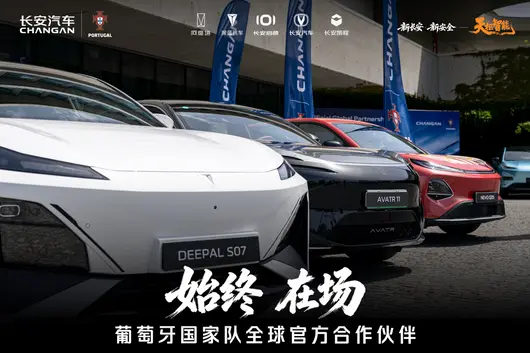
On June 1, Changan Automobile announced deliveries of 209,100 units in May, including 70,700 units delivered overseas, a year-on-year increase of 38%. New energy deliveries totaled 92,400 units, a year-on-year increase of 5.8%.
Among its sub-brands, Changan Qiyuan delivered 34,528 units in May, the flagship new Q05 delivered 15,812 units, with orders in Thailand exceeding 3,000 within three days of launch; Deepal Auto sales reached 33,243 units in May, up 30% year-on-year, overseas cumulative sales from January to May totaled 28,704 units, up 167% year-on-year; Avatr delivered 7,336 units in May, the Avatr 07L appeared in the MIIT announcement, will be the first to carry Huawei Qiankun ADS 5; Changan Automobile (Gravity) delivered 48,900 units in May, CS75PLUS&Eado Blue Whale Super Engine dual-car launch delivery, launch special price starting from 79,900 yuan; Changan Kaicheng delivered 21,100 units in May, new energy sales up 21% year-on-year.
Behind the steady climb in sales is the solid advancement of Changan Automobile's three major strategies. In May, Changan Automobile officially announced becoming the Global Official Partner of the Portuguese National Football Team, another step taken in the global "Inclusive" Plan 2.0; Changan's self-developed Tianzhu Leading End-to-End Technology is about to be mass-produced on vehicles, the intelligent "Beidou Tianzhu 2.0" plan secures another victory; Changan Blue Whale Super Engine dual-car launch delivery starts in hundreds of cities and thousands of stores across the country, the new energy "Shangri-La" plan achieves a 50% reduction in fuel consumption for blue-plate vehicles.



The first in China, SAIC Group's cumulative production and sales exceed 100 million vehicles! On May 28, at the Shanghai North Bund World Living Room, SAIC Group took this place as the origin to launch a global-reaching "First 100 Millionth User" vehicle delivery ceremony, becoming the first automotive group in Chinese automotive history to break 100 million cumulative production and sales. As a global leader in new energy commercial vehicles, SAIC Commercial Vehicles, with Maxus, Keya, IVECO, Hongyan, and Sunwin five brands, completed the global delivery relay from the 100,000,009th to the 100,000,013th vehicle, jointly creating a milestone in the Chinese automotive industry and engraving a historical coordinate for the Chinese commercial vehicle industry.
Behind the 100 million vehicles lies the long-term accumulation and explosive growth of SAIC's 70-plus years of deep cultivation, and it is also a vivid miniature of Chinese commercial vehicles moving from scale leadership to value leadership. Relying on the group's global resource empowerment, SAIC Commercial Vehicles has built the industry's most complete commercial vehicle matrix covering heavy trucks, buses, light trucks, light vans, pickups, MPVs, and RVs, continuously leading the Chinese commercial vehicle industry with a 35% new energy penetration rate and seizing opportunities in the global carbon neutrality wave. With reliable quality, cutting-edge technology, and a complete ecosystem, products are sold in over 100 countries and regions, winning deep trust from top global partners such as DHL, becoming the core force for Chinese commercial vehicles going global, moving in, and moving up.
Continuously leading Chinese brands to go global, Maxus drives global green logistics upgrade with benchmark strength. In Singapore, Maxus delivered eDeliver 5 (domestic Dana V1) to international logistics giant DHL, welcoming the group's 100,000,009th user. This is another milestone moment since both parties joined hands in 2017. Years of deep cultivation, Maxus not only won the largest procurement order of Chinese brands in DHL's European region, but also firmly stayed in its list of preferred partners for green transformation, with cooperation footprints covering Europe, America, Asia, and Oceania. Nowadays, relying on leading product strength and global strategy, Maxus light vans and high-end pickup export volumes firmly rank first in China, building five 10,000-unit level core markets; won C-NCAP, Euro NCAP, ANCAP global three major five-star safety certifications, continuously leading exports in high-end markets such as Singapore, Europe, Australia, and successfully joined the preferred cooperation camp of global top enterprises such as FedEx, DPD, JD.com, SF Express, Cainiao Logistics, with global strength to strongly expand the 100 million user map.


Based on the domestic market, the four brands deeply cultivate two major tracks of livelihood and infrastructure with green capacity. Keya delivered Dana T1 to Dizhantie in Yangzhou, Jiangsu, relying on high load-bearing, long range, and intelligent connectivity advantages to cover green urban distribution scenarios. In 2025, Keya delivered nearly 10,000 units cumulatively to Dizhantie, unblocking urban-rural logistics "capillaries". Sunwin delivered 10-series low-floor pure electric buses in Shanghai, empowering urban public transport smart upgrade with zero-carbon travel. Hongyan delivered i Jieshi dump trucks in Taiyuan, Shanxi, calmly mastering complex mountain operating conditions with military foundation and powerful performance, deeply protecting the construction of a strong country in infrastructure. IVECO delivered Juxing EV in Luoyang, Henan, 100-degree large capacity battery solved the mountain operation range problem, setting a new benchmark for green passenger transport. The four brands relay delivery, welcomed the group's 100,000,010 to 100,000,013th users, jointly casting a 100-million level milestone with hardcore strength.


From domestic core cities to key overseas markets, from logistics delivery and infrastructure engineering to public travel and tourist passenger transport, every delivery of the five brands is a vivid practice of SAIC Commercial Vehicles "Hand in Hand with Chinese Power, Driving the World's Pulse". 100 million users are not the end point, but a new starting point of trust. Facing the future, SAIC Commercial Vehicles will continue to take technological innovation as the core, user value as the guide, lead green transformation, deepen global layout, and write the brilliant chapter of the Chinese commercial vehicle industry on the new journey.

May 28, SAIC Motor completed delivery of its 100 millionth new vehicle, becoming the first domestic automotive group to exceed 100 million in cumulative production and sales, resetting the production and sales record of Chinese automakers.

The vehicle model delivered this time is the IM LS9 Hyper, the top-spec version of the IM LS9. It features a full wire-controlled four-wheel steering system, equipped with a 520-line ultra-vision LiDAR, Nvidia Thor chip, and the Momenta intelligent driving large model.
Regarding power, the vehicle is built on an all-domain 800V high-voltage platform, equipped with the Star Super Range Extender System, and features the Gold Badge Hurricane Three-Motor System. The peak power of the motors reaches 160kW (Front), 195kW (Rear Left), and 195kW (Rear Right) respectively. The comprehensive range exceeds 1400 kilometers.

In 1955, the Shanghai Internal Combustion Engine Parts Manufacturing Company was established, marking the formal start of the Shanghai automotive industry; in 1958, the first "Phoenix" sedan went off the line, achieving a zero breakthrough in Shanghai sedan manufacturing. In the 1980s, SAIC introduced the Santana model through joint ventures and cooperation, promoting the scaled development of China's sedan industry. In 1997, Shanghai GM was established, setting a record of 23 months from factory construction to vehicle delivery. The Roewe brand was born in 2006, and the first Internet car, Roewe RX5, was launched in 2016. In 2020, IM Motors was established, positioning itself in the high-end intelligent electric vehicle track.
In terms of overseas markets, SAIC Motor has already established over 100 parts production bases and a dealer network of more than 3000, with products and services covering more than 170 countries and regions globally. Additionally, 3 major R&D and innovation centers, including London, have been built, along with 4 production and manufacturing centers in Thailand, Indonesia, India, and Pakistan. The owned Anji Logistics operates 42 various Ro-ro ships, with 8 international routes covering Southeast Asia, Europe, and the Americas.
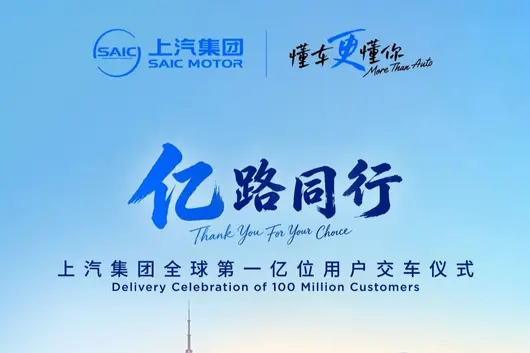
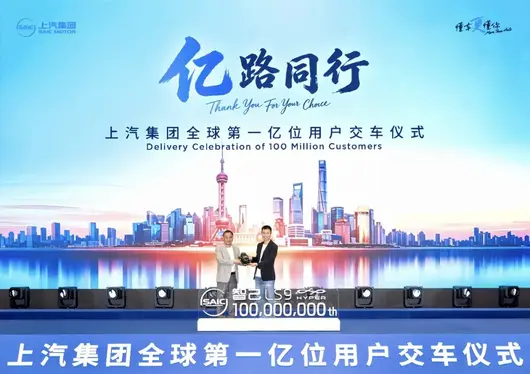
May 28, 2026, a date worth mentioning repeatedly in the history of China's automotive industry.
SAIC Group delivered an IM LS9 Hyper to the world's 100 millionth user—Momenta CEO Cao Xudong—at the North Bund World Welcome Hall in Shanghai. This is not an ordinary delivery. At the same time, more than a dozen brands under SAIC and 19 car models relayed deliveries in multiple locations around the world. From Shanghai to Nanjing, Liuzhou, and Taiyuan, from the UK to Indonesia and Singapore, a cross-continental "delivery relay" announced a fact: The first automotive group in China to exceed 100 million cumulative production and sales was born.

100 million vehicles. This number used to belong only to Toyota, Volkswagen, and GM. Today, it belongs to a Chinese enterprise.
Many might say: So what if it's 100 million vehicles? It's just "large volume". But I exactly think, the most worth savoring in these 100 million vehicles is not "quantity", but "change".
First Layer of Change: From "Hammering Cars" to "Building Cars", From "Trading Market for Technology" to "Technology Defining the Market"
In 1958, Shanghai workers hammered out the first "Phoenix" brand sedan with hammers. That was the infancy of China's automotive industry, clumsy and primitive, but full of longing.

In 1983, the Santana came off the line, China's auto industry entered the joint venture era. The logic of that stage was: trade market for technology. We provide the market, the foreign party provides technology. The biggest gain for SAIC in this process was not only learning to build cars, but constructing a full industry chain capability from components to whole vehicles, from R&D to manufacturing. Many people don't know that the Santana localization consortium was once China's automotive industry's most solid "Whampoa Military Academy".

In 2016, the Roewe RX5 was launched, claiming to be the "World's First Internet-connected Car". At that time, many people thought it was a gimmick. Looking back, that was actually SAIC's first signal: The initiative of intelligence should be ours.
In 2020, IM Motors was founded, leading up to today's 100 millionth vehicle—the IM LS9 Hyper, equipped with full-by-wire four-wheel steering, full-domain 800V high-voltage platform, Star Super Extended Range, L3-level intelligent driving redundancy capability, and even co-launched "Endogenous Security" technology with Zijinshan Laboratory, pulling safety from the physical world into the information world.

The evolutionary trajectory of these 100 million vehicles is very clear: From "I Can Build Cars", to "I Can Build Good Cars", to "I Can Define the Standards for the Next Generation of Cars".
Second Layer of Change: From "Product Going Global" to "Value Chain Going Global"
Among SAIC's 100 million vehicles, cumulative overseas sales have exceeded 7 million. MG won the European sales champion for Chinese brands for 11 consecutive years. In 2025, annual European sales exceeded 300,000 vehicles, becoming the first Chinese brand to exceed one million cumulative sales in Europe and the UK.
What is more worth noting is SAIC's released "Glocal Strategy" (Global + Local) last year. What does it mean? No longer simply shipping cars from domestic to foreign to sell, but building R&D centers and production bases locally, and even reverse-engineering technology for the local market. Semi-solid-state batteries, Hybrid+ hybrid technology, were all premiered first at overseas Tech Days, then fed back to the global market.
This is the true "Value Chain Going Global". Brands, technology, standards, ecosystems, all go out together.
Third Layer of Change: From "I Understand Cars" to "I Understand You"
The detail that moved me most about this SAIC delivery ceremony was not those cool technical parameters, but that they invited various real users: Luo Zhenyu, Yang Chen, Cao Kailiang, public welfare barber Liu Jia... Behind every user is a story of "Why This Car Suits Me".
SAIC proposed a concept called "Understand Cars, Understand You Even More". In the past, when car companies said "Understand Cars", it was boasting engineering capabilities; now saying "Understand You", it means translating technology into human language, turning it into the peace of mind, convenience, and fun you can feel when driving every day.
100 million vehicles is not a cold factory cumulative number. It is 100 million specific people, 100 million different travel lives. Enterprises that can reach this magnitude must not only have built cars well, but have taken good care of "people".

Finally, let me share a bit of my exclusive observation
Many view "100 million vehicles" as the coming-of-age ceremony of China's automotive industry. I don't see it that way. I believe this is the watershed where China's auto industry enters "ecosystem competition" from "scale competition".
In the past, we compared whose capacity was larger, who was cheaper, who sold more. In the future, it's about who can build a complete ecosystem including energy networks, intelligent driving systems, data closed-loops, and user communities on a global scale. SAIC's 100 million vehicles exactly proves it has sufficient user base, product breadth, and technical depth to support the establishment of this ecosystem.
The 100 millionth vehicle delivered to Momenta's CEO, this detail is very symbolic—the relationship between the OEM and the intelligent driving supplier has changed from "procurement" to "co-creation".
This is not a delivery, but a confirmation of an alliance.
From 1955 to 2026, 71 years, 100 million vehicles. The next 100 million vehicles will not need another 71 years. But the key to the next 100 million vehicles is not speed, but height.
China's automotive industry finally has a truly "100 million-level calling card". What is written on this card is not "World Factory", but "Global Co-creation".
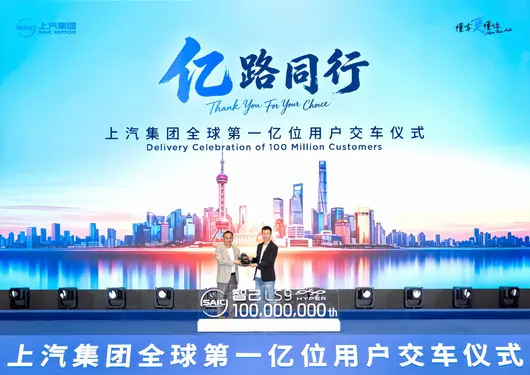

On May 28, 2026, SAIC Group held the "World's First 100 Millionth User Delivery Ceremony" at the World Living Room of Shanghai North Bund, becoming the first automotive group in the history of China's automotive industry to exceed 100 million cumulative production and sales. Previously, only the United States, Japan, Germany, South Korea, etc. had "100-million-level automakers." SAIC's breakthrough marks a new historical step for China's automotive industry.

Over 70 Years, From Hand-Built to Leading
SAIC's starting point was the Shanghai Internal Combustion Engine Parts Manufacturing Company, established in 1955. In 1958, workers hammered out the first "Phoenix" sedan in an alley factory, achieving the "zero breakthrough" for Shanghai's sedan manufacturing.
Subsequent key milestones: The first Santana rolled off the line in 1983,开启 a new era of joint cooperation; Shanghai GM was established in 1997, creating the "Shanghai Speed" of 23 months from factory construction to vehicle launch; In 2006, the independent brand Roewe was born; In 2016, the world's first Internet car Roewe RX5 was launched; In 2020, the high-end smart electric brand IM Motors was established. Over 70 years, SAIC has experienced and driven the entire process of China's automotive industry from nothing to something, from weak to strong.
IM LS9 Hyper, SAIC's Culmination of Technology

The 100 millionth vehicle delivery model is IM LS9 Hyper, known as the culmination of SAIC's technical strength. It is equipped with three major core technologies:
Full Steer-by-Wire Four-Wheel Steering: The first fully steer-by-wire steering technology in China verified by the China Automotive Technology and Research Center, pre-installed with redundancy capabilities for L3 and higher-level intelligent driving.
Maximized Intelligent Driving Hardware: 520-line super-vision LiDAR + NVIDIA Thor chip, paired with Momenta end-to-end reinforcement learning large model.
Three-Electric Systems: Global 800V high-voltage platform + Star Super Range Extender, with comprehensive range exceeding 1400 km; First equipped with SAIC Golden Label Hurricane Three-Motor, joining the "3-Second Club".

It is worth mentioning that IM LS9 Hyper launched the "Endogenous Security" technology jointly with Purple Mountain Labs globally, expanding the automotive safety boundary from physical security to information and system security.
The 100 millionth user is Cao Xudong, CEO of Momenta — SAIC's core strategic partner in the intelligent driving field. "Partner becomes owner" is a microcosm of deep technological co-creation.
January to April Sales 1.302 Million Vehicles, Four Consecutive Months Champion

The foundation of 100 million vehicles is solid market performance. From January to April 2026, SAIC Group cumulatively sold 1.302 million vehicles, ranking first among Chinese automakers for four consecutive months. Among them, independent brand sales were 910,000, accounting for nearly 70%; New energy vehicle sales were 412,000; Overseas market sales were 459,000, a year-on-year surge of 50.2%.
Regarding R&D investment, in the past decade, SAIC has cumulatively invested over 150 billion yuan in new energy and intelligent connected fields, forming nearly 26,000 valid patents. In 2014, the sales proportion of SAIC new energy vehicles was less than 0.1%, while in 2025, this proportion exceeded one-third.
Global Layout, Products Spanning Over 170 Countries and Regions

SAIC is a pioneer in China's automotive industry "going global." Currently, it has over 100 parts production bases and over 3,000 dealer networks overseas, with 3 major R&D innovation centers including London, and 4 production centers in Thailand, Indonesia, India, and Pakistan. SAIC Logistics owns 42 roll-on/roll-off ships, with 8 international routes covering Southeast Asia, Europe, and the Americas.
As of now, SAIC's products and services cover over 170 countries and regions, with cumulative overseas sales exceeding 7 million units. MG has won the champion of European sales for Chinese brands for 11 consecutive years; in 2025, European annual sales exceeded 300,000, becoming the first Chinese automotive brand to accumulate over one million sales in Europe and the UK.
In 2025, SAIC released the overseas "Glocal Strategy" (Global + Local), accelerating the shift from "Product Going Global" to "Value Chain Going Global".
Final Thoughts
100 million vehicles is not the end point, but a new starting line for SAIC to "start a second entrepreneurship" towards the future of smart electricity. From 1955 to 2026, from the first user to the 100 millionth user, from "hand-built" manufacturing to global technology leadership, SAIC's development history is itself a condensed history of the rise of China's automotive industry. SAIC has already proved the depth and resilience of China's automotive industry with 100 million vehicles. Who will be the next 100-million-level automaker?
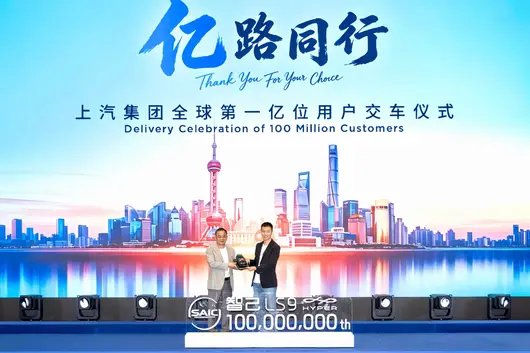




On the afternoon of May 28, 2026, the 100,000,000th vehicle of SAIC Motor — an IM LS9 Hyper — was delivered at the Shanghai North Bund World Living Room to SAIC's 100 millionth user, Momenta CEO Cao Xudong.

The delivery list provided by SAIC Motor shows that the 99,999,999th user is Yang Chen, a former Chinese national football team player who played in Germany; the delivered model is SAIC Volkswagen ID. ERA 9X, and the delivery location is Shanghai Anting. In addition, for users from the 99,999,996th to the 100,001,100th, apart from the majority of users from China, there were also users from London, UK; Jakarta, Indonesia; and Singapore, and models included multiple models from multiple brands such as Shangjie Z7, Huajing S, MG4 EV Urban, AUDI E7X, Buick Zhijing Shijia, Sunwin Series 10 Pure Electric Bus, and Jiyue Danaka T1.

Sales data from January to May this year shows that SAIC Motor has cumulatively sold 1.651 million new vehicles, of which overseas cumulative sales reached 589,000 units, accounting for a proportion of up to 35% of the group's sales. Among them, in Australia and New Zealand, the MG3 and MG4 led, with market share shares of 21.1% and 12.8% respectively, ranking TOP 1 and TOP 3 in the CAR-B segment market; in Belgium, MG sales doubled directly; in the UK, the MG brand ranked in the top six; in Chile, MG ZS successfully took the top spot in the local SUV market. Especially in SAIC's largest overseas regional market — Europe, the global car brand MG cumulatively sold 150,000 units from January to May, a year-on-year increase of 20%, continuing to claim the title of "Chinese Brand Europe Sales Champion".
Data from 2025 shows that SAIC Motor's cumulative sales reached 4.507 million units, ranking 7th among global automotive groups, leading world-established automotive groups such as Ford and Honda. This means that today's SAIC Motor has transformed from the "handcraft workshops" of those years into a global automotive enterprise.
From Hand Hammering to 18 Consecutive Years of Sales Champion, Haipai Culture is Key
SAIC Motor's growth history is basically a microcosm of the Shanghai automotive industry, and even the national automotive industry, going from 0 to 1, from weak to strong.
In 1955, the predecessor of SAIC Motor — Shanghai Internal Combustion Engine Parts Manufacturing Company — was established. This company consolidated a total of 274 original factories and workshops in the entire industry, the vast majority of which were alleyway handcraft workshops and small private repair and matching workshops. This illustrates the hardships of the start of China's automotive industry.
In 1958, workers hammered out the first "Phoenix" brand sedan with hammers, achieving a "zero breakthrough" in Shanghai sedan manufacturing.

Then in 1978, the state established the policy that "joint venture operations can be carried out", and Shanghai Volkswagen and Shanghai General Motors were established successively. As the earliest generation of joint venture enterprises in China, Shanghai Volkswagen's greatest contribution was "persisting in German Volkswagen's high standards, enabling the Chinese automotive standard system to span 30 years". "Shanghai General Motors established in the late 1990s also brought the full set of models for contemporary automotive marketization operations: network, brand, public relations, service, used cars, evolving from pure manufacturing to forming systemic competitiveness in the value chain". Li Anding described the contribution of joint venture enterprises under SAIC Motor to the entire Chinese automotive industry in this book "Car Diary".
In fact, not only joint venture enterprises, relying on the unique "Haipai Culture", SAIC Motor was the sales champion of Chinese car companies every year during the 18 years from 2006 to 2023. In these eighteen years, various parts enterprises, forward-looking technology research and development centers led and founded by SAIC Motor, the vast majority have become the leaders or market segment drivers of the entire Chinese automotive industry. China as a whole also established a highly complete and developed automotive supply chain. It was thanks to this highly developed and complete automotive supply chain that there were the magnificent new energy vehicles in the Chinese market later.
"A century of historical sedimentation has created the 'Haipai' connotation of Shanghai automobiles: open, market-oriented, integrity; exquisite craftsmanship, superior quality; inclusiveness, good at building bridges between East and West." Li Anding wrote so in the book "Car Diary". In fact, this openness, marketization, integrity, exquisite craftsmanship, and superior quality are also a true portrait of SAIC Motor.
From Joint Venture to Independent, SAIC Motor's Final "Butterfly Transformation"
If the "Phoenix" born in 1958 represents the original intention of China developing independent brands, IM Motors established by SAIC Motor in 2020 represents Chinese automotive professionals who have always stood at the forefront of China's automotive industry, experiencing decades of wind and rain, still not forgetting this original intention.
Shanghai has always been Shanghai, and SAIC has always been that SAIC.
In 2003, SAIC Motor launched the acquisition of the British century-old factory Rover, the acquisition target was only the intellectual property rights of two Rover 25 and Rover 75 models. This is completely different from the situation where most Chinese automotive enterprises acquire the brand itself along with the industrial M&A overseas. This means that from the beginning, SAIC Motor has chosen the road of fully developing independent brands.
In 2006, SAIC Motor launched the brand-new independent brand Roewe, the first car chosen was the mid-size car Roewe 750, hoping to break away from the old road of Chinese brands "poor quality and cheap price". In comparison, in the past era, most independent brands often chose to start from compact cars or even micro cars. SAIC Motor in 2006 was undoubtedly one step ahead. In 2016, SAIC Roewe launched the world's first mass-produced Internet car Roewe RX5, which further set off the development wave of Internet cars in the entire Chinese market later.
In 2020, SAIC Motor established the IM brand, the pricing and positioning of the new brand was clearly aimed at the high-end market. From the current trend that the market share of independent brands in China's automotive market is getting higher and higher, and independent high-end brands are beginning to occupy the BBA market share on a large scale, SAIC Motor's approach, its foresight, and determination to pursue brand elevation are obvious.
Latest data shows that in recent years, the proportion of independent brand sales of SAIC Motor in the group has been increasing, first breaking 50% in 2021, reaching 65% in 2025, and this year January-May even broke 70% for the first time, reaching 71.1%. SAIC Motor's striving upward has much to do with SAIC Motor's innate Haipai Culture.
Nowadays, not only SAIC's independent brands Roewe and IM, including overseas brands cooperating with SAIC, German Volkswagen and American General Motors, are all making use of SAIC Motor as an important innovation base, starting the development path of comprehensive transformation towards electrification and intelligence.

On May 20, 2024, again at the World Living Room, SAIC Motor and Audi Cars officially signed a cooperation agreement to jointly develop multiple high-end intelligent electric new cars for SAIC Audi and jointly develop Advanced Digitized Platform intelligent digital platform. Audi Cars, for this cooperation, even went so far as to use the AUDI letter logo, a logo used when the Audi brand was established, as the brand logo for SAIC Audi. The last time this logo appeared independently as an Audi brand car logo can be traced back to 1994, 30 years ago.

"Audi Cars possesses powerful high-end model product definition, whole vehicle R&D and engineering technology capabilities; SAIC Motor's intelligent electric innovation technology is industry-leading, both sides will join hands through this cooperation to "technologically empower" SAIC Audi, fully support joint venture brands to sprint on new tracks and grasp new opportunities", both sides wrote so on the cooperation agreement. "SAIC Motor's intelligent electric innovation technology is industry-leading", for China's automotive industry, obtaining recognition from the German automotive industry which once led China's automotive industry significantly, and becoming a partner on equal footing with German cars, took China's automobiles a full 40 years. And for SAIC Motor established in 1955, it took a full 71 years.

Not only that, in April 2026, SAIC and Audi further cooperated to set up the Audi Innovation Technology Center in Shanghai Anting, forming the AUDI brand's technology home port in China, helping SAIC Audi continue R&D in China. This innovation technology center is even Audi's first "full value chain" R&D entity outside of Europe.
China R&D, China manufacturing luxury brand cars, re-exporting globally, this is SAIC Audi's new brand goal. Behind this brand goal, the underlying logic is precisely SAIC Motor's industry-leading intelligent electric innovation technology.
In fact, not only Volkswagen, but General Motors from the United States is also making use of SAIC Motor to build its intelligent electric vehicle whole vehicle R&D and manufacturing base in China. The brand-new high-end new energy sub-brand Zhijing of SAIC General Buick was established in such a context. Looking at the sales volume this year in May, Buick Zhijing terminal sales reached 12,253 vehicles, a month-on-month surge of 64.8%.
In fact, the first "Joint Venture" partner chosen by China's initial automotive industry was American General Motors, not German Volkswagen. And the concept of Joint Venture was also proposed by General Motors CEO Thomas Murphy at that time when he came to China to discuss cooperation in October 1978. Nowadays, SAIC Motor's cooperation with General Motors has also gone from the initial "Joint Venture", to later establishing the global R&D innovation base PanAsia Automotive Technical Center jointly by both sides, to now Zhijing brand focusing on new energy vehicles, SAIC Motor's technical weight in the entire Joint Venture system has been raised to a new height.
"The accumulation of a century of Haipai car culture has not only made Shanghai the backbone of China's car manufacturing industry, but also made Shanghai the earliest starting and most accomplished car R&D innovation base. This point, although the competent authorities and media have not paid sufficient attention, multinational corporations have already regarded it as a rare cooperative force." This is the observation given by Li Anding when writing the book "Car Diary" in 2010. More than ten years later, the constantly evolving cooperative relationship between SAIC Motor and Volkswagen, General Motors further confirmed Li Anding's observation.
Just on the afternoon of May 28, at the delivery ceremony of SAIC Motor's 100,000,000th new vehicle, a new car delivery ceremony originally worthy of being written extensively by enterprises and the entire industry "China's First 100-Million-Level Vehicle Enterprise", instead appeared restrained and low-key.
On the entire delivery ceremony, among the delivered car owners, there were former national team players and football stars like Yang Chen, current CEOs of top-tier enterprises like Momenta Cao Xudong, internet celebrities like Luo Zhenyu, Indonesian active national team players, DHL Senior Vice Presidents, and Village Party Secretaries, etc. Models also included multiple brands from passenger cars to commercial vehicles, from ordinary family sedans to luxury cars. But in this press conference, there were no leadership speeches popular in the industry, no parameter stacking that consumers found somewhat annoying, and no exaggerated and affected emotional performance. All temperature, height, breadth, and depth condensed into a string of numbers: 100,000,000.

From 0 to 1, from 1 to 100 million, it is less said that SAIC Motor is telling an "100-Million-Level Vehicle Enterprise" industry story, telling the era changes spanning a full 71 years, rather, it is telling the life legend of 100,000,000 users. Just as SAIC Motor's corporate Slogan says: Understand Cars, Understand You Better. This is what SAIC Motor wants to accomplish.



© 2024 Bitauto.com. All Rights Reserved.
Bitauto (www.yiche.com and www.bitauto.com) is one of the most visited automotive websites in China. We provide detailed info on Chinese car brands available in your area. Please note that the information provided on this website is based on publicly available data and is for reference only. It may not be fully updated or accurate at all times.

Help us improve our website


