

HomeDelivery

Search History
Popular Searches
Dealer Login / Sign Up


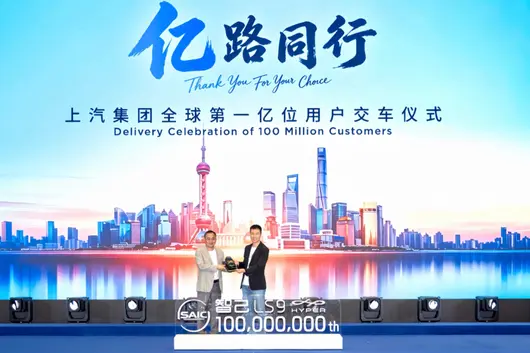
On May 28, SAIC Motor held the "Global First 100-Millionth User Vehicle Delivery Ceremony" in Shanghai. Centered on this major historical honor milestone, multiple brands under SAIC Motor synergized.
SAIC Volkswagen ID. ERA 9X's 6,999th owner officially received delivery, at the same time the vehicle became SAIC Motor's global 99,999,999th delivered car, with Chinese player Yang Chen, the first to compete in the Bundesliga, becoming its owner. Thus ID. ERA 9X also achieved delivery of over 7,000 units within 30 days of launch.
The honor of the 100-millionth unit vehicle went to IM LS9 Hyper, with Momenta CEO Cao Xudong becoming its owner. Momenta is SAIC's core strategic partner in the intelligent driving field. ID. ERA 9X also debuted with the Momenta R7 Large Model.

Looking back at SAIC Motor's history, in 1955, Shanghai Internal Combustion Engine Parts Manufacturing Company was established, and Shanghai's automotive industry started from here. In 1958, workers hammered out the first "Phoenix" sedan, achieving a "zero breakthrough" in Shanghai sedan manufacturing.
For over 70 years, SAIC experienced and promoted the entire process of China's automotive industry from nothing to something, from weak to strong: In 1983, the Santana went off the line, marking the start of joint venture cooperation; In 1997, SAIC-GM was established, creating the "Shanghai Speed" of building a factory and producing vehicles in 23 months; In 2006, the independent brand Roewe was born; In 2020, the high-end intelligent electric brand IM Motors was established.
From January to April 2026, SAIC's cumulative sales reached 1.302 million vehicles, ranking first among Chinese automakers for four consecutive months. Among them, independent brand sales were 910,000 vehicles, accounting for nearly 70%; New energy vehicle sales were 412,000; Overseas market sales were 459,000, surging 50.2% year-on-year.
SAIC is also a pioneer of Chinese automotive enterprises "going global": It has over 100 parts production bases and over 3,000 dealer networks overseas, built 3 major R&D innovation centers including London and 4 production centers in Thailand, Indonesia, India, Pakistan; Anji Logistics owns 42 RoRo ships of various types, 8 international routes covering Southeast Asia, Europe, Americas. Nowadays, SAIC's products and services are distributed in over 170 countries and regions, with cumulative overseas sales exceeding 7 million vehicles.
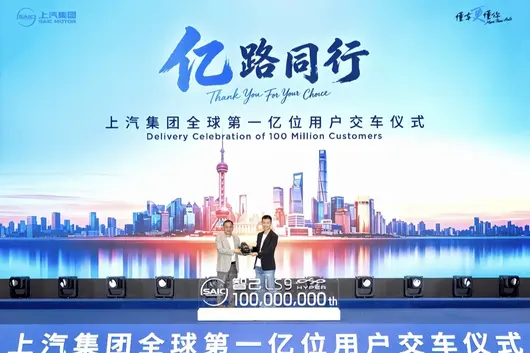

[CNMO Tech News] On May 29, Tesla officially announced that the Model Y L model has started its first deliveries in Singapore.

Model Y L First Deliveries Begin in Singapore
According to CNMO Tech, in May this year, the 6-seater version of the Model Y L received a five-star comprehensive safety rating from the Australasian New Car Assessment Program (ANCAP). The Model Y L scored high in all four major test categories: adult protection, child protection, pedestrian and cyclist protection, and safety assistance systems. The model has previously been launched in multiple markets and will be delivered to other markets in the future, and will also participate in evaluation and certification by local safety institutions.

In March this year, Tesla Executive Vice President Tao Lin stated that the Model Y has been on the market for 7 years and has been the world's best-selling passenger vehicle for three consecutive years. The Model Y was rated "Best Electric Car of 2026" by the authoritative magazine "Consumer Reports" and has won numerous awards in markets such as Australia, New Zealand, Japan, etc. The Model 3 also performed well, winning two major awards in Singapore: "Car of the Year 2026" and "Best Electric Sedan".
It is worth mentioning that recently, Tesla launched a June car purchasing benefit. The down payment for the Model Y L is only CNY 99,900, and the monthly payment can be as low as approximately CNY 3,985. Tesla also launched a new "Easy Loan" campaign. Taking the Model Y Rear-Wheel Drive version with a price of CNY 263,500 as an example, the balloon payment is CNY 52,700, with a down payment starting from CNY 55,900, and the minimum monthly payment for a five-year term is approximately CNY 2,691.
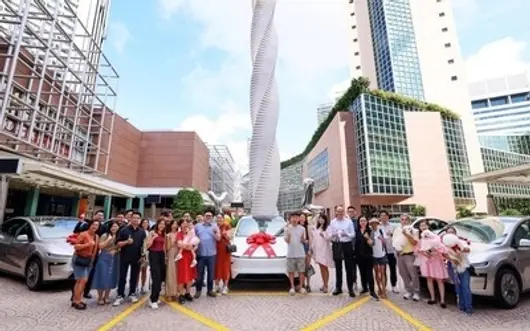

On May 28, SAIC Motor completed the global 100 millionth new vehicle delivery ceremony, becoming the first automotive manufacturer in China to break 100 million in sales. From the establishment of the Shanghai Internal Combustion Engine Parts Manufacturing Company in 1955 to 1958, workers hammered out the first "Phoenix" brand sedan off the production line. Having gone through more than 71 years of development, SAIC Motor now possesses more than 10 whole vehicle brands, with products covering categories from sedans, SUVs, MPVs, to commercial vehicles.

From January to April 2026 alone, SAIC's cumulative sales reached 1.302 million units, ranking as the sales champion among Chinese automakers for four consecutive months. Among them, independent brand sales were 910,000, accounting for nearly 70%; new energy vehicle sales were 412,000; overseas market sales were 459,000, a surge of 50.2% year-on-year.

As a pioneer among Chinese automotive enterprises in "going global," SAIC Motor owns more than 100 parts production bases and more than 3,000 dealer networks overseas, having built 3 major R&D innovation centers including London, and 4 production and manufacturing centers in Thailand, Indonesia, India, and Pakistan. Today, SAIC's products and services are distributed in over 170 countries and regions, with cumulative overseas sales breaking 7 million units.

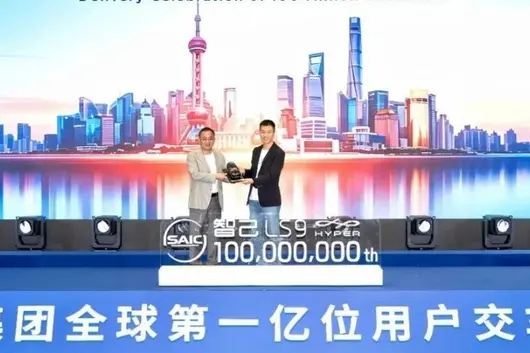
At the delivery ceremony site, the 100 millionth vehicle model delivered was the flagship SUV — IM Motors LS9 Hyper — which was delivered to the 100 millionth user, Momenta CEO Cao Xudong.

The new car is equipped with full line-by-wire four-wheel steering, a 520-line LiDAR + NVIDIA Thor chip, providing L3 level hardware capabilities. In addition, the new car is built with a whole-domain 800V architecture, adopts an extended-range electric system, and can achieve a 0-100 km/h acceleration in 3 seconds.

At the delivery ceremony site, all SAIC brands and the entire product matrix coordinated their efforts. Independent brands went all out: Shangjie Z7, Huajing S, Roewe M7, MG4 Semi-Solid State Battery Edition, Wuling Starlight 560, Maxus eDeliver5, Hongyan Heavy Truck, Yuejin Dana T1, Sunwin Pure Electric Bus, Iveco Juxing EV, etc., were delivered successively, covering multiple scenarios such as personal travel, family life, commercial operations, and logistics transportation.


Joint venture brands concentrated on displaying "Joint Venture 2.0" achievements: Volkswagen ID. ERA 9X will debut globally equipped with Momenta R7 Reinforcement Learning World Model, delivering over 7,000 units within one month of launch.

Audi E7X plans to become the first Audi model globally to implement L3 level autonomous driving; Buick Zhijing E7 is built based on the "Xiaoyao" Super Fusion Architecture, delivering over 10,000 units within one month of launch.



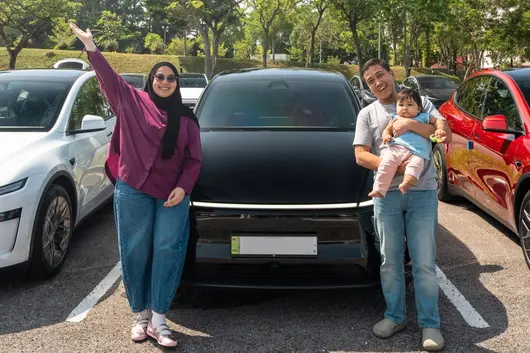
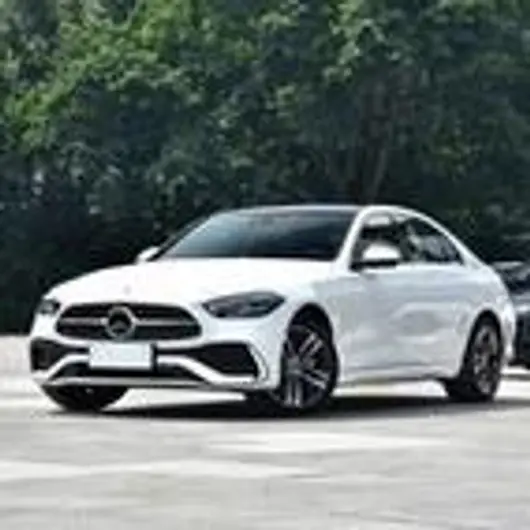
In Australia, the Philippines, and South Korea
after Thailand, Singapore, and New Zealand
The Model Y L produced at the Shanghai Super Factory
Malaysia 🇲🇾 has also kicked off its first batch of deliveries 👏
Why do people around the world choose it?
Safe, intelligent, easy to drive, easy to use, good-looking, and money-saving ⚡️


On May 28, 2026, the Shanghai North Bund World Reception Hall hosted a delivery ceremony to be recorded in the history of China's automotive industry. As an IM LS9 Hyper drove out, SAIC Motor officially welcomed its 100 millionth user globally. At this moment, SAIC Motor became the first automotive company in China's industry to surpass 100 million cumulative production and sales, setting a new milestone for the development of China's automotive industry. This delivery ceremony was not limited to a single venue; instead, through the form of "Global Relay Delivery," the delivery scene extended from the main venue in Shanghai to domestic cities such as Nanjing and Liuzhou, as well as overseas markets like the UK, Indonesia, and Singapore. This was not only a delivery spanning continents but also a concentrated display of the globalization operational capability of Chinese automotive brands.

SAIC's 100 million journey almost spanned the entire process of China's modern automotive industry from nothing to something, from weak to strong. The establishment of the Shanghai Internal Combustion Engine Parts Manufacturing Company in 1955 marked the beginning of Shanghai's automotive industry; in 1958, workers hammered out the first "Phoenix" brand sedan with hammers, achieving a zero breakthrough in domestic sedan manufacturing. Over the subsequent decades, SAIC has always walked at the forefront of industry transformation: the launch of the Santana in 1983 opened the precedent for Chinese automotive joint venture cooperation; the establishment of Shanghai General Motors in 1997 created the "Shanghai Speed" of "plant construction and vehicle production within 23 months"; the birth of the Roewe brand in 2006 marked the rise of independent innovation; in 2016, the Roewe RX5 took the lead in defining the "Internet Car". Today, the establishment of the high-end smart electric brand IM is the mark of SAIC's comprehensive entry into the smart electric era. What runs through this long journey is SAIC's consistent adherence to the concept of "Understanding Cars and Understanding You More," transforming breakthroughs in core technologies into travel experiences perceptible to users.

As the model for the 100 millionth unit off the line, the IM LS9 Hyper embodies over 70 years of SAIC's technical accumulation. This flagship model is equipped with a full-line-by-wire four-wheel steering chassis, a 520-line super-vision LiDAR, and the NVIDIA Thor chip, combined with a global 800V high-voltage platform and the Star Super Range-Extending Technology, achieving breakthroughs in handling, intelligent driving, and range. It is worth mentioning that the 100 millionth user is exactly Momenta, the core strategic partner of SAIC in the field of intelligent driving - Cao Xudong, CEO of Momenta Company. This delivery model of "ecosystem partners becoming users" also confirms the new paradigm of technical co-creation in China's automotive industry.

Behind the scale of 100 million units is the support of SAIC's powerful full-value-chain ecosystem. Data shows that in the first four months of 2026, SAIC Motor led the Chinese car market with 1.302 million units in sales, among which overseas market sales increased by more than 50% year-on-year. Currently, SAIC has established over 100 parts bases, more than 3,000 sales outlets overseas, as well as 8 international logistics routes covering Southeast Asia, Europe, and the Americas. From early product exports to the release of the "Glocal" Global Localization Integration strategy, SAIC is accelerating the transformation from "product going global" to "value chain going global". The MG brand has held the title of best-selling Chinese brand in the European market for eleven consecutive years, the IM AD intelligent driving system covers five continents globally, and cutting-edge technologies such as semi-solid-state batteries have also landed in the global market. Standing at the new starting point of 100 million scale, SAIC is using technological innovation as a pen to re-write the narrative method of China's automotive industry participating in global competition.

At the delivery site, in addition to the full-scale offensive of independent brands, the performance of joint venture brands was equally bright. Volkswagen ID. ERA 9X, Audi E7X, and Buick Zijing E7 models were displayed together, marking the entry of SAIC joint venture cooperation into the "2.0 era". In this stage, SAIC's technical role has changed from early "local adaptation" to "technical definition". For example, the Volkswagen ID. ERA 9X globally first deployed Momenta R7 Reinforced Learning World Model, and the Audi E7X plans to become the first Audi global model to achieve landing of L3-level autonomous driving. This ability of technical reverse output is a powerful proof of SAIC's over 70 years of technical accumulation.
"Understanding Cars and Understanding You More" is not an empty slogan, but is reflected in the story of every real user. From the tech blogger moved by Stelato Z7 Huawei Intelligent Driving, to the London intern doctor who inherited their grandfather's sentiment and chose MG; from former national football player Yang Chen who chose Volkswagen ID. ERA 9X, to public welfare blogger Liu Jia who was moved by Buick Zijing E7 cockpit. Whether it is white-collar workers commuting in the city, players who love off-roading, or strivers working on the logistics front line, every user is a witness to SAIC's development process.

100 million units is both a milestone and a new starting point. In 2014, SAIC was the first to respond to the national new energy vehicle development strategy, opening the "second entrepreneurship" of smart electric transformation. Today, SAIC has formed a development pattern of coordination between independent and joint ventures, parallel progress between passenger and commercial vehicles, and resonance between domestic and overseas. With the in-depth promotion of the "Glocal Strategy", SAIC is continuously perfecting the overseas product matrix covering SUV, sedan, MPV, pickup and other full categories, promoting Chinese smart manufacturing to go further to the world. From the 1955 initial exploration to the 2026 industry leadership, SAIC will continue to walk the 100 million journey with global users and co-create a new future for better travel.
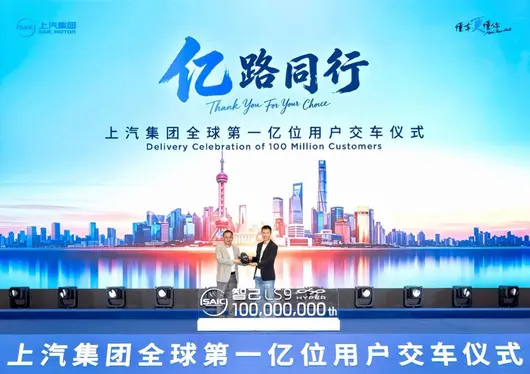

100 million vehicles. China's automotive industry witnessed its first "hundred-million club".

On May 28, at the World Living Room at North Bund in Shanghai, with the keys to the IM LS9 Hyper handed to Momenta CEO Cao Xudong, SAIC Motor officially welcomed its global 100 millionth user. Oriental TV broadcast the event live in full. No lengthy speeches, no parameter PPTs, just a "Global Connected Delivery" spanning the Eurasian continent and involving multiple locations—from passenger cars to commercial vehicles, from independent brands to joint ventures, from China to the UK, Indonesia, and Singapore.
This is indeed worth celebrating. But more worth questioning than the number is: After 100 million vehicles, where does SAIC plan to go next?
The answer lies in the signal from the ceremony itself: How to convert the user base, technical reserves, industrial depth, and global network behind the 100 million vehicles into systemic competitiveness for the next journey.
The Value of 100 Million Users
Not Inventory, But Insights and Understanding
For SAIC, 100 million vehicles represent scale, and more importantly, a user base formed by long-term service to different markets, scenarios, and usage needs.
Equal emphasis on passenger and commercial vehicles, dual-wheel drive of independent and joint ventures, coordination between domestic and overseas markets—this "family portrait" structure gives SAIC rare user insight depth among Chinese automakers. What kind of tool vehicle does a rural grassroots worker need? Why did an overseas athlete choose a Chinese brand? How does a multinational logistics company evaluate new energy commercial vehicles? The answers to these questions cannot be derived solely from market research company questionnaires; they come more from the continuous feedback of 100 million vehicles in real-world scenarios.
This is the real context of SAIC's "Understanding Cars and Understanding You Better". "Understanding Cars" is the engineering capability, quality system, manufacturing standards, and industrial foundation accumulated by SAIC over more than 70 years; "Understanding You" is converting these capabilities into user-perceivable, usable, and trustworthy product experiences, precisely responding to users' real needs.
Therefore, 100 million vehicles are not the end point, but the starting point for SAIC to re-activate user value. Future competition will be measured not by "who has more products", but by "who can better convert user insights into product appeal".
Technology Democratization
Progression from "Having It" to "Having It Well"
In the intelligent electrification era, various technologies emerge one after another and iterate rapidly; "competing on parameters" has become something every automaker must do. When everyone shouts "technology democratization", the real dividing line is: How long does it take for technology to go from the lab to the driver's seat? How much functionality is lost from multi-million flagship models to tens-of-thousands national cars?
This is the key to what SAIC proposed as "Equity-driven Progression". Equity is far more than downgrading configurations; it is about letting more people enjoy advanced technology. Progression is not just technological innovation, but requires truly improving user experience.
The models involved in this delivery perfectly present the different levels of SAIC's technology conversion. The 100 millionth IM LS9 Hyper concentrated on showing SAIC's next-generation technology reserves: Star Super Range Extender, Full-Line-by-Wire Four-Wheel Steering, Lizard Digital Chassis 3.0, Momenta Intelligent Driving Large Model. But more worth noting is that these capabilities are being explored towards broader price ranges and usage scenarios: HuaJing S brings the Huawei Qiankun Smart Family Bucket into the 150,000-level family SUV market, making high-level intelligence no longer strongly bound to high prices; Wuling Rongguang Pure Electric Version puts a 100kW Silicon Carbide Rear-Wheel Drive Motor and a 32.6 kWh Shenlian Battery with replaceable cells into a 69,800 yuan level wealth-creation micro-van; Roewe M7 Dark Horse Version is equipped with the DMH 6.0 Super Hybrid System, responding to family users' demand for quality travel with long range and low energy consumption. High-level technology is no longer exclusive to high-end models, but enters the daily travel of more users through SAIC's product matrix.
This is SAIC's true technology moat: Relying on R&D, manufacturing, supply chain, and quality systems, converting complex technology into safe, reliable, and convenient daily experiences. Here, "parameters" are no longer footnotes on a launch event PPT, but core value that truly meets user expectations and solves real pain points.
Open Ecosystem
Why Him as the 100 Millionth User?
Cao Xudong standing on the delivery stage was the most thought-provoking moment of the entire ceremony.
He is not a "car owner" in the traditional sense. As Momenta CEO, his relationship with SAIC has long gone beyond ordinary business cooperation - IM and Momenta were "Foundational Lighthouse Partners" from the very beginning of the brand's birth, jointly refining IM's full-series intelligent driving solutions. Now, the partner actively becomes a car owner and announces that L3-level autonomous driving will land at SAIC first, planning to use this LS9 Hyper for validation testing, turning "Open Co-creation" from an industry slogan into a touchable business reality.
This open posture has been consistent throughout SAIC's more than 70 years of development. From the Santana localization community, to joint ventures like SAIC Volkswagen and SAIC GM, to independent brand building, SAIC has always learned in openness, accumulated in cooperation, and grown in innovation. Entering the intelligent electrification era, open cooperation is entering a new stage.
On one hand, the connotation of joint venture cooperation is upgrading. In the past, Joint Venture 1.0 more meant the introduction of advanced products, manufacturing systems, and management experience; today, Joint Venture 2.0 emphasizes co-creation of technology. The delivery of SAIC Volkswagen ID.ERA 9X is a representative of this change. It is not a simple electrification of traditional joint venture products, but integrates Chinese intelligent technology, Chinese speed, and local user insights on top of German automotive heritage, presenting a new look of joint venture brands on the new intelligent electrification track.
On the other hand, SAIC's cooperation with technology partners such as Huawei, Momenta, OPPO, Doubao, and Horizon Robotics has also extended the boundary of openness from the traditional industrial chain to new fields such as intelligent driving, intelligent cockpits, AI ecosystems, and software experiences. The Huawei Qiankun ADS 4.1 on Shangjie Z7, the Huawei Qiankun Family Bucket on HuaJing S, and the deep collaboration between IM and Momenta — behind these delivery models lies an "open wall-less" industrial rainforest.
Whether it is the deep binding of joint venture partners or the ecosystem synergy of cross-industry technology companies, it is the industrial connotation of SAIC's "Beauty Shared Together" concept. 100 million vehicles are not just SAIC's 100 million vehicles, but the result jointly nurtured by this open ecosystem network.
Globalization
From "Selling Out" to "Taking Root"
At the London delivery site, intern doctor Natalia formed a deep bond with this century-old brand because of her grandfather's classic MGB, and firmly chose the MG4 EV Urban. Two generations, the same brand, spanning the technological change from fuel to pure electric, witnessing Chinese intelligence endowing the British heritage with a whole new era connotation.
This story just happens to answer the ultimate question of the outside world regarding Chinese automotive going global: Can a century-old brand operated by a Chinese automaker still win over the new generation of overseas consumers? MG answered this with the achievement of being the first Chinese brand to break one million cumulative sales in Europe.
This is also the core of SAIC's overseas strategy "Glocal 3.0": Achieve "Global thinking, local action", forming personalized and intelligent product plans for different regional markets. 3 major overseas R&D centers, 4 production bases, over 3000 dealer networks, 42 self-operated Ro-Ro ships, SAIC has built a full industrial chain going global capability that is rare among Chinese automakers. True globalization is far more than just selling cars globally. In every market, deeply combining technical advantages, industrial chain advantages, and operational experience with local needs is the only way to achieve the leap from scale going global to value going global.
After 100 Million Vehicles
It is a Test of "Systemic Resilience"
Standing at the 100 million vehicle node, SAIC is facing competition that is no longer single-dimensional. Product appeal, technological strength, institutional vitality — these three aspects jointly constitute the systemic competitiveness for the future.
The true value of this delivery lies in the signal it conveys: When the market is still trapped in short-term zero-sum games, SAIC has already given an answer with a "family portrait" spanning the globe — the ultimate end of the automotive industry is never a solo act of a single enterprise or brand, but a contest regarding systemic strength.
From the Phoenix brand to the first 100 million vehicles, SAIC took more than 70 years to witness and participate in the historical leap of China's automotive industry. The next 100 million vehicles will test not just speed, but resilience, depth, and the degree of "Understanding You". It writes a new chapter for Chinese automotive brands moving from scale leadership to innovation leadership, and from the Chinese market to the higher end of the global value chain. Everything has just begun.
Sodium-ion battery energy storage is transitioning from demonstration and verification to the fast lane of scaled application.
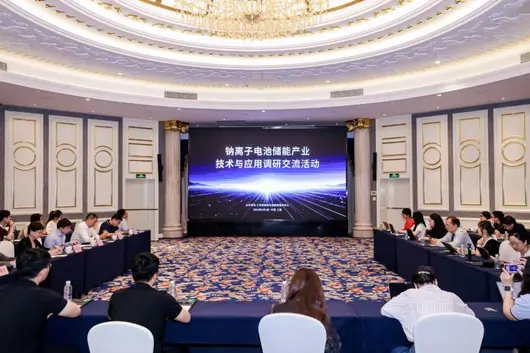
In the past, sodium-ion batteries were viewed as "spare tires" or "supplements", but at the June Ministry of Industry and Information Technology (MIIT) "Sodium-ion Battery Energy Storage Industry Technology and Application Survey Exchange Activity" meeting, representatives from all links of the industry chain, from material innovation to system integration and further to downstream applications, gave completely different judgments.

Synchronized maturity at the material, manufacturing, system, and application ends.
The era of sodium batteries has truly arrived.
The most solid advantage of sodium-ion batteries is not technology, but the geopolitical immunity of resource endowments.
Lithium resources are extremely unevenly distributed globally, and China's dependence on external lithium raw materials has long exceeded 60%. Cobalt and nickel resources are also highly concentrated in countries such as the Democratic Republic of Congo and Indonesia.
This concentration of resources exposes the lithium battery industry chain to continuous geopolitical risks and price volatility risks.
Sodium resources are completely different, with a crustal abundance of about 2.3%, over 1,000 times that of lithium; reserves in seawater and salt lakes are almost infinite; China is the world's largest producer of crude salt, with crude salt production exceeding 100 million tons in 2025.
This means the raw material supply for sodium battery cathode materials is completely free from international resource political constraints.

Breakthrough at the Material End
Recreating the LFP Miracle
Whether sodium-ion batteries can be applied on a large scale depends on materials and costs.
"Sodium-ion batteries are recreating the Lithium Iron Phosphate path of 2020." Wang Zunzhi, General Manager of the Sodium Battery Division of Ronbay Technology, judged.

He provided specific data support:
Currently, the pressed density of sodium battery cathode sheets has increased to 2.5g/cm³, the cycle life of composite sodium ferrous phosphate (NFPP) exceeds 15,000 times, and production stability is constantly being verified.
As the leader in cathode materials, Ronbay Technology is vigorously promoting the polyanion route centered on NFPP.
Wang Zunzhi revealed that the company, through its pioneering adaptation of sodium battery processes and equipment, innovatively reduced the processing cost of polyanion sodium battery materials by 30%-50%, which is undoubtedly a key move to accelerate sodium battery mass production.
In terms of capacity layout, Ronbay has landed 6,000 tons of polyanion cathode material capacity in Xiantao, Hubei, which will expand to 28,000 tons in 2026. By 2027, it plans to build a 300,000-ton sodium battery production line according to market demand.
There is also good news for anode materials.
The cost reduction rate of hard carbon anodes has exceeded market expectations, and is expected to drop from 60,000 to 70,000 Yuan per ton in 2024 to 35,000 to 40,000 Yuan in 2026, with a long-term goal aimed below 25,000 Yuan/ton.

Wei Dong, General Manager of the Marketing Center of Wanhua Chemical Battery Industry Company, stated that opening up two engineering hard carbon technology routes based on coal and resin fundamentally solves the supply limitations and performance fluctuations caused by early reliance on natural biomass raw materials.
The coal-based route has prominent cost advantages, suitable for price-sensitive scenarios, while the resin-based route performs better in product consistency and comprehensive performance.
Specifically, the NFPP (composite sodium ferrous phosphate) route promoted by Ronbay Technology has sodium phosphate and ferrous sulfate as its core raw materials, which are bulk chemical products with extremely mature supply chains.
The coal/resin-based hard carbon route opened by Wanhua Chemical, the raw materials come from coal chemical by-products and petrochemical products, both of which have sufficient domestic supply in China.
Cathode cost halved, anode cost halved, the cost reduction curve at the material end is clear.

Sodium-ion Battery
Has Welcomed Full Productization
The maturity of the material end has provided battery and system integrators with the possibility of stepping onto the stage.
Lin Jiubiao, CTO of CATL's domestic energy storage solutions, stated: "Sodium-ion batteries have ushered in the era of full productization."
CATL has made rapid progress in sodium-ion batteries.

Sodium-ion battery characteristics reconstruct electrochemical models, tackling mass production difficulties such as hard carbon electrode moisture control and gas production, and the products have wide temperature ranges and 15,000 times ultra-long cycle life.
Lin Jiubiao introduced that CATL adopts a "One Shell, Two Cores" platform solution, maintaining the same dimensions as lithium battery systems and achieving convenient switching.
A complete energy storage unit composed of a 3MWh DC cabin and a 3MW step-up converter integrated machine has been launched, with a system lifespan of 20 years.
Lin Jiubiao also revealed the mass production and delivery schedule.
CATL is promoting cost reduction in two aspects: product design and manufacturing production, and a dedicated sodium-ion battery production line has been built and put into production. At the same time, since sodium battery materials do not contain lithium, cobalt, or nickel, it does not need to bear the premium of these strategic metals.
In September this year, the company will deliver the first batch of sodium-ion battery energy storage systems to customers, achieving GWh-level shipments for the full year. This marks that sodium battery energy storage has truly entered the commercial delivery stage.
GWh-level shipments mean that sodium-ion battery energy storage is no longer megawatt-level demonstration, but has truly entered the track of scaled commercial delivery.

Large Orders Locked
Wang Lei, General Manager of HiTHiSTOR Experimental Test Center, gave a clear application scenario:
Sodium-ion battery energy storage has significant differentiation advantages in large-scale independent energy storage power stations, computing-power synergy and other new high-energy-consuming scenarios, 4-6 hours and above long-duration energy storage, high-cycle frequency energy storage projects, and projects with operational cycles of more than 15 years.
At a large wind-solar base in Northwest China, a lithium-sodium fusion energy storage power station was built supporting it. During the day, solar power generates, and the lithium battery system is responsible for high-frequency frequency regulation response; at night, when 4-6 hours of stable power support is needed, sodium batteries with cost advantages and long cycle life begin to play a role.
This "Lithium-Sodium Fusion" mode not only exerts the high energy density and fast response advantages of lithium batteries, but also utilizes the economy and long-duration energy storage capabilities of sodium batteries, achieving the maximization of overall system benefits.
In addition, with the development of AI large models, "computing-power synergy" has become a highly promising scenario.
Data center power demand surges and requires uninterrupted, high-quality power supply. The excellent wide temperature range performance and inherent safety of sodium-ion batteries make it an ideal choice for data center backup power and peak-valley arbitrage.
Seeing the potential demand, the market has voted with its feet. HiTHiSTOR will promote the scaled application of sodium-ion battery energy storage and build a lithium-sodium fusion energy storage power station demonstration project, with the first batch of projects to be implemented and landed within 2026.
CATL and HiTHiSTOR have signed a 3-year sodium-ion battery energy storage order with a scale of 60GWh. This super-large order has injected strong confidence into the entire sodium battery industry chain.


Future
Industry confidence also comes from the support of top-level design.
Liu Yafang, adjunct professor at Zhejiang University and chief expert at China Energy Society, pointed out that looking forward to the "15th Five-Year Plan", the sodium-ion battery energy storage industry should take advantage of policy tailwinds to accelerate R&D and industrialization landing, and actively expand large base, computing-power synergy and other application scenarios.
Of course, challenges still exist.
Zhou Bo, General Manager of the Research Center of the Power Battery Application Branch of China Association for Chemical and Physics Power Sources, suggested that the industry needs to quickly promote the establishment of standards and certification systems for the full lifecycle and accelerate the industrialization process.
Ronbay Technology's 300,000-ton capacity plan, Wanhua Chemical hard carbon anode cost moving towards 25,000 Yuan/ton, CATL's GWh-level shipment and "One Shell, Two Cores" platform design, HiTHiSTOR's 60GWh order lock.
15,000 times cycle life technology verification, 20-year system life commercial commitment, sodium-ion battery energy storage industry is completing the key leap from "technically feasible" to "commercially feasible".
From cost reduction breakthroughs at the material end, to GWh-level delivery at the system end, to the 60GWh large order lock at the application end, sodium-ion battery energy storage is no longer a "concept" or "alternative".
The key point is that HiTHiSTOR proposed "building a lithium-sodium fusion energy storage power station demonstration project", and CATL adopted the "One Shell, Two Cores" scheme to achieve lithium-sodium same dimension switching.
The true advantage of sodium-ion battery energy storage is not to replace lithium iron phosphate, but to form a complementary combination with lithium batteries in a large-scale energy storage system:
Lithium batteries undertake the main role of high energy density and high power density.
Sodium batteries undertake the auxiliary role of long-duration energy storage, high cycle frequency, and low-temperature environments.
Through unified platform design (same dimensions, same interface), reduce the complexity of system integration and switching costs.
This "Lithium-Sodium Fusion" architecture can optimize the asset portfolio of the entire energy storage system:
Use sodium batteries to cover operating conditions that lithium batteries are not good at or uneconomical, thereby improving the full lifecycle returns of the entire power plant. Under this framework, the advantages of sodium batteries are not absolute, but relatively complementary.
Cars in winter, that's the guarantee~


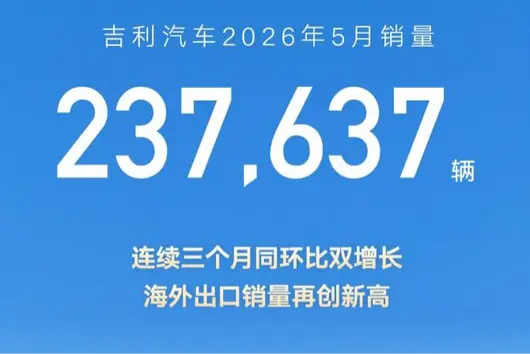
Recently, Geely’s May overseas sales figures were released, with overseas export sales exceeding 85,000 units, reaching a new high, representing a year-on-year growth of 184%.
Previously in April, Geely’s overseas new energy vehicle sales grew by 624.5% year-on-year, retaining the top spot in growth rate for Chinese new energy vehicle exports.
In segmented markets, Geely’s sales performance continues to bloom in multiple areas. Among them, Geely has entered the Australian market for only 14 months, with delivery volume exceeding 10,000 units, becoming one of the fastest-growing Chinese automakers locally; simultaneously, in the Brazilian market, sales climbed to over 4,000 units, breaking the highest single-month sales record in that country. The Mexico market accumulated 16,000+ units from January to April, setting a new all-time high.
Geely EX2 achieved top 1 in B-segment hatchback new energy vehicle sales in multiple markets such as Mexico, Indonesia, and Costa Rica; Geely EX5 topped the pure electric SUV-C market in the first quarter in multiple countries including Australia, UAE, and Uruguay. Zeekr's 7X and 009 became sales champions in segmented markets, among which Zeekr 7X sales topped the list again in the Australian market, surpassing the long-dominant Tesla Model Y.
Facing order surge pressure, Geely relies on the Ningbo export hub, activating Ro-Ro ships, container ships, and international railway trains to conduct sea-land combined transport, fully ensuring complete vehicle delivery. The head of international business of Geely Auto Group Logistics Center stated in an interview that emergency new transportation routes have been added, forming a capacity resource layout with 4 major railway ports and 6 major sea ports, equipped with two own Ro-Ro ships, while new cross-border transport lines have been opened, continuously supplementing various capacity resources, able to stably ship nearly 10,000 new vehicles monthly to core European ports. The China-Europe Railway Express Geely special train operates routinely, reducing transportation time by 40 days compared to sea freight. In the future, to cope with the explosive growth of overseas sales, Geely will continue to expand overseas transportation scale, further improving vehicle delivery times.
The surge in Geely's overseas sales clearly demonstrates Geely's strong product capabilities and the implementation of its localization strategy, further reflecting the strong strength of the Chinese automotive industry in high-end exporting and technology globalization.





Written by Zhao Yun
There were no long speeches from leaders, no dazzling solo dance of concept cars, nor any deliberately emotional brand promotion.
This doesn't even look like a traditional new car delivery press conference.
On May 28, 2026, at the Shanghai North Bund World Reception Hall. Dragon TV cameras started here, spanning the Asian and European continents, connecting Nanjing, Yangzhou, Liuzhou, and Taiyuan, crossing the English Channel to reach London, and crossing the Malacca Strait to illuminate Indonesia and Singapore — SAIC Group used a true "Global Relay Delivery" to complete a narrative never before seen in the history of China's automotive industry: delivering 100 million pieces of trust under the gaze of global audiences, achieving a continuous relay.
One hundred million, at this moment, is not a cold sales figure. One hundred million is the "moving and vivid history co-creation lesson" written by SAIC Group over seventy-one years together with 100 million vibrant car owners and tens of millions of Chinese families, and 100 million stories of human life's warmth.
And the first page of this lesson begins with two ordinary people.
01
Lantian and London: 2 out of 100 Million Human Realities
Lantian, Shaanxi, tricycle of Village Secretary Pang Fuqiang
Lantian County, Xi'an City, 64-year-old Village Secretary Pang Fuqiang was once a chef. Starting from August 2025, he launched a "loss-making business": making lunch for 74 left-behind elderly people in the village every day, charging only 2 yuan per meal. For elderly people with difficulty in movement, he delivered food to their homes.
The food delivery routes are scattered on mountain village roads, running 8 or 9 kilometers every day. Pang Fuqiang used a tricycle with a small load capacity. One trip wasn't enough, running two trips took too long. In winter, cold wind poured into his neck, and in summer, the car seat became too hot to sit on after sun exposure. More critically, the tricycle lacked safety protection. On rainy days when roads were slippery, he fell.
In February 2026, CCTV News broadcast his story. Xinhua News Agency and China Youth Daily reported subsequently. Someone asked him, "Secretary Pang, what are you aiming for?"
He said, "I aim for these 74 elderly people to have a hot meal."

SAIC-GM-Wuling saw this news. Without hesitation, the enterprise decided to gift Pang Fuqiang a Wuling vehicle — not charity, but tribute. Under the framework of the "Strivers Special Plan", Wuling, relying on the "SAIC-GM-Wuling Benevolence Fund" that has been operating continuously for 19 years, invested 15 million yuan in funds and vehicles to provide the village secretary who runs for 74 elderly people every day with safer and more efficient tools.
"What the tricycle can't carry is the hot meals for all the elderly in the village. Wuling helps you carry it."
This is not an advertising slogan. This is a response from a Chinese automotive enterprise to a Chinese grassroots striver.
The camera cut from the remote Lantian mountain village to London, the world financial center.

26-year-old intern doctor Natalia stood at the MG London Delivery Center, receiving the keys to the MG4 EV Urban. Her eyes were a little moist.
Her grandfather once owned a classic MG B. That was her childhood memory: her grandfather drove her for a ride, she sat in the passenger seat, small hands touching the dashboard, fantasizing one day she could also drive it.
Her grandfather passed away many years ago. But what the MG B left behind was not just a car, but a spirit — every generation of MG owners has a beam of unextinguished glory in their hearts.
Now, Natalia has become a young generation MG owner. The MG4 EV Urban she chose is an urban commuting tool for the pure electric era: WLTP range 416 km, 28 minutes fast charging, 577L trunk space. But to her, this is not just a commuting tool.
"What my grandfather passed down to me is not just the love for MG, but also that spirit of courage to explore and embrace innovation."
Two generations, two cars, the same brand. From London to Shanghai, from fuel to electric, the MG spirit is inherited in the family bloodline and continues in the hearts of a million global owners.
One is a village secretary delivering food to left-behind elderly people in a Chinese mountain village; the other is an intern doctor in a British city inheriting his grandfather's feelings. They did not know each other, but because of the same SAIC Group, on this day of May 28, 2026, they were written into the same history.
They are the most ordinary "one in 100 million" among SAIC's 100 million car owners.
If Pang Fuqiang and Natalia's stories represent the "warmth" and "heritage" of 100 million vehicles, then the next car owner represents the "height" and "future" of 100 million vehicles.
The 100 Millionth User: Partner & Owner, Shouldering Towards the Future
Cao Xudong, Momenta CEO, leading figure in the field of intelligent driving in China.

At the delivery ceremony, he received the keys to the IM LS9 Hyper from the Chairman of SAIC Group. This car is the culmination of 71 years of SAIC's technical accumulation: full electronic four-wheel steering, 520-line super vision LiDAR, NVIDIA Thor chip, full-domain 800V high-voltage platform, Star Super Range Extender... and the "endogenous security" technology jointly launched globally with Purple Mountain Laboratories, expanding car safety from "physical security" to "information and system security."
Cao Xudong is not an ordinary car owner. IM Motors and Momenta have been "founding lighthouse partners" from the very beginning of the brand's birth. The teams of both sides, back-to-back and heart-to-heart, jointly polished the driver assistance solutions for all IM Motors series models.
"Partner becomes Owner", this is a rare deep resonance in the history of the automotive industry.
At the delivery scene, Cao Xudong said the following words:
"I chose the IM LS9 Hyper because I have full confidence in its driver assistance and intelligent level. I will personally drive this car and use it for L3 autonomous driving verification testing. I want to ensure that what is delivered to users is the most mature and reliable system."
He called this car "a bright pearl of the Chinese automotive industry" and announced: Momenta L3 autonomous driving capability will be launched first on SAIC.
This is not a simple delivery. This is a technology partner binding their name deeply with the product; this is a strategic partner endorsing the technology with their daily commuting.
And Cao Xudong's identity also makes us unable to help thinking: what does it mean to have 100 million car owners?
02
If 100 Million Car Owners Are Compared to a Country
Before the press conference, SAIC Group made a short film named "Memory". Below the short film, there were countless online users leaving chain messages: "one in 100 million". Obviously, behind every account is a car owner whose heart is throbbing at this moment.
Let us conduct a hypothetical experiment.
If we look at SAIC Group's 100 million car owners as a country, what would be the ranking of its population scale in the world?

Only 14 countries in the world have a population exceeding 100 million. SAIC's "Car Owner Country" will be ranked 15th, on the same level as Egypt, Vietnam, Germany, Iran, and other countries.
100 million vehicles is not just a business achievement, but also an economic miracle.
In the history of the global automotive industry, how many enterprises have accumulated production and sales exceeding 100 million vehicles?
Toyota, Volkswagen, Ford, GM, Nissan, Honda, Hyundai... and now SAIC Group.
SAIC is the only member of the 100 million vehicle club from China.
What does this mean?
It means that for every 100 vehicles sold globally, a considerable proportion comes from Chinese brands; it means that China's automotive industry went from "bringing in" to "going out" and took 70 years to finally stand at the center of the world stage; it means that the steering wheels in the hands of that 100 million car owners hold not only their own commuting but also the dignity of Made in China, Smart Made in China, and Created in China.

And turning our eyes back to this year, SAIC's market performance is equally solid. In the past May, SAIC Group's complete vehicle sales were 349,000 units. From January to May, cumulative sales reached 1.651 million units, continuing to lead the Chinese automotive industry. The proportion of independent brands broke through 70% for the first time. New energy vehicles surged 46.5%, and the overseas market surged 45.9%. The historical mark of 100 million vehicles, combined with the current sales leadership, jointly constitutes SAIC's complete narrative from past to present.
03
Global Relay: SAIC's Control Capability
Why did SAIC do this delivery ceremony?
Because it requires four "wholes":
Full Brand Matrix: Roewe, MG, IM, Shangjie, Wuling, Maxus, Hongyan, Yuejin, Sunwin, Iveco... Independent brands launched the entire line; Volkswagen, Audi, Buick, Cadillac... Joint venture brands showcased their strength. From A0-segment commuter cars to 500,000-level luxury flagship models, from sedans, SUVs to MPVs, pickups, from passenger vehicles to commercial vehicles, from city logistics to infrastructure transport — covering all scenarios.

Full Product Categories: Shangjie Z7, Hua Jing S, Roewe M7, MG4 Semi-Solid State Battery Version, Wuling Starlight 560, Maxus eDeliver5, Hongyan Heavy Truck, Yuejin Danaka T1, Sunwin Pure Electric Bus, Iveco Polaris EV... Every vehicle aims at different users, different scenarios, and different lives.
Global Layout: Overseas has over 100 parts production bases, over 3,000 dealer networks, 3 major R&D innovation centers including London, 4 production centers in Thailand, Indonesia, India, and Pakistan. ANG Logistics owns 42 various roll-on roll-off ships, 8 international routes covering Southeast Asia, Europe, and the Americas. Products and services spread over more than 170 countries and regions. Overseas cumulative sales broke through 7 million vehicles.
Full Industry Chain System: Covering six major sectors including complete vehicles, parts, mobility and services, finance, international business, and innovation technology. Close synergy, mutual empowerment, integrated development, forming a full value chain closed loop.
This "Global Relay" is the concentrated appearance of SAIC's system competitiveness.
Starting from Shanghai, Nanjing, Yangzhou, Liuzhou, Taiyuan... UK, Indonesia, Singapore... Car owners of different time zones, different languages, and different cultures completed the delivery relay at the same moment because of the same brand.
And supporting this grand narrative are individual vibrant users, as well as scale and systems.
04
The Essence of Delivery is the Start of a Relationship
In the traditional sense, car delivery is the end of a transaction — money on one hand, car on the other, contract fulfilled. But SAIC's global relay turned delivery into the starting point of a relationship.

Pang Fuqiang's Wuling Rongguang is not the end, but the new starting point of him delivering 74 hot meals every day; Natalia's MG4 EV is not the end, but the emotional sequel of her and her grandfather across space and time; Cao Xudong's IM LS9 Hyper is not the end, but the starting line for Level 3 autonomous driving landing in China. Each relay baton is opening a new narrative.
100 million vehicles are 100 million relationships unfolding. SAIC redefined "delivery" with this ceremony: it is not just about handing over the car key to end, but taking over the user's trust and continuing to walk forward. This explains better than any number why a car company can survive for more than 70 years and still make people expect its next 100 million.
05
Behind 100 Million Vehicles: 100 Million Vibrant Beating Hearts
SAIC Group's "Knows cars better, understands you better" has never been a slogan.
It is embodied in Pang Fuqiang's Wuling vehicle — "The hot meals the tricycle can't carry, Wuling helps you carry."
It is embodied in Natalia's MG4 EV — "Grandfather's MG B is my childhood memory, my MG4 is the starting point of the future."
It is embodied in Cao Xudong's IM LS9 Hyper — "I will personally test Level 3 autonomous driving to ensure the system delivered to users is the most reliable."
It is also reflected in the stories of more car owners:

Dedao App founder Luo Zhenyu, as the Hua Jing S 001st tester, went from praising Huawei Qiankun Intelligent Driving in the New Year's Eve speech to visiting the factory to witness the lineup. He said: "Hua Jing S is not just a car, it is the crystallization of Chinese technology co-creation."

Former German League footballer Yang Chen, chose ID.ERA 9X, because "Premium Range Extender and long-termism are in line." He said: "When playing football, be steady; when driving, be steady too. This car is steady."

Public Welfare Blogger Liu Jia, for five consecutive years, cuts hair and sends companionship to left-behind children in Guangxi mountainous areas. Buick provided immediate aid, and he was moved by Zhijing E7's "Full Score Cabin". He said: "I guard the children's smiles, Buick guards my commute."
After Cao Kailiang's family ordered cars, idol Jay Chou happened to become the spokesperson for the Buick MPV family. He said: "This is not a coincidence, this is fate."
And there is DHL, Jiading Public Transport, Henglongsheng Industry and Trade, Di Shangtie, Henan Zhonglian Tourism... Every commercial vehicle is a "wealth creation tool" for strivers.
A car owner from Henan Zhonglian Tourism said on site: "We run on the road every day, the car is our rice bowl. SAIC Maxus has never let us down. 100 million vehicles, we are also among them — glorious."
A driver from Jiading Public Transport, after receiving the keys to the Sunwin Pure Electric City Bus, only said one sentence: "This car is quiet, starts steadily, passengers sit comfortably. We drivers also feel dignified."
And the deeper meaning lies in: these 100 million car owners are not cold statistical figures. They are Pang Fuqiang, Natalia, Cao Xudong, Luo Zhenyu, Yang Chen, Liu Jia, Cao Kailiang, DHL drivers, Jiading Public Transport drivers, Henan Zhonglian Tourism leaders, you, me, every person striving forward in life.
SAIC, knows cars better, understands you better, now has a more concrete meaning at this moment.
06
100 Million is a Starting Point, Not an End Point
At the end of the ceremony, Dragon TV cameras swept across the global delivery sites again.
Shanghai main venue, IM LS9 Hyper drove out slowly; London streets, MG4 EV Urban穿梭ed along the banks of the Thames; Jakarta, Indonesia, Wuling new energy vehicles delivered to local families; Changi, Singapore, SAIC Maxus drove into the urban expressway...

From 1955 to 2026, from the first user to the 100 millionth user, from startup exploration to industry leadership.
In 2014, SAIC actively implemented the important directive "Developing new energy vehicles is the only path for China to move from a car powerhouse to a car superpower", taking the lead in comprehensive transformation. Twelve years later, the 12 zodiac signs completed a full cycle. SAIC, with 12 years of persistence, completed a historic leap from "leading the pack" to "ten thousand horses galloping".
100 million vehicles are the stage report of SAIC's 71-year development, and more, a new starting line facing the future of smart and electric transformation.
100 million vehicles, 100 million simple wishes. Some aim for a hot meal, some aim for family heritage, some aim for a technical dream.
100 million is a number. 100 million vibrant beating hearts are where the hearts of the people lie.
SAIC Group, Traveling the Billion Mile Journey Together.

On November 15, 1977. A customized gas-powered Fairmont Futura rolled off the line at the New Jersey plant. This was Ford's 100 millionth vehicle produced in the US. Under the pressure of the CAFE mandate, the influx of Japanese cars, and controversies over excessive cost-cutting, Ford decided not to sell this car. Instead, it used it to kick off a cross-coast tour to celebrate.
When the Detroit Three and Toyota were staging a showdown of the century in the world's largest auto market, a bold idea appeared on the banks of the Huangpu River, 11,460 kilometers away. The accumulation of handmade Phoenix sedans became the momentum for Shanghai-brand sedans entering a steady development phase. Even with an annual output close to 3,000 units, this still could not meet the soaring demand. The concept of adopting Ford's assembly line operations for China's sedan production was brought back to the agenda.
Joint venture cooperation with transnational automakers became the most realistic option. Across the domestic automotive industry, there was only one place capable of mass-producing sedans and having an assembly line: Shanghai. Next, the story of China's auto industry entered the SAIC Volkswagen (now known as: SAIC Volkswagen) era. Amidst the acclaim of "driving a Santana anywhere is safe", transnational car companies rushed to China to seek fortune. The craze of sedans entering ordinary households caused the world's largest auto market to shift accordingly. After the fierce competition of the fuel vehicle era, the machine changing the world gradually switched to the smart-electric track.

On the afternoon of May 28, 2026. Inside the World Living Room of North Bund, Shanghai. SAIC Group Chairman Wang Xiaoqiu handed an IM LS9 Hyper exclusive custom model to Momenta CEO Cao Xudong. Applause erupted, they shook hands, and SAIC Group's 100 millionth vehicle delivery was frozen in time. Over 70 years of vehicle building journey converged in the giant waves of Shanghai's new era, making SAIC the first Chinese vehicle group to enter the global 100 million-level auto camp: Leading the charge at the forefront of the tide.
In January 1997. Toyota welcomed its 100 millionth car after 50 years. Cross Ford's assembly line operations, Toyota used its unique lean production method to pull the efficiency of the fuel vehicle era to the peak. In the shadow of the Heisei recession and the Asian financial crisis, Japanese cars completed the disassembly of the Euro-American auto myths. Amidst a chorus of praise, Toyota did not indulge in the steel dividends piled by 100 million fuel vehicles. Less than 10 months later, Toyota shocked the world again. The Economist wrote at the turn of the century: When Detroit was still obsessed with the roar of large-displacement SUVs, this Eastern automaker knocked on the door of green and low-carbon early with the Prius.
Now, SAIC IM LS9 Hyper is accelerating the transformation of the auto world with a Chinese way. This car is equipped with the next-generation Star Super Extended-Range Power System, the next-generation Full-Line-by-Wire Four-Wheel Steering System, and the next-generation Intelligent Driving Technology. Every item points to the highest standards of the next generation of electric vehicles. It is both the culmination of SAIC's 70 years of vehicle building foundation and technology, and more importantly, a declaration of China's new energy to the auto world. If the Prius was a gentle reform of the fuel vehicle order, then SAIC IM LS9 Hyper is a breakthrough reshaping of the global automotive gravitational field. Chinese Academy of Engineering academician Wu Wangxing said that LS9 Hyper implants China's original endogenous safety system into the car, which is a very important highlight moment for the whole world: it is the flagship benchmark for the Chinese automotive industry entering the "Fourth Generation Electric Vehicle" era.

Looking back, from a golden phoenix hatched from a grassy nest, to SAIC Volkswagen taking root in Anting, to SAIC GM rising in Pudong, MG, Roewe, IM, Wuling, Baojun, Maxus, etc. have become the backbone of independent brands, Shangjie and Huajing are forging new roads for vehicle building; from fuel vehicles to pure electric; from passenger cars to commercial vehicles; Shanghai's open-mindedness that accepts hundreds of rivers has made SAIC Group different: no technical walls, no ecological islands.
In May 2005. With a silver Touran rolling off the production line, Wolfsburg's 100 millionth car pushed the Volkswagen brand to the 100 million automobile brand club. It is the highest harvest of human mechanical manufacturing system on hardware replication consistency. The golden age of China's automobiles provided even richer dividends for Volkswagen. Crossing the threshold of 100 million automobile scale has never been in the soil of coincidence. In the slice of auto history, it corresponds to three hardcore indicators: anti-risk ability in the face of external changes, industrial consistency under a modern manufacturing system, and strategic agility.
20 years later, these three hardcore indicators welcome a redefinition of smart electrification. Entering 2026, the new energy penetration rate of China's auto market continues to climb. Among them, the penetration rate of passenger cars in April broke through 60 percent for the first time. Standing at the new starting point of cumulative 100 million vehicles, SAIC Group has demonstrated strategic agility in capability output to the global auto market.

This May, SAIC Group's vehicle sales reached 349,000 units, continuing to hold the top position in the industry. In the first five months, independent brand cumulative sales reached 1.173 million units, up 8.6% year-on-year; new energy vehicle sales reached 595,000 units, up 13.2% year-on-year; overseas market sales reached 589,000 units, up 45.9% year-on-year. Independent joint ventures, passenger and commercial vehicles, domestic and overseas working in the same direction, promoting SAIC to continue upward while navigating the cycle.
It is worth mentioning that SAIC's joint venture new energy sector also welcomed new growth points. Joint venture new energy made a strong comeback in May. SAIC GM's new energy vehicle sales in May reached 13,000 units, up 75% year-on-year, with Zhijing E7 deliveries breaking 10,000 in its first month after launch. SAIC Volkswagen's new energy vehicle sales in May reached nearly 10,000 units, up 34.3% year-on-year; the newly launched ID.ERA 9X cumulative deliveries exceeded 7,000 units.
SAIC GM Buick's Series 7 models adopt the locally self-researched Xiaoyao Super Architecture, with the Zhenlong Hybrid Power System. From the three-electric system to high-level intelligent driving with LiDAR redundancy, the underlying R&D logic is realized through localization. SAIC's technology output allowed the Buick brand to be reborn. SAIC Volkswagen's flagship SUV model for the Volkswagen brand, ID.ERA 9X, and Audi's AUDI E7X, are all aggregating global resources and precisely customizing for Chinese users' smart-electric needs.
At this year's Greater Bay Area Auto Show, the AUDI E7X officially launched with a starting price of 269,800 RMB, becoming a new answer for BBA solving the China puzzle. With the dense landing of these models, the cooperation between SAIC Group and General Motors and Volkswagen has completed a transgenerational transition from introducing technology to joint development, to the current "Joint Venture 2.0". Volkswagen's 100 million units in 2005 was built on the fuel dividends of 23 million Golfs and 13 million Passats, erecting the peak of hardware replication consistency.
SAIC Group's 100 million units in 2026, one of its most core contents, is through its own technology and architecture output, restructuring the cooperative division of labor of joint venture brands. This has become the optimal solution for transnational automakers to establish themselves in the Chinese market. This round of new energy transformation in the global auto industry is stormy with uncertainties. Holding the trump cards of technology, SAIC has gradually established a position as a rule maker in the future smart-electric era: Ignore the sound of wind and rain through the woods; why not chant aloud and walk leisurely?
In September 2024. After 57 years of building the factory, a Hyundai IONIQ 5 produced at the Ulsan plant pushed its production record to 100 million. This is the Han River Miracle, a new narrative in the history of the world auto business. The Hyundai Motor Group, therefore, became one of the most globalized automakers. After the export volume of Chinese automakers climbed to the scale of 8 million units, Korea and Japan's auto export records were rewritten. The example of Hyundai and Toyota advancing globally has a new protagonist.

On May 30, 2026. After SAIC Group stood on the first 9-digit delivery volume, the first user of the next 100 million appeared in the UK. London doctor Natalia exchanged her grandfather's MGB from memory for the new generation MG4 EV Urban. The ticking pointer brings a new story. In Shanghai Pudong, in Jakarta, Indonesia, in Lantian, Shaanxi, in Singapore DHL Supply Chain Advanced Regional Center, in Taiyuan, Shanxi, in Hechi, Guangxi, the delivery of 15 brands under SAIC Group is laid out by the second.
Along with the alternating pictures on the screen, SAIC Group's Glocal strategy extends a new outline. It is no longer traditional commodity foreign trade and one-way export of products, but using the whole value chain's Chinese smart-electric core to comprehensively fit the specific lives of different global time zones: Every car of SAIC must turn China's best intelligent technology into steady happiness within reach for every family in the world.
In Oceania, MG's small cars rank at the head of the niche market; in Thailand, MG has become the most stable growing Chinese brand; in 7 countries of South America, MG's sales are approaching the 10,000 unit mark; in Europe, MG has held the European sales champion of Chinese brands for 11 consecutive years, and is also the first Chinese automobile brand with sales breaking 1 million.
In the first five months of this year, cumulative sales exceeded 150,000 units, up 20% year-on-year, continuing to lead Chinese brands. The glory of 100 million+, rushes forward along the Huangpu River. In London's rain, in Bangkok's sunset, in the waves of the Suez Canal, in every corner where Chinese smart-electric solutions take root, it is a new answer sheet of a more international SAIC Group: Stars hang low over the vast plains; the moon surges with the flow of the great river.

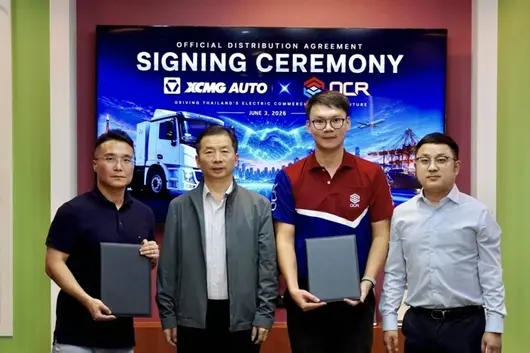
Recently, XCMG signed a procurement agreement for 300 new energy commercial vehicles with OCR, a leading distributor in Thailand, in Bangkok. The first batch of 100 units has been delivered. Xia Yongyong, Deputy General Manager of XCMG Group, Party Secretary and General Manager of XCMG Automobile, attended the ceremony.
This strategic cooperation between XCMG and OCR is not limited to complete vehicle sales, but covers lifecycle value management including technical services, spare parts supply, and financial support. This means XCMG is simultaneously embedded in the local service network and parts guarantee system, helping users reduce operating costs and improve operational availability.

Deep Cultivation: Building Long-term Value with Full-cycle Service
In 2005, XCMG's first piece of equipment arrived at a Thai port, planting the seeds of cooperation with OCR Company.
In June 2025, Chairman Yang Dongsheng attended the 20th anniversary celebration of the cooperation between XCMG and OCR. Through the in-depth integration of "Product + Scenario", the two sides are jointly promoting the green transformation of the Thai construction machinery industry and building a new ecosystem for green and sustainable industrial development.
In Southeast Asia, XCMG has established a perfect service network and spare parts warehouse. It is this capability upgrade from "selling products" to "full lifecycle" that became the reason for OCR choosing to cooperate with XCMG to develop the transportation market.
Overcoming Challenges: Establishing a Firm Footing in the Southeast Asian Market with Technical Strength
Thailand is a logistics hub in Southeast Asia, currently ushering in an acceleration period for the green transformation of transportation. However, the local hot and humid climate characteristics, combined with diverse and complex working conditions such as trunk logistics, ore material transfer, and urban construction transportation, pose tests for new energy commercial vehicles far beyond general markets.

As a senior force in the local commercial vehicle sector in Thailand, OCR Company actively guides traditional fleets towards green transformation. XCMG Automobile is a leading enterprise in China's new energy commercial vehicles, with new energy heavy truck sales ranking first in the industry for three consecutive years. Relying on a mature localized service network and good user reputation, combined with the product's excellent safety, reliability, and economy, XCMG has truly won OCR's recognition.
Relying on XCMG's independently developed core battery, motor, and electronic control technologies, combined with overseas exclusive vehicle calibration and high quality control, XCMG's products maintained stability and economy in actual operations with high temperature, high humidity, and complex road conditions, gradually becoming a demonstration benchmark for local green transport capacity.

Currently, the demand for new energy commercial vehicles in Thailand is accelerating.
In the process of global transportation green and low-carbon transformation, XCMG new energy commercial vehicles have transformed from product providers to value creation builders. XCMG will take this cooperation as a fulcrum to replicate and promote the "Product + Scenario" integrated solution to more countries and regions.

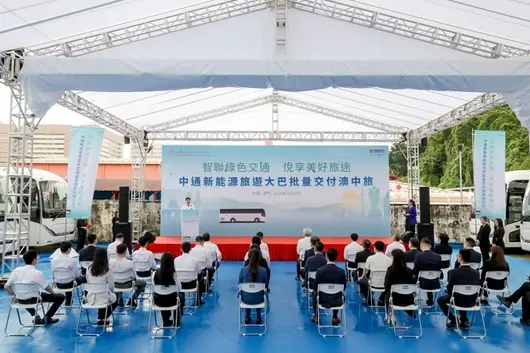
Connecting smart green transportation, enjoying a wonderful journey! On May 22, the ceremony for the batch delivery of Zhongtong New Energy Tourist Coaches to Macao China Travel Service Co., Ltd. under the Southlight Group (hereinafter referred to as "Southlight Macao Travel") was successfully held in Macao. Wang Zhijian, Party Secretary and Chairman of Shandong Heavy Industry Group, and Fu Jianguo, Chairman of Southlight Group, attended the event and cut the ribbon.

The delivery of this batch of range-extended new energy coaches is a landmark achievement of the deep collaboration between Zhongtong Bus and Macao's culture, tourism, and transportation sectors to jointly build a green and low-carbon Greater Bay Area. It is also a vivid practice of Zhongtong Bus using core technologies to create green application cases for the global high-end market and promoting the high-quality development of global green transportation.

Deeply Cultivating Core New Energy Technologies
Empowering Macao's Low-Carbon Transportation Development
As a high-end window for China's opening up and an important node city of the Greater Bay Area, Macao sets strict standards for the safety, stability, comfort, and regional environmental adaptability of passenger vehicles. It is a "high-end trial field" to test the smart manufacturing strength of new energy coaches.

Southlight Macao Travel is Macao's largest land passenger transport service provider. As a leading enterprise in Macao's tourism industry and a core operating entity for transportation, culture, and tourism, it has deeply cultivated Macao's entire industry chain of "eating, living, traveling, entertainment, sightseeing, and shopping". It is the backbone force of Macao's public transportation and cultural tourism passenger transport services.
To actively respond to the Macao Special Administrative Government's "Macau Long-term Decarbonization Strategy" and "Green Transition of Land Transportation" deployment, and implement the national "Dual Carbon" goals, in recent years, Southlight Macao Travel has comprehensively launched the new energy upgrade of its passenger fleet, accelerating the construction of a green, smart, and efficient modern passenger transport system. Zhongtong Bus has become its core partner for new energy development.

Zhongtong Bus has deepened its focus on new energy technology R&D and possesses the capability for full-series new energy coach product solutions, including pure electric, hybrid, and range-extended technologies. At the same time, with deep exploration of the global market, Zhongtong Bus has accumulated a massive amount of complex road conditions and multi-scenario operation data. Technology iterations continue to lead the industry.
Relying on hardcore technology and extreme adaptability, Zhongtong Bus's cooperation with Southlight Group covers cross-border, urban, and tourist passenger transport fields. The total cooperation scale reached 600 units, effectively boosting the quality improvement and upgrade of the local transportation industry.
Deeply Adapting to Macao Scenarios
Customizing to Build Green Travel Benchmarks
Macao has a special regional environment, complex road conditions, congested traffic, and limited charging resources, facing challenges in new energy transition. Based on a deep understanding of Macao's local operation scenarios, Zhongtong Bus has tailored a range-extended product solution for the local area.

Zhongtong range-extended coaches combine the dual advantages of pure electric models (quiet and comfortable, zero idling pollution) and fuel vehicle models (worry-free range, convenient refueling/recharging), precisely solving Macao's pain points of insufficient charging infrastructure, limited long-distance range, and high operating costs.
At the same time, the vehicle has undergone comprehensive upgrades in comfort details and intelligent safety. High-end configurations such as ergonomic seats and healthy environmental interior decoration improve the quality standards of cultural tourism passenger transport. Deeply optimized vehicle passability and turning radius make the vehicle better adapt to Macao's street conditions, improving operational flexibility and safety. At the same time, the vehicle integrates intelligent systems such as collision warning, automatic emergency braking, tire pressure monitoring, and driving assistance, achieving a dual upgrade in safety and intelligence.

Relying on refined customization and all-dimensional comfort experiences, Zhongtong range-extended coaches have now become the main model for Macao tourism transfer and commuter services. Delivered in three batches to the Macao market, it has won high recognition from passengers and users.
Leading the Global Green Track
Zhongtong Manufacturing Empowers Global High-Quality Development
Currently, the global carbon neutrality process is accelerating, and the green public transportation system is iterating and upgrading. New energy coaches have become a winning track for China's automotive industry development.

As a representative enterprise in China's coach industry, Zhongtong Bus closely follows the national "Going Global" strategy and the "Belt and Road" Initiative deployment. It takes new energy going overseas as a core development strategy, continuously increasing investment in overseas markets. Against diverse global market needs, it adheres to localization strategies, tailoring solutions for the market and enhancing product adaptability.
In Chile, over 1,000 Zhongtong pure electric coaches have become the backbone of local green public transportation; in Denmark, Zhongtong coaches on Bornholm Island have become a green landscape for the local area; in Dubai, Zhongtong Bus pioneered the entry of Chinese coach brands into the Dubai public transportation system; in Singapore, Zhongtong new energy coaches continue to provide innovative solutions for public transportation in Singapore's high-density cities...

Currently, more than 100,000 Zhongtong new energy coaches are roaming around the world. They not only bring green, intelligent, and efficient travel experiences to the world but also demonstrate the quality standards and innovative strength of Chinese manufacturing to the globe. With high-quality, highly intelligent, and low-energy-consumption green coach product solutions, they contribute Chinese wisdom and Chinese solutions to the development of global green transportation.

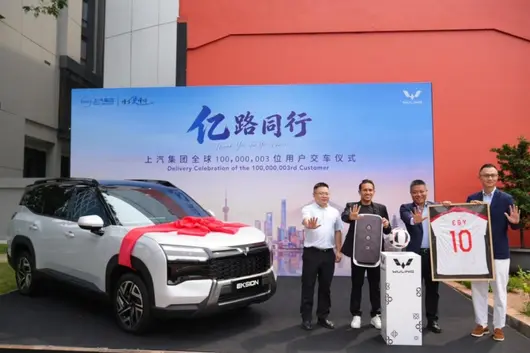
On May 28, SAIC Group achieved global cumulative delivery of its 100 millionth vehicle, becoming China's first auto group to accumulate production and sales exceeding 100 million vehicles. Among them, SAIC-GM-Wuling contributed a cumulative total of over 32 million vehicles. On that day, the SAIC-GM-Wuling global vehicle EKSION was delivered to the first batch of users in Jakarta, Indonesia.

[SAIC Group's 100,000,003rd Vehicle Delivered in Jakarta, Indonesia]
"Whatever people need, Wuling makes." SAIC-GM-Wuling accurately understands the market and responds to user needs with blockbuster products. Wuling Hongguang, with its versatile characteristics of "suitable for business and home, durable and robust", became the preferred model for many entrepreneurs and families. As residents' consumption gradually upgrades towards quality life, Baojun 730 broke the monopoly of joint-venture brands in the Home Multi-Purpose Vehicle (MPV) market with its flexible space and high cost-performance ratio. In 2020, during the window period of new energy transformation of China's automotive industry, the launched Hongguang MINIEV became one of the pioneers in the domestic new energy transportation sector. This May, the first high-tech flagship large six-seat SUV co-created by SAIC-GM-Wuling and Huawei Qiankun - HuaJing S officially launched, breaking the technical premium barriers of high-end intelligent driving through cross-boundary collaborative innovation practices.
 [Equipped with Huawei Qiankun Tech Flagship Large Six-Seat HuaJing S]
SAIC-GM-Wuling is accelerating its new energy and intelligence layout. While promoting the electrification and intelligence upgrade of products, its layout in the global market is also deepening and solidifying. Currently, the cumulative overseas sales of SAIC-GM-Wuling have exceeded 1.5 million vehicles, with business covering more than 110 countries and regions globally.
The company has built a full-dimensional core competitiveness covering the smart manufacturing system, product matrix, and industrial ecosystem. First, the world's first Smart Island Manufacturing System adopts the flexible smart manufacturing model of "vehicle finds workstation, material finds vehicle", achieving full-dimensional breakthroughs in efficiency, quality, and cost; Second, a diversified product matrix adapted to the global market, EKSION (Starlight 560), DARION (Starlight 730), BINGO (Wuling Bingo), BINGO S (Bingo S) and other models have landed overseas successively, covering mainstream categories such as SUV, MPV, and sedans, meeting the differentiated mobility needs of different countries and different consumer groups; Third, the unique "Relocating Chains Overseas" global model, through the deep synergy of the Five Chains: Manufacturing Chain, Supply Chain, Sales Chain, Finance Chain, and Talent Chain, broke the single export path of traditional product trade, promoting China's smart manufacturing system and standards to go global.
[World's First Smart Island Manufacturing System (I²MS)]
The EKSION global vehicle delivered in Indonesia this time is the latest footnote of Wuling's in-depth globalization strategy. Relying on Indonesia as a core fulcrum, SAIC-GM-Wuling continues to deepen the "Indonesia-Malaysia-Thailand Integration" regional strategy, fully covering Malaysia and Thailand with new energy products and localized supply chain systems, and gradually radiating to Vietnam, Philippines and other ASEAN countries, forming a global pattern of regional collaboration and linked development.

Recently, Geely announced its May overseas sales figures. Overseas export sales exceeded 85,000 units, hitting a new record, with a year-on-year increase of 184%.
In April, Geely's overseas new energy vehicle sales increased by 624.5% year-on-year, ranking first among Chinese new energy vehicle brands for overseas growth rate again.
In segmented markets, Geely's sales performance continues to flourish across multiple areas. Among them, only 14 months after entering the Australian market, delivery volume surpassed 10,000 units, becoming one of the fastest-growing Chinese automakers locally; meanwhile in the Brazilian market, sales climbed to over 4,000 units, refreshing the highest single-month sales record in that country. The Mexican market accumulated sales of 16,000+ units from January to April, creating a new historical record.
The Geely EX2 achieved B-segment hatchback new energy vehicle sales Top 1 in multiple markets including Mexico, Indonesia, and Costa Rica; The Geely EX5 became the sales champion in the pure electric SUV-C market in the first quarter in multiple countries such as Australia, the UAE, and Uruguay. Zeekr models 7X and 009 became the sales champions in the segmented markets, among which the Zeekr 7X topped the sales chart in the Australian market again, surpassing the long-time market leader Tesla Model Y.
Facing pressure from surging orders, Geely relied on the Ningbo overseas export hub, simultaneously deploying Ro-Ro vessels, container ships, and international railway trains to conduct sea-land intermodal transport, fully guaranteeing complete vehicle delivery. The head of international business at Geely Auto Group Logistics Center stated in an interview that currently multiple transport routes have been urgently added, forming a capacity resource layout of 4 major rail ports and 6 major sea ports, equipped with two self-owned Ro-Ro vessels, and multiple new cross-border transport lines have been opened to continuously supplement various capacity resources, capable of stably shipping nearly 10,000 new vehicles to core European ports monthly. The China-Europe Railway Express Geely special train operates regularly, reducing transport time by 40 days compared to sea transport. In the future, to cope with the explosive growth in overseas sales, Geely will continue to expand its overseas transport scale and further optimize vehicle delivery timelines.
The surge in Geely's overseas sales intuitively demonstrates Geely's strong product capabilities and the implementation of its localization strategy, and further reflects the strong strength of Chinese automobiles in the field of high-end and technology exports.


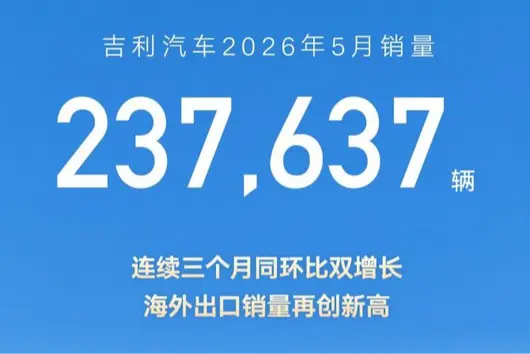
© 2024 Bitauto.com. All Rights Reserved.
Bitauto (www.yiche.com and www.bitauto.com) is one of the most visited automotive websites in China. We provide detailed info on Chinese car brands available in your area. Please note that the information provided on this website is based on publicly available data and is for reference only. It may not be fully updated or accurate at all times.

Help us improve our website


