

HomeSAIC Group

Search History
Popular Searches
Dealer Login / Sign Up
This year is a milestone year for Chinese automakers going global. According to new car sales statistics from the European Automobile Manufacturers Association, in May, sales of Chinese brand cars in Europe surpassed Japanese brands for the first time.
Following this, SAIC Group also sparked a wave of enthusiasm in the UK. On July 8, SAIC MG held a technology conference in London, bringing the most cutting-edge intelligent and electric technology back to the brand's birthplace; On July 9, SAIC MG appeared at the Goodwood Festival of Speed, where two concept cars, the two-door electric compact MG Go! and the coupe SUV Cyber Concept, shone brightly. The heritage of a century-old brand and the strength of a technological ace sparked sparks, as Chinese automakers ignite the global automotive market with intelligent and electric innovation technologies.

Scene of MG UK Technology Conference
At the same time, SAIC's overseas market also submitted an excellent half-year exam report: Sales overseas in June reached 146,000 vehicles, a year-on-year surge of 61.2%, setting a historical high. In the first half of this year, SAIC's overseas market cumulative sales reached 735,000 vehicles, a strong increase of 48.7% year-on-year, ranking among the leaders in the industry. Driven by the "Glocal Strategy", SAIC is transforming from selling cars to full-chain global expansion, continuously deepening overseas value chain construction.
Comprehensive Technological Advancement, Polishing the Product Name Card
At the technical brand level, SAIC is systematically building global intelligent labels for "Hybrid+ Hybrid Technology", "SolidCore Solid/Semi-Solid Battery Technology", and "i-Smart Intelligent Driving Technology". At the UK technology conference, the MG brand showcased MG Plug-in Hybrid+ Hybrid, SolidCore Semi-Solid Battery, and MG Parking Smart Cockpit and Assistive Driving. In addition, MG became the first automotive brand globally to achieve mass production of semi-solid batteries; The IM AD intelligent driving system of IM Motors has covered five continents globally; The global activation volume of the overseas travel i-Smart system has exceeded one million.

Scene of MG UK Technology Conference
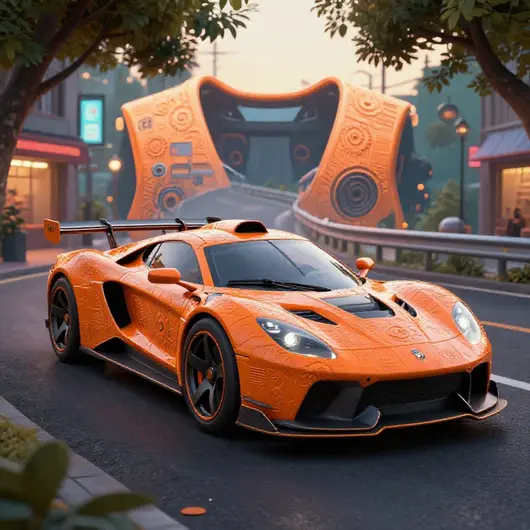
At the Goodwood Festival of Speed, the MG brand unveiled globally two concept models: the two-door electric compact MG Go! and the coupe SUV Cyber Concept, stunning the entire audience. The design inspiration for the two models comes from MGB GT, MG 6 R4 Group B Rally Cars, MG EX181 Streamlined Racing Cars, and other classic brand models, showcasing brand heritage and future vision.

MG GO! Concept Car

MG Cyber Concept Concept Car
At the product implementation level, SAIC will achieve massive product global deployment in the next three years: Full powertrains cover ICE, HEV, PHEV, EV four forms, adapting to energy policies and consumption habits of various countries; At the same time, SAIC is creating over ten new overseas models including SUV, sedan, MPV, pickup, comprehensively covering household, commuting, high-end driving, long-distance travel, outdoor and other full scenario needs, connecting global mainstream market segments.
From Frankfurt to London, from technology exhibitions to runways, SAIC MG advances in leaps and bounds, showcasing a new name card of Chinese intelligent manufacturing to the world with more cutting-edge technology and newer models.
Deepening Regional Markets, Serving Global Users
While technology sails overseas, the pace of SAIC deepening the global market is also accelerating. Currently, SAIC's products and services cover over 170 countries and regions worldwide, forming 1 "300,000-class" market (Europe) and 5 "50,000-class" markets (Americas, Middle East, Australia & New Zealand, ASEAN, South Asia), with overseas cumulative sales exceeding 7 million vehicles.
Europe is SAIC's largest overseas market. The MG brand has won the "Chinese Brand European Sales Champion" for 11 consecutive years and has become the first Chinese automotive brand to exceed 1 million cumulative sales in Europe. In the first half of this year, MG brand sales in Europe exceeded 190,000 vehicles, a year-on-year growth of over 20%. On July 1, MG brand established a direct sales company in Belgium and Luxembourg, which is also an important step for SAIC to implement the "Glocal Strategy" and take root in local Europe. From leading Chinese automotive brands in sales scale to deepening the European market and building long-term user relationships, MG is realizing a transformation from "selling cars" to "managing", thereby better improving service capabilities, listening to customer needs, achieving agile responses to market dynamics, and precise control of customer experiences.

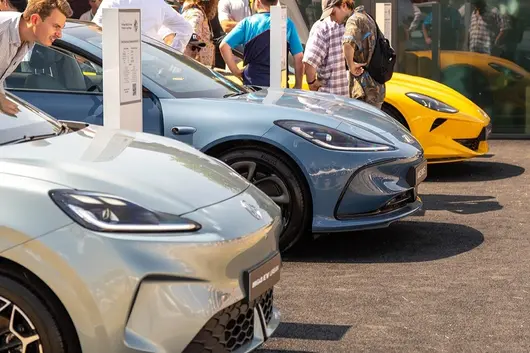
MG Brand Appears at Goodwood Festival of Speed
Not only in Europe, SAIC is blooming in multiple points globally by continuously deepening local markets. In Thailand, the MG brand launched the new service strategy "MG SMILE" in May, solving local user concerns such as price transparency, dealer commitment fulfillment, and consumer rights protection with a full-process service standard system, and providing lifetime warranty for three-electric systems for pure electric models. With the support of new service standards and lifetime warranty policies, the new MG URBAN went on sale in Thailand on June 24, bringing high-quality products and services of Chinese intelligent manufacturing to more Thai users.

MG URBAN
In Central Asia, in June this year, multiple models such as SAIC Volkswagen Tiguan L Pro, Passat Pro, Teramont X, Teramont Pro, T-Roc New, Lavida New entered the Uzbekistan market, achieving the "zero breakthrough" for SAIC Volkswagen in the Central Asian market. Previously, the SAIC Group Almaty MG Flagship Store officially opened in April this year, SAIC joined hands with Allur, Kazakhstan's largest automotive production and assembly enterprise to achieve localized production and model adaptation for customer needs. The two brands join hands to explore the Central Asian map, providing more intelligent models and higher-level services for local consumers.
Good news also came from the commercial vehicle sector. Recently, SAIC Hongyan formally reached a strategic cooperation agreement with a top port major customer in Thailand for 1,000 new energy heavy trucks. The first batch of complete vehicles has completed packing and boarded ships in batches, setting off from domestic production bases to Thailand. This also marks that SAIC Hongyan, relying on independent core three-electric technologies, full-scenario customization capabilities, and a comprehensive overseas local service system, breaks the monopoly of foreign brands in the Thai heavy truck market, showcasing the complete industrial chain of Chinese commercial vehicles and the hard power of green intelligent manufacturing to the world.
From monthly sales breaking the best historical record to technology label formation and localization deepening landing, behind SAIC's overseas market report card is the systemic effectiveness of the Glocal Strategy "Global Automotive Brand + Localized System Ecosystem". Facing the future, SAIC will continuously accelerate the transformation from complete vehicle overseas to value chain overseas, writing a new chapter of Chinese intelligent manufacturing in the global automotive industry landscape.
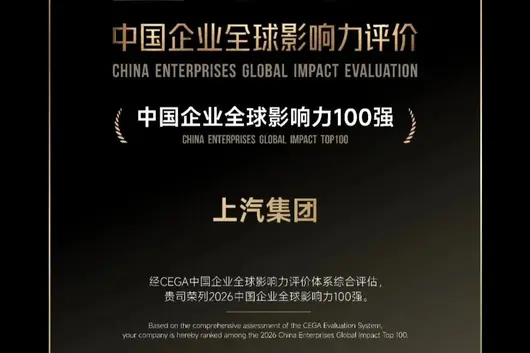
Recently, at the "2026 China Enterprises Global Influence Dialogue" gala hosted by Jiemian Cailian Press under the guidance of Shanghai United Media Group, the "2026 China Enterprises Global Influence Report" was officially released. SAIC Group won the two major awards of "Top 100 Most Globally Influential Chinese Enterprises" and "Top 10 in the Complete Vehicle Industry", and the company's overseas business strength and international brand reputation were recognized by authoritative institutions.


This China Enterprises Global Influence evaluation is an authoritative certification in the field of domestic corporate globalization. The evaluation conducts a systematic and quantifiable panoramic assessment of enterprises based on three dimensions: product popularity, image recognition, and local contribution, from aspects such as overseas business strength, international brand reputation, and overseas social responsibility performance. It aims to objectively evaluate the global influence of Chinese enterprises, set benchmarks, share experiences, and lead the direction. SAIC Group won two major awards due to its deep local cultivation and multi-point breakthroughs in overseas markets, as well as the global adaptability capability of diversified technologies.
Since the beginning of this year, SAIC Group's overseas business has continued to accelerate. In May, SAIC's overseas sales reached 130,000 vehicles, with cumulative sales of 589,000 vehicles from January to May, a year-on-year increase of 45.9%. With the trend of technology going global, value chain going global, and ecosystem co-creation, SAIC is driving Chinese brands to accelerate into the global market with a fusion strategy of "global layout + local cultivation".

Deep Local Cultivation, Multi-point Breakthrough
SAIC's deep localization cultivation in different regional markets has borne fruit. With multi-brand, multi-regional, and multi-category synergy, it has laid a solid foundation for the high-quality development of the group's overseas business.
In Europe, the cumulative sales of SAIC MG have surpassed one million vehicles, becoming the first Chinese car brand to reach this milestone. MG continues to lead this year, with cumulative sales of 150,000 vehicles from January to May, a year-on-year increase of 20%, remaining the number one Chinese car brand. In May, MG's direct operation system was established in Belgium, Luxembourg, and Switzerland, accelerating the consolidation of overseas regional markets. In the UK market, MG was particularly outstanding, remaining the sales champion of Chinese brands and ranking steadily in the top six, with May sales reaching 7,463 vehicles, a year-on-year increase of 13%. MG HS PHEV was ranked first by the British gold-medal automotive media "Auto Express", and its product technical strength has been highly recognized.

In multiple markets globally, SAIC also sees multi-point blossoming. During the Bangkok International Motor Show in Thailand, MG secured 10,537 orders, with sales surpassing Japanese brands such as Honda, Mazda, Suzuki, and Nissan. In Australia and New Zealand, MG3 and MG4 ranked first and third in the CAR-B sub-segment market with market shares of 21.1% and 12.8% respectively. In Chile, MG ZS took the sales champion of the local SUV market.

The pace of other SAIC brands going overseas is also accelerating. In May, SAIC Maxus overseas sales reached 12,392 vehicles, a year-on-year increase of 56%, among which light commercial vehicles maintained the first place in market share in the Singapore market. SAIC-GM-Wuling overseas sales in May reached 30,090 vehicles, breaking 30,000 vehicles for two consecutive months. In the high-end new energy field, IM Motors is accelerating its global layout and has achieved full coverage of the five continents. With excellent driving control, intelligent technology, and three-electric strength, it has won a warm response in the overseas market. Facing different regional markets, multiple brands under SAIC are advancing together, with richer product combinations and operational capabilities closer to local needs, continuously improving global market competitiveness.
Diversified Technology, Global Adaptation
Taking intelligent electric technology as a breakthrough point, SAIC is accelerating the promotion of technology going global. In March this year, SAIC MG held a Technology Day in Frankfurt, Germany, highlighting two core technologies: SolidCore semi-solid-state battery and Hybrid+ hybrid. The semi-solid-state battery responds to European users' concerns about safety and low-temperature range through electrolyte form innovation; Hybrid+ hybrid power balances low fuel consumption with high performance, winning positive feedback from local users and media. Currently, the MG Hybrid+ family's overseas monthly sales have exceeded 20,000 vehicles, becoming a new business card of Chinese Intelligent Manufacturing.

There is both "going out" and "bringing in". In late April, IM Motors held a "2026 Overseas Strategy Launch" event during the Beijing Auto Show, inviting nearly 200 overseas guests to China, and released the IM FUSION NOVA core technology architecture. This architecture integrates the full-line Lingxi digital chassis, IM AD ZETA intelligent driving large model, and Intelligent Cockpit Qianwen large model. With mature domestic leading technology as the cornerstone, it builds a technical blueprint for overseas intelligent product iteration and travel ecosystem development.
In the commercial vehicle sector, SAIC is also promoting the export of Chinese Intelligent Manufacturing standards. In April this year, SAIC Commercial Vehicle released a new overseas strategy, building an integrated development system around full-category resources, and established the "Global Modification Ecosystem Alliance" with global partners to extend business from product supply to standard co-construction, scenario co-creation, and ecosystem synergy. The alliance will integrate high-quality global modification resources, provide customized solutions for logistics, passenger transport, and other scenario needs in different markets, and help Chinese commercial vehicle standards and services go global.
From the export of high-end intelligent new energy products to the systematic development of commercial vehicles, and then to the localization synergy of the industrial chain, SAIC is transforming the group's systemic capabilities into service capabilities and growth momentum in overseas markets. Relying on global capabilities in R&D, marketing, logistics, parts, manufacturing, finance, and services, SAIC continues to improve the overseas full-chain operation system and strengthen the competitive moat of the "Global Brand".
Looking to the future, SAIC Group will continue to focus on intelligence, electrification, and globalization directions, enhancing product charm, technological strength, and global management capabilities. With more competitive products and higher quality services, it will polish the business card of Chinese Intelligent Manufacturing going global and meet the quality travel needs of global users.

What does 100 million vehicles represent?
If 100 million vehicles are connected, they can wrap around the Earth's equator exactly 10 times. If entrusted to a Chinese automotive group, it is called SAIC.
In May 2026, SAIC Group officially delivered to the world's 100 millionth user, becoming the first automotive group in Chinese automotive history to exceed 100 million cumulative production and sales. This is not a solo show of one brand, but a system-level collective appearance.
At this moment, SAIC Maxus, as the core entity of light commercial vehicles for SAIC Group, stood in the relay delivery zone with its Maxus main brand and Foray brand: Maxus brand delivered 100,000,009 vehicles, Foray brand delivered 100,000,012 vehicles. Two brands jointly accounted for half of the LCVs in the group's 100 million milestone.

Different from the solo breakthrough of passenger car brands, SAIC Maxus took a path of "dual-brand synergy, dual-track new energy growth". The Maxus brand achieved brand renewal with a "World Maxus" vision; the Foray brand, with the posture of a "dark horse" of "Foray All the Way", quickly broke out in the new energy light truck track. Each has its strengths, achieving a 1+1>2 effect.
World Maxus: Brand Renewal, Leading in New Energy
"Global Maxus, Quality Maxus, Tech Maxus, Eco Maxus"—these four core strengths are pushing Maxus to the position of "Global Leader in Light Commercial Vehicles".
In November 2025, Maxus brand released a new "Zhonghui" Logo, simultaneously renewing the brand mission: "Build a user-centric enterprise with leading technology and a full ecosystem chain". This is not a simple visual upgrade, but a complete turn from product thinking to user thinking. Subsequently, the Eco Maxus strategy was fully implemented, establishing a Global Modification Eco-Alliance, deepening strategic cooperation with Huawei and CATL, and industry-first "7-day free trial", 8S Store User Experience Center and other innovative service models.
In the new energy transition, the Maxus brand is also at the forefront. Domestic new energy penetration rate broke 50% in a single month, far ahead among traditional LCV enterprises. In April 2026, the industry's first super range-extender large light bus—Dana Super Range Extender launched, equipped with CATL 50kWh Tianxing Battery, CLTC pure electric range 312 km, combined range 1,260 km.配合 Volume halved, weight under 70kg Xingpai Super Range Extender, 1 liter of fuel generates 3.3 kWh of electricity, fuel consumption as low as 2.65 L per 100 km, truly achieving "Low cost of EVs + Zero anxiety of ICE vehicles".

On a global scale, Maxus light bus export volume ranks first among Chinese brands, high-end pickup export volume also ranked top. In high-end markets such as Europe, Australia, Singapore, market share continued to lead Chinese brands. In May 2026, overseas sales broke 10,000 units in a month, year-on-year growth 40%, global giants like DHL, J&T Express continue to repurchase, proving the "World Maxus" hard-core strength.
Foray All the Way: Dark Horse Stance, Green Breakthrough in New Energy Light Trucks
If Maxus brand represents "Stability" and "Distance", then Foray brand embodies "Speed" and "Sharpness". As the core carrier for light trucks under SAIC Maxus, Foray brand, with sales growth of "Hot-selling 40,000 units in 2025, YoY growth nearly 128%, new energy light truck share nearly 57%, YoY surge 222%", became an不可忽视 "Dark Horse Power" in the group's 100 million user milestone.
Foray brand's growth was not a blind sprint, but built on solid technology and product foundation. In March 2026, Foray globally debuted "Tianyuan Architecture". As SAIC Commercial Vehicle Global New Energy Smart Light Truck Architecture, this architecture takes electric drive rear axle as core, compatible with charging/swapping/range-extending multiple power replenishment modes, integrating smart driving and smart cockpit, accurately adapting to and leading industry intelligence and connectivity trends. On the foundation of inherited 68 years of military-grade quality, Foray relied on the forward-looking "Tianyuan Architecture", launched new energy light truck series like Dana T2/T3, covering full scenarios like express delivery, supermarket distribution, municipal operations, intercity transport. Among them, Dana T3 won "2025 Light Truck Sales TOP Award", leading the sub-track with hard-core strength.

Channels and services are even the hard foundation of Foray brand development. On the terminal channel side, SAIC Maxus Foray brand built a "Scenario-based + Digital" channel network. Optimizing channel layout for different logistics scenarios, promoting "Batch customization + Long-term cooperation" model in the B-end market, quickly seizing the key account market. In 2025, the brand newly established 44 primary channels, in 2026 will continue to deepen prefecture-level city coverage. This "Refined operations" model allows Foray to complete market downscaling with lower cost and higher efficiency, truly serving small and micro wealth creation groups.
Two Battlefields, One Core Value
The amazing thing about SAIC Maxus is: Left hand can sign big European orders with DHL, Right hand can save money for county express couriers.
In the domestic market, Maxus Dana series sales continuously reach new highs, monthly sales nearly 6,000 units in May, a true "Big hit" in the new energy light bus market, becoming a star model in urban distribution logistics market and pet cars, milk tea cars and other innovation and entrepreneurship fields; On the global market, Maxus brand in Europe, Australia, ASEAN directly confronts century-old brands. Global giants like DHL, J&T Express support with purchasing, buying Maxus cars truly achieved operational efficiency.

Foray brand also plays no empty talk, really helps small micro users in logistics calculate detailed accounts: Ultimate TCO means saving a few cents per kilometer, earning an extra car in a year. In 2025, TiE delivered nearly 10,000 Dana T series, More and more Foray figures in China Post and SF Express fleets.
On one side "Livelihood wealth creation", on the other "Global giants", no matter where users are, no matter what size of users, SAIC Maxus two brands always grasp users' "Make Money, Save Money" needs, adhere to "Wealth Creation Partner" core value.
Conclusion: 100 Million is Just the Starting Point, Dual Brands Move Forward
100 million vehicles, is a new coordinate of Chinese automotive industry. But for SAIC Maxus, this is more like a starting gun.
Maxus brand continues to deepen in light bus, pickup and MPV markets, Foray brand continues refined operations in light truck market, but the destination is consistent—let the wealth creation capability of commercial vehicles truly land on every user, helping users earn money and live better.
The light sail has passed ten thousand waves, ahead is still the wide sky and open sea.


From its birth in 1955 to 2026, Shanghai's automotive industry has evolved from nothing to something, from weak to strong. Guided by the "Understanding Cars, Understanding You Better" philosophy, it has formed a flourishing scenario with independent and joint ventures, passenger and commercial vehicles, and domestic and overseas markets.
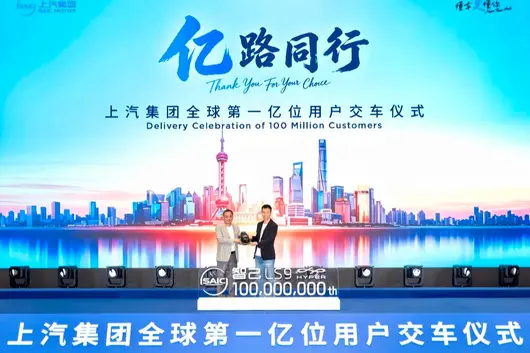
On May 28, 2026, the "Global 100 Millionth User Delivery Ceremony" of SAIC Group was held at the Shanghai North Bund World Living Room. Over ten vehicle brands and nineteen models under SAIC coordinated globally through "Global Relay Delivery." SAIC Group thereby became the first Chinese automotive enterprise to accumulate production and sales exceeding 100 million vehicles, creating a new milestone.

In 1955, the Shanghai Internal Combustion Engine Parts Manufacturing Company was established, marking the start of Shanghai's automotive industry. In 1958, workers hammered out the first "Phoenix" sedan, achieving a "zero breakthrough" in Shanghai sedan manufacturing. For over seventy years, SAIC has witnessed and promoted the entire process of China's automotive industry evolving from nothing to something, from weak to strong: In 1983, the Santana rolled off the line, opening joint venture cooperation; In 1997, Shanghai GM was established, creating the "Shanghai Speed" of building a factory and producing cars in 23 months; In 2006, the independent brand Roewe was born, and in 2016, the world's first internet car, Roewe RX5, was launched; In 2020, the intelligent electric brand IM Motors was established.

Running through this journey is the "Understanding Cars, Understanding You Better" user philosophy that SAIC has always upheld. From the Santana localization community to Joint Venture 2.0 technology co-creation, from internet cars to full wire-controlled chassis, solid/semi-solid batteries, and AI large models in cars—every leap forward is an upgrade in "Understanding Cars" capabilities and an inheritance of the original intention of "Understanding You".

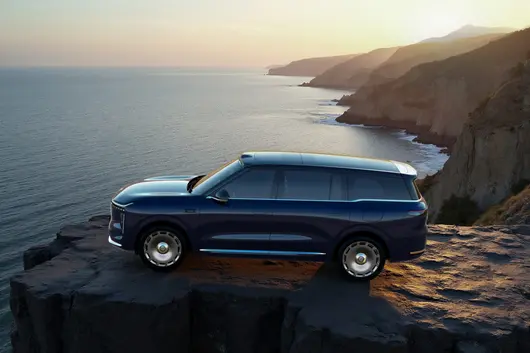
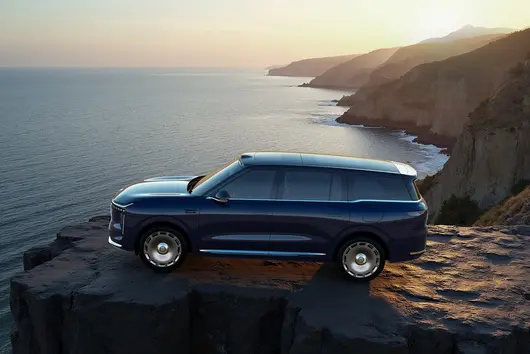
SAIC Group Global 100,000,000th User Delivery, IM LS9 Hyper
The 100 millionth vehicle delivered by SAIC Group is the IM LS9 Hyper, a masterpiece consolidating over 70 years of SAIC's technical accumulation: It is equipped with next-generation chassis technology, featuring the first-in-class full wire-controlled four-wheel steering system; next-generation intelligent driving hardware, including 520-line ultra-view LiDAR and NVIDIA Thor chips; next-generation powertrain system—global 800V high-voltage platform and Star Super Range Extender. This car also fully reserves the capability for continuous evolution towards L3 and above advanced intelligent driving. At the same time, the IM LS9 Hyper adopts the SAIC Gold Label Hurricane Three-Motor for the first time, joining the 3-second 0-100km/h club; it also jointly launched the "Intrinsic Security" technology with Purple Mountain Laboratory globally for the first time, expanding automotive safety boundaries from "Physical Security" to "Information and System Security," serving as an essential safety cornerstone for the AI era.

Behind the 100 million vehicles is SAIC's full value-chain closed loop covering six major sectors: complete vehicles, parts, mobility and services, finance, international operations, and innovative technology. From January to April 2026, SAIC accumulated sales of 1.302 million vehicles, ranking first in sales among Chinese automakers for four consecutive months. Among them, independent brand sales were 910,000, accounting for nearly 70%; new energy vehicles sold 412,000; overseas market sales were 459,000, a year-on-year surge of 50.2%.

At the delivery ceremony site, SAIC's full brand and product matrix collaborated. Independent brands went all out, covering multiple scenarios such as personal mobility, family life, commercial operations, and logistics transportation. Joint venture brands showcased "Joint Venture 2.0" results: Volkswagen ID. ERA 9X will globally debut with the Momenta R7 Reinforcement Learning World Model; AUDI E7X plans to become Audi's first global model to achieve L3 autonomous driving landing; Buick Zhijing E7 is built based on the "Xiaoyao" Super Fusion Architecture, achieving over 10,000 deliveries one month after launch.

Starting from the main venue in Shanghai, the delivery scene lit up successively in multiple domestic cities such as Nanjing, Liuzhou, Taiyuan, and countries including the UK, Indonesia, and Singapore. Behind this lies SAIC's deep foundation for global layout. SAIC is a pioneer in Chinese automotive enterprises "Going Global": It owns over 100 parts production bases and over 3,000 dealer networks overseas, has built 3 major R&D innovation centers including London, and 4 manufacturing centers in Thailand, Indonesia, India, and Pakistan; Anji Logistics owns 42 Ro-Ro ships of various types, with 8 international routes covering Southeast Asia, Europe, and the Americas. Today, SAIC's products and services are distributed in over 170 countries and regions, with cumulative overseas sales exceeding 7 million vehicles. SAIC MG has retained the title of the European sales champion among Chinese brands for 11 consecutive years; in 2025, European annual sales surpassed 300,000 units, becoming the first Chinese automotive brand to break one million in cumulative sales in Europe and the UK. In March this year, MG held a Tech Day in Frankfurt, Germany, globally debuting semi-solid state batteries and Hybrid+ hybrid technology, with the Hybrid+ family's overseas monthly sales already exceeding 20,000 units. In 2025, SAIC released the overseas "Glocal Strategy" (Global + Local), accelerating from "Product Going Global" to "Value Chain Going Global," allowing "Chinese Smart Manufacturing" to go further into the world.

100 million vehicles is a phased answer sheet for SAIC's over 70 years of development, and even more so, a new starting line for SAIC's "second entrepreneurial journey" towards the future of intelligent electric vehicles. In 2014, SAIC actively implemented the important instruction that "developing new energy vehicles is the only path for China to move from a car major power to a car strong power," leading the way in comprehensive transformation. Twelve years later, from the "leading the way" of intelligent electric transformation to a "flourishing boom" in independent/joint ventures, passenger/commercial, and domestic/overseas, SAIC will continuously take "Understanding Cars, Understanding You Better" as the user philosophy, letting technological innovation truly benefit every user.
The author of this article is A Lai from TiCheBang
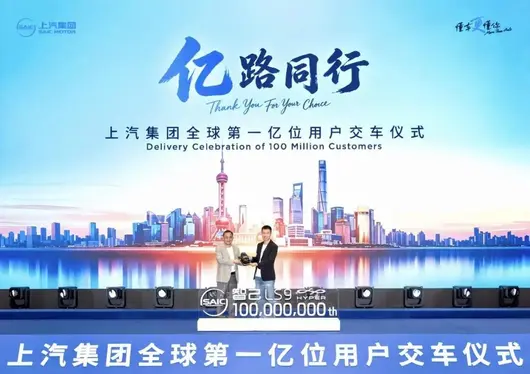

On the afternoon of May 28, 2026, at the World Living Room at North Bund, Shanghai, one IM LS9 Hyper was officially delivered, and SAIC Group welcomed its 100 millionth global user. Accompanying this "global relay delivery"—15 brands and 19 models under its umbrella were delivered synchronously both domestically and overseas—SAIC became the first automaker group in the history of China's automotive industry to accumulate production and sales exceeding 100 million vehicles, the eighth automaker globally to join the "Hundred-Million Club".

This is not a simple breakthrough of a set of sales figures. From the first Phoenix brand sedan hammered out by workers with hammers in 1958 to the cumulative global delivery of 100 million vehicles today, SAIC's growth trajectory of over 70 years is almost a microcosm of the entire Chinese automotive industry developing from nothing to something, and from weak to strong. What truly gives the 100 million vehicles industry research value is the full industrial chain system SAIC has gradually built over these years—coordinated operation of various sectors including complete vehicles, parts, mobility, finance, international operations, and innovative businesses, entered the Fortune Global 500 for 21 consecutive years, ranking 7th globally in 2025 with sales of 4.508 million vehicles, with a year-on-year growth of 12.33%.

100 million vehicles is a weighty threshold, but what deserves more attention than this number is the two fundamentals distinguishing SAIC from most domestic automakers: overseas layout and technology accumulation.

In terms of overseas markets, SAIC is one of the earliest and largest Chinese automotive enterprises to "go out." First achieving passenger car exports in 2001, now its products and services cover more than 170 countries and regions globally, and cumulative overseas deliveries exceed 7 million vehicles. Overseas, SAIC owns more than 100 parts production bases, over 3,000 dealer networks, built 3 major R&D innovation centers including London, and 4 production manufacturing centers in Thailand, Indonesia, India, Pakistan, and established China's largest self-operated vehicle logistics fleet. In 2025, SAIC's annual exports and overseas market sales reached 1.071 million vehicles, the MG brand ranked 1st in European sales among Chinese brands for 11 consecutive years, and entered the top 10 in passenger car market sales in 18 countries in regions such as Australia-New Zealand, Middle East, Latin America, Southeast Asia. During the 2025 Shanghai Auto Show, SAIC released Overseas Strategy 3.0 - "Glocal Strategy" (Global + Local combination strategy), planning to build 17 new overseas models including SUVs, sedans, MPVs, and pickup trucks in the next 3 years, gradually implementing HEV hybrid and solid-state battery technologies into global mainstream markets. From product export to value chain export, this road has taken more than 20 years, the system is built, the next step is to look at the brand power and depth of localized operations.

On the technology level, there are several key advances worth mentioning. In January 2026, the first mass-produced semi-solid-state battery model of the MG brand started delivery, to date, the delivery volume has broken through 1,000 units, the 2026 MG4 launched at the April 2026 Beijing Auto Show equipped with semi-solid-state battery, starting price under 70,000 yuan, bringing frontier technology down to the mainstream consumption market, which is rare in the industry. IM AD Intelligent Driving System cooperates with Momenta, has covered all five continents globally, including markets in Thailand, Mexico, UK, Australia, Nepal, Egypt, Singapore, Norway, New Zealand, UAE, etc., adopting a mapless end-to-end solution, possessing strong global scene adaptability. In addition, from a data perspective, SAIC's R&D investment in new energy and intelligent connected fields has accumulated to over 150 billion yuan, effective patents nearing 26,000 items, NEV sales share jumped from less than 0.1% in 2014 to over one-third in 2025.

Of course, 100 million vehicles is a reflection of historical accumulation, the real test lies in the upcoming market competition. SAIC internally calls this node the starting line of the second entrepreneurship, the direction is leaping from scale leadership to quality leadership, technology leadership, and ecosystem leadership. Previously, the comment of Cui Dongshu, Secretary-General of the China Passenger Car Association, also hit the key point: "'These 100 million vehicles are not the end point, but a springboard for China's automotive industry to create another glory'." China's automotive industry has moved from following to running parallel or even leading in local areas, whether SAIC can continue to produce competitive products on the three fronts of new energy, intelligence, and globalization is the key to determining how many years the next 100 million vehicles will take. But one thing is certain: When a car company experiences a technical transformation and global layout throughout a complete industry cycle, the system capabilities it accumulates cannot be measured by simple sales figures.

May 28, 2026, Shanghai. With an IM LS9 Hyper delivered to a user, SAIC Group's cumulative production and sales officially exceeded 100 million units, marking a major milestone in the history of China's automotive industry.

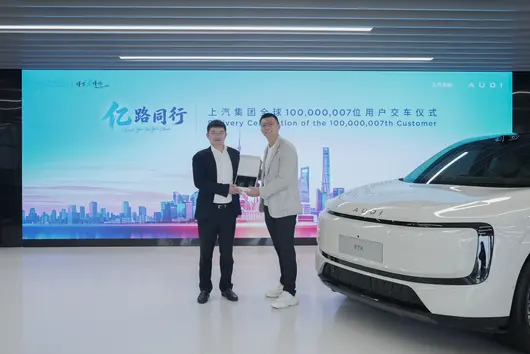
Meanwhile, the 100,000,007th unit of SAIC Group rolled off the line at the SAIC Audi AUDI Intelligent Manufacturing Base. Tao Hailong, Party Secretary and General Manager of SAIC Volkswagen Automobile Co., Ltd., delivered the Audi E7X to user Shen Jimin, turning a new page in the history of China's automotive industry from then on.
On that day, four delivery events distributed domestically and abroad silently outlined the growth trajectory of this state-owned enterprise giant, from the industrial foundation of SAIC Volkswagen, to Buick's local affection, to the independent breakthrough of Roewe and MG, and to Wuling's globalization moves in the down-market.

SAIC Volkswagen: The Weight of the Foundation
In the noise of celebration, the silent foundation is often easily forgotten. SAIC Volkswagen is not only an important sales pillar for SAIC Group but also the "Whampoa Military Academy" of China's automotive industry modernization.
Looking back to 1984, the joint venture contract signed at the Great Hall of the People opened not just a joint venture company, but a complete chain from CKD knock-down assembly to the establishment of a localized system, from the introduction of quality standards to the cultivation of a supply chain ecosystem. It is an industry-recognized fact that without SAIC Volkswagen's system capability honing a sword for over thirty years, there would be no later accumulation and breakthrough for SAIC's independent sector.
This time delivering the Audi E7X as the 100,000,007th vehicle symbolizes that this "foundation" is undergoing a profound reconstruction. Shifting from traditional German mechanical quality to all-aluminum chassis, 900V high-voltage fast charging, and intelligent driving. This turnaround is not flashy, yet solid enough—it proves that traditional joint venture giants still possess strong engineering implementation capabilities in the wave of electrification.

Buick: The "Emotional Ledger" of Joint Ventures
Different from SAIC Volkswagen's industrial rationality, the Buick brand attempted to answer a softer question in this celebration: when joint venture brands have walked for nearly thirty years in China, besides sales, what remains?
SAIC-GM Vice General Manager Xue Haitao delivered the 100,000,100th complete vehicle—the Buick Zhijing E7—to user Liu Jia. This ordinary person, who has been giving free haircuts to left-behind children in the mountains for over a decade, attracted attention from netizens when their old car broke down on a mountain road. Buick's intervention transformed this social news into a commercial delivery about "trust".
This is not a simple public welfare event. As the inaugural work of Buick's high-end new energy sub-brand, the Zhijing E7 focuses on "The Perfect Score Cockpit for Children", returning the product origin to family and children scenarios. The report card showing delivery breakthrough of 10,000 units in the first month since launch indicates: joint venture brands have not lost their halo, but must learn to redefine products using "real needs of Chinese families".

Roewe and MG: Two Paths of Independent Breakthrough
In SAIC's 100 million unit map, the rise of the independent sector is a highly dramatic chapter. Roewe and MG represent two different breakthrough logics.
Roewe chose the "upward" path. From Roewe 750 opening the door to the mid-to-high-end market in early years, to RX5 defining "Internet Cars", to the M7 Dark Horse Edition breaking the stereotype of family cars today, Roewe is completing the leap from "manufacturing" to "quality manufacturing". At the vehicle handover ceremony, an old Roewe 750 owner passed the keys to his son-in-law. This trust spanning twenty years is more convincing than any parameter comparison.
 MG takes the "broader" route. As a British brand with a hundred-year history, MG achieved identity reconstruction in SAIC's hands. Ranking first in European sales of Chinese car brands for 11 consecutive years, cumulative sales in the UK and Europe market exceeded one million—this marks that China's automotive export has progressed from "product trade" to "brand output". That couple of international students who met MG in the UK and still chose MG4 after returning home is exactly a footnote to this globalization identity.

Wuling: The Silent Base and Secret Export
Outside all spotlights, Wuling is a very large and silent cornerstone in SAIC's 100 million units. Hongguang, Baojun 730, Hongguang MINIEV... these models constitute the real capillaries of China's county economy.
"Wuling builds whatever the people need." Behind this slightly simple slogan lies the precise capture of supply chain cost control and user pain points. More strategically significant is its delivery ceremony in Jakarta, Indonesia. Unlike the brand output of Roewe and MG, Wuling adopted "moving the chain overseas"—packaging and replicating the manufacturing chain, supply chain, and sales chain to the ASEAN market.
Relying on the Indonesia pivot, radiating to Malaysia, Thailand, and even the entire ASEAN, Wuling is solving the deep-seated problem of "going global" for China's automotive industry: how to make Chinese manufacturing standards take root in a foreign land.

Zhang Guan Commentary: The Exam Paper After 100 Million Units
Standing on the threshold of 100 million units and looking back, SAIC's scorecard is a microcosm of China's automotive industry catching up and running side by side.
However, 100 million units is both a milestone and a brand new exam paper. When incremental dividends fade, when competition shifts from "capacity war" to "system efficiency and brand thickness", the challenges faced by SAIC are more severe: How to maintain strategic resolve within a multi-brand matrix? How to progress from "selling cars" to "operating brands" in the overseas market?


Written by Zhao Yun
There were no long speeches from leaders, no dazzling solo dance of concept cars, nor any deliberately emotional brand promotion.
This doesn't even look like a traditional new car delivery press conference.
On May 28, 2026, at the Shanghai North Bund World Reception Hall. Dragon TV cameras started here, spanning the Asian and European continents, connecting Nanjing, Yangzhou, Liuzhou, and Taiyuan, crossing the English Channel to reach London, and crossing the Malacca Strait to illuminate Indonesia and Singapore — SAIC Group used a true "Global Relay Delivery" to complete a narrative never before seen in the history of China's automotive industry: delivering 100 million pieces of trust under the gaze of global audiences, achieving a continuous relay.
One hundred million, at this moment, is not a cold sales figure. One hundred million is the "moving and vivid history co-creation lesson" written by SAIC Group over seventy-one years together with 100 million vibrant car owners and tens of millions of Chinese families, and 100 million stories of human life's warmth.
And the first page of this lesson begins with two ordinary people.
01
Lantian and London: 2 out of 100 Million Human Realities
Lantian, Shaanxi, tricycle of Village Secretary Pang Fuqiang
Lantian County, Xi'an City, 64-year-old Village Secretary Pang Fuqiang was once a chef. Starting from August 2025, he launched a "loss-making business": making lunch for 74 left-behind elderly people in the village every day, charging only 2 yuan per meal. For elderly people with difficulty in movement, he delivered food to their homes.
The food delivery routes are scattered on mountain village roads, running 8 or 9 kilometers every day. Pang Fuqiang used a tricycle with a small load capacity. One trip wasn't enough, running two trips took too long. In winter, cold wind poured into his neck, and in summer, the car seat became too hot to sit on after sun exposure. More critically, the tricycle lacked safety protection. On rainy days when roads were slippery, he fell.
In February 2026, CCTV News broadcast his story. Xinhua News Agency and China Youth Daily reported subsequently. Someone asked him, "Secretary Pang, what are you aiming for?"
He said, "I aim for these 74 elderly people to have a hot meal."

SAIC-GM-Wuling saw this news. Without hesitation, the enterprise decided to gift Pang Fuqiang a Wuling vehicle — not charity, but tribute. Under the framework of the "Strivers Special Plan", Wuling, relying on the "SAIC-GM-Wuling Benevolence Fund" that has been operating continuously for 19 years, invested 15 million yuan in funds and vehicles to provide the village secretary who runs for 74 elderly people every day with safer and more efficient tools.
"What the tricycle can't carry is the hot meals for all the elderly in the village. Wuling helps you carry it."
This is not an advertising slogan. This is a response from a Chinese automotive enterprise to a Chinese grassroots striver.
The camera cut from the remote Lantian mountain village to London, the world financial center.

26-year-old intern doctor Natalia stood at the MG London Delivery Center, receiving the keys to the MG4 EV Urban. Her eyes were a little moist.
Her grandfather once owned a classic MG B. That was her childhood memory: her grandfather drove her for a ride, she sat in the passenger seat, small hands touching the dashboard, fantasizing one day she could also drive it.
Her grandfather passed away many years ago. But what the MG B left behind was not just a car, but a spirit — every generation of MG owners has a beam of unextinguished glory in their hearts.
Now, Natalia has become a young generation MG owner. The MG4 EV Urban she chose is an urban commuting tool for the pure electric era: WLTP range 416 km, 28 minutes fast charging, 577L trunk space. But to her, this is not just a commuting tool.
"What my grandfather passed down to me is not just the love for MG, but also that spirit of courage to explore and embrace innovation."
Two generations, two cars, the same brand. From London to Shanghai, from fuel to electric, the MG spirit is inherited in the family bloodline and continues in the hearts of a million global owners.
One is a village secretary delivering food to left-behind elderly people in a Chinese mountain village; the other is an intern doctor in a British city inheriting his grandfather's feelings. They did not know each other, but because of the same SAIC Group, on this day of May 28, 2026, they were written into the same history.
They are the most ordinary "one in 100 million" among SAIC's 100 million car owners.
If Pang Fuqiang and Natalia's stories represent the "warmth" and "heritage" of 100 million vehicles, then the next car owner represents the "height" and "future" of 100 million vehicles.
The 100 Millionth User: Partner & Owner, Shouldering Towards the Future
Cao Xudong, Momenta CEO, leading figure in the field of intelligent driving in China.

At the delivery ceremony, he received the keys to the IM LS9 Hyper from the Chairman of SAIC Group. This car is the culmination of 71 years of SAIC's technical accumulation: full electronic four-wheel steering, 520-line super vision LiDAR, NVIDIA Thor chip, full-domain 800V high-voltage platform, Star Super Range Extender... and the "endogenous security" technology jointly launched globally with Purple Mountain Laboratories, expanding car safety from "physical security" to "information and system security."
Cao Xudong is not an ordinary car owner. IM Motors and Momenta have been "founding lighthouse partners" from the very beginning of the brand's birth. The teams of both sides, back-to-back and heart-to-heart, jointly polished the driver assistance solutions for all IM Motors series models.
"Partner becomes Owner", this is a rare deep resonance in the history of the automotive industry.
At the delivery scene, Cao Xudong said the following words:
"I chose the IM LS9 Hyper because I have full confidence in its driver assistance and intelligent level. I will personally drive this car and use it for L3 autonomous driving verification testing. I want to ensure that what is delivered to users is the most mature and reliable system."
He called this car "a bright pearl of the Chinese automotive industry" and announced: Momenta L3 autonomous driving capability will be launched first on SAIC.
This is not a simple delivery. This is a technology partner binding their name deeply with the product; this is a strategic partner endorsing the technology with their daily commuting.
And Cao Xudong's identity also makes us unable to help thinking: what does it mean to have 100 million car owners?
02
If 100 Million Car Owners Are Compared to a Country
Before the press conference, SAIC Group made a short film named "Memory". Below the short film, there were countless online users leaving chain messages: "one in 100 million". Obviously, behind every account is a car owner whose heart is throbbing at this moment.
Let us conduct a hypothetical experiment.
If we look at SAIC Group's 100 million car owners as a country, what would be the ranking of its population scale in the world?

Only 14 countries in the world have a population exceeding 100 million. SAIC's "Car Owner Country" will be ranked 15th, on the same level as Egypt, Vietnam, Germany, Iran, and other countries.
100 million vehicles is not just a business achievement, but also an economic miracle.
In the history of the global automotive industry, how many enterprises have accumulated production and sales exceeding 100 million vehicles?
Toyota, Volkswagen, Ford, GM, Nissan, Honda, Hyundai... and now SAIC Group.
SAIC is the only member of the 100 million vehicle club from China.
What does this mean?
It means that for every 100 vehicles sold globally, a considerable proportion comes from Chinese brands; it means that China's automotive industry went from "bringing in" to "going out" and took 70 years to finally stand at the center of the world stage; it means that the steering wheels in the hands of that 100 million car owners hold not only their own commuting but also the dignity of Made in China, Smart Made in China, and Created in China.

And turning our eyes back to this year, SAIC's market performance is equally solid. In the past May, SAIC Group's complete vehicle sales were 349,000 units. From January to May, cumulative sales reached 1.651 million units, continuing to lead the Chinese automotive industry. The proportion of independent brands broke through 70% for the first time. New energy vehicles surged 46.5%, and the overseas market surged 45.9%. The historical mark of 100 million vehicles, combined with the current sales leadership, jointly constitutes SAIC's complete narrative from past to present.
03
Global Relay: SAIC's Control Capability
Why did SAIC do this delivery ceremony?
Because it requires four "wholes":
Full Brand Matrix: Roewe, MG, IM, Shangjie, Wuling, Maxus, Hongyan, Yuejin, Sunwin, Iveco... Independent brands launched the entire line; Volkswagen, Audi, Buick, Cadillac... Joint venture brands showcased their strength. From A0-segment commuter cars to 500,000-level luxury flagship models, from sedans, SUVs to MPVs, pickups, from passenger vehicles to commercial vehicles, from city logistics to infrastructure transport — covering all scenarios.

Full Product Categories: Shangjie Z7, Hua Jing S, Roewe M7, MG4 Semi-Solid State Battery Version, Wuling Starlight 560, Maxus eDeliver5, Hongyan Heavy Truck, Yuejin Danaka T1, Sunwin Pure Electric Bus, Iveco Polaris EV... Every vehicle aims at different users, different scenarios, and different lives.
Global Layout: Overseas has over 100 parts production bases, over 3,000 dealer networks, 3 major R&D innovation centers including London, 4 production centers in Thailand, Indonesia, India, and Pakistan. ANG Logistics owns 42 various roll-on roll-off ships, 8 international routes covering Southeast Asia, Europe, and the Americas. Products and services spread over more than 170 countries and regions. Overseas cumulative sales broke through 7 million vehicles.
Full Industry Chain System: Covering six major sectors including complete vehicles, parts, mobility and services, finance, international business, and innovation technology. Close synergy, mutual empowerment, integrated development, forming a full value chain closed loop.
This "Global Relay" is the concentrated appearance of SAIC's system competitiveness.
Starting from Shanghai, Nanjing, Yangzhou, Liuzhou, Taiyuan... UK, Indonesia, Singapore... Car owners of different time zones, different languages, and different cultures completed the delivery relay at the same moment because of the same brand.
And supporting this grand narrative are individual vibrant users, as well as scale and systems.
04
The Essence of Delivery is the Start of a Relationship
In the traditional sense, car delivery is the end of a transaction — money on one hand, car on the other, contract fulfilled. But SAIC's global relay turned delivery into the starting point of a relationship.

Pang Fuqiang's Wuling Rongguang is not the end, but the new starting point of him delivering 74 hot meals every day; Natalia's MG4 EV is not the end, but the emotional sequel of her and her grandfather across space and time; Cao Xudong's IM LS9 Hyper is not the end, but the starting line for Level 3 autonomous driving landing in China. Each relay baton is opening a new narrative.
100 million vehicles are 100 million relationships unfolding. SAIC redefined "delivery" with this ceremony: it is not just about handing over the car key to end, but taking over the user's trust and continuing to walk forward. This explains better than any number why a car company can survive for more than 70 years and still make people expect its next 100 million.
05
Behind 100 Million Vehicles: 100 Million Vibrant Beating Hearts
SAIC Group's "Knows cars better, understands you better" has never been a slogan.
It is embodied in Pang Fuqiang's Wuling vehicle — "The hot meals the tricycle can't carry, Wuling helps you carry."
It is embodied in Natalia's MG4 EV — "Grandfather's MG B is my childhood memory, my MG4 is the starting point of the future."
It is embodied in Cao Xudong's IM LS9 Hyper — "I will personally test Level 3 autonomous driving to ensure the system delivered to users is the most reliable."
It is also reflected in the stories of more car owners:

Dedao App founder Luo Zhenyu, as the Hua Jing S 001st tester, went from praising Huawei Qiankun Intelligent Driving in the New Year's Eve speech to visiting the factory to witness the lineup. He said: "Hua Jing S is not just a car, it is the crystallization of Chinese technology co-creation."

Former German League footballer Yang Chen, chose ID.ERA 9X, because "Premium Range Extender and long-termism are in line." He said: "When playing football, be steady; when driving, be steady too. This car is steady."

Public Welfare Blogger Liu Jia, for five consecutive years, cuts hair and sends companionship to left-behind children in Guangxi mountainous areas. Buick provided immediate aid, and he was moved by Zhijing E7's "Full Score Cabin". He said: "I guard the children's smiles, Buick guards my commute."
After Cao Kailiang's family ordered cars, idol Jay Chou happened to become the spokesperson for the Buick MPV family. He said: "This is not a coincidence, this is fate."
And there is DHL, Jiading Public Transport, Henglongsheng Industry and Trade, Di Shangtie, Henan Zhonglian Tourism... Every commercial vehicle is a "wealth creation tool" for strivers.
A car owner from Henan Zhonglian Tourism said on site: "We run on the road every day, the car is our rice bowl. SAIC Maxus has never let us down. 100 million vehicles, we are also among them — glorious."
A driver from Jiading Public Transport, after receiving the keys to the Sunwin Pure Electric City Bus, only said one sentence: "This car is quiet, starts steadily, passengers sit comfortably. We drivers also feel dignified."
And the deeper meaning lies in: these 100 million car owners are not cold statistical figures. They are Pang Fuqiang, Natalia, Cao Xudong, Luo Zhenyu, Yang Chen, Liu Jia, Cao Kailiang, DHL drivers, Jiading Public Transport drivers, Henan Zhonglian Tourism leaders, you, me, every person striving forward in life.
SAIC, knows cars better, understands you better, now has a more concrete meaning at this moment.
06
100 Million is a Starting Point, Not an End Point
At the end of the ceremony, Dragon TV cameras swept across the global delivery sites again.
Shanghai main venue, IM LS9 Hyper drove out slowly; London streets, MG4 EV Urban穿梭ed along the banks of the Thames; Jakarta, Indonesia, Wuling new energy vehicles delivered to local families; Changi, Singapore, SAIC Maxus drove into the urban expressway...

From 1955 to 2026, from the first user to the 100 millionth user, from startup exploration to industry leadership.
In 2014, SAIC actively implemented the important directive "Developing new energy vehicles is the only path for China to move from a car powerhouse to a car superpower", taking the lead in comprehensive transformation. Twelve years later, the 12 zodiac signs completed a full cycle. SAIC, with 12 years of persistence, completed a historic leap from "leading the pack" to "ten thousand horses galloping".
100 million vehicles are the stage report of SAIC's 71-year development, and more, a new starting line facing the future of smart and electric transformation.
100 million vehicles, 100 million simple wishes. Some aim for a hot meal, some aim for family heritage, some aim for a technical dream.
100 million is a number. 100 million vibrant beating hearts are where the hearts of the people lie.
SAIC Group, Traveling the Billion Mile Journey Together.
On May 28, 2026, SAIC Group held the "First Global 100 Millionth User Delivery Ceremony" grandly at the Shanghai North Bund World Living Room. More than ten whole vehicle brands and 19 main models under SAIC, with the innovative form of "Global Relay Delivery", spanned continents and linked domestic and overseas markets, officially declaring SAIC Group as the first in China's automotive industry to break 100 million in cumulative production and sales, carving a historic milestone for the development of China's automotive industry.

From the first "Phoenix" sedan born in 1958, to today's global automotive group with a scale of 100 million vehicles; from local car making hammered by hand, to full industry chain synergy and intelligent manufacturing of Chinese globalization; from single product output to technology, brand, and service full value chain going global, SAIC has written the era's answer for Chinese cars to catch up, run alongside, and go from local to global with over 70 years of progress. 100 million vehicles is not only a quantum leap in production and sales scale, but also a heavy load of 100 million units of user trust, a testament to the strength of China's automotive industry's rise.

I. Over 70 Years of Progress: From "Zero Breakthrough" to "100 Million-Level Leap"
The development history of SAIC Group is a condensed history of China's automotive industry's progress.
In 1955, the Shanghai Internal Combustion Engine Parts Manufacturing Company was established, and Shanghai's automotive industry officially set sail. In 1958, the first generation of automotive workers manually assembled the first **"Phoenix" sedan**, achieving a "zero breakthrough" in Shanghai sedan manufacturing, opening the difficult exploration of China's independent car making. At that time, conditions were simple and technology was weak, but the seed of steadfastness for independence and pursuit of quality was planted.
After the Reform and Opening Up, SAIC seized the opportunity of the times and entered a new stage of joint cooperation and rapid growth. In 1983, the Santana officially came off the line, not only opening the tide of popularization of Chinese household sedans, but also driving the establishment of a modern automotive parts supporting system, promoting the systemization and standardization upgrade of China's automotive manufacturing system. In 1997, SAIC General Motors was established, achieving a "Shanghai Speed" with 23 months to go from "building factory to delivering vehicles", refreshing industry records, and simultaneously building the first joint venture exclusive automotive R&D and design center domestically, achieving a leap from manufacturing to R&D.

Entering the new century, SAIC firmly promoted independent innovation and brand upward movement. In 2006, the Roewe brand was born, sounding the horn for the comprehensive rise of independent passenger cars; in 2016, the world's first Internet car Roewe RX5 went on sale, opening a new era of automotive intelligence; in 2020, IM Motors appeared, targeting the global luxury market with a high-end intelligent electric track. From fuel vehicles to new energy, from traditional manufacturing to intelligent electric, from local layout to global operations, SAIC has always been at the forefront of industry transformation.
For over 70 years of wind and rain, SAIC has always adhered to the core concept of **"Know Cars, Know You Better"**. "Know Cars", is the ultimate pursuit of core technologies, is the continuous breakthrough of cutting-edge technologies such as full wire-controlled chassis, semi-solid state batteries, AI large models, intelligent driving; "Know You", is to convert hardcore technology into user-perceivable and enjoyalbe travel experiences, letting every innovation serve real car usage scenarios. From the first vehicle to the first 100 millionth vehicle, what changes is scale and technology, what remains unchanged is the original intention of sticking to quality and serving users. 100 million vehicles is the most powerful fulfillment of this original intention.
Full System Strength Support: Full Brand Matrix + Global Layout, Casting the Foundation of 100 Million Vehicles
Behind the 100 million vehicle scale is SAIC's full value chain closed-loop system covering six sectors: whole vehicles, parts, mobility, financial services, international operations, and innovative technology, and the strong comprehensive strength of synergy between independent and joint ventures, passenger and commercial vehicles, and domestic and overseas linkage.
Sales data corroborates hardcore strength: From January to April 2026, SAIC Group's cumulative sales reached 1.302 million vehicles, ranking first among Chinese automakers for four consecutive months; among them, independent brand sales were 910,000 vehicles, accounting for nearly 70%, becoming the core engine of growth; new energy vehicle sales were 412,000 vehicles, stably in the first echelon of the industry; overseas market sales were 459,000 vehicles, surging 50.2% year-on-year, continuing to lead Chinese brand exports.

This global relay delivery, SAIC's full brand matrix made a powerful appearance. Independent brands went all out: Shangjie Z7, Huajing S, Roewe M7, MG4 Semi-Solid State Battery Version, Wuling Starlight 560, Maxus eDeliver5, Hongyan Heavy Truck, Yuexing Dana T1, SUNWIN Electric Bus, Iveco Juzing EV and other models were delivered in batches, covering household commuting, family travel, business operations, logistics transportation, urban public transport all scenarios, meeting users' diversified needs.
Joint ventures entered the "Joint Venture 2.0" technology co-innovation stage, showing heavy results: Volkswagen ID. ERA 9X globally debuted with Momenta R7 Reinforced Learning World Model, delivered over 7,000 units in the first month of listing; AUDI E7X is planned to become Audi's first model globally landing L3-level autonomous driving; Buick Zhijing E7 is built on the "Xiaoyao" Super Fusion Architecture, sales broke 10,000 units in the first month of listing. From "Market for Technology" to "Technology Defines Products", SAIC achieved a complete role leap, leading the new direction of high-quality development of joint ventures.
Global layout is the key support for SAIC's 100 million leap. As a pioneer in Chinese automotive "Going Global", SAIC has already deployed over 100 parts bases and over 3000 dealer outlets overseas, built 3 Global R&D Centers in London, as well as 4 overseas manufacturing bases in Thailand, Indonesia, India, Pakistan; Anji Logistics formed 42 professional Ro-Ro ships, opened 8 international routes, building an efficient global logistics system.
Currently, SAIC's products and services have covered over 170 countries and regions worldwide, with cumulative overseas sales breaking 7 million vehicles. MG brand ranked first among Chinese brands in European sales for 11 consecutive years, European annual sales broke 300,000 in 2025, becoming the first Chinese automotive brand to break 1 million in cumulative sales in Europe and the UK. In March 2026, MG released Semi-Solid State Battery and Hybrid + Hybrid Technology in Germany, breaking 20,000 units in a single month overseas, winning global market recognition with hardcore technology. SAIC is moving from "Product Going Global" to "Value Chain Going Global", letting Chinese Intelligent Manufacturing shine on the global stage.
User-Centric: 100 Million Trusts, Originating from "Know Cars, Know You Better"
SAIC's 100 million leap is essentially the accumulation and precipitation of user trust. In this delivery gala, there was no grand technology presentation, but focused on every real user, letting ordinary people become the protagonists, vividly interpreting the deep connotation of "Know Cars, Know You Better".

GET App founder Luo Zhenyu served as the 001st Experience Officer for Huajing S, from praising Huawei Qiankun Smart Driving to deeply visiting the factory to witness the off-line, recognizing SAIC's dual strength of technology and quality; former national team player Yang Chen chose Volkswagen ID. ERA 9X, valuing its high-efficiency range extender system and consistency with long-termism values; charity blogger Liu Jia stuck to mountain area charity for five years, was moved by Buick Zhijing E7's "Full Score Cockpit"; London doctor Natalia inherited family MG sentiment, returning couple brought overseas car usage memories back to the motherland; there were also bulk users such as logistics enterprises, bus companies, tourism teams, letting SAIC become a reliable partner for fighters.
From tech bloggers to sports stars, from public welfare persons to entrepreneurs, from overseas users to local families, every user's choice is an endorsement of SAIC products and services. SAIC always insists that the ultimate value of technology is to serve people, the ultimate goal of car making is to guard every journey, warming every family. 100 million vehicles is the carrying of 100 million life stories, the guard of 100 million beautiful journeys, and more 100 million heavy trusts.
At the product level, SAIC oriented by user needs, built a product matrix covering all categories, all price points, all scenarios. Home cars pursue comfort and energy saving, high-end car owners focus on intelligent luxury, commercial vehicles focus on reliability and efficiency, new energy vehicles achieve range and safety balance. At the same time, continuously upgrading quality and experience, from infant-level healthy cockpit, full domain security protection, to intelligent interaction, comfortable chassis, every detail is polished around users' real car usage scenarios, letting high-end inclusion, letting technology approachable.
Start New Journey: Starting from 100 Million Level, Towards the New Era of Smart Electric
100 million vehicles is a milestone, but also a new starting point. Facing the wave of smart electrification, SAIC in the posture of "Second Entrepreneurship", full sprint for new heights of the global automotive market.
Technology innovation continues to lead: Deeply cultivating solid / semi-solid batteries, full wire-controlled chassis, AI large models, high-level intelligent driving and other cutting-edge technologies, promoting core technology autonomous and controllable; global R&D system synergy effort, quickly transforming laboratory technology into mass production configuration, letting users enjoy tech dividends first.

Brand upward movement is unswerving: Strengthen IM, Roewe, MG, Wuling and other independent matrices, upgrade Volkswagen, Audi, Buick and other joint venture brands, form a high-low matching, domestic and overseas coordinated brand system, meeting global users' differentiated needs.
Global strategy depth promotion: Deepen "Glocal" Global + Local strategy, expand overseas production capacity and channel layout, promote technology, standards, services synchronously going global, improving Chinese automotive brands' global voice.
User service comprehensive upgrade: Stick to "Know Cars, Know You Better" concept, with user full lifecycle experience as the core, building a more considerate, more convenient, more intelligent service system, letting every user feel SAIC's temperature and sincerity.
From 1955 to 2026, from the first vehicle to the first 100 millionth vehicle, SAIC witnessed and promoted China's automotive industry from nothing to something, from weak to strong. 100 million leap is a breakthrough of scale, a victory of technology, a result of globalization, and more a crystallization of user trust.
Standing at a brand new historical starting point, SAIC will continue to adhere to the original intention, stick to innovation, deep dive into users, lead globally, walk together with 100 million users and global partners, with the power of Chinese Intelligent Manufacturing, create a better travel future together, and continue to contribute to China moving from an automotive powerhouse to an automotive strong country!
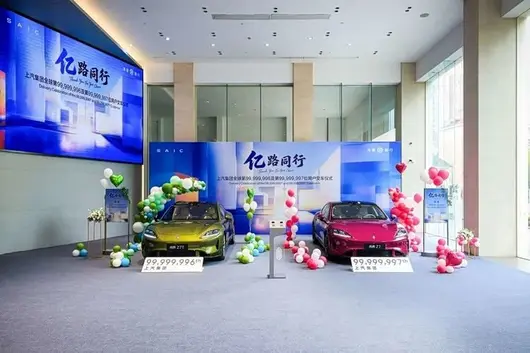

Seen plenty of car delivery ceremonies? But what about the 100-millionth user?
On May 28, 2026, SAIC Group held a "Global First 100-Millionth User Delivery Ceremony", becoming the first Chinese automotive group to exceed 100 million cumulative production and sales!
The first 100-millionth delivery vehicle is the IM LS9 Hyper, the culmination of SAIC's over 70 years of technical accumulation.

Full steer-by-wire four-wheel steering, 520-line ultra-line-of-sight LiDAR, NVIDIA Thor chip, global 800V high-voltage platform, Stellar Super Range Extender, SAIC Gold Badge Hurricane three-motor, as well as pre-embedded redundant capabilities for continuous evolution of L3 and higher-level intelligent driving, etc., are all highlights of the IM LS9 Hyper.
So are you curious who the 100-millionth user is? Momenta CEO Cao Xudong!
It is indeed SAIC's core strategic partner in the intelligent driving sector, and the results and vehicle deployments of Momenta in the intelligent driving field are undoubtedly familiar to everyone.

At the delivery site, besides the 100-millionth user, there were the 100,000,001st, 100,000,002nd...
Dominestic brands went all out: Shangjie Z7, Huajing S, Roewe M7, MG4 Semi-Solid State Battery Version, Wuling Starlight 560, Maxus eDeliver 5, Hongyan Heavy Truck, Yuejin Danaka T1, Sunwin Pure Electric Bus, Iveco Juxing EV, etc., were delivered successively, covering diverse scenarios such as personal mobility, family life, commercial operations, and logistics transport.
Joint Venture Brands centrally displayed "Joint Venture 2.0" achievements: Volkswagen ID. ERA 9X will be the global debut with Momenta R7 Reinforcement Learning World Model, achieving over 7,000 units deliveries in one month after listing; AUDI E7X plans to become Audi's first global vehicle to achieve L3-level autonomous driving landing; Buick Zhijing E7 is built on the "Xiaoyao" Super Fusion Architecture, achieving over 10,000 units deliveries in one month after listing.

100 million vehicles is a significant number, reflecting SAIC's systemic strength.
From complete vehicles, parts, mobility and services, finance, international operations to innovation technology, six major sectors, achieving a closed loop of the entire value chain.
From January to April 2026, SAIC's cumulative sales reached 1.302 million vehicles, ranking first among Chinese automakers for four consecutive months. Among them, domestic brand sales were 910,000 vehicles, accounting for nearly 70%; New energy vehicle sales were 412,000 vehicles; Overseas market sales were 459,000 vehicles, year-on-year growth of 50.2%.

Gaining the trust of 100 million users, this owes to the power of globalization. SAIC's global layout has deep foundations, owning over 100 parts production bases, over 3,000 dealer networks abroad, and having built London and other 3 major R&D innovation centers, as well as 4 manufacturing centers in Thailand, Indonesia, India, Pakistan; Anji Logistics owns 42 Ro-Ro ships of various types, 8 international routes covering Southeast Asia, Europe, Americas. Now, SAIC's products and services cover over 170 countries and regions, overseas cumulative sales exceeded 7 million vehicles.
Among them, SAIC MG has ranked first in China brand European sales for 11 consecutive years, 2025 European annual sales exceeded 300,000 vehicles, becoming the first Chinese automotive brand to exceed one million cumulative sales in Europe and the UK.

From 1955 to 2026, 100 million users, is a phased answer sheet for SAIC's over 70 years of development, and at the same time its new starting line towards the intelligent electric future "second start-up". Continuing to travel the billion-mile journey together with global users and global partners, creating a new future of beautiful mobility, this is what SAIC needs to do next!

On May 28, 2026, the "SAIC Group Global 100 Millionth User Delivery Ceremony" was held at the World Living Room in the North Bund, Shanghai. Over ten vehicle brands and nineteen models under SAIC achieved "global relay delivery", spanning mountains and seas and connecting globally. SAIC Group thereby became the first Chinese automotive group to break through 100 million in cumulative production and sales, forging a new milestone for the Chinese automotive industry.

From "Phoenix" to "IM": 100 Million Units Witness the Striving and Original Aspiration of China's Automotive Industry
In 1955, the Shanghai Internal Combustion Engine Parts Manufacturing Company was established, marking the start of Shanghai's automotive industry. In 1958, workers hammered out the first "Phoenix" sedan, achieving a "zero breakthrough" in Shanghai sedan manufacturing. For over seventy years, SAIC has witnessed and driven the entire process of China's automotive industry from nothing to something, from weak to strong: In 1983, the Santana rolled off the production line, launching joint venture cooperation; In 1997, SAIC-GM was established, creating the "Shanghai Speed" with a 23-month factory-to-road timeline; In 2006, the independent brand Roewe was born; In 2016, the world's first internet car Roewe RX5 was launched; In 2020, the premium smart electric brand IM Motors was established.


Running through this journey is the user philosophy "Understand Cars, Understand You Better" consistently upheld by SAIC. Understand cars is an ultimate pursuit of core technologies; understand you is the precise implementation of cutting-edge technology into an exquisite travel experience perceptible to users. Every leap is an advancement of "Understand Cars" capabilities and a continuous inheritance of the "Understand You" original aspiration.
The 100 Millionth Unit: IM LS9 Hyper, Condensing Over 70 Years of SAIC's Technical Achievements
The first 100 millionth delivery model, IM LS9 Hyper, is a masterpiece condensing over 70 years of SAIC's technical accumulation, ushering in a new era of the "New Three Major Components" for new energy vehicles. It is equipped with next-generation chassis technology, industry-leading full wire-controlled four-wheel steering; next-generation intelligent driving hardware, 520-line ultra-vision LiDAR + NVIDIA Thor chip, next-generation powertrain—full domain 800V high-voltage platform and Star Super Range Extender. It comprehensively pre-embedded redundant capabilities for continuous evolution towards L3 and above high-level intelligent driving. At the same time, IM LS9 Hyper is the first to equip SAIC Gold Badge Hurricane Tri-Motor, calmly joining the Performance 3-Second Club; it also co-launched "Intrinsic Security" technology with Purple Mountain Laboratory globally, extending the automobile safety boundary from "Physical Security" to "Information and System Security", a necessary security cornerstone of the AI era.
The 100 millionth user, Momenta CEO Cao Xudong, is precisely SAIC's core strategic partner in the intelligent driving field. The intelligent driving technology co-created in depth by both parties has empowered multiple independent and joint-venture brands. "Partners become car owners", not only a satisfactory delivery between manufacturer and user, but also a deep resonance among intelligent automotive ecosystem partners.

System Strength: Global Relay Delivery of SAIC's Full Brand Matrix
At the delivery ceremony scene, SAIC's full brands and full product matrix collaborated. Independent brands launched an all-out attack: Shangjie Z7, Huajing S, Roewe M7, MG4, Wuling Eksion (Starlight 560), MAXUS eDeliver 5 (Dasheng V1), Hongyan Heavy Truck, Yuejin Dasheng T1, SHAC Pure Electric Bus, IVECO Juxing EV, etc., were delivered successively, covering diverse scenarios such as personal travel, family life, commercial operations, and logistics transport. Joint-venture brands showcased their "Joint-Venture 2.0" results: Volkswagen ID. ERA 9X will be launched globally with Momenta R7 Reinforcement Learning World Model, exceeding 7,000 deliveries in one month of launch; AUDI E7X plans to become Audi's first globally launched model achieving L3 autonomous driving landing; Buick ZhiJing E7 is built on the "Xiaoyao" Super Fusion Architecture, exceeding 10,000 deliveries in one month of launch.


Starting from the Shanghai main venue, the delivery scenes continued to light up in multiple domestic cities such as Nanjing, Liuzhou, Taiyuan, and countries such as the UK, Indonesia, Singapore, creating a new narrative method for Chinese automobile brands. Behind this lies SAIC's profound foundation for global layout. SAIC is a pioneer of Chinese automotive enterprises "Going Global". Today, SAIC products and services are distributed in over 170 countries and regions, with overseas cumulative sales breaking 7 million units. SAIC MG has retained the title of European sales champion for Chinese brands for 11 consecutive years. In 2025, European annual sales broke 300,000 units, becoming the first Chinese automobile brand to exceed one million in cumulative sales in Europe and the UK. In 2025, SAIC released the overseas "Glocal Strategy" (Global + Local), accelerating the transition from "Product Going Global" to "Value Chain Going Global", letting "Chinese Intelligent Manufacturing" further go global.
100 million units is a phased answer of SAIC's 70 years of development, and is more importantly a new starting line for SAIC's "Second Startup" towards the intelligent and electric future.

1. Total number of electric vehicle charging infrastructure (charging guns) in China exceeds 21 million

According to data from the national charging facility monitoring and service platform, as of the end of April 2026, the total number of electric vehicle charging infrastructure (charging guns) in China reached 21.955 million, a year-on-year increase of 47.4%. Among them, public charging infrastructure (charging guns) totaled 4.907 million, a year-on-year increase of 29.6%, with a total rated power of 237 million kilowatts and an average power of approximately 48.38 kilowatts; private charging infrastructure (charging guns) totaled 17.048 million, a year-on-year increase of 53.5%, with a declared electricity capacity of 149 million kilovolt-amperes.
2. Concerns over the overweight trend in new energy vehicles

When "large refrigerators, large TVs, and large sofas" become standard equipment, when new energy vehicle companies use "upgraded dimensions" as a selling point, Chinese consumers seem to have already accepted a fact: new cars are getting bigger and heavier. MIIT data shows that in 2024, the average curb weight of new passenger cars in China reached 1,704 kilograms, while in 2012 this figure was only 1,312 kilograms. In just 12 years, an ordinary family car has been forced to "gain" nearly 400 kilograms in weight. What is more worrying is that the speed of vehicle weight gain is accelerating: the weight gain from 2020 to 2024 exceeds the total weight gain from 2012 to 2020. This is even more pronounced in new energy vehicles, with average curb weights often exceeding 2 tons. In 2024, Li Auto and Seres both exceeded 2.4 tons, Nio exceeded 2.2 tons, and XPeng exceeded 2 tons.
Although 2025 latest data has not yet been released, looking at the emerging trends, the "weight gain" of new cars is not optimistic. Recently, two Zunjie models landed in the MIIT, both with total mass exceeding 3 tons, with the Zunjie V800 reaching 3.8 tons—heavier than a light truck. "This change can be attributed to the expansion of body dimensions caused by consumers' pursuit of large SUVs, the battery weight expansion driven by the pursuit of long range in new energy vehicles, and the excessive stacking of configurations such as refrigerators, TVs, and multi-functional ultra-luxury seats," Professor Han Zhiyu of the School of Automotive Studies at Tongji University stated in an interview with the media. With the rapid improvement of new energy vehicle penetration rates, the phenomenon of automotive "obesity" is becoming increasingly prominent. During interviews, the reporter found that industry insiders generally call for regulatory measures on the phenomenon of vehicle "weight gain". Multiple interviewees confirmed that relevant regulatory departments have begun to discuss a reform of the automobile tax system based on vehicle weight.
3. Japanese cars hit hard by the US

Once the financial reports came out, Japanese car manufacturers fell silent. Under the combined influence of multiple unfavorable factors, profits for the seven major Japanese car companies—Toyota, Honda, Nissan, Suzuki, Mazda, Subaru, and Mitsubishi—shrunk significantly. Net profit for the 2026 fiscal year (April 2026-March 2027) is expected to be half of that of the 2023 fiscal year (April 2023-March 2024), which was the historical peak. Even Toyota, which once made a fortune in the global auto market, is experiencing a difficult situation of declining profits for consecutive years. Sales increased by 5.5%, but net profit fell by 19.2%, and operating profit dropped by 21.5%. Honda's operating loss reached 414.3 billion yen, marking the first annual loss in nearly 70 years since listing.
Interestingly, the two core external factors leading to the significant profit shrinkage of Japanese car companies are related to the United States. First, the US-Iran conflict caused shipping blockage in the Strait of Hormuz. Second, the high tariffs imposed by the US Trump government acted like two shackles, squeezing from both sides and continuously pressuring, tightly locking down the global supply chain and profit system of Japanese automobiles. On one side is the brute-force harvesting of trade protectionism, on the other is the indiscriminate impact of the geopolitical storm. Japanese car companies are struggling to move within these two whirlwinds.
4. SAIC Group overall vehicle production and sales about to break 100 million

SAIC Group announced that at the end of this month, it will welcome the delivery of the 100 millionth global user, becoming the first automotive group in China's automotive history to accumulate production and sales exceeding 100 million vehicles. The predecessor of SAIC can be traced back to the Shanghai Internal Combustion Engine Parts Manufacturing Company in 1955. The first Phoenix brand sedan was produced in 1958, the first domestic Santana was assembled in 1983, and the world's first Internet car was launched in 2015. Currently, SAIC's products and services cover over 170 countries and regions, with cumulative overseas deliveries exceeding 7 million vehicles. It has built four major manufacturing and production centers in Thailand, Indonesia, India, and Pakistan, as well as three major research and innovation centers including London.
5. 2026 Model Sea Lion 06 DM-i Starts at 129,900 Yuan

The 2026 BYD Sea Lion 06 DM-i has officially launched. The official guide price for the 4 configurations is 129,900 to 159,900 yuan. The new model made adjustments to appearance and interior details, adding Luguang Silver exterior and Muse Blue interior color schemes, making the style more minimalist and fashionable. In terms of comfort configuration, features such as seat massage, passenger leg rest, and in-car fragrance have been added, further optimizing the driving experience.
Intelligent configuration also advances in sync, supporting the optional selection of God's Eye B Auxiliary Driving Laser Version, providing urban leading assistance, highway leading assistance, and full-scenario detour yielding functions. In terms of chassis, the YunNian-C Intelligent Damping Control System has been added, with a new road surface preview function. Range capability is also a highlight of this model change, with CLTC pure electric range breaking through a maximum of 300 km.
6. Suspected Leapmotor C16 Long Wheelbase Version Spy Photos Exposed

Recently, a set of spy photos of a suspected Leapmotor C16 Long Wheelbase Version road test were released on the internet. The test vehicle was wrapped in tight camouflage stickers, but the body outline and some details already revealed many clues. The front face design is consistent with the new C16, the wheelbase and third-row body area are significantly lengthened, and the rear overhang size is greatly increased, effectively improving third-row seating space.
Coinciding with Leapmotor Auto about to launch the new C16, industry insiders speculate that the possibility of launching a long-wheelbase version simultaneously is relatively high. Although the spy photos did not display interior details, combining Leapmotor C16's product positioning and new model planning, the long-wheelbase version is expected to continue the core configuration of the current model and may further improve comfort.
7. Ferrari's First Electric Vehicle Debut

Amidst European and American car companies reducing their EV transformation efforts, luxury sports car brand Ferrari, the European company with the highest market value, officially launched its first pure electric vehicle — Luce (meaning "Light" in Italian), with a starting price of 550,000 Euros, approximately 4.34 million RMB. To boost market expectations, Ferrari specially invited Apple legendary designer Jonathan Ive and his founded LoveFrom design agency to participate in the design. Without unexpected issues, this car is covered with iPhone's iconic Corning Glass, and the entire upper part of the body and interior such as the central control appear with large-area glass elements.
This car is also Ferrari's first 5-seat model, adopting a hatchback body design. The interior retains the traditional steering wheel, knobs, and switches, as well as the central console characterized by glass design. Although the whole vehicle is over 5 meters long, this electric vehicle can still complete 0 to 60 mph acceleration in less than 2.5 seconds, with a top speed exceeding 192 mph. As a sacrifice for performance, even with the 122 kWh battery pack equipped with 800V electrical architecture, the Luce's full-charge range is only 330 miles.

[CNMO Tech News] On May 22, SAIC Group announced that it will welcome the delivery to its 100 millionth global user by the end of this month, becoming the first automotive group in the history of China's automotive industry to achieve cumulative production and sales exceeding 100 million vehicles.

SAIC Group
According to CNMO Tech, in 1955, Shanghai Internal Combustion Engine Parts Manufacturing Company was established; in 1958, the first Phoenix sedan was successfully prototype-made; in 1983, riding the wind of reform and opening up, SAIC pioneered industry joint venture cooperation, and the first domestic Santana was assembled successfully; in 2015, SAIC pioneered the creation of the world's first internet-connected car. For over seventy years, SAIC and numerous Chinese automakers have jointly witnessed and promoted the great journey of China's automotive industry from nothing to something, from weakness to strength, and from "following and learning" to "innovation and leadership".

SAIC is the earliest and largest Chinese automotive enterprise to "go global". In 2001, SAIC achieved passenger vehicle exports for the first time; now its products and services cover over 170 countries and regions globally, with overseas cumulative deliveries exceeding 7 million vehicles. Overseas, SAIC owns over 100 parts production bases, over 3000 dealer networks, has built 3 major R&D innovation centers including London, as well as 4 production and manufacturing centers in Thailand, Indonesia, India, Pakistan, and has established China's first and globally leading self-operated vehicle logistics fleet.
In 2025, SAIC launched the overseas "Glocal Strategy" — "Global + Local" combination strategy. Relying on profound accumulation in electric intelligent connected technology, SAIC will actively create new overseas models including SUVs, sedans, MPVs, pickups. Models equipped with the new HEV hybrid power system will cover mainstream global market segments. Disruptive technologies such as solid-state batteries will also gradually achieve implementation and application, further building a global automobile brand and localized system ecosystem.
SAIC Group stated that 100 million vehicles is a glorious milestone and even more so a new starting point for progress. Standing at this new starting point, SAIC will continue to walk the 100-million journey together with global users, jointly opening the next brilliant chapter of China's automotive industry.

The first in China, SAIC Group's cumulative production and sales exceed 100 million vehicles! On May 28, at the Shanghai North Bund World Living Room, SAIC Group took this place as the origin to launch a global-reaching "First 100 Millionth User" vehicle delivery ceremony, becoming the first automotive group in Chinese automotive history to break 100 million cumulative production and sales. As a global leader in new energy commercial vehicles, SAIC Commercial Vehicles, with Maxus, Keya, IVECO, Hongyan, and Sunwin five brands, completed the global delivery relay from the 100,000,009th to the 100,000,013th vehicle, jointly creating a milestone in the Chinese automotive industry and engraving a historical coordinate for the Chinese commercial vehicle industry.
Behind the 100 million vehicles lies the long-term accumulation and explosive growth of SAIC's 70-plus years of deep cultivation, and it is also a vivid miniature of Chinese commercial vehicles moving from scale leadership to value leadership. Relying on the group's global resource empowerment, SAIC Commercial Vehicles has built the industry's most complete commercial vehicle matrix covering heavy trucks, buses, light trucks, light vans, pickups, MPVs, and RVs, continuously leading the Chinese commercial vehicle industry with a 35% new energy penetration rate and seizing opportunities in the global carbon neutrality wave. With reliable quality, cutting-edge technology, and a complete ecosystem, products are sold in over 100 countries and regions, winning deep trust from top global partners such as DHL, becoming the core force for Chinese commercial vehicles going global, moving in, and moving up.
Continuously leading Chinese brands to go global, Maxus drives global green logistics upgrade with benchmark strength. In Singapore, Maxus delivered eDeliver 5 (domestic Dana V1) to international logistics giant DHL, welcoming the group's 100,000,009th user. This is another milestone moment since both parties joined hands in 2017. Years of deep cultivation, Maxus not only won the largest procurement order of Chinese brands in DHL's European region, but also firmly stayed in its list of preferred partners for green transformation, with cooperation footprints covering Europe, America, Asia, and Oceania. Nowadays, relying on leading product strength and global strategy, Maxus light vans and high-end pickup export volumes firmly rank first in China, building five 10,000-unit level core markets; won C-NCAP, Euro NCAP, ANCAP global three major five-star safety certifications, continuously leading exports in high-end markets such as Singapore, Europe, Australia, and successfully joined the preferred cooperation camp of global top enterprises such as FedEx, DPD, JD.com, SF Express, Cainiao Logistics, with global strength to strongly expand the 100 million user map.


Based on the domestic market, the four brands deeply cultivate two major tracks of livelihood and infrastructure with green capacity. Keya delivered Dana T1 to Dizhantie in Yangzhou, Jiangsu, relying on high load-bearing, long range, and intelligent connectivity advantages to cover green urban distribution scenarios. In 2025, Keya delivered nearly 10,000 units cumulatively to Dizhantie, unblocking urban-rural logistics "capillaries". Sunwin delivered 10-series low-floor pure electric buses in Shanghai, empowering urban public transport smart upgrade with zero-carbon travel. Hongyan delivered i Jieshi dump trucks in Taiyuan, Shanxi, calmly mastering complex mountain operating conditions with military foundation and powerful performance, deeply protecting the construction of a strong country in infrastructure. IVECO delivered Juxing EV in Luoyang, Henan, 100-degree large capacity battery solved the mountain operation range problem, setting a new benchmark for green passenger transport. The four brands relay delivery, welcomed the group's 100,000,010 to 100,000,013th users, jointly casting a 100-million level milestone with hardcore strength.


From domestic core cities to key overseas markets, from logistics delivery and infrastructure engineering to public travel and tourist passenger transport, every delivery of the five brands is a vivid practice of SAIC Commercial Vehicles "Hand in Hand with Chinese Power, Driving the World's Pulse". 100 million users are not the end point, but a new starting point of trust. Facing the future, SAIC Commercial Vehicles will continue to take technological innovation as the core, user value as the guide, lead green transformation, deepen global layout, and write the brilliant chapter of the Chinese commercial vehicle industry on the new journey.
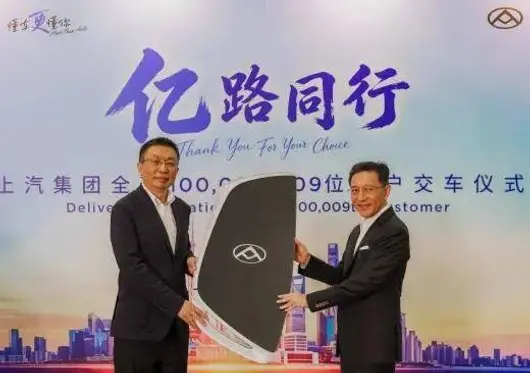

On May 28, 2026, SAIC Group hosted the "Delivery Ceremony for the Global 100 Millionth User" at the North Bund World Living Room in Shanghai, officially becoming the first Chinese automotive group to cumulatively exceed 100 million vehicles in production and sales, setting a new milestone for China's automotive industry.

From workers hammering out the first "Phoenix" sedan in 1958 to today's presence of over a dozen brands with products distributed in more than 170 countries and regions, SAIC has personally experienced and driven the entire process of China's automotive industry from weakness to strength. Running through this journey is the user philosophy of "Knows Cars, Knows You Better" — pursuing excellence in core technology while making cutting-edge technology tangible through enjoyable mobility experiences.

Behind the 100 million vehicles lies SAIC's full value chain closed loop covering six sectors: complete vehicles, parts, mobility, finance, international operations, and innovative technology. From January to April 2026, SAIC cumulatively sold 1.302 million units, ranking first among Chinese automakers for four consecutive months. Among them, the proportion of self-owned brands was nearly 70%. New energy vehicle sales reached 412,000 units, and overseas market sales reached 459,000 units, a year-on-year increase of 50.2%.

At the delivery ceremony, self-owned brands and joint-venture brands collaborated: Shangjie Z7, Roewe M7, MG4 Semi-solid Battery Edition, Wuling Starlight 560, etc., covering multiple scenarios such as personal mobility and commercial operations. Volkswagen ID. ERA 9X deliveries exceeded 7,000 units within a month of launch, and Buick Zhijing E7 deliveries surpassed 10,000 units. Delivery scenes extended from Shanghai to Nanjing, Liuzhou, as well as countries like the UK and Indonesia, demonstrating global layout strength. SAIC has over 3,000 dealer networks overseas, 4 production and manufacturing centers. Anji Logistics operates 42 Ro-Ro vessels and 8 international routes. SAIC MG has ranked first in European sales among Chinese brands for 11 consecutive years, with European annual sales exceeding 300,000 units in 2025. The overseas "Glocal Strategy" released in 2025 is accelerating the shift from "Product Going Overseas" to "Value Chain Going Overseas".

From Luo Zhenyu as the Huajing S Experience Officer, to former national team player Yang Chen choosing the ID. ERA 9X, to real user stories of charity bloggers and logistics business owners, the warmth of "Knows Cars, Knows You Better" is interpreted. 100 million vehicles is a phased answer for SAIC over seven decades, and also a new starting point for "Second Entrepreneurial Venture" towards the intelligent and electrified future. SAIC will continue to journey together with global users and partners, co-creating a new future of beautiful mobility.
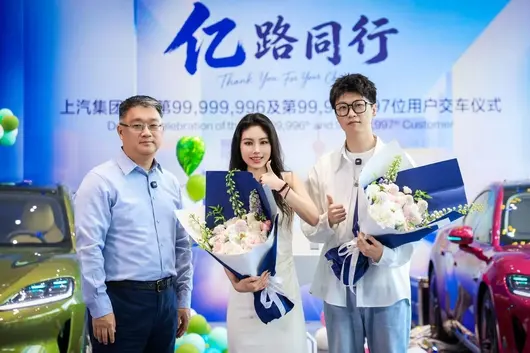


On May 28, 2026, with the formal delivery of the key to an IM LS9 Hyper model into the user's hands, the Chinese automotive industry welcomed an important milestone in its development process — SAIC Group's cumulative production and sales officially broke through 100 million vehicles, becoming the first domestic automotive group to achieve this level.
Just a few days later, SAIC Group released May sales data: single-month sales of 349,000 vehicles, cumulative Jan-May sales of 1.651 million vehicles, continuing to lead China's automotive industry. Independent brand share broke 70% for the first time, new energy vehicles surged 46.5%, and overseas sales surged 45.9%. The historical milestone and current leading trends together outline the complete picture of SAIC from past to present.

This is not a simple stacking of numbers, but an industrial narrative spanning more than 70 years: SAIC's growth trajectory has always resonated with China's industrial modernization process.
Relying on Shanghai, a century-old open port, and leveraging the open genes of the Huangpu River estuary, SAIC walked a unique advanced path for China's leading auto companies. Its development process can be divided into three stages: knowing the world, integrating into the world, and changing the world. This is not only the growth lineage of a company, but also accurately outlines the identity leap of China's automotive industry in the global landscape — from marginal participants to active integrators, and then to rule definer.
Knowing the World: Building a Foundation with Openness, Constructing the Underlying System of China's Automotive Industry
The beginning of China's modern automotive industry, core is a journey of learning outward and benchmarking the world. As early as the 1950s, China's automotive industry was still in a blank stage, Shanghai workers hand-built the first Phoenix sedan. Although the process was simple and capacity was limited, it sowed the seed of independent car manufacturing in China, entrusting the original intention of local manufacturing breakthroughs. And the real modernization transformation was achieved through systematic openness after reform and opening-up.

Unlike the shallow development model of "import and assemble, simple replication" in the early industry, SAIC took joint ventures and cooperation as a key opportunity to build a complete industrial ecosystem and solidify local car manufacturing capabilities from the beginning.
In 1983, the first Volkswagen Santana rolled off the line in Shanghai. Initially, the localization rate was less than 3%, almost relying entirely on imported knock-down kits. But SAIC was not satisfied with this. Under the state's clear requirement to "never settle for substitutes", it pushed to establish a rigorous parts certification system, forcing local suppliers to improve process standards.
Within a short few years, the Santana localization rate jumped to over 90%, directly driving hundreds of local suppliers to complete technical iteration and quality upgrade, successfully building the first domestic automotive supply chain system conforming to international standards, and completely ending the backward and scattered development situation of China's sedan industry.

This thought of "promote reform with openness, promote capability with cooperation" also became the core methodology of SAIC's steady development over decades. Whether establishing a joint venture with GM in 1997 or integrating Wuling to form the "China-Outside-China" model in 2002, SAIC always emphasized "initiative in cooperation": not passively accepting foreign technology input, but actively participating in product definition, manufacturing process, and localization adaptation.
For example, the Wuling Sunshine and Hongguang models launched by SAIC-GM-Wuling were not simple copies of foreign platforms, but were redesigned based on the actual needs of Chinese urban and rural users. Finally, relying on high adaptability and high practicality, they established themselves in the market, achieving the brand reputation of "What people need, Wuling makes".
The core value of this stage lies in SAIC laying the foundation of "system capability" for China's automotive industry. It proved that openness is the means, growth is the core; technology introduction is the starting point, independent self-sustaining is the ultimate goal.
Through deeply embedding into the global division of labor system, SAIC not only thoroughly understood complete vehicle manufacturing technology but also mastered the complete operational logic of large-scale complex industrial industries, covering R&D, procurement, production, and quality control across the full chain. This solid system capability also became the underlying support for SAIC's subsequent independent breakthrough and global layout.
Integrating into the World: Independent Breakthrough from Borrowing Ships to Go Global to Brand Globalization
Entering the 21st century, the global automotive industry landscape began to loosen, emerging markets rose, and the waves of electrification and intelligence first appeared. SAIC then faced a critical choice: continue to rely on joint venture dividends, or actively build independent brands? The answer was quickly revealed.
In 2004, SAIC started the Rover project. Although it did not complete the overall acquisition of the enterprise, it successfully obtained core car-making intellectual property, and launched the Roewe brand based on this foundation. This layout was regarded by the industry as a landmark event of "technological self-awareness" in China's automotive industry. Since then, SAIC completely got rid of foreign technology dependency, possessed its own product definition, technical iteration, and brand shaping capabilities, and was no longer the localization OEM of international car companies.
The return of the century-old British brand MG further improved SAIC's autonomous global layout. SAIC endowed MG with a brand new positioning of younger and electrification, making it the main brand for going global, thus starting a new stage of China's automotive deeply cultivating global mainstream markets.
Early China car companies going global mostly focused on trial in low-end markets and inventory clearance, lacking long-term planning. SAIC, starting from 2010, completely broke this model, elevating going global to a core strategy, no longer limited to developing country markets, fully advancing into Europe, Australia & New Zealand and other global mainstream mature markets, competing directly with international first-tier brands.
Market data was enough to prove its strength: In 2019, MG UK sales surpassed Honda and Mazda; in 2022, it joined the top ten in Europe's pure electric market; in 2025, one out of every three EV models sold in the European market came from MG.
Behind the bright results is the support of hardcore product power. MG4, relying on a pure rear-drive platform, high safety battery technology, and localization smart cockpit configuration, precisely fit European consumer demands, successfully established itself in the global mainstream new energy market.

More importantly, SAIC's globalization is not a single product export, but a complete systematic output. Currently, SAIC has already built modern production bases in countries such as Thailand, Indonesia, India, Mexico, arranged overseas R&D centers in London, Silicon Valley, Tel Aviv, and relied on SAIC Logistics' self-operated RoRo fleet to build an overseas industrial ecosystem integrating "R&D, production, sales, service, logistics". At the same time, adhering to global localization operations, optimize product configurations for different regional markets, such as local voice assistants exclusive to the India market, Brazil version MG ZS EV optimized tropical climate battery thermal management system, winning global user recognition through deep adaptation.
In this development stage, SAIC completed a major leap from "Made in China export" to "Independent brand globalization". It proved that Chinese car companies do not rely on low-price involution, but only by technical differentiation, ecosystem synergy capabilities, and refined localization operations, can they establish themselves in global mainstream markets, and also pave a new globalization path for China's automotive industry different from Japan and Korea car companies.
Changing the World: Hundred-Million Level Volume Starts a New Chapter, From Industry Follower to Rule Leader
The achievement of 100 million vehicles is, on the surface, a victory of scale, but in substance, a comprehensive leap of system competitiveness. Today's SAIC is no longer the student who needs to look up to international giants, but a leader who can reverse empower global partners and define technical directions.
The most significant change has occurred in the technical field. In the past, joint venture enterprises were the main channel for technology input; now, SAIC's independent innovation results feed back to joint venture brands.

In 2024, SAIC signed a deep cooperation agreement with Audi, not only jointly developing new cars but also setting up an Audi Innovation Technology Center in Shanghai, focusing on smart cockpits, electronic and electrical architecture, and advanced intelligent driving. This means that future Audi models will deeply integrate Chinese R&D technical modules. Similarly, Volkswagen ID.ERA 9X premiered the Momenta R7 World Model, and Audi E7X will become the world's first L3 level autonomous driving production model — these technical foundations all originate from SAIC and its ecosystem partners.
In May, SAIC's joint venture new energy also welcomed a strong recovery, joint venture new energy strong recovery in May. SAIC-GM new energy vehicles sold 13,000 units in May, soaring 75% year-on-year, with Zhijing E7 deliveries breaking 10,000 in the first month of listing. SAIC Volkswagen new energy vehicles sales reached nearly 10,000 units in May, increasing by 34.3% year-on-year; the newly listed ID.ERA 9X cumulative delivery exceeded 7,000 units; at the Greater Bay Area Auto Show at the end of May, Tiguan L ePro, Passat ePro equipped with brand new generation "Golden Super Hybrid" technology, and Audi Smart Performance Flagship SUV AUDI E7X were listed continuously.
In the new energy and intelligence track, SAIC's independent brands are even more at the forefront. In 2016, Roewe RX5, as the world's first Internet car, pioneered the trend of "software defined cars"; in 2024, "Zero-Burn Magic Cube Battery" won the National Science and Technology Progress Second Prize, solving the high-nickel battery thermal runaway problem; in 2025, MG became the world's first mass-produced semi-solid state battery car brand; in 2026, IM LS9 Hyper equipped with full steer-by-wire, Thor Chip, and Star Super Extended Range System, representing the highest level of China's high-end intelligent electric vehicles.
These are not isolated technical breakthroughs, but a complete technical stack covering batteries, electric drives, chips, operating systems, and AI large models, which are technical barriers difficult for opponents to copy.
Besides technology leading, SAIC's "Glocal" Global Localization Strategy is also reshaping operational rules in the global automotive industry. On the basis of unified global technical platforms, promoting localization agile iteration by adapting to local conditions, this development concept has been recognized and referenced by many multinational car companies. At the same time, SAIC built a complete industrial ecosystem covering intelligent driving, core computing power, and hydrogen energy by laying out high-quality enterprises such as Momenta, Horizon, and Jieqing Technology, forming a dual competitive advantage of "Complete vehicle manufacturing + Core ecosystem".

Standing on a brand new starting point of 100 million vehicles, SAIC will fully advance from "Scale leading" to "Ecosystem leading", thoroughly saying goodbye to extensive scale growth, focusing on three major core directions: high-quality going global, high-value brands, and high-resilience supply chain. The company officially announced that it will invest 300 billion yuan in R&D funds in the next five years, with 70% of resources key investing in electrification, intelligence, and internationalization core tracks. This is not only the enterprise's strategic choice, but also a firm bet on the future direction of China's automobiles.
Conclusion: 100 Million Vehicle Journey, Writing the Era's Answer of Made in China
From hand hammering by the bank of Huangpu River to user delivery in over 170 countries globally; from the localization breakthrough of Santana to the technology leading of IM high-end intelligent electric vehicles, SAIC's 100 million vehicle journey is the microcosm of China's automobile from weakness to strength.

It tells us: True industrial rise does not lie in temporary scale explosion, but in whether it can build sustainable system capability; True globalization does not lie in how many cars are sold, but in whether it can export technology, standards, and values; True independent innovation does not lie in working in isolation, but in integrating global resources with an open mindset, and then reconstructing value chains with local wisdom.
Today, standing on the new starting point of 100 million vehicles, SAIC's mission has gone beyond the enterprise itself. What it represents is the possibility of Made in China from "Following run" to "Parallel run" to "Leading run". This 100 million vehicles is also a powerful answer to the historical question of "Can China build a car powerhouse".
The future has come. This time, China is no longer just the world's factory, but the definer of future mobility. And SAIC will also continuously rely on technical innovation and global layout, continuing to write a brand new chapter belonging to China's automobiles.
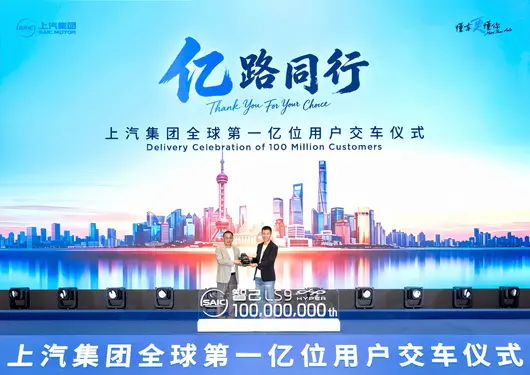

China's first automobile group to surpass 100 million cumulative production and sales has been born!
Recently, SAIC Group welcomed its "Global 100 Millionth User", and SAIC Group thereby became the first Chinese automobile group to surpass 100 million cumulative production and sales, casting a new milestone for the Chinese automobile industry.
To celebrate this important historical moment, SAIC Group held a grand "Global 100 Millionth User Car Handover Ceremony" on May 28 at the Shanghai North Bund World Living Room. More than 10 complete vehicle brands and 19 car models under SAIC carried out "Global Relay Delivery", crossing mountains and seas, spanning continents, and connecting the globe. On that day, a grand car handover ceremony was also held simultaneously at the Chengdu Buick 4S Store.

In 1955, the Shanghai Internal Combustion Engine Parts Manufacturing Company was established, and the Shanghai Automotive Industry started from here. In 1958, workers forged the first "Phoenix Brand" sedan with hammers, achieving a "zero breakthrough" in Shanghai sedan manufacturing. Over the past 70 years, SAIC has witnessed and driven the entire process of the Chinese automotive industry developing from nothing to something, from weak to strong: In 1983, the Santana rolled out, opening up joint cooperation; in 1997, Shanghai GM was established, creating the "Shanghai Speed" of building a factory and producing a vehicle in 23 months; in 2006, the independent brand Roewe was born; in 2016, the world's first Internet car Roewe RX5 was launched; in 2020, the high-end smart electric brand IM Motors was established.
Running through this journey is the user philosophy that SAIC has always adhered to: "Know Cars, Understand You Better". From the Santana localization community to Joint Venture 2.0 technology co-creation, from Internet cars to full control chassis, solid-state/semi-solid-state batteries, AI Large Models on board - every leap is the advancement of "Know Cars" capability, and the inheritance of "Understand You Better" original intention.

The 100 Millionth vehicle delivery model, IM LS9 Hyper, is the comprehensive work of SAIC's technology accumulation over 70 years, opening a new era of "New Three Major Components" for new energy vehicles. The 100 Millionth user, Cao Xudong, CEO of Momenta, is precisely SAIC's core strategic partner in the intelligent driving field. The intelligent driving technology co-created in depth by both sides has already empowered multiple independent and joint venture brands. "Partner becomes Owner" is not only a satisfied delivery between manufacturer and user, but also a deep resonance between intelligent car ecosystem partners.
Behind the 100 million vehicles is the full value chain closed loop of SAIC covering six sectors: complete vehicles, parts, mobility and services, finance, international business, and innovative technology. In January-April 2026, SAIC's cumulative sales reached 1.302 million vehicles, ranking as China's top car manufacturer sales champion for four consecutive months. Among them, independent brand sales were 910,000 vehicles, accounting for nearly 70%; new energy vehicle sales were 412,000 vehicles; overseas sales were 459,000 vehicles, surging 50.2% year-on-year.
At the delivery ceremony site, SAIC's full brands and full product matrix coordinated to exert force. Independent brands launched in full force: Shangjie Z7, Huajing S, Roewe M7, MG4 Semi-solid Battery Version, Wuling Starlight 560, MAXUS eDeliver5, Hongyan Heavy Truck, Yuejin Dana T1, Sunwin Pure Electric Bus, Iveco Juxing EV, etc., were successively delivered, covering diverse scenarios such as personal travel, family life, commercial operations, and logistics transportation.
Joint venture brands showcased results of "Joint Venture 2.0": Volkswagen ID. ERA 9X will globally premiere equipped with Momenta R7 Reinforcement Learning World Model; after one month on the market, deliveries broke 7,000 units; Audi E7X plans to become Audi's first global model to achieve L3 level autonomous driving implementation; Buick Zhijing E7 is built based on the "Xiaoyao" Super Fusion Architecture, and deliveries broke 10,000 units one month after launch.

From the Shanghai main venue, the delivery scenes were continuously lit up in Nanjing, Liuzhou, Taiyuan and other domestic cities, and in countries like the UK, Indonesia, Singapore. Behind this is SAIC's deep foundation of global layout.
SAIC is a pioneer of Chinese automotive enterprises "Going Global": Overseas, it owns over 100 parts production bases and over 3,000 dealer networks, and has built 3 R&D Innovation Centers and 4 Production Centers; Anji Logistics owns 42 ro-ro ships of various types, with 8 international routes covering Southeast Asia, Europe, and the Americas.
Nowadays, SAIC's products and services are spread across over 170 countries and regions, with overseas cumulative sales surpassing 7 million vehicles. SAIC MG has ranked as the European sales champion of Chinese brands for 11 consecutive years; in 2025, its European annual sales surpassed 300,000 vehicles, becoming the first Chinese car brand with cumulative sales breaking 1 million in Europe and the UK.
In 2025, SAIC launched the overseas "Glocal Strategy" (Global + Local), accelerating the shift from "Product Going Global" to "Value Chain Going Global", letting "Chinese Smart Manufacturing" further reach the world.

The ultimate focal point of "Know Cars, Understand You Better" is the travel life of every real user. Luo Zhenyu, founder of "Dedao APP", as the No. 001 Experience Officer of Huajing S, went from praising Huawei Qiankun Intelligent Driving in the New Year's Eve Speech to entering the factory to witness the roll-out; former German national team player Yang Chen chose ID. ERA 9X, because its Golden Extended Range and Long-termism coincided; after Cao Kailiang ordered a car for his whole family, his idol Jay Chou happened to become the spokesperson for the Buick MPV Family; charity blogger Liu Jia has given haircuts and companionship to left-behind children in Guangxi mountainous areas for five consecutive years; Buick aided immediately when contacted, and he was moved by the Buick Zhijing E7's "Full Score Cabin". From self-media bloggers to village secretaries, from charity guardians to logistics enterprises - every user is a microcosm of real life, which is the most vivid interpretation of "Know Cars, Understand You Better".
100 million vehicles is a phased report card of SAIC's 70-year development, and even more a brand new starting line for SAIC's "Second Entrepreneurship" facing the future of Smart Electric. In 2014, SAIC actively implemented the important directive that "Developing new energy vehicles is the only way for China to move from a major automotive country to a strong automotive power", leading the comprehensive transformation. Twelve years later, from being "Leading" in the Smart Electric Transformation to "All Galloping" in Independent & Joint, Passenger & Commercial, Domestic & Overseas, SAIC will continuously take "Know Cars, Understand You Better" as the user philosophy, making technological innovation truly benefit every user.
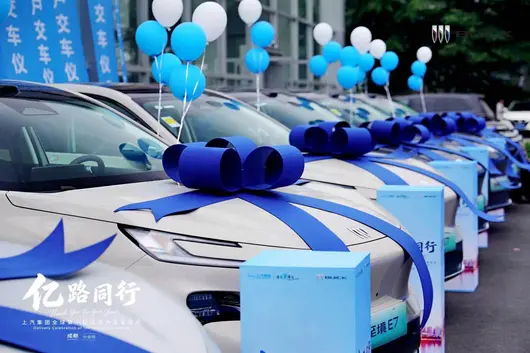
© 2024 Bitauto.com. All Rights Reserved.
Bitauto (www.yiche.com and www.bitauto.com) is one of the most visited automotive websites in China. We provide detailed info on Chinese car brands available in your area. Please note that the information provided on this website is based on publicly available data and is for reference only. It may not be fully updated or accurate at all times.

Help us improve our website


