

HomeToyota Camry

Search History
Popular Searches
Dealer Login / Sign Up

虽然当下台风“巴威”已经减弱,但仍将对赛事带来不确定因素。
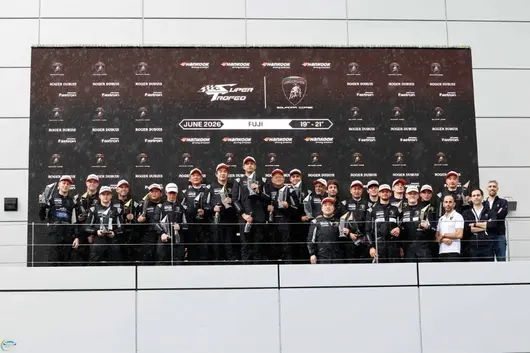
7月16日至18日,2026赛季兰博基尼Super Trofeo亚洲挑战赛第四站将重返韩国麟蹄Speedium赛道。这条全长3.908公里、以高速流畅布局和剧烈海拔起伏著称的赛道,因其极具挑战性的特性被誉为“亚洲的斯帕”,而减弱后的台风“巴威”预计也会带来降雨和强风,继而增加了赛事的可观赏性。
本周末,三位入选2026赛季Super Trofeo Junior青年车手培养计划的新星——Vincenzo Sospiri Racing车队的Liam Sceats(20岁,新西兰)、Gustaw Wiśniewski(18岁,波兰)以及兰博基尼Bundang by Racegraph车队的Titus Sherlock(21岁)——将在此迎来全新考验。该计划隶属于兰博基尼Squadra Corse青年车手发展项目,今年已进入第13个年头,本赛季共有17位车手入选。

目前,Wiśniewski与Sceats搭档位居PRO组积分榜第二,而Sherlock与中国车手黎智聪的组合则位列第四。他们的共同目标,是追击目前以20分优势领跑积分榜的Batmobile Racing车队英国车手William Tregurtha。这位同样26岁的年轻人在赛季揭幕战马来西亚站以单人身份首次亮相便夺得PRO组冠军,自第二站起与摩纳哥名将Jonathan Cecotto搭档后,更是在中国宁波和日本富士站连赢四场全场冠军,势头无人可挡。
值得关注的是,Cecotto虽缺席揭幕战,但凭借近四场的全胜表现,目前已迅速攀升至PRO组积分榜前列,距Sceats与Wiśniewski仅差7分。而他在2025赛季曾与队友Gavin Huang在麟蹄Speedium取得一冠一季的成绩,这段宝贵经验或将成为本周末打破现有格局的关键变量。

麟蹄赛道20个弯角与剧烈起伏对赛车动力输出与刹车稳定性提出严苛要求——兰博基尼Huracán Super Trofeo EVO2搭载的5.2升V10自然吸气发动机在此需兼顾高速弯中的牵引力与重刹区间的耐久性,而后轮转向系统与可调防倾杆的配合,将在连续复合弯中决定车手能否以更激进的线路完成超越。赛道特性与天气变数叠加,极可能放大新老车手之间的差距。

PRO组还将迎来一位全新面孔——23岁的美国车手Barrett Wolfe将在兰博基尼Busan by Racegraph车队主场赛事中以单人身份出战。他曾获美国F4锦标赛领奖台,本赛季征战美洲区区域方程式锦标赛,并在2025赛季大洋洲区域方程式锦标赛中与现Racing Bulls F1车队车手Arvid Lindblad等优秀对手同场竞技。此次亚洲首秀能否在“亚洲斯帕”一鸣惊人,同样令人期待。

PRO-AM组方面,Vincenzo Sospiri Racing车队的Chris van der Drift与Todd Kingsford自马来西亚站首次搭档以来,已豪取六战全胜,以49分巨大优势领跑积分榜。然而麟蹄多变的山地气候与复杂赛道布局,或将成为他们不败金身的最大威胁。目前排名第二的Batmobile Racing车队马来西亚组合Putera Mu’azzam与Kumar Prabakaran自宁波站加入后连续登上领奖台,正伺机打破统治。本土车队SQDA-GRIT Motorsport则派出Yoon Jeon与Kevin Lee出战PRO-AM组,其中Yoon Jeon在富士站曾连续两回合登上AM组领奖台,主场作战无疑增添变数。
AM组方面,True Visions Motorsports Thailand车手Suttiluck Buncharoen自雪邦第二回合登台后,已在宁波和富士豪取四连胜,并两度跻身全场前五。但KAM LUNG Racing车手Bertram Lau始终紧咬不放,目前仅落后18分,冠军归属悬念丛生。

兰博基尼杯方面,Siamgas Corse车队的Supachai Weeraborwornpong本赛季仅有一场失手,但兰博基尼Bundang by Racegraph组合Gerald Goh与Terence Tse仅落后16分,兰博基尼Busan by Racegraph组合钱龙与Kim Sangho同样虎视眈眈,冠军争夺远未落幕。
麟蹄Speedium赛道于2013年启用,距首尔以东约120公里,赛道布局形似海马,以其对车手技术、体能和专注力的极限要求,被视为亚洲最具挑战性的赛道之一。本周末,高速弯角中的空气动力学平衡与长直道尾端的刹车抗热衰性能将成为决定性因素,而山区突如其来的降雨更可能彻底改写战术板。

赛事将于7月16日(星期四)以两节各一小时官方练习赛拉开帷幕。7月17日(星期五)上午10:50进行两节各15分钟排位赛,第一回合正赛于当天下午15:45发车;第二回合则于7月18日(星期六)下午14:40起跑(以上时间均为UTC+9)。当“亚洲斯帕”遇上新生代冲击波,麟蹄的周末,注定不会平静。
作者:欧子杰

Pada pasaran SUV di Malaysia, ramai pembeli ketika memilih kereta sering membandingkan Perodua Aruz dan Mazda CX-30. Kedua-dua kereta ini mempunyai harga dan posisi yang hampir sama, hari ini kita akan membuat perbandingan terperinci dari pelbagai aspek untuk membantu anda menjimatkan masa membuat kajian.
Harga OTR Perodua Aruz di Malaysia adalah RM 72,900 - 77,900, terdapat 2 varian, termasuk 1.5L X (RM 72,900), 1.5L AV (RM 77,900) dan lain-lain.
Harga OTR Mazda CX-30 di Malaysia adalah RM 122,409 - 146,409, terdapat 4 varian, termasuk 2025 2.0L High+ Premium (RM 146,409), 2025 2.0L High+ (RM 138,409), 2025 2.0L High (RM 130,409) dan lain-lain.
Dari segi harga, harga permulaan Perodua Aruz memang RM 49,509 lebih murah daripada Mazda CX-30. Jika bajet anda terhad, versi permulaan Perodua sudah cukup untuk memenuhi keperluan harian. Namun perlu juga diingat, berbeza harganya beberapa ribu itu mungkin mempunyai pertukaran dari segi peralatan, bergantung pada keperluan anda.

Perodua Aruz ditenagai 1.5L 4-silinder, kuasa 105 hp. Penggunaan minyak rasmi 6.0 L/100km.
Mazda CX-30 ditenagai 1.5L Turbo, kuasa 140 hp. Penggunaan minyak rasmi 7.0 L/100km.
Dari segi kuasa, Turbo 1.5L Mazda CX-30 mempunyai 35 hp lebih banyak daripada 1.5L 4-silinder Perodua Aruz. Namun memandu secara harian di bandar, kuasa kedua-dua kereta ini sudah memadai, tidak akan terasa kurang kuasa.

Penilaian keselamatan Perodua Aruz adalah 5★ (ASEAN NCAP), sistem keselamatan aktif termasuk.
Penilaian keselamatan Mazda CX-30 adalah 5★ (ASEAN NCAP), sistem keselamatan aktif termasuk i-Activsense.
Penilaian keselamatan kedua-dua kereta ini sama, peralatan keselamatan dalam tahap ini dianggap cukup lengkap. Keselamatan kereta baru sekarang tidak buruk, tidak perlu risau banyak tentang perkara ini.

Perodua Aruz menggunakan sistem pemacu FWD.
Mazda CX-30 menggunakan sistem pemacu FWD.
Sistem pemacu kedua-dua kereta ini sama, keduanya FWD, rasa memandu harian tidak akan berbeza banyak.

Secara keseluruhannya, Perodua Aruz dan Mazda CX-30 adalah model kereta yang sangat bagus di pasaran Malaysia. Memilih mana satu, ia bergantung pada keperluan dan bajet peribadi anda. Kami sarankan anda melakukan kajian terlebih dahulu, bandingkan harga dari beberapa kedai kereta, kemudian uji memandu untuk membuat keputusan akhir. Membeli kereta adalah perkara penting, meluangkan sedikit masa untuk membuat kajian pasti tidak salah.

Dalam pasaran SUV di Malaysia, ramai pembeli akan membandingkan Perodua Aruz dan Mazda CX-30 ketika memilih kereta. Kedua-dua kereta ini mempunyai julat harga dan kedudukan yang hampir sama. Hari ini kita akan membuat perbandingan terperinci dari pelbagai aspek untuk membantu anda menjimatkan masa mencari maklumat.
Harga OTR Perodua Aruz di Malaysia ialah RM 72,900 - 77,900, ia mempunyai sebanyak 2 versi, termasuk 1.5L X (RM 72,900), 1.5L AV (RM 77,900) dan lain-lain.
Harga OTR Mazda CX-30 di Malaysia ialah RM 122,409 - 146,409, ia mempunyai sebanyak 4 versi, termasuk 2025 2.0L High+ Premium (RM 146,409), 2025 2.0L High+ (RM 138,409), 2025 2.0L High (RM 130,409) dan lain-lain.
Dilihat dari harga, harga permulaan Perodua Aruz memang lebih murah sebanyak RM 49,509 berbanding Mazda CX-30. Jika bajet anda terhad, versi asas Perodua sudah boleh memenuhi keperluan harian. Tetapi berhati-hatilah, perbezaan harga beberapa ribu ringgit ini mungkin melibatkan kompromi dalam kelengkapan, bergantung kepada keperluan anda.
Panjang badan Perodua Aruz adalah 4400 mm, kapasiti boot 400 L.
Panjang badan Mazda CX-30 adalah 4500 mm, kapasiti boot 450 L.
Dari segi ruang, badan Mazda CX-30 lebih panjang 100 mm berbanding Perodua Aruz, ruang penumpang lebih menguntungkan. Walau bagaimanapun, Perodua Aruz lebih fleksibel untuk diparkir di bandar, masing-masing mempunyai kompromi.
Perodua Aruz mempunyai jaminan 5 tahun/150,000 km, selang penyelenggaraan setiap 10,000 km atau 6 bulan.
Mazda CX-30 mempunyai jaminan 5 tahun/150,000 km, selang penyelenggaraan setiap 10,000 km atau 6 bulan.
Syarat jaminan kedua-dua kereta adalah sama, tidak perlu bimbang mengenai aspek ini. Kos penyelenggaraan sebenar juga bergantung pada rangkaian perkhidmatan jenama dan harga komponen, disyorkan bertanya kepada pemilik sebenar dalam komuniti kereta.
Perodua Aruz dan Mazda CX-30 adalah pilihan utama pasaran Malaysia, sesuai untuk kegunaan keluarga dan perjalanan harian. Jika anda lebih menghargai reputasi jenama dan harga pasaran kedua, pertimbangkan yang mempunyai reputasi lebih baik; jika anda lebih mengutamakan nilai dan kelengkapan, pilih yang mempunyai konfigurasi lebih kaya. Akhir sekali, disyorkan untuk memandu ujian kedua-dua model, pengalaman sendiri adalah yang paling penting.
Secara keseluruhan, Perodua Aruz dan Mazda CX-30 adalah model kereta yang sangat baik di pasaran Malaysia. Memilih mana satu, penting untuk melihat keperluan dan bajet peribadi anda. Disyorkan untuk membuat kajian terlebih dahulu, bandingkan sebut harga daripada beberapa pengedar, kemudian buat keputusan akhir selepas memandu ujian. Membeli kereta adalah perkara besar, meluangkan masa untuk membuat kajian pasti tidak akan salah.

Dalam pasaran SUV Malaysia, ramai pembeli sering membandingkan Perodua Aruz dan Mazda CX-30 semasa memilih kereta. Kedua-dua model ini mempunyai harga dan klasifikasi yang sangat hampir, hari ini kita akan melakukan perbandingan terperinci dari pelbagai aspek, membantu anda menjimatkan masa melakukan kajian.
Perodua Aruz dijual di Malaysia dengan harga OTR RM 72,900 - 77,900, terdapat 2 varian keseluruhan, termasuk 1.5L X (RM 72,900), 1.5L AV (RM 77,900) dan lain-lain.
Mazda CX-30 dijual di Malaysia dengan harga OTR RM 122,409 - 146,409, terdapat 4 varian keseluruhan, termasuk 2025 2.0L High+ Premium (RM 146,409), 2025 2.0L High+ (RM 138,409), 2025 2.0L High (RM 130,409) dan lain-lain.
Dari segi harga, Perodua Aruz mempunyai harga permulaan yang lebih murah RM 49,509 berbanding Mazda CX-30. Jika bajet anda terhad, versi masuk Perodua sudah boleh memenuhi keperluan harian. Namun, perlu diingat, perbezaan harga beberapa ribu ringgit itu mungkin memerlukan pengorbanan pada spesifikasi, ia bergantung pada keperluan anda.
Perodua Aruz mempunyai panjang badan 4400 mm, ruang bonet 400 L.
Mazda CX-30 mempunyai panjang badan 4500 mm, ruang bonet 450 L.
Dari segi ruang, badan Mazda CX-30 lebih panjang 100 mm berbanding Perodua Aruz, ruang duduk penumpang lebih unggul. Namun Perodua Aruz lebih fleksibel untuk memarkir di bandar, ada kelebihan masing-masing.
Perodua Aruz menggunakan cara pemacu FWD.
Mazda CX-30 menggunakan cara pemacu FWD.
Kedua-dua kereta menggunakan cara pemacu yang sama, iaitu FWD, pengalaman memandu harian tidak akan berbeza banyak.
Perodua Aruz dan Mazda CX-30 adalah pilihan utama di pasaran Malaysia, sesuai untuk kegunaan keluarga, perjalanan harian. Jika anda lebih mengutamakan reputasi jenama dan harga tangan kedua, pilih mana yang lebih berkualiti; jika anda lebih mengutamakan nilai dan spesifikasi, maka pilih model yang lebih lengkap. Akhir sekali, disarankan untuk uji jalan kedua-dua model, pengalaman sendiri adalah yang paling penting.
Secara keseluruhan, Perodua Aruz dan Mazda CX-30 adalah model yang sangat bagus di pasaran Malaysia. Memilih yang mana, kuncinya bergantung pada keperluan dan bajet anda. Disarankan membuat kajian, bandingkan tawaran dari beberapa pengedar, kemudian uji jalan untuk keputusan akhir. Membeli kereta adalah perkara penting, meluangkan masa melakukan kajian tidak akan salah.

Dalam pasaran SUV di Malaysia, ramai pembeli membandingkan Perodua Aruz dan Toyota Yaris Cross semasa memilih kereta. Kedua-dua kereta ini sangat hampir dari segi harga dan penentuan pasaran. Hari ini, kami akan membuat perbandingan terperinci dari pelbagai aspek untuk membantu anda menjimatkan masa membuat kajian.
Perodua Aruz dijual dengan harga OTR di Malaysia ialah RM 72,900 - 77,900, terdapat 2 varian, termasuk 1.5L X (RM 72,900), 1.5L AV (RM 77,900) dan lain-lain.
Toyota Yaris Cross dijual dengan harga OTR di Malaysia ialah RM 99,900 - 109,900, terdapat 2 varian, termasuk 2026 1.5L Standard (RM 99,900), 2026 HEV 1.5L Standard (RM 109,900) dan lain-lain.
Dari segi harga, harga permulaan Perodua Aruz memang lebih murah RM 27,000 berbanding Toyota Yaris Cross. Jika bajet anda terhad, varian permulaan Perodua sudah boleh memenuhi keperluan harian. Namun perlu diingat, perbezaan harga beberapa ribu ringgit ini mungkin melibatkan kompromi dari segi pelengkapan, bergantung pada keperluan anda.
Perodua Aruz dilengkapi enjin 1.5L 4-silinder, kuasa 105 hp. Penggunaan minyak rasmi 6.0 L/100km.
Toyota Yaris Cross dilengkapi enjin 1.5L 4-silinder, kuasa 105 hp. Penggunaan minyak rasmi 6.0 L/100km.
Kedua-dua kereta menggunakan set sistem pemacu yang sama, pengalaman memandu harian pada dasarnya tiada perbezaan. Dari segi penggunaan minyak pun hampir sama, tiada perlu terlalu berfikir panjang mengenai hal ini.
Perodua Aruz panjang badan 4400 mm, ruang bagasi 400 L.
Toyota Yaris Cross panjang badan 4400 mm, ruang bagasi 400 L.
Saiz kedua-dua kereta hampir sama, ruang dalaman tidak banyak berbeza. Kereta dalam kelas ini sudah cukup untuk penggunaan harian.
Perodua Aruz menggunakan cara pemacu FWD.
Toyota Yaris Cross menggunakan cara pemacu FWD.
Cara pemacu kedua-dua kereta sama, kedua-duanya FWD, pengalaman memandu harian tidak akan terlalu berbeza.

Perodua Aruz waranti 5 tahun/150,000km, selang penyelenggaraan setiap 10,000km atau 6 bulan.
Toyota Yaris Cross waranti 5 tahun/jarak tanpa had, selang penyelenggaraan setiap 10,000km atau 6 bulan.

Secara keseluruhannya, Perodua Aruz dan Toyota Yaris Cross adalah model kereta yang sangat bagus di pasaran Malaysia. Memilih yang mana, ia bergantung pada keperluan dan bajet peribadi anda. Kami mengesyorkan anda membuat kajian terlebih dahulu, membandingkan harga dari beberapa pengedar kereta, kemudian buat ujian memandu untuk membuat keputusan akhir. Membeli kereta adalah perkara penting, menghabiskan masa membuat kajian pasti tidak salah.

The first half of 2026, China's car market produced a somewhat complex performance report.
Data from the CPCA shows that domestic passenger vehicle cumulative retail sales reached 8.701 million vehicles from January to June this year, a year-on-year decrease of 20.2%. Affected by the contraction in total market volume, the sales growth rate for the vast majority of automakers slowed down in the first half, and annual growth targets came under pressure.
This is because the era where "delivery volume" determines ranking and success or failure has passed. With the fuel vehicle base accelerating its momentum loss, volatility in overseas policies intensifying, and the industry's average profit margin dropping to the 3.4% warning line, the competitive dimension of China's car market is shifting from "scale competition" to "structural generation gap".
Behind the sales figures, the invisible gap that truly determines life or death has already widened.
The sales landscape has changed again
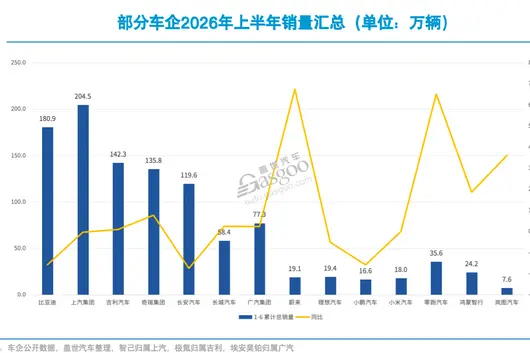
Gasgoo statistics on the sales situation of nearly 20 automakers in the first half showed a clear step-like distribution.
SAIC Group returned to the sales summit with 2.045 million vehicles, becoming the only full-vehicle group to break through 2 million vehicles so far. This time SAIC returned to first place, relying on the combined efforts of independent brands, new energy vehicles, and exports, achieved through a "radical reform" upon itself.
BYD cumulative sales for the first half reached 1.809 million vehicles. Although the domestic market had declined, relying on overseas market growth, it welcomed a recovery momentum of 403,500 vehicles in June.
Geely (1.423 million) and Chery (1.358 million) are accelerating the chase from behind, further narrowing the gap with the top two. The top tier formed by these four no longer competes on how many of a single blockbuster car was sold, but on whose full industry chain turns faster and whose overseas channels are deployed deeper.

Compared to the blossoming of the top tier, the survival status of the second sales tier exposes the cruelest side of this elimination race: the incremental volume of new energy vehicles is starting to fail to fill the gap left by the decline in fuel vehicles.
Changan is like this, selling 1.196 million vehicles in the first half, a year-on-year decrease of 17.4%. The problem it faces is that the speed of the decline in the fuel vehicle front exceeds the replacement speed of new energy brands.
GAC Group cumulative sales for the first half reached 773,000 vehicles, up 2.4% year-on-year, with moderate performance, urgently needing a new blockbuster. Perhaps the Qijing brand, built with Huawei, could be the breakthrough. Great Wall (584,000) increased slightly by 2.5%, but under the double-pronged attack from rivals on plug-in hybrids and pure electric, the shortcoming of a low proportion of new energy vehicles continues to drag down the overall market.
In this dramatic structural change, the confrontation between the camps of emerging new forces and joint venture brands is exposing deeper differences.
New forces have mostly achieved impressive growth rates. Leapmotor sold 356,000 vehicles in the first half, soaring 65% year-on-year. Zeekr, NIO, and Harmony Intelligent also had fierce offensives, especially the former two with year-on-year growth rates exceeding 60%. However, brands like Li Auto and XPeng encountered sales declines due to insufficient new product competition.
NIO's sales breakthrough was largely thanks to mutual support from three major brands: NIO, Onvo, and Firefly. For example, in an environment where the industry generally relies on aggressive pricing to exchange price for volume, Onvo delivered 42,000 vehicles in the first half, and the average transaction price held above 240,000 yuan, achieving a balance between sales growth and price stability, helping NIO achieve significant improvement in performance fundamentals.
Conversely, foreign brands continue to face pressure in China. CPCA data shows that retail sales of mainstream joint ventures decreased by 34% in June. Among them, SAIC Volkswagen shrank by over 30% in the first half, and GAC Honda was directly halved to 68,000 vehicles. The core issue foreign brands face in China remains how to break the inertia of momentum loss caused by the contraction of the fuel vehicle base and achieve scale effects in the new energy market.
Saying goodbye to broad rises, new energy vehicles enter the structural competition stage
No denying, new energy vehicles remain the deciding factor for the overall car market. In June this year, the retail penetration rate of domestic new energy passenger vehicles soared to a historical high of 62.8%, while pure fuel vehicles plummeted by 42%. But upon closer inspection, the bonus period of broad rise in the new energy market has ended.
As CPCA Secretary General Cui Dongshu put it, the new energy market is sliding towards a polarization of "high-end explosion, low-end pressure".
Data is the most direct microscope. In June, wholesale sales of Class B pure electric vehicles surged by 37% year-on-year, while sales in the A00 class pure electric market, serving as entry-level commuter tools, were directly halved by 50%. Consumers no longer buy simply for green license plates or cheapness, but have focused their gaze on products with higher configurations and stronger intelligent capabilities.
In this structural reshaping, resources are accelerating to converge at the top. Only 20 new energy automakers achieved wholesale sales over 10,000 in June, yet they accounted for 94% of the market share. Among them, independent brands took over more than 60% of the share, emerging new forces split 26%, while the share left for mainstream joint venture brands was only 4.3%.

But even within independent brands holding absolute advantages, differentiation is intensifying.
BYD locks the leading position thanks to coverage of the full price range. Geely advanced on dual lines of plug-in hybrids and pure electric vehicles, with new energy scale reaching 800,000 in the first half, and penetration rate approaching 60%. In contrast, while new energy transformation at companies like Chery, Changan, and Great Wall is accelerating, penetration rates still hover around 30%.
And in the new forces camp, the generation gap in growth rates often depends on who can trickle down high-end technologies to the mainstream market.
Leapmotor is a typical representative, with June sales reaching 93,000, far exceeding Li Auto, XPeng, NIO, etc. The explosion of Leapmotor is essentially based on full-domain in-house R&D cost control capabilities, building an SUV product matrix in the core market under 200,000 yuan, turning intelligence and high configuration into inclusive products. This extremely lethal cost-performance strategy allowed it to expand its market share under the general market pressure on the low end.
Different from Leapmotor relying on a full-spectrum blockbuster to break out upwards, NIO is achieving technology spillover downwards through sub-brands. For example, its sub-brand Onvo leverages NIO's system technology and battery swapping network, bringing 900V high-voltage architecture, self-developed chips, and operating systems, originally belonging to flagship models, into the 200,000 to 300,000 yuan family vehicle market, solving refueling anxiety for pure electric users.
In contrast, due to new products being in a replacement vacancy period or lacking sufficient competition, growth rates for some automakers like Li Auto and XPeng slowed to varying degrees in the first half.
Market increments are accelerating to concentrate at top automakers. Players who can continuously produce blockbusters and build full-spectrum matrices are building competitive barriers higher and higher.
Overseas competition has entered the "deep water zone"
While reshaping the domestic market competition landscape, the overseas market has become the second growth pole that almost all automakers are vying for.
In June this year, domestic passenger vehicle exports surged 82.3% year-on-year to 877,000 vehicles, with new energy exports soaring 152.7% even more. Exports are no longer garnishes on automaker financial reports, but have become key variables influencing the overall market.
However, in the second half of going overseas, the focus of competition has shifted from "how many cars were exported" to "whether one can establish global operations and risk resistance capabilities". In other words, single trade-type exports are entering a downward phase, while overseas localization production and globalization system construction are becoming the invisible gap that truly widens the generation gap between enterprises.
In this global leap, the differentiation at the top has already begun to show signs.
Among the automakers, Chery remains a typical "global harvestor" domestically, with cumulative exports reaching 944,000 vehicles in the first half, achieving a high-speed growth of 71.5%. Its export scale ranks first in the domestic automotive industry, with overseas sales accounting for nearly 70% of total sales. The channel advantages formed in Latin America, the Middle East, and Russia have built a very thick survival foundation for Chery.
More worthy of attention are players like BYD who are completing the leap from exporting products to exporting systems. With overseas factories in Thailand, Brazil, etc., gradually starting production, BYD's overseas sales climbed to 789,000 vehicles in the first half, nearly doubling year-on-year. Its overseas sales have accounted for 40% of total sales. This approach of "building factories in the opponent's home base" is the best way to avoid tariff barriers and achieve localization rooting.

At the same time, Geely and Changan are also accelerating tactical shifts. Geely accelerated the overseas launch of affordable series like Starship, recording an export scale of 474,000 vehicles in the first half, with June alone breaking 100,000 vehicles. Changan pulled export growth by 35% to 402,000 vehicles through overseas efforts on new energy models like Deepal and Qiyuan.
While some are accelerating, others are bearing the pressure of defending their city. SAIC exported 735,000 vehicles in the first half. Although relying on the MG brand for deep cultivation in Europe, Southeast Asia, etc., maintained stable shipments, it has already shown signs of being overtaken by Chery and BYD in the landing pace of overseas localization capacity. With competitor localization factories in Europe and Southeast Asia gradually starting operations, if SAIC cannot quickly upgrade overseas system bonuses, its past first-mover advantage will face the risk of continuous erosion.
In the new forces camp, Leapmotor took another shortcut. It cooperated with the international giant Stellantis, leveraging the latter's global channel network and production bases. Its overseas scale quickly approached 100,000 vehicles in the first half, successfully walking a path of light assets and high-efficiency globalization.
XPeng is also accelerating the expansion of the overseas market. In the first half, its overseas sales reached 32,000 vehicles, up more than 70% year-on-year, increasing the proportion of total sales to about 20%. Chairman and CEO He Xiaopeng had explicitly stated the strategic goal of "half of sales coming from overseas in the next ten years".
XPeng tries to bet directly on the global battlefield by self-operating technology, putting intelligent advantages there. Currently, the results of this strategy are initially visible. But under the current international geopolitical environment, this will put extremely high cross-cycle requirements on the enterprise's overseas supply chain elasticity.
Especially, this year's demand fluctuations in some Middle East markets, and the uncertainty of the global trade environment, objectively tested the risk resistance cycles of each automaker. The traditional single trade model relying solely on domestic production and sea shipping exports, when facing overseas policy adjustments, has a relatively short defensive depth.
This also means that the focus of competition in the second half of going overseas is no longer the frequency of sea shipping logistics, but the construction and landing of overseas localization capacity.
How to break through the final exam in the second half?
The data of half a year is just the process. What the market truly cares about is: Can the sales targets set at the beginning of the year still be completed?
According to Gasgoo Auto Research Institute's forecast, China's passenger vehicle wholesale sales in 2026 will be about 29.634 million vehicles, a slight decrease of 1.4% year-on-year. The overall market is basically treading water, meaning any automaker's growth must snatch food from opponents' mouths. At the node of the first half ending, the gaps in completion rates among each family have already widened.
BYD has not publicly disclosed clear annual sales figures, but forecasts given by UBS and other institutions are around 5 million vehicles. Supporting this massive volume is domestic full price range product coverage and the continuous release of overseas capacity. With the production launch of factories such as Thailand and Brazil, BYD's overseas expansion has upgraded from product output to system output.

Among automakers that have disclosed specific goals, Geely and Chery have higher completion rates, both around 40%, with both having clear sales pillars supporting them.
Geely's new energy penetration rate broke through 60%, running volume on dual lines of plug-in hybrids and pure electric. In the second half, its domestic market will continue to harvest 100,000 to 200,000 yuan mainstream new energy share through models like Starship E5 and Starship 7, and plans to enter the mid-to-high-end track through new products like Starship TT. Overseas will leverage affordable vehicles of the Starship series to land in Europe for volume boosting, and target overseas high-end premium markets with models like Zeekr 9X, thereby hedging against domestic involution.
Chery's overseas exports shoulder nearly 70% of sales, with channel bonuses in markets like Latin America, Middle East, Russia still being released. In the second half, Chery puts its focus on Europe and emerging markets. Through the new brand LEPAS, hybrid flagship layout in Europe, and model launches like Exeed ET8 in Russia and Central Asia, it uses a strategy of blossoming in multiple points to maintain lightweight growth throughout the year.
In contrast, Changan and Great Wall are the two with low completion rates. Changan's annual target is 3.3 million vehicles, completed 36% in the first half. In the second half, the ramp-up speed of new models like Deepal L05, Qiyuan Q06, Avatr 07 L, etc., will directly affect Changan's sales.
Great Wall's completion rate is also around 30%. Its Tank series stabilized the basic platform of hardcore off-road through plug-in hybrids, but the real volume-driving Haval brand lacks an absolute blockbuster in the new energy mass market. In the second half, whether new models like Tank 300, Haval H10 can tear open a breakthrough in the mainstream new energy market is the variable for Great Wall to reverse the situation.
SAIC also faces considerable pressure to achieve an annual target of 5 million vehicles. Its core highlights for the second half lie in whether the incremental release of new energy models like IM Motors and STELATO Z7 can be released, and whether the decline amplitude of the joint venture basic platform can be narrowed.
In the new forces camp, second half pressure also shifted to rapid volume increase of new product sequences. Leapmotor's annual target is 1.05 million vehicles, completing 30% in the first half. To achieve the target in the second half, monthly average sales need to be pulled to above 110,000. Besides the C-Series holding the basic platform under 200,000 yuan, the high-end D-Series and Lafa5 Series will become the main attackers for volume boosting.
NIO anchors its annual growth target around 40% (about 450,000 vehicles), betting most of the increment on Onvo. In the second half, as flagship models L90, L80, and new L60, etc., welcome the product explosion cycle, Onvo's market performance will directly affect NIO's final results for the year.
XPeng and Harmony Intelligent completion rates are also around 30%. XPeng will quickly increase volume in the second half relying on the global launch of new series like MONA L03, GX. Harmony Intelligent needs to rely on new products like STELATO G9, Qijing GT7, etc., to pull deliveries.
The direction of foreign joint venture brands lacks suspense. Under the pinch attack of continuously shrinking fuel base and new energy products far from forming scale, the main task for joint venture brands in the second half can only be to try to slow down the decline speed. Gasgoo Auto Research Institute forecasts that Volkswagen China is expected to reach around 2 million vehicles for the year, and Toyota in China around 1.3 million.
Of course, sales targets are only surface rulers. In January-May this year, China's automotive industry profit margin has dropped to 3.4%. In the second half, if continuing to rely solely on price cuts to boost volume, it will only further overdraft the blood-making ability of enterprises to survive in the deep water zone. At this stage, blindly stacking delivery numbers has lost practical significance.
The real deciding factor is to see whether each automaker can solidly convert the product cycles planned in hand into quality and cash flow-supported scale explosions.

Di pasaran SUV Malaysia, ramai pembeli yang membandingkan Perodua Aruz dan Honda WR-V semasa memilih kereta. Kedua-dua kereta ini mempunyai harga dan posisi pasaran yang sangat hampir sama. Hari ini kita akan buat perbandingan terperinci dari pelbagai aspek untuk membantu anda menjimatkan masa membuat kajian.
Harga Runcit OTR Perodua Aruz di Malaysia ialah RM 72,900 - 77,900, terdapat 2 varian, termasuk 1.5L X (RM 72,900), 1.5L AV (RM 77,900) dan lain-lain.
Harga Runcit OTR Honda WR-V di Malaysia ialah RM 89,900 - 107,900, terdapat 4 varian, termasuk 2023 1.5L V (RM 99,900), 2023 1.5L E (RM 95,900), 2023 1.5L S (RM 89,900) dan lain-lain.
Dari segi harga, harga permulaan Perodua Aruz memang lebih murah RM 17,000 berbanding Honda WR-V. Jika bajet anda terhad, varian pemula Perodua sudah boleh memenuhi keperluan harian. Tetapi berhati-hatilah, perbezaan harga beberapa ribu ringgit itu mungkin melibatkan pemotongan ciri, ia bergantung pada keperluan anda.
Gred keselamatan Perodua Aruz ialah 5★ (ASEAN NCAP), sistem keselamatan aktif termasuk.
Gred keselamatan Honda WR-V ialah 5★ (ASEAN NCAP), sistem keselamatan aktif termasuk Honda SENSING.
Gred keselamatan kedua-dua kereta adalah sama, pelengkapan keselamatan dalam tahap ini dianggap lengkap. Keselamatan kereta baharu sekarang tidak buruk, anda tidak perlu terlalu bimbang tentang hal ini.
Panjang badan Perodua Aruz ialah 4400 mm, ruang bagasi 400 L.
Panjang badan Honda WR-V ialah 4400 mm, ruang bagasi 400 L.
Dimensi kedua-dua kereta adalah hampir sama, ruang dalaman kenderaan tidak banyak perbezaannya. Kereta dalam tahap ini sudah cukup untuk kegunaan harian.
Perodua Aruz menggunakan sistem drif FWD.
Honda WR-V menggunakan sistem drif FWD.
Sistem drif kedua-dua kereta adalah sama, keduanya FWD, pengalaman memandu harian tidak akan ada perbezaan besar.

Secara keseluruhannya, Perodua Aruz dan Honda WR-V adalah model kereta yang sangat baik di pasaran Malaysia. Memilih mana satu, yang penting adalah keperluan peribadi dan bajet anda. Disarankan untuk membuat kajian, bandingkan banyak tawaran dari kedai kereta, kemudian buat ujian memandu untuk membuat keputusan akhir. Membeli kereta adalah perkara penting, mengambil masa untuk membuat kajian tidak akan salah.
Dalam pasaran SUV di Malaysia, ramai pembeli semasa memilih kereta sering membandingkan Perodua Aruz dan Proton X70. Kedua-dua kereta ini sangat dekat dari segi harga dan penjenamaan, hari ini kita akan buat perbandingan terperinci dari pelbagai aspek, membantu anda menjimatkan masa membuat kajian.
Perodua Aruz mempunyai harga OTR di Malaysia ialah RM 72,900 - 77,900, terdapat keseluruhan 2 varian, termasuk 1.5L X (RM 72,900), 1.5L AV (RM 77,900) dan lain-lain.
Proton X70 mempunyai harga OTR di Malaysia ialah RM 106,800 - 122,300, terdapat keseluruhan 3 varian, termasuk 1.5L Standard 2WD (RM 106,800), 1.5L Executive 2WD (RM 115,800), 1.5L Premium 2WD (RM 122,300) dan lain-lain.
Dari segi harga, permulaan harga Perodua Aruz memang lebih murah RM 33,900 berbanding Proton X70. Jika bajet anda terhad, versi permulaan Perodua sudah boleh memenuhi keperluan harian. Tetapi perhatikan juga, perbezaan harga tersebut mungkin memerlukan pengorbanan pada kelengkapan, bergantung kepada keperluan anda.
Panjang badan Perodua Aruz adalah 4400 mm, kapasiti bagasi 400 L.
Panjang badan Proton X70 adalah 4400 mm, kapasiti bagasi 400 L.
Dimensi kedua-dua kereta hampir sama, ruang dalaman tidak banyak bezanya. Kereta kelas ini, untuk kegunaan harian sudah cukup.
Perodua Aruz jaminan 5 tahun / 150,000km, selang penyelenggaraan setiap 10,000km atau 6 bulan.
Proton X70 jaminan 5 tahun / 150,000km, selang penyelenggaraan setiap 10,000km atau 6 bulan.
Ketentuan jaminan kedua-dua kereta sama, tidak perlu bimbang tentang ini. Kos penyelenggaraan sebenar bergantung pada rangkaian servis jenama dan harga komponen, disarankan bertanya ahli kumpulan kereta untuk pengalaman pemilik sebenar.
Perodua Aruz dan Proton X70 adalah pilihan utama di pasaran Malaysia, sesuai untuk kegunaan keluarga, perjalanan harian. Jika anda lebih mementingkan reputasi jenama dan harga kereta terpakai, boleh utamakan model yang mempunyai reputasi lebih baik; jika anda lebih mengutamakan nilai berbanding kos dan kelengkapan, pilih model yang lebih lengkap. Akhir sekali disarankan kedua-dua model untuk dipandu ujian, pengalaman sendiri yang paling penting.
Secara keseluruhan, Perodua Aruz dan Proton X70 adalah model kereta yang sangat bagus di pasaran Malaysia. Memilih yang mana, kunci utama bergantung kepada keperluan peribadi dan bajet anda. Disarankan buat kajian terlebih dahulu, bandingkan beberapa penjenamaan kereta, kemudian buat ujian pemandu untuk membuat keputusan akhir. Membeli kereta adalah perkara besar, meluangkan masa membuat kajian tidak akan salah.

Dalam pasaran SUV di Malaysia, ramai pembeli semasa memilih kereta akan membandingkan Perodua Aruz dan Proton X50. Kedua-dua kereta ini mempunyai harga dan kedudukan yang hampir sama, hari ini kita akan buat perbandingan terperinci dari pelbagai aspek, membantu anda menjimatkan masa membuat kajian.
Harga OTR Perodua Aruz di Malaysia adalah RM 72,900 - 77,900, terdapat 2 versi, termasuk 1.5L X (RM 72,900), 1.5L AV (RM 77,900) dan lain-lain.
Harga OTR Proton X50 di Malaysia adalah RM 89,800 - 113,300, terdapat 4 versi, termasuk 1.5T Executive (RM 89,800), 1.5T Premium (RM 101,800), 1.5T Flagship (RM 113,300) dan lain-lain.
Dari segi harga, harga permulaan Perodua Aruz memang RM 16,900 lebih murah daripada Proton X50. Jika bajet anda terhad, versi permulaan Perodua sudah cukup untuk keperluan harian. Namun perlu diingat, perbezaan harga itu mungkin melibatkan kompromi dari segi kelengkapan, bergantung pada keperluan anda.
Perodua Aruz dilengkapi enjin 1.5L 4-cyl, 105 hp. Penggunaan bahan api rasmi 6.0 L/100km.
Proton X50 dilengkapi enjin 1.5L 4-cyl, 105 hp. Penggunaan bahan api rasmi 6.0 L/100km.
Kedua-dua kereta menggunakan set sistem kuasa yang sama, rasa semasa memandu sehari-hari hampir tiada bezanya. Penggunaan bahan api juga hampir sama, tidak perlu terlalu berfikir tentang hal ini.
Perodua Aruz panjang kenderaan 4400 mm, ruang bagasi 400 L.
Proton X50 panjang kenderaan 4400 mm, ruang bagasi 400 L.
Saiz kedua-dua kereta hampir sama, ruang dalaman tidak jauh perbezaannya. Kereta kelas ini, penggunaan harian sudah cukup sepenuhnya.
Perodua Aruz menggunakan cara pemanduan FWD.
Proton X50 menggunakan cara pemanduan 4WD.
Perodua FWD dan Proton 4WD akan memberikan rasa yang berbeza dari segi pengendalian, disarankan untuk melakukan ujian memandu bagi perbandingan.

Perodua Aruz jaminan 5 tahun/150,000km, jarak servis setiap 10,000km atau 6 bulan.
Proton X50 jaminan 5 tahun/150,000km, jarak servis setiap 10,000km atau 6 bulan.
Kedua-dua kereta mempunyai syarat jaminan yang sama, dari segi ini tidak perlu risau. Kos servis sebenar bergantung kepada rangkaian servis jenama dan harga komponen, disarankan bertanya pengalaman pemilik sebenar di kumpulan pengguna kereta.

Secara keseluruhan, Perodua Aruz dan Proton X50 adalah model kereta yang sangat baik di pasaran Malaysia. Memilih yang mana, penting bergantung pada keperluan peribadi dan bajet anda. Kami mengesyorkan untuk membuat kajian, bandingkan beberapa penawaran dari kedai kereta, kemudian buat ujian memandu untuk membuat keputusan akhir. Membeli kereta adalah perkara penting, meluangkan masa untuk membuat kajian tidak akan salah.
Di pasaran SUV di Malaysia, ramai pembeli ketika memilih kereta akan membandingkan Perodua Ativa dan Proton X90. Kedua-dua kereta ini mempunyai harga dan penjenamaan yang agak hampir, hari ini kita akan membuat perbandingan terperinci dari pelbagai aspek untuk membantu anda menjimatkan masa membuat penyelidikan.
Perodua Ativa mempunyai harga OTR di Malaysia dari RM 62,500 - 73,400, terdapat 3 varian, termasuk 1.0L Turbo X (RM 62,500), 1.0L Turbo H (RM 67,300), 1.0L Turbo AV (RM 73,400) dan lain-lain.
Proton X90 mempunyai harga OTR di Malaysia dari RM 106,800 - 122,800, terdapat 4 varian, termasuk 2026 1.5T Prime X (RM 122,800), 2026 1.5T Prime (RM 116,800), 2026 1.5T Lite (RM 106,800) dan lain-lain.
Dari segi harga, harga permulaan Perodua Ativa memang lebih murah daripada Proton X90 sebanyak RM 44,300. Jika bajet anda terhad, varian permulaan Perodua sudah boleh memenuhi keperluan harian. Tetapi perlu juga berhati-hati, beberapa ribu ringgit yang lebih murah itu mungkin ada kompromi dari segi kelengkapan, bergantung kepada keperluan anda.

Perodua Ativa dilengkapi enjin 1.5L 4-cyl, kuasa 105 hp. Konsumsi bahan api rasmi 6.0 L/100km.
Proton X90 dilengkapi enjin 1.5L Turbo, kuasa 140 hp. Konsumsi bahan api rasmi 7.0 L/100km.
Dari segi kuasa, enjin 1.5L Turbo Proton X90 mempunyai 35 kuasa kuda lebih berbanding enjin 1.5L 4-cyl Perodua Ativa. Namun untuk penggunaan harian di bandar, kuasa kedua-dua kereta ini sudah mencukupi, tidak akan terasa kurang tenaga.
Perodua Ativa panjang badan 4400 mm, muatan bagasi 400 L.
Proton X90 panjang badan 4400 mm, muatan bagasi 400 L.
Saiz kedua-dua kereta hampir sama, perbezaan ruang dalaman tidak begitu ketara. Untuk kereta dalam kategori ini, penggunaan harian sudah cukup sepenuhnya.
Perodua Ativa menggunakan cara pemacu FWD.
Proton X90 menggunakan cara pemacu FWD.
Cara pemacu kedua-dua kereta sama, iaitu FWD, pengalaman memandu harian tidak akan berbeza banyak.

Perodua Ativa waranti 5 tahun/150,000 km, jarak penyelenggaraan setiap 10,000 km atau 6 bulan.
Proton X90 waranti 5 tahun/150,000 km, jarak penyelenggaraan setiap 10,000 km atau 6 bulan.
Keadaan waranti kedua-dua kereta sama, tidak perlu bimbang tentang ini. Kos penyelenggaraan sebenar masih bergantung kepada jaringan servis jenama dan harga bahagian, disarankan bertanya dalam kumpulan pemilik kereta untuk pengalaman pemilik sebenar.
Secara keseluruhan, Perodua Ativa dan Proton X90 adalah model kereta yang sangat baik di pasaran Malaysia. Memilih yang mana satu, kuncinya tetap bergantung kepada keperluan dan bajet peribadi anda. Kami menyarankan anda membuat penyelidikan, bandingkan beberapa kedai jualan kereta, kemudian buat ujian memandu untuk membuat keputusan akhir. Membeli kereta adalah perkara besar, meluangkan masa membuat penyelidikan pasti tidak salah.


喺馬來西亞嘅 SUV 市場,好多買家喺揀車嘅時候都會拿 Perodua Ativa 同 Honda WR-V 嚟做比較。呢兩款車喺價位同定位上都蠻接近嘅,今日我就由多個方面做一個詳細嘅對比,幫你省咗做功課嘅時間。
Perodua Ativa 喺馬來西亞嘅 OTR 售價係 RM 62,500 - 73,400,一共有 3 個版本,包括 1.0L Turbo X(RM 62,500)、1.0L Turbo H(RM 67,300)、1.0L Turbo AV(RM 73,400) 等。
Honda WR-V 喺馬來西亞嘅 OTR 售價係 RM 89,900 - 107,900,一共有 4 個版本,包括 2023 1.5L V(RM 99,900)、2023 1.5L E(RM 95,900)、2023 1.5L S(RM 89,900) 等。
由價錢睇落,Perodua Ativa 嘅起步價真係比 Honda WR-V 平咗 RM 27,400。如果你預算有限,Perodua 嘅入門版已經可以滿足日常需求。但都要留意,平嗰幾千蚊,可能喺配備上會有取捨,具體要看你嘅需求。
Perodua Ativa 嘅安全評級係 5★ (ASEAN NCAP),主動安全系統包括 ASA 3.0 + ACC + LDA + LKA + BSM + RCTA。
Honda WR-V 嘅安全評級係 5★ (ASEAN NCAP),主動安全系統包括 Honda SENSING。
兩款車嘅安全評級一樣,喺呢個級別裡面安全配備都算給得好齊全。而家嘅新車安全性都唔差,唔使太擔心這一點。
Perodua Ativa 採用 FWD 驅動方式。
Honda WR-V 採用 FWD 驅動方式。
兩款車嘅驅動方式一樣,都係 FWD,日常駕駛感受唔會有太大分別。
Perodua Ativa 保修 5 年/150,000km,保養間隔 每 10,000km 或 6 個月。
Honda WR-V 保修 5 年/無限制里程,保養間隔 每 10,000km 或 6 個月。
總嚟講,Perodua Ativa 同 Honda WR-V 都係馬來西亞市場好唔錯嘅車型。揀邊一輛,關鍵仲係要看你嘅個人需求同預算。建议大家做好功課,多比較幾間車行嘅報價,再去試車做最終決定。買車係件大事,花少少時間做功課絕對唔會錯。

In the Malaysian SUV market, many buyers compare Perodua Ativa and Proton X90 when choosing a car. These two models are quite close in price and positioning, so today we will make a detailed comparison from multiple aspects to help you save time on research.
Perodua Ativa's OTR price in Malaysia is RM 62,500 - 73,400, with a total of 3 versions, including 1.0L Turbo X (RM 62,500), 1.0L Turbo H (RM 67,300), 1.0L Turbo AV (RM 73,400) etc.
Proton X90's OTR price in Malaysia is RM 106,800 - 122,800, with a total of 4 versions, including 2026 1.5T Prime X (RM 122,800), 2026 1.5T Prime (RM 116,800), 2026 1.5T Lite (RM 106,800) etc.
From the price perspective, Perodua Ativa's starting price is indeed RM 44,300 cheaper than Proton X90. If your budget is limited, Perodua's entry-level version is already sufficient for daily needs. But be aware, the few thousand cheaper, might have trade-offs in features, specifically depends on your needs.
Perodua Ativa's safety rating is 5★ (ASEAN NCAP), active safety systems include ASA 3.0 + ACC + LDA + LKA + BSM + RCTA.
Proton X90's safety rating is 5★ (ASEAN NCAP), active safety systems include ADAS (ACC, AEB, LKA, LDA, BSM, RCTA).
Both cars have the same safety rating, safety features are quite comprehensive for this level. New cars nowadays have good safety, no need to worry too much about this.
Perodua Ativa body length 4400 mm, trunk 400 L.
Proton X90 body length 4400 mm, trunk 400 L.
The dimensions of the two cars are almost the same, interior space difference is not significant. Cars in this class are completely sufficient for daily use.
Perodua Ativa adopts FWD drive mode.
Proton X90 adopts FWD drive mode.
Both cars have the same drive mode, both are FWD, daily driving feel will not be too different.
Overall, Perodua Ativa and Proton X90 are both very good models in the Malaysian market. Which one to choose depends on your personal needs and budget. We suggest doing your research, compare quotes from several dealerships, then test drive to make the final decision. Buying a car is a big deal, spending time on research will never be wrong.

In the Malaysian SUV market, many buyers compare Perodua Ativa and Proton X70 when choosing a car. These two cars are quite close in price and positioning, today we will make a detailed comparison from multiple aspects to help you save time on research.
The OTR price of the Perodua Ativa in Malaysia is RM 62,500 - 73,400, with a total of 3 versions, including 1.0L Turbo X (RM 62,500), 1.0L Turbo H (RM 67,300), 1.0L Turbo AV (RM 73,400) etc.
The OTR price of the Proton X70 in Malaysia is RM 106,800 - 122,300, with a total of 3 versions, including 1.5L Standard 2WD (RM 106,800), 1.5L Executive 2WD (RM 115,800), 1.5L Premium 2WD (RM 122,300) etc.
In terms of price, the starting price of the Perodua Ativa is indeed RM 44,300 cheaper than the Proton X70. If your budget is limited, the entry-level version of Perodua can already meet daily needs. However, note that the savings of a few thousand ringgit might involve compromises in features, depending on your specific requirements.
The Perodua Ativa is equipped with 1.5L 4-cyl, 105 hp. Official fuel consumption 6.0 L/100km.
The Proton X70 is equipped with 1.5L Turbo, 140 hp. Official fuel consumption 7.0 L/100km.
In terms of power, the Proton X70's 1.5L Turbo has 35 more horsepower than the Perodua Ativa's 1.5L 4-cyl. However, for daily driving in the city, the power of both cars is sufficient and won't feel underpowered.
The Perodua Ativa body length is 4400 mm, trunk capacity 400 L.
The Proton X70 body length is 4400 mm, trunk capacity 400 L.
The dimensions of both cars are almost identical, and interior space difference is not large. For this class of car, daily use is completely sufficient.
The Perodua Ativa adopts FWD drive mode.
The Proton X70 adopts FWD drive mode.
Both cars use the same drive mode, both are FWD, daily driving experience will not have a huge difference.
Perodua Ativa warranty 5 years/150,000km, service interval every 10,000km or 6 months.
Proton X70 warranty 5 years/150,000km, service interval every 10,000km or 6 months.
Both cars warranty conditions are same, no need to worry about this aspect. Actual maintenance costs still depend on brand service network and parts prices, suggested to ask real owner experience in car owner groups.
Overall, Perodua Ativa and Proton X70 are both very good models in the Malaysian market. Choosing which one, key still depends on your personal needs and budget. It is recommended to do homework, compare quotes from several dealerships, then test drive to make final decision. Buying a car is a big matter, spending time doing homework will never be wrong.

In Malaysia's SUV market, many buyers compare Perodua Ativa and Proton X50 when choosing a car. These two cars are quite close in price and positioning. Today, we will make a detailed comparison from multiple aspects to help you save time doing research.
Perodua Ativa's OTR price in Malaysia is RM 62,500 - 73,400, with a total of 3 versions, including 1.0L Turbo X (RM 62,500), 1.0L Turbo H (RM 67,300), 1.0L Turbo AV (RM 73,400), etc.
Proton X50's OTR price in Malaysia is RM 89,800 - 113,300, with a total of 4 versions, including 1.5T Executive (RM 89,800), 1.5T Premium (RM 101,800), 1.5T Flagship (RM 113,300), etc.
From a price perspective, Perodua Ativa's starting price is indeed RM 27,300 cheaper than Proton X50. If your budget is limited, Perodua's entry-level version is sufficient for daily needs. But note that the savings of a few thousand ringgit may involve trade-offs in equipment, which depends on your specific needs.
Perodua Ativa comes with a 1.5L 4-cyl engine, 105 hp. Official fuel consumption is 6.0 L/100km.
Proton X50 comes with a 1.5L 4-cyl engine, 105 hp. Official fuel consumption is 6.0 L/100km.
Both cars use the same powertrain system, the driving feel in daily use is basically the same. Fuel consumption is also similar, no need to worry too much about this point.
Perodua Ativa's safety rating is 5★ (ASEAN NCAP), active safety systems include ASA 3.0 + ACC + LDA + LKA + BSM + RCTA.
Proton X50's safety rating is 5★ (ASEAN NCAP), active safety systems include ADAS (ACC, AEB, LKA, LDA, BSM, RCTA).
Both cars have the same safety rating, safety features in this class are considered very complete. New cars' safety performance is not bad these days, no need to worry too much about this.
Perodua Ativa adopts FWD drive system.
Proton X50 adopts 4WD drive system.
Perodua's FWD and Proton's 4WD will have different handling experiences, test drive comparison is recommended.
Perodua Ativa and Proton X50 are both mainstream choices in the Malaysian market, suitable for family use and daily commuting. If you value brand reputation and resale value more, you can prioritize the one with better reputation; if you care more about cost-performance ratio and equipment, choose the one with richer configuration. Finally, it is recommended to test drive both models, experiencing it personally is the most important.
Overall, Perodua Ativa and Proton X50 are both very good models in the Malaysian market. Which one to choose depends mainly on your personal needs and budget. It is recommended to do your research, compare quotes from several dealerships, and then test drive to make a final decision. Buying a car is a big matter, spending time doing research is never wrong.

In the Malaysian SUV market, many buyers compare Perodua Ativa and Proton X50 when choosing a car. These two cars are quite close in price and positioning. Today we will make a detailed comparison from multiple aspects to help you save time on research.
Perodua Ativa OTR price in Malaysia is RM 62,500 - 73,400, with 3 versions in total, including 1.0L Turbo X (RM 62,500), 1.0L Turbo H (RM 67,300), 1.0L Turbo AV (RM 73,400) etc.
Proton X50 OTR price in Malaysia is RM 89,800 - 113,300, with 4 versions in total, including 1.5T Executive (RM 89,800), 1.5T Premium (RM 101,800), 1.5T Flagship (RM 113,300) etc.
From the price perspective, Perodua Ativa's starting price is indeed RM 27,300 cheaper than Proton X50. If your budget is limited, Perodua's entry-level version can already meet daily needs. But also note, those few thousand cheaper might have trade-offs in features, it depends on your specific needs.
Perodua Ativa safety rating is 5★ (ASEAN NCAP), Active Safety Systems include ASA 3.0 + ACC + LDA + LKA + BSM + RCTA.
Proton X50 safety rating is 5★ (ASEAN NCAP), Active Safety Systems include ADAS (ACC, AEB, LKA, LDA, BSM, RCTA).
Both cars have the same safety rating, safety features are quite comprehensive for this level. New cars nowadays are not bad in safety, no need to worry too much about this.
Perodua Ativa body length 4400 mm, trunk 400 L.
Proton X50 body length 4400 mm, trunk 400 L.
Dimensions of both cars are almost the same, interior space difference is not big. For this level of cars, daily use is completely sufficient.
Perodua Ativa and Proton X50 are both mainstream choices in the Malaysian market, suitable for family use, daily commute. If you value brand reputation and resale value more, you can prioritize the one with better reputation; if you care more about value for money and features, then choose the one with richer configuration. Ultimately it is recommended to test drive both, personal experience is the most important.
Overall, Perodua Ativa and Proton X50 are both very good car models in the Malaysian market. Which one to choose depends on your personal needs and budget. It is recommended to do research, compare quotes from several car dealerships, and then test drive to make the final decision. Buying a car is a big matter, spending time on research will never be wrong.

喺馬來西亞嘅 SUV 市場,好多買家喺揀車嘅時候都會拿 寶達 Ativa 同 寶騰 X50 嚟做比較。呢兩款車喺價位同定位上都好接近,而家我哋就從多個方面做一個詳細嘅比較,幫你節省咗做功課嘅時間。
寶達 Ativa 喺馬來西亞嘅 OTR 售價係 RM 62,500 - 73,400,一共有 3 個版本,包括 1.0L Turbo X(RM 62,500)、1.0L Turbo H(RM 67,300)、1.0L Turbo AV(RM 73,400)等。
寶騰 X50 喺馬來西亞嘅 OTR 售價係 RM 89,800 - 113,300,一共有 4 個版本,包括 1.5T Executive(RM 89,800)、1.5T Premium(RM 101,800)、1.5T Flagship(RM 113,300)等。
由價錢睇,寶達 Ativa 嘅起步價確實比 寶騰 X50 平咗 RM 27,300。如果你預算有限,寶達嘅入門版已經可以滿足日常需要。但都要注意,平少少嘅錢,可能喺配備上會有取舍,具體要看你嘅需要。
寶達 Ativa 配備 1.5L 4-cyl,馬力 105 hp。官方油耗 6.0 公升/100 公里。
寶騰 X50 配備 1.5L 4-cyl,馬力 105 hp。官方油耗 6.0 公升/100 公里。
兩款車用緊同一套動力系統,日常開落嚟嘅感覺基本冇分別。油耗方面都差不多,唔使太糾結呢一點。
寶達 Ativa 嘅安全評級係 5★ (ASEAN NCAP),主動安全系統包括 ASA 3.0 + ACC + LDA + LKA + BSM + RCTA。
寶騰 X50 嘅安全評級係 5★ (ASEAN NCAP),主動安全系統包括 ADAS (ACC, AEB, LKA, LDA, BSM, RCTA)。
兩款車嘅安全評級一樣,喺呢個級別入面安全配備都算給得好齊全。而家嘅新車安全性都唔差,唔使太擔心呢一點。
寶達 Ativa 採用 FWD 驅動方式。
寶騰 X50 採用 4WD 驅動方式。
寶達嘅 FWD 同 寶騰嘅 4WD 喺操控上會有唔同感受,建議試駕對比。
寶達 Ativa 同 寶騰 X50 都係馬來西亞市場嘅主流選擇,適合家庭使用、日常通勤。如果你更睇重品牌口碑同二手價,可以優先考慮口碑更好嗰一款;如果你更在意性價比同配備,就揀配置更豐富嗰款。最終都係建議兩款都去試駕,親身體驗先係最重要嘅。
總嘅嚟講,寶達 Ativa 同 寶騰 X50 都係馬來西亞市場幾唔錯嘅車型。揀邊輛,關鍵都係要看你嘅個人需求同預算。建議大家做好功課,多比較幾間車行嘅報價,再去做試駕做最終決定。買車係件大事,花少少時間做功課絕對唔會錯。

喺馬來西亞嘅 SUV 市場,好多買家揀車嘅時候都會拿 寶路華 Ativa 同 寶騰 X70 嚟比較。呢兩部車喺價格同定位上都幾接近,今日我哋就從多個方面做一個詳細嘅對比,幫你省返做功課嘅時間。
寶路華 Ativa 喺馬來西亞嘅 OTR 售價係 RM 62,500 - 73,400,一共有 3 個版本,包括 1.0L Turbo X(RM 62,500)、1.0L Turbo H(RM 67,300)、1.0L Turbo AV(RM 73,400) 等等。
寶騰 X70 喺馬來西亞嘅 OTR 售價係 RM 106,800 - 122,300,一共有 3 個版本,包括 1.5L Standard 2WD(RM 106,800)、1.5L Executive 2WD(RM 115,800)、1.5L Premium 2WD(RM 122,300) 等等。
從價錢嚟睇,寶路華 Ativa 嘅入門價確實比 寶騰 X70 慳咗 RM 44,300。如果你預算有限,寶路華嘅入門版已經可以满足日常需要。但都要注意,平嗰幾千蚊,可能喺配備上會有取捨,具體睇你嘅需要。
寶路華 Ativa 車身長 4400 mm,行李箱 400 L。
寶騰 X70 車身長 4400 mm,行李箱 400 L。
兩部車嘅尺寸幾乎一樣,車內空間分別唔大。呢個級別嘅車,日常使用完全夠用。
寶路華 Ativa 採用 FWD 驅動方式。
寶騰 X70 採用 FWD 驅動方式。
兩部車嘅驅動方式一樣,都係 FWD,日常駕駛感受唔會有太大分別。
寶路華 Ativa 同 寶騰 X70 都係馬來西亞市場嘅主流選擇,適合家庭使用、日常通勤。如果你更睇重品牌口碑同二手價,可以優先考慮口碑更好嗰款;如果你更在意性價比同配備,就揀配備更豐富嗰款。最尾都係建議兩部都去試駕,親身體驗先係最重要嘅。
總體嚟講,寶路華 Ativa 同 寶騰 X70 都係馬來西亞市場好唔錯嘅車型。揀邊一部,關鍵都係睇你嘅個人需要同預算。建議大家做足功課,多比較幾間車行嘅報價,再去試駕做最終決定。買車係件大事,花少少時間做功課絕對冇錯。
喺馬來西亞嘅 SUV 市場,好多買家喺揀車嗰陣都會拿 Perodua Ativa 同 Proton X90 嚟比較。呢兩款車喺價位同定位上都幾接近,今日我哋就從多個方面做一個詳細嘅比較,幫你慳做功課嘅時間。
Perodua Ativa 喺馬來西亞嘅 OTR 售價係 RM 62,500 - 73,400,一總共有 3 個版本,包括 1.0L Turbo X(RM 62,500)、1.0L Turbo H(RM 67,300)、1.0L Turbo AV(RM 73,400) 等。
Proton X90 喺馬來西亞嘅 OTR 售價係 RM 106,800 - 122,800,一總共有 4 個版本,包括 2026 1.5T Prime X(RM 122,800)、2026 1.5T Prime(RM 116,800)、2026 1.5T Lite(RM 106,800) 等。
從價錢睇,Perodua Ativa 嘅起步價確實比 Proton X90 平咗 RM 44,300。如果你預算有限,Perodua 嘅入門版已經可以满足日常需求。但都要留意,平嗰幾千蚊,可能喺配備上會有取舍,具體要看你嘅需求。
Perodua Ativa 搭載 1.5L 4-cyl,馬力 105 hp。官方油耗 6.0 L/100km。
Proton X90 搭載 1.5L Turbo,馬力 140 hp。官方油耗 7.0 L/100km。
動力方面,Proton X90 嘅 1.5L Turbo 比 Perodua Ativa 嘅 1.5L 4-cyl 多咗 35 匹馬力。不過日常喺市區開,兩款車嘅動力都夠用,唔會覺得唔夠力。
Perodua Ativa 嘅安全評級係 5★ (ASEAN NCAP),主動安全系統包括 ASA 3.0 + ACC + LDA + LKA + BSM + RCTA。
Proton X90 嘅安全評級係 5★ (ASEAN NCAP),主動安全系統包括 ADAS (ACC, AEB, LKA, LDA, BSM, RCTA)。
兩款車嘅安全評級一樣,喺呢個級別入面安全配備都算給好齊全。而家嘅新車安全性都唔差,唔使太擔心呢一點。
Perodua Ativa 採用 FWD 驅動方式。
Proton X90 採用 FWD 驅動方式。
兩款車嘅驅動方式一樣,都係 FWD,日常駕駛感受唔會有太大分別。
總嘅嚟講,Perodua Ativa 同 Proton X90 都係馬來西亞市場幾唔錯嘅車型。揀邊一輛,關鍵都係要睇你嘅個人需求同預算。建議大家做好功課,多比較幾間車行嘅報價,再走去試駕做最終決定。揀車係件大事,花少少時間做功課絕對唔會錯。

喺馬來西亞嘅 SUV 市場,好多買家喺揀車嘅時候都會拿 Proton X70 同 Mazda CX-60 嚟做比較。呢兩部車喺價位同定位上都幾接近,今日我哋就從多個方面做一個詳細嘅比較,幫你省返做功課嘅時間。
Proton X70 喺馬來西亞嘅 OTR 售價係 RM 106,800 - 122,300,一共有 3 個版本,包括 1.5L Standard 2WD(RM 106,800)、1.5L Executive 2WD(RM 115,800)、1.5L Premium 2WD(RM 122,300) 等。
Mazda CX-60 喺馬來西亞嘅 OTR 售價係 RM 200,510 - 252,873,一共有 2 個版本,包括 2026 3.3T 4WD High Plus(RM 252,873)、2025 2.5L 2WD High(RM 200,510) 等。
由價錢睇落,Proton X70 嘅起步價確實比 Mazda CX-60 平咗 RM 93,710。如果你預算有限,Proton 嘅入門版已經可以滿足日常需要。但都要留神,平嗰幾千蚊,可能喺配備上會有取舍,具體就要睇你嘅需要。

Proton X70 嘅安全評級係 5★ (ASEAN NCAP),主動安全系統包括 ADAS (ACC, AEB, LKA, LDA, BSM, RCTA)。
Mazda CX-60 嘅安全評級係 5★ (Euro NCAP),主動安全系統包括 i-Activsense Pro。
安全配備方面,兩部車都拿到唔錯嘅評級。不過 Proton X70 嘅 ADAS (ACC, AEB, LKA, LDA, BSM, RCTA) 同 Mazda CX-60 嘅 i-Activsense Pro 喺功能上有些分別,如果你比較重視主動安全嘅話,可以仔細比較下兩者嘅功能清單。

Proton X70 採用 FWD 驅動方式。
Mazda CX-60 採用 FWD 驅動方式。
兩部車嘅驅動方式一樣,都係 FWD,日常駕駛感受唔會有太大分別。

Proton X70 保修 5 年/150,000km,保養間隔 每 10,000km 或 6 個月。
Mazda CX-60 保修 5 年/150,000km,保養間隔 每 10,000km 或 6 個月。
兩部車嘅保修條件一樣,呢方面唔使糾結。實際保養成本仲要看品牌嘅服務網絡同零件價格,建議去車友群問下真實車主嘅經驗。
Proton X70 同 Mazda CX-60 都係馬來西亞市場嘅主流選擇,適合家庭用途、日常通勤。如果你更重視品牌聲譽同二手價,可以優先考慮聲譽好嗰一款;如果你更介意性價比同配備,那就揀配備更豐富嗰款。最終仲係建議兩部都去試駕,親身體驗先至最重要。
總體嚟講,Proton X70 同 Mazda CX-60 都係馬來西亞市場好好嘅車款。揀邊一部,關鍵都要睇你嘅個人需要同預算。建議大家做足功課,多比較幾間車行嘅報價,再去試駕做最終決定。買車係件大事,花少少時間做功課絕對無錯。


喺馬來西亞嘅 SUV 市場,好多買家喺揀車嘅時候都會拿 Proton X70 同 Chery Tiggo 8 嚟做比較。呢兩款車喺價位同定位上都好接近,今日我哋就從多個方面做一個詳細嘅對比,幫你省返做功課嘅時間。
Proton X70 喺馬來西亞嘅 OTR 售價係 RM 106,800 - 122,300,一共有 3 個版本,包括 1.5L Standard 2WD(RM 106,800)、1.5L Executive 2WD(RM 115,800)、1.5L Premium 2WD(RM 122,300)等。
Chery Tiggo 8 喺馬來西亞嘅 OTR 售價係 RM 129,750 - 129,750,一共有 1 個版本,包括 2026 1.6T Standard(RM 129,750)等。
由價錢睇,Proton X70 嘅起步價確實比 Chery Tiggo 8 平咗 RM 22,950。如果你預算有限,Proton 嘅入門版已經可以滿足日常需求。但都要留意,便宜嗰幾千塊,可能喺配備上會有取捨,具體要看你嘅需求。

Proton X70 搭載 1.5L Turbo,馬力 140 hp。官方油耗 7.0 L/100km。
Chery Tiggo 8 搭載 1.5L Turbo,馬力 140 hp。官方油耗 7.0 L/100km。
兩款車用咗同一套動力系統,日常開起嚟嘅感受基本冇分別。油耗方面都差不多,唔使太糾結這一點。

Proton X70 嘅安全評級係 5★ (ASEAN NCAP),主動安全系統包括 ADAS (ACC, AEB, LKA, LDA, BSM, RCTA)。
Chery Tiggo 8 嘅安全評級係 TBD,主動安全系統包括 Basic。
安全配備方面,兩款車都拿到唔錯嘅評級。不過 Proton X70 嘅 ADAS (ACC, AEB, LKA, LDA, BSM, RCTA) 同 Chery Tiggo 8 嘅 Basic 喺功能上有些差異,如果你比較睇重主動安全嘅話,可以仔細對比下兩者嘅功能列表。

Proton X70 採用 FWD 驅動方式。
Chery Tiggo 8 採用 FWD 驅動方式。
兩款車嘅驅動方式一樣,都係 FWD,日常駕駛感受唔會有太大分別。
Proton X70 同 Chery Tiggo 8 都係馬來西亞市場嘅主流選擇,適合家庭用、日常通勤。如果你更睇重品牌口碑同二手價,可以優先考慮口碑更好嗰一款;如果你更在意性價比同配備,那就揀配置更豐富嗰款。最終都建議兩款都去試駕,親身體驗先係最重要嘅。
總括嚟講,Proton X70 同 Chery Tiggo 8 都係馬來西亞市場幾唔錯嘅車型。揀邊一輛,關鍵都要睇你嘅個人需求同預算。建議大家做好功課,多比較間車行嘅報價,再去試駕做最終決定。買車係件大事情,花啲時間做功課絕對唔會錯。

© 2024 Bitauto.com. All Rights Reserved.
Bitauto (www.yiche.com and www.bitauto.com) is one of the most visited automotive websites in China. We provide detailed info on Chinese car brands available in your area. Please note that the information provided on this website is based on publicly available data and is for reference only. It may not be fully updated or accurate at all times.

Help us improve our website


