

HomeToyota

Search History
Popular Searches
Dealer Login / Sign Up











The narrative of "cool domestically and hot internationally" has become the main theme of China's automotive market.
According to the latest data from CPCA, July domestic passenger car retail sales reached 1.461 million units, a 20.9% year-over-year decline. Year-to-date cumulative retail sales stand at 10.173 million units, down 20.3% from last year.
Meanwhile, July passenger car exports hit 918,000 units, surging 87.8% year-over-year, with the proportion of export volume to total manufacturer sales climbing to 41% (37% last month, 21% in the same period of 2025).

Regarding the "cool domestic market," CPCA analysis suggests this is due to the resonance of multiple factors, including oil price rebounds, weakening macroeconomics, seasonal slumps, prior demand exhaustion, and policy shifts.
Conversely, the contraction of domestic demand has accelerated the pace of Chinese car companies "going global"—since the domestic market is overcrowded, they go overseas to find blue oceans.
On this rising export curve, BYD's performance has been the most striking.
Data released by BYD shows that overseas sales reached 179,800 units in July, a 124.3% year-over-year increase. Even according to CPCA's statistical standards, BYD's 174,000 unit NEV export sales in July exceeded the combined total of the second-ranked (Chery, 83,000 units) and third-ranked (Tesla, 66,000 units) exporters, establishing a fractured leading advantage.

More importantly, BYD's export proportion of total sales in July rose to 43.1%. It is worth noting that just two years ago in 2024, this proportion was only a little over 10%.
This means BYD is no longer a Chinese brand simply relying on the domestic market, but a truly global car company. This has prompted the outside world to re-examine the strategic vision previously proposed by Wang Chuanfu of "achieving the largest scale globally in five years."
If BYD wants to "achieve the #1 global scale," it will face Toyota, this "giant."
Toyota's strength lies in its global production and sales network and extreme cost control in the fuel vehicle era. What BYD currently demonstrates is the ability to reconstruct the global market on the new energy track.
CPCA data shows that July NEV passenger car exports reached 540,000 units, up 147.8% year-over-year, accounting for 58.8% of total exports, an increase of 14 percentage points compared to the same period last year.
According to CPCA Secretary-General Cui Dongshu's statistics, from January to June 2026, China's NEV passenger car world share reached 62%, and the share in the plug-in hybrid field was as high as 71%.

The share of Chinese NEVs worldwide is rising rapidly. As the global NEV sales champion, BYD is actually standing at the forefront of the global output of China's supply chain.
Data shows that in the first half of 2026, Toyota's global sales were 5.0089 million units, ranking first globally for seven consecutive years; BYD's first-half global sales were 1.8085 million units, ranking sixth. The difference between the two was 3.62 million units, but the speed of narrowing the gap is accelerating—the gap was 13.4 times in 2021, narrowed to 2.7 times in 2023, and by the first half of 2026, the gap between the two is less than 1.7 times.
It took BYD less than two years to increase the export proportion from 10% to 40%. If the overseas market can maintain this growth rate, and Toyota continues to struggle in the quagmire of electrification transformation, then "surpassing" will no longer be a "whether possible" question, but a "when it happens" question.
But sales figures are just the most superficial things. What is truly worth thinking about is, what does BYD rely on to fill this gap of over 3 million units?
Toyota's foundation is a global fuel vehicle system that has been operating for decades; from supply chain to channels to brand perception, it is all stacked up by time.
BYD's opportunity lies in the fact that the technical logic and cost structure of NEVs are completely different from fuel vehicles. It does not need to fight position warfare in Toyota's home field, but uses a new product logic to find its entry point in every regional market.
BYD's overseas strategy can be summarized as "precise entry" and "deep localization." This strategy shows highly flexible adaptability in different regional markets. A highly representative case is the launch of BYD's K-Car in the Japanese market.

On July 28, BYD's pure electric K-Car "Sea Otter Racco," built specifically for the Japanese market, was launched. As of August 9, in less than two weeks, orders broke 1,000 units, with 80% coming from the top-spec version. For any car company wanting to penetrate the Japanese market, this is a capital worth "boasting" about.
It is worth noting that the Japanese market has long been a solid fortress of the global auto industry, with local brands holding absolute dominance. Even "giants" like Volkswagen and Hyundai find it difficult to open the Japanese market. Especially the K-Car market, which has an annual retail volume exceeding 1.6 million units and is known as the totem of Japanese auto culture, has been monopolized for over thirty years by three local giants: Suzuki, Daihatsu, and Honda.
More importantly, due to the adoption of Chinese self-developed parts, the Sea Otter can only receive a subsidy of 150,000 yen in Japan, while local competitors like Nissan Sakura can receive 580,000 yen. Under the subsidy disadvantage of three times that of competitors, orders still exceeded expectations. This directly shows that BYD has already possessed the strength to directly confront Japanese car companies in manufacturing processes and cost control.

An earlier example is BYD's Shark Pickup launched for the Americas, Australia, and other markets. It accurately hit the pain point of combining commercial and home use in the local market, becoming one of the best-selling Chinese brand models. CPCA data shows that BYD Shark Pickup overseas market monthly average sales are about 3,000 units, with sales in some months even exceeding 4,500 units.
Data released by BYD shows that under the boost of the Shark Pickup and subsequent imported Seagull and other NEV models, Brazil has become BYD's largest overseas market, with cumulative export volume reaching 194,700 units in the first half. Meanwhile, just on July 16, the 100,000th car of BYD Brazil factory officially rolled off the production line.
From Japan's exquisite K-Car to America's tough Pickup, BYD is no longer exporting "global products," but providing "regional customization." This transformation allows it to quickly fill the market void left by traditional brands.
Orient Securities forecasts that BYD's 2026 full-year sales will exceed 5 million units, with overseas sales between 1.8 million and 1.9 million units, a year-over-year growth of 75%.
Morgan Stanley predicts that BYD overseas sales will reach 1.6 million to 1.8 million units, with a year-over-year growth of 68% to 89%. It estimates that the company's passenger car share in markets like Brazil, Thailand, and Australia has exceeded 5%, and NEV sales share in multiple regions exceeds 20%.
Under the dual drive of "involution" and "going overseas," Chinese car companies represented by BYD are gradually transforming "surpassing Toyota" from a vision into reality through differentiated product strategies and deep localization layout. Whether it is the K-Car in the Japanese market or the Shark Pickup in the Americas, it proves that China's automotive industry has the ability to compete in the global diverse market.
In the future, with more companies like BYD digging deep in the overseas market, China's automotive industry's global share is expected to further increase, and the industry trend of "East Rising, West Declining" will be irreversible.

“Dingin di Dalam, Panas di Luar” telah menjadi melodi utama dalam industri kereta di China.
Data terkini dari Persatuan Kereta Penumpang China menunjukkan, jualan eceran kereta penumpang domestik pada Julai ini sebanyak 1.461 juta unit, menurun 20.9% berbanding tahun lalu. Kumpulannya sejak awal tahun ini mencapai 1,017.3 juta unit, menurun 20.3% berbanding masa yang sama tahun sebelumnya.
Sementara itu, eksport kereta penumpang pada Julai mencapai 918,000 unit, meningkat secara pesat sebanyak 87.8% secara tahunan. Pecahan kuantiti eksport dalam jumlah jualan pengilang terus meningkat hingga ke paras 41% (37% pada bulan lalu, 21% pada bulan Julai tahun 2025).
Bagi fenomena “Dingin di Dalam”, Persatuan Kereta Penumpang China mengesyorkan bahawa ia disebabkan oleh pelbagai faktor yang bertindak serentak seperti harga minyak meningkat semula, ekonomi makro yang lemah, musim senyap, permintaan telah dipinjam terlebih awal dan perubahan dasar.
Sementara itu, penyusutan permintaan domestik secara tidak langsung mempercepatkan langkah syarikat kereta China “berlari ke luar” – jika pasaran dalam negara terlalu sesak, cari Pasaran Biru di luar negara.
Dan di atas laluan eksport yang naik dan gemilang ini, prestasi BYD adalah yang paling menawan.
Menurut data yang dikeluarkan BYD, jualan luar negeri pada Julai mencapai 179,800 unit, meningkat 124.3% secara tahunan. Walaupun menggunakan kaedah pengiraan Persatuan Kereta Penumpang China, jumlah eksport kereta Tenaga Baharu BYD pada Julai sebanyak 174,000 unit, telah melebihi gabungan jualan eksport yang menduduki tempat kedua (Chery, 83,000 unit) dan tempat ketiga (Tesla, 66,000 unit), membentuk keunggulan berjara-jara.
Yang lebih penting, pecahan eksport BYD pada Julai meningkat ke paras 43.1%, perlu diingat, hanya dua tahun yang lalu pada tahun 2024, nisbah ini hanyalah sedikit melebihi 10%.
Ini bermakna, BYD sudah bukan lagi jenama China yang semata-mata bergantung kepada pasaran domestik, tetapi sebuah pengilang kereta yang benar-benar global. Ini juga memaksa pihak luar menilai semula visi strategik Wang Chuanfu yang mencadangkan “mencapai kedudukan pertama di dunia dari segi saiz dalam lima tahun”.
Dan untuk BYD mahu “mencapai kedudukan pertama di dunia”, ia akan berdepan dengan “raksasa” Toyota.
Keteguhan Toyota terletak pada rangkaian penjanaan dan jualan globalnya dan kawalan kos yang maksimal pada zaman Kereta Bahan Api. Manakala apa yang BYD tunjukkan sekarang adalah keupayaan merekonstruksi pasaran global di laluan Tenaga Baharu.
Data Persatuan Kereta Penumpang China menunjukkan, eksport kereta penumpang Tenaga Baharu pada Julai mencapai 540,000 unit, meningkat 147.8% secara tahunan, mewakili 58.8% daripada jumlah eksport, meningkat 14 titik peratus berbanding tahun lalu.
Sedangkan menurut statistik Setiausaha Agung Persatuan Kereta Penumpang China, Cui Dongshu, pada Januari-Jun 2026, sahan pasaran dunia kereta penumpang Tenaga Baharu China mencapai 62%, di mana di sektor Hibrid Plugs-in, sahan pasaran tersebut bahkan mencapai 71%.
Sahan pasaran kereta tenaga baharu China di peringkat dunia sedang meningkat dengan cepat, sebagai juara jualan kereta tenaga baharu global, BYD sebenarnya sedang berada di hujung arus keluaran rantaian bekalan global China.
Data menunjukkan, pada semi-tahun pertama 2026, jumlah jualan global Toyota ialah 5.0089 juta unit, menduduki tempat pertama di dunia selama tujuh tahun berturut-turut; jumlah jualan global BYD pada semi-tahun pertama ialah 1.8085 juta unit, menduduki tempat keenam. Beza antara keduanya ialah 3.62 juta unit, tetapi kelajuan mengecilkan jurang semakin cepat – beza pada tahun 2021 ialah 13.4 kali, pada tahun 2023 mengecil kepada 2.7 kali, dan pada semi-tahun pertama 2026, beza antara keduanya sudah kurang daripada 1.7 kali.
Daripada satu persepuluh hingga empat persepuluh dalam pecahan eksport, BYD hanya menggunakan masa kurang daripada dua tahun. Jika pasaran luar negara dapat mengekalkan kadar pertumbuhan sedemikian, manakala Toyota terus bergelut dalam lumpur transformasi elektrifikasi, maka “melebihi” tidak lagi menjadi isu “sama ada mungkin” tetapi isu “bila akan berlaku”.
Tetapi nombor jualan hanyalah perkara paling permukaan. Yang sebenarnya patut difikirkan, dengan apa BYD akan mengisi jurang lebih daripada tiga juta unit ini?
Pokok pangkal Toyota adalah satu sistem Kereta Bahan Api global yang telah berjalan selama beberapa dekad, dari rantaian bekalan ke saluran hingga ke kesedaran jenama, semuanya dibina dengan masa.
Peluang BYD terletak pada logik teknologi Kereta Tenaga Baharu dan struktur kosnya yang berbeza sepenuhnya daripada Kereta Bahan Api, ia tidak perlu berperang parit di tapak utama Toyota, sebaliknya menggunakan satu logik produk baru untuk mencari titik masuk di setiap pasaran wilayah.
Strategi ekspori BYD boleh dirumuskan sebagai “Menyerang Tepat” dan “Pengamalan Tempatan Dalam”. Strategi ini menunjukkan keupayaan penyesuaian yang sangat fleksibel di pasaran wilayah yang berbeza. Satu kes yang sangat mewakili ialah pelancaran K-Car BYD di pasaran Jepun.
Pada 28 Julai, Kereta Penumpang Murni K-Car “Berang-berang Laut Racco” yang direka khas oleh BYD untuk pasaran Jepun dilancarkan. Sehingga 9 Ogos, dalam masa kurang daripada dua minggu, pesanan telah memecahkan 1,000 unit, dan lapan daripada sepuluh pesanan berasal dari versi terbaik. Ini merupakan modal yang perlu dipamerkan untuk mana-mana syarikat kereta yang ingin memasuki pasaran Jepun.
Perlu diketahui pasaran Jepun selama ini merupakan benteng kukuh industri kereta global, jenama tempatan mendominasi secara mutlak, malah raksasa seperti Volkswagen dan Hyundai pun sukar membuka pasaran Jepun. Terutamanya pasaran K-Car yang menjadi simbol budaya kereta Jepun, dengan jualan eceran tahunan melebihi 1.6 juta unit, yang selama lebih tiga puluh tahun lepas telah dimonopoli oleh tiga raksasa tempatan iaitu Suzuki, Daihatsu dan Honda.
Yang lebih penting, kerana menggunakan komponen direka sendiri China, Rakun di Jepun hanya boleh menerima subsidi 150,000 yen, manakala produk saingan tempatan seperti Nissan Sakura boleh menerima 580,000 yen. Di bawah kerugian subsidi tiga kali ganda daripada produk saingan, pesanan tetap melebihi jangkaan. Ini secara langsung menunjukkan bahawa BYD dalam hal proses pembuatan dan kawalan kos, sudah mempunyai kekuatan untuk bersembung dengan syarikat kereta Jepun.
Contoh lebih awal pula ialah Pick-up Hiu (Shark) yang dilancarkan oleh BYD untuk pasaran Amerika, Australia, dan lain-lain, yang secara tepat mengenai masalah utama pasaran setempat yang mem兼顾kan penggunaan perniagaan dan rumah, menjadikannya salah satu model jenama China yang paling laku. Data Persatuan Kereta Penumpang China menunjukkan, jumlah jualan bulanan Purata Pick-up Hiu BYD di pasaran luar negeri ialah kira-kira 3,000 unit, sebahagian bulan jumlah jualan bahkan melebihi 4,500 unit.
Menurut data yang dikeluarkan BYD, di bawah pendorongan Pick-up Hiu dan model-model Tenaga Baharu lain seperti Burung Laut yang diperkenalkan kemudian, Brazil telah menjadi pasaran luar negara terbesar BYD, jumlah eksort kumulatif semi-tahun pertama ialah 194,700 unit. Pada masa yang sama, pada 16 Julai, keretapi ke-100,000 di kilang Brazil BYD juga telah dilepaskan secara rasmi.
Dari K-Car halus Jepun, hingga Pick-up Hiu keras di Amerika, BYD tidak lagi mengeluarkan “Produk Global”, tetapi menyediakan “Penyesuaian Wilayah”, perubahan ini membolehkan ia mengisi kekosongan pasaran yang ditinggalkan jenama tradisional dengan segera.
Soochow Securities menjangkakan jumlah jualan BYD sepanjang tahun 2026 melebihi 5 juta unit, di mana jualan luar negara ialah 1.8 juta hingga 1.9 juta unit, meningkat 75% secara tahunan.
Manakala Morgan Stanley meramal, jualan luar negara BYD akan mencapai 1.6 juta hingga 1.8 juta unit, meningkat 68% hingga 89% secara tahunan, dan menganggarkan sahan pasaran kereta penumpang di pasaran Brazil, Thailand dan Australia telah melebihi 5%, sahan jualan kereta tenaga baharu di beberapa wilayah bahkan melebihi 20%.
Dalam dorongan dua arah “Persaingan Berat” dan “Ekspori Global”, syarikat kereta China yang diwakili BYD, melalui strategi produk yang berbeza dan pelan pengamalan tempatan yang mendalam, sedang mengubah “melebihi Toyota” secara beransur-ansur dari satu visi kepada realiti. Sama ada K-Car di pasaran Jepun, atau Pick-up Hiu di pasaran Amerika, semuanya membuktikan bahawa industri kereta China telah memiliki kemampuan untuk bersaing dalam pasaran global pelbagai.
Masa depan, seiring dengan lebih banyak syarikat seperti BYD yang bekerja keras dan teliti di pasaran luar negara, sahan pasaran global industri kereta China dijangka akan meningkat lagi, trend industri “Kebangkitan Timur, Kemerosotan Barat” tidak dapat diubah.

The global automotive market in the first half of 2026 delivered its results amidst multiple shifts: escalating geopolitical conflicts, repeated supply chain disruptions, and the electrification transition entering a critical phase. Looking at internationally mainstream automakers with announced data, the sales landscape shows significant differentiation: Japanese, German, and American traditional giants generally face pressure and decline, while some Chinese independent brands and automakers focusing on emerging markets achieve resilient growth. This structural reshuffle reflects the profound reshaping of the global automotive industry landscape.
Toyota Retains Sales Crown, Multiple Chinese Brands Reach the Top Tier
According to the official H1 2026 global sales data announced by each automaker, Toyota Motor remained the sales champion for the first half of the year, with global sales of approximately 5.39 million units, a year-over-year decrease of 2.8%. This marks the first time Toyota has seen a year-over-year decline in global H1 sales in two years. The Volkswagen Group ranked second globally with approximately 4.126 million sales, with the year-over-year decline widening to 6.3%, a gap of 1.26 million units from Toyota. The Hyundai Motor Group (combined Hyundai and Kia) had a total H1 sales of approximately 3.579 million units, overall performance relatively stable, holding the third place globally.

(Note: Some automakers have not yet announced H1 sales data)
The Stellantis Group ranked fourth with H1 sales of 2.958 million units, the only traditional giant achieving double-digit positive growth, with a year-over-year increase of 11%, demonstrating surprising resilience and elasticity. Stellantis Group H1 global sales were approximately 1.36 million units in the first quarter, a year-over-year increase of 12%; 1.597 million units in the second quarter, a year-over-year increase of 10%, mainly driven by the North American and European markets.
General Motors delivered approximately 2.721 million units in the first half of the year, a year-over-year decrease of 8.9%. However, benefiting from the high premium of North American pickups and SUVs, its sales revenue instead grew counter-trend slightly to $91.7 billion, showing the rare characteristic of "volume down, profit stable".
Notably, Chinese brands occupy three spots on the top 10 list. BYD's cumulative sales reached 1.809 million units in the first half of the year, a year-over-year decrease of 15.7%. Geely's total sales for the first half of the year were approximately 1.423 million units, including brands such as Geely, Lynk & Co, and Zeekr, a slight year-over-year increase of 1%, with new energy product penetration reaching 56%. During the same period, Chery Group's total sales for the first half of the year reached 1.358 million units, a year-over-year increase of 7.7%, setting a new historical high. Among them, June single-month sales were 256,612 units, a year-over-year increase of 9.8%.
Japanese automaker Suzuki's total sales for the first half of the year were 1.8 million units, a significant year-over-year increase of 110.3%. The company saw sales growth in markets such as India, Indonesia, Pakistan, and Africa, driving its overseas H1 sales to a new record. Nissan's sales for the first half of the year were 1.506 million units, a year-over-year decrease of 6.7%, continuing the sluggish trend of recent years.
Traditional Giants Lose Speed: Loss of China Market Resonates with Middle East Geopolitical Impact
In traditional automakers where performance declined, the sluggish sales in the China market, the spillover effects of Middle East geopolitical conflicts, US tariffs, and the retreat of electric vehicle policies, together formed the "headwinds" suppressing their global performance.
An announcement issued by Toyota Motor at the end of July stated that due to weakening demand in the Chinese market and the drag from model replacement adjustments of the popular model RAV4, the company's global production and sales in the first half of the year saw a decline. From January to June this year, Toyota's sales in the Chinese market plummeted by 17.1%, offsetting demand growth in the North American and Japanese markets. In the announcement, the Toyota Group stated: "North American and Japanese market demand is stable, demand for hybrid models and other models in the North American market remains strong, but was offset by the decline in sales in the Chinese market."

Image Source: Toyota Motor
Geopolitical conflict combined with fierce competition in the Chinese market has begun to impact the profit records set by Toyota in the previous fiscal year. In June this year, sales of Toyota and Lexus brands in the Middle East region decreased by 24% year-over-year, while sales in the Chinese market decreased by 27% year-over-year. At the performance conference in May this year, Toyota stated that the automaker exports approximately 500,000 to 600,000 vehicles to the Middle East annually, and the company estimates that nearly half of the export volume could be impacted by the situation in the Middle East.
However, Toyota also adjusted the combined sales forecast for automobiles upwards by 100,000 units from the previous forecast, to 9.7 million units, a figure higher than the previous fiscal year's total sales of 9.595 million units. Toyota stated that the upward adjustment originated from strong demand in North American and European markets, while alternative logistics channels to the Middle East were completed, driving a recovery in local sales.
Volkswagen Group's performance pressure in the first half of the year was also highly concentrated in the Asia-Pacific market, where the decline in the Chinese market was particularly obvious. Volkswagen delivered 24% less in the Asia-Pacific market in the first half of the year, and deliveries in the Chinese market decreased by 25.9% year-over-year. From the perspective of sub-sectors, the downward trend of pure electric models is particularly significant: from January to June this year, Volkswagen Group's deliveries of pure electric models in China plummeted by 47.9%. Volkswagen also had a difficult situation in the North American market in the first half of the year, with pure electric business performance particularly pronounced. In the first half of the year, the group's sales of pure electric models in North America fell sharply by 68.8%, plummeting from 31,300 units in the same period last year to only 9,800 units in the first half of the year.
General Motors' global deliveries for the first half of the year decreased by 8.9%, but supported by stable prices and strong demand for pickups and SUVs, global sales revenue still climbed slightly, demonstrating the profit moat of the North American market. However, General Motors' performance in the Chinese market was also not optimistic, as its joint venture brands face all-round siege from Chinese local brands.
Chinese Brands: From Domestic Fierce Competition to Global Offense
Represented by automakers such as BYD, Geely, and Chery, Chinese automakers ranked high on the global sales list in the first half of the year, showing an unprecedented scale presence for Chinese brands. These three automakers supported overall sales with explosive growth in overseas markets. The core engine of these brands' growth has shifted from domestic to overseas, and the globalization of Chinese automakers is changing from slogans to reality.

Image Source: BYD
Although BYD's total sales declined in the first half of the year, its structural highlight lies in the continuous breakthrough in overseas markets — cumulative overseas sales of passenger cars and pickups reached 789,000 units, a year-over-year increase of 68%, and the proportion of overseas sales to total sales has exceeded 43%. This means BYD has transformed from a "Chinese new energy giant" into a true "global new energy automaker".
BYD's export destinations in the first half of the year showed a layout characteristic of "Latin America leading, Europe breaking out at multiple points, Oceania, Southeast Asia, and Middle East differentiated expansion". Brazil continues to firmly occupy the position of this automaker's largest overseas market, and the top five countries in Europe also rank in the top ten of BYD's export destinations.
Geely's total sales for the first half of the year were approximately 1.423 million units, with outstanding overseas export performance, cumulative exports of 474,228 units, a year-over-year increase of 158%, a figure that has already exceeded the total export volume for the full year of 2025. June single-month exports were 102,874 units, a year-over-year increase of 157%, a month-on-month increase of 21%, achieving year-over-year and month-on-month double growth for six consecutive months, marking that Geely's export business has entered the stage of scale release. Geely's new energy product export sales in the first half of the year were 277,189 units, a surge of 585% year-over-year, with new energy proportion reaching 59%.
As a leader of Chinese brands going global, Chery Automobile accumulated 943,817 exports in the first half of the year, a year-over-year increase of 71.5%, with export proportion approaching 70%, making it a Chinese brand with high degree of internationalization. In July, Chery's exports of automobiles were 202,533 units, a year-over-year increase of 70.1%, breaking the record for Chinese car single-month exports for five consecutive months, becoming the first Chinese automaker to break through 200,000 exports in a single month.
Summary:
In the second half of the year, the global automotive industry will still move forward heavily burdened: weak demand, continuous heating of trade protection, cost increases brought by Middle East turmoil, and logistics and supply chain disruptions, transnational automakers will continue to promote cost reduction, production capacity contraction, and adjustment of electrification pace. These factors will also lead to the global car market still being full of high uncertainty. But a clear trend has been established: with the rise of Chinese automakers, the global automotive industry is accelerating from "Triopoly of Japan, Germany, and America" to "Multipolar Competition".


Pasar automotif global pada semester pertama 2026, dalam keadaan konflik geopolitik yang berterusan, gangguan rantaian bekalan yang kerap dan transisi elektrifikasi yang memasuki peringkat mendalam, telah memberikan keputusan. Berdasarkan data yang telah diumumkan oleh syarikat automotif arus perdana antarabangsa, corak jualan menunjukkan pembezaan ketara: pengilang tradisional Jepun, Jerman dan Amerika biasanya menghadapi tekanan dan penurunan, manakala sebahagian pengilang bebas China dan syarikat automotif yang fokus pada pasaran baru mencapai pertumbuhan songsang. Pembalikan struktur ini mencerminkan penyusunan semula yang mendalam dalam peta industri automotif global.
Toyota Kekal Juara Jualan, Beberapa Jenama China Masuk Teratas
Berdasarkan data jualan global semester pertama 2026 yang diumumkan rasmi oleh pelbagai syarikat automotif, juara jualan semester pertama kekal pada Toyota Motor, dengan jualan globalnya kira-kira 5.39 juta unit, turun 2.8% berbanding tahun lalu. Ini adalah kali pertama Toyota mengalami penurunan jualan global semester pertama secara tahun-ke-tahun dalam tempoh dua tahun. Kumpulan Volkswagen menempati kedudukan kedua global dengan jualan kira-kira 4.126 juta unit, penurunan tahun-ke-tahun meluas kepada 6.3%, jurang dengan Toyota ialah 1.26 juta unit. Kumpulan Hyundai (Hyundai dan Kia dikira bersama) mempunyai jumlah jualan semester pertama kira-kira 3.579 juta unit, prestasi keseluruhan relatif stabil, mengekalkan kedudukan ketiga global.
(Nota: Sebilangan pengilang automotif belum mengumumkan data jualan semester pertama)
Kumpulan Stellantis pada semester pertama menduduki tempat keempat dengan pencapaian 2.958 juta unit, merupakan satu-satunya entiti dalam pengilang tradisional yang mencapai pertumbuhan positif berangka dua, kenaikan tahun-ke-tahun adalah 11%, menunjukkan ketahanan dan fleksibiliti yang luar biasa. Jualan global Kumpulan Stellantis pada suku pertama tahun ini ialah kira-kira 1.36 juta unit, meningkat 12% tahun-ke-tahun; suku kedua ialah 1.597 juta unit, meningkat 10% tahun-ke-tahun, digerakkan terutamanya oleh pasaran Amerika Utara dan Eropah.
Penghantaran General Motors pada semester pertama ialah kira-kira 2.721 juta unit, turun 8.9% tahun-ke-tahun, namun manakala mendapat manfaat daripada keupayaan premium tinggi pikap dan SUV di Amerika Utara, pendapatan penjualannya sebaliknya meningkat sedikit songsang kepada AS$91.7 bilion, menunjukkan ciri "jumlah menurun, keuntungan stabil" yang jarang berlaku.
Perlu diperhatikan, jenama China menduduki tiga tempat dalam senarai 10 teratas. BYD mencapai jualan kumulatif 1.809 juta unit pada semester pertama, turun 15.7% tahun-ke-tahun. Jumlah jualan keseluruhan Geely pada semester pertama ialah kira-kira 1.423 juta unit, merangkumi jenama Geely, Lynk & Co, Zeekr, meningkat 1% tahun-ke-tahun, kadar penetrasi produk tenaga baharu telah mencapai 56%. Pada masa yang sama, jumlah jualan keseluruhan Kumpulan Chery tahun ini mencapai 1.358 juta unit, meningkat 7.7% tahun-ke-tahun, mencatat rekod tertinggi. Di antaranya, jualan tunggal bulan Jun 256,612 unit, meningkat 9.8% tahun-ke-tahun.
Pengilang automotif Jepun Suzuki dengan jumlah jualan semester pertama ialah 1.8 juta unit, meningkat 110.3% secara besar-besaran tahun-ke-tahun, syarikat ini mencapai pertumbuhan jualan di pasaran seperti India, Indonesia, Pakistan, Afrika, mendorong jualan luar negara semester pertamanya mencapai rekod baru. Jualan Nissan pada semester pertama ialah 1.506 juta unit, turun 6.7% tahun-ke-tahun, melanjutan keadaan lesi terkini beberapa tahun kebelakangan ini.
Pengilang Tradisional Melambat: Kehilangan Pasaran China Dan Goncangan Geopolitik Timur Tengah Bergema
Dalam kalangan syarikat automotif tradisional yang prestasi kewangan menunjukkan penurunan, keadaan pasaran China yang lesu, kesan luar konflik geopolitik Timur Tengah, tarif Amerika dan faktor-faktor lain seperti pelonggaran dasar kenderaan tenaga baharu, secara bersama-sama membentuk "angin kepala" yang menekan prestasi global mereka.
Dalam pengumuman yang diterbitkan oleh Toyota pada akhir Julai, ia menyatakan bahawa terjejas oleh permintaan pasaran China yang lemah dan pergantungan pada pelarasan model popular RAV4 generasi baru, produksi global dan jualan syarikat pada semester pertama mengalami penurunan. Dari Januari hingga Jun tahun ini, jualan Toyota di pasaran China turun 17.1%, membatalkan pertumbuhan permintaan di pasaran Amerika Utara dan Jepun. Kumpulan Toyota menyatakan dalam pengumuman: "Permintaan pasaran Amerika Utara dan Jepun stabil, permintaan model hibrid dan model lain di pasaran Amerika Utara kekal kuat, tetapi dibatalkan oleh penurunan jualan di pasaran China."
Sumber gambar: Toyota
Konflik geopolitik ditambah dengan persaingan sengit di pasaran China, telah mula menggoncang rekod keuntungan yang diwujudkan oleh Toyota pada tahun kewangan sebelumnya. Pada Jun tahun ini, jualan Toyota dan jenama Lexus di kawasan Timur Tengah turun 24% tahun-ke-tahun, manakala di pasaran China turun 27% tahun-ke-tahun. Dalam sidang akhbar prestasi Mei tahun ini, Toyota menyatakan bahawa syarikat automotif ini mengimport kira-kira 500,000 hingga 600,000 kenderaan ke Timur Tengah setiap tahun, syarikat memperkirakan hampir separuh daripada jumlah eksport ini mungkin akan terjejas oleh situasi Timur Tengah.
Walaupun begitu, Toyota juga akan menaikkan jangkaan jualan kenderaan dalam skala penggabungan daripada ramalan sebelumnya sebanyak 100,000 unit, sehingga kepada 9.7 juta unit, nilai ini lebih tinggi daripada jumlah jualan 9.595 juta unit tahun kewangan sebelumnya. Toyota menyatakan, kenaikan kali ini berpunca daripada permintaan pasaran Amerika Utara dan Eropah yang kuat, serentak dengan laluan logistik alternatif menuju kawasan Timur Tengah telah siap dibina, mendorong jualan tempatan kembali hangat.
Tekanan prestasi Volkswagen pada semester pertama juga sangat tertumpu pada pasaran Asia-Pasifik, khususnya penurunan ketara di pasaran China yang sangat jelas. Pada semester pertama, penghantaran Volkswagen di wilayah Asia-Pasifik turun mendadak 24%, penghantaran di pasaran China turun 25.9% tahun-ke-tahun. Dari segi sektor perincian, trend penurunan model sepenuhnya elektrik sangat ketara: Januari- Jun tahun ini, penghantaran model sepenuhnya elektrik Volkswagen di China jatuh mendadak 47.9%. Volkswagen juga berada dalam keadaan sukar di pasaran Amerika Utara pada semester pertama, prestasi perniagaan sepenuhnya elektrik sangat menonjol. Pada semester pertama, penjualan model sepenuhnya elektrik kumpulan ini di Amerika Utara turun mendadak 68.8%, jatuh dari 31,300 unit pada tempoh yang sama tahun lalu kepada hanya 9,800 unit pada semester pertama.
Penurunan penghantaran global General Motors pada semester pertama ialah 8.9%, namun manakala mendapat manfaat daripada harga yang stabil dan permintaan pikap dan SUV yang kuat, pendapatan penjualan global masih sedikit meningkat, menunjukkan parit keuntungan pasaran Amerika Utara. Namun, prestasi General Motors di pasaran China juga tidak boleh diabaikan, jenama gabungan di negara ini sedang menghadapi pengepungan menyeluruh daripada jenama tempatan China.
Jenama China: Dari Perkelahian Di Dalam Negara ke Serangan Global
Ketua syarikat automotif China yang diwakili oleh BYD, Geely, Chery, pada semester pertama telah masuk ke teratas senarai jualan global, menunjukkan kehadiran skala yang belum pernah berlaku bagi jenama China. Ketiga-tiga syarikat automotif ini bersandar pada pertumbuhan meletup di pasaran luar negara untuk menyangga jualan keseluruhan. Enjin utama pertumbuhan jenama ini telah bertukar dari domestik ke luar negara, globalisasi syarikat automotif China telah berubah daripada slogan menjadi realiti.
Sumber gambar: BYD
Walaupun jumlah jualan BYD pada semester pertama mengalami penurunan, titik highlight berstrukturalnya terletak pada penerobosan berterusan di pasaran luar negara - kenderaan penumpang dan pikap yang dijual di luar negara kumulatif 789,000 unit, meningkat 68% tahun-ke-tahun, peratusan jualan luar negara melebihi 43% daripada jumlah jualan. Ini bermakna BYD telah bertukar daripada "raksasa tenaga baharu China" menjadi "syarikat automotif tenaga baharu global yang sebenar".
Pada semester pertama, tujuan eksport BYD menunjukkan ciri susunan "Amerika Latin memimpin, Eropah menerobos di beberapa titik, Australia dan Tenggara Asia serta Timur Tengah dikembangkan secara berbeza". Brazil masih kukuh memegang kedudukan pasaran luar negara utama syarikat automotif ini, lima negara Eropah juga masuk ke dalam sepuluh tujuan eksport BYD.
Total jualan Geely pada semester pertama ialah kira-kira 1.423 juta unit, prestasi eksport luar negara menonjol, eksport kumulatif 474,228 unit, meningkat 158%, angka ini telah melebihi jumlah jumlah eksport keseluruhan tahun 2025. Eksport tunggal bulan Jun 102,874 unit, meningkat 157% tahun-ke-tahun, meningkat 21% bulan-ke-bulan, enam bulan berturutan mencapai pertumbuhan tahun-ke-tahun dan bulan-ke-bulan, menandakan perniagaan eksport Geely memasuki peringkat pelepasan skala. Eksport penjualan produk tenaga baharu Geely pada semester pertama ialah 277,189 unit, melonjak 585% tahun-ke-tahun, peratusan tenaga baharu mencapai 59%.
Sebagai barisan hadapan keluar jenama China, Chery Automotive kumulatif eksport pada semester pertama ialah 943,817 unit, meningkat 71.5%, peratusan eksport hampir 70%, adalah jenama China yang mempunyai tahap internasionasi yang tinggi. Pada Julai, eksport kereta Chery 202,533 unit, meningkat 70.1% tahun-ke-tahun, lima bulan berturutan memecahkan rekod eksport tunggal bulan kereta China, menjadi syarikat automotif China pertama yang memecahkan 200,000 unit eksport tunggal bulan.
Kesimpulan:
On semester kedua, industri automotif global masih akan berjalan dengan beban berat: permintaan yang lemah, pelindungan dagang terus meningkat, kenaikan kos yang dibawa oleh ketidakstabilan keadaan Timur Tengah dan gangguan logistik, rantaian bekalan, syarikat automotif transnasional akan terus memajukan penurunan kos, pengecutan kapasiti dan penyesuaian irama elektrifikasi, faktor-faktor ini akan menyebabkan pasaran automotif global masih penuh dengan ketidakpastian yang tinggi. Tetapi satu trend yang jelas telah ditetapkan: dengan kebangkitan syarikat automotif China, industri automotif global sedang mempercepat dari "tiga kuasa kuat Jepun, Jerman, Amerika" menuju ke "persaingan multipolar".


Written by | Liu Ying
Edited by| Huang Dalu
Designed by | Zhen Youmei
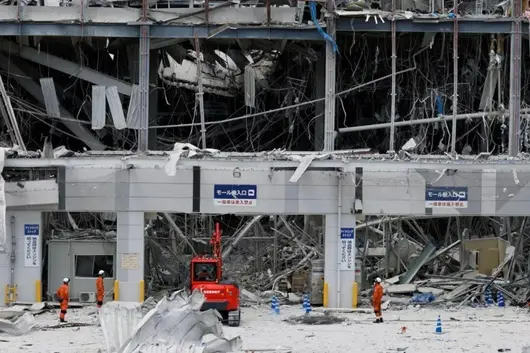
On the evening of July 28, 2026, the ground in Kyushu began to shake without warning.
On the assembly line at the Miyata Plant in Fukuoka Prefecture, robotic arms hung in mid-air and suddenly stopped. Workers put down their tools and quickly evacuated the workshop along the safety aisle. Minutes later, the production lines at the Kanda and Kokura plants also came to a standstill.
This was a magnitude 7.1 earthquake.
Toyota initially thought it could resume operations quickly, but several hours later, it had to shut down three plants again. Production was scheduled to resume on July 31, but the deadline was subsequently pushed back to August 5.
The shadow of the halt quickly spread from Kyushu to Honshu. Nissan HQ initially announced "production as usual" externally, but only two days later, due to parts not arriving at the factory in time, some production lines had to stop as well. A Toyota plant in Aichi Prefecture, over 600 kilometers away, was also affected.
As of August 4, 2026, four Toyota plants in Kyushu were still scheduled to shut down until August 5, and another plant in central Japan was scheduled to halt until August 7. Two of these four plants are vehicle assembly bases.

Such scenes are not unfamiliar to the Japanese automotive industry.
In 1995, factories in Kobe were filled with cracks after the earthquake; in 2004, the shutdown of a small factory in Niigata forced all four Honda production bases to stall simultaneously; in 2007, an inconspicuous piston ring held back half of the Japanese automotive companies; in 2011, a tsunami swept away factories along the coastline, and Toyota buyers traced layer by layer along supply relationship maps, finally marking 659 damaged supply points in the ruins.
For thirty years, Japanese car companies have continuously reinforced their supply chains, but this earthquake proved again that a factory withstanding impact does not mean the production line can be restarted immediately.
The Factory Withstood the Earthquake
The aftershocks had not yet subsided, but engineers were already wearing hard hats and walking back into the workshop with inspection checklists. The light beam from flashlights swept across weld seams, and precision equipment had to be checked one by one.
Toyota did not find large-scale structural damage in the three plants, yet they did not resume work.
Just because the factory looks undamaged does not mean production conditions have been restored. After violent shaking, the processing accuracy inside precision equipment may have quietly shifted. Engineers must remeasure and calibrate parameters, then confirm quality using prototype products. Only when equipment, pipelines, energy supply, and product accuracy all meet requirements can the production line restart.
The company's statement reflected a kind of caution: "Including aftershocks and recovery work, the situation changes every day."

During this period, Mitsubishi reduced production at its Mizushima Plant in Okayama Prefecture, and Honda extended the shutdown time at its Kumamoto Plant to repair damaged facilities.
The situation encountered by semiconductor factories was even more tricky.
In Renesas Electronics' two plants in Kumamoto, ceiling blocks fell off, walls cracked with fine patterns, and accumulated water seeped from damaged pipes. Sony and TSMC also suspended operations. Engineers crawled into clean rooms to check gas lines and precision equipment for shifts one by one.
TSMC began restoring partial operations several hours after the earthquake; Renesas planned to restart the Kumamoto Plant in phases from August 5; Sony, however, would not be able to restore production lines to pre-quake levels until mid-August.
Nobuhiko Kiuchi, Chief Economist at Nomura Research Institute, gave a relatively optimistic judgment: "The negative impact on production activities and supply chains may be relatively short-term."
The damage from this earthquake to housing and infrastructure was relatively limited, and the shutdown of many factories included a component of preventive inspection. However, for the automotive industry which calculates beats by the minute, "short-term shutdown" still means the loss of output from multiple shifts.
As long as one key supplier has not recovered, assembly lines hundreds of kilometers away may continue to wait.
For thirty years, the change in the Japanese automotive industry has not been to eliminate this waiting entirely, but to strive to make it happen less frequently and end faster.
Small Parts Stop Big Factories
Early morning on January 17, 1995, the Great Hanshin Earthquake tore through Kobe and surrounding industrial areas. Port crane arms twisted and deformed, roads split with deep gullies, and factories and warehouses revealed collapsed corners in the morning light.
Daihatsu's two assembly plants stopped production. Mazda, due to parts shortages, was forced to suspend Hiroshima and Hofu plants, with estimated losses of about 3,000 vehicle units.
Toyota's vehicle plants themselves were not heavily damaged, but the supply of brake calipers and audio components was cut off. The company could only close all assembly facilities in Japan, with an estimated reduction of about 20,000 vehicles.
Post-event statistics showed this earthquake damaged 13 supplier production points, a number not particularly large. But some of these parts had no inventory buffer, and no alternative factories could be found to immediately step in.
Nine years later, the story repeated itself.
In October 2004, the Chuetsu earthquake in Niigata Prefecture collapsed part of the Nippon Precision Machine Nagano Factory's facilities, stopping the instrument cluster production line abruptly. Honda's Saitama and Suzuka vehicle plants, Yachiyo Industrial's Yokkaichi micro-car plant, and the Kumamoto engine plant fell into silence in succession.
Honda later disclosed that the manufacturing precision required for analog instrument pointers was extremely high, and at that time most similar products globally were produced in Niigata. The company's risk management at the time mainly targeted parts "mass-produced in only one place," relying on increased inventory to leave some buffer for supply interruptions.
In July 2007, the Chuetsu-Oki earthquake in Niigata Prefecture struck again. The walls of Riken Kashiwazaki Factory cracked, and the supply of piston rings and other parts was interrupted.

Major Japanese car companies such as Toyota, Honda, Nissan, Mazda, Mitsubishi, and Suzuki successively halted or reduced production. Honda's work stoppage area expanded from Suzuka all the way to Saitama, Yokkaichi, Hamamatsu, and Kumamoto. Whether subsequent work could resume depended entirely on when Riken could restart its machines.
Multiple car companies sent engineers, equipment maintenance personnel, and even R&D personnel to Kashiwazaki to clean the factory area, repair water and electricity with Riken employees, and check machines one by one. Honda wrote in its official history that at that time almost the entire company was mobilized, including the R&D department.
Brake calipers, instrument pointers, and piston rings are not the most expensive components on a car, but they have similar supply characteristics: concentrated production locations, limited inventory, and specialized processes that are difficult to replicate quickly.
Even if another company has the capability to produce similar parts, it must go through matching, testing, and quality confirmation. Qualified parts cannot be directly installed on another car company's production line the day after the original factory halts production.
At that time, the recovery capability of the Japanese automotive industry relied more on the tacit understanding between companies to assist each other. When the original supplier restarted determined when assembly lines hundreds of kilometers away would resume rotation.
The bigger problem was that car companies did not even fully know where their parts actually came from.
First Time Seeing the Complete Supply Network
On March 11, 2011, the ground churned violently in Japan's Tohoku region, tsunamis followed closely, and the shadow of the Fukushima nuclear accident subsequently overshadowed the whole situation.
Ports were paralyzed, roads were broken, and power and communications were interrupted on a large scale. Toyota's own production facilities were relatively limited in damage, but parts and material shortages still caused the company to suspend all vehicle production in Japan starting from March 14.
On March 15, Toyota's procurement and production teams sent out investigation teams, braving aftershocks to visit the sites of about 200 suppliers, and then tracing layer by layer along procurement relationships to continue pursuing second-tier and third-tier suppliers.
Ultimately, the company confirmed 659 supply points were damaged, procurement interruptions involved 1,260 types of parts and materials, and in the worst case might affect about 80% of global models. About 500 types of materials needed immediate repair, production transfer, or alternative development from scratch.
Honda later found during a review that many Tier 1 suppliers used products from the same damaged material factory. The company previously knew nothing about this relationship and could only temporarily unite procurement and R&D departments to use alternative materials to re-develop parts.
Renesas Electronics' Naka Plant was one of the most serious breakpoints.

The main factory building withstood the earthquake, but internal equipment, ceilings, cables, and ventilation systems suffered severe damage, and the supply of automotive microcontrollers stopped abruptly. Engineers initially estimated it would take a full six months for the factory to recover.
Dan Mahoney, then President and CEO of Renesas Electronics Americas, later recalled: "These buildings withstood the earthquake, performing quite excellently."
While the walls were saved, the facilities inside the factory, which were intertwined and precise like watch gears, still needed to be repaired and adjusted bit by bit.
At its peak, about 2,500 employees and external contractors crowded into the Naka Plant to repair day and night. Multiple car companies and suppliers sent manpower and equipment, and competitors also voluntarily postponed their orders to make space for automotive chip production.
Renesas transferred about 60% of the affected output to other factories. The Naka Plant eventually recovered partial production in three months, three months earlier than initially expected.

Toyota originally expected that all global models and production lines would not fully recover until November or December 2011. As the materials needing key processing shrunk from about 500 types at the end of March to about 30 types in May, domestic Japanese plants returned to normal first in early July, while overseas production dragged on until September to approach full recovery.
Relevant studies later found that the disruptions caused by the Great East Japan Earthquake affected not only the disaster-hit enterprises but also transmitted to their direct and indirect suppliers and customers along the trading network. This earthquake and its supply chain chain reaction caused the growth rate of Japan's actual GDP in the following year to decline by about 0.47 percentage points.
After 2011, Japanese car companies finally realized that supply chain risks do not only come from visible Tier 1 suppliers. A material or chip factory hidden deep in the network can also bring global production to a halt.
To make the supply chain more resilient, the first step is not to prepare more rescue personnel, but to first see clearly where the breakpoints are.
From Calling One by One to Finding Breakpoints According to Maps
After the Great East Japan Earthquake, Toyota established the supply chain database RESCUE, entering the production locations and upstream and downstream relationships of about 6,800 types of materials into the system, and conducting disaster drills regularly with suppliers.
From then on, procurement personnel could filter suppliers by disaster-affected areas and quickly determine which parts, models, and plants might be affected.
Honda also entered parts and actual production locations into the SCRKeeper system. In 2011, Honda still needed to call one by one to confirm supply status; later, suppliers needed to pre-register manufacturing locations and distribution routes, allowing the procurement department to see where risks were concentrated earlier.
Nissan, on the other hand, focused its efforts on the first few minutes after the earthquake occurred.
On March 11, 2011, the company established the Global Disaster Control HQ at its Yokohama HQ in just 15 minutes, immediately starting to confirm the status of employees, plants, dealers, and suppliers. Three weeks before the earthquake occurred, Nissan had just completed a related drill.
These improvements were put to the test in the 2016 Kumamoto earthquake.

On April 14 and 16, two consecutive strong earthquakes struck. Aisin Kyushu and Aisin Kyushu Casting were forced to stop production, and continuous aftershocks made inspectors hesitate to enter the building interior. Wiring, pipes, and transformer facilities inside the factory were damaged, and power was cut.
As soon as the supply of doors and engine parts produced by Aisin was cut, Toyota suspended most vehicle assembly lines in Japan starting from April 18.
This time, damaged suppliers and relevant parts could be identified relatively quickly. But knowing where the breakpoint is does not mean molds, equipment, and manufacturing processes there can be immediately replicated.
Starting from April 19, huge cranes lifted equipment and molds out of damaged factories piece by piece and slowly loaded them onto trucks.
Aisin sent 339 employees to the disaster area to shift production to affiliated enterprises in the Kyushu region and Aichi plants, with some products even urgently imported from overseas. After molds and equipment arrived at alternative bases, they still had to go through installation, debugging, trial production, and quality confirmation; every step could not be omitted.
Supply chain databases solve the "where to find" problem, but they cannot omit the physical processes required to restore manufacturing capabilities.
Progress in supply chain management is not about making these processes disappear, but about discovering problems earlier, initiating transfers earlier, and shortening shutdown times as much as possible.
Toyota Leaves Months of Inventory for Semiconductors
After the Great East Japan Earthquake, Toyota also re-examined the relationship between Just-in-Time production and inventory.
The cycle from ordering to delivery for automotive chips is long, and production is highly concentrated. According to Reuters, Toyota subsequently required suppliers in its business continuity plan to reserve two to six months of semiconductor inventory for them according to their respective delivery cycles.
This arrangement did not extend to all automotive parts. Just-in-Time and low inventory are still the basic rules for most procurement links, only microcontrollers with long production cycles, highly concentrated supply, and difficult to find temporary alternative sources, were separately included in inventory buffers.
Toyota's spokesperson spoke frankly: "For us, this is a classic lean solution."
Toyota also requires companies to master core technologies of chips used in automobiles internally and cannot hand over semiconductor capabilities completely to suppliers. Long before the launch of the Prius, Toyota began accumulating design and manufacturing capabilities for microcontrollers.
Long-accumulated technical capabilities, combined with targeted inventory reserves, meant that Toyota's impact during the initial phase of the global chip shortage in 2021 was relatively small. However, when the duration of the shortage exceeded the scope that inventory could cover, Toyota still had to adjust production.

Inventory can buy time, but cannot indefinitely offset supply interruptions.
On January 1, 2024, the Noto Peninsula earthquake struck, affecting multiple Toyota suppliers and affiliated enterprises. Before the holiday had ended, Toyota's inventory checks and damaged plant investigations had already been launched.
On January 8, the company decided to maintain the operation of Japanese vehicle plants and stated externally: "We will use parts stored outside the disaster area."
Toyota first determined the production arrangement after January 8, then step by step decided how to produce in the next stage based on aftershocks and supplier recovery progress. By January 10, the company announced that production would continue according to plan after January 15, based precisely on inventory reserves outside the disaster area and the gradual recovery of some damaged suppliers.
Off-site inventory did not replace damaged factories, but bought them a few days of breathing time.
For automotive assembly lines that calculate part inventory by the hour, these few days often determine whether the factory needs to stop immediately.
From Factory to Power, Molten Aluminum, and Data
In September 2018, the Iburi East Earthquake in Hokkaido caused widespread power outages, with darkness covering the entire industrial area.
Powertrain parts such as gearboxes produced by Toyota Motor Hokkaido Co. were subsequently cut off. Multiple Toyota vehicle plants in Japan were affected by both power restrictions and parts shortages. Motomachi, Takada, Tsutsumi, Tahara, and group company production lines could only recover in stages from September 11 to 13.
Aisin later disclosed a thrilling detail.
The Hokkaido power outage lasted for more than two days, and the company urgently gathered temporary power generation equipment from all over Japan, just to prevent the molten aluminum in the holding furnace from solidifying during the power failure.
Once high-temperature metal hardens inside the furnace, the loss is no longer just a few production shifts, but will expand to the cleaning and long-term repair of the entire set of equipment.
After this, Aisin increased its own power generation equipment and regularly conducted simulated power outage tests, determining the power supply priority order for furnace bodies, information systems, and key production facilities during power outages one by one.
The scope of disaster prevention thus expanded from walls, equipment, and pipelines to energy, work-in-progress, and even production data itself.

The way of shutdown is also becoming more refined.
On February 13, 2021, a sudden strong earthquake hit off the coast of Fukushima Prefecture. Toyota suspended 14 production lines at 9 plants in Japan. RAV4, Harrier, Land Cruiser, and multiple Lexus models were affected.
In March 2022, a strong earthquake hit off the coast of Fukushima Prefecture again. Toyota's 18 production lines at 11 plants in Japan were suspended. Crown, Mirai, RAV4, Harrier, Land Cruiser, and multiple Lexus models were affected again.
Unlike shutting down all Japanese assembly facilities together in the past, companies at this time were already able to subdivide the shutdown arrangement to specific plants, production lines, models, dates, and even shifts based on parts supply conditions.
Production lines where parts arrived normally continued to operate, and lines short of materials quietly waited for suppliers to recover. Each factory no longer had to be forced to stop and restart together at the same rhythm.
Japanese car companies will still shut down, but the probability of one supply cutoff dragging down the entire production system is decreasing.
Saving Equipment Ten Years Ago, Verifying Quality Ten Years Later
In July 2026, Aisin Kumamoto Plant once again neared the epicenter. The shaking on site was even more violent than in 2016, some water pipes burst on sound, but the factory building and major equipment did not suffer serious damage.
Aisin CFO Daisuke Kondo stated that seismic measures implemented after 2016 reduced the losses caused by this earthquake. Nearly 200 Aisin employees, customers, and partner enterprise personnel then entered the site and invested in recovery work.
Ten years ago, the starting point of recovery work was completely different.
In 2016, Aisin had to rescue molds and large equipment from damaged factories first; in 2026, major equipment was preserved, and the focus of recovery work had shifted to quality verification, logistics recovery, and supplier coordination.

The factory was still shut down, but the work content had changed. Ten years ago, the company first had to re-establish manufacturing capabilities; ten years later, major manufacturing capabilities were preserved, and on-site personnel could enter earlier for inspection, debugging, and trial production.
The reinforcement measures after 2016 did not eliminate shutdowns, but reduced direct damage and shortened the distance from the earthquake occurrence to starting production recovery.
Over the past thirty years, the first layer of change in the Japanese automotive supply chain was formed here: supply networks became more transparent, factories and equipment became more robust, key materials had more targeted inventory, and companies could also control shutdown scopes by production line rather than the entire company.
The second layer of change occurred outside Japan.
Overseas Plants Provide a Second Layer of Buffer
Domestic disaster prevention infrastructure eventually has physical limits. Faced with Japan's frequent geological disasters, in terms of macro strategy, the globalization of production capacity (such as the rise of India and Thailand bases) passively or actively became the highest level of "risk hedging".
Data from the Japan Automobile Manufacturers Association shows that Japan's domestic motor vehicle production was 8.23 million units in 2024, down 8.5% year-on-year; in the same year, Japanese car companies' overseas vehicle production reached 16.48 million units, about twice the domestic production.
Overseas plants have long undertaken most of the car production for Japanese brands. In the past, these plants mainly served local markets; now, production bases in India and Thailand began to supply more models to the Japanese market, and the number of automotive reverse imports increased accordingly.

Suzuki Motor President Toshihiro Suzuki stated in January 2025 that India will become the global production base for Suzuki EVs, and the first EV, e Vitara, will be exported to Japan, Europe, and other markets.
Toshihiro Suzuki described this game as follows: "India's scale advantage is Suzuki's strength. We will fully utilize this advantage to provide high-quality and attractive products to markets such as Europe, Japan, the Middle East, Africa, and South and Central America."
Honda plans to use India as the production and export base for a new EV starting from 2027. Toyota, Honda, and Suzuki are also continuing to expand local investment. Lower labor costs, increasingly mature parts systems, and a huge local market jointly support this round of expansion.
The importance of Indian plants is not just about lower costs. When overseas bases can produce models for Japan and multiple countries, Japanese car companies gain greater space for production allocation.
But overseas plants are not mirror backups of Japanese factories that can be activated at any time.
Models produced in different factories, parts systems, dedicated equipment, and market specifications are not exactly the same. Shifting a car from Japan to be produced in India or Thailand still requires going through equipment preparation, supplier adjustment, quality confirmation, market certification, and logistics organization.
Therefore, global layout is difficult to solve the shutdown within days after an earthquake. It provides risk dispersion over a longer cycle: reducing enterprise dependence on a single production area, and allowing for the possibility of supplementing supply from other regions when some models are restricted from production in Japan.

Japanese domestic plants will not disappear for this reason.
Toyota announced in August 2025 that it will build a new vehicle plant in Toyota City, Aichi Prefecture, planned to start production in the early 2030s. This is the first time the company has built a new vehicle assembly plant in Japan proper since 2012.
At the same time, Toyota still maintains a long-term policy of annual production of about 3 million units in Japan, with about half used for export.
Nissan moves in the opposite direction. The company plans to stop vehicle production at the Tsu Plant before March 2028, transfer related output to Nissan Automotive Kyushu, and compress global annual capacity from 3.5 million units to 2.5 million units, reducing manufacturing bases from 17 to 10.
Tsu Plant started production in 1961 and has long been known as Nissan's "Mother Plant," cumulatively producing over 17.8 million cars. Before closing, it had about 3,900 employees. Nissan Japan plants have an average capacity utilization of only about 60%. After Tsu output is transferred to Kyushu, the company expects Kyushu plant's capacity utilization will rise to 100%.

A factory carrying memories of more than half a century is about to end vehicle production, while capacity concentrates on more efficient bases.
Toyota building new plants and Nissan closing plants look in opposite directions, but the logic behind them is interconnected: Japanese automotive manufacturing will not simply move entirely overseas, but will reallocate resources between local technical capabilities, production efficiency, and global capacity.
Overseas plants will undertake more mass-market models facing the Japanese and global markets; Japan proper will retain a large amount of vehicle production capacity, continuing to undertake export, high-end models, complex powertrains, and new process introduction.
Domestic and overseas are no longer just a choice of cost high or low, but gradually constitute two layers of supply chain resilience.
Thirty Years Have Passed
Over the past thirty years, the Japanese automotive supply chain has not become a network that will not break, but Japanese car companies have successively filled in several obvious gaps.
Dedicated equipment and molds still cannot be instantly replicated, precision production lines still need recalibration, and power, logistics, parts, and personnel still must be restored simultaneously. As long as automotive production continues to rely on highly specialized equipment and suppliers, earthquakes may still bring factories to a halt.
What truly changed is the way enterprises withstand interruptions.
The actual production location of suppliers has been entered into the database, so after an earthquake, it is not necessary to inquire layer by layer starting from Tier 1 suppliers; key chips have longer inventory, which can buy recovery time for damaged factories; factory buildings, equipment, and power systems have been reinforced so as not to start with rescuing molds and machines every time; shutdown arrangements can also be subdivided into specific plants, production lines, and shifts.
By 2026, Japanese car companies are already able to quickly locate affected suppliers, keep shutdowns within specific plants and production lines, and shift the focus of recovery to quality, logistics, and coordination under the condition that equipment is basically preserved.

Domestic plants rely on seismic reinforcement, supply chain databases, key inventory, and refined production management to shorten short-term shocks; overseas plants provide more long-term capacity dispersion for enterprises by undertaking more models.
The former allows car companies to stand up faster after earthquakes, while the latter reduces the production system's long-term dependence on a single region.
After thirty years, earthquakes will still force Toyota to stop and will also make Nissan assembly lines hundreds of kilometers away fall silent for not waiting for a part. But the Japanese automotive industry is clearer than before about where to start recovery and how to recover.
"Automotive Business Review" believes that in the era of intelligent electrification, when the dependence of cars on chips and precision electronics rises exponentially, the value of this "transparent supply chain" defense system exchanged by Japanese car companies for thirty years of earthquakes will be far greater than before.

Ditulis oleh | Liu Ying
Diedit | Huang Dalu
Rekabentuk | Zhen Youmei
Petang 28 Julai 2026, tanah di Kyushu bergetar tanpa sebarang tanda.
Dalam talian pemasangan Pabrik Miyada di Wilayah Fukuoka, lengan robot berhenti mendadak di udara. Pekerja meletakkan alat tangan mereka, dan beransur keluar dari bengkel melalui laluan keselamatan. Beberapa minit kemudian, talian pemasangan di dua kilang Kanda dan Kokura juga henti.
Ini adalah gempa bumi magnitud 7.1.
Toyota pada mulanya menyangka dapat memulakan operasi dengan segera, tetapi beberapa jam kemudian, mereka terpaksa menghentikan tiga kilang sekali lagi. Pemulihan kerja yang sepatutnya pada 31 Julai 2026, kemudian ditangguhkan sehingga 5 Ogos 2026.
Bayang-bayang penutupan pengeluaran dengan cepat melepasi Kyushu, merebak ke Honshu. Ibu pejabat Nissan pada awalnya mengisytiharkan kepada orang luar bahawa "pengeluaran berjalan seperti biasa", hanya dua hari kemudian, kerana komponen tidak sampai ke kilang, beberapa talian pengeluaran juga terpaksa dihentikan. Di Wilayah Aichi sejauh lebih daripada 600 kilometer, sebuah kilang Toyota juga terjejas.
Sehingga 4 Ogos 2026, empat kilang Toyota di Kyushu masih merancang untuk berhenti sehingga 5 Ogos, manakala sebuah kilang di tengah Jepun perlu berhenti sehingga 7 Ogos. Dua daripada empat kilang ini adalah tapak pemasangan kenderaan.
Adegan sedemikian tidak asing bagi industri automotif Jepun.
1995, kilang di Kobe dipenuhi retakan selepas gempa bumi; 2004, penutupan sebuah kilang kecil di Niigata menyebabkan banyak tapak pengeluaran Honda mati serentak; 2007, cincin piston yang tidak mencolok menahan separuh syarikat automotif Jepun; 2011, tsunami menghisap kilang di sepanjang pantai, para pembeli belian Toyota menelusuri satu demi satu gambar hubungan suplai, dan akhirnya menandakan 659 titik bekalan yang rosak di atas reruntuhan.
Setelah tiga puluh tahun, syarikat automotif Jepun terus mengukuhkan rantaian bekalan, tetapi gempa bumi kali ini sekali lagi membuktikan, walaupun bangunan dapat menahan gangguan, tidak bermakna talian pengeluaran dapat segera dihidupkan semula.
Pembinaan Menahan Gempa Bumi
Gempa susulan belum reda, jurutera telah memakai helm keselamatan, memegang senarai semakan untuk memasuki semula bengkel. Sinaran lampu suluh mengembara di sepanjang setiap lasan, peralatan canggih pula perlu diperiksa satu persatu.
Toyota tidak menemui kerosakan struktur meluas di ketiga-tiga kilang, namun mereka tidak memulakan semula kerja.
Rupa bangunan kelihatan tidak berkecai, tetapi bukan bermakna keadaan produksi telah pulih. Selepas guncangan kuat, ketepatan pemprosesan di dalam peralatan canggih mungkin telah berubah secara senyap. Jurutera mesti mengukur dan mengkalibrasi parameter semula, kemudian mengesahkan kualiti dengan produk prototaip. Hanya apabila peralatan, paip, bekalan tenaga dan ketepatan produk semua memenuhi syarat, talian pengeluaran boleh dihidupkan semula.
Ulasan syarikat menunjukkan sikap berhati-hati: "Termasuk gempa susulan dan kerja pemulihan, keadaan berubah setiap hari."
Semasasa ini, Mitsubishi mengurangkan sebahagian pengeluaran di Pabrik Mizushima Wilayah Okayama, Honda mempermasukkan masa berhenti Pabrik Kumamoto untuk membaiki kemudahan yang rosak.
Kilang semikonduktor mengalami masalah yang lebih rumit.
Dalam dua kilang Renesas Electronics di Kumamoto, siling terkelupas secara berpecah-pecah, dinding retak dengan urat nipis, air terkumpul meresap dari paip yang rosak. Sony dan TSMC juga menghentikan operasi, jurutera masuk ke ruang bersih, memeriksa satu persatu paip gas dan peralatan canggih untuk melihat apakah telah tersesar.
TSMC memulakan semula sebahagian operasi beberapa jam selepas gempa bumi; Renesas merancang untuk memulakan semula Pabrik Kumamoto secara berperingkat dari 5 Ogos; Sony pula perlu menunggu sehingga pertengahan Ogos untuk memulakan talian pengeluaran ke tahap sebelum gempa bumi.
Pakar ekonomi utama Institut Kajian Nomura, Kinouchi Nobuhide, memberikan penilaian yang agak optimis: "Dampak negatif terhadap aktiviti pengeluaran dan rantaian bekalan mungkin relatif singkat."
Kerosakan gempa bumi kali ini terhadap perumahan dan infrastruktur adalah relatif terhad, banyak kilang berhenti termasuk komponen pemeriksaan pencegahan. Namun bagi industri automotif yang mengira saat berdasarkan minit, "berhenti sebentar" masih bermaksud kehilangan pengeluaran beberapa giliran.
Seperti mana seorang pembekal utama belum pulih, talian pemasangan sejauh beratus kilometer mungkin terus menunggu.
Setelah tiga puluh tahun, perubahan industri automotif Jepun bukan menghapuskan penungguan ini sepenuhnya, tetapi berusaha mengurangkan kekerapannya, dan berakhir dengan lebih cepat.
Komponen Kecil Menghentikan Kilang Besar
17 Januari 1995 pada awal pagi, gempa bumi Hanshin merobek kawasan perindustrian Kobe dan sekitarnya. Crane di pelabuhan melengkung terdistorsi, jalan retak menjadi parit dalam, kilang dan gudang di cahaya fajar menampakkan sudut runtuh.
Dua kilang pemasangan Daihatsu berhenti, Mazda terpaksa menghentikan Pabrik Hiroshima dan Hofu kerana kekurangan komponen, dianggarkan kerugian sekitar 3000 unit pengeluaran.
Kilang kereta lengkap Toyota sendiri tidak terjejas teruk, tetapi bekalan kaliper brek dan komponen audio terputus. Syarikat hanya dapat menutup semua kemudahan pemasangan di Jepun, mengurangkan sekitar 20,000 unit pengeluaran.
Statistik selepas itu, gempa bumi ini merosakkan 13 lokasi pengeluaran pembekal, jumlahnya tidak banyak. Namun antara mereka, beberapa komponen tiada stok penimbal, dan tidak dapat mencari kilang alternatif untuk digantikan dengan segera.
Sembilan tahun kemudian, kisah berulang.
Oktober 2004, gempa bumi Chuetsu Wilayah Niigata meruntuhkan sebahagian kemudahan Pabrik Nippon Seiki Nagaoka, talian pemasangan komponen instrumen berhenti mendadak. Dua kilang kereta lengkap Honda di Saitama dan Suzuka, Pabrik Minivan Yachiyo Yokkaichi dan Pabrik Enjin Kumamoto, masing-masing masuk ke dalam kesenyapan.
Honda kemudian mendedahkan, keperluan ketepatan pembuatan jarum penunjuk instrumen analog adalah sangat tinggi, pada masa itu sebahagian besar produk serupa di dunia terkumpul di Niigata. Pengurusan risiko syarikat pada masa itu merujuk terutamanya kepada komponen "diproduksi secara besar-besaran di satu tempat", bergantung pada penambahan stok untuk memberi sedikit penimbal terhadap gangguan bekalan.
Julai 2007, gempa bumi Chuetsu-oki Wilayah Niigata menyerang sekali lagi. Dinding kilang Riken Kashiwazaki retak, bekalan cincin piston dan komponen lain terputus.
Toyota, Honda, Nissan, Mazda, Mitsubishi, Suzuki dan syarikat automotif utama Jepun lain menghentikan atau mengurangkan pengeluaran. Skop penghentian Honda meluas dari Suzuka sehingga ke Saitama, Yokkaichi, Hamamatsu dan Kumamoto. Sama ada dapat memulakan kerja atau tidak, bergantung sepenuhnya pada bila Riken dapat menghidupkan semula mesin.
Berbilang syarikat automotif menghantar jurutera, kakitangan penyelenggaraan peralatan bahkan kakitangan penyelidikan dan pembangunan ke Kashiwazaki, untuk membersihkan kawasan kilang, membaik pulih air dan elektrik, memeriksa mesin satu persatu bersama pekerja Riken. Honda menulis dalam sejarah rasmi mereka sendiri, pada masa itu hampir menggerakkan keseluruhan syarikat, termasuk jabatan penyelidikan dan pembangunan.
Kaliper brek, jarum penunjuk instrumen, cincin piston, bukan komponen termahal dalam sebuah kereta, namun mempunyai ciri bekalan yang serupa: lokasi pengeluaran terkumpul, stok terhad, teknik khusus sukar disalin dengan cepat.
Walaupun syarikat lain mempunyai keupayaan untuk mengeluarkan komponen serupa, mereka perlu melalui proses penyesuaian, ujian dan pengesahan kualiti. Komponen yang sah tidak boleh terus dipasang ke talian pengeluaran syarikat automotif lain pada hari kedua kilang asal berhenti.
Pada masa itu, keupayaan pemulihan industri automotif Jepun lebih bergantung pada kesefahaman antara syarikat untuk saling membantu. Bila pembekal asal akan bekerja semula, menentukan bila talian pemasangan beratus kilometer boleh kembali berputar.
Masalah yang lebih besar, syarikat automotif tidak sepenuhnya mengetahui di mana komponen mereka berasal.
Memandang Rantaian Bekalan Lengkap Pertama Kali
11 Mac 2011, tanah bergempar ganas di wilayah timur laut Jepun, tsunami menyertai dengan segera, bayang-bayang insiden nuklear Fukushima kemudian menutupi keseluruhan.
Pelabuhan lumpuh, jalan terputus, bekalan elektrik dan komunikasi terganggu secara besar-besaran. Kemudahan pengeluaran Toyota sendiri terjejas secara relatif terhad, kekurangan komponen dan bahan membuatkan syarikat menghentikan semua pengeluaran kereta lengkap di Jepun dari 14 Mac.
15 Mac, pasukan pembelian dan pengeluaran Toyota menghantar pasukan penyiasat, melawat kira-kira 200 lokasi pembekal semasa gempa susulan, kemudian meneruskan penyiasatan ke pembekal peringkat kedua dan ketiga melalui lapisan hubungan pembelian yang berlapis-lapis.
Akhirnya, syarikat mengesahkan 659 lokasi bekalan yang rosak, gangguan pembelian melibatkan 1260 jenis komponen dan bahan, dalam keadaan terburuk mungkin menjejaskan kira-kira lapan puluh peratus model di dunia. Di mana kira-kira 500 jenis bahan perlu segera dibaiki, dipindahkan pengeluaran, atau dibangunkan alternatif dari awal.
Honda kemudian menganalisis semula, mendapati banyak pembekal peringkat pertama menggunakan produk kilang bahan yang sama dan rosak. Syarikat sebelum ini tidak mengetahui hubungan lapisan ini langsung, hanya boleh menyatukan jabatan pembelian dan penyelidikan untuk membangunkan komponen semula menggunakan bahan alternatif.
Kilang Naka Renesas Electronics adalah salah satu titik putus yang paling serius.
Bangunan utama berjaya menahan gempa bumi, tetapi peralatan dalaman, siling gantung, kabel dan sistem pengudaraan mengalami kerosakan teruk, bekalan pengawal mikro automotif berhenti mendadak. Jurutera pada mulanya menjangkakan, kilang perlu menghabiskan sepanjang enam bulan untuk memulihkan.
Pengerusi dan CEO syarikat Renesas Electronics Amerika, Dan Mahoney, kemudian mengingati: "Bangunan-bangunan ini menahan gempa bumi, berprestasi agak cemerlang."
Dinding dapat dipelihara, namun peralatan yang saling terikat di dalam kilang, rumit seperti gear jam tangan, masih perlu dibaiki dan ditala satu demi satu.
Pada zaman puncak, kira-kira 2500 pekerja dan kontraktor luar memaksa diri di kilang Naka untuk membaiki siang dan malam. Berbilang syarikat automotif dan pembekal menghantar tenaga kerja dan peralatan, kompetitor juga secara aktif menangguhkan pesanan mereka sendiri, membuka ruang untuk pengeluaran cip automotif.
Renesas memindahkan kira-kira enam puluh peratus produksi yang terjejas ke kilang lain. Kilang Naka akhirnya menggunakan tiga bulan untuk memulakan semula sebahagian pengeluaran, lebih awal dari jangkaan awal sepenuhnya tiga bulan.
Toyota pada mulanya menjangkakan, semua model global dan talian pengeluaran perlu menunggu sehingga November atau Disember 2011 untuk pulih sepenuhnya. Mengikut jumlah bahan yang perlu ditangani dengan fokus berkurang dari kira-kira 500 jenis pada akhir bulan Mac kepada kira-kira 30 jenis pada bulan Mei, kilang domestik Jepun pulih normal terlebih dahulu pada awal Julai, pengeluaran luar negara kemudian melambat sehingga September untuk hampir pulih sepenuhnya.
Kajian berkaitan kemudian mendapati, gangguan yang disebabkan oleh gempa bumi besar timur Jepun tidak hanya menjejaskan syarikat yang musibah, tetapi juga mengkonduksi ke pembekal langsung dan tidak langsung mereka melalui rangkaian transaksi. Gempa bumi ini dan reaksi berantai rantaian bekalan, menyebabkan pertumbuhan hasil dalam negara sebenar Jepun menurun kira-kira 0.47 peratus poin dalam tahun berikutnya.
Selepas 2011, syarikat automotif Jepun akhirnya sedar, risiko rantaian bekalan bukan hanya berasal dari pembekal peringkat pertama yang kelihatan. Kilang bahan atau cip yang tersembunyi di kedalaman rangkaian, sama boleh menghentikan pengeluaran global.
Rantaian bekalan hendak lebih tahan lasak, langkah pertama bukan menyediakan lebih banyak kakitangan bantuan, tetapi terlebih dahulu melihat di mana titik putus itu.
Dari Berpanggilan Satu Per Satu, Hingga Mencari Titik Putus Mengikut Peta
Selalut gempa bumi besar timur Jepun, Toyota membina pangkalan data rantaian bekalan RESCUE, memasukkan lokasi pengeluaran kira-kira 6800 jenis bahan dan hubungan atas-bawah ke dalam sistem, dan melakukan latihan bencana berkala dengan pembekal.
Sejak itu, pembeli boleh menapis pembekal mengikut kawasan musibah, dengan cepat membuat penilaian mengenai komponen, model dan kilang yang mungkin terjejas.
Honda juga memasukkan lokasi sebenar pengeluaran komponen ke dalam sistem SCRKeeper. Pada 2011, Honda perlu menelefon satu per satu untuk mengesahkan keadaan bekalan; kemudian, pembekal perlu mendaftar lokasi pembuatan dan laluan peredaran terlebih dahulu, jabatan pembelian dapat melihat lebih awal di mana risiko sebenarnya terkumpul.
Nissan pula meletakkan usaha dalam beberapa minit pertama selepas gempa bumi.
11 Mac 2011, syarikat hanya menggunakan 15 minit di ibu pejabat Yokohama untuk mengasaskan Pusat Kawalan Bencana Global, dengan segera memulakan pengesahan keadaan pekerja, kilang, pengedar dan pembekal. Dan tiga minggu sebelum gempa bumi, Nissan baru sahaja selesai latihan berkaitan.
Peningkatan ini menghadapi ujian dalam gempa bumi Kumamoto 2016.
14 dan 16 April, dua gempa bumi kuat berterusan menyerang. Pabrik Kyushu Aisin dan Pabrik Penuangan Kyushu Aisin dipaksa berhenti, gempa susulan berterusan membuatkan juru pemeriksaan tidak berani masuk ke dalam bangunan. Perpaip, paip dan peralatan transformator di dalam kilang rosak, bekalan elektrik juga terputus.
Saat komponen pintu dan enjin yang dihasilkan Aisin terputus bekalan, Toyota dari 18 April menghentik semua talian pemasangan kereta lengkap di Jepun.
Kali ini, pembekal yang terjejas dan komponen berkaitan telah dapat diperiksa dengan lebih cepat. Namun mengetahui di mana titik putus itu, bukan bermakna boleh serta-merta menyalin acuan, peralatan dan proses pembuatan di sana.
Dari 19 April, kren besar mengangkat peralatan dan acuan satu persatu dari kilang yang terjejas, perlahan-lahan memuatkan ke atas trak.
Aisin menghantar 339 pekerja ke kawasan musibah, memindahkan pengeluaran ke perusahaan berkaitan di wilayah Kyushu dan kilang Wilayah Aichi, sebahagian produk malah dibawa masuk secara kecemasan dari luar negara. Selepas acuan dan peralatan tiba di tapak pengganti, mereka perlu melalui pemasangan, penalaan, pengeluaran percubaan dan pengesahan kualiti, setiap langkah tidak boleh dihilangkan.
Pangkalan data rantaian bekalan menyelesaikan masalah "mencari di mana", tetapi tidak boleh menghilangkan proses fizikal yang diperlukan untuk memulihkan keupayaan pembuatan.
Kemajuan pengurusan rantaian bekalan bukan menghilangkan proses ini, tetapi lebih awal mengesan masalah, lebih awal memulakan pemindahan, memperkarkan masa penghentian sebanyak mungkin.
Toyota Memberi Ruang Stok Bagi Semikonduktor
Selalut gempa bumi besar timur Jepun, Toyota juga meninjau semula hubungan antara pengeluaran tepat pada masa dan stok.
Pecut automotif dari pemesanan hingga penghantaran berkitaran masa panjang, pengeluaran pula sangat terkumpul. Menurut laporan Reuters, Toyota kemudiannya dalam pelan kesinambungan perniagaan meminta pembekal mengikut kitaran penghantaran masing-masing, menyediakan stok semikonduktor selama dua hingga enam bulan.
Perancangan ini tidak dikembangkan ke semua komponen automotif. Pengeluaran tepat pada masa dan stok rendah masih menjadi peraturan asas bagi kebanyakan langkah pembelian, hanya pengawal mikro yang mempunyai kitaran pengeluaran panjang, bekalan sangat terkumpul, dan sukar mencari sumber pengganti sementara, dimasukkan secara khas ke dalam penimbal stok.
Pakar kaitan Toyota berkata dengan jujur: "Bagi kami, ini adalah penyelesaian lean klasik."
Toyota juga meminta pihak dalaman menguasai teknologi teras cip automotif yang digunakan, tidak boleh menyerahkan sepenuhnya keupayaan semikonduktor kepada pembekal. Sebelum Prius muncul, Toyota telah mula mengakumulasi keupayaan reka bentuk dan pembuatan pengawal mikro.
Keupayaan teknologi yang terkumpul secara panjang, ditambah dengan penimbal stok yang mempunyai sasaran tertentu, membuatkan Toyota semasa kekurangan cip global 2021 awal menerima gangguan relatif kecil. Namun, apabila tempoh kekurangan melebihi julat yang dapat diliputi oleh stok, Toyota akhirnya juga terpaksa menyesuaikan pengeluaran.
Stok boleh mendapat masa, tidak boleh menentang gangguan bekalan secara tanpa had.
1 Januari 2024, gempa bumi Semenanjung Noto menyerang, menjejaskan berbilang pembekal Toyota dan perusahaan berkaitan. Cuti perayaan belum berakhir, pemeriksaan stok Toyota dan penyiasatan kilang yang terjejas telah dimulakan.
8 Januari, syarikat memutuskan untuk mengekalkan operasi kilang kereta lengkap di Jepun, dan memberitahu orang luar: "Kami akan menggunakan komponen yang disimpan di luar kawasan musibah."
Toyota terlebih dahulu menentukan jadual pengeluaran selepas 8 Januari, kemudian berdasarkan gempa susulan dan kemajuan pemulihan pembekal, langkah demi langkah memutuskan bagaimana hendak menghasilkan pada peringkat seterusnya. Pada 10 Januari, syarikat mengumumkan bahawa selepas 15 Januari akan teruskan mengikut jadual kerja, berdasarkan stok yang disimpan di luar kawasan musibah, dan sebahagian pembekal yang terjejas yang semakin pulih.
Stok di lokasi berbeza tidak menggantikan kilang yang terjejas, tetapi memberi masa rehat beberapa hari kepada mereka.
Bagi talian pemasangan automotif yang mengira stok komponen mengikut jam, beberapa hari ini sering menentukan sama ada kilang perlu segera berhenti.
Dari Pembinaan Kilang Meluas ke Elektrik, Cecair Aluminium dan Data
September 2018, gempa bumi timur timur Todoroki Hokkaido menimbulkan pemadaman secara besar-besaran, kegelapan meliputi seluruh kawasan perindustrian.
Komponen enjin kuasa seperti pemacu yang dihasilkan oleh Toyota Automobile Hokkaido terputus bekalan. Berbilang kilang kereta lengkap Toyota di Jepun terjejas ganda oleh kekangan bekalan elektrik dan komponen, talian pengeluaran Motomachi, Takaoka, Tsutsumi, Tahara dan perusahaan kumpulan hanya dapat pulih secara berperingkat dari 11 hingga 13 September.
Aisin kemudian mendedahkan satu butiran yang berbahaya.
Pemadaman di Hokkaido berterusan lebih daripada dua hari, syarikat mengumpul peralatan penjana sementara dari seluruh Jepun, hanya untuk memastikan tidak membeku cecair aluminium dalam tungku penghabatan semasa pemadaman.
Metal panas begitu sekali dalam tungku keras, kerugian bukan hanya beberapa giliran pengeluaran, tetapi akan meluas ke pembersihan keseluruhan peralatan dan pembaikan jangka panjang.
Seterusnya, Aisin menambah peralatan penjana sendiri, dan melakukan ujian pemadaman secara berkala, menentukan satu persatu urutan keutamaan bekalan untuk badan tungku, sistem maklumat dan kemudahan pengeluaran utama semasa pemadaman.
Julat pencegahan bencana oleh itu daripada dinding, peralatan dan paip, meluas ke tenaga, barang dalam pengeluaran, bahkan data pengeluaran sendiri.
Cara penghentian juga semakin teliti.
13 Februari 2021, gempa bumi kuat berlaku secara mendadak di lepas pantai Wilayah Fukushima, Toyota menghentikan 14 talian pengeluaran di 9 kilang Jepun, RAV4, Harrier, Land Cruiser dan pelbagai model Lexus terjejas.
Mac 2022, gempa bumi kuat berlaku sekali lagi di lepas pantai Wilayah Fukushima. 18 talian pengeluaran di 11 kilang Toyota Jepun dihentikan, Crown, Mirai, RAV4, Harrier, Land Cruiser dan pelbagai model Lexus sekali lagi terjejas.
Berbanding dengan masa lalu penghentian semua kemudahan pemasangan Jepun secara serentak, syarikat pada masa ini sudah boleh mengelaskan jadual penghentian kepada kilang, talian, model, tarikh bahkan giliran berdasarkan keadaan bekalan komponen.
Talian yang komponen sampai dengan normal terus beroperasi, talian yang kekurangan bahan menunggu pembekal pulih dengan tenang. Tiada lagi kilang yang terpaksa berhenti bersama-sama pada irama yang sama, kemudian dihidupkan bersama-sama.
Syrikat automotif Jepun masih akan menghentikan pengeluaran, tetapi kebarangkalian satu titik putus menahan keseluruhan sistem pengeluaran semakin menurun.
Ten tahun lalu menyelamatkan peralatan, sepuluh tahun kemudian mengesahkan kualiti
Julai 2026, Pabrik Kumamoto Aisin sekali lagi berdekatan dengan pusat gempa. Guncangan di lokasi lebih ganas daripada 2016, beberapa paip air putus teriak, namun bangunan dan peralatan utama tidak mengalami kerosakan serius.
Pengerusi Kewangan Utama Aisin, Daisuke Kondo menyatakan, langkah-langkah tahan gempa yang dilaksanakan selepas 2016 mengurangkan kerugian gempa bumi kali ini. Lebih kurang 200 pekerja Aisin, pelanggan dan kakitangan perusahaan berkaitan kemudian memasuki lokasi, terlibat dalam kerja pemulihan.
Tempoh sepuluh tahun lalu, titik permulaan kerja pemulihan berbeza sama sekali.
2016, Aisin perlu menyelamat acuan dan peralatan besar dari kilang yang terjejas; 2026, peralatan utama terpelihara, fokus kerja pemulihan telah beralih kepada pengesahan kualiti, pemulihan logistik dan koordinasi pembekal.
Kilang masih berhenti, namun kandungan kerja berubah. Sepuluh tahun lalu, syarikat perlu membina semula keupayaan pembuatan; sepuluh tahun kemudian, keupayaan pembuatan utama dapat dipelihara, kakitangan di lokasi boleh masuk lebih awal untuk pemeriksaan, penalaan dan pengeluaran percubaan.
Tindakan pengukuhan selepas 2016 tidak menghilangkan penghentian, tetapi mengurangkan kerosakan langsung, dan memperkarkan jarak dari gempa bumi berlaku hingga memulakan pemulihan pengeluaran.
Empat puluh tahun yang lalu, perubahan pertama rantaian bekalan automotif Jepun terbentuk: rangkaian bekalan lebih telus, bangunan dan peralatan lebih kukuh, bahan penting mempunyai stok yang lebih terarah, syarikat juga boleh mengawal skop penghentian mengikut talian pengeluaran bukan seluruh syarikat.
Perubahan kedua, berlaku di luar Jepun.
Kilang Luar Negeri Menyediakan Lapisan Penimbal Kedua
Infrastruktur pencegahan bencana tempatan akhirnya mempunyai had fizikal, menghadapi bencana geologi yang kerap di Jepun, secara strategi makro, perancangan global pengeluaran (seperti kebangkitan tapak India, Thailand) secara pasif atau aktif menjadi "lindung nilai" tahap tertinggi.
Menurut data Persatuan Perindustrian Automotif Jepun, 2024 jumlah produksi kenderaan di Jepun ialah 8.23 juta unit, menurun 8.5% dari tahun sebelumnya; pada tahun yang sama, pengeluaran automotif luar negara syarikat automotif Jepun mencapai 16.48 juta unit, kira-kira dua kali ganda pengeluaran domestik.
Kilang luar negara telah mengambil alih sebahagian besar pengeluaran automotif jenama Jepun. Pada masa lalu, kilang ini terutamanya melayani pasaran tempatan; kini, tapak pengeluaran seperti India dan Thailand mula membekalkan lebih banyak model ke pasaran Jepun, jumlah import balik automotif secara terbalik turut meningkat.
Presiden Syarikat Suzuki, Shunhiko Suzuki, pada Januari 2025 menyatakan, India akan menjadi tapak pengeluaran global kereta elektrik Suzuki, kereta elektrik pertama e Vitara akan dieksport ke Jepun, Eropah dan pasaran lain.
Shunhiko Suzuki menggambarkan papan catur ini: "Kelebihan saiz India adalah kekuatan Suzuki, kami akan menggunakan sepenuhnya kelebihan ini, menyediakan produk berkualiti tinggi dan menarik ke pasaran Eropah, Jepun, Timur Tengah, Afrika, Amerika Tengah dan Selatan."
Honda merancang dari 2027, menjadikan India sebagai tapak pengeluaran dan eksport satu model kereta elektrik baharu. Toyota, Honda dan Suzuki juga terus memperluaskan pelaburan setempat. Kos buruh yang lebih rendah, sistem komponen yang semakin matang dan pasaran tempatan yang besar, bersama-sama menyokong pengembangan gelombang ini.
Kepentingan kilang India bukan sahaja kos yang lebih rendah. Apabila tapak luar negara dapat menghasilkan model yang menargetkan Jepun dan pelbagai negara, syarikat automotif Jepun memperoleh ruang penyesuaian pengeluaran yang lebih besar.
Namun kilang luar negara bukan backup imej yang boleh digunakan serta-merta seperti kilang Jepun.
Model yang dihasilkan oleh kilang berbeza, sistem komponen, peralatan khusus dan spesifikasi pasaran tidak sepenuhnya sama. Memindahkan sebuah kereta dari Jepun ke India atau Thailand untuk pengeluaran, perlu melalui persiapan peralatan, penyesuaian pembekal, pengesahan kualiti, pengesahan pasaran dan organisasi logistik.
Oleh itu, perancangan global sukar menyelesaikan penghentian pada beberapa hari selepas gempa bumi. Ia menyediakan penyebaran risiko jangka panjang yang lebih: mengurangkan kebergantungan syarikat terhadap satu kawasan pengeluaran, dan apabila model tertentu terhad untuk menghasilkan di tanah air Jepun, mempunyai kemungkinan melengkapi bekalan dari kawasan lain.
Kilang tanah air Jepun tidak akan hilang dengan ini.
Toyota pada Ogos 2025 mengumumkan, akan membina kilang kereta lengkap baharu di Bandar Toyota Wilayah Aichi, dijanjikan mula pengeluaran awal 2030-an. Ini adalah kilang pemasangan kereta lengkap baharu pertama di tanah air Jepun syarikat sejak 2012.
Sehubungan itu, Toyota masih mengekalkan dasar jangka panjang pengeluaran tahunan Jepun kira-kira 3 juta unit, di mana kira-kira separuh untuk eksport.
Nissan ke arah hujung yang lain. Syarikat merancang untuk menghentikan pengeluaran kereta lengkap Pabrik Ohashi sebelum Mac 2028, memindahkan pengeluaran berkaitan ke Nissan Kyushu Automobile, dan mengompres keupayaan pengeluaran global tahunan dari 3.5 juta unit kepada 2.5 juta unit, tapak pembuatan dikurangkan dari 17 kepada 10.
Pabrik Ohashi mula beroperasi 1961, lama dipanggil sebagai "kilang ibu" Nissan, secara kumulatif menghasilkan lebih 17.8 juta kereta, sebelum ditutup mempunyai kira-kira 3900 pekerja. Purgasi purata utiliti keupayaan kilang Nissan Jepun hanya sekitar 60%, setelah pengeluaran Ohashi dipindahkan ke Kyushu, syarikat menjangkakan utiliti keupayaan Pabrik Kyushu akan meningkat ke 100%.
Satu kilang yang memuatkan ingatan setengah abad akan berakhir pengeluaran kereta lengkap, keupayaan maka terkumpul ke tapak yang lebih efisien.
Toyota membina kilang baharu, Nissan menutup kilang, kelihatan arah berbeza, tetapi logik di belakangnya mempunyai kesamaan: pembuatan automotif Jepun tidak akan terus pindah ke luar negara, tetapi mengatur semula sumber antara keupayaan teknologi tanah air, kecekapan pengeluaran dan keupayaan pengeluaran global.
Kilang luar negara akan承担 lebih banyak model pasaran umum yang menargetkan Jepun dan pasaran global; tanah air Jepun mengekalkan sebahagian besar keupayaan kereta lengkap, terus memikul eksport, model kelas atasan, sistem kuasa kompleks dan pengenalan teknologi baharu.
Tanah air dan luar negara bukan lagi hanya pilihan tinggi atau rendah kos, secara beransur-ansur membentuk dua lapisan ketahanan rantaian bekalan.
Tiga puluh Tahun Berlalu
Empat puluh tahun yang lalu, rantaian bekalan automotif Jepun tidak menjadi rangkaian yang tidak akan putus, syarikat automotif Jepun beransur-ansur menutup beberapa kekosongan yang jelas.
Peralatan khusus dan acuan masih tidak dapat disalin serta-merta, talian pengeluaran canggih masih perlu dikalibrasi semula, elektrik, logistik, komponen dan personel masih mesti dipulihkan serentak. Selagi pengeluaran automotif terus bergantung pada peralatan dan pembekal yang sangat berspesialisasi, gempa bumi mungkin menghentikan kilang.
Sesuatu yang benar-benar berubah, ialah cara syarikat menanggung gangguan.
Lokasi pengeluaran sebenar pembekal direkodkan ke dalam pangkalan data, selepas gempa bumi tidak perlu lagi dari pembekal peringkat pertama mengutip satu demi satu; cip penting mempunyai stok yang lebih panjang, boleh memberi masa pemulihan kepada kilang yang terjejas; bangunan, peralatan dan sistem elektrik mendapat pengukuhan, tidak perlu setiap kali bermula dari menyelamat acuan dan mesin; jadual penghentian juga boleh dikhususkan kepada kilang, talian dan giliran spesifik.
Sehingga 2026, syarikat automotif Jepun sudah dapat dengan cepat melokasikan pembekal yang terjejas, mengawal penghentian di kilang dan talian spesifik, dan dalam keadaan peralatan基本 terpelihara, beralih fokus pemulihan kepada kualiti, logistik dan kerjasama.
Kilang tanah air bergantung pada pengukuhan tahan gempa, pangkalan data rantaian bekalan, stok penting dan pengurusan pengeluaran yang teliti, mengurangkan impak jangka pendek; kilang luar negara melalui membawa masuk lebih banyak model, memberikan penyebaran keupayaan pengeluaran jangka panjang yang lebih bagi syarikat.
Yang pertama membuat syarikat automotif bangun lebih cepat selepas gempa bumi, yang kedua mengurangkan kebergantungan jangka panjang sistem pengeluaran terhadap satu kawasan.
Tiga puluh tahun berlalu, gempa bumi masih akan memaksa Toyota berhenti, juga membuatkan talian pemasangan Nissan beratus kilometer jauhnya陷入 senyap kerana menunggu satu komponen. Namun industri automotif Jepun sudah lebih jelas dari dulu, seharusnya bermula pemulihan dari mana, seharusnya pulih seperti mana.
"Ulasan Perniagaan Automotif" berpendapat, pada zaman elektifikasi pintar, apabila kebergantungan automotif terhadap cip dan komponen elektronik canggih meningkat secara eksponen, sistem pertahanan "rantaian bekalan telus" yang diperoleh syarikat automotif Jepun melalui tiga puluh tahun gempa bumi, nilainya akan jauh melebihi dahulu.
© 2024 Bitauto.com. All Rights Reserved.
Bitauto (www.yiche.com and www.bitauto.com) is one of the most visited automotive websites in China. We provide detailed info on Chinese car brands available in your area. Please note that the information provided on this website is based on publicly available data and is for reference only. It may not be fully updated or accurate at all times.

Help us improve our website


