

HomeWuling

Search History
Popular Searches
Dealer Login / Sign Up

Recently, the State Administration for Market Regulation officially announced the list of the first batch of National Quality Standard Laboratory cultivation construction projects. The "National New Energy Vehicle Quality Standard Laboratory" declared by SAIC-GM-Wuling Motor Co., Ltd. successfully entered the list, becoming the only state-quality standard laboratory approved for construction declared by an automaker. This marks that the enterprise has entered a new national stage in the construction of the new energy vehicle quality technology system.
The National Quality Standard Laboratory is a national-level technical innovation platform established according to the "Outline for Building a Quality Powerhouse". It mainly undertakes tasks such as basic research and application of major industry quality standards, development and promotion of high-level quality standards, and cultivation and gathering of quality standard talents. It has important strategic significance for promoting the construction of a Quality Powerhouse.

[SAIC-GM-Wuling "National New Energy Vehicle Quality Standard Laboratory" Successfully Selected]
The "National New Energy Vehicle Quality Standard Laboratory" approved for SAIC-GM-Wuling gathers over 4,000 R&D personnel, including PhDs, Master's holders, and foreign experts. It features multiple national-level innovation platforms such as a Postdoctoral Research Station, National Enterprise Technology Center, and National Industrial Design Center. It possesses 14 laboratories of international first-class standards, covering full-chain verification capabilities in Three-Electric Systems, Crash, NVH, EMC, Thermal Management, Intelligent Connected Networks, and Lightweight Materials. It has received 275 CNAS accreditations (including 81 international ECE accreditations) and possesses full-link testing capabilities from whole vehicles to components.
Relying on scenario data from 32 million base users and a big data center for million-vehicle level new energy vehicles, the laboratory can replicate users' real usage conditions, achieving full-chain quality prediction and closed-loop iteration from R&D testing to user usage. It fully supports the experimental verification of new energy vehicle electrification and intelligence technologies.

[Vehicle Test Site]

[Crash Laboratory]

[Three-Electric System Laboratory]
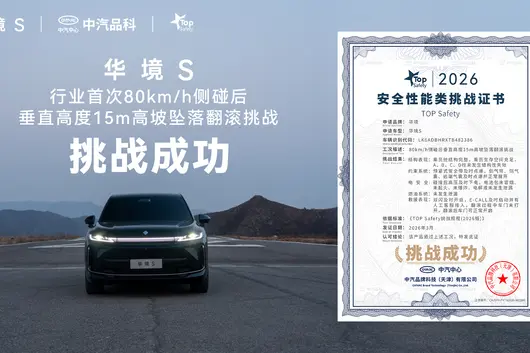
Currently, the laboratory has formed a batch of world-first, internationally leading, and industry-advanced landmark achievements. These include the world-first Intelligent Island Manufacturing System, which was selected for the country's first batch of "Pioneer-level Smart Factory" cultivation list; the Hongjing S passed the industry's first 80km/h side collision 15m high slope drop challenge; the Shenlian battery achieved a 76.6 billion km zero spontaneous combustion record. In addition, Wuling Air EV safety design was incorporated into ASEAN official technical specifications, and the DC charging standard obtained Indonesian SNI certification, achieving a "zero breakthrough" for Chinese vehicle enterprises in the ASEAN standard-setting field, successfully breaking the barriers of US, European, and Japanese standards.

[Hongjing S Passes Industry's First 80km/h Side Collision 15m High Slope Drop Challenge]
This selection in the first batch of National Quality Standard Laboratories is the result of SAIC-GM-Wuling's long-term persistence in positive R&D and deep cultivation of quality infrastructure construction. It means that the enterprise's new energy vehicle quality technology standards will align with the highest national benchmarks, achieving a key leap from "making good cars" to "defining good car standards", truly realizing technological autonomy, standard autonomy, quality autonomy, and controllable safety. At the same time, the laboratory will achieve technical breakthroughs, standard leadership, experimental verification, and industry empowerment through innovative quality management and service models, allowing "Chinese Standards" to go global along the industrial chain, contributing Wuling's strength to the "Belt and Road" standard connectivity. For users, the National Quality Standard Laboratory will become the "highest verification field" for SAIC-GM-Wuling product quality - from Three-Electric safety to body structure, from intelligent connectivity to whole vehicle durability, every model will undergo rigorous refinement under a high-standard, high-starting-point quality system.
Looking to the future, SAIC-GM-Wuling will use the construction of the National Quality Standard Laboratory as strategic support, promoting Chinese new energy vehicles from scale leadership to standard leadership, bringing higher quality mobility experiences to global consumers.

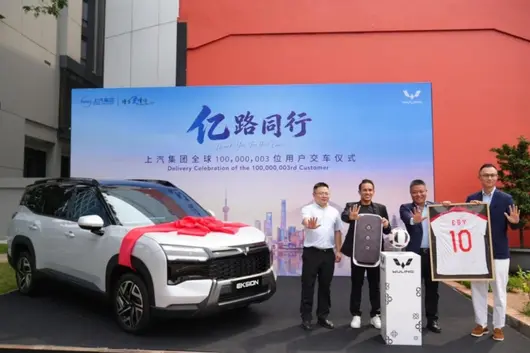
On May 28, in Jakarta, Indonesia, at the delivery site of SAIC-GM-Wuling's global car EKSION, there was not too much noisy ritual, yet it carried a highly symbolic milestone—on this day, SAIC Group welcomed the global delivery of the 100 millionth whole vehicle. 100 million vehicles, this is a number never seen in the history of China's automobile industry. And in this long accumulation chain, SAIC-GM-Wuling alone contributed over 32 million units.
If "100 million vehicles" is the size footnote of SAIC Group as a leading enterprise of China's automobile industry, then the delivery of EKSION in Indonesia looks more like a declaration towards the future: China's automotive globalization is no longer a simple product output, but a "Five Chains Going Global" road covering manufacturing, supply chain, sales, finance, and talent.

From "Hit Product" to "Ecosystem"
Looking back at the development trajectory of SAIC-GM-Wuling, a clear evolutionary path can be seen. The early Wuling Hongguang entered the market with "suitable for business and home, durable and robust", becoming the first car for countless Chinese entrepreneurs; Baojun 730 accurately captured the demand for family consumption upgrades, breaking the monopoly of joint venture brands on the MPV market; in 2020, the Hongguang MINIEV emerged like a thunderclap, activating the blue ocean market for new energy commuting vehicles with extreme cost-effectiveness.
But what is truly worth attention is not the success of single models, but the product methodology gradually formed by this enterprise: Centered on real user scenarios, with extreme cost control as a means, achieving maximum functional satisfaction within a limited price range.
This May, the launch of the Hua Jing S co-created with Huawei Qukun marks that Wuling is breaking through the traditional cognition of "Low Price = Low Configuration", bringing high-level intelligent driving technology into a more mainstream consumer market. From tool-type vehicles to family vehicles, from commuting small cars to intelligent flagship SUVs, Wuling's product matrix has completed a qualitative change.

Indonesia, More Than Just a Market
The delivery of EKSION in Jakarta is worth being amplified and interpreted because behind it is the construction of a set of "localization" capabilities.
Unlike the light mode of early Chinese car enterprises of "full vehicle export, overseas distribution", SAIC-GM-Wuling's investment in Indonesia is heavy asset, systematic. From manufacturing bases to supply chain systems, from sales networks to financial plans, to the training of local talent, Wuling has built a complete automotive industry ecosystem in Indonesia.
This also explains why Wuling can propose the "Indonesia-Malaysia-Thailand Integration" regional strategy. Indonesia, as the largest automotive market in ASEAN, is both a fulcrum and a model. Once the closed loop from manufacturing to sales to service is completed in Indonesia, this system can be quickly replicated in Malaysia, Thailand, Vietnam, Philippines and other surrounding countries.
Data shows that SAIC-GM-Wuling's cumulative overseas sales have broken 1.5 million units, business coverage exceeding 110 countries and regions. But more important than sales volume is the fact that it is outputting a set of "Chinese Standards"—from the flexible production method of the Smart Island Manufacturing System (I²MS) to the global management capability of supply chain collaboration.

Industrial Upgrade Behind "Moving Chains Out"
The so-called "Moving Chains Out" is essentially a dimensional upgrade of the traditional international trade model. In the past, China's automobile exports were more about "moving cars out", the product was sold out, the chain was cut. But Wuling's model is "Moving Chains Out"—moving manufacturing capability, supply chain relations, sales systems, financial services, talent standards all "out" together.
Among these, the most representative is the globally first Smart Island Manufacturing System. Traditional automobile production lines are "people finding cars, cars finding workstations", while the Smart Island model achieves "cars finding workstations, materials finding cars" flexible manufacturing, greatly improving production efficiency and multi-model mixed production capability. This manufacturing system is not only the source of Wuling's domestic competitiveness, but also becomes its technical foundation for quickly responding to local demand and achieving localized production in overseas markets.

Global Car, Chinese Heart
Back to EKSION itself. The delivery of this car in Indonesia is not only the latest step of Wuling's global strategy, it also has a deeper symbolic meaning: when Chinese automobile brands start to tailor products for overseas markets, rather than simply "exporting" domestic models, it means that China's automobile industry has completed the leap from "Going Out" to "Going In".
"Whatever people need, Wuling will build." This slogan, well-known in China, is now being given new connotations. What kind of cars do Indonesian people need? What kind of new energy products does the Southeast Asian market need? The answers to these questions are being written one by one by Wuling's R&D and manufacturing network in Jakarta, in Liuzhou, and around the world.
SAIC Group's 100 million vehicles is a period and also a comma. For Wuling, the real story, perhaps, has just begun.
[CNMO Tech News] On June 3, SAIC Motor announced that recently, the State Administration for Market Regulation officially published the list of the first batch of national quality standard laboratory training and construction candidates. The "National New Energy Vehicle Quality Standard Laboratory" applied by SAIC-GM-Wuling was successfully selected, becoming the only one approved to be built among car manufacturer applications for national quality standard laboratories.

SAIC Motor
According to CNMO Tech, the "National New Energy Vehicle Quality Standard Laboratory" approved by SAIC-GM-Wuling gathers over 4,000 R&D personnel, covering PhDs, Masters, and foreign experts. It features multiple national-level innovation platforms, including postdoctoral research stations, national enterprise technology centers, and national industrial design centers. It owns 14 laboratories of international first-class standards, covering full-chain verification capabilities in three-electric systems, crash testing, NVH, EMC, thermal management, intelligent connectivity, lightweight materials, etc. It has obtained 275 CNAS accreditations (including 81 ECE international accreditations) and possesses full-link testing capabilities from complete vehicles to components.


Three-Electric System Laboratory
Relying on scenario data from 32 million base users and a big data center for new energy vehicles at the million-vehicle level, the laboratory can reproduce real user operating conditions, achieving full-chain quality prediction and closed-loop iteration from R&D testing to user usage, comprehensively supporting the test verification of electrification and intelligence technologies for new energy vehicles.

Currently, the laboratory has formed a batch of global first, internationally leading, and industry-advanced landmark achievements, including the global first intelligent island manufacturing system, which was selected into the national first batch of "Navigator-level Smart Factory" training list; Huanjing S passed the industry's first 80km/h side collision 15m high slope drop challenge; Shenlian Battery achieved a record of 0 spontaneous combustion over 76.6 billion kilometers. In addition, the Wuling Air ev safety design was included in ASEAN official technical specifications, the DC charging standard obtained Indonesian SNI certification, achieving a "zero breakthrough" for Chinese car manufacturers in the ASEAN standard-setting field, and successfully breaking the standards barriers of Europe, the US, and Japan.
© 2024 Bitauto.com. All Rights Reserved.
Bitauto (www.yiche.com and www.bitauto.com) is one of the most visited automotive websites in China. We provide detailed info on Chinese car brands available in your area. Please note that the information provided on this website is based on publicly available data and is for reference only. It may not be fully updated or accurate at all times.

Help us improve our website


