

HomeWuling

Search History
Popular Searches
Dealer Login / Sign Up

On October 22, 2026, SAIC-GM-Wuling announced that the cumulative sales of the Bingo Family surpassed 800,000 units. This milestone data proves that it has transcended the limitations of a single hit product and matured into a user-oriented product family in the A0-class new energy commuting segment. Since the first Bingo went on sale in 2023, within three years, the Bingo, Bingo Plus, Bingo S, and Bingo Pro four models were launched successively, forming a product matrix with clear gradients. In August and September of this year, the Bingo Family's monthly sales exceeded 20,000 units for two consecutive months, stably ranking in the first tier of small pure electric sedans. 
Under the matrix stratification, each vehicle model has its own focus. Bingo Pro focuses on entry-level full configuration, starting at 56,800, with 80+ standard configurations. The five-door five-seater design paired with high space efficiency, the 403km version supports 15-minute 30%-80% fast charging, lowering the entry threshold for premium commuting. The Bingo S targets higher quality needs, with up to 525km range, featuring liquid-cooled batteries, 74.5% high-strength steel content, standard four airbags, and smart infotainment with wireless fast charging, catering to family travel needs.
A series of industry awards form an endorsement of the product's technical strength. Bingo won the Silver Award for Design at the China Patent Awards, Bingo S won the International CMF Design Award and China Top 10 Car Bodies, and the 12-in-1 electric drive of Bingo Pro received the domestic first five-star quality electric drive certification, pulling the evaluation standard of A0-class vehicles from low price, easy to drive and park, up to the dimension of overall vehicle quality.
While establishing a foothold in the domestic market, the Bingo Family continues to expand overseas, with products landing in markets such as Indonesia, Thailand, and Pakistan. Wuling is not simply exporting modified models, but exporting the mature premium commuting model verified domestically. 800,000 units represents the market's recognition of the trend of premium commuting consumption upgrade, and also establishes the Bingo Family's leading position in the A0-class pure electric market.
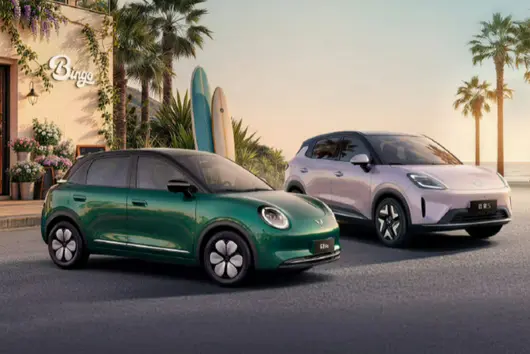

22 Oktober 2026, SAIC-GM-Wuling mengumumkan, Keluarga Wuling Bingo telah capai jualan kumulatif melebihi 800,000 unit. Data tonggak ini membuktikan ia telah melampaui had produk viral tunggal, berkembang menjadi keluarga produk berorientasikan pengguna yang matang dalam segmen pengangkutan tenaga baharu Kelas A0. Sejak pelancaran Wuling Bingo pertama pada 2023, dalam tempoh tiga tahun, model Wuling Bingo, Wuling Bingo Plus, Wuling Bingo S, dan Wuling Bingo Pro berturut-turut dilancarkan, membina matriks produk dengan lapisan yang jelas. Pada bulan Ogos hingga September tahun ini, Keluarga Wuling Bingo berjaya melebihi 20,000 unit jualan sebulan selama dua bulan berturut-turut, kekal stabil dalam barisan depan kereta elektrik kompak.
Di bawah pembenihan matriks, kedudukan model mempunyai tumpuan masing-masing. Wuling Bingo Pro menargetkan spesifikasi penuh tahap permulaan, harga bermula 56,800, dilengkapi lebih daripada 80 jenis spesifikasi, lima pintu lima tempat duduk ditambah kegunaan ruang tinggi, versi 403 km menyokong cas pantas 30%-80% dalam 15 minit, menurunkan ambang permulaan pengangkutan premium. Wuling Bingo S menargetkan keperluan kualiti lebih tinggi, julat jarak paling tinggi 525 km, dilengkapi bateri berpendingin cecair, keluli kekuatan tinggi merangkumi 74.5%, dilengkapi empat beg udara standard, ditambah sistem kereta pintar dan cas pantas tanpa wayar, sesuai dengan keperluan perjalanan keluarga.
Serangkaian anugerah industri, membentuk sandaran kekuatan asas produk. Wuling Bingo menang Anugerah Reka Bentuk Luar Anugerah Paten China, Wuling Bingo S memungut Anugerah Reka Bentuk CMF Antarabangsa, Badan Kereta Teratas 10 China, Wuling Bingo Pro pendorong elektrik dua belas dalam satu capai pengesahan pendorong elektrik kualiti lima bintang pertama di dalam negara, menaikkan ukuran penilaian model Kelas A0, dari harga rendah mudah dikemudi mudah diparkir, dinaikkan ke dimensi kualiti kenderaan penuh.
Sambil meneguhkan kedudukan di pasaran domestik, Keluarga Wuling Bingo terus menembusi pasaran antarabangsa, produk berturut-turut mendarat di pasaran Indonesia, Thailand, Pakistan dan lain-lain. Wuling bukan sekadar mengubah model untuk eksport, sebaliknya mengekspor model pengangkutan premium yang telah diuji matang di dalam negara. 800,000 unit, adalah pengiktirafan pasaran terhadap trend peningkatan pengangkutan premium, juga menentukan kedudukan kepimpinan Keluarga Wuling Bingo dalam pasaran elektrik Kelas A0.

On October 22, SAIC-GM-Wuling officially announced that the cumulative sales of the Bingo family have officially exceeded 800,000 units. Since the launch of the first Wuling Bingo in 2023, this family has sequentially introduced models such as Bingo, Bingo PLUS, Bingo S, and Bingo Pro, reaching a cumulative sales of 800,000 units in three years. In August and September 2026, the monthly sales of the Bingo family exceeded 20,000 units each, ranking in the TOP 2 of small new energy sedan sales. As a reference, the cumulative global sales of Wuling commuter cars have exceeded 3,000,000 units.

In terms of products, the Bingo family has formed a product matrix covering different range, space, and configuration needs. From the entry-level version focusing on exquisite and small design to the advanced models with long range and large space, CLTC range covers 203km to 525km, corresponding to different usage scenarios such as short-distance commuting, city commuting, and nearby travel. Among them, the Bingo Pro launched in May 2026 is priced from 56,800 to 70,800 yuan, with cumulative sales exceeding 50,000 units within 80 days of launch; Bingo S offers three range versions of 325km, 430km, and 525km.
In terms of design, the retro and rounded styling is a signature feature of the Bingo family, officially summarized as the "Retro Fluid Aesthetics" design language. This year, the Wuling Bingo "Automobile" appearance design patent won the Silver Prize for Chinese Industrial Design at the 26th China Patent Award. In terms of practicality, multiple models are equipped with a sunken trunk. Taking the Bingo Pro as an example, its space utilization rate reaches 84.8%, and the storage space can be expanded to 1,370L after folding the rear seats, capable of accommodating large items such as strollers and camping equipment; the infotainment system is equipped with the LingOS system, supporting AI voice interaction without a wake word. The Bingo S is equipped with an upgraded smart cockpit, integrating large AI model capabilities to achieve smoother human-machine dialogue. According to official information, the Bingo S has been awarded "2025 China Top 10 Car Bodies", with a high-strength steel ratio of the white body reaching 74.5%, and four airbags are standard across the entire series.
In terms of charging, family models support fast charging. Taking the Bingo Pro 403km version as an example, it takes about 15 minutes to charge from 30% to 80%, capable of adapting to different charging scenarios such as public fast charging and home slow charging. In terms of channels, relying on Wuling's relatively widespread distribution and service network, users can obtain corresponding service support in the purchasing and maintenance links.
Against the background of increasingly fierce competition in the A0-class pure electric market, the Bingo family has continued its product positioning aimed at ordinary family users, maintaining a balance between price, space, and configuration. The cumulative sales of 800,000 units reflect the scale of real-world demand for commuting in this price segment. Currently, the Bingo family has entered overseas markets such as Indonesia, Thailand, and Pakistan. SAIC-GM-Wuling stated that it will continue to promote the product layout of new energy commuter cars in the direction of premiumization and globalization.
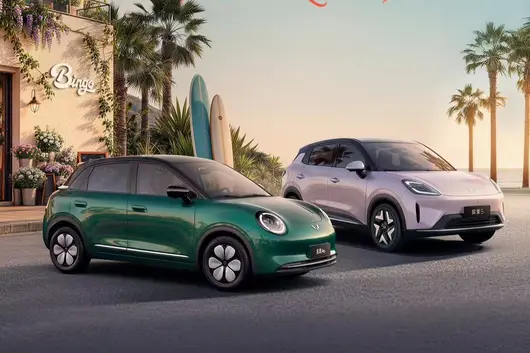

22 Oktober, SAIC-GM-Wuling secara rasmi mengisytiharkan bahawa jualan terkumpul Keluarga Binguo telah secara rasmi melepasi 800,000 unit. Sejak pelancaran pertama Wuling Binguo pada tahun 2023, keluarga ini secara berurutan melancarkan model-model seperti Binguo, Binguo PLUS, Binguo S, dan Binguo Pro, dengan jumlah jualan terkumpul mencapai 800,000 unit dalam tempoh tiga tahun. Pada Ogos dan September 2026, jualan bulanan Keluarga Binguo masing-masing telah melebihi 20,000 unit, menduduki kedudukan ke-2 dalam senarai jualan sedan elektrik kecil. Sebagai rujukan, jualan terkumpul kereta Wuling untuk pengangkutan harian di seluruh dunia telah melebihi 3 juta unit.
Dari segi produk, Keluarga Binguo telah membentuk rangkaian produk yang merangkumi keperluan julat bateri, ruang, dan konfigurasi yang berbeza. Dari versi permulaan yang menonjolkan saiz kecil dan bergaya, sehingga model tahap lanjut dengan julat bateri panjang dan ruang besar, julat CLTC merangkumi 203km hingga 525km, sesuai untuk senario penggunaan berbeza seperti pengangkutan jarak dekat, perjalanan kerja bandar, dan perjalanan rekreasi luar bandar. Daripada itu, Binguo Pro yang dilancarkan pada Mei 2026 berharga 56,800 hingga 70,800 yuan, jualan terkumpul selepas 80 hari melebihi 50,000 unit; Binguo S menawarkan tiga versi julat iaitu 325km, 430km, dan 525km.
Dari segi reka bentuk, corak bulat klasik adalah ciri penanda Keluarga Binguo, pihak rasmi meringkasnya sebagai bahasa reka bentuk "Estetika Aliran Klasik". Tahun ini, paten reka bentuk luaran kereta Wuling Binguo telah memenangi Pingat Perak reka bentuk luaran China pada Hadiah Paten China ke-26. Dari segi kegunaan, pelbagai model dilengkapi dengan ruang beg yang lebih rendah, sebagai contoh Binguo Pro, kegunaan ruangnya mencapai 84.8%, selepas melunjurkan baris belakang ruang simpanan boleh dikembangkan hingga 1370L, boleh memuatkan barang besar seperti kerusi roda bayi, peralatan kem; sistem kereta dilengkapi dengan Sistem LingOS, menyokong interaksi suara AI tanpa panggilan, Binguo S dilengkapi dengan kokpit pintar yang di-upgrade, menyambung ke keupayaan model besar, mencapai perbualan manusia-mesin yang lebih lancar. Sekadar maklumat rasmi, Binguo S telah dianugerahkan "10 Kereta Terbaik China 2025", nisbah keluli berkekuatan tinggi dalam kenderaan putih mencapai 74.5%, keseluruhan siri dilengkapi piawai dengan empat beg udara.
Dari segi pengisian tenaga, model keluarga menyokong cas pantas, sebagai contoh versi Pro 403km Binguo, kuasa bateri dari 30% dicas hingga 80% memerlukan kira-kira 15 minit, boleh disesuaikan untuk senario pengisian kuasa berbeza seperti cas pantas awam dan cas perlahan di rumah. Dari segi saluran, dengan memanfaatkan rangkaian perkhidmatan peruncit yang luas yang dirakamkan oleh Wuling, pengguna boleh menerima sokongan perkhidmatan yang berkaitan dalam proses pembelian kereta dan penyelenggaraan.
Dalam latar belakang persaingan pasaran elektrik tulen kelas A0 yang semakin sengit, Keluarga Binguo meneruskan penjenamaan yang menumpukan kepada pengguna keluarga biasa, mengekalkan keseimbangan antara harga, ruang dan konfigurasi. Jualan terkumpul 800,000 unit mencerminkan skala keperluan sebenar untuk pengangkutan di segmen harga ini. Pada masa ini, Keluarga Binguo telah memasuki pasaran luar negara seperti Indonesia, Thailand, Pakistan dan lain-lain. SAIC-GM-Wuling menyatakan akan meneruskan memajukan pelan susun atur produk untuk pengangkutan baru dalam arah premiumisasi dan globalisasi.



September in Guangxi sees two important milestones for Chinese automobile exports one after another
On September 8, a batch of auto parts departed from Guangxi to Vietnam via the Pinglu Canal. Compared to previous exports via Guangzhou and Shenzhen, this new route is expected to reduce logistics costs by 18%. Nine days later, at the 23rd China-ASEAN Expo, SAIC-GM-Wuling officially released its Global 5 global strategy and signed a strategic cooperation agreement with Malaysia Chan Chang Group on the localized battery CKD project.

One is a logistics channel connecting to the sea, and the other is a corporate strategy facing the global market. Seemingly belonging to different dimensions, they both point to the same proposition: How Chinese automobiles can shift from "going out" to "going deep" in the global market, thereby achieving long-term, stable, and sustainable operations.
In recent years, Chinese automobile exports have grown rapidly, with new energy vehicles becoming an important incremental factor. However, with intensifying international market competition, rising tariffs, regulations, supply chain security requirements, and localization demands, the model of opening markets solely through whole vehicle trade is facing challenges. The export of Chinese automobiles has entered a new phase of competing on system capabilities: it requires not only products but also the ability to implement manufacturing, supply chains, services, talent, finance, and standards collaboratively.
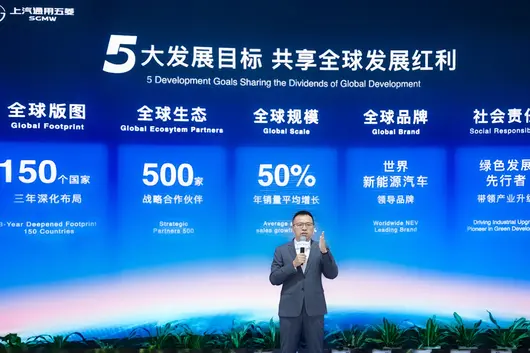
SAIC-GM-Wuling's release of the Global 5 global strategy at this juncture is a systematic response to changes in the industry environment. With the core "5S System" comprising five strength foundations, five cooperation models, five service guarantees, five market layouts, and five development goals, SAIC-GM-Wuling has built a new globalization concept. In the next 3 years, it will deepen its layout in 150 countries, expand 500 strategic partners, achieve an average annual sales growth of 50%, and strive to become a leading global brand in new energy vehicles.

This is both a grand plan and reflects new thinking by Chinese automakers on the logic of globalization development: overseas markets are not simply an extension of domestic competition, and going out cannot be limited to increasing export quantities. Instead, it must establish operating systems rooted locally around the industrial foundations, policy environments, and consumption demands of different countries.
Going Out Is Not Just About Selling Cars, But Building an Ecosystem
SAIC-GM-Wuling's globalization did not start from scratch. After 31 years of exploration, its products have entered over 120 countries and regions, with cumulative overseas sales exceeding 1.6 million units (sets), and overseas exports growing for 10 consecutive years. From January to August this year, SAIC-GM-Wuling's exports exceeded 240,000 units (sets), with monthly exports surpassing 30,000 units (sets) for 5 consecutive months. To date, SAIC-GM-Wuling's global cumulative production and sales have exceeded 32 million units, with cumulative new energy vehicle sales exceeding 4 million units.
Scale is the foundation for enterprises to further globalize, but scale itself does not equal global competitiveness. What truly deserves attention is that SAIC-GM-Wuling is converting the product, technology, and industrial chain advantages accumulated domestically into a system that can be replicated, adapted, and operated continuously overseas.
"Behind this is the systematic overseas expansion of SAIC-GM-Wuling with 'Five Chains Integration' as the core." Liu Yan, Deputy Secretary of the Party Committee of the Overseas Division of SAIC-GM-Wuling, told reporters from China Automotive News, "SAIC-GM-Wuling is promoting the synergy and overall implementation of the intelligent manufacturing chain, supply chain, sales chain, talent chain, and financial chain—the 'Five Chains'—to complete the leap from whole vehicle exports to ecosystem construction."
The intelligent manufacturing chain is a key support for the implementation of the overseas system. Backed by the world-first I²MS intelligent island manufacturing system, SAIC-GM-Wuling has built I²MS-NKD intelligent island semi-knock-down assembly workshops with an annual packaging and shipping capacity of 250,000 units (sets). Compared with traditional fixed assembly lines, the intelligent island model emphasizes flexible organization and modular production, which is conducive to adapting to the needs of the overseas market for multiple varieties, small batches, and rapid switching. Through the interconnection of domestic and overseas manufacturing nodes, multimodal transport costs via road, rail, and water can be reduced by 30%.

The value of this model lies not only in improving production efficiency but also in reallocating the functions of domestic bases and overseas factories. SAIC-GM-Wuling's Liuzhou headquarters undertakes R&D, technology and standard output, talent empowerment, and supply chain coordination, while overseas bases focus on local production, local supply chain cultivation, and market operations. Liu Yan summarized it as "Capability Output + Local Adaptation": the headquarters outputs product platforms and process standards, while overseas bases conduct adaptive development combining local needs, achieving bidirectional synergy in R&D, manufacturing, and supply chains.
The supply chain is the foundation of system overseas expansion. Acting as the "chain owner," SAIC-GM-Wuling led 17 domestic core suppliers to jointly layout overseas, covering core components such as batteries, motors, and electronic control. It also independently developed over 100 local suppliers in Indonesia, increasing the localization rate of local factories to over 60%. For parts enterprises following the OEMs overseas, this synergy can reduce the cost of independently opening up markets and improve order stability. For whole vehicle enterprises, it can shorten logistics cycles, reduce tariff expenses, and enhance supply chain resilience.
"Five Chain Synergy" has not stopped at the production stage. In the sales chain, SAIC-GM-Wuling entered the market in the mode of "Vehicle + Charging Facilities", currently having built over 200 dealer stores and more than 1,000 public charging piles, and providing free home charging pile installation for 15,000 users. In the talent chain, it trained local technical talents through education and training centers and industry-education integration projects, cumulatively training over 400 international students. In the finance chain, Indonesia's diversified finance company provides financing and insurance services for 150 local dealers and end consumers.

This means that as a vehicle enters the overseas market, supporting manufacturing capabilities, supply systems, sales channels, charging facilities, vocational education, and financial services also land synchronously. Compared to traditional whole vehicle exports, although this model involves heavier investment and a longer construction cycle, it enhances the connection between the enterprise and the local industry, employment, and consumption systems.
Liu Yan believes that localization is "not just about building factories, but building ecosystems." Only by cultivating local suppliers, co-building infrastructure, and training local talents, allowing the local area to share the value of industrial development, can enterprises change from "guests" of the market to "family" of the industry. This judgment grasps the core change in current Chinese automobile exports: competitiveness is shifting from the "cost-performance ratio of a single car" to the "synergy of an industrial chain" and the depth of rooting locally.
Promoting Deep Localization with ASEAN as a Fulcrum
In the global automobile market, different countries have significant differences in market size, industrial foundation, investment policies, tariff systems, and consumption habits. If globalization is promoted with a single model, it will not only be costly but also prone to mismatches between production capacity, channels, and market demand.
SAIC-GM-Wuling's Global 5 strategy proposes five cooperation models for this: trade, distribution, production and sales, full industrial chain, and technology licensing, flexibly adapting by depth according to the development stage of different markets. Liu Yan introduced that for markets that do not yet have local manufacturing conditions, trade or distribution models can be adopted first; for countries with certain industrial foundations and localization policy requirements, production and sales models such as KD and CKD assembly can be adopted; in markets with relatively complete industrial chain foundations, full industrial chain cooperation can be further promoted; in some markets, products, management experience, and talent capabilities can be exported through technology licensing.
From the existing layout, the Philippines focuses on distribution cooperation, with the enterprise providing market, brand, channel, and service support to partners. Markets such as Thailand, Vietnam, Cambodia, and Myanmar adopt production and sales models more frequently, reducing comprehensive costs through KD or CKD assembly and meeting local manufacturing requirements. Indonesia has become a representative of the full industrial chain model, promoting manufacturing, supply chain, sales, talent, finance, and standard construction synchronously. Markets such as India and Malaysia have also formed practices in technology licensing cooperation.
This differentiated path addresses the problem of how to balance "wide coverage" and "high-quality growth" in global operations. Trade and distribution models have relatively lighter investment, conducive to quickly entering markets and verifying demand. Production and sales and full industrial chain models can form long-term capabilities in key markets. Technology licensing helps integrate local partner resources and reduces the uncertainty of independent investment. Different models are not isolated but can be upgraded gradually as market size and industrial conditions change.
ASEAN is an important testing ground for this model and also the bridgehead for SAIC-GM-Wuling's global layout. On one hand, China and ASEAN are geographically close with complementary industries, and regional economic and trade ties continue to deepen. On the other hand, the market maturity, localization policies, and industrial capabilities of ASEAN countries differ significantly, providing application space for various cooperation models. Currently, SAIC-GM-Wuling has laid out CKD factories in Indonesia, India, Egypt, Malaysia, Vietnam, and other places, and is promoting "Indonesia-Malaysia-Thailand Integration" with Indonesia as an anchor, further radiating to markets such as Vietnam and the Philippines.

The cooperation this time with Malaysia's Chan Chang Group to build a battery localization CKD production line is the first landed project after the release of the Global 5 global strategy, also reflecting the enterprise's localization thinking extending from whole vehicle manufacturing to core components. Facing the rising thresholds for battery and whole vehicle localization in ASEAN countries, battery localization production can reduce import taxes, improve cost structures, and enhance the stability of core component supply.
Liu Yan stated that this project will export the core component supply chain, build a Malaysia-based autonomous supply chain system, and further improve SAIC-GM-Wuling's industrial map in ASEAN. Its significance is not only to reduce the production costs of a single vehicle model but also to form battery support capabilities that can serve the regional market and drive the Guangxi new energy vehicle industry chain to participate in cross-border synergy.
From a deeper level, the value of the ASEAN market for Chinese automakers is no longer just sales growth. Here is a market where new energy vehicle demand is growing rapidly, and also an important platform for testing Chinese automakers' global manufacturing, local operations, and cross-cultural adaptation capabilities. Only by establishing mature models in the complex and diverse environment of ASEAN can these capabilities be further replicated to other global regions.
Local Adaptation and Standard Output Advance Together
System overseas expansion ultimately needs to be implemented into user value. The demand of ASEAN consumers for new energy vehicles can be summarized as high cost-performance, high reliability, high convenience, and high adaptability. Purchase and usage costs remain important decision factors, but high temperature and high humidity climate, complex road conditions, multi-language environments, as well as charging and after-sales networks, also put more detailed requirements on products.
To this end, SAIC-GM-Wuling formed a "5+N" global product layout, with five global products: Starlight 560, Starlight 730, 5th Gen Wuling Hongguang MINIEV, Bingo Family, Yangguang EV, covering SUV, MPV, micro mobility, urban new energy, and commercial vehicle markets, and developing niche demands through other categories. Products are not simply exporting domestic models with changed badges, but emphasize "Global Platform, Local Adaptation".

Taking Indonesia as an example, the local population is dense and family sizes are relatively large, with stable demand for MPVs. Starlight 730 has undergone more than a dozen optimizations for Indonesian usage scenarios. The enterprise also adjusted interior materials, air conditioning systems, car systems, and AI voice interaction around Islamic culture worship needs, high temperature and high humidity climate, local network conditions, and dialect accents. From this, it can be seen that localization capabilities have penetrated into product definition and R&D front ends, not just the production stage.
Beyond product adaptation, the output of technical standards is becoming new content for Chinese automobile globalization. In the past, Chinese automobiles entering overseas markets mainly met local existing regulations. Now, with the expansion of leading advantages in new energy vehicle technology and industrial scale, Chinese enterprises are beginning to participate in regional rule and technical standard construction.
SAIC-GM-Wuling jointly established the China-ASEAN Automobile Standard and Regulation Research Platform with relevant institutions, promoting the passage of Chinese DC fast charging equipment through Indonesia's SNI certification, enabling national standard DC fast charging piles to be legally deployed locally; the safety design of Air ev has been included in relevant ASEAN technical specifications. In Thailand, the enterprise participated in standard policy discussions around battery sustainable management, power battery recycling, and battery passport tracing, and carried out cooperation on ASEAN electric vehicle standard systems, technical terminology, and talent training.
"For Chinese automobile brands, technical standard output is the symbol of going from 'following and running alongside' to 'leading'." Liu Yan stated that co-building standards can reduce repeated testing and certification, lowering the institutional costs for enterprises entering the ASEAN market; at the same time, it can also export new energy vehicle regulations, testing, and certification experiences locally, promoting the co-construction and sharing of regional testing and certification capabilities.
For the entire industry, China and ASEAN strengthening standard acceptance and mutual recognition of testing helps reduce repeated investment and provide convenience for more Chinese brands to enter regional markets; for the host country, it can accelerate the construction of new energy vehicle industry infrastructure and regulatory systems. Standard co-building promoted by enterprises should ultimately form public value for industrial cooperation, not just the company's own competitive barriers.

From this perspective, the novelty shown in the Global 5 strategy lies in including products, manufacturing, supply chains, and market layouts into the same globalization framework, and placing services, talent, finance, standards, and sustainable development in positions equally important to sales volume. What it pursues is to form a long-term mechanism that benefits enterprises, partners, suppliers, and local society together.
Chinese automobile exports are still in a growth period, but the industry's evaluation scale is changing. In the future, the standards for measuring an automaker's globalization level will not only include export volume and overseas revenue, but also include local manufacturing capabilities, supply chain resilience, brand recognition, compliance capabilities, standard participation, and contributions to local industry and society.
Starting from Liuzhou, connecting to ASEAN via Pinglu Canal, and radiating to five continents from ASEAN, SAIC-GM-Wuling is exploring an advanced path from product trade, capability output to ecosystem co-construction. Its value lies not only in the enterprise opening up new growth space for itself, but also in providing an observable, verifiable, and replicable practical sample for Chinese automobile exports.
Globalization has never been a sprint. The Global 5 strategy proposes goals for the next 3 years, but what truly needs to be established is operational capability facing a longer cycle. For Chinese automobiles to go steady and far in the global market, they must not only maintain product and technology advantages but also learn to grow together with local industries. From "selling out" to "staying", and then to "joint development", this might well be the most important direction for the next stage of Chinese automobile exports.

Guangxi pada bulan September, disambut berturut-turut dua titik penting berkaitan eksport automotif China
8 September, set automotif dari Guangxi berangkat, melalui Saliran Pinglu dihantar ke Vietnam. Berbanding eksport lalu melalui Guangzhou, Shenzhen, laluan baharu ini dijangka boleh menurunkan kos logistik sebanyak 18%. 9 hari kemudian, pada Pameran China-ASEAN ke-23, SAIC-GM-Wuling secara rasmi melancarkan Strategi Global 5, dan menandatangani Perjanjian Kerjasama Strategik Projek CKD Pengeluaran Bateri Tempatan dengan Kumpulan Chan Chong Malaysia.
Satu adalah laluan logistik yang menghubungkan ke lautan, satu pula strategik perusahaan yang bersifat global, kelihatan berbeza dimensi, namun di belakangnya merujuk kepada satu soalan sama: Bagaimanakah automotif China dalam pasaran global beralih dari "keluar ke luar" ke "masuk ke dalam", seterusnya mencapai operasi jangka panjang, stabil dan berkelanjutan.
Beberapa tahun lepas, eksport automotif China meningkat pesat, kenderaan elektrik menjadi peningkatan penting. Namun seiring persaingan pasaran antarabangsa semakin meningkat, tarif, peraturan, keselamatan rantaian bekalan dan keperluan tempatan semakin tinggi, model membuka pasaran hanya bergantung perdagangan kenderaan siap menghadapi cabaran. Eksport automotif China telah masuk ke peringkat baharu yang membandingkan keupayaan sistem: bukan sahaja perlu produk, malah perlu keupayaan pembumian yang bersinergi pengeluaran, rantaian bekalan, perkhidmatan, bakat, kewangan dan piawaian.
SAIC-GM-Wuling dalam titik ini melancarkan Strategi Global 5, tepat merupakan respons sistemik terhadap perubahan persekitaran industri. SAIC-GM-Wuling dengan lima asas kekuatan, lima model kerjasama, lima perkhidmatan jaminan, lima taburan pasaran dan lima sasaran pembangunan sebagai teras "Sistem 5S", membina idea baharu globalisasi, 3 tahun akan datang akan memperdalam taburan 150 negara, mengembangkan 500 rakan strategik, mencapai pertumbuhan jualan tahunan purata 50%, bergerak ke arah jenama kepimpinan kenderaan elektrik global.
Ini bukan sahaja pelan agung, malah mencerminkan pemikiran baharu syarikat automotif China terhadap logik pembangunan global: pasaran luar negara bukan lanjutan mudah persaingan dalaman, eksport tidak boleh berhenti pada penambahan bilangan eksport, malah perlu mengikut asas industri negara berbeza, persekitaran dasar dan permintaan penggunaan, membina sistem operasi yang boleh berakar tempatan.
Eksport bukan sahaja jualan kereta, malah perlu membina ekosistem
Globalisasi SAIC-GM-Wuling bukan bermula dari sifar.经过 31 年探索 -> Selepas 31 tahun penerokaan (Wait, translate number too: 31 tahun).其产品已进入 120 多个国家和地区,海外累计销量突破 160 万辆(套), 海外出口连续 10 年增长。 -> Produknya telah memasuki lebih 120 negara dan wilayah, penjualan terkumpul luar negara melebihi 1.6 juta unit (set), eksport luar negara berturut-turut 10 tahun meningkat。今年 1-8 月,上汽通用五菱出口突破 24 万辆(套),连续 5 个月单月出口超过 3 万辆(套)。 -> Tahun ini Jan Ogos, eksport SAIC-GM-Wuling melebihi 240,000 unit (set), 5 bulan berturut-turut jualan tunggal melebihi 30,000 unit (set). 时至今日,上汽通用五菱全球累计产销已突破 3200 万辆,新能源汽车累计销量超过 400 万辆。 -> Sehingga hari ini, penjualan dan pengeluaran terkumpul global SAIC-GM-Wuling telah melebihi 32 juta unit, penjualan terkumpul kenderaan elektrik melebihi 4 juta unit.
Skal adalah asas perusahaan semakin global, namun skala itu sendiri tidak sama dengan daya saing global. Yang benar-benar perlu diberi perhatian ialah, SAIC-GM-Wuling sedang mengubah kelebihan produk, teknologi dan rantaian industri terkumpul domestik, menjadi satu set sistem yang boleh direplikasi, disesuaikan dan beroperasi secara berterusan di luar negara.
"Di sebalik ini, adalah 'Penyatuan Lima Rantaian' sebagai teras sistemik SAIC-GM-Wuling." Liu Yan, Setiausaha Komite Parti Bahagian Luar Negeri SAIC-GM-Wuling, ketika menerima wawancara wartawan "Koran Automotif China", berkata, SAIC-GM-Wuling sedang mendorong sintesis dan pembumian keseluruhan "Lima Rantaian": Rantaian Pembuatan Pintar, Rantaian Bekalan, Rantaian Jualan, Rantaian Bakat dan Rantaian Kewangan, dengan demikian menamatkan daripada eksport kenderaan siap ke lompatan pembinaan ekosistem.
Rantaian Pembuatan Pintar adalah sokongan utama pembumian sistem luar negara. SAIC-GM-Wuling dengan sistem pembuatan Pulau Pintar I²MS ciptaan dunia sebagai sokongan, membina bengkel assembly suku cadang I²MS-NKD Pintar, mempunyai keupayaan pembungkusan dan penghantaran tahunan 250,000 unit (set). Berbanding talian tetap tradisional, mod Pulau Pintar menekankan organisasi lentur dan pengeluaran modular, memudahkan menyesuaikan keperluan pelbagai jenis, jumlah kecil dan pertukaran pantas pasaran luar negara. Melalui penghubung titik pembuatan domestik dan luar negara, kos pelbagai moda pengangkutan darat, kereta api dan air boleh diturunkan 30%.
Nilai mod ini, bukan sahaja meningkatkan kecekapan pengeluaran, malah memaksudkan pengagungan semula fungsi tapak domestik dan kilang luar negara. Ibu pejabat utama Liuzhou SAIC-GM-Wuling menanggung pengeluaran penyelidikan, teknologi dan piawaian, pemberdayaan bakat serta penstrukturan rantaian bekalan, tapak luar negara lebih menumpukan pengeluaran tempatan, pembiakan rantaian bekalan tempatan dan operasi pasaran. Liu Yan merumuskannya sebagai "Output Keupayaan + Penyesuaian Tempatan": Ibu pejabat output platform produk dan piawaian proses, tapak luar negara menggabungkan keperluan tempatan untuk pembangunan adaptasi, untuk mencapai sinkronisasi dua hala penyelidikan, pengeluaran dan rantaian bekalan.
Rantaian bekalan adalah asas ekosistem. SAIC-GM-Wuling dengan identiti "Pemilik Rantaian" membawa 17 pembekal teras domestik bersama-sama meluas luar negara, meliputi bateri, motor, sistem kawalan dan komponen teras lain, dan di Indonesia membangunkan lebih 100 pembekal tempatan secara autonomi, menjadikan kadar penyesuaian tempatan kilang tempatan melebihi 60%. Bagi syarikat komponen yang mengikuti kilang utama ke luar negara, sinergi ini boleh menurunkan kos开拓 pasaran secara mandiri, meningkatkan kestabilan pesanan; bagi perusahaan kenderaan utama, boleh memendekkan kitaran logistik, mengurangkan perbelanjaan tarif, meningkatkan ketahanan rantaian bekalan.
"Lima Rantaian Bersinergi" tidak berhenti pada peringkat pengeluaran. Dalam Rantaian Jualan, SAIC-GM-Wuling dengan cara "Kenderaan + Fasilitas Pengisian" masuk pasaran, hingga kini telah membina lebih 200 bengkel pengedar, lebih 1,000 tiang pengecas awam, dan untuk 15,000 pengguna memasang tiang pengecas rumah percuma; Dalam Rantaian Bakat, melalui pusat pendidikan latihan dan projek integrasi industri-pendidikan memupuk bakat teknikal tempatan, terkumpul memupuk pelajar antarabangsa lebih 400 orang; Dalam Rantaian Kewangan, syarikat kewangan pelbagai Indonesia menyediakan perkhidmatan pembiayaan dan insurans untuk 150 pengedar tempatan dan pengguna terminal.
Ini bermakna, semasa sebuah kenderaan masuk pasaran luar negara, kapasiti pengeluaran yang disokong, sistem bekalan, saluran jualan, fasilitas pengecas, pendidikan vokasional dan perkhidmatan kewangan juga berlaku pembumian serentak. Berbanding eksport kenderaan siap tradisional, mod ini walaupun pelaburan lebih berat, kitaran pembinaan lebih lama, tetapi boleh meningkatkan tahap sambungan perusahaan dengan industri tempatan, pekerjaan dan sistem penggunaan.
Liu Yan berpendapat, tempatan "bukan sahaja membina kilang, malah membina ekosistem". Hanya memupuk pembekal tempatan, bersama membina infrastruktur, memupuk bakat tempatan, membiarkan tempatan berkongsi nilai pembangunan industri, perusahaan boleh berubah daripada "tetamu" pasaran kepada "keluarga" industri. Penilaian ini menangkap perubahan teras eksport automotif China semasa: daya saing sedang berubah dari "nisbah harga-kegunaan satu kenderaan", kepada "keupayaan sintesis satu rantaian industri", serta kedalaman berakar tempatan.
Menggunakan ASEAN sebagai titik sokongan memajukan tempatanan mendalam
Dalam pasaran automotif global, negara berbeza dalam saiz pasaran, asas industri, dasar pelaburan, sistem tarif dan kebiasaan penggunaan wujud perbezaan ketara. Jika menggunakan satu mod memajukan globalisasi, bukan sahaja kos tinggi, juga mudah berlaku penyesuaian antara kapasiti, saluran dan permintaan pasaran.
SAIC-GM-Wuling Global 5 strategik untuk ini mencadangkan perdagangan, pengedaran, pengeluaran-penjualan, seluruh rantaian industri dan lesen teknologi lima mod kerjasama, dan mengikut tahap pembangunan pasaran berbeza dari cetek ke dalam, menyesuaikan secara fleksibel. Liu Yan memperkenalkan, bagi pasaran yang sementara tidak mempunyai keadaan pengeluaran tempatan, boleh terlebih dahulu menggunakan mod perdagangan atau pengedaran; bagi negara dengan asas industri tertentu dan wujud keperluan dasar tempatan, maka menggunakan mod pengeluaran-penjualan seperti assembly KD, CKD; Dalam pasaran yang asas rantaian industri lebih lengkap, boleh memajukan kerjasama seluruh rantaian industri lebih lanjut; Dalam beberapa pasaran, maka melalui output lesen teknologi produk, pengalaman pengurusan dan keupayaan bakat.
Dari taburan sedia ada, Filipina dengan kerjasama pengedaran utama, oleh perusahaan kepada rakan kongsi menyediakan pasaran, jenama, saluran dan sokongan perkhidmatan; Pasaran Thailand, Vietnam, Kemboja, Myanmar lebih menggunakan mod pengeluaran-penjualan, melalui KD atau CKD assembly menurunkan kos komprehensif, dan memenuhi keperluan pembuatan tempatan; Indonesia menjadi wakil mod seluruh rantaian industri, pembuatan, rantaian bekalan, jualan, bakat, kewangan dan pembinaan piawaian berjalan serentak; Pasaran India, Malaysia juga telah membentuk amalan kerjasama lesen teknologi.
Laluan berbeza ini, menyelesaikan masalah dalam operasi globalisasi "liputan luas" dan "pertumbuhan berkualiti tinggi" bagaimana menjaga. Mod perdagangan dan pengedaran pelaburan relatif lebih ringan, memudahkan pantas masuk pasaran dan mengesahkan permintaan; Mod pengeluaran-penjualan dan seluruh rantaian industri boleh membentuk keupayaan jangka panjang dalam pasaran penting; Lesen teknologi membantu mengintegrasikan sumber rakan kongsi tempatan, menurunkan ketidakpastian pelaburan mandiri. Mod berbeza bukan saling terputus, tetapi boleh mengikut perubahan saiz pasaran dan keadaan industri secara beransur-ansur naik taraf.
ASEAN adalah medan ujian penting mod ini, juga benteng depan taburan global SAIC-GM-Wuling. Di satu pihak, China dan ASEAN geografi berhampiran, industri saling melengkapi, hubungan perdagangan wilayah semakin mendalam; Di satu pihak, kedewasaan pasaran negara ASEAN, dasar tempatan dan keupayaan industri perbezaan jelas, tepat untuk pelbagai mod kerjasama menyediakan ruang aplikasi. Sekarang ini, SAIC-GM-Wuling telah melancarkan kilang CKD di Indonesia, India, Mesir, Malaysia, Vietnam, dan dengan Indonesia sebagai titik jangkar memajukan "Kesatuan Indonesia-Malaysia-Thailand", memancarkannya ke pasaran Vietnam, Filipina lebih lanjut.
Kerjasama kali ini dengan Kumpulan Chan Chong Malaysia membina talian pengeluaran CKD bateri tempatan, adalah projek pertama turun padam selepas pelancaran Strategi Global 5, juga mencerminkan idea tempatanan perusahaan dari pengeluaran kenderaan utama ke komponen teras. Hadapan negara ASEAN meningkatkan ambang tempatanan bateri dan kenderaan utama, pengeluaran tempatanan bateri boleh mengurangkan cukai import, memperbaiki struktur kos, semasa meningkatkan kestabilan bekalan komponen teras.
Liu Yan menyatakan, projek ini akan melalui ekspor rantaian bekalan komponen teras, membina sistem rantaian bekalan autonomi tempatan Malaysia,进一步完善 SAIC-GM-Wuling dalam ASEAN peta industri. Maknanya bukan sahaja menurunkan kos pengeluaran model tunggal, malah membentuk kemampuan penyediaan bateri yang boleh melayani pasaran wilayah, dan mendorong penyertaan industri rantaian kenderaan elektrik Guangxi dalam sinergi merentas sempadan.
Dari sudut lebih dalam, nilai pasaran ASEAN bagi perusahaan automotif China bukan sahaja peningkatan jualan. Di sini adalah pasaran pertumbuhan permintaan kenderaan elektrik pantas, juga platform penting menguji keupayaan pengeluaran global, operasi tempatan dan kemampuan adaptasi lintas budaya perusahaan automotif China. Membina mod matang dalam persekitaran pelbagai ASEAN, barulah boleh meniru keupayaan berkaitan ke wilayah lain global lebih lanjut.
Penyesuaian tempatan dan output piawaian berjalan beriringan
Sistem ekspor akhirnya mesti jatuh pada nilai pengguna. Keperluan pengguna ASEAN terhadap kenderaan elektrik boleh diringkaskan sebagai harga-kegunaan tinggi, kebolehpercayaan tinggi, kecekapan tinggi dan keupayaan disesuaikan tinggi. Kos pembelian dan penggunaan masih faktor keputusan penting, namun iklim panas lembap, keadaan jalan kompleks, persekitaran pelbagai bahasa serta rangkaian pengecas dan售后 (setelah jualan), juga menuntut keperluan lebih terperinci terhadap produk.
Untuk ini, SAIC-GM-Wuling membentuk "5+N" pelan produk global, dengan Xingguang 560, Xingguang 730, Hongguang MINIEV Generasi Kelima, Keluarga Binguo, Yangguang EV lima produk global, meliputi SUV, MPV,代步 mini, kenderaan elektrik bandar dan pasaran kenderaan komersial, dan melalui kategori lain membuka keperluan terbahagi. Produk bukan sekadar menukar label kenderaan domestik untuk eksport, malah menekankan "Platform Global, Penyesuaian Tempatan".
Dengan Indonesia sebagai contoh, penduduk setempat padat, saiz keluarga besar, MPV mempunyai permintaan stabil. Xingguang 730针对印度尼西亚使用场景进行了十余项优化。-> Xingguang 730 telah melakukan lebih 10 penyesuaian mengikut senario penggunaan Indonesia. 企业还围绕伊斯兰文化礼拜需求、高温多雨气候、当地网络条件和方言口音,对车内材质、空调系统、车机系统和 AI 语音交互进行调整。-> Perusahaan juga mengelilingi keperluan solat budaya Islam, iklim panas dan hujan, keadaan rangkaian tempatan dan loghat dialek, menyesuaikan bahan dalaman kenderaan, sistem pendingin udara, sistem komputer kenderaan dan interaksi suara AI. 由此可以看到,本地化能力已经深入到产品定义和研发前端,而不只是生产环节。-> Dari ini boleh dilihat, keupayaan tempatanan telah masuk mendalam ke peringkat definisi produk dan penyelidikan awal, bukan sahaja peringkat pengeluaran.
Di luar adaptasi produk, output piawaian teknologi sedang menjadi kandungan baharu globalisasi automotif China. Dulu, automotif China masuk pasaran luar negara utama memenuhi peraturan tempatan sedia ada; Kini, seiring teknologi kenderaan elektrik dan kelebihan industri skala semakin luas, perusahaan China mula menyertai pembangunan peraturan wilayah dan piawaian teknologi.
SAIC-GM-Wuling bersama institusi berkaitan mengasaskan Platform Penyelidikan Peraturan dan Piawaian Automotif China-ASEAN, mendorong peralatan cas pantas DC negara kita melalui sijil SNI Indonesia, membolehkan tiang cas pantas DC piawaian negara dilaksanakan secara sah di sana; Air ev keselamatan direka dimasukkan ke dalam peraturan teknikal berkaitan ASEAN. Di Thailand, perusahaan mengelilingi isu pengurusan berterusan bateri, pemulihan bateri dan pemuliharaan bateri pasport menyertai perbincangan dasar piawaian, dan menjalankan kerjasama ASEAN sistem piawaian kenderaan elektrik, terminologi teknikal dan pemupukan bakat.
"Bagi jenama automotif China, output piawaian teknologi adalah tandan 'mengikut, berlari setara, memimpin' dari 'menjejak, berlari setara' melangkah 'memimpin'." Liu Yan menyatakan, pembinaan piawaian bersama boleh mengurangkan pemeriksaan dan pengesahan berulang, menurunkan kos institusi perusahaan masuk pasaran ASEAN; Semasa itu, juga boleh output kepada tempatan peraturan kenderaan elektrik, pengalaman ujian dan pengesahan, mendorong pembinaan dan perkongsian keupayaan ujian dan pengesahan wilayah.
Bagi industri seluruhnya, China dan ASEAN memperdalam penerimaan piawaian dan pengiktirafan ujian bersama, membantu mengurangkan pelaburan berulang, untuk lebih banyak jenama China masuk wilayah pasaran menyediakan kemudahan; Bagi negara tuan rumah, boleh mempercepatkan pembinaan infrastruktur dan sistem pengawasan industri kenderaan elektrik. Oleh perusahaan mendorong pembinaan piawaian bersama, akhirnya harusnya membentuk nilai awam kerjasama industri, bukan sahaja penghalang daya saing perusahaan itu sendiri.
Dari makna ini, Global 5 strategik yang ditunjukkan barulah, ialah memasukkan produk, pengeluaran, rantaian bekalan dan taburan pasaran ke dalam satu kerangka globalisasi sama, dan meletakkan perkhidmatan, bakat, kewangan, piawaian dan pembangunan berkelanjutan pada kedudukan sama pentingnya dengan jualan. Yang diketahuinya, ialah membentuk mekanisme jangka panjang yang perusahaan, rakan kongsi, pembekal dan masyarakat tempatan berkongsi manfaat.
Eksport automotif China masih dalam fasa pertumbuhan, namun skala penilaian industri sedang berubah. Masa depan, mengukur satu perusahaan automotif tahap globalisasi standard, bukan hanya bilangan eksport dan pendapatan luar negara, malah akan termasuk kemampuan pengeluaran tempatan, ketahanan rantaian bekalan, pengiktirafan jenama, keupayaan mematuhi peraturan, keperluan piawaian dan sumbangan terhadap industri tempatan dan masyarakat.
Dari Liuzhou berangkat, melalui Saliran Pinglu menyambung ASEAN, kemudian dari ASEAN memancarkan lima benua, SAIC-GM-Wuling sedang meneroka satu laluan peningkatan dari perdagangan produk, output keupayaan hingga pembinaan ekosistem. Nilainya bukan sahaja kerana perusahaan sendiri membuka ruang pertumbuhan baharu, malah kerana memberikan satu sampel amalan boleh dilihat, boleh disahkan, boleh direplikasi kepada eksport automotif China.
Globalisasi bukanlah lari jarak pendek. Global 5 strategik yang dicadangkan adalah sasaran 3 tahun akan datang, namun yang benar-benar perlu dibina, ialah keupayaan operasi yang berhadapan kitaran lebih panjang. Automotif China dalam pasaran global berjalan mantap dan mencapai jauh, baik perlu kekalkan kelebihan produk dan teknologi, juga perlu belajar bersama industri tempatan berkembang. Dari "dijual keluar" menuju "tinggal di tempat", lagi menuju "perkembangan bersama", mungkin tepat arah paling penting fasa seterusnya eksport automotif China.


On September 17, SAIC-GM-Wuling officially released the Global 5 Global Strategy at the China-ASEAN Expo, while signing a cooperation agreement with Malaysia's Choon Seng Group to launch local industrial localization layout.
If only looking at the surface, this is a routine global strategy release. But judging from the content proposed by Wuling, what it aims to solve is no longer selling more cars overseas, but how to transform the R&D, manufacturing, supply chain, and channel capabilities formed domestically in the past into a business system that can be replicated across different markets.
This is actually an unavoidable question for China's automotive overseas expansion up to this point.
Beyond Export Scale, Localization is HarderWuling has a long-established overseas business foundation. According to official disclosures, as of now, its global cumulative production and sales have exceeded 32 million units, new energy vehicle sales exceeded 4 million units, and overseas cumulative export sales exceeded 1.6 million units/sets, maintaining overseas export growth for 10 consecutive years.
At this scale, simply emphasizing export numbers no longer holds as much significance as in the early days.
In the past round of overseas expansion, China's automobiles relied largely on complete supply chains, cost control, and new energy technology advantages. But as the market progresses, localization issues become more prominent. Regulations, tariffs, after-sales, supply chains, financial systems, and even local employment and industrial policies will directly determine whether a car manufacturer can stay for the long term.
One point worth noting in Global 5 is that Wuling divided globalization into five cooperation modes: trade, distribution, production and sales, entire industry chain, and technology licensing.
This shows it is not preparing to copy one fixed model globally.
Some markets are suitable for direct export, some require local assembly, and some need further entry into the supply chain or even technical cooperation. For many Chinese car companies, overseas expansion in the past was more like "products go out first, then complement the system"; now it is increasingly necessary to design entry methods in advance according to different markets.
Although this step may not be as intuitive as sales growth, it determines how far globalization can go.
What Wuling Truly Starts to Export is the "System" Accumulated Over Past DecadesAnother change in Global 5 is that it does not only talk about products.
Wuling proposed "Smart Manufacturing Chain, Supply Chain, Sales Chain, Talent Chain, Finance Chain" five-chain synergy, while putting the intelligent manufacturing system, technology brand, and full-category products into the same global framework.
The logic behind this is clear. China's automotive industry's current biggest competitive advantage is no longer just that a certain car is cheap or a certain configuration is higher, but the complete industrial system behind it.
Fast R&D speed, fast supply chain response, high manufacturing efficiency, and mature new energy technology, these capabilities have been repeatedly verified in long-term domestic competition. But to truly become a global competitive edge, this capability needs to be moved overseas.
This cooperation with Malaysia's Choon Seng Group is a very specific landing point. Both sides plan to expand cooperation around battery local CKD and core component supply chains. Wuling hopes to gradually build a local independent supply chain system.
This is already significantly different from simply exporting complete vehicles in the past.
When supply chains, manufacturing, and talent systems truly enter the local area, the relationship between enterprises and markets will also change. Cars will no longer be goods shipped from China but become part of the local industrial system.
ASEAN Will Become an Important Testbed for Chinese Automakers' GlobalizationWuling placing the Global 5 at the ASEAN Expo for release and positioning ASEAN as the bastion of globalization also has strong practical significance.
There are huge differences in development levels, industrial foundations, and policy environments among ASEAN countries. There are both mature automotive industrial markets and markets still in the rapid automotive popularization stage. For Chinese car companies, this region is actually a very typical globalization testbed.
Here, relying solely on low prices is difficult to build long-term advantages; local supply chains, channel networks, and service capabilities will become increasingly important.
Wuling proposed to deepen layout in 150 countries over the next 3 years, expand to 500 strategic partners, and set a target of 50% average annual growth in overseas sales. Whether these goals can be finally accomplished depends on the specific landing speed of different markets, but the strategic direction is already relatively clear: Wuling is not satisfied with being a Chinese brand with a larger export scale but hopes to enter the local industry chain.
This is also a watershed that China's automotive globalization is currently appearing.
The first phase compares who can sell cars out. The second phase starts to compare who can produce, serve, and operate continuously locally. Further on, it compares who can truly build brand and industrial influence.
For Wuling, what Global 5 truly needs to verify is exactly this point.
1.6 million overseas sales have already proven that products can go out. What is harder next is whether the supply chain, manufacturing system, talent, and brand can stay together.
If this step can be run through, Wuling's globalization will be considered truly moved from "export business" to a long-term business.

17 September, SAIC-GM-Wuling secara rasmi melancarkan strategi Global 5 pada Pameran China-Asean, pada masa yang sama menandatangani perjanjian kerjasama dengan Kumpulan Chan Chong Malaysia, memulakan susun atur industri tempatan.
Jika dilihat dari permukaan, ini ialah pelancaran strategi globalisasi yang biasa. Namun, berdasarkan kandungan yang dikemukakan oleh Wuling, apa yang ingin diselesaikannya bukan lagi menjual lebih banyak kereta ke luar negara, tetapi bagaimana menukarkan keupayaan penyelidikan dan pembangunan, pembuatan, rantai bekalan dan saluran yang terbentuk di negara domestik sebelum ini kepada satu sistem operasi yang boleh ditiru di pasaran berbeza.
Ini sebenarnya juga merupakan satu soalan yang tidak dapat dielakkan bagi eksport kereta Cina sehingga hari ini.
Selepas skala eksport, yang lebih sukar ialah pendudukan tempatan
Wuling telah mempunyai asas perniagaan luar negara yang agak panjang. Menurut pendedahan rasmi, sehingga kini, jumlah pengeluaran dan jualan kumulatif globalnya telah melepasi 32 juta unit, jualan kenderaan tenaga baharu melebihi 4 juta unit, jualan eksport luar negara kumulatif melebihi 1.6 juta unit/set, dan telah mengekalkan pertumbuhan eksport luar negara selama 10 tahun berturut-turut.
Apabila mencapai skala ini, hanya menekankan jumlah eksport lagi tidak lagi begitu bermakna seperti pada awal.
Gelombang eksport sebelumnya bagi kereta Cina bergantung secara besar-besaran kepada rantai bekalan yang lengkap, kawalan kos dan kelebihan teknologi tenaga baharu. Namun, semakin ke hadapan pasaran, isu pendudukan tempatan semakin ketara. Peraturan, duti masuk, servis selepas jualan, rantai bekalan, sistem kewangan, malah pekerjaan tempatan dan dasar industri, akan menentukan secara langsung sama ada sebuah syarikat kereta dapat kekal dalam tempoh lama atau tidak.
Satu perkara yang agak menarik untuk diperhatikan dalam Global 5 ialah Wuling telah memecahkan globalisasi kepada lima model kerjasama iaitu perdagangan, pengedaran, pengeluaran-penjualan, seluruh rantai industri dan lisensi teknologi.
Ini menunjukkan ia tidak bersedia untuk menyalin satu model tetap ke seluruh dunia.
Ada pasaran yang sesuai untuk eksport terus, ada yang perlu rakit tempatan, ada yang perlu masuk lebih jauh ke rantai bekalan malah kerjasama teknologi. Bagi banyak syarikat kereta Cina, pengembangan luar negara sebelum ini lebih seperti 'produk pergi dahulu, kemudian susun sistem'; kini semakin perlu merancang cara masuk lebih awal mengikut pasaran berbeza.
Langkah ini kelihatan tidak seintuitif pertumbuhan jualan, namun menentukan sejauh mana globalisasi dapat berjalan.
Yang benar-benar mulai dieksport oleh Wuling ialah 'sistem' yang dikumpulkan selama beberapa dekad lalu
Perubahan lain dalam Global 5 ialah ia tidak hanya membincangkan produk.
Wuling mengemukakan 'rantai pembuatan pintar, rantai bekalan, rantai jualan, rantai bakat, rantai kewangan' lima rantai bekerjasama, serentak meletakkan sistem pembuatan pintar, merek teknologi dan produk pelbagai kategori ke dalam kerangka global yang sama.
Logik di sebaliknya adalah jelas. Kelebihan persaingan terbesar bagi kereta Cina pada masa ini bukan lagi kereta tertentu murah atau kelengkapan tertentu lebih tinggi, tetapi sistem industri lengkap di sebaliknya.
Kecepatan penyelidikan dan pembangunan, tindak balas rantai bekalan, kecekapan pembuatan, ditambah teknologi tenaga baharu yang matang, keupayaan ini telah divalidasi berulang kali dalam persaingan tempoh panjang di negara domestik. Namun untuk benar-benar menjadi daya saing global, perlu memindahkan keupayaan ini ke luar negara.
Kerjasama dengan Kumpulan Chan Chong Malaysia kali ini ialah titik penempatan yang sangat spesifik. Kedua-dua pihak merancang untuk mengembangkan kerjasama sekitar pendudukan tempatan bateri CKD dan rantai bekalan komponen teras, Wuling berharap secara beransur-ansur membina sistem rantai bekalan autonomi tempatan.
Ini sudah berbeza ketara daripada eksport kenderaan lengkap yang mudah sebelum ini.
Apabila sistem rantai bekalan, pembuatan dan bakat benar-benar masuk ke tempatan, hubungan antara syarikat dan pasaran juga akan berubah. Kereta tidak lagi menjadi barangan yang diangkut dari Cina, tetapi akan menjadi sebahagian daripada sistem industri tempatan.
Asean akan menjadi medan ujian penting bagi globalisasi syarikat kereta Cina
Wuling kali ini melancarkan Global 5 pada Pameran Asean, dan meletakkan Asean sebagai jembatan globalisasi, juga mempunyai kepentingan praktikal yang kuat.
Tahap pembangunan, asas industri dan persekitaran dasar antara negara Asean berbeza banyak, ada pasaran industri automotif matang, ada juga pasaran yang masih dalam fasa popularisasi pesat kenderaan. Bagi syarikat kereta Cina, kawasan ini sebenarnya adalah medan ujian globalisasi yang sangat tipikal.
Di sini, jika hanya bergantung pada harga rendah sukar untuk membina kelebihan jangka panjang, rantai bekalan tempatan, rangkaian saluran dan keupayaan servis akan semakin penting.
Wuling mencadangkan dalam 3 tahun akan datang memperdalam susun atur di 150 negara, mengembangkan 500 rakan strategik, dan menetapkan sasaran pertumbuhan jualan luar negara tahunan 50%. Adakah sasaran ini dapat dicapai akhirnya, bergantung pada kadar pelaksanaan spesifik pasaran berbeza, tetapi arah strategi sudah agak jelas: Wuling tidak berpuas hati hanya menjadi jenama eksport besar Cina, tetapi ingin masuk ke rantai industri tempatan.
Ini juga merupakan garis pemisah yang sedang muncul bagi globalisasi kereta Cina.
Fasa pertama adalah siapa yang boleh menjual kereta, fasa kedua bermula siapa yang boleh menghasilkan, berkhidmat dan beroperasi secara berterusan di tempatan. Selepas itu, perbandingan ialah siapa yang benar-benar boleh membina pengaruh jenama dan industri.
Bagi Wuling, apa yang benar-benar perlu disahkan dalam Global 5 juga adalah perkara ini.
1.6 juta jualan luar negara sudah membuktikan produk boleh pergi ke luar negara, seterusnya lebih sukar ialah adakah rantai bekalan, sistem pembuatan, bakat dan jenama dapat kekal bersama.
Jika langkah ini berjaya dilaksanakan, globalisasi Wuling baru boleh dianggap benar-benar daripada 'perniagaan eksport', menuju satu perniagaan jangka panjang.

September 17, Nanning, Guangxi, SAIC-GM-Wuling, with the theme "Global Wuling, Shining in ASEAN", appeared at the 23rd China-ASEAN Expo. The Global 5 Global Strategy was launched on site, and an in-depth strategic cooperation agreement was signed with Malaysia's Chunchang Group.
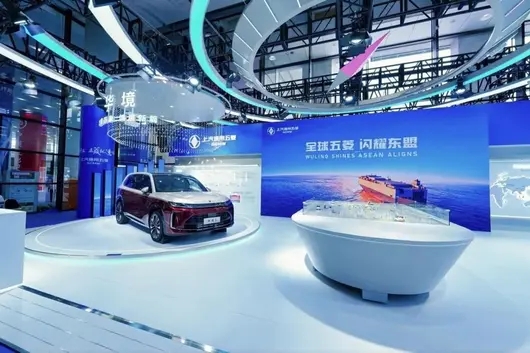
As a benchmark enterprise for the collaborative global expansion of China's automotive industry, SAIC-GM-Wuling concurrently occupied the two featured exhibition halls of the "New Energy and Intelligent Connected Vehicles" Zone and the "Advanced Technology" Zone at this ASEAN Expo, presenting users with the flagship large 6-seater Hua Jing S equipped with Huawei Qiankun Technology, the G20 Summit Official Vehicle Air ev, the "Tian", "Ling", "Shen" technology brands, as well as the I²MS Smart Island Manufacturing System and other achievements, comprehensively showcasing SAIC-GM-Wuling's global strength from products to technology, and from brand to ecosystem.

SAIC-GM-Wuling "New Energy and Intelligent Connected Vehicles" Zone

SAIC-GM-Wuling "Advanced Technology" Zone
Currently, the global new energy transformation is facing the three gaps of "large affordability gap, high localization threshold, and ecosystem chain break". Facing the questions of the era, SAIC-GM-Wuling convened a global strategy press conference and officially launched the Global 5 Global Strategy. With a new posture, it joins hands with ASEAN and global partners to co-draw a new blueprint for the global new energy vehicle ecosystem.
China's automotive industry is moving from a "Major Automobile Power" to an "Automobile Powerhouse". On this road to a powerhouse, SAIC-GM-Wuling submitted a brilliant report card: cumulative global production and sales surpassed 32 million units; new energy vehicle sales exceeded 4 million units; overseas exports grew continuously for 10 years, with cumulative exports surpassing 1.6 million units/sets. From initially leveraging partnerships to go global, to today relying on the advantages of the New Land-Sea Corridor, smart manufacturing, and green manufacturing, SAIC-GM-Wuling has grown into a global car company leading in both scale and growth rate, and is also one of the Chinese brands favored by ASEAN users. In the future, SAIC-GM-Wuling will plan the globalization path from five dimensions of strength, model, market, guarantee, and goal, defining new standards for high-quality development of the global automotive industry.
The Global 5 Global Strategy is the China solution contributed by SAIC-GM-Wuling for the Chinese automotive industry to move towards a full-chain ecosystem export. SAIC-GM-Wuling brings full-scenario mobility solutions with a full-category product layout, builds pragmatic and reliable core technologies centered on the "Tian Ling Shen" technology system, breaks the century-old assembly line convention with the globally first I²MS Smart Island Manufacturing System, constructs a full-industry-chain ecosystem layout with the synergy of the "Smart Manufacturing Chain, Supply Chain, Sales Chain, Talent Chain, and Finance Chain", casts extreme trust and reputation with 68 years of car-making history and 32 million units of cumulative production and sales, constructs five major strength bases, and systematically converts full-link independent research and construction capabilities into overseas market competitiveness. At the same time, SAIC-GM-Wuling, targeting the development stages and policy environments of different global markets, launched five open cooperation models of trade, distribution, production and sales, full industry chain, and technology licensing. It goes from shallow to deep, adapts flexibly, and partners can choose freely according to their own needs.
In addition, SAIC-GM-Wuling also constructed five major service guarantee systems including global quality guarantee, supply chain guarantee, partner empowerment guarantee, localized after-sales guarantee, and sustainable operation guarantee, covering the entire lifecycle of cooperation; with ASEAN as a bridgehead, it continues to deepen the layout of five major markets in Asia, Africa, the Americas, Europe, and Oceania; formulated five major development goals of deepening the layout of 150 countries in 3 years, expanding 500 strategic partners, an annual sales growth rate of 50%, becoming a world new energy leader brand, and becoming a pioneer in industrial upgrading and green development, to achieve a win-win pattern of the "Wuling Development Wing" and the "Wuling Partner Wing" flying together with both wings.

SAIC-GM-Wuling Global 5 Global Strategy
As the first landing result after the launch of the Global 5 Global Strategy, SAIC-GM-Wuling and Malaysia's Chunchang Group signed an in-depth strategic cooperation agreement on site at the press conference, officially launching the local industrial layout in Malaysia. Relying on the export of the core parts supply chain, SAIC-GM-Wuling will build a Malaysia local independent supply chain system, continue to improve the industrial map of the ASEAN region, and promote international capacity layout and cross-border industrial coordinated development.

G20 Summit Official Vehicle


SAIC-GM-Wuling Global Product Matrix Makes A Grand Debut at China-ASEAN Expo
Summary:
SAIC-GM-Wuling fully presented the system upgrade of China's automotive industry from product export to full-chain ecosystem export, providing a replicable experience sample for local enterprises and manufacturing to "go out" at high quality.
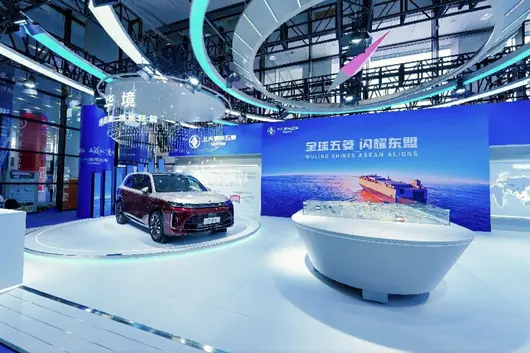

At the Nanning International Convention and Exhibition Center, on the opening day of the 23rd China-ASEAN Expo, SAIC-GM-Wuling's exhibition stands appeared simultaneously in two exhibition halls, the New Energy and Intelligent Connected Vehicle Exhibition Area and the Advanced Technology Exhibition Area. A flagship large six-seater Hua Jing S equipped with Huawei Qiankun technology was parked in a prominent position, next to which was the G20 Summit official vehicle Air ev. Walking further in, models of the three technology brands Tian, Ling, Shen and the I²MS Smart Island Manufacturing System occupied nearly half of the display space.

 Moving the manufacturing system into the auto show is a signal in itself. The theme of SAIC-GM-Wuling's participation this time is called 'Global Wuling Shines in ASEAN', but the core exhibit on the stand was not a single car, but a complete export logic, shifting from product output to full-chain ecosystem output.

This logic was named the Global 5 Global Strategy on site at the Expo. At the press conference, Zhao Xiaobin, Vice President of SAIC-GM-Wuling Motor Co., Ltd., did the math: cumulative global production and sales exceeded 32 million units, New Energy vehicle sales exceeded 4 million units, overseas exports grew for 10 consecutive years, cumulative exports exceeded 1.6 million units/sets. "From initially borrowing ships to go to sea, to today relying on the New Land-Sea Corridor in Western China, intelligent manufacturing, and green manufacturing advantages," he said, "we are no longer just selling cars overseas."

The '5' in Global 5 has five layers of meaning. Shi Jiangong, Vice President of SAIC-GM-Wuling's Overseas Division, broke down the implementation path of this strategy at the press conference: Five major strength bases, Five open cooperation models, Five major service guarantee systems, Five major regional market layouts, Five major development goals.

Among these, the design of the cooperation mode is most noteworthy. For the development stages and policy environments of different markets, SAIC-GM-Wuling launched five models: trade, distribution, production and sales, full industrial chain, and technology licensing, from shallow to deep, partners can choose freely. This means going overseas is no longer a single 'selling cars' logic, they can do only trade, build distribution networks, establish joint ventures, move the entire industrial chain over there, or even only output technology.
Supporting this flexibility is 'Five-Chain Collaboration': Smart Manufacturing Chain, Supply Chain, Sales Chain, Talent Chain, Financial Chain. Shi Jiangong summarized it as 'systematically transforming full-link self-research and self-construction capabilities into overseas market competitiveness'. Specifically on the product side, it is a full-category layout covering SUV, MPV, micro transportation, urban new energy, commercial vehicles, and other scenarios; on the technology side, it is the 'Tian-Ling-Shen' technology system; on the manufacturing side, it is the globally first I²MS Smart Island Manufacturing System, this system breaks the assembly line production method used for a century.

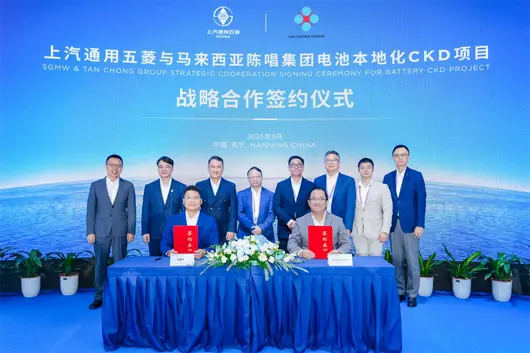
On the day the strategy was released, the first landing project was signed. SAIC-GM-Wuling signed a deep strategic cooperation agreement with Malaysia Chan Tong Group, launching the Malaysia localization industrial layout. Liu Zhijun, Director of the Marketing and Service Department of Liuzhou Sake Technology, and Yun Weishan, General Manager of TQWULING, signed on behalf of both parties. Shi Guoyong, Member of the Party Committee of SAIC-GM-Wuling, Party Secretary of Liuzhou Sake Technology, and Vice President, Executive Vice President Huang Yaosong, Vice President Zhao Xiaobin witnessed it together.
The key of this signing was not in the complete vehicle, but in the supply chain. Relying on the core parts supply chain going overseas, SAIC-GM-Wuling will build a local independent supply chain system in Malaysia. This is exactly the typical path from 'product going overseas' to 'ecosystem going overseas', not transporting cars made in China to sell there, but taking manufacturing capabilities, supply chain systems, talent, and financial services together over there, forming an industrial loop locally.

On the same day, a think tank report was also released. SAIC-GM-Wuling collaborated with People's Forum, inviting three industry experts to jointly release the 'New Paradigm for Collaborative Overseas Expansion of Green Manufacturing and Automotive Industry'. The report refined SAIC-GM-Wuling's practice into three major paths: 'New Quality Ecosystem, New Quality Brand, New Quality Product', and specifically mentioned the deep binding of corporate globalization paths with Guangxi's 'Beijing-Shanghai-Guangdong R&D + Guangxi Integration + ASEAN Application' development path.
Zhang Lei, Director of the Artificial Economy Research Room of the Institute of Economics, Chinese Academy of Social Sciences, said at the press conference, SAIC-GM-Wuling, through Five-Chain Collaboration, systematically transformed domestically accumulated technology, manufacturing, and supply chain advantages into global competitive advantages. Zhou Changping, Executive Vice President of the National Bamboo Industry Research Institute, paid attention to another detail: SAIC-GM-Wuling led the integration of the country's first auto parts 'Bamboo instead of Plastic' full industrial chain. Zhao Xinli, Dean of the School of Advertising and Branding at Communication University of China, interpreted from a brand perspective, believing that SAIC-GM-Wuling broke the low-end prejudice of overseas markets against Chinese brands with high cost-performance and deep scenario adaptation.


Looking at these pieces of information together, the goal of the Global 5 strategy becomes clear. According to the plan, SAIC-GM-Wuling will take ASEAN as a bridgehead, deepening the layout of five major markets in Asia, Africa, America, Europe, and Oceania, covering 150 countries in 3 years, expanding 500 strategic partners, achieving an annual sales growth rate of 50%, finally becoming a world leader in new energy brands and a pioneer in industrial upgrade and green development. Zhao Xiaobin called this layout the 'Two Wings Flying Together' of 'Wuling Development Wing' and 'Wuling Partner Wing'.
China's automotive overseas expansion has gone through several stages. Earliest was complete vehicle export, comparing who's cars were cheaper; later was building factories, doing localization, comparing who has stronger manufacturing capabilities; now it has reached the third stage, outputting standards, outputting supply chains, outputting ecosystems, comparing who can move a whole system overseas and make it run. What SAIC-GM-Wuling displayed at this ASEAN Expo, is exactly a sample of this stage.
Facing the '15th Five-Year Plan', how far this system can go depends on the actual landing effect of Five-Chain Collaboration in the overseas market, and also depends on whether the five cooperation models can truly adapt to the differentiated needs of different countries. But at least looking from the stand in Nanning, the narrative of China's automotive overseas expansion has changed, no longer 'where our cars are sold', but 'where our systems are operating'.

Pada hari pembukaan Pameran China-ASEAN ke-23 di Pusat Konvensyen Antarabangsa Nanning, booth SAIC-GM-Wuling muncul di dua pavilion secara serentak, iaitu zona Kenderaan Ejen Elektrik dan Jaringan Cerdas serta zona Teknologi Canggih. Sebuah model flagship SUV enam tempat duduk besar, Hua Jing S yang dilengkapkan dengan Teknologi Huawei Qiankun, diparkir di tempat yang menonjol, di sebelah ialah Air ev, kenderaan rasmi Puncak G20, terus ke dalam, model daripada tiga jenama teknologi Tian, Ling, Shen dan sistem pembuatan I²MS Smart Island menguasai hampir separuh daripada ruang tersebut. Memindahkan sistem pembuatan ke pameran kenderaan, pada asalnya adalah satu isyarat. SAIC-GM-Wuling mengikuti pameran ini dengan tema "Wuling Global Bersinar di ASEAN", tetapi produk teras di atas meja pameran bukan sebarang kenderaan, tetapi keseluruhan logik eksport, daripada output produk kepada output ekosistem merentasi rantaian.
Logik ini dinamakan secara rasmi semasa pameran sebagai Strategi Global 5. Dalam sidang akhbar, Naib Presiden SAIC-GM-Wuling Automotive Co., Ltd., Zhao Xiaobin mengira satu kiraan: jumlah pengeluaran dan jualan global telah mengatasi 32 juta unit, jualan kenderaan elektrik baharu melebihi 4 juta unit, eksport luar negara meningkat selama 10 tahun berturut-turut, jumlah eksport terkumpul mengatasi 1.6 juta unit/set. "Dari pinjaman kapal untuk eksport pada awalnya, hingga hari ini bergantung kepada laluan barat darat laut baharu, pembuatan pintar dan kelebihan pembuatan hijau," katanya, "Kita bukan sahaja menjual kenderaan ke luar negara."
Angka "5" dalam Global 5 mempunyai lima makna. Naib Presiden Bahagian Luar Negara SAIC-GM-Wuling, Shi Jianguo, membongkar laluan pelaksanaan strategi ini dalam sidang akhbar: Lima asas kekuatan utama, lima mod kerjasama terbuka, lima sistem perkhidmatan dan sokongan, lima susun atur pasaran wilayah utama, lima sasaran pembangunan utama.
Antara yang paling ketara ialah reka bentuk mod kerjasama. Mengikut peringkat pembangunan pasaran yang berbeza dan persekitaran dasar, SAIC-GM-Wuling telah melancarkan lima mod: Perdagangan, Pengedaran, Pembuatan dan Jualan, Rantaian Industri Penuh, dan Lisensi Teknologi, dari yang ringan hingga dalam, rakan kongsi boleh memilih dengan sendiri. Ini bermakna eksport bukan lagi logik "jualan kenderaan" yang tunggal, boleh hanya melakukan perdagangan, boleh membina rangkaian pengedaran, boleh membina kilang secara perkongsian, boleh memindahkan keseluruhan rantai industri, malah hanya mengeluarkan teknologi.
Yang menyokong kepelbagaian ini ialah "Sintesis Lima Rantaian": Rantaian Pembuatan Pintar, Rantaian Suplai, Rantaian Jualan, Rantaian Talento, Rantaian Kewangan. Shi Jianguo meringkaskannya sebagai "mengubah keupayaan penyelidikan dan pembinaan rantaian lengkap menjadi daya saing pasaran luar negara secara sistematik". Secara khusus ke hujung produk, adalah susun atur pelbagai kategori meliputi SUV, MPV, mikro kenderaan, e-mobiliti bandar, lori perniagaan dan lain-lain senario; hujung teknologi, adalah sistem teknologi "Tian Ling Shen"; hujung pembuatan, adalah sistem pembuatan I²MS Smart Island yang pertama di dunia, sistem ini mematahkan cara pengeluaran barisan pemprosesan yang digunakan selama seratus tahun.
Pada hari pengumuman strategi, projek pelaksanaan pertama telah ditandatangani. SAIC-GM-Wuling menandatangani strategi kerjasama mendalam dengan Group Chenchang Malaysia, memulakan susun atur industri tempatan Malaysia. Pengarah Jabatan Pemasaran dan Perkhidmatan Liuzhou Saik Technology, Liu Zhijun dan Ketua Pegawai Eksekutif TQWULING, Yun Weishan mewakili kedua-dua belah menandatangani, Anggota Jawatankuasa Parti SAIC-GM-Wuling, Setiausaha Parti Liuzhou Saik Technology, Naib Presiden Shi Guoyong, Naib Presiden Eksekutif Huang Yaosong, dan Naib Presiden Zhao Xiaobin bersama-sama menyaksikan.
Kunci penandatanganan ini bukan pada kenderaan lengkap, tetapi pada rantaian suplai. Bergantung pada rantaian suplai komponen teras untuk eksport, SAIC-GM-Wuling akan membina sistem rantaian suplai autonomi tempatan di Malaysia. Ini adalah laluan tipikal dari "ekosistem produk" ke "ekosistem eksport", bukan menghantar kereta buatan China untuk dijual, tetapi membawa keupayaan pembuatan, sistem rantaian suplai, talenta dan perkhidmatan kewangan bersama-sama, membentuk gelung industri di tempat tersebut.
Pada hari yang sama, laporan pemikiran juga diterbitkan. SAIC-GM-Wuling bekerjasama dengan Forum Rakyat, jemput tiga pakar industri bersama-sama memeterai "Paradigma Baharu Kerja Sama Keluar Laut Pembuatan Hijau dan Industri Automotif". Laporan ini merumuskan amalan SAIC-GM-Wuling sebagai "Ekosistem Baharu, Merek Baharu, Produk Baharu" tiga laluan utama, dan secara khususnya menyebut pengikatan mendalam laluan globalisasi syarikat dengan laluan pembangunan "R&D Beijing-Shanghai-Guangzhou + Integrasi Guangxi + Aplikasi ASEAN" Guangxi.
Zhang Lei, Ketua Jabatan Ekonomi Kecerdasan Buatan Institut Ekonomi Akademi Sains Sosial China berkata dalam sidang akhbar, SAIC-GM-Wuling melalui Sintesis Lima Rantaian, mengubah kelebihan teknologi, pembuatan dan rantaian supai yang terkumpul di dalam negara menjadi kelebihan daya saing global secara sistematik. Naib Presiden Tetap Institut Penyelidikan Industri Bambu Negara, Zhou Changping pula memberi tumpuan kepada satu butiran lain: SAIC-GM-Wuling mengetuai penyelesaian keseluruhan rantaian industri "Bambu Menggantikan Plastik" untuk komponen automotif yang pertama di negara ini. Zhao Xinli, Dekan Sekolah Iklan dan Merek Universiti Komunikasi China membina dari sudut merek, percaya SAIC-GM-Wuling dengan nisbah prestasi tinggi dan penyuaian senario mendalam telah mematahkan prasangka rendah pasaran luar terhadap merek China.
Jika melihat maklumat ini bersama, objektif strategi Global 5 menjadi jelas. Mengikut perancangan, SAIC-GM-Wuling akan menggunakan ASEAN sebagai kubu hadapan, memperdalam susun atur lima pasaran utama Asia, Afrika, Amerika, Eropah, dan Oceania, menggunakan masa 3 tahun untuk menutupi 150 negara, mengembangkan 500 rakan kongsi strategik, mencapai peningkatan jualan tahunan purata 50%, akhirnya menjadi jenama pemimpin global dalam e-mobiliti dan pelopor industri dan pembangunan hijau. Zhao Xiaobing memanggil格局 ini sebagai "Sayap Pembangunan Wuling" dan "Sayap Rakan Kongsi Wuling" terbang bersama.
Eksport automotif China telah melalui beberapa peringkat. Paling awal ialah eksport kenderaan lengkap, membandingkan siapa yang lebih murah kereta mereka; kemudian membina kilang, membuat tempatanan, membandingkan siapa yang lebih kuat keupayaan pembuatan; sekarang telah tiba fasa ketiga, mengeluarkan piawaian, mengeluarkan rantaian suplai, mengeluarkan ekosistem, membandingkan siapa yang boleh memindahkan keseluruhan sistem ke luar negara dan menjalankannya. Apa yang dipamerkan oleh SAIC-GM-Wuling dalam Pameran ASEAN kali ini, adalah tepat satu sampel fasa ini.
Memasuki "Rancangan Lima Tahun ke-15", sejauh mana sistem ini berjalan, bergantung kepada kesan pelaksanaan sebenarnya Sintesis Lima Rantaian di pasaran luar negara, juga bergantung kepada sama ada lima mod kerjasama boleh menyesuaikan keperluan perbezaan negara yang berbeza dengan betul. Tetapi sekurang-kurangnya dari booth Nanning, naratif eksport automotif China telah berubah, bukan lagi "ke mana kereta kami dijual", tetapi "di mana sistem kami berjalan".

17 September, Nanning, Wilayah Guangxi, SAIC-GM-Wuling dengan tema "Wuling Global, Bersinar di ASEAN", melangkah masuk Pameran China-ASEAN ke-23. Di lokasi, melancarkan secara rasmi Strategi Global 5, menandatangani perjanjian kerjasama strategik yang mendalam dengan Syarikat Chan Chong, Malaysia.
Sebagai syarikat berpemimpin dalam pelancaran industri automotif China, SAIC-GM-Wuling juga hadir di Pameran ASEAN kali ini di dua pameran khas "Kereta Elektrik Baharu dan Kereta Pintar Berhubung Rangkaian" dan "Teknologi Canggih", membawa kepada pengguna kereta mewah besar berenapan enam tempat duduk Huajing S dengan teknologi Huawei Qiankun, kenderaan rasmi Mesyuarat Puncak G20 Air ev, jenama teknologi "Tian", "Ling", "Shen", serta sistem pembuatan Pulau Pintar I²MS, dan lain-lain, mempersembahkan sepenuhnya kekuatan globalisasi SAIC-GM-Wuling dari produk ke teknologi, dari jenama ke ekosistem.
SAIC-GM-Wuling Pameran "Kereta Elektrik Baharu dan Kereta Pintar Berhubung Rangkaian"
SAIC-GM-Wuling Pameran "Teknologi Canggih"
Belakangan ini, transformasi global tenaga baharu sedang menghadapi tiga jurang besar: jurang inklusiviti besar, standard tempatan tinggi, dan rantai ekosistem terputus. Menjawab soalan zaman ini, SAIC-GM-Wuling mengadakan pelancaran strategi global, secara rasmi melancarkan Strategi Global 5, dengan sikap baharu, berganding bahu dengan rakan kongsi ASEAN dan global, melukis semula pelan besar ekosistem global automotif tenaga baharu.
Industri automotif China sedang beralih dari "negara besar automotif" ke "negara kuat automotif", dalam perjalanan menjadi negara kuat ini, SAIC-GM-Wuling telah menjadikannya prestasi yang cemerlang: jumlah jualan dan pengeluaran global melebihi 32 juta unit; jualan kereta elektrik baharu melebihi 4 juta unit; eksport luar negara meningkat selama 10 tahun berturut-turut, jumlah eksport melebihi 1.6 juta unit/set. Dari mula-mula menggunakan bantuan luar, hingga hari ini bergantung kepada Koridor Darat-Laut Barat Baru, pembuatan pintar dan keunggulan pembuatan hijau, SAIC-GM-Wuling telah berkembang menjadi syarikat automotif global yang mengetuai saiz dan pertumbuhan, sekaligus salah satu jenama China yang digemari pengguna ASEAN. Masa hadapan, SAIC-GM-Wuling akan merancang laluan globalisasi dari lima dimensi kekuatan, model, pasaran, perlindungan, dan sasaran, menetapkan piawaian baharu untuk pembangunan berkualiti tinggi industri automotif global.
Strategi Global 5 adalah penyelesaian China yang dikongsikan oleh SAIC-GM-Wuling untuk industri automotif China menuju pelancaran ekosistem rantaian penuh. SAIC-GM-Wuling membawa penyelesaian mobiliti seluruh skenario melalui layout produk pelbagai kategori, membina teknologi teras yang amalan dan boleh dipercayai dengan sistem teknologi "Tian, Ling, Shen" sebagai teras, memecahkan amalan loji penapaian beratus tahun dengan sistem pembuatan Pulau Pintar I²MS yang pertama di dunia, membina layout ekosistem rantaian industri penuh dengan kolaborasi lima rantai "pembuatan pintar, rantaian bekalan, rantaian jualan, rantaian bakat, rantaian kewangan", dengan 68 tahun sejarah pembuatan kereta dan 32 juta unit jualan dan pengeluaran terkumpul mengukuhkan kepercayaan dan reputasi yang hebat, membina lima asas kekuatan utama, mengubah keupayaan penyelidikan dan pembinaan rantaian penuh secara sistematik kepada daya saing pasaran luar negara. Pada masa yang sama, SAIC-GM-Wuling menawarkan lima model kerjasama terbuka seperti perdagangan, pengedaran, pengeluaran dan jualan, rantaian industri penuh, lisensi teknologi bagi peringkat pembangunan dan persekitaran dasar pasaran global yang berbeza, daripada mudah ke dalam, menyesuaikan diri dengan fleksibel, rakan kongsi boleh memilih sendiri berdasarkan keperluan mereka.
Selain itu, SAIC-GM-Wuling juga telah membina lima sistem perlindungan perkhidmatan seperti perlindungan kualiti global, perlindungan rantaian bekalan, perlindungan penjana rakan kongsi, perlindungan pospenjualan tempatan, perlindungan operasi berterusan, merangkumi keseluruhan kitar hayat kerjasama; dengan ASEAN sebagai platform, memperdalam layout lima pasaran Asia, Afrika, Amerika, Eropah, Oceania; menetapkan tiga tahun layout mendalam 150 negara, mengembangkan 500 rakan kongsi strategik, pertumbuhan jualan tahunan 50%, menjadi jenama terkemuka tenaga baharu dunia, menjadi pelopor industri dan pembangunan hijau sebagai lima sasaran pembangunan, untuk mencapai corak menang-menang "Sayap Pembangunan Wuling" dan "Sayap Rakan Kongsi Wuling" terbang bersama.
SAIC-GM-Wuling Strategi Global 5
Sebagai hasil pelaksanaan pertama selepas pelancaran Strategi Global 5, SAIC-GM-Wuling menandatangani perjanjian kerjasama strategik yang mendalam dengan Syarikat Chan Chong, Malaysia di lokasi pelancaran, secara rasmi memulakan布局 industri tempatan Malaysia. Dengan rantaian bekalan komponen teras keluar ke laut, SAIC-GM-Wuling akan membina sistem rantaian bekalan autonomi tempatan Malaysia, terus menyempurnakan peta industri wilayah ASEAN, memajukan layout keupayaan antarabangsa dan pembangunan industri serantau merentasi sempadan.
Kenderaan Rasmi Mesyuarat Puncak G20
Matriks Produk Global SAIC-GM-Wuling Hadir Cemerlang di Pameran China-ASEAN
Kesimpulan:
SAIC-GM-Wuling telah mempersembahkan sepenuhnya peningkatan sistem industri automotif China dari pelancaran produk ke pelancaran ekosistem rantaian penuh, menyediakan sampel pengalaman yang boleh digandakan untuk keluar ke luar negara berkualiti tinggi syarikat tempatan dan pembuatan.


From "relying on others to go global" to "full-chain ecosystem" global expansion. On September 17, at the 23rd China-ASEAN Expo held in Nanning, SAIC-GM-Wuling officially released the Global 5 global strategy, and drew a clear scale for this transformation: 3 years to deepen layout in 150 countries, expand 500 strategic partners, and achieve an average annual sales growth of 50%.

At the press conference, Wuling signed a battery local CKD project agreement with Malaysia's Tan Cheng Group, becoming the first result of the new strategy implementation.
Detailed explanation of the Global 5 global strategy. The first is five major strength foundations: All-category products covering SUV, MPV, micro-commuting, urban new energy, and commercial vehicles, "Tian, Ling, Shen" technology system, the world's first MS Smart Island manufacturing system, synergy of "Smart Manufacturing Chain, Supply Chain, Sales Chain, Talent Chain, Finance Chain", plus 68 years of car manufacturing reputation and global cumulative sales and production of 32 million units.

The second is five major cooperation models: Open trade, distribution, production-sales, full industry chain, and technology licensing five paths for different markets, shallow to deep, selected on demand — among which "technology licensing" means Wuling not only exports products but also starts to export manufacturing and technology capabilities.
In addition, the strategy is also supported by five major service guarantees covering the full lifecycle of cooperation, five major markets ranging from ASEAN bridgehead to Asia, Africa, Americas, Europe, and Oceania, and a set of goals supported by a foundation: Wuling products are currently sold in more than 110 countries and regions, overseas marketing outlets exceed 230, and in the next 3 years, the layout will be deepened to 150 countries, 500 strategic partners will be expanded, and annual sales will grow by 50% on average — equivalent to taking nearly 40 new markets on the existing map.

Zhao Xiaobin, Vice General Manager of SAIC-GM-Wuling, provided the foundation data for the Global 5 strategy: global cumulative sales and production exceeded 32 million units, new energy vehicle sales exceeded 4 million units, overseas exports grew continuously for 10 years, and cumulative breakthrough exceeded 1.6 million units/sets. Shi Jiangong, Vice General Manager of the Overseas Business Department, stated that Wuling will transform the full-link self-research and self-construction capabilities into overseas market competitiveness systematically.
This strategy's weight must be viewed in the big picture of Chinese automotive exports. Data from China Association of Automobile Manufacturers shows that in the first 8 months of 2026, Chinese automobile exports reached 7.153 million units, up 66.7% year-on-year, exceeding the total amount of the whole year last year; monthly exports stood on the million-unit level for 3 consecutive months; new energy vehicle exports reached 3.435 million units, accounting for more than half for 3 consecutive months. Chen Shihua, Deputy Secretary-General of CAAM, judged that Chinese automotive exports are shifting from short-term sales expansion to a more stable scale stage, and enterprises need to move from "selling products" to "building systems."

Wuling's choice happens to step on this node. It did not stop the strategy at export targets, but packaged manufacturing, supply chain, finance, talent, and after-sales as a whole, and then used the five-level ladder from trade to technology licensing to adapt to markets at different development stages. This is exactly the typical play of "ecosystem going global."
ASEAN is the most realistic model: Wuling entered Indonesia in 2017. The Cikarang plant produced 200,000 units cumulatively over nine years, driven 16 domestic three-electric enterprises to land, cultivated over 100 local suppliers; from January to July this year, the enterprise's overseas sales exceeded 200,000 units/sets, and monthly sales exceeded 30,000 for 4 consecutive months. This Malaysia CKD project signing is replicating this localization play in another country.

When tariff barriers and localization requirements become the new normal for going global, the window for simply shipping cars out is narrowing. The significance of the Global 5 global strategy lies in equipping Wuling's overseas business with a replicable "systematic operating system" — foundation in ASEAN, protection of five chains, three years as the goal. In the second half of Chinese automotive globalization, the competition is no longer about who sells more, but who can truly take root overseas. Wuling's step is aimed at "rooting."
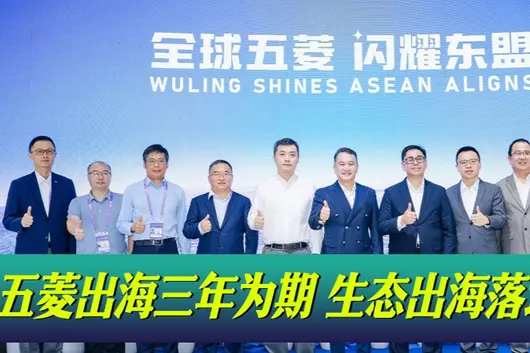

Dari "menumpang kapal untuk ekspansi antarabangsa", ke "ekspansi ekosistem rantaian lengkap". 17 September, pada Pameran China-ASEAN ke-23 yang diadakan di Nanning, SAIC-GM-Wuling telah secara rasmi melancarkan Strategi Global 5, dan memberikan takat yang jelas bagi perubahan ini: 3 tahun memperdalam pelan di 150 negara, mengembangkan 500 rakan kongsi strategik, pertumbuhan jualan tahunan sebanyak 50%.
Di lokasi pelancaran, Wuling menandatangani perjanjian projek CKD penglokalitan bateri dengan Kumpulan Chen Chang Malaysia, menjadi hasil pertama pelaksanaan strategi baru.
Penjelasan terperinci Strategi Global 5. Yang pertama ialah lima asas kekuatan: produk pelbagai kategori merangkumi SUV, MPV, kenderaan ringan kecil, kenderaan tenaga bandar dan kenderaan dagangan, sistem teknologi "Tian, Ling, Shen", sistem pembuatan "MS Smart Island" pertama di dunia, koordinasi "lima rantaian": Rantaian Pembuatan Pintar, Rantaian Bekalan, Rantaian Jualan, Rantaian Talenta, Rantaian Kewangan, ditambah dengan reputasi 68 tahun pembuatan kereta, jumlah pengeluaran dan jualan kumulatif global melebihi 32 juta unit.
Yang kedua ialah lima mod kerjasama: berbeza mengikut pasaran, membuka laluan perdagangan, pengedaran, pengeluaran dan penjualan, rantaian industri penuh dan pelulusan teknologi, dari mudah ke mendalam, pilih mengikut keperluan - di mana "pelulusan teknologi" bermaksud Wuling tidak hanya mengesahkan produk, tetapi juga mula mengesahkan keupayaan pembuatan dan teknologi.
Selain itu, strategi ini juga menyokong lima servis sokongan yang merangkumi kitaran hayat kerjasama penuh, sebagai pintu utama ASEAN, menjangkau Asia, Afrika, Amerika, Eropah, Oceania lima pasaran, dan satu set sasaran yang disokong asas: produk Wuling kini telah dijual ke lebih 110 negara dan wilayah, rangkaian pemasaran luar negara melebihi 230 buah, masa depan 3 tahun akan memperdalam pelan ke 150 negara, mengembangkan 500 rakan kongsi strategik, pertumbuhan jualan tahunan 50% - bersamaan dengan mengambil hampir 40 pasaran baharu lagi di atas peta sedia ada.
Timbalan Pengurus Besar SAIC-GM-Wuling, Zhao Xiaobin memberikan data asas Strategi Global 5: jumlah pengeluaran dan jualan global melebihi 32 juta unit, jualan tenaga baharu melebihi 4 juta unit, eksport luar negara berturutan 10 tahun, jumlah kumulatif melebihi 1.6 juta unit/set. Timbalan Pengurus Besar Bahagian Luar Negara, Shi Gongjian menyatakan, Wuling akan mengubah keupayaan penyelidikan dan pembangunan rantaian penuh secara sistematik menjadi daya saing pasaran luar negara.
Bobot strategi ini, perlu dilihat dalam bingkai besar eksport automotif China. Data Persatuan Automotif China menunjukkan, 8 bulan pertama 2026 eksport automotif China 715.3 juta unit, meningkat 66.7% berbanding tahun lalu, lebih tinggi daripada jumlah keseluruhan tahun lalu, eksport bulanan berturutan 3 bulan berada di tangga jutaan unit; eksport kenderaan tenaga baharu 343.5 juta unit, bahagian berturutan 3 bulan melebihi separuh. Timbalan Setiausaha Agung Persatuan Automotif China, Chen Shihua menilai, eksport automotif China sedang beralih daripada pengembangan jualan jangka pendek ke fasa berskala lebih stabil, perusahaan perlu bergerak dari "jualan produk" ke "pembinaan sistem".
Wuling memilih untuk berada pada titik ini. Ia tidak meletakkan strategi pada sasaran eksport, tetapi membungkus pembuatan, rantaian bekalan, kewangan, talenta dan posjual secara keseluruhan, kemudian menggunakan tangga lima tahap dari perdagangan ke pelulusan teknologi, menyesuaikan pasaran pada fasa pembangunan yang berbeza, inilah taktik tipikal "ekspansi ekosistem".
ASEAN merupakan contoh yang paling realistik: Wuling memasuki Indonesia pada 2017, Kilang Cikarang selama sembilan tahun menghasilkan kumulatif 200,000 unit, mendorong 16 syarikat kuasa tiga domestik China mendarat, memupuk lebih 100 pembekal tempatan; pada Januari hingga Julau tahun ini jualan luar negara syarikat telah memecahkan 200,000 unit/set, berturut-turut 4 bulan tunggal melebihi 30,000. Penyambungan projek CKD Malaysia kali ini, adalah menyalin taktik penglokalitan ini ke satu negara lagi.
Apabila perhalangan tarif dan keperluan penglokalitan menjadi norma baharu dalam ekspansi antarabangsa, tetingkap membawa kereta keluar dengan mudah semakin menyempit. Kepentingan Strategi Global 5 antarabangsa, adalah memasang satu "sistem pengendalian terformat" yang boleh ditirukan untuk perniagaan luar negara Wuling - ASEAN sebagai asas, lima rantaian mendampingi, tempoh tiga tahun. Bab kedua globalisasi automotif China, tidak lagi bersaing siapa menjual lebih banyak, tetapi siapa yang benar-benar berakar di luar negara. Langkah Wuling ini, dituju untuk "berakar".
© 2024 Bitauto.com. All Rights Reserved.
Bitauto (www.yiche.com and www.bitauto.com) is one of the most visited automotive websites in China. We provide detailed info on Chinese car brands available in your area. Please note that the information provided on this website is based on publicly available data and is for reference only. It may not be fully updated or accurate at all times.

Help us improve our website


