Honda has reported a strong start to its 2027 fiscal year, with operating profit more than doubling in the first quarter (March 2026-June 2026).
For the three months ended June 30, the Japanese automaker posted revenue of JPY 6.06 trillion, up 13.5% year on year, while operating profit jumped 117.4% to JPY 530.7 billion, marking a record high for a first quarter.
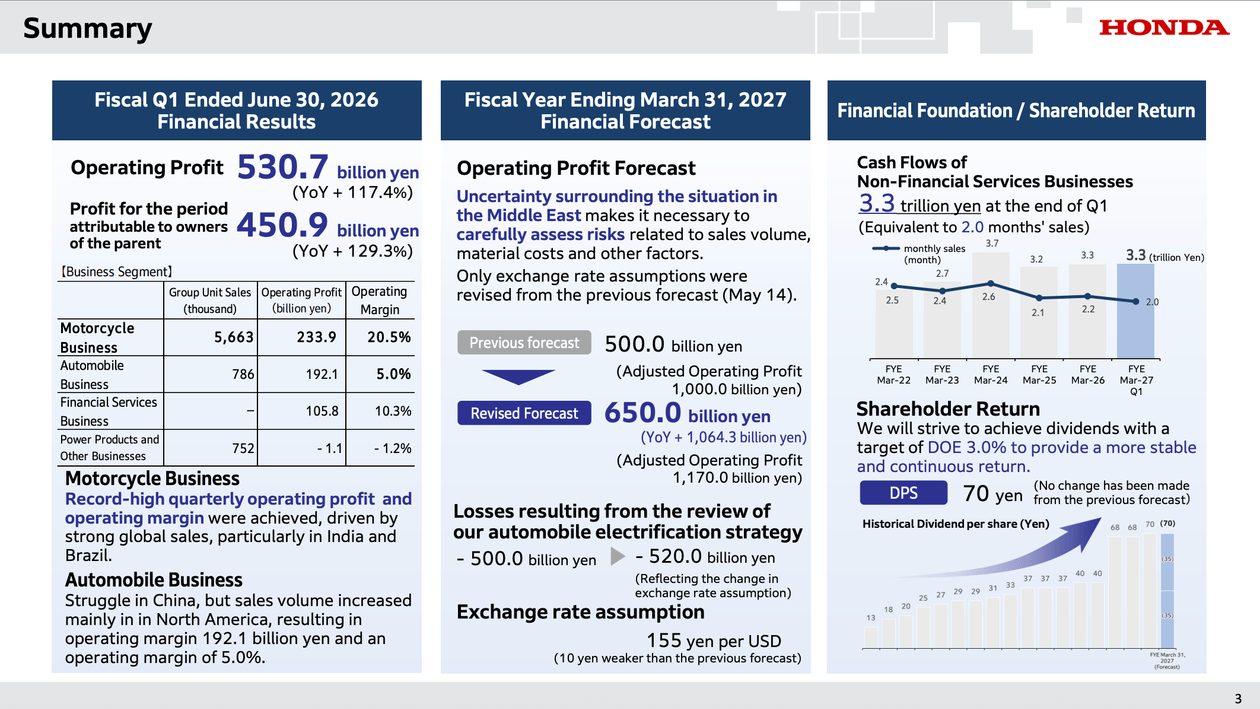
Honda's strong profit recovery was driven mainly by its motorcycle business, while its automotive operations also returned to profit.
Honda's Operating Profit by Business Segment
|
Business |
Q1 FY2026 |
Q1 FY2027 |
Change |
|
Motorcycles |
JPY 189 billion |
JPY 233.9 billion |
+JPY 44.9 billion |
|
Automobiles |
-JPY 29.6 billion |
JPY 192.1 billion |
+JPY 221.7 billion |
|
Financial Services |
JPY 85 billion |
JPY 105.8 billion |
+JPY 20.8 billion |
|
Other |
-JPY 0.2 billion |
-JPY 1.1 billion |
-JPY 0.9 billion |
(Source: Honda's Q1 FY2027 financial report)
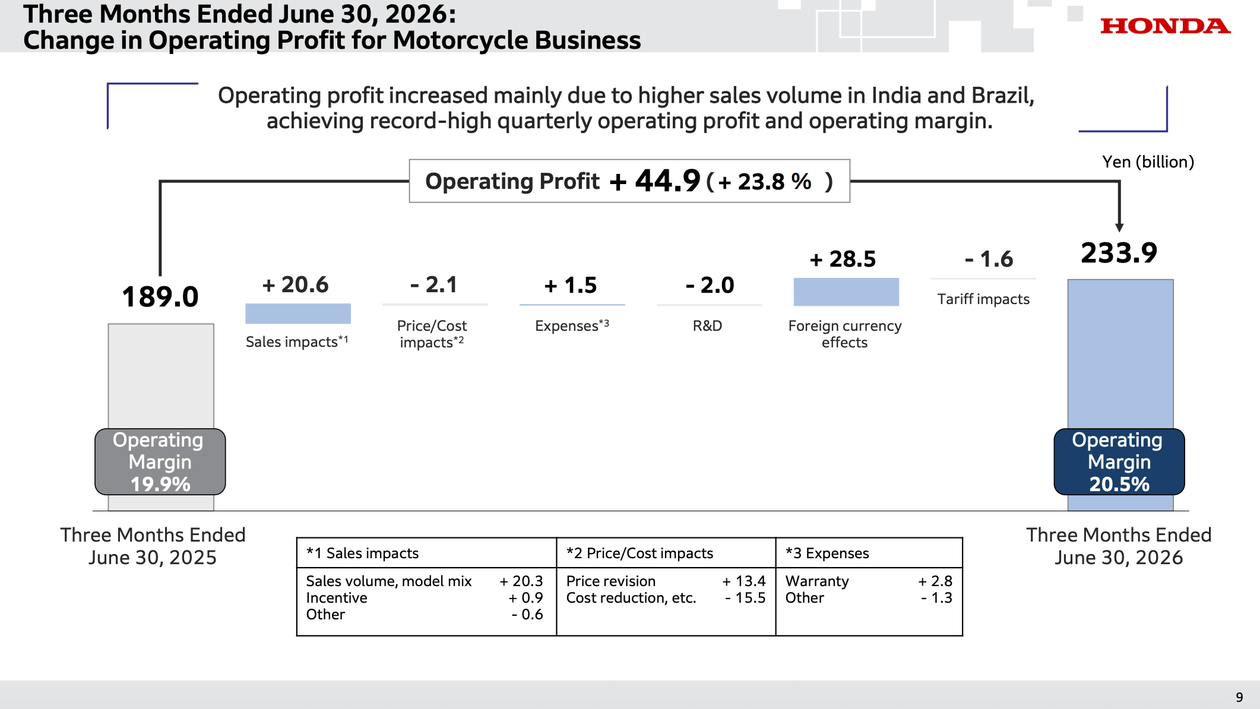
The motorcycle business remains Honda's most consistent source of profit.
In the first quarter, global motorcycle sales reached 5.663 million units, up 10.1% year on year. Operating profit rose to JPY 233.9 billion, giving the business an operating margin of 20.5%.
The motorcycle business has also proved more resilient than cars in markets such as Southeast Asia, India and Brazil, where demand has remained relatively stable despite wider economic and geopolitical pressures.
Honda's automotive business returned to profit, posting JPY 192.1 billion in operating profit for the quarter. Strong hybrid sales in North America and favourable currency movements helped support the result.
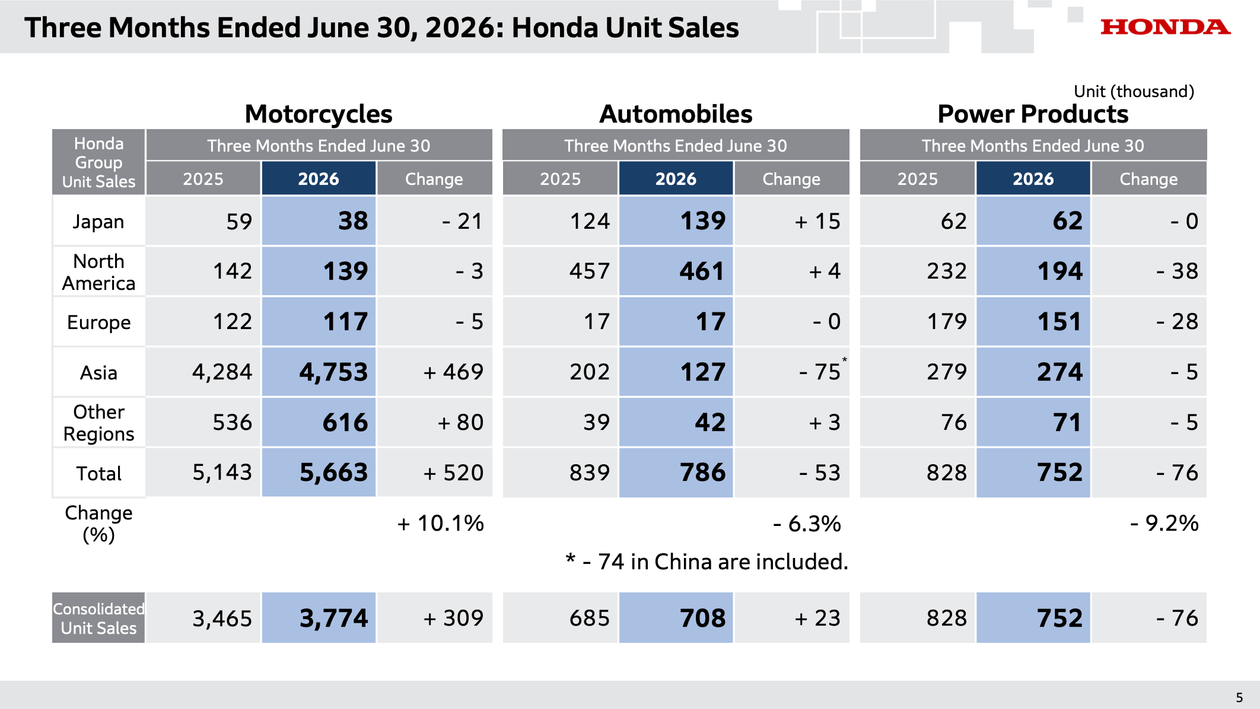
China, however, remains a much tougher market for Honda. The automaker continues to face intense competition as Chinese consumers move increasingly towards electrified vehicles, putting pressure on traditional Japanese brands.
The sharp increase in profit was not entirely down to the underlying performance of Honda's core businesses.
The company recorded significant costs related to changes to its electrification strategy in the same quarter last year, while no comparable charge was recorded this time. Currency movements and changes in tariff policies also helped lift profit during the quarter.
As a result, part of this year's improvement reflects factors outside Honda's underlying operations, rather than a straightforward increase in earnings power.
The latest results give Honda some breathing room, but the company still faces challenges ahead. Tariffs, currency movements and weaker growth in some markets could continue to affect its performance.
At the same time, Honda will need to strengthen its automotive business as competition in electrified vehicles intensifies, particularly in China and other fast-growing markets.
Its motorcycle business remains a strong source of earnings, but the bigger question is how Honda can use that strength while continuing to invest in the transformation of its automotive operations.

The first-quarter results mark a significant improvement for Honda, but sustaining that momentum will depend on how successfully the company navigates the shift towards electrification and rebuilds the competitiveness of its car business.
Read Also: Honda FY2027 Q1 Financial Results

Your go-to source for all things automotive in Malaysia. 🚗 Latest reviews, breaking news, launches & industry trends.
+ Follow This weekend is your chance to own a Volvo Selekt Certified Used Car, priced from just RM 148,000.
What are you waiting for?
#volvo 1 minute ago
This weekend is your chance to own a Volvo Selekt Certified Used Car, priced from just RM 148,000.
What are you waiting for?
#volvo 1 minute ago  We saw this accident this morning, and here’s a reminder to everyone: please drive safe. 2 days ago
  The G50 BMW 3 series is now here, adopting much of the i3's design elements.
So, where's the BMW M3?
#bmw #BMW3Series 4 days ago
The G50 BMW 3 series is now here, adopting much of the i3's design elements.
So, where's the BMW M3?
#bmw #BMW3Series 4 days ago Get the latest car news first!
Your go-to source for all things automotive in Malaysia. 🚗 Latest reviews, breaking news, launches & industry trends.
This weekend is your chance to own a Volvo Selekt Certified Used Car, priced from just RM 148,000.
What are you waiting for?
#volvo 1 minute ago We saw this accident this morning, and here’s a reminder to everyone: please drive safe. 2 days ago The G50 BMW 3 series is now here, adopting much of the i3's design elements.
So, where's the BMW M3?
#bmw #BMW3Series 4 days ago  ProtonGWMVolkswagenJAECOOVolvoPeroduaToyotaHondaTESLAMitsubishiMazdaJetourCheryBYDLexusBMWMercedes-BenziCAURZeekrIsuzuNissanLeapmotorPorscheFordOMODAMINIMGSuzukiXPengHyundaiWulingKiaSubaruDenzaGACLand RoverDongfengCAMAudiPeugeotFotonMAXUSsmartDaihatsuJACJMCMaseratiLotusAlfa RomeoRenaultGolden DragonKaiceneSeresLamborghiniFerrariJeepRolls-RoyceLepasAston MartinMcLarenChevroletBentleyFiatBAICForthingGeelyRoeweAeolusChanganARCFOXDeepalExeedHongqiVoyahJaguarKGMBuforiAcuraCadillacDodgeAbarthINEOSMHEROJMEVFreelander
© 2024 Bitauto.com. All Rights Reserved.
Bitauto (www.yiche.com and www.bitauto.com) is one of the most visited automotive websites in China. We provide detailed info on Chinese car brands available in your area. Please note that the information provided on this website is based on publicly available data and is for reference only. It may not be fully updated or accurate at all times.
Help us improve our website


