

Homecommunity

Search History
Popular Searches
Dealer Login / Sign Up

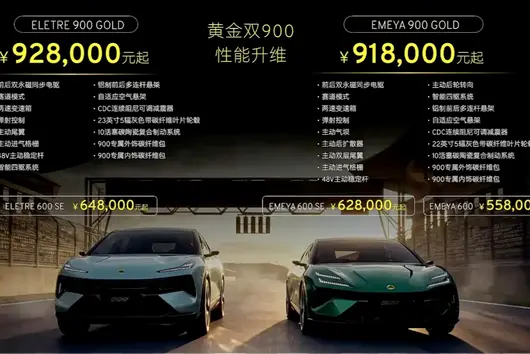
8 月 31 日,蓮花跑車官方宣佈,ELETRE 900 GOLD 與 EMEYA 900 GOLD 和蓮花 Emira 420Sport 三款旗艦車型正式發售。ELETRE 900 GOLD 和 EMEYA 900 GOLD 分別售價 92.8 萬元和 91.8 萬元。新車搭載了操控裝備包,包含碳纖維套件和 10 活塞碳陶瓷制動等性能配備。

全新 Emira 420 Sport 共推出 2 款車型,售價區間 98.8-118.8 萬元,新車將於 10 月開啓交付。三款新車已陸續登陸全國蓮花體驗店。

兩款 900 GOLD 車型最大的產品亮點在於將“高性能核心操控裝備包”(即“操控黃金包”)作為標準配備。該裝備包涵蓋四大核心組件:碳纖維空氣動力學套件、10 活塞碳陶瓷制動系統、鍛造碳纖維輪轂以及專屬碳纖維徽標。

兩款新車在車身上共 61 處採用碳纖維部件,最大碳纖維面積達到 6.1 平方米。


兩款車型定位各有側重。EMEYA 900 GOLD 定位為高性能純電四門 GT 轎跑,ELETRE 900 GOLD 則為純電超跑 SUV。二者共同構成蓮花在高端純電細分市場的双旗艦佈局。

外觀方面,EMEYA 900 GOLD 新增洛韋綠專屬車漆,以英國賽車綠為靈感,致敬蓮花征戰賽道的英倫傳奇。

ELETRE 900 GOLD 則新增雲釉青專屬車漆,汲取汝瓷千年美學,復刻“雨過天青雲破處”的傳世意境。

智能配置方面,搭載雙 NVIDIA Orin 芯片、四顆隱藏翻轉式激光雷達構成五重冗餘感知體系。座艙採用 UNREAL 引擎驅動的 HYPER OS,配備 55 英寸等效 AR-HUD、PDLC 智能分區天幕、流媒體外後視鏡等科技配備。此外,專屬賽道報告系統可為用戶提供專業級駕駛數據分析。


動力方面,兩款車型均搭載雙電機四驅系統,系統總功率 918 馬力,峰值扭矩 985N·m,匹配兩檔自動變速箱。

EMEYA 900 GOLD 的 0-100km/h 加速時間為 2.78 秒,極速 256km/h;ELETRE 900 GOLD 的 0-100km/h 加速時間為 2.95 秒,0-200km/h 加速僅 11.5 秒,極速可達 265km/h。


底盤與操控方面,兩款 900 GOLD 車型均配備雙腔空氣懸掛、CDC 48V 主動穩定桿、後輪主動轉向系統。主動後輪轉向在低速時縮小轉彎半徑,高速時與前輪同向偏轉以提升穩定性。輪胎採用蓮花與倍耐力聯合定制的 P Zero LTS 專屬輪胎。

空氣動力學方面,兩款新車搭載了主動氣壩、主動後擴散器、主動擾流板、主動進氣格柵四大主動空氣動力學套件。蓮花官方稱,這是全球量產車中唯一同時搭載這四項配備的車型。

制動系統方面,標配 10 活塞碳陶瓷制動系統,前盤尺寸 420 毫米、後盤 410 毫米,相比傳統鑄鐵剎車盤可降低約 30 公斤簧下質量。輪轂方面,EMEYA 配備 22 英寸碳纖維輪轂,ELETRE 配備 23 英寸鍛造碳纖維插片輪轂。

值得一提的是,EMEYA 900 GOLD 在浙江國際賽道創下 1 分 35.728 秒的圈速紀錄,刷新四門轎車及純電車型圈速成績;在馬來西亞雪邦 F1 賽道以原廠狀態跑出 2 分 20.317 秒的圈速,刷新該賽道量產電動車最快圈速紀錄。
全新 Emira 420 Sport 正式登陸中國市場。

作為現款 Emira 的性能升級版本,Emira 420 Sport 被定位為“賽道級公路跑車”。公開報道稱,新車國內預計售價約為 108 萬元,作為參考,現款 Emira 在內地的售價為 90.28 萬元。
Emira 420 Sport 是蓮花“Focus 2030”戰略發布後跑車領域的首次落地驗證。在電氣化轉型的浪潮下,這款車也被視為蓮花純燃油中置跑車的終極作品之一。

以下是關於這款新車的核心信息:
動力性能:搭載源自 Mercedes-AMG 的 2.0 升中置直列四缸渦輪增壓發動機,經蓮花團隊重新調校后,可輸出 420 馬力的最大功率與 500 牛 · 米的峰值扭矩。匹配 8 速雙離合器變速箱,采用中置後驅佈局,0-100km/h 加速僅需 3.9 秒,最高時速可達 300km/h。
輕量化與操控:通過選裝“輕量化操控套件”,整車質量可再減 25 公斤,整備質量降至 1405 公斤。同時,優化的空氣動力學設計為車尾增加了 25 公斤的下壓力。
底盤與配備:采用前後雙叉臂式獨立懸掛,配備 Multimatic 雙向可調阻尼減振器。標配 Michelin Pilot Sport Cup 2 半熱熔輪胎。車身高度較現款降低了 5 毫米。
外觀與空氣動力學:外觀延續 Emira 的設計,但細節上更加激進。配備了碳纖維百葉尾門、20 英寸超輕型鋁合金鍛造輪轂及鈦合金排氣系統。優化的空氣動力學套件使外部散熱器氣流量提升 15%,剎車冷卻效率提升 10%。

Di pasaran SUV Malaysia, ramai pembeli ketika memilih kereta akan membandingkan Honda HR-V dan Mazda CX-30. Kedua-dua kereta ini sangat hampir dari segi harga dan penempatan, hari ini kita akan membuat perbandingan terperinci dari pelbagai aspek untuk membantu anda menjimatkan masa melakukan kajian.
Harga OTR Honda HR-V di Malaysia ialah RM 115,900 - 143,900, terdapat keseluruhan 4 versi, termasuk 2026 e:HEV 1.5L RS (RM 143,900), 2026 1.5T V (RM 137,900), 2026 1.5T E (RM 130,900) dan lain-lain.
Harga OTR Mazda CX-30 di Malaysia ialah RM 122,409 - 146,409, terdapat keseluruhan 4 versi, termasuk 2025 2.0L High+ Premium (RM 146,409), 2025 2.0L High+ (RM 138,409), 2025 2.0L High (RM 130,409) dan lain-lain.
Dari segi harga, harga permulaan Honda HR-V memang lebih murah RM 6,509 berbanding Mazda CX-30. Jika bajet anda terhad, versi asas Honda sudah dapat memenuhi keperluan harian. Namun, perlu diingat, beribu-ribu ringgit yang lebih murah itu mungkin ada kompromi pada kelengkapan, ia bergantung pada keperluan anda.

Honda HR-V dilengkapi 1.5L Turbo, kuasa 140 hp. Kecekapan bahan api rasmi 7.0 L/100km.
Mazda CX-30 dilengkapi 1.5L Turbo, kuasa 140 hp. Kecekapan bahan api rasmi 7.0 L/100km.
Kedua-dua kereta menggunakan sistem kuasa yang sama, perasaan memandu harian pada dasarnya tiada perbezaan. Dari segi kecekapan bahan api juga hampir sama, tidak perlu terlalu bimbang dengan perkara ini.

Pengkelasan keselamatan Honda HR-V ialah 5★ (ASEAN NCAP), sistem keselamatan aktif termasuk Honda SENSING (ACC, CMBS, LKAS, RDM).
Pengkelasan keselamatan Mazda CX-30 ialah 5★ (ASEAN NCAP), sistem keselamatan aktif termasuk i-Activsense.
Pengkelasan keselamatan kedua-dua kereta sama, dalam kelas ini kelengkapan keselamatan dianggap sangat lengkap. Keselamatan kereta baharu masa kini tidak terlalu buruk, tidak perlu terlalu bimbang tentang hal ini.

Panjang badan Honda HR-V 4500 mm, ruang muat belakang 450 L.
Panjang badan Mazda CX-30 4500 mm, ruang muat belakang 450 L.
Dimensi kedua-dua kereta hampir sama, ruang dalam kereta tidak terlalu berbeza. Kereta dalam kelas ini, untuk penggunaan harian sudah memadai.

Honda HR-V dan Mazda CX-30 adalah pilihan utama pasaran Malaysia, sesuai untuk kegunaan keluarga dan perjalanan harian. Jika anda lebih menghargai reputasi jenama dan nilai jualan semula, anda boleh memberi keutamaan kepada yang mempunyai reputasi lebih baik; jika anda lebih mempedulikan nilai dan kelengkapan, pilih yang mempunyai kelengkapan lebih banyak. Akhir sekali, disyorkan untuk mencuba memandu kedua-duanya, pengalaman sendiri adalah yang paling penting.
Secara keseluruhannya, Honda HR-V dan Mazda CX-30 adalah model kereta yang sangat baik di pasaran Malaysia. Memilih yang mana, kuncinya adalah melihat keperluan dan bajet peribadi anda. Disarankan untuk membuat kajian terlebih dahulu, bandingkan beberapa tawaran dari kedai kereta berbeza, kemudian buat ujian memandu untuk membuat keputusan akhir. Membeli kereta adalah urusan besar, meluangkan masa untuk membuat kajian pasti tidak akan salah.


Di pasaran SUV Malaysia, ramai pembeli membandingkan Honda HR-V dan Mazda CX-3 semasa memilih kereta. Kedua-dua model ini hampir sama dari segi harga dan penjenamaan. Hari ini, kami akan membandingkan secara terperinci dari pelbagai aspek untuk membantu anda menjimatkan masa membuat kajian.
Harga OTR Honda HR-V di Malaysia ialah RM 115,900 - 143,900, terdapat 4 versi, termasuk 2026 e:HEV 1.5L RS (RM 143,900), 2026 1.5T V (RM 137,900), 2026 1.5T E (RM 130,900) dan sebagainya.
Harga OTR Mazda CX-3 di Malaysia ialah RM 126,159 - 139,159, terdapat 2 versi, termasuk 2023 2.0L High (RM 139,159), 2023 2.0L Plus (RM 126,159) dan sebagainya.
Dari segi harga, harga permulaan Honda HR-V memang lebih murah RM 10,259 berbanding Mazda CX-3. Jika bajet anda terhad, versi permulaan Honda sudah boleh memenuhi keperluan harian. Tetapi perhatikan, perbezaan harga beberapa ribu ringgit ini, mungkin melibatkan pengurangan dari segi kelengkapan, bergantung pada keperluan anda.
Pencapaian keselamatan Honda HR-V ialah 5★ (ASEAN NCAP), sistem keselamatan aktif termasuk Honda SENSING (ACC, CMBS, LKAS, RDM).
Pencapaian keselamatan Mazda CX-3 ialah 5★ (ASEAN NCAP), sistem keselamatan aktif termasuk i-Activsense.
Pencapaian keselamatan kedua-dua kereta adalah sama, kelengkapan keselamatan pada tahap ini dianggap cukup lengkap. Keselamatan kereta baharu sekarang tidak banyak berbeza, tidak perlu terlalu risau mengenai hal ini.
Honda HR-V mempunyai jaminan 5 tahun / tanpa had kilometer, selang servis setiap 10,000km atau 6 bulan.
Mazda CX-3 mempunyai jaminan 5 tahun / 150,000km, selang servis setiap 10,000km atau 6 bulan.
Honda HR-V dan Mazda CX-3 kedua-duanya adalah pilihan utama pasaran Malaysia, sesuai untuk kegunaan keluarga dan perjalanan harian. Jika anda lebih mengutamakan reputasi jenama dan harga semasa jualan semula, boleh utamakan yang mempunyai reputasi lebih baik; jika anda lebih memberi perhatian kepada nilai dan kelengkapan, maka pilih yang mempunyai kelengkapan lebih banyak. Akhir sekali, disyorkan untuk memandu ujian kedua-dua model, pengalaman langsung adalah yang paling penting.

Secara keseluruhannya, Honda HR-V dan Mazda CX-3 adalah model kereta yang cukup baik di pasaran Malaysia. Memilih salah satu, ia bergantung kepada keperluan dan bajet individu anda. Kami cadangkan untuk membuat kajian, bandingkan beberapa kutipan harga dari pengedar kereta berbeza, kemudian buat ujian memandu untuk membuat keputusan akhir. Membeli kereta adalah perkara penting, meluangkan masa untuk membuat kajian pasti tidak salah.

Dalam pasaran SUV Malaysia, ramai pembeli membandingkan Honda HR-V dan Toyota Corolla Cross apabila memilih kereta. Kedua-dua kereta ini mempunyai harga dan penjenamaan yang agak hampir. Hari ini, kami akan membuat perbandingan terperinci dari pelbagai aspek untuk membantu anda menjimatkan masa membuat kajian.
Harga OTR Honda HR-V di Malaysia ialah RM 115,900 - 143,900, terdapat 4 varian termasuk 2026 e:HEV 1.5L RS (RM 143,900), 2026 1.5T V (RM 137,900), 2026 1.5T E (RM 130,900) dan sebagainya.
Harga OTR Toyota Corolla Cross di Malaysia ialah RM 133,800 - 148,800, terdapat 3 varian termasuk 2026 HEV 1.8L GR Sport (RM 148,800), 2026 HEV 1.8L Standard (RM 140,800), 2026 1.8L Standard (RM 133,800) dan sebagainya.
Dari segi harga, harga permulaan Honda HR-V memang RM 17,900 lebih murah berbanding Toyota Corolla Cross. Jika bajet anda terhad, varian asas Honda sudah cukup untuk keperluan harian. Tetapi harus diingat, beberapa ribu ringgit yang lebih murah itu mungkin melibatkan pengorbanan pada kelengkapan, bergantung pada keperluan anda.
Penilaian keselamatan Honda HR-V adalah 5★ (ASEAN NCAP), sistem keselamatan aktif termasuk Honda SENSING (ACC, CMBS, LKAS, RDM).
Penilaian keselamatan Toyota Corolla Cross adalah 5★ (ASEAN NCAP), sistem keselamatan aktif termasuk TSS (PCS, LDA, ACC, LTA).
Penilaian keselamatan kedua-dua kereta adalah sama, kelengkapan keselamatan dalam kategori ini dianggap lengkap. Keselamatan kereta baharu semasa tidak teruk, tidak perlu terlalu bimbang mengenai perkara ini.
Panjang badan Honda HR-V ialah 4500 mm, ruang muatan 450 L.
Panjang badan Toyota Corolla Cross ialah 4400 mm, ruang muatan 400 L.
Dalam hal ruang, badan Honda HR-V lebih panjang 100 mm berbanding Toyota Corolla Cross, ruang duduk dalam kenderaan akan sedikit lebih lapang, terutamanya ruang kaki untuk kerusi belakang. Jika anda sering membawa keluarga atau perlu meletakkan kereta bayi, badan kereta yang lebih besar memang lebih praktikal.
Honda HR-V jaminan 5 tahun / tanpa had jarak, selang penyelenggaraan setiap 10,000km atau 6 bulan.
Toyota Corolla Cross jaminan 5 tahun / tanpa had jarak, selang penyelenggaraan setiap 10,000km atau 6 bulan.
Kondisi jaminan kedua-dua kereta adalah sama, tidak perlu bimbang mengenai perkara ini. Kos penyelenggaraan sebenar bergantung pada rangkaian servis jenama dan harga bahagian, disarankan bertanya pengalaman pemilik sebenar dalam kumpulan pemilik kenderaan.

Honda HR-V dan Toyota Corolla Cross adalah pilihan utama dalam pasaran Malaysia, sesuai untuk penggunaan keluarga dan perjalanan harian. Jika anda lebih mementingkan reputasi jenama dan harga kedua, boleh utamakan model dengan reputasi lebih baik; jika anda lebih mementingkan nisbah harga dan kelengkapan, pilih model yang mempunyai konfigurasi lebih lengkap. Pada akhirnya disarankan untuk memandu uji kedua-duanya, pengalaman sendiri adalah yang paling penting.

Secara keseluruhan, Honda HR-V dan Toyota Corolla Cross adalah model yang sangat bagus dalam pasaran Malaysia. Memilih mana satu, kunci utama masih melihat keperluan dan bajet peribadi anda. Disarankan anda membuat kajian, bandingkan beberapa tawaran dari pengedar kereta, kemudian buat keputusan akhir selepas memandu uji. Membeli kereta adalah perkara besar, mengambil sedikit masa untuk kajian pasti tidak akan salah.

Dalam pasaran SUV di Malaysia, banyak pembeli semasa memilih kereta sering membandingkan Honda HR-V dengan Toyota Corolla Cross. Kedua-dua kereta ini mempunyai harga dan posisi yang agak hampir, hari ini kita akan buat perbandingan terperinci dari pelbagai aspek, membantu anda menjimatkan masa menjalankan kajian.
Harga OTR Honda HR-V di Malaysia adalah RM 115,900 - 143,900, terdapat 4 varian, termasuk 2026 e:HEV 1.5L RS (RM 143,900), 2026 1.5T V (RM 137,900), 2026 1.5T E (RM 130,900) dan lain-lain.
Harga OTR Toyota Corolla Cross di Malaysia adalah RM 133,800 - 148,800, terdapat 3 varian, termasuk 2026 HEV 1.8L GR Sport (RM 148,800), 2026 HEV 1.8L Standard (RM 140,800), 2026 1.8L Standard (RM 133,800) dan lain-lain.
Dari segi harga, harga permulaan Honda HR-V memang RM 17,900 lebih murah daripada Toyota Corolla Cross. Jika bajet anda terhad, varian asas Honda sudah cukup untuk keperluan harian. Tetapi ambil perhatian, ribuan ringgit yang lebih murah itu, mungkin ada sedikit kekurangan pada kelengkapan, bergantung kepada keperluan anda.
Honda HR-V dilengkapi enjin 1.5L Turbo, kuasa 140 hp. Penggunaan bahan api rasmi 7.0 L/100km.
Toyota Corolla Cross dilengkapi enjin 1.5L Turbo, kuasa 140 hp. Penggunaan bahan api rasmi 7.0 L/100km.
Kedua-dua kereta menggunakan sistem kuasa yang sama, perasaan memandu harian pada dasarnya tiada perbezaan. Dari segi penggunaan bahan api juga hampir sama, tiada perlu terlalu risau tentang hal ini.
Honda HR-V menggunakan cara pemanduan FWD.
Toyota Corolla Cross menggunakan cara pemanduan FWD.
Cara pemanduan kedua-dua kereta sama, iaitu FWD, perasaan memandu harian tidak akan ada perbezaan besar.
Honda HR-V jaminan 5 tahun / jarak tanpa had, selang penyelenggaraan setiap 10,000km atau 6 bulan.
Toyota Corolla Cross jaminan 5 tahun / jarak tanpa had, selang penyelenggaraan setiap 10,000km atau 6 bulan.
Syarat jaminan kedua-dua kereta sama, tidak perlu risau tentang hal ini. Kos penyelenggaraan sebenar bergantung pada rangkaian perkhidmatan jenama dan harga komponen, disarankan untuk bertanya ahli komuniti pemilik kereta mengenai pengalaman pemilik sebenar.
Honda HR-V dan Toyota Corolla Cross adalah pilihan utama dalam pasaran Malaysia, sesuai untuk kegunaan keluarga dan perjalanan harian. Jika anda lebih mengutamakan reputasi jenama dan harga kenderaan terpakai, boleh memilih terlebih dahulu model yang mempunyai reputasi lebih baik; jika anda lebih mementingkan nisbah harga dan kelengkapan, pilih model yang lebih kaya dengan kelengkapan. Akhir sekali, disarankan untuk menguji kedua-dua model ini memandu, pengalaman sendiri adalah yang paling penting.
Secara keseluruhan, Honda HR-V dan Toyota Corolla Cross adalah model yang sangat baik dalam pasaran Malaysia. Memilih yang mana, kunci utama adalah melihat keperluan peribadi dan bajet anda. Disarankan anda menjalankan kajian, bandingkan beberapa tawaran dari dealer kereta, kemudian uji memandu untuk membuat keputusan akhir. Membeli kereta adalah perkara besar, meluangkan masa membuat kajian pasti tidak salah.


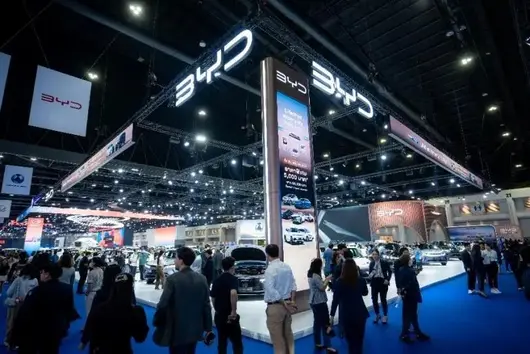
On the last day of the Bangkok Auto Show, the temperature in front of the BYD booth was even higher than outside.
The air conditioner was set to maximum, the crowd was packed together, and the emitted heat made the cool air thin. There was a faint scent of sweat in the air.
A Thai boy of five or six years old lay in front of the car's central control screen at the exhibition, his fingers moving fast. The animation on the screen jumped around in response.
His mother stood behind him watching for a while, and in Thai said: “This looks like an iPad.” Several young couples nearby heard and laughed.
The Toyota exhibition area next door was a completely different scene. The exhibition fixtures were polished to a shine. Sales staff wore dark grey suits, neatly ironed, standing with hands folded on the side of the booth. After standing there all morning, he looked down and scrolled through Line.
When the monthly data came out, the entire industry was stunned.
Chinese brands sold 43,791 vehicles in Thailand, while Japanese cars sold 43,789 vehicles.
With a narrow advantage of just two vehicles, Japanese cars, which had dominated Thailand for over sixty years, were pushed off the monthly top spot by Chinese brands for the first time, even though this was a pulse market driven by rushed registrations before the EV3.0 subsidy expired.

That month, the pure electric market was a landslide. Chinese brands took more than three-quarters of the market share. BYD alone sold nearly 13,000 vehicles, ranking only behind Toyota among all brands.
In the car flow on the streets of Bangkok, new faces with familiar logos appeared more frequently.
A Chinese local running a travel agency took a photo at a traffic light intersection. On the left was a BYD Seal, and on the right was a Toyota Camry.
He posted it on WeChat Moments with four characters: Times are changing.
On the first day of February, Thailand's electric vehicle subsidy policy shifted gears.
Switching from EV3.0 to EV3.5, the subsidy per vehicle was cut from a maximum of 150,000 Baht to 100,000. Imported vehicles no longer enjoyed preferential consumption tax; the standard tax rate was restored, and subsidies no longer covered imported vehicles.
Chinese brands that previously relied on imported models to lead the charge saw terminal prices jump instantly. BYD saw some models rise by about one-third, while a key MG model was directly adjusted up by 100,000 Baht.
The market cooled faster than anyone predicted.
Data from the Federation of Thai Industries shows that February pure electric vehicle sales plummeted by over eighty percent month-on-month.
The market share of Chinese brands across all categories dropped sharply from 47.3% to 11.65%. BYD fell from over 12,000 units to less than 300. Not a single Chinese brand entered the top five that month.

In a BYD showroom in northern Bangkok, a Thai female salesperson named Kim experienced it all. She is in her early thirties, a local from Bangkok, and previously sold cars at Toyota for 5 years.
She jumped ship because she found that more and more young people coming to the Toyota store mentioned a Chinese brand she had never heard of.
In the week of the January Auto Show, she signed 17 orders, more than double her average monthly sales volume at Toyota. In February, she didn't sell a single car.
In her phone, she saved a photo taken on the last day of the January Auto Show. On the whiteboard in the corner of the booth, the day's order count was written in scrawl. Next to the number, someone drew a funny face.
Asked why she didn't quit. She didn't answer directly. After a while, she said: “There are more and more Chinese cars on the street, this will be the future of Bangkok streets.”
It rained outside the showroom. She stood at the door watching for a while. The rain wet a row of cars parked on the street opposite. There were Toyota and Honda, but also BYD and Great Wall.
From peak to ice point, the calendar turned a page. Chinese brands did not exit completely and soon came back with a vengeance.

In March, Chery sold 2,155 vehicles, ranking fifth. MG sold 1,625, ranking seventh. Great Wall sold 1,350, ranking ninth.
In April, during the Bangkok Auto Show, Chinese brands exploded again. Reservation volume reached 90,530 units, accounting for nearly seventy percent. BYD topped the list with 17,354 reservations, surpassing Toyota's 15,750. In the top ten, except for Toyota and Honda, all 7 seats were occupied by Chinese brands.
At that time, what Kim did not know was that the policy change she feared came again in May.
In May, the Thailand Electric Vehicle Association, in conjunction with 10 automotive industry associations, submitted a document with 8 emergency policy suggestions to the government. The association representatives exceeded 1,500 enterprises.
The wording in the document was restrained, but the meaning was clear: some car companies were importing complete vehicles from China using zero tax rates instead of local production, which had already hurt Thailand's local component manufacturers.
Almost at the same time, Japanese Ambassador to Thailand Masato Otake publicly stated: “Shifting to electric vehicles completely at this stage is a bit too early.”
Behind these proposals and statements was the vast interest network built by Japanese car companies in Thailand over 60 years.
The automotive industry is a pillar industry in Thailand, accounting for more than ten percent of GDP. Thailand is the largest in ASEAN and the 10th largest in the world for car production, with more than 2,200 enterprises setting up operations here.
Rayong is southeast of Bangkok, less than two hours by car.
Japanese car companies gathered factories and thousands of component enterprises there for over 40 years. In the 1980s, workshops echoed with Japanese, but now Chinese can be heard.
7 major Chinese car companies have established complete vehicle production bases in Thailand, with a combined planned total capacity exceeding 600,000 vehicles.

The BYD Rayong factory has a designed annual capacity of 150,000 vehicles. In the two years since production started, cumulative deliveries have exceeded 130,000 vehicles. Changan's Rayong factory total investment exceeds 10 billion Baht, with Phase 1 annual capacity of 100,000 vehicles.
On the surface, Chinese enterprises are targeting the Thai market, but the true strategy is grander.
Right-hand drive markets cover India, Japan, UK, Australia, and other countries and regions, accounting for about 35% of the global population. Right-hand drive vehicles require separate design for steering devices, instrument panels, pedal structures, braking systems, airbags, wiring harnesses, and many other components. Building a new right-hand drive supply chain from scratch is difficult to estimate in terms of cost and time.
Chinese enterprises chose a smarter path, directly utilizing the industrial ecosystem Japan accumulated in Thailand over decades.
BYD, Changan, Great Wall, and Dongfeng Xiaokang do not view Thailand just as the Thai market, but as the starting point for the right-hand drive global market.
Japanese media calls this change “Thai Right-Hand Drive Automotive Supply Chain, China Replaces Japan”.

According to a series of reports by Nihon Keizai Shimbun in 2025, the market share of Japanese brands in major ASEAN countries such as Indonesia, Thailand, and Vietnam are all declining. Indonesia fell below 81%, Thailand dropped to 68%, and Vietnam fell to 33%. At the same time, the market share of Chinese brands in New Energy Vehicles in the six ASEAN countries exceeded 60%. Thailand 78%, Indonesia as high as 91%.
The same report also mentioned another interesting trend: Japanese car companies are rapidly expanding the procurement of Chinese components. Chinese components have a 30% to 40% cost advantage, and the speed is much faster. Chinese enterprises can mass-produce 10 months after receiving an order, while Japanese companies take a year and a half or more.
The Vice President of Toyota Gosei, a resin component company, said: “There is no longer a gap in quality.”
In the evening in Rayong, outside the walls of Japanese factories, the lights of Chinese factories are turning on.
A Thai technician named Anucha worked at a Toyota factory for 20 years. He quit at the end of 2025 and reported to Great Wall in early 2026. He said: “They pay 3,000 Baht more.” 3,000 Baht is equivalent to about 600 Yuan.
Anucha is responsible for a process on the battery pack assembly line at the Great Wall Rayong factory. When passing in front of the Toyota factory, sometimes he stops to smoke a cigarette, looking at the other side of the wall.

From May to July, the market gradually returned to normal. Chinese brands overall market share stabilized around 17%, moving out of the valley bottom of 11.65% in February, but never again saw the near-50% pulse situation of January. Chinese brands still accounted for about 90% of the pure electric market, but fuel vehicles and pickup truck markets were still held by Japanese companies.
Kim knew little about Rayong; she only saw the flow of customers in the showroom slowly returning. In March, people started coming into the store.
One afternoon in May, she signed a new customer, a Thai middle-aged man in his 50s, who had driven Hondas for over 20 years.
Kim asked why he thought of switching to a Chinese car. The other party said: “I tried them all. For a similar price, Chinese cars offer much more configurations and are easier to drive.”
Before the lights turned on on both sides of the Rayong walls, the first Chinese light that Thais saw was actually a bowl.
Lampang Rooster Bowls originated from ceramic skills brought by Chinese immigrants, used in noodle shops for noodle soup, and at street stalls for soup noodles.
Because they are hand-painted, every bowl has a different rooster, seen as a cultural calling card of Lampang Province by locals.
Later, Thais discovered China also has Rooster Bowls, produced on assembly lines with industrial printing. The production capacity is dozens of times that of hand-painted bowls, and the price is less than one-quarter.
A large influx of Chinese Rooster Bowls made local workshops fall apart.

Thais were angry: “Thai Rooster Bowls are artworks, each with a soul. How can soulless Chinese goods compare.”
More destructive than Rooster Bowls are motorcycles.
In the late 1990s, Chinese motorcycles entered Southeast Asia en masse. For the same model, Japanese motorcycles sold for $2,100, while Chinese motorcycles sold for $1,200 to $1,300. The price advantage pushed Chinese motorcycles to 80% of Vietnam's market share.
But Japanese motorcycles could be ridden for 10 years, while Chinese motorcycles had problems in a year or two. “Made in China” was solidified in Southeast Asia as a synonym for low quality and cheap.
These lessons were remembered by later Chinese enterprises when entering Thailand.
In 2002, Haier came. The first batch of products were moved over directly, but they didn't push. Haier did one thing: rooted. Local R&D, local manufacturing, local marketing.

Targeting the pain point of Thailand's hot weather where turning on the air conditioner at midnight easily leads to catching a cold, they developed voice-controlled air conditioners. By 2025, Haier's market share in Thailand rose to 14.5%, maintaining first place.
Around the same time, OPPO, Huawei, and Xiaomi also entered. The Thai public's perception of Chinese mobile phones slowly changed from “cheap” to “technology”.
From cheap to advanced, this cognitive shift is most intense in the automotive field.
Research by Southeast Asian independent brand communication consulting firm Vero shows that 72% of Thai consumers have a good impression of Chinese cars, believing they are affordable, technologically advanced, and fashionable.
In the Rooster Bowl workshop in Lampang, an old craftsman sat in front of the potter's wheel, hands turning. The bowls he made, the rooster was still painted stroke by stroke. He said: “Now no one buys hand-painted bowls. The stamped bowls from China are too cheap.”
He occasionally heard people mention that young people graduating from Lampang schools are working at factories in Rayong, earning much higher wages than in town.
At dusk of a bowl, is the boom of a movie and the dawn of a car.

In a Bangkok cinema, before the screen lit up, the BYD logo lit up first.
In July this year, the Chinese movie Love Letter to Grandma premiered in Thailand. BYD took exclusive sponsorship. On the opening night, BYD Thailand General Manager took the stage to give a speech.
A few days later, BYD's cumulative deliveries in Thailand exceeded 130,000 vehicles. The 130,000th vehicle was handed to the actress who played Grandma in the film.
BYD people said quite truthfully: “Use a movie about family affection to build a bridge between the audiences of the two countries.”

The Thai electric vehicle market is expanding at an amazing speed.
In the first half of 2026, electric vehicle registrations exceeded 100,000, a year-on-year increase of over 90%, and the penetration rate of the new car market reached 30%. At the beginning of the year, industry institutions predicted that annual sales would exceed 150,000 vehicles.
In the past few decades, car advertisements on Thai screens were almost completely taken over by Japanese brands.
Toyota advertisements were played on TV in loops. In Thai dramas, the car driven by the protagonist was no surprise Toyota, Honda, or Mitsubishi. Now Chinese brands are starting to broadcast on movie screens.

Changan shot three Thai-style short films “Thai Swift” “Thai Understands” “Thai Comprehensive” around the Rayong factory, using Thai language and humor to tell the story of Chinese brands.
On the same land, Japanese media is telling the same story with another visual language.
At the end of 2024, Nihon Keizai Shimbun released a documentary called “The Disappearing Engine Sounds of Thailand”, filming how Chinese electric cars are taking the market from Japanese cars.
Japanese people have never let go of their pride, but they also have to bow their heads and endure.
In the latest registration data of July, 7 Chinese brands were on the top 10 list of new cars in Thailand, but Toyota's single-month sales of nearly 20,000 vehicles still led by a wide margin.
On the brand sales list for the first half of the year, Toyota accumulated over 100,000 units, up 11.3% year-on-year. BYD ranked third with over 25,000 units, lagging behind Honda's 40,000. Chery grew amazingly, breaking 20,000 units, up more than 10 times year-on-year. MG, Aion, and Great Wall also squeezed into the top 10.
From 2020 to 2026, the market share of Chinese brands in Thailand climbed from an almost negligible 3.4% to 47.34%. Japanese cars slid from a high of 86.7% to around 47.33%.
In a Toyota repair shop in a small town in central Thailand, owner Somchai voiced another side. He is over 50 years old and has repaired Japanese cars all his life.
“Toyota cars are easy to fix,” he said. “If the wires break, connect them and it goes. Chinese electric cars break and you have to wait for parts. Who can wait a month?”
Then he laughed: “I also bought my daughter a Chinese electric car. It's good-looking, smart, quality is not bad, she likes it very much.”
This is the real picture of the Thai market. The consumption preferences of middle-aged people and young people are diverging, and reason and emotion are going their separate ways.
In fact, Chinese cars are only showing half their advantage in Thailand. Fuel saving, quiet, and high configurations are these real benefits.
The other half of the advantage, intelligence, is basically useless in Thailand.
Google Maps doesn't work well, and many drivers still use mobile phone navigation. Assisted driving is stuck at L2 level. Highway pilot and urban pilot are difficult to land.
Many models going out to Thailand have canceled LiDAR, or kept hardware but locked high-level intelligent driving functions, because local compliant high-precision maps are missing.

Charging infrastructure is also a problem. As of January 2026, Thailand already had 4,643 public charging stations and 13,977 public charging interfaces, but finding a charging pile outside of Bangkok is still anxiety-inducing.
When Kim took customers for test drives, the most asked question was charging. She had to patiently explain where the pile was, how long to charge, and how far to run. Sometimes customers shook their heads and left halfway through.
At the same time, cost is not an advantage. The ten component industry alliance led by the Thailand Electric Vehicle Association EVAT pointed out that under equal conditions, electric vehicles manufactured locally in Thailand cost 30% to 40% more than complete vehicles imported directly from China. Also, policy is uncertain. The EV3.5 policy expires at the end of 2027.
After the market digestion from May to July, Chinese cars are still everywhere. Toyota and Honda fuel pickups still account for a large proportion of the car flow.
Geopolitics is another ceiling. US tariffs on Chinese electric vehicles rose from 25% to 100%, starting to focus on checking transshipment assembly of Chinese brands assembled in Thailand.
Kim does not care about these, only caring about whether there are more guests in the showroom. Fortunately, performance has been getting more stable these past few months. Kim plans to buy another house with a mortgage.
That Rooster Bowl is still there, but now in Bangkok malls, you have to run to many places to find a Rooster Bowl. However, huge ads for Chinese electric vehicles are everywhere in the malls. There are even Chinese car showrooms and enthusiastic sales staff running around.

Kim is still full of energy and full of expectation for the future. Anucha has worked for half a year at Great Wall Rayong factory and has already called on several people around him to buy Great Wall cars. Somchai's daughter has driven a Chinese electric car for over half a year. When Somchai charges the car, sometimes neighbors will talk to him about Chinese cars and Japanese cars, and he answers with a smile.
The buzz of “Love Letter to Grandma” passed in Bangkok, but Chinese cars are everywhere. The reversal in January was a sudden firework triggered by policy. The data from May to July is the new normal of the Sino-Japanese car rivalry marathon.
On the streets of Bangkok, the green light is on. Cars from different countries pour out at the same time. No one is waiting for anyone, and no one is yielding to anyone...

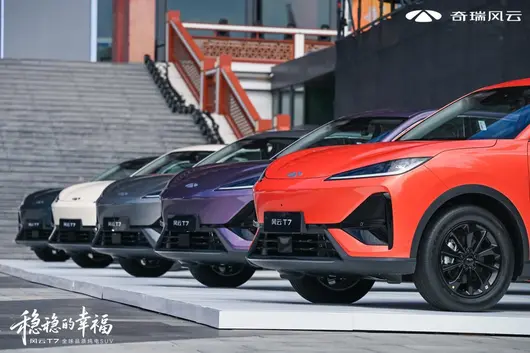
日前,奇瑞風雲 T7 正式上市。呢款車一共三個版型,上市指導價定喺 9.79 萬蚊到 11.89 萬蚊之間,如果算埋換領補貼,搶先換領價更係嚟到 9.49 萬蚊起。喺十萬級純電動 SUV 呢個競爭最激烈嘅市場入面,風雲 T7 嘅定價策略好明確:唔玩套路,直接將全球標準嘅產品拉到呢個價碼段。
講真,而家市面上唔少十萬級純電車型為咗將價格壓落去,慣用嘅手法係喺續航、安全配置或者智能化上整高低配差異。入門版往往電池縮水、續航打折,想要長續航同完整嘅安全配置就得加錢上高配。

風雲 T7 今次反其道而行,全系標配 65.05kWh 嘅犀牛電池,CLTC 純電續航統一俾到 600 公里,實測續航仲係跑咗 681.6 公里。呢種反向虛標嘅做法,對於每日通勤幾十公里、週末仲想帶家人近郊出遊嘅普通用戶嚟講,係意味著真真正正嘅安心。更關鍵係,30% 到 80% 嘅快充只需要 20 分鐘,一杯咖啡嘅時間就能補返差唔多 300 公里嘅續航,日常使用基本唔會有人哋里程焦慮。
安全方面,風雲 T7 落咗唔少硬功。車身採用九橫五縱籠式結構,高強度鋼占比達到 80%,熱成型鋼占比 18.84%。更唔少少注意嘅係,佢按照 2026 版 E-NCAP 五星安全標準開發,配備咗同級最多嘅 9 個安全氣囊,其中包括 48L 嘅雙腔遠端氣囊。電池安全同樣冇妥協,6D 鎖子甲 31 層防護結構、IP68 級防水、200kN 嘅側邊抗擠壓性能,呢啲參數對於普通消費者可能點抽象,但簡單來講就係:遇到碰撞、涉水或者極端天氣,電池包唔容易出問題。奇瑞仲俾咗動力電池安全兜底承諾,如果因為電池自身原因導致熱失控損毀,直接賠償同款新車。呢種承諾喺行業內並唔多見,說明廠家對自身產品有足夠嘅底氣。

智能化配置係另一個亮點。風雲 T7 搭載咗同級首發嘅 8775 座艙駕控一體芯片,採用 4nm 製程,算力達到 72TOPS。呢套芯片同時驅動智能座艙同輔助駕駛,系統響應延遲控制在 80 毫秒。實際體驗層面,佢支持 300 多種全場景自動泊車,包括跨樓層智能泊車同 100 米循跡倒車,對於停車困難戶嚟講非常實用。高速領航輔助功能能夠提前 500 米預判變線同匝道口匯入,長途駕駛可以減輕唔少疲勞。15.6 英寸嘅 2.5K 高清大屏幕、支持 CarPlay 同 HiCar 嘅全品牌手機互聯,呢啲配置放喺十萬級車型入面,確實算得上十足誠意。

當然,風雲 T7 最大嘅差異化標籤都係全球車。奇瑞連續 23 年位居中國品牌乘用車出口第一,全球用戶超過 2000 萬。風雲 T7 並唔係國內特供車型簡單改個標出海,而係從研發之初就同步適配全球 210 個國家同地區嘅用車需求。佢經歷咗全球 21 個國家嘅實車驗證,累計測試里程超過 600 萬公里,其中耐用專項實測 145 萬公里,覆蓋咗從北歐極寒到中東高溫、從東南亞高濕到德國高速嘅 100 多種極限路況。同源車型 Lepas L6 已經喺南非、泰國上市,接下來仲要進入歐盟、澳新等市場。呢種先跑遍全球再返國上市嘅路徑,令到風雲 T7 喺底盤調校、環境適應性、法規符合性上都積累咗大量前置經驗。

從實際用車場景嚟睇,風雲 T7 嘅產品定義好貼近中國家庭嘅日常需求。84% 嘅車內得房率、後排純平地板、1955mm 乘 1310mm 嘅純平大床模式,帶細路出街或者露營休息都比較實用。450 升嘅後尾箱常規容積,放倒後能擴展到 1550 升,裝嬰兒車、露營裝備或者搬屋嘅大件物品都夠用。9 層雲感舒適座椅支持三檔加熱同吸風,冬天唔使凍屁股,夏天唔會悶汗。呢啲細節睇落嚟唔如續航、加速咁咁耀眼,但恰恰係家庭用戶每日上車都能感受到嘅體驗。
上市權益方面,風雲 T7 亦都拿出咗真金白銀嘅誠意。除咗 3000 蚊換領補貼同 2 年 6 萬 0 息或 5 年 10 萬 3 年免息嘅金融方案,仲有價值 6000 蚊嘅個性車色限時免費、整車終身保養(含三電)、666 蚊購買價值 3999 蚊嘅終身基礎保養套餐等。對於預算喺十幾萬出頭、想買一台可靠純電動 SUV 嘅消費者嚟講,呢啲權益進一步降低咗購車同用車嘅門檻。

總體嚟講,風雲 T7 嘅產品邏輯好清晰:喺十萬級價碼段,唔做夠用就得嘅湊合產品,而係將長續航、高安全、真智能同全球驗證嘅質素一次過俾到位。佢可能唔係參數最勁嘅車型,但勝喺均衡同踏實。如果你係一位注重實用性、希望少掙扎、追求穩紮穩打用車體驗嘅家庭用戶,風雲 T7 值得去店度實際睇下、試下。畢竟,喺呢個價碼段,能把全球標準同 600 公里續航同時做到全系標配嘅,而家真係唔多見。

喺馬來西亞嘅 SUV 市場,好多買家喺揀車嗰陣都會拿 Honda HR-V 同 Mazda CX-3 嚟做比較。兩款車喺價位同定位上都好接近,今日我哋就由多個方面做一次詳細嘅比較,幫你省返啲做功課嘅時間。
Honda HR-V 喺馬來西亞嘅 OTR 售價係 RM 115,900 - 143,900,一共有 4 個版本,包括 2026 e:HEV 1.5L RS(RM 143,900)、2026 1.5T V(RM 137,900)、2026 1.5T E(RM 130,900) 等。
Mazda CX-3 喺馬來西亞嘅 OTR 售價係 RM 126,159 - 139,159,一共有 2 個版本,包括 2023 2.0L High(RM 139,159)、2023 2.0L Plus(RM 126,159) 等。
由價錢睇,Honda HR-V 嘅起步價真係比 Mazda CX-3 平咗 RM 10,259。如果你預算有限,Honda 嘅入門版已經可以滿足日常需要。但亦都要注意,平嗰幾千蚊,可能在配備上會有取捨,具體要睇你嘅需要。
Honda HR-V 嘅安全評級係 5★ (ASEAN NCAP),主動安全系統包括 Honda SENSING (ACC, CMBS, LKAS, RDM)。
Mazda CX-3 嘅安全評級係 5★ (ASEAN NCAP),主動安全系統包括 i-Activsense。
兩款車嘅安全評級一樣,喺呢個級別入面安全配備都算好齊全。而家嘅新車安全性都唔差,唔使太擔心呢一點。
Honda HR-V 車身長 4500 mm,尾箱 450 L。
Mazda CX-3 車身長 4500 mm,尾箱 450 L。
兩款車嘅尺寸幾乎一樣,車內空間差別唔大。呢個級別嘅車,日常使用完全夠用。
Honda HR-V 採用 FWD 驅動方式。
Mazda CX-3 採用 FWD 驅動方式。
兩款車嘅驅動方式一樣,都係 FWD,日常駕駛感覺唔會有太大分別。
總體嚟講,Honda HR-V 同 Mazda CX-3 都係馬來西亞市場好唔錯嘅車型。揀邊一輛,關鍵仲係要睇你個人需要同預算。建議大家做好功課,多比較幾間車行嘅報價,先再試駕做最終決定。買車係件大事,花啲時間做功課絕對唔會錯。

August 26, the global quality pure electric SUV Fengyun T7 launch event grandly opened in Beijing. The new car officially launches Enjoy Edition, Comfort Edition, and Smart Edition three configurations, official guide price RMB 97,900-118,900. After users enjoy priority exchange rights, the starting price is as low as RMB 94,900. As a heavy hitter of Chery Fengyun deep-diving into the home pure electric market, Fengyun T7 did not continue the current new energy market's "price reduction, reduced configuration, blind material stacking" involution old path, but rather with the core concept "Global Car, Rushing is Impossible", relying on hard strength of range equality, global domain safety, global standards, smart accessibility, broke through pain points of the RMB 100,000-level pure electric SUV market, set a new value benchmark for mass market pure electric travel, and reshaped the industry competition logic of entry-level pure electric models.

Looking at the current domestic RMB 100,000-level pure electric SUV market, homogenized involution, reduced entry-level configurations, false range labeling, safety standard downgrade have become common chaos. Most brands, to lower starting prices, deliberately distinguish high and low config ranges, reduce core safety configurations, cut energy-saving hardware, causing consumers to fall into a dilemma of "low price low quality, high config premium". The launch of Fengyun T7, the core breakthrough lies in overturning the industry's unwritten rule of "graded shrinkage", with extreme product inclusiveness, realizing a cross-class experience of entry-level full configuration, which is also its core differentiated advantage compared to peer competitors.

This new car's biggest industry innovation is landing true "range equality", completely ending entry pure electric range anxiety. Different from peer models' high and low config range differentiation tactics, Fengyun T7 full system uniformly equips 65.05kWh Rhinoceros Battery, CLTC standard range full system maxed at 600km, achieving three configurations range no difference, hardware no reduction. More worth noting is, the car achieves industry-rare "reverse false labeling", official measured range up to 681.6km, far exceeding official标定 data, true range ability far exceeds peer mainstream models. Meanwhile, new car supports 30%-80% power 20 minutes ultra-fast charge, pairing full system standard dual-source wide temperature range heat pump AC and high-voltage PTC, low-temperature range can improve 30%, completely solving home pure electric car winter range loss, long-distance recharging trouble core pain points, letting RMB 100,000-level models also balance daily commute, long-distance self-driving, outdoor camping etc. full-scenario travel needs.

In the safety field consumers pay most attention to, Fengyun T7 with "Six Major Redundant Safety Systems", redefines home pure electric safety bottom line, breaking "low-price cars have no high-config safety" inherent cognition. Body uses nine horizontal five vertical cage architecture, 80% high-strength steel support, pairing professional Shotgun anti-collision structure and 9 airbags, including industry-rare far-side anti-side collision airbags, comprehensively guarding driving passengers safety. Battery level, equips 6D Chainmail 31-layer protection structure Rhinoceros Battery, endured multiple strict extreme tests, meanwhile official launches battery thermal runaway compensation new car, limited scenario intelligent driving insurance highest 5 million coverage, whole vehicle and three-electric lifetime warranty exclusive rights, from hardware protection to after-sales guarantee, builds full-dimension safety barrier, letting home pure electric travel say goodbye to safety compromise.
Different from most focusing on "domestic exclusive" peer models, Fengyun T7 is real **Global Quality Model**, achieving domestic price affordable, quality globally sourced. It is understood, this car source model Lepas L6 successfully landed South Africa, Thailand etc. overseas markets, later will also gradually enter EU, Australia & New Zealand etc. strict standard regions, whole vehicle R&D, production, verification all follow global unified standards, endured massive extreme road conditions and environment tests, own far exceeding peer whole vehicle reliability and durability. This "global quality down to RMB 100,000-level market" product strategy, completely subverts past "global model high-end" industry convention, letting ordinary consumers no longer pay for brand premium, regional differences, affordable price can own world-class manufacturing quality.

Intelligence and texture level, Fengyun T7 equally refuses low config perfunctory, continues global high config approach. Relying on Chery mature intelligent R&D system, new car equips high-level intelligent interaction system, balancing fluidity and practicality, adapting home user daily travel intelligent assistance, audio-visual entertainment, convenient control etc. core needs. Meanwhile, whole vehicle upholds "Aesthetic Global" design concept, appearance simple and atmospheric, interior texture delicate, balancing home stability attribute and global aesthetics, fitting mainstream family user car usage aesthetics. Launch event site, famous musician, #001 owner Hamilton Wu appeared with "Happiness Experience Officer" identity, combined real car usage scenarios sharing experience, accurately interpreted Fengyun T7 "Steady Happiness" product core, letting hard product power land into user perceptible travel happiness.

From industry depth interpretation perspective, Fengyun T7 launch, is not once simple new car iteration, but for RMB 100,000-level pure electric SUV market once value reconstruction. Current new energy market polarization severe, high-end models compete tech, compete luxury, entry models compete price, compete low price, most brands discarded "cost-performance and high quality balancing" middle track. And Fengyun T7 accurately grasps home user core demands, no parameter gimmicks, no config tricks, with range equality, safety redundancy, global quality, lifetime warranty four core advantages, directly hit industry pain points.
Reporter's Perspective: In fuel car continuous price drop, entry electric involution intensifying current, Fengyun T7 relying "no price hike, no reduction, high standard, global" core competitiveness, successfully opened "affordable price + cross-class quality" market track. For consumers, it lowered high-quality pure electric travel threshold; for industry, it ended entry pure electric reduced config chaos, forcing peer market return to product essence. Future, as Fengyun T7 formally enters market and starts delivery, this global high-quality home pure electric SUV,有望成为 RMB 100,000-level new energy market benchmark model, leading industry from "price involution" to "value competition" comprehensive transformation.

喺馬來西亞嘅 SUV 市場,好多買家喺揀車嘅時候都會拎 Honda HR-V 同 Toyota Fortuner 嚟做比較。呢兩款車喺價位同定位上都幾接近,而家我哋就由多個方面做一個詳細嘅比較,幫你省做做功課嘅時間。
Honda HR-V 喺馬來西亞嘅 OTR 售價係 RM 115,900 - 143,900,一共有 4 個版本,包括 2026 e:HEV 1.5L RS(RM 143,900)、2026 1.5T V(RM 137,900)、2026 1.5T E(RM 130,900)等。
Toyota Fortuner 喺馬來西亞嘅 OTR 售價係 RM 195,880 - 241,880,一共有 3 個版本,包括 2024 2.8T VRZ Diesel(RM 241,880)、2024 2.7L SRZ Petrol(RM 202,880)、2024 2.4L Standard Diesel(RM 195,880)等。
從價錢嚟睇,Honda HR-V 嘅起步價真係比 Toyota Fortuner 平咗 RM 79,980。如果你預算有限,Honda 嘅入門版已經可以滿足日常需要。但要留意,平嗰幾千蚊,可能喺配備上會有取捨,具體要睇你嘅需要。
Honda HR-V 配備 1.5L Turbo,馬力 140 hp。官方油耗 7.0 L/100km。
Toyota Fortuner 配備 2.5L Diesel,馬力 187 hp。官方油耗 8.5 L/100km。
動力方面,Toyota Fortuner 嘅 2.5L Diesel 比 Honda HR-V 嘅 1.5L Turbo 多咗 47 匹馬力。不過日常喺市區行,兩款車嘅動力都夠用,唔會覺得唔夠力。
Honda HR-V 嘅安全評級係 5★ (ASEAN NCAP),主動安全系統包括 Honda SENSING (ACC, CMBS, LKAS, RDM)。
Toyota Fortuner 嘅安全評級係 5★ (ASEAN NCAP),主動安全系統包括 。
兩款車嘅安全評級一樣,喺呢個級別入面安全配備都算畀得好齊全。而家嘅新車安全性都唔差,唔使太擔心呢一點。
Honda HR-V 保用 5 年/無限制里數,保養間隔 每 10,000km 或 6 個月。
Toyota Fortuner 保用 5 年/無限制里數,保養間隔 每 10,000km 或 6 個月。
兩款車嘅保用條件一樣,呢方面唔使糾結。實際保養成本仲要睇品牌嘅服務網絡同零件價格,建議去車友群問問真實車主嘅經驗。

Honda HR-V 同 Toyota Fortuner 都係馬來西亞市場嘅主流選擇,適合家庭使用、日常通勤。如果你更睇重品牌口碑同二手價,可以優先考慮口碑更好嗰一款;如果你更在意性價比同配備,就揀配置更豐富嗰款。最終都係建議兩款都去試駕,親身體驗先係最重要嘅。

總嘅嚟講,Honda HR-V 同 Toyota Fortuner 都係馬來西亞市場好唔錯嘅車型。揀邊架,關鍵都要睇你嘅個人需要同預算。建議大家做好做功課,多比較幾間車行嘅報價,再去試駕做最終決定。買車係一件大事,花少少時間做做功課絕對唔會錯。

In the Malaysian SUV market, many buyers compare Honda HR-V and Toyota Yaris Cross when choosing a car. These two cars are quite close in price and positioning. Today we will make a detailed comparison from multiple aspects to help you save time doing your research.
Honda HR-V OTR price in Malaysia is RM 115,900 - 143,900. There are a total of 4 versions, including 2026 e:HEV 1.5L RS (RM 143,900), 2026 1.5T V (RM 137,900), 2026 1.5T E (RM 130,900), etc.
Toyota Yaris Cross OTR price in Malaysia is RM 99,900 - 109,900. There are a total of 2 versions, including 2026 1.5L Standard (RM 99,900), 2026 HEV 1.5L Standard (RM 109,900), etc.
From a price perspective, Toyota Yaris Cross's starting price is RM 16,000 cheaper than Honda HR-V. Honestly, in this price segment, a difference of a few thousand is not significant. The key is to look at the overall value for money and long-term usage costs.
Honda HR-V's safety rating is 5★ (ASEAN NCAP). Active safety systems include Honda SENSING (ACC, CMBS, LKAS, RDM).
Toyota Yaris Cross's safety rating is 5★ (ASEAN NCAP). Active safety systems include TSS.
Both cars have the same safety rating. Safety features are quite comprehensive in this class. Safety in new cars nowadays is generally good, so no need to worry too much about this.
Honda HR-V adopts FWD drivetrain.
Toyota Yaris Cross adopts FWD drivetrain.
Both cars have the same drivetrain, both are FWD, so the daily driving experience won't differ much.
Honda HR-V warranty is 5 years / unlimited mileage. Maintenance interval is every 10,000km or 6 months.
Toyota Yaris Cross warranty is 5 years / unlimited mileage. Maintenance interval is every 10,000km or 6 months.
Both cars have the same warranty conditions, no need to worry about this. Actual maintenance costs also depend on the brand's service network and parts prices. It is recommended to ask real owners in car groups for their experience.

Honda HR-V and Toyota Yaris Cross are both mainstream choices in the Malaysian market, suitable for family use and daily commuting. If you value brand reputation and resale value more, you can prioritize the one with the better reputation; if you care more about value for money and features, choose the one with more configurations. In the end, it is recommended to test drive both cars, as hands-on experience is the most important.

Overall, Honda HR-V and Toyota Yaris Cross are both very good models in the Malaysian market. Which one to choose mainly depends on your personal needs and budget. It is recommended to do your research, compare quotes from several dealerships, and then test drive to make the final decision. Buying a car is a big deal; spending some time doing research is never a mistake.

In Malaysia's SUV market, many buyers compare Honda HR-V and Toyota Corolla Cross when choosing a car. These two cars are quite close in price and positioning. Today we will make a detailed comparison from multiple aspects to help you save time on research.
Honda HR-V OTR price in Malaysia is RM 115,900 - 143,900, with 4 versions in total, including 2026 e:HEV 1.5L RS (RM 143,900), 2026 1.5T V (RM 137,900), 2026 1.5T E (RM 130,900), etc.
Toyota Corolla Cross OTR price in Malaysia is RM 133,800 - 148,800, with 3 versions in total, including 2026 HEV 1.8L GR Sport (RM 148,800), 2026 HEV 1.8L Standard (RM 140,800), 2026 1.8L Standard (RM 133,800), etc.
From a price perspective, Honda HR-V's starting price is indeed RM 17,900 cheaper than Toyota Corolla Cross. If your budget is limited, Honda's entry-level version can already meet daily needs. But also note, the few thousand difference might involve trade-offs in equipment, depending on your specific needs.
Honda HR-V safety rating is 5★ (ASEAN NCAP), active safety systems include Honda SENSING (ACC, CMBS, LKAS, RDM).
Toyota Corolla Cross safety rating is 5★ (ASEAN NCAP), active safety systems include TSS (PCS, LDA, ACC, LTA).
Both cars' safety ratings are the same, safety equipment in this class is quite comprehensive. New cars nowadays do not lack in safety, no need to worry too much about this point.
Honda HR-V warranty 5 years/unlimited mileage, maintenance interval every 10,000km or 6 months.
Toyota Corolla Cross warranty 5 years/unlimited mileage, maintenance interval every 10,000km or 6 months.
Both cars' warranty conditions are the same, no need to dwell on this aspect. Actual maintenance costs also depend on the brand's service network and parts prices, suggest asking in car owner groups for real owners' experience.
Honda HR-V and Toyota Corolla Cross are both mainstream choices in the Malaysian market, suitable for family use, daily commuting. If you value brand reputation and resale value more, you can prioritize the one with better reputation; if you value price-performance ratio and equipment more, then choose the one with richer configuration. Finally, it is suggested to test drive both, personal experience is the most important.
In general, Honda HR-V and Toyota Corolla Cross are both very good models in the Malaysian market. Which one to choose depends mainly on your personal needs and budget. We suggest everyone do their research, compare quotes from a few more dealerships, then go test drive to make the final decision. Buying a car is a big matter, spending some time doing research will never be wrong.

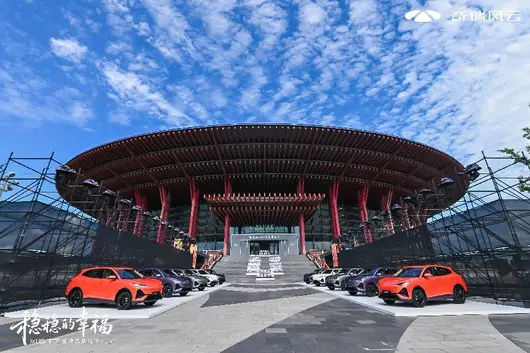
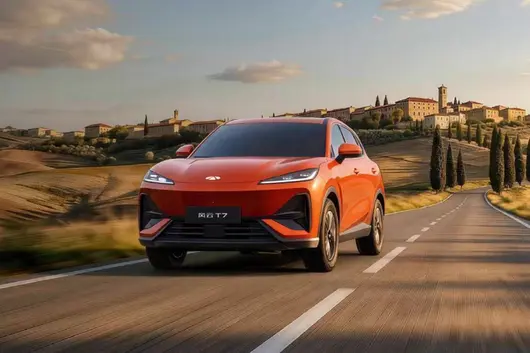
8 月 26 日,雁栖湖畔,奇瑞風雲 T7 正式上市。三款車型,上市搶先置換價 9.49 萬元至 11.59 萬元,同步推出九重購車權益。

對一輛面向家庭用戶嘅純電 SUV 來說,呢個主題其實好具體:續航要實實在在,電池要經得住時間,空間要坐得舒展,開起來要輕鬆唔累,多年之後依然能讓人安心。奇瑞把風雲 T7 嘅重點放在呢啲日常使用中最基礎,亦最容易被忽略嘅地方,想用更扎實嘅體驗,去回應普通家庭真正關心嘅問題。
奇瑞有一個容易被忽略嘅身份,連續 23 年中國品牌乘用車出口第一,全球用戶超過 2000 萬,產品賣到 130 多個國家和地區,放喺風雲 T7 上,佢變成咗產品邏輯。

風雲 T7 整車累計測試里程超過 600 萬公里,耐久專項驗證 145 萬公里,跑過全球 100 多個極限路況環境,從巴西高減速坎、墨西哥鵝卵石路,到德國高速大曲率彎道、南非非鋪裝泥路,溫度跨度從 -40℃到 55℃。
呢啲數字背後有一個好實際嘅道理,一輛車如果喺全球唔同法規、唔同路況、唔同氣候下跑落嚟,再返嚟國內服務一個普通家庭,佢嘅可靠性基礎係唔一樣嘅,真正嘅耐久、防腐、熱管理、底盤一致性,係喺呢種「慢功夫」入面磨出來嘅。
同源車型 Lepas L6 已經喺南非、泰國上市,仲進咗米蘭設計周。

風雲 T7 全系標配 65.05kWh 電池,CLTC 續航 600km,但官方俾咗一個更有意思嘅數字:媒體實測續航 681.6 公里,電池循環壽命超過 2500 次,使用壽命標稱 15 年,支持 20 分鐘從 30% 充到 80%。
對低溫呢個純電老難題,全系給咗熱泵空調加高壓 PTC,配 AGS 智能進氣格柵同低風阻設計,零下 10℃環境下續航提升 30%。電驅係 12 合 1 鵬超能電驅,峰值功率 178kW,最大扭矩 275N·m,綜合效率 90.8%。

空間上,車長 4570mm,軸距 2700mm,得房率 84%,後排腿部空間 911mm,地板純平。後備廂 450L,下沉儲物 99L,後排放倒後能到 1550L,屬於那種坐進去唔憋屈、裝東西唔費勁嘅家用車。

風雲 T7 喺安全上,高強度鋼占比 80%,熱成型鋼 18.84%,電池有 31 層「鎖子甲」結構,IP68 防水能力係國標 96 倍,側邊抗擠壓能力 200kN,國標 2 倍。全車 9 個安全氣囊,同級別最多之一。值得注意嘅兩個細節,一係同級首發嘅雙框副車架加 Pack 防撞梁,二係 Shotgun 結構。前者係保護電池,後者係分散碰撞能量。
底盤俾到 70mm 大尺寸襯套、One-Box 線控制動,前後軸荷比 50.8:49.2,佢影響嘅唔係紙面性能,而係煞車點頭、彎道姿態、滿載穩定性呢啲日常體感。
風雲 T7 首發 4nm 製程 8775 艙駕一體晶片,NPU 算力 72TOPS,系統響應延遲 80ms。屏幕係 15.6 英寸 2.5K,亮度 1000nit,支持 CarPlay、HiCar、CarLink。輔助駕駛搭載嘅係獵鷹 500,22 個傳感器,支持 300 多種自動泊車場景、100 米循跡倒車、高速領航輔助。

風雲 T7 提出嘅「穩穩嘅幸福」,其實係對呢種需求嘅一種回歸。佢把奇瑞二十年出口積累嘅全球驗證能力,下放喺一個 10 萬級純電 SUV 上,用更笨、更慢嘅方式造一輛讓人安心嘅車。
一輛車能跑多快,係參數;一輛車能陪你幾耐,先係價值。風雲 T7 揀嘅,顯然是後者。
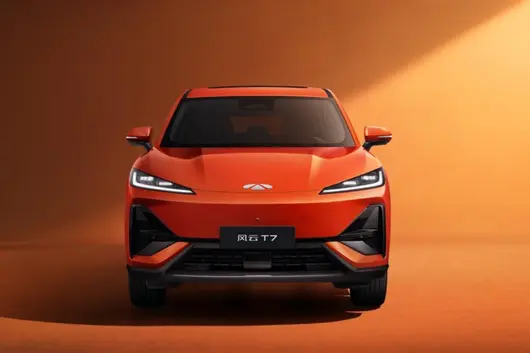

喺馬來西亞嘅 SUV 市場,好多買家喺揀車嘅時候都會拿 本田 HR-V 同 豐田 Corolla Cross 嚟做比較。兩款車喺價位同定位上都好接近,今日我就從多個方面做一個詳細嘅比較,幫你節省咗做功課嘅時間。
本田 HR-V 喺馬來西亞嘅 OTR 售價係 RM 115,900 - 143,900,一共有 4 個版本,包括 2026 e:HEV 1.5L RS(RM 143,900)、2026 1.5T V(RM 137,900)、2026 1.5T E(RM 130,900) 等。
豐田 Corolla Cross 喺馬來西亞嘅 OTR 售價係 RM 133,800 - 148,800,一共有 3 個版本,包括 2026 HEV 1.8L GR Sport(RM 148,800)、2026 HEV 1.8L Standard(RM 140,800)、2026 1.8L Standard(RM 133,800) 等。
從價錢嚟睇,本田 HR-V 嘅起步價確實比 豐田 Corolla Cross 平咗 RM 17,900。如果你預算有限,本田嘅入門版已經可以滿足日常需要。但亦要留意,平嗰幾千蚊,可能喺配備上要有取舍,視乎你嘅需要。
本田 HR-V 配備 1.5L Turbo,馬力 140 hp。官方油耗 7.0 L/100km。
豐田 Corolla Cross 配備 1.5L Turbo,馬力 140 hp。官方油耗 7.0 L/100km。
兩款車用咗同一套動力系統,日常開起嚟嘅感受基本冇乜分別。油耗方面都差唔多,唔使太糾結呢一點。
本田 HR-V 嘅安全評級係 5★ (ASEAN NCAP),主動安全系統包括 本田 SENSING (ACC, CMBS, LKAS, RDM)。
豐田 Corolla Cross 嘅安全評級係 5★ (ASEAN NCAP),主動安全系統包括 TSS (PCS, LDA, ACC, LTA)。
兩款車嘅安全評級一樣,喺呢個級別入面安全配備都算好齊全。而家嘅新車安全性都唔差,唔使太擔心呢一點。
本田 HR-V 採用 FWD 驅動方式。
豐田 Corolla Cross 採用 FWD 驅動方式。
兩款車嘅驅動方式一樣,都係 FWD,日常駕駛感受唔會同嗰咁大分別。
總體嚟講,本田 HR-V 同 豐田 Corolla Cross 都係馬來西亞市場幾唔錯嘅車型。揀邊輛,關鍵係要睇你嘅個人需要同預算。建議大家做好功課,多比較幾間車行嘅報價,再嚟試駕先做最終決定。買車係一件大事,花啲時間做功課絕對唔會錯。
In the Malaysian SUV market, many buyers compare Honda HR-V and Toyota Corolla Cross when choosing a car. These two cars are quite close in price and positioning. Today we will make a detailed comparison from multiple aspects to help you save time on research.
The OTR price of Honda HR-V in Malaysia is RM 115,900 - 143,900, with a total of 4 versions, including 2026 e:HEV 1.5L RS (RM 143,900), 2026 1.5T V (RM 137,900), 2026 1.5T E (RM 130,900), etc.
The OTR price of Toyota Corolla Cross in Malaysia is RM 133,800 - 148,800, with a total of 3 versions, including 2026 HEV 1.8L GR Sport (RM 148,800), 2026 HEV 1.8L Standard (RM 140,800), 2026 1.8L Standard (RM 133,800), etc.
From a price perspective, the starting price of Honda HR-V is indeed RM 17,900 cheaper than Toyota Corolla Cross. If your budget is limited, Honda's entry-level version can already meet daily needs. However, you should also note that the few thousand difference may involve trade-offs in features, depending on your specific needs.
Honda HR-V safety rating is 5★ (ASEAN NCAP), active safety systems include Honda SENSING (ACC, CMBS, LKAS, RDM).
Toyota Corolla Cross safety rating is 5★ (ASEAN NCAP), active safety systems include TSS (PCS, LDA, ACC, LTA).
Both cars have the same safety rating, and safety features are quite comprehensive in this class. New cars nowadays generally have good safety, so there is no need to worry too much about this.
Honda HR-V uses FWD drive method.
Toyota Corolla Cross uses FWD drive method.
Both cars have the same drive method, both are FWD, so daily driving experience won't differ much.
Honda HR-V and Toyota Corolla Cross are both mainstream choices in the Malaysian market, suitable for family use and daily commuting. If you value brand reputation and resale value more, you can prioritize the one with better reputation; if you care more about value for money and features, choose the one with richer configurations. Ultimately, it is recommended to test drive both, as personal experience is the most important.
Overall, Honda HR-V and Toyota Corolla Cross are both very good models in the Malaysian market. Which one to choose ultimately depends on your personal needs and budget. It is recommended to do your research, compare quotes from multiple dealerships, and then test drive to make a final decision. Buying a car is a big matter, spending time on research will never be wrong.

In Malaysia's SUV market, many buyers compare Honda WR-V and Subaru Crosstrek when choosing a car. These two cars are quite close in price and positioning. Today, we will make a detailed comparison from multiple aspects to help you save time on research.
The OTR price of Honda WR-V in Malaysia is RM 89,900 - 107,900, with a total of 4 versions, including 2023 1.5L V (RM 99,900), 2023 1.5L E (RM 95,900), 2023 1.5L S (RM 89,900), etc.
The OTR price of Subaru Crosstrek in Malaysia is RM 145,000 - 160,000, with a total of 1 version, including 2.0L e-Boxer (RM 150,000), etc.
In terms of price, the starting price of Honda WR-V is indeed RM 55,100 cheaper than Subaru Crosstrek. If your budget is limited, Honda's entry-level version can already meet daily needs. But note, the few thousand dollars cheaper might involve trade-offs in features, depending on your needs.

Honda WR-V is equipped with a 1.5L 4-cyl, 105 hp. Official fuel consumption is 6.0 L/100km.
Subaru Crosstrek is equipped with a 1.5L Turbo, 140 hp. Official fuel consumption is 7.0 L/100km.
In terms of power, Subaru Crosstrek's 1.5L Turbo has 35 more horsepower than Honda WR-V's 1.5L 4-cyl. However, for daily city driving, the power of both cars is sufficient, you won't feel underpowered.

The safety rating of Honda WR-V is 5★ (ASEAN NCAP), active safety systems include Honda SENSING.
The safety rating of Subaru Crosstrek is 5★ (Euro NCAP), active safety systems include EyeSight.
In terms of safety features, both cars have received good ratings. However, there are some differences in functionality between Honda WR-V's Honda SENSING and Subaru Crosstrek's EyeSight. If you value active safety, you can compare their feature lists carefully.

Honda WR-V body length is 4400 mm, trunk 400 L.
Subaru Crosstrek body length is 4400 mm, trunk 400 L.
The dimensions of both cars are almost the same, and the interior space difference is not significant. For this class of cars, daily use is more than enough.

Honda WR-V warranty is 5 years/unlimited mileage, service interval every 10,000km or 6 months.
Subaru Crosstrek warranty is 3 years/100,000km, service interval every 10,000km or 6 months.

Overall, Honda WR-V and Subaru Crosstrek are both quite good models in the Malaysian market. Which one to choose depends mainly on your personal needs and budget. It is recommended to do your research, compare quotes from several dealerships, and then test drive to make the final decision. Buying a car is a big matter, spending time on research will definitely not go wrong.


In the Malaysian SUV market, many buyers compare Honda WR-V and Kia Sportage when choosing a car. These two cars have quite similar pricing and positioning. Today we will do a detailed comparison from multiple angles to help you save time on research.
Honda WR-V OTR pricing in Malaysia is RM 89,900 - 107,900, with a total of 4 versions, including 2023 1.5L V (RM 99,900), 2023 1.5L E (RM 95,900), 2023 1.5L S (RM 89,900), etc.
Kia Sportage OTR pricing in Malaysia is RM 129,639 - 179,320, with a total of 4 versions, including 2025 1.6T DCT 4WD High (RM 179,320), 2025 1.6T DCT 2WD High (RM 159,320), 2025 2.0L AT 2WD High (RM 139,639), etc.
In terms of price, the starting price of Honda WR-V is indeed RM 39,739 cheaper than Kia Sportage. If your budget is limited, Honda's entry-level version already meets daily needs. But be aware, that savings of a few thousand may involve trade-offs in features, depending on your specific needs.
Honda WR-V is equipped with a 1.5L 4-cyl, 105 hp. Official fuel economy 6.0 L/100km.
Kia Sportage is equipped with a 1.5L Turbo, 140 hp. Official fuel economy 7.0 L/100km.
In terms of power, Kia Sportage's 1.5L Turbo has 35 more horsepower than Honda WR-V's 1.5L 4-cyl. However, for daily city driving, both cars have sufficient power and won't feel underpowered.
Honda WR-V safety rating is 5★ (ASEAN NCAP), active safety system includes Honda SENSING.
Kia Sportage safety rating is 5★ (ASEAN NCAP), active safety system includes Drive Wise.
Both cars have the same safety rating, and safety features are quite comprehensive for this segment. New car safety is generally good these days, so no need to worry too much about this.
Honda WR-V warranty 5 years/unlimited mileage, service interval every 10,000km or 6 months.
Kia Sportage warranty 5 years/300,000km, service interval every 10,000km or 6 months.

Both Honda WR-V and Kia Sportage are popular choices in the Malaysia market, suitable for family use and daily commuting. If you value brand reputation and resale value more, prioritize the one with better reputation; if you care more about value for money and features, choose the one with richer configuration. Ultimately, it is recommended to test drive both, as personal experience is the most important.
Overall, Honda WR-V and Kia Sportage are both very good models in the Malaysia market. Which one to choose depends on your personal needs and budget. It is recommended to do your homework, compare quotes from several car dealerships, and then test drive to make a final decision. Buying a car is a big matter, spending time researching is never wrong.

On August 26, Chery Fengyun T7 officially launched. The theme of this launch event was somewhat unique — no discussion of parameters, no stacking of configurations; the five words "Steady Happiness" permeated the entire venue. Well-known musician Hacken Wu appeared at the launch event in the role of "Happiness Experience Officer". What he talked about on stage was not how grand the tech concepts were, but whether the color schemes were pleasing, if the space was large enough, and if parking was troublesome. This perspective hit exactly on the simplest concerns of family users when choosing a car.

On that day, Hacken Wu himself became the 001 owner of the Fengyun T7. At the launch, he also jointly launched the Fengyun T7 "Happiness Co-creation Plan" with Chery Automobile Executive Vice President Li Xueyong.
A 100,000-level pure electric SUV, why talk about happiness? Let's look at the price first.
Price: Full series 600km range, trade-in price starting from 94,900 yuan
Fengyun T7 launches 3 models this time: 600km Enjoyment Edition MSRP 97,900 yuan, priority trade-in price 94,900 yuan; 600km Comfort Edition MSRP 108,900 yuan, priority trade-in price 105,900 yuan; 600km Smart Edition MSRP 118,900 yuan, priority trade-in price 115,900 yuan.

From now until September 30 placing an order, enjoy 8-fold gift package benefits: 6,000 yuan value Blaze Orange, Mountain Smoke Purple custom car colors free for a limited time; 2-year 60,000km 0% interest or 5-year 100,000km 3-year interest-free financial plan; 3,000 yuan/vehicle trade-in subsidy regardless of brand. Pre-sale period 1,000 yuan deposit worth 2,000 yuan car purchase amount expansion gift extended until August 31.
Two underlying benefits are particularly hard-core: Power battery thermal runaway damage due to own reasons, Chery compensates with same new car; Within one year of purchase, accident caused by intelligent driving assistance system in parking, intelligent guidance scenarios, compensation up to 5 million yuan.
Global Car: Slow work yields fine products, go overseas first then return home
Fengyun T7 positioning is "Global Quality Pure Electric SUV". It is not a simple domestic model modification for overseas export, but a native global car built from the start of R&D for the global market.

Chery ranked first in Chinese brand passenger car exports for 23 consecutive years, products sold to more than 130 overseas markets. Fengyun T7 homologous model Lepas L6 launched first in South Africa, Thailand, landed in Indonesia in August, entered EU in September, landed in Aus/NZ, UK, Israel, Malaysia markets in October.
"True global cars are not developed domestically first then modified for export." This sentence at the launch revealed the underlying logic of Fengyun T7.
To achieve "Native Global", Fengyun T7 went through a 3-year R&D cycle, polished relying on Chery Global 1+7+N R&D System. 10 global design centers, 100+ designers collaborated to build, gathered 5000+ global users for deep co-creation. Homologous model Lepas L6 appeared at Milan Design Week and received wide praise.
In terms of standards, Fengyun T7 is designed according to 2026 Edition E-NCAP Five-Star Safety Standard, adapting to vehicle use needs in 210 countries and regions worldwide.

Verification link shows more "slow work". Chery invested 81 exclusive durability test cars for simultaneous road testing, cumulative vehicle test mileage over 6 million kilometers, durability special test 1.45 million kilometers. Covers 7 extreme environments such as high temp, extreme cold, high humidity, high salinity, adapting to -40°C to 55°C ultra-wide temperature range.
Global road type verification covers over 95%: Brazil high speed bump, Mexico cobblestone road, Germany highway high curvature curve, South Africa unpaved muddy road, etc. Southeast Asia rainy season 500mm off-road water wading ability, Middle East high temp sun exposure, Nordic extreme cold snow rain, Indonesia high humidity environment, all included in verification scope.

Super Run: Full series 600km, Actual test 681.6km
Range is the core anxiety of pure electric users. Fengyun T7 full series standard equipped with 65.05kWh Rhino battery, CLTC range 600km — no high/low config range differentiation, entry level is long range. Media actual test range reached 681.6km, worthy of being called "reverse false labeling".
30%-80% fast charging only needs 20 minutes. Battery cycle life over 2500 times, whole vehicle usage cycle does not need to change battery.

Full series standard equipped with dual-source wide temperature range heat pump AC + High Voltage PTC, -30°C to 55°C ultra-wide temp range stable operation, -10°C range can increase 30%. AGS smart front grille reduces drag 12%. 14 items low drag design, 12-in-1 Kunpeng Drive comprehensive efficiency 90.8%, same electricity run further.
Safer: 80% High-Strength Steel + 9 Airbags + 6D Battery Protection
Fengyun T7 adopts nine-horizontal five-vertical cage body structure, high-strength steel proportion 80%, hot-formed steel proportion 18.84%. Unique shotgun structure and dual-frame subframe + Pack crash beam at same level, add force transmission channels to disperse collision energy.

Whole car equipped with 9 airbags, including 48L double-chamber far-end airbags and 1778mm integrated side curtain airbags, most at same level.
In terms of battery safety, 6D Lock Armor 31-layer protection structure, three-horizontal one-vertical design. IP68 waterproof reaches national standard 96 times, side anti-crushing 200kN is 2 times national standard. Passed 1008 hours salt spray test, national standard 1.5 times fire test.

Chassis led by former Maserati chassis tuning expert international team, 50.8:49.2 golden axle load ratio, 80km/h moose test capability, 500mm safe wading depth.
Good Wisdom: 8775 Chip + Lingxi Smart Cockpit 2.0 + Falcon 500
Fengyun T7 same-level first 4nm process 8775 Cockpit-Driving Integrated Chip, 72TOPS computing power. 15.6 inch 2.5K HD big screen, 1000nit brightness. Lingxi Smart Cockpit 2.0 x Doubao Large Model, full scene fuzzy voice interaction.

22 high-precision sensors support 300+ full scene automatic parking, including remote parking entry, exit car parking, cross-floor smart parking, 100-meter trail reversing. Highway navigation assistance predicts lane change 500 meters in advance, ramp merging.

Beautiful Global: Oriental Wind-riding Aesthetics, 6 Elegant Car Colors
Fengyun T7 adopts Oriental Wind-riding Aesthetics design, car length 4570mm, width 1852mm, height 1694mm, wheelbase 2700mm. 6 Oriental Elegant car colors: Blaze Orange, Mountain Smoke Purple, Cloud Pink Beige, Flowing Light Silver, Green Bamboo Grey, Ink Stone Black. Blaze Orange uses Axalta co-created Tri-coat three-layer luxury car paint craft.
Inside 84% space utilization rate, rear legroom 911mm+ floor pure flat. Rear seats 4/6 fold down form 1955mm×1310mm pure flat big bed. 9-layer cloud feel comfortable seats, 3-gear heating/ventilation. Trunk normal volume 450L, max can expand to 1550L.
Writing at the end
100,000-level pure electric SUV market, range shrinkage, safety reduction, smart price markup tricks are not rare. Fengyun T7 took a different road — complete strict verification in global market first, then return to domestic with sincere price. From 3-year R&D, 6-million km road test to 1.45-million km durability verification, this car "cannot be rushed at all".

But what it brings, perhaps is exactly "Steady Happiness" needed by family users: 600km range no anxiety, rock body protects perfectly, 9 airbags underpin safety, 8775 chip makes smart not compromising. 97,900 yuan starting price, after adding launch benefits less than 100,000 yuan can get a global quality pure electric SUV.
Fengyun T7 has already started listing to delivery. This "slow work" global car, whether it can move those family users who pursue stability and peace of mind in a fast-paced market? The answer might lie in the hands of everyone who sits in the car.

8 月 25 日,由比亞迪擔任全程出行合作夥伴嘅“2026 絲綢之路萬里行·啟迪之路”喺新加坡圓滿結束。比亞迪集團品牌及公關處總經理李飛雲與陝西廣電融媒體集團(台)黨委書記、董事長、台長張連業共同宣佈活動圓滿結束。絲路遠行綠能相伴,車隊歷經 33 天、行駛上萬公里,橫跨中國六省,並穿越泰國、馬來西亞,最終抵達新加坡。

2026 年係中國—東盟建立全面戰略夥伴關係五週年,本活動以“科技向新·文明向心”為主題,立足西安陸上絲路起點同新加坡海上絲路樞紐,將文化交融、科技對話、經貿互通融為一體,展現“一帶一路”陸海聯動發展嘅時代命題。海內外各界嘉賓、僑界代表、媒體同仁齊聚獅城,共同見證新時代陸海絲路煥發新嘅文明共鳴。

中國駐新加坡大使館文化參贊蔡山帝致辭

新加坡陝西會會長王剛致辭
活動中,比亞迪王朝、海洋、騰勢、方程豹、仰望五網四品牌組成新能源車隊,完成高速公路、山區道路同城市擁堵路段等多種場景行駛。閃充同天神之眼輔助駕駛系統兩大核心技術經受住萬里實景檢驗:“5 分鐘充好、9 分鐘充飽”嘅閃充能力,憑藉全國近萬座閃充站嘅網絡佈局,化解長途補能難題;天神之眼憑藉日均超 2.2 億公里真實駕駛數據持續更新,有效減輕長距離行車壓力,保障車隊一路順暢奔赴南洋。絲路遠行綠能相伴,由西安到新加坡,古絲路駝隊驛站補給嘅圖景,演變為今日科技賦能嘅現代遠征。

截至 2026 年 7 月,比亞迪已連續 19 個月位居新加坡乘用車全品牌銷量第一。2026 年 1-7 月,比亞迪乘用車市場份額達到 24.7%,純電市場份額達到 40.3%。持續領先嘅銷量表現進一步提升咗比亞迪喺當地嘅品牌認知度,而家喺新加坡嘅城市道路、核心商圈同購物中心,都頻繁見到比亞迪嘅身影。
新加坡係全球汽車擁有成本較高嘅市場之一,較高嘅購車門檻亦都令當地消費者喺品牌同車型選擇上更加審慎。喺呢類市場環境下,比亞迪車型整體售價唔低,仍持續保持良好嘅銷售表現,進一步增強咗當地經銷商對品牌長期發展嘅信心。而家,比亞迪已經喺當地佈局 16 處零售觸點,部分門店進駐核心購物中心。隨著品牌影響力同市場認可度不斷提升,當地經銷商持續加大終端投入,喺門店規模、區位選擇、空間設計同品牌展示等方面均保持較高規格。

2026 年比亞迪海外業務繼續保持高速增長,1-7 月海外累計銷量超 97 萬輛,同比增長約 76%;7 月海外銷量 17.98 萬輛,同比增長 124.3%。截至今日,比亞迪新能源汽車已經進入全球超 120 個國家同地區。
今年上半年,比亞迪喺泰國、新加坡獲得新能源汽車銷量冠軍;喺意大利、西班牙登頂當地新能源銷量榜,英國銷量達 3.8 萬輛;巴西銷量近 10 萬輛,繼續保持當地新能源銷量第一。喺沙特、阿聯酋、南非,比亞迪同樣位居新能源汽車銷量榜首。

今次絲路萬里行活動將絲路文化尋訪同新能源汽車跨國出行結合,呈現咗中國品牌參與共建“一帶一路”國家綠色交通發展嘅最新進展。隨著汽車產品、智能製造同服務喺更多海外市場落地,比亞迪正以新能源汽車為載體,持續參與全球汽車產業協作同綠色轉型。
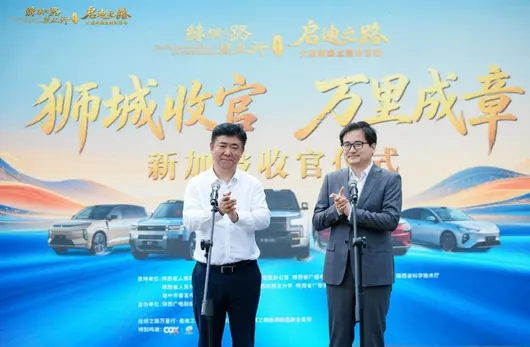

August 25, the "2026 Silk Road 10,000-Mile Journey · Enlightenment Road", in which BYD served as the full journey travel partner, concluded in Singapore. Li Yunfei, General Manager of the Brand and PR Department of BYD Group, and Zhang Lianye, Party Secretary, Chairman, and Station Master of Shaanxi Broadcasting and TV Media Fusion Group (Station), jointly announced the successful conclusion of the event. Green energy accompanies the Silk Road journey; the fleet traveled for 33 days, covering over 10,000 kilometers, spanning six provinces in China, and crossing Thailand and Malaysia, finally arriving in Singapore.
2026 marks the fifth anniversary of the establishment of the comprehensive strategic partnership between China and ASEAN. This event, themed "Technology Innovates, Civilization Converges", anchored at the starting point of the overland Silk Road in Xi'an and the maritime Silk Road hub in Singapore, integrates cultural exchange, technological dialogue, and trade connectivity, showcasing the era's proposition of land-sea linkage development of the "Belt and Road Initiative". Guests from home and abroad, overseas Chinese representatives, and media colleagues gathered in the Lion City, together witnessing the new era overland and maritime Silk Roads resonating with new civilizational echoes.
Cai Shandi, Cultural Counselor of the Chinese Embassy in Singapore, delivered a speech.
Wang Gang, President of the Singapore Shaanxi Association, delivered a speech.
During the event, BYD's Dynasty, Ocean, Denza, Fang Cheng Bao, and Yang Wang, comprising five brands, formed the new energy vehicle fleet, completing driving in various scenarios including highways, mountain roads, and urban congested sections. The two core technologies, Flash Charge and Divine Eye Assisted Driving System, withstood the test of a ten-thousand-mile actual scene: the Flash Charge capability of "charging well in 5 minutes, fully charged in 9 minutes", relying on the network layout of nearly 10,000 flash charging stations nationwide, resolves the long-distance energy replenishment challenge; Divine Eye relies on daily actual driving data of over 220 million kilometers for continuous iteration, effectively reducing long-distance driving pressure, ensuring the fleet travels smoothly to Southeast Asia. Green energy accompanies the Silk Road journey; from Xi'an to Singapore, the scene of ancient Silk Road camel caravan station supply has evolved into a modern expedition empowered by technology today.
As of July 2026, BYD has ranked first in total passenger car sales of all brands in Singapore for 19 consecutive months. From January to July 2026, BYD passenger car market share reached 24.7%, and pure electric vehicle market share reached 40.3%. Continuously leading sales performance further enhanced BYD's brand recognition locally; now, BYD can be frequently seen on Singapore's urban roads, core business districts, and shopping malls.
Singapore is one of the markets with high total cost of vehicle ownership globally. Higher purchase thresholds also make local consumers more prudent in brand and model selection. In this market environment, although BYD models have relatively high overall selling prices, they continue to maintain good sales performance, further strengthening local dealers' confidence in the brand's long-term development. Currently, BYD has laid out 16 retail touchpoints locally, with some stores entering core shopping malls. With the continuous improvement of brand influence and market recognition, local dealers continue to increase terminal investment, maintaining high standards in store scale, location selection, spatial design, and brand display.
In 2026, BYD's overseas business continues to maintain high-speed growth. Cumulative overseas sales from Jan-July exceeded 970,000 units, a year-on-year increase of about 76%; July overseas sales were 179,800 units, a year-on-year increase of 124.3%. As of now, BYD new energy vehicles have entered over 120 countries and regions globally.
This year, BYD won the new energy vehicle sales champion in Thailand and Singapore; topped the local new energy sales list in Italy and Spain; UK sales reached 38,000 units; Brazil sales were nearly 100,000 units, continuing to rank first in local new energy sales. In Saudi Arabia, UAE, and South Africa, BYD also ranked first in new energy vehicle sales.
This Silk Road 10,000-Mile Journey activity combines Silk Road cultural visits with new energy vehicle cross-border travel, presenting the latest progress of Chinese brands participating in building the "Belt and Road" countries' green transportation development. With automotive products, intelligent manufacturing, and services landing in more overseas markets, BYD is continuously participating in global automotive industry collaboration and green transformation using new energy vehicles as the carrier.
© 2024 Bitauto.com. All Rights Reserved.
Bitauto (www.yiche.com and www.bitauto.com) is one of the most visited automotive websites in China. We provide detailed info on Chinese car brands available in your area. Please note that the information provided on this website is based on publicly available data and is for reference only. It may not be fully updated or accurate at all times.

Help us improve our website


