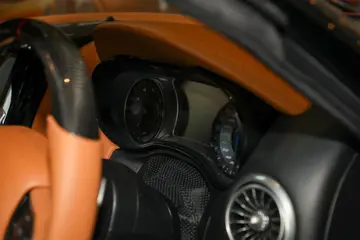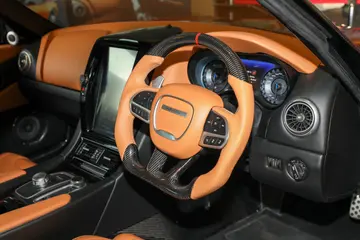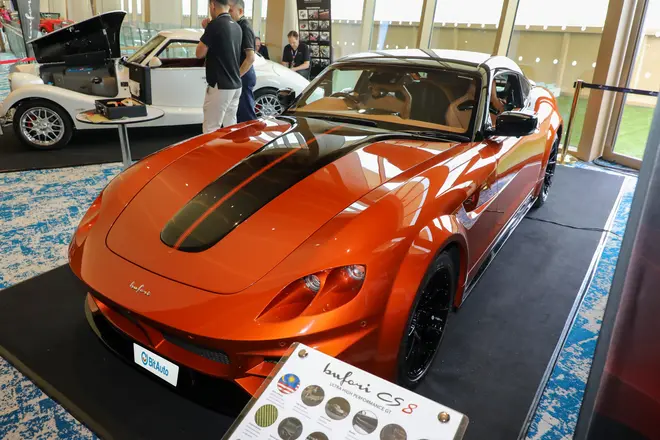
Bufori CS8
TBC
- Specifications
Report Incorrect Specs Compare Specs →
Coming Soon
2025 6.4T Standard
TBC
No data available
Bufori Dealers
Choose a dealer near you
Bufori Motor Car Company (M) Sdn Bhd
34B Jalan 5/32A, 6½ Mile, Off Jalan Kepong 52000 Kuala Lumpur Malaysia
Copy Address
Successful Replication
60362591000 Contact
Book a Consultation
We will call you back with more vehicle information.
Your Name
Phone Number
Submit

FAQs
What is the story behind the Bufori CS8?
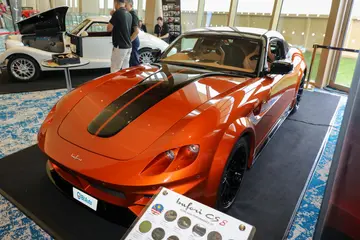
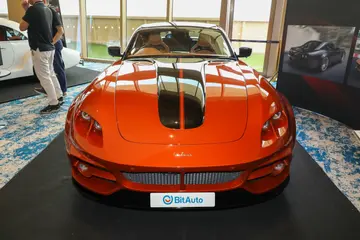
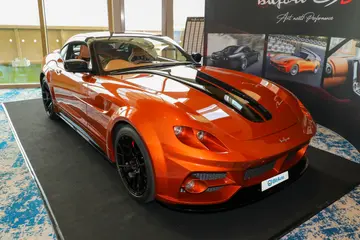
The Bufori CS8 is a Malaysian-made ultra high-performance grand tourer launched in August 2025 after 10 years of development. It is built by Bufori Motor Car Company, a handcrafted car manufacturer based in Kepong, Kuala Lumpur, which has been producing bespoke vehicles for over 40 years. Each Bufori CS8 takes over 9,000 man-hours to build, which is 15 times longer than a Rolls-Royce. The car represents Bufori's shift from its sports car origins to a luxury grand touring brief.
What are the powertrain specifications of the Bufori CS8?
The Bufori CS8 features a front mid-mounted 6.4-litre supercharged Hemi V8 engine producing 810 hp (750 hp at the rear wheels) and 973 Nm of torque. It is paired with an 8-speed torque converter automatic transmission with paddle shifters, sending power to the rear wheels via a limited-slip differential. The car can accelerate from 0-100 km/h in 3.0 seconds with launch control, and has a top speed of 330 km/h.
Are there other engine options for the Bufori CS8?
Yes, the Bufori CS8 offers five engine options in total, all supplied by Stellantis, and the price remains the same regardless of choice. Options include a naturally aspirated 6.4-litre V8 (475 hp/640 Nm), a naturally aspirated 3.6-litre V6 (320 hp/352 Nm), a supercharged 3.6-litre V6 (455 hp/495 Nm), and a twin-turbo 3.0-litre inline-six (550 hp/677 Nm).
What materials are used for the Bufori CS8's body and chassis?
The Bufori CS8 features a carbon-kevlar hybrid composite monocoque body, a material Bufori has used since 1989. The body panels are made of carbon-kevlar, while the chassis is a stainless-steel monocoque structure. This combination provides exceptional rigidity while keeping weight low – the car has an estimated kerb weight of 1,550 kg, similar to a standard Porsche 911.
Show More
Questions & answers
All Brands
Perodua
Proton
Toyota
Honda
Chery
BYD
Jetour
Zeekr
GWM
MG
Leapmotor
XPeng
Mitsubishi
Mazda
Mercedes-Benz
BMW
Lexus
Ford
Nissan
Isuzu
GAC
TESLA
Porsche
Suzuki
Volkswagen
MINI
Volvo
Peugeot
Kia
Subaru
Land Rover
Hyundai
Denza
CAM
Foton
Dongfeng
smart
Wuling
Audi
Maserati
MAXUS
Daihatsu
Lotus
Renault
JAC
Alfa Romeo
iCAUR
JAECOO
OMODA
Golden Dragon
JMC
Kaicene
Lamborghini
Ferrari
Rolls-Royce
Bentley
Boon Koon
McLaren
Jeep
Chevrolet
BAIC
Roewe
Jaguar
Acura
Cadillac
Aston Martin
Changan
Dodge
ARCFOX
Aeolus
Deepal
Lepas
KGM
Exeed
Forthing
Geely
Hongqi
INEOS
Fiat
Abarth
Bufori
MHERO
Voyah
Popular Cars
- Perodua Bezza
- Proton Saga
- Perodua Axia
- Perodua Myvi
- Perodua Alza
- Proton X50
- Proton S70
- Perodua Ativa
- Perodua Traz
- Toyota Hilux
- Proton e.MAS 5
- Toyota Vios
- Proton e.MAS 7
- Honda City
- Toyota Alphard
- Mitsubishi Xforce
- Toyota Corolla Cross
- Perodua Aruz
- Honda HR-V
- Jetour T2
- Honda Civic
- BYD Atto 3
- JAECOO J5
- Chery Tiggo Cross
- Mazda 3
- Toyota Veloz
- Proton Persona
- Proton X70
- Toyota Harrier
- JAECOO J7
Vehicle Lineup