
Search History
Popular Searches
English
Dealer Login / Sign Up
On the evening of March 11th, Porsche officially released its 2025 financial report, which can be described as its most difficult performance report in recent years. Core profitability indicators dropped off a cliff, the global market came under general pressure, and the sharp decline in the Chinese market was the most prominent pain point.
As the core "profit cow" under the Volkswagen Group, Porsche once led the luxury car market with its strong brand power and high profit margin. Today, it is trapped in a growth dilemma amid the wave of industry transformation, and the effectiveness of a series of transformation measures remains to be tested by the market.
The core data in the financial report came under comprehensive pressure, with many indicators falling sharply. In 2025, the full-year revenue reached 36.27 billion euros, a year-on-year decrease of 9.5%; the operating profit plummeted from 5.64 billion euros to 413 million euros, a year-on-year drop of 92.7%, setting a rare historical decline.
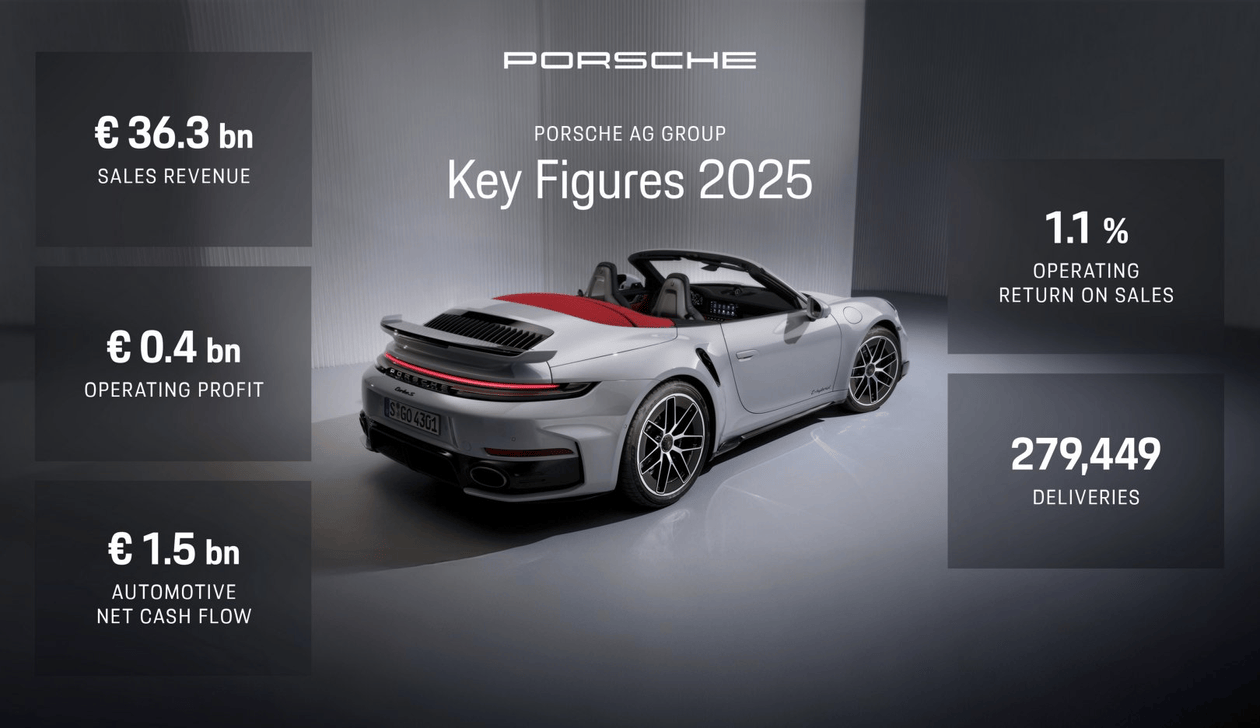
The return on sales was only 1.1%, a significant shrinkage from 14.1% in 2024, far below the industry average; the EBITDA margin of the automotive business also dropped from 22.7% to 13.3%, indicating a significant weakening of profitability.
Porsche explained that the sharp drop in profits was due to special expenses of approximately 3.9 billion euros, mainly including three parts: about 2.4 billion euros for product strategy adjustment and scale optimization, about 700 million euros for additional costs related to battery business, and about 700 million euros affected by U.S. tariffs.
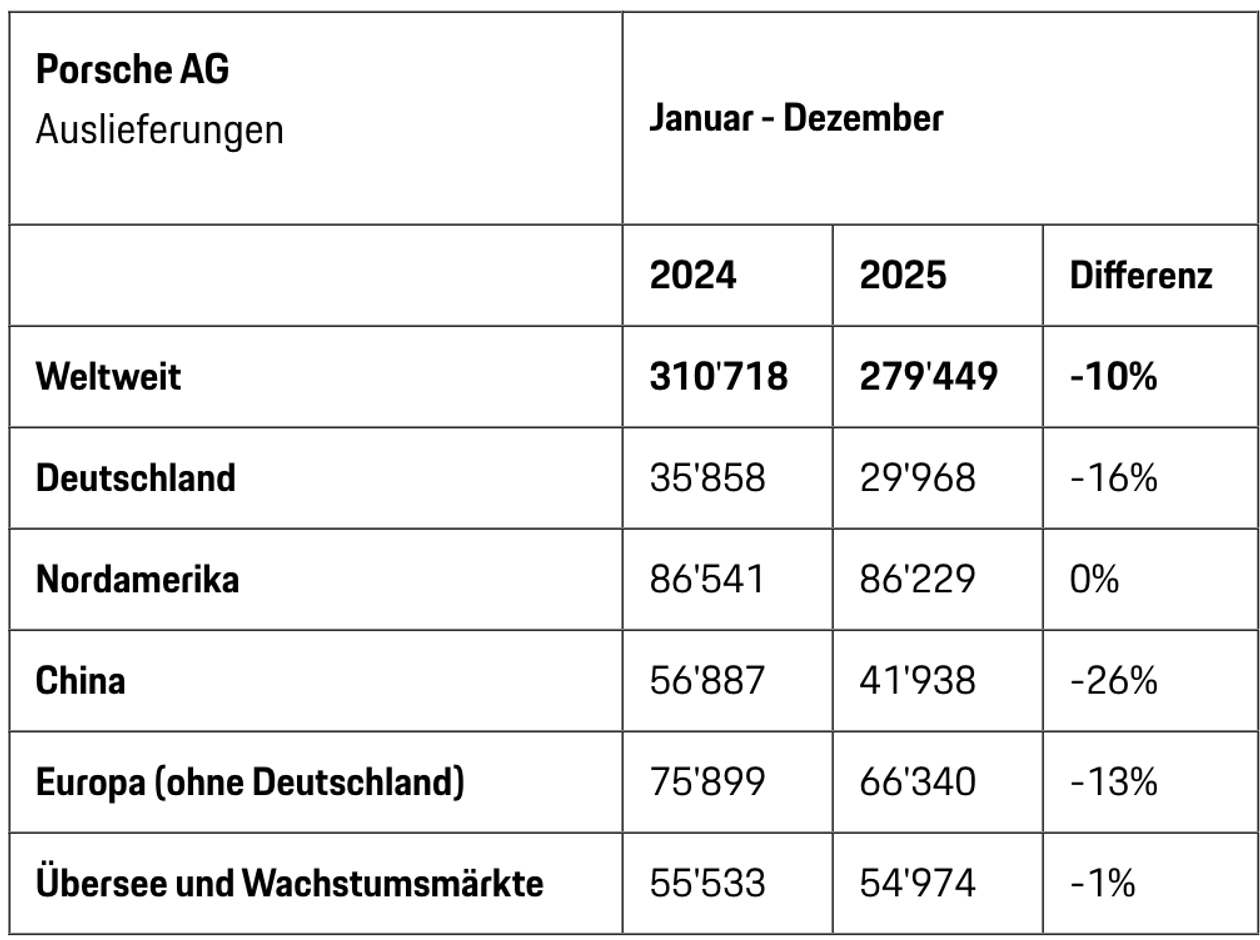
The sales side was also not optimistic, with the global market facing a collective downturn. In 2025, Porsche delivered a total of 279,449 new cars throughout the year, a year-on-year decrease of 10%, and only the North American market remained basically flat in sales (86,299 units).
Among the core regions, sales in the German domestic market fell by 16% year-on-year to 29,968 units, and sales in Europe (excluding Germany) fell by 13% to 66,340 units. The Chinese market became the region with the largest decline, with full-year sales of 41,938 units, a year-on-year decrease of 26%, accounting for 15% of the global total sales, and has dropped from the world's largest single market to the second.
Dr. Jochen Breckner, Chief Financial Officer of Porsche, responded that the decline in the Chinese market was due to the severe environment of the luxury car market and the fierce competition in the pure electric market, but he emphasized that Porsche would continue to adhere to a value-oriented sales strategy and not blindly pursue sales volume.
The continued downturn in the Chinese market is the result of the combined effect of Porsche's own lag in transformation and changes in the market pattern. Among them, the lag in the transformation pace is the key to its loss of competitive advantage.
As a representative of traditional luxury fuel vehicles, Porsche has a profound accumulation in the field of fuel vehicles, but its layout of pure electric models is slow. The in-vehicle infotainment system of its launched luxury electric vehicles adopts European logic, and navigation and intelligent interaction are difficult to adapt to Chinese users, which has been criticized for being "detached from the Chinese market".
The generally long R&D cycle of European automakers makes it difficult for Porsche to quickly respond to China's intelligent needs. Even though local R&D has been launched, it is difficult to make up for the gap with local brands in the short term.
On the other hand, the high-end breakthrough of Chinese local brands has further squeezed Porsche's market space. In 2025, local brands such as AITO, Li Auto, and Denza accelerated their rise and occupied an important position in the high-end market above 400,000 RMB.
These local brands have attracted a large number of consumers who originally tended to choose Porsche with their intelligent configurations tailored to Chinese users, precise scenario positioning and high cost performance. At the same time, Porsche's strategy of adhering to brand value and not participating in price wars has further weakened its competitiveness.
In addition, the main consumer group of high-end cars in China has shifted to young, highly educated new elites who value intelligent functions and driving experience more than pure brand premium, which also makes it difficult for Porsche to exert its traditional brand advantages.
Faced with the performance dilemma, Porsche launched a comprehensive transformation on the day of the financial report release, with the core direction of "leaner, faster and more attractive", clarifying "quality over quantity", and trying to rebuild high profit margins through cost reduction, efficiency improvement and strategy optimization.
At the global level, Porsche plans to cut 3,900 jobs by 2030, streamline management levels, reduce operating costs, and promote the Strategy 2035 to focus on core businesses.
In terms of product strategy, it will extend the life cycle of internal combustion engine and hybrid models, postpone some pure electric model plans, give priority to ensuring investment in classic fuel vehicles such as the 911 and high-profit models, reduce product complexity and focus on core advantages.
For the Chinese market, Porsche's adjustment measures are more specific. In terms of channels, it plans to reduce the number of dealerships in China from 114 to 80 by the end of 2026, focusing on core cities and improving single-store efficiency.
In terms of R&D, its first overseas comprehensive R&D center in Jiading, Shanghai has been opened, and more than 300 engineers are fully committed to developing infotainment systems and advanced driver assistance solutions adapted to Chinese users, which are planned to be installed on multiple models in the middle of 2026.
However, Porsche clearly stated that it would refuse localized production in China, adhere to pure import, and not join the price war. This means that its transformation in China still faces challenges, and it is difficult to quickly recover market share by relying solely on brand premium and cost reduction.
Porsche is cautious about its expectations for the 2026 fiscal year. It is estimated that the full-year operating income will be between 35 billion and 36 billion euros, basically the same as 2025; the group's return on sales will rebound to 5.5% to 7.5%, and the net cash flow margin of the automotive business will be 3% to 5%.
Dr. Breckner admitted that the adjustment measures in 2026 will still have a one-time impact of several hundred million euros, and sales in the Chinese market are expected to further decline to 30,000 units, and the market environment is still full of challenges.
Porsche's dilemma is not an isolated case, but a microcosm of the transformation of traditional luxury automakers. European automakers lag behind Chinese and American competitors in fields such as autonomous driving and intelligent cockpits, and long approval processes and strict standards further restrict their transformation.
As the world's largest new energy vehicle market, the rise of Chinese local brands is reshaping the luxury car pattern. If traditional luxury brands cannot quickly adapt to local needs and accelerate transformation, their market share may be further eroded.
In general, 2025 is a "painful year" for Porsche. The sharp drop in profits and the decline in the Chinese market are external manifestations of industry changes. The core problem is that it has failed to keep up with the wave of new energy and intelligence, and there is a deviation between its brand strategy and the needs of the Chinese market.
In the future, Porsche's transformation path is full of thorns, and it needs to make efforts in cost reduction, efficiency improvement, product optimization and local R&D. How to find a balance between adhering to brand value and adapting to market needs is the key for it to recover the Chinese market and rebuild high profit margins.

Your go-to source for all things automotive in Malaysia. 🚗 Latest reviews, breaking news, launches & industry trends.
+ Follow We saw this accident this morning, and here’s a reminder to everyone: please drive safe. 2 days ago
  The G50 BMW 3 series is now here, adopting much of the i3's design elements.
So, where's the BMW M3?
#bmw #BMW3Series 4 days ago
The G50 BMW 3 series is now here, adopting much of the i3's design elements.
So, where's the BMW M3?
#bmw #BMW3Series 4 days ago  DRIFT PARTY in Malaysia! Can the Xiaomi SU7, Yangwang U8 mix it up against JDM favourites in KL?
Our adventure with the Xiaomi SU7 and Yangwang U8 brings us to APDCrew circuit as we give witness a drift show. With pro drifters and fan-favourites - RX7s, S15s, Skylines, Supras, and more - in the mix, can our Xiaomi SU7 and Yangwang U8 hold their own?
It's also a quick look at Malaysian car culture, including some wildly modified minivans, and more!
#drift #malaysia #xiaomisu7 #yangwangu8 #larrychen #drifting #JDM跑車 4 days ago
DRIFT PARTY in Malaysia! Can the Xiaomi SU7, Yangwang U8 mix it up against JDM favourites in KL?
Our adventure with the Xiaomi SU7 and Yangwang U8 brings us to APDCrew circuit as we give witness a drift show. With pro drifters and fan-favourites - RX7s, S15s, Skylines, Supras, and more - in the mix, can our Xiaomi SU7 and Yangwang U8 hold their own?
It's also a quick look at Malaysian car culture, including some wildly modified minivans, and more!
#drift #malaysia #xiaomisu7 #yangwangu8 #larrychen #drifting #JDM跑車 4 days ago Get the latest car news first!
Your go-to source for all things automotive in Malaysia. 🚗 Latest reviews, breaking news, launches & industry trends.
We saw this accident this morning, and here’s a reminder to everyone: please drive safe. 2 days ago The G50 BMW 3 series is now here, adopting much of the i3's design elements.
So, where's the BMW M3?
#bmw #BMW3Series 4 days ago DRIFT PARTY in Malaysia! Can the Xiaomi SU7, Yangwang U8 mix it up against JDM favourites in KL?
Our adventure with the Xiaomi SU7 and Yangwang U8 brings us to APDCrew circuit as we give witness a drift show. With pro drifters and fan-favourites - RX7s, S15s, Skylines, Supras, and more - in the mix, can our Xiaomi SU7 and Yangwang U8 hold their own?
It's also a quick look at Malaysian car culture, including some wildly modified minivans, and more!
#drift #malaysia #xiaomisu7 #yangwangu8 #larrychen #drifting #JDM跑車 4 days ago  ProtonGWMVolkswagenJAECOOVolvoPeroduaToyotaHondaTESLAMitsubishiMazdaJetourCheryBYDLexusBMWMercedes-BenziCAURZeekrIsuzuNissanLeapmotorPorscheFordOMODAMINIMGSuzukiXPengHyundaiWulingKiaSubaruDenzaGACLand RoverDongfengCAMAudiPeugeotFotonMAXUSsmartDaihatsuJACJMCMaseratiLotusAlfa RomeoRenaultGolden DragonKaiceneSeresLamborghiniFerrariJeepRolls-RoyceLepasAston MartinMcLarenChevroletBentleyFiatBAICForthingGeelyRoeweAeolusChanganARCFOXDeepalExeedHongqiVoyahJaguarKGMBuforiAcuraCadillacDodgeAbarthINEOSMHEROJMEVFreelander
 © 2024 Bitauto.com. All Rights Reserved.
Bitauto (www.yiche.com and www.bitauto.com) is one of the most visited automotive websites in China. We provide detailed info on Chinese car brands available in your area. Please note that the information provided on this website is based on publicly available data and is for reference only. It may not be fully updated or accurate at all times.
Help us improve our website


