
Search History
Popular Searches
English
Dealer Login / Sign Up
In response to the viral rumors over the weekend claiming that BYD had shelved its local assembly (CKD) plans due to dissatisfaction with government conditions, the Ministry of Investment, Trade and Industry (MITI) has issued an official statement to debunk these claims. MITI emphasized that Malaysia's automotive policy is not designed to create arbitrary barriers for specific brands, but rather to ensure the sustainable development of the local automotive ecosystem.
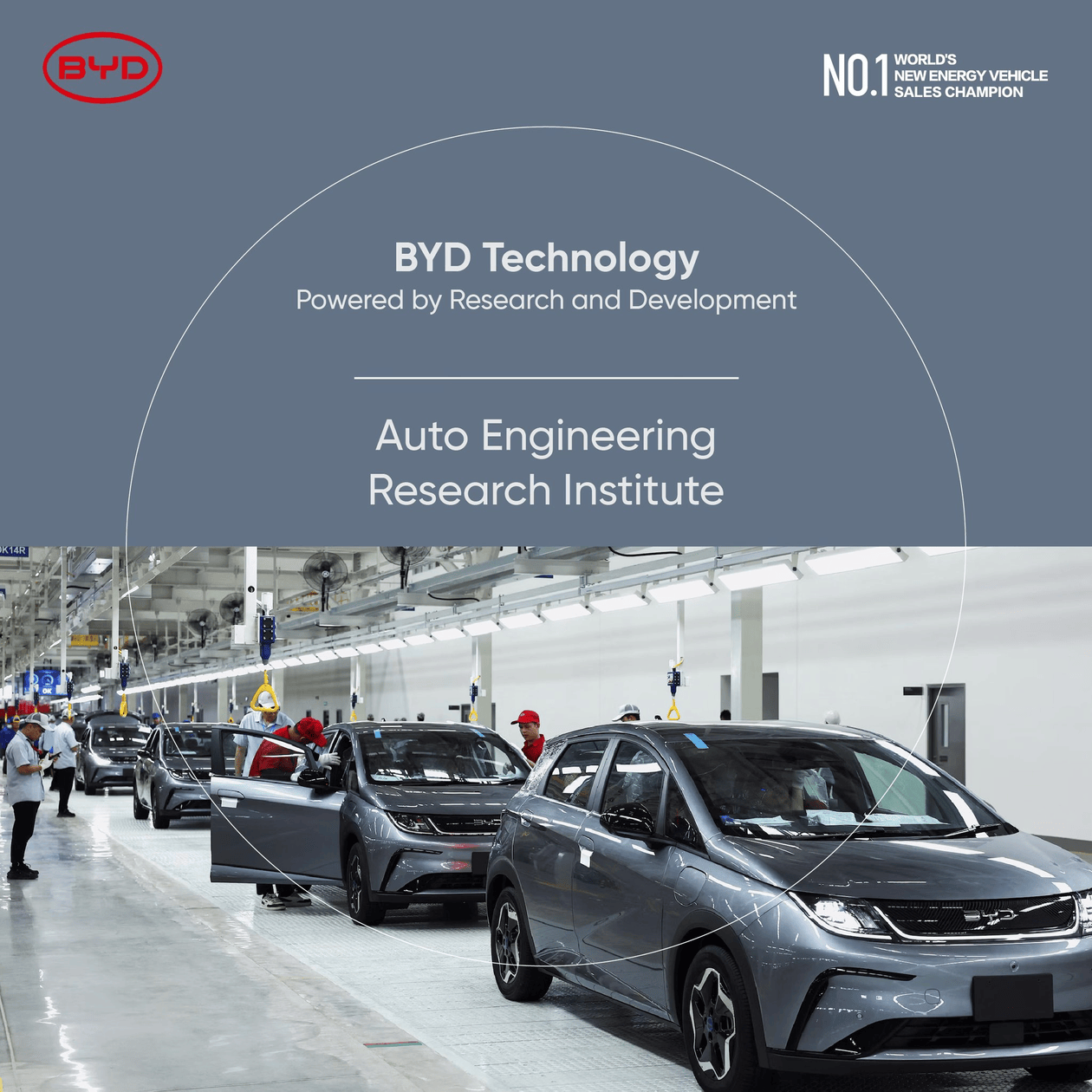
Earlier reports suggested that MITI had imposed stringent conditions on BYD's CKD project in Tanjung Malim, including a requirement to export 80% of its Malaysian production and a minimum selling price of over RM200,000 for units sold locally. As these rumored terms contradicted BYD's current mass-market strategy, the news sparked concerns among netizens regarding BYD's potential withdrawal from its Malaysian assembly plans.
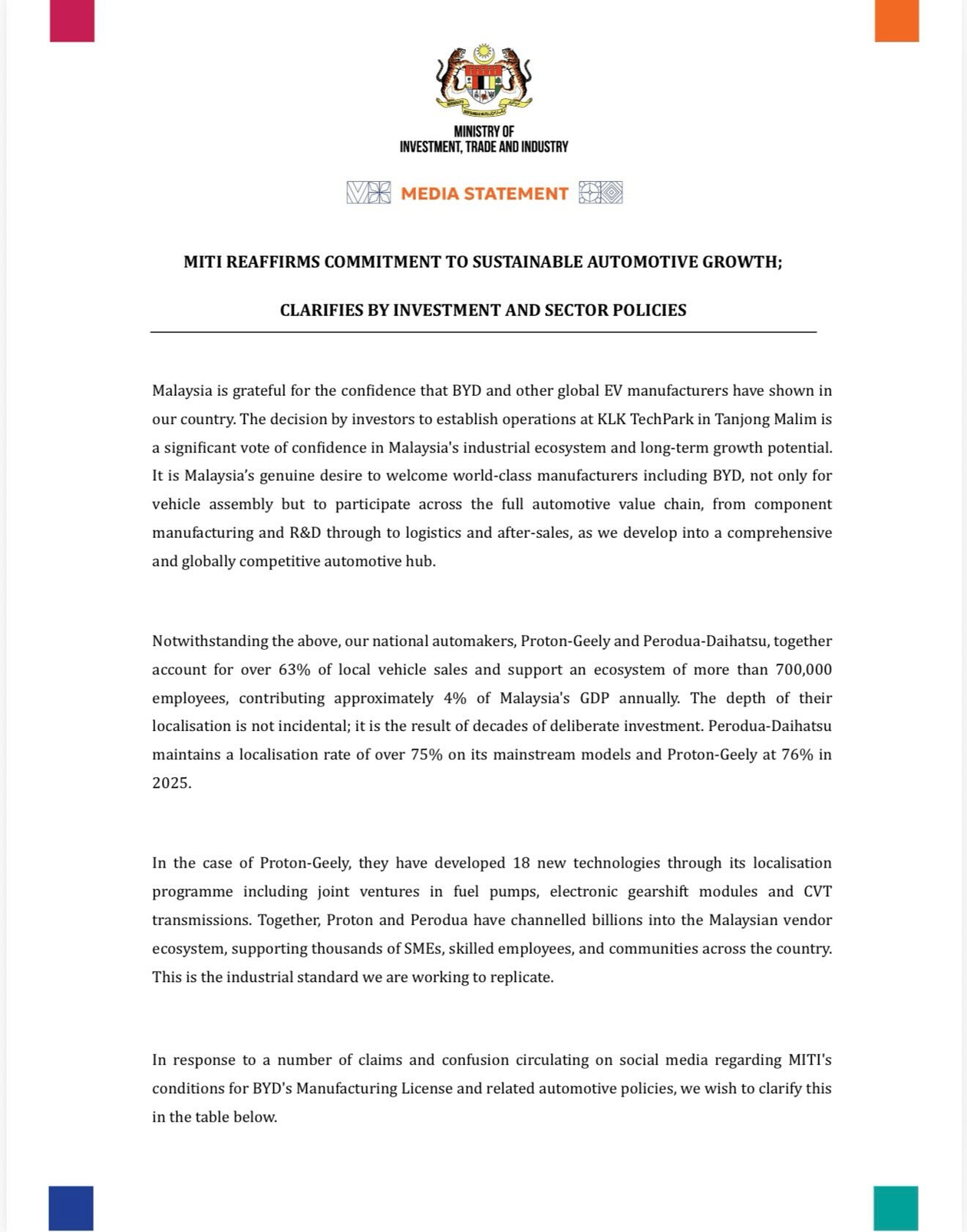
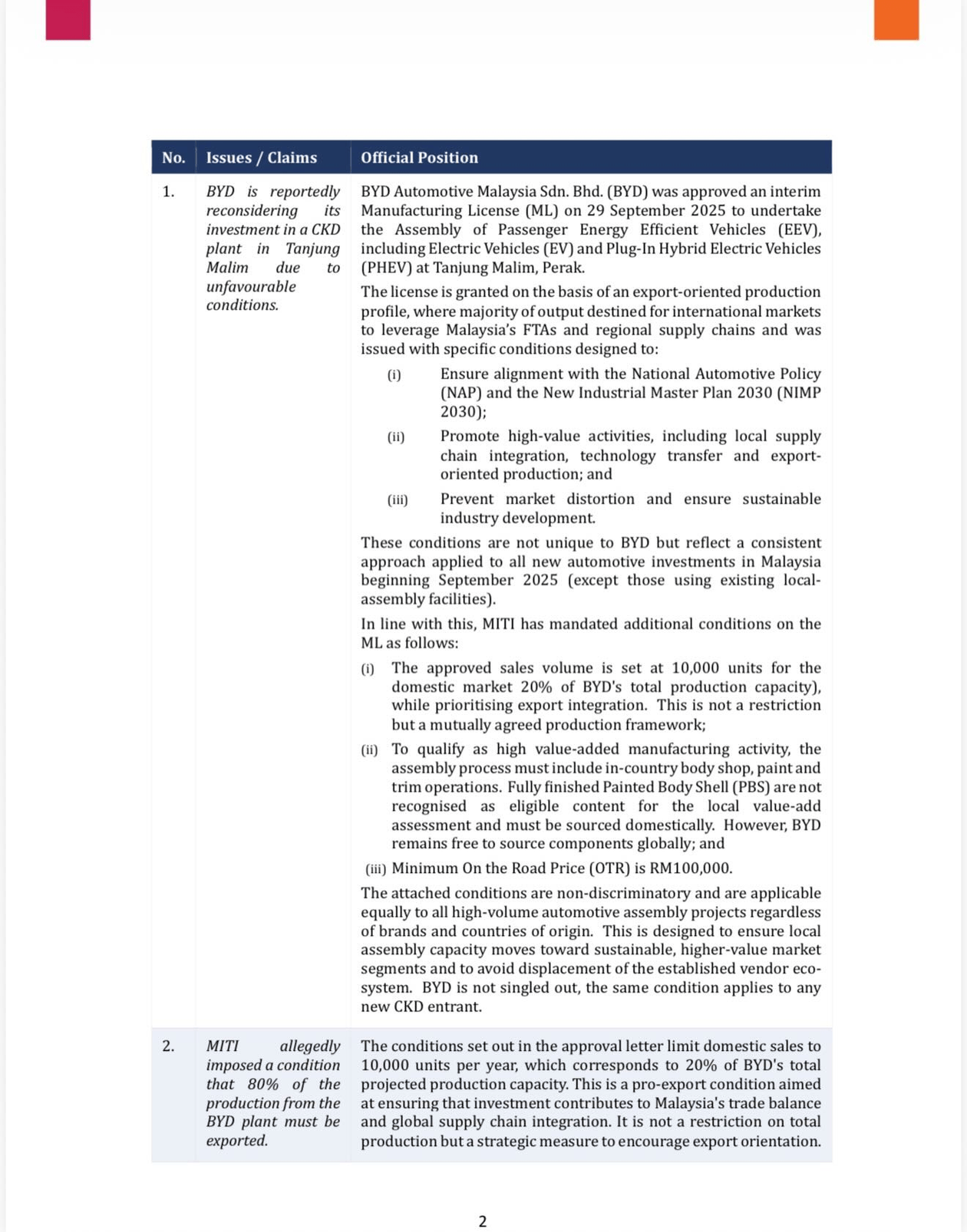
In an official statement released on March 31, 2026, MITI dismissed the misleading claims circulating on social media. Below are the key points of the official clarification:
Entry Threshold: The rumored RM 200,000 base price is inaccurate. MITI confirmed that for all new automotive investments, including BYD's CKD project, the minimum on-the-road (OTR) price for locally assembled units is set at RM100,000.
Policy Consistency: This standard aims to balance foreign investment with the protection of the local industry, ensuring the local supplier ecosystem — which supports 700,000 jobs and contributes 4% to Malaysia's GDP — has an adequate transition buffer.
Manufacturing Licenses: MITI highlighted that manufacturing licenses are being granted to those who align with Malaysia's long-term goals. BYD was granted its interim manufacturing license in September 2025, while Chery received its official license as early as June 2025, proving that Malaysia remains a welcoming and open hub for global EV players.
In its official statement, MITI underscored the success stories of Proton-Geely and Perodua-Daihatsu. Currently, the local content procurement rate for both national car giants exceeds 75%.
The ministry's stance is clear:
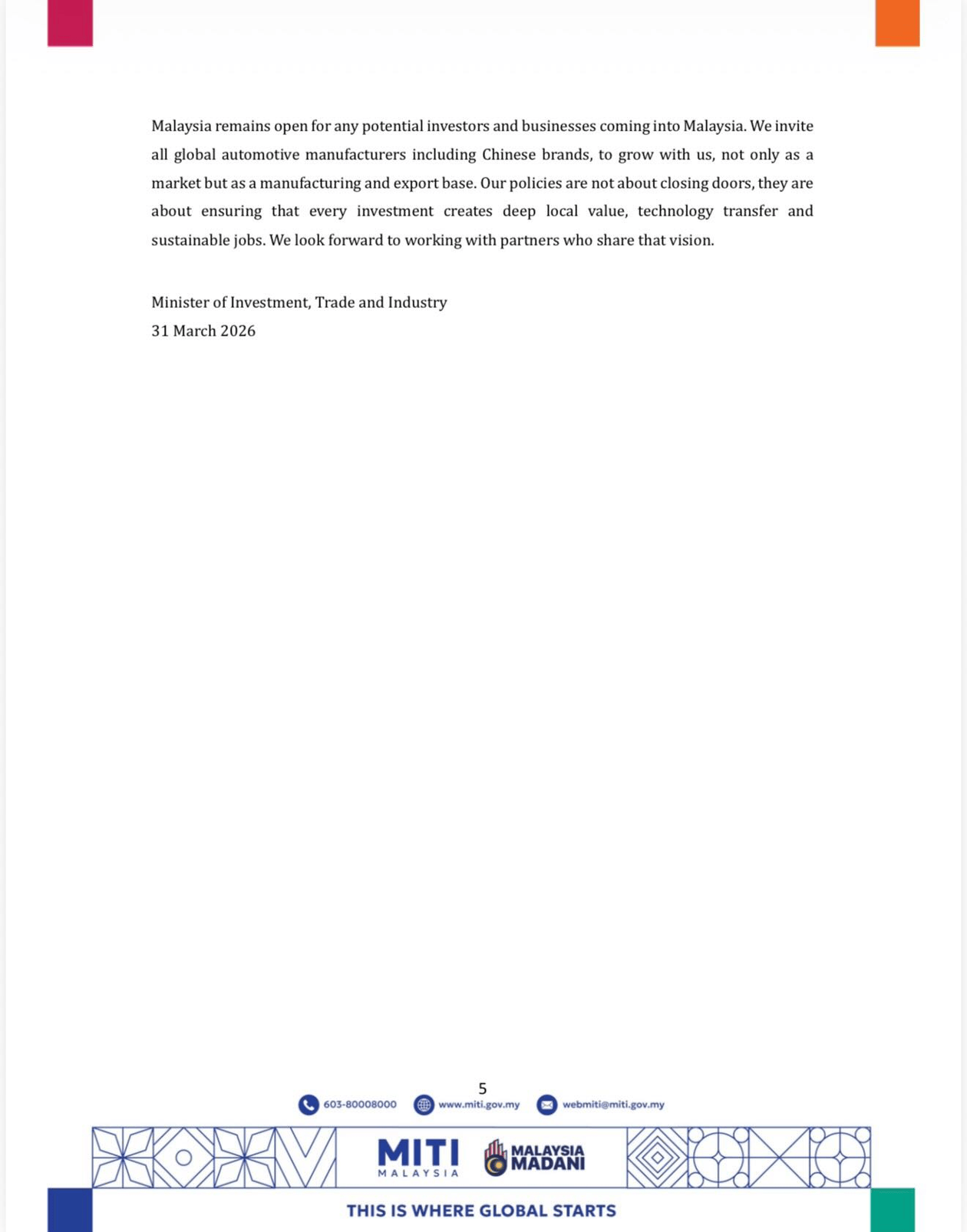
"Malaysia remains open for any potential investors and businesses coming into Malaysia, We invite
all global automotive manufacturers including Chinese brands, to grow with us, not only as a
market but as a manufacturing and export base. Our policies are not about closing doors, they are
about ensuring that every investment creates deep local value, technology transfer and
sustainable jobs. We look forward to working with partners who share that vision."
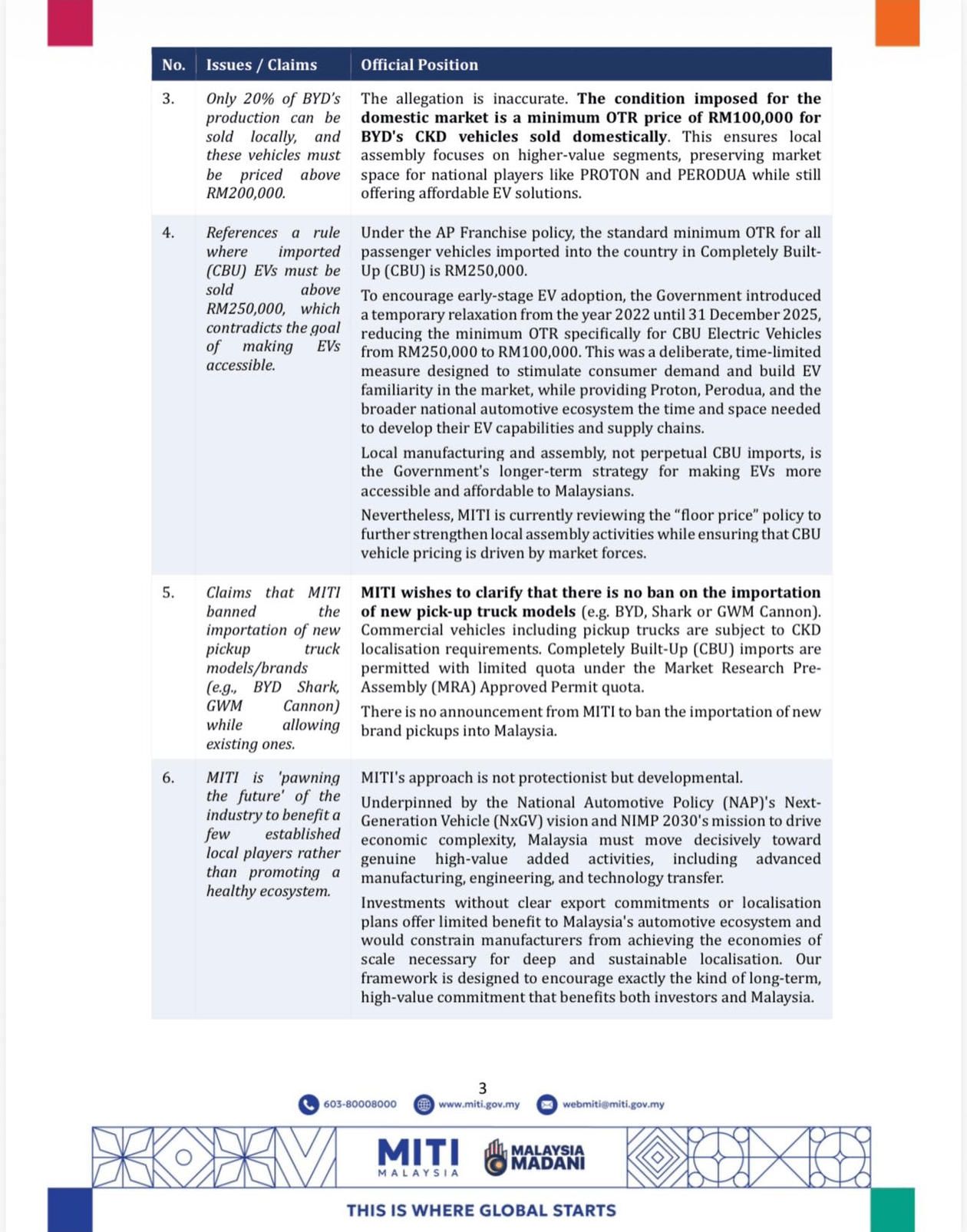
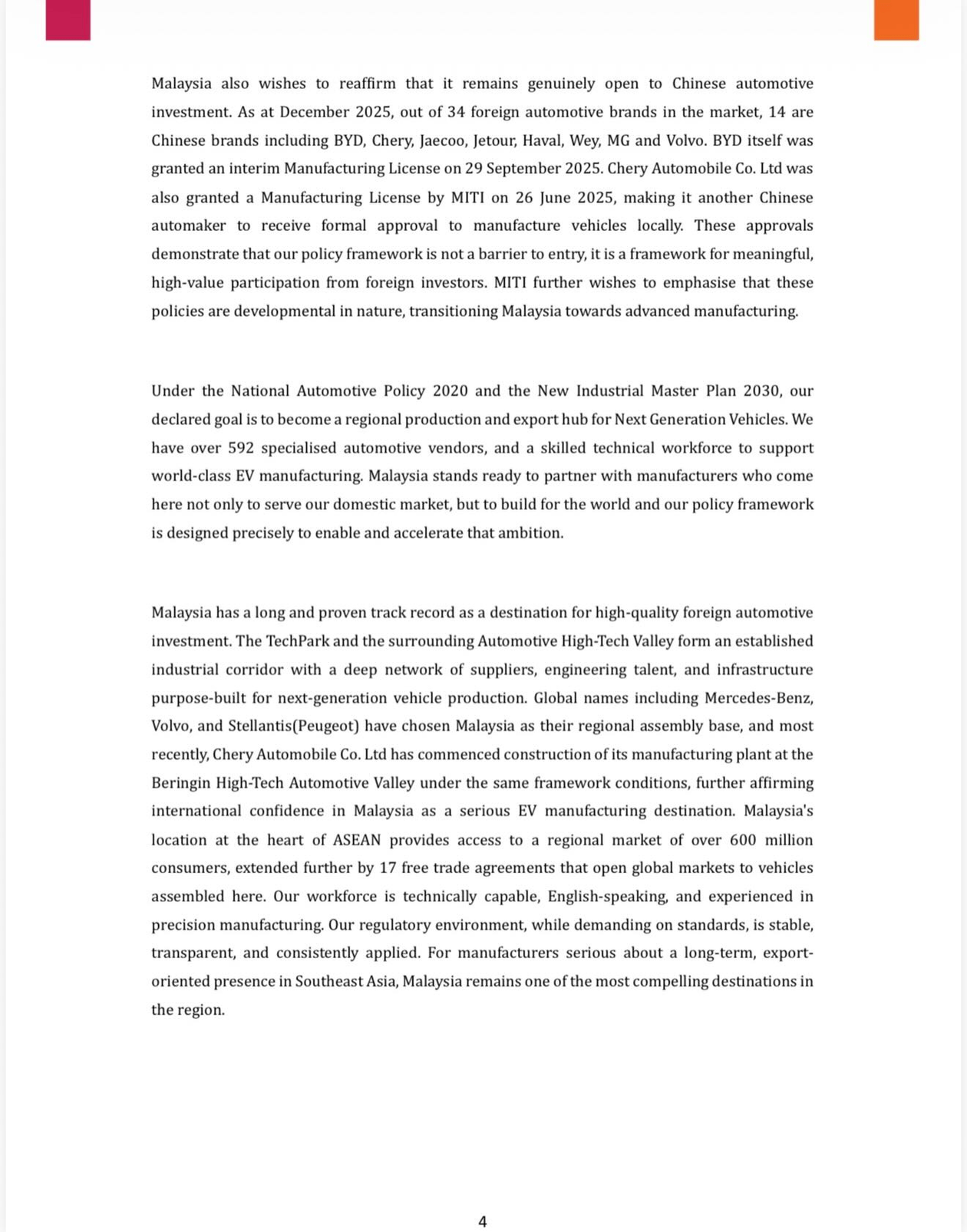
Currently, 14 Chinese automotive brands have established a presence in the Malaysian market. Beyond BYD and Chery, global giants like Mercedes-Benz, Volvo, and Stellantis have also chosen Malaysia as their regional assembly base.
Supported by the National Automotive Policy 2020 (NAP 2020) and the New Industrial Master Plan 2030 (NIMP 2030), Malaysia's automotive sector is backed by over 592 specialized suppliers. MITI reaffirmed that Malaysia's doors remain wide open to brands committed to high-value investment and technology transfer. By leveraging Malaysia's 17 Free Trade Agreements (FTAs), these manufacturers gain a competitive gateway to a regional market of over 600 million consumers.
MITI's swift and transparent clarification provides a much-needed boost of confidence to the industry and prospective buyers awaiting BYD's CKD models. While the RM 100,000 base price remains a firm boundary to protect the national car ecosystem, it also sets a clear benchmark for the future: we can expect more affordable, high-spec, and locally assembled EVs to hit the Malaysian roads soon.

Your go-to source for all things automotive in Malaysia. 🚗 Latest reviews, breaking news, launches & industry trends.
+ Follow This weekend is your chance to own a Volvo Selekt Certified Used Car, priced from just RM 148,000.
What are you waiting for?
#volvo 1 minute ago
This weekend is your chance to own a Volvo Selekt Certified Used Car, priced from just RM 148,000.
What are you waiting for?
#volvo 1 minute ago  We saw this accident this morning, and here’s a reminder to everyone: please drive safe. 2 days ago
  The G50 BMW 3 series is now here, adopting much of the i3's design elements.
So, where's the BMW M3?
#bmw #BMW3Series 4 days ago
The G50 BMW 3 series is now here, adopting much of the i3's design elements.
So, where's the BMW M3?
#bmw #BMW3Series 4 days ago Get the latest car news first!
Your go-to source for all things automotive in Malaysia. 🚗 Latest reviews, breaking news, launches & industry trends.
This weekend is your chance to own a Volvo Selekt Certified Used Car, priced from just RM 148,000.
What are you waiting for?
#volvo 1 minute ago We saw this accident this morning, and here’s a reminder to everyone: please drive safe. 2 days ago The G50 BMW 3 series is now here, adopting much of the i3's design elements.
So, where's the BMW M3?
#bmw #BMW3Series 4 days ago  ProtonGWMVolkswagenJAECOOVolvoPeroduaToyotaHondaTESLAMitsubishiMazdaJetourCheryBYDLexusBMWMercedes-BenziCAURZeekrIsuzuNissanLeapmotorPorscheFordOMODAMINIMGSuzukiXPengHyundaiWulingKiaSubaruDenzaGACLand RoverDongfengCAMAudiPeugeotFotonMAXUSsmartDaihatsuJACJMCMaseratiLotusAlfa RomeoRenaultGolden DragonKaiceneSeresLamborghiniFerrariJeepRolls-RoyceLepasAston MartinMcLarenChevroletBentleyFiatBAICForthingGeelyRoeweAeolusChanganARCFOXDeepalExeedHongqiVoyahJaguarKGMBuforiAcuraCadillacDodgeAbarthINEOSMHEROJMEVFreelander
 © 2024 Bitauto.com. All Rights Reserved.
Bitauto (www.yiche.com and www.bitauto.com) is one of the most visited automotive websites in China. We provide detailed info on Chinese car brands available in your area. Please note that the information provided on this website is based on publicly available data and is for reference only. It may not be fully updated or accurate at all times.
Help us improve our website


